

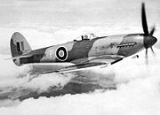
Hawker Tempest

Encyclopedia
The Hawker Tempest was a British fighter aircraft
primarily used by the Royal Air Force
(RAF) in the Second World War
. The Tempest was an improved derivative of the Hawker Typhoon
, and one of the most powerful fighter aircraft used during the war.
the design team, under the leadership of Sydney Camm, were already planning design improvements, this process resulting in the Hawker P. 1012 (or Typhoon II).
Although the Typhoon was basically a good design, Camm and his design team were disappointed with the wing
which proved to be too thick in its cross section
; this created problems with the airflow and inhibited the performance of the aircraft, especially at higher altitudes. The Typhoon's wing, using a NACA 4 digit series wing section
, had a maximum thickness to chord ratio of 19.5% (root) to 12% (tip). In March 1940, engineers were assigned to investigate the new low drag
laminar flow
wing developed by NACA
in the United States, which had been used in the new North American
P-51 Mustang
. A laminar flow wing adopted for the Tempest series had a maximum thickness to chord ratio of 14.5% at the root, tapering to 10% at the tip. The maximum thickness of the Tempest wing was set further back at 37.5% of the chord versus 30% for the Typhoon's wing.
The wingspan was originally greater than that of the Typhoon at 43 ft (13.1 m), but the wingtips were later "clipped" and the wing became shorter; 41 ft (12.5 m) versus 41 ft 7 in (12.7 m). The wing planform
was changed to an elliptical
shape to accommodate the 800 rounds of ammunition
for the four 20 mm (.79 in) Hispano cannon
s, which were moved back further into the wing. The new elliptical wing had greater area than the Typhoon's.
However, the new wing design sacrificed the leading edge fuel tanks of the Typhoon; to make up for this loss in capacity, Hawker engineers added a new 21 in (53 cm) fuel bay in front of the cockpit, with a 76 gal
(345 l) fuel tank. In addition, two inter-spar wing tanks, each of 28 gal (127 l), were fitted on either side of the centre-section and, starting with late model Tempest Vs, a 30 gal (136 l) tank was carried in the leading edge of the port wingroot, giving the Tempest a total internal fuel capacity of 162 gal (736 l). In service Tempests also carried two specially designed, streamlined, drop-tanks of 45 gal (204 l) giving a maximum of 360 gal (1,636 l) and an operational radius of 500 mi (805 km)
Another important feature of the new wing was Camm's proposal that radiator
s for the new Napier Sabre IV
engine were to be fitted into the leading edge
of the wing inboard of the undercarriage
. This eliminated the distinctive "chin
" radiator associated with the Typhoon and improved aerodynamics
.
A further improvement of the Tempest wing over that of the Typhoon was the exceptional, flush riveted surface finish, essential on a high performance laminar flow airfoil
. Fortunately for the pilots the new wing and airfoil, and the four-bladed propeller unit, eliminated the high frequency vibrations that had plagued the Typhoon.
The redesigned main undercarriage legs were longer and had a wider track (16 ft/5 m) to improve stability at the high landing speed of 110 mph (180 km/h), and to allow tip clearance
for a new de Havilland four-blade, 14 ft (4 m) diameter
propeller
. The main undercarriage units were designed to incorporate a system of trunnions which shortened the legs as they retracted. The main wheels also needed new thin tyre
s in order to fit within the wing. Finally, the retractable tailwheel was fully enclosed by small doors.
 Camm and the Hawker design team placed a high priority on making their aircraft easily accessible to both air and ground crews; to this end the forward fuselage and cockpit areas of the earlier Hurricane and the Tempest and Typhoon families were covered by large removable panels providing access to as many components as possible, including flight controls
and engine accessories. Both upper wingroots incorporated panels of non-slip coating. For the pilot a retractable foot stirrup under the starboard root trailing edge was linked to a pair of handholds which were covered by spring-loaded flaps. Through a system of linkages, when the canopy was open the stirrup was lowered and the flaps opened, providing easy access to the cockpit. As the canopy was closed the stirrup was raised into the fuselage and the flaps snapped shut.
The new design was finalised by October 1941 and the Air Ministry
issued specification F.10/41 that had been written to fit the aircraft. A contract for two initial prototype
s was issued the next month. The aircraft was originally named the "Typhoon Mark II" but was renamed "Tempest" in January 1942 when more prototypes with various experimental configurations were ordered. The problems experienced with delivery of engines led the Air Ministry to ask for six prototypes with different engines so that if a delay hit one engine an alternative would be available. This gave the Mk I (aircraft HM599
) with a Sabre IV
, two Mk IIs (LA602 and LA607) with the Centaurus IV
, MK III (LA610) with a Griffon IIB
, Mk IV (LA614) with a Griffon 61
and the Mk V (HM595) with the Sabre II
.
The first Tempest prototype, the Mark V, was first flown by Philip Lucas from Langley on 2 September 1942. This aircraft retained the Typhoon's framed canopy
, car
-style door, the Sabre II engine, and "chin" radiator. It was quickly fitted with a bubble canopy
like the later Typhoons and a modified tailfin
that almost doubled the vertical tail surface area. The horizontal tailplanes and elevators
were also increased in span and chord (these were also fitted to late production Typhoons.)
 Test pilot
s found the Tempest a great improvement over the Typhoon in performance; in February 1943 the pilots from the A&AEE at Boscombe Down reported that they were impressed by "a manoeuverable and pleasant aircraft to fly with no major handling faults". The Air Ministry had already ordered 400 Tempests in August but production of the new Sabre IV engine ran into protracted problems and delays. The second prototype, the "Tempest Mark I" with the Sabre IV did not fly until 24 February 1943. This prototype also had at first the older Typhoon cockpit structure and vertical tailplane. Elimination of the "chin" radiator did much to improve performance and the Tempest Mark I was the fastest aircraft Hawker had built to that time, attaining a speed of 466 mph (750 km/h).
Continual problems with the Sabre IV meant that only one Mark I (HM599) was built; consequently Hawker went into production with the Sabre II engined "Tempest V". The first rolled off the production line on 21 June 1943. The first Tempest Vs delivered had the long-barrelled
20 mm (.79 in) Hispano Mk II cannon. Later production aircraft used the short-barrelled 20 mm (.79 in) Hispano Mk V cannon
, eliminating the protruding barrels—though these had not been as prominent as on the Typhoon.
The ultimate offshoot of the Typhoon and Tempest family was the Fury/Sea Fury.
 The Mk V was a much different Tempest to the Mk I with many improvements over preceding variants. The Mk Vs received the initially problem-plagued Napier Sabre II series engines developing in excess of 2,000 hp (1,491 kW) with their H-24 cylinder configuration. Compared with the Mk I prototype, the wing root oil coolers were moved to a location directly behind the main "chin" radiator. The first production Tempest V, JN729 was first flown by test pilot Bill Humble
on 21 June 1943. Several of the early production aircraft underwent extensive service trials at Boscombe Down including clearances to be fitted with external stores, including 500 lb (227 kg) and 1,000 lb (454 kg) bombs and 3 in (76.2 mm) RP-3
rockets. Examination of captured Fw 190s brought about improvements in the windscreen/ side windows; by careful design and positioning of the frame structure blind spots were reduced to an absolute minimum.
During production of the first batch of 100 (JNxxx serialled) Tempest Vs changes were progressively introduced:
The rear fuselage fuselage
/empennage
joint originally featured the 20 external reinforcing "fishplates" first seen fitted to the Typhoon
. Sometime during this production batch the rear fuselage was modified and became detachable. The first Tempest Vs used long barrelled 20 mm (.79 in) Hispano Mk. IIs which projected ahead of the wing leading edges. These were later replaced by short barrelled Mk. Vs which were flush with the leading edges. "Five spoke" wheels, of a similar pattern to those of the Typhoon, were later replaced by a reinforced "four spoke" pattern.
Initially, Tempest Vs used a built-up rear spar pick-up/bulkhead assembly (just behind the cockpit) which was adapted from the Typhoon. Small blisters on the upper rear wing root fairing covered the securing bolts. This was later changed to a new forged, lightweight assembly which connected to new spar booms: the upper wing root blisters were replaced by small "teardrop" fairings under the wings. The new spar structure also allowed the wings to carry up to 2,000 lb (907 kg) of external stores. Also developed specifically for the Tempest by Hawker was a streamlined 45 gal (205 l) "drop tank" and carrier fairing; the redesigned wing incorporated the plumbing for these tanks, one to each wing. The ailerons were fitted with spring-loaded tabs which lightened the aerodynamic loads, making them easier for the pilot to use and dramatically improving the roll rate
above 250 mph (402 km/h). Different models of the Sabre II were introduced. The later versions were capable of producing over 2,400 hp (1,789 kW) on emergency boost for short periods of time.
As in all mass-produced aircraft, there may have been some overlap of these features as new components became available. In mid to late 1944 other features were introduced to both the Typhoon and Tempest: A Rebecca
transponder unit was fitted, with the associated aerial appearing under the portside centre section. A small, elongated oval static port
appeared on the rear starboard fuselage, just above the red centre spot. This was apparently used to more accurately measure the aircraft's altitude.
Unusually, in spite of the Tempest V being the RAF's best low to medium altitude fighter, it was not equipped with the new Mk IIC gyroscopic gunsight
, an asset which was fitted in RAF Spitfires and Mustangs from mid-1944 and one which considerably improved the chances of shooting down opposing aircraft. Tempest pilots continued to use the Mk.IIL reflector gunsight
until just after World War II, when the gyro-gunsight was introduced in Tempest IIs.
In December 1943, the US Army Air Forces Materiel Command tested the Tempest V JN729 and concluded with: The Tempest should prove to be a very excellent fighter airplane. It is easy to fly and exhibits very desirable fighter characteristics coupled with excellent performance.
Externally the Tempest V bore a strong resemblance to the Typhoon: the longer nose, thinner wings and larger tail unit, with a gracefully curved dorsal fin, enhanced the looks of the fighter, and were the most noticeable differences.
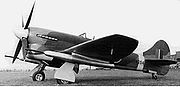 Two Tempest Vs, EJ518 and NV768, were fitted with Napier Sabre Vs and experimented with several different Napier made annular radiator
s, with which they resembled Tempest IIs. This configuration proved to generate less drag than the standard "chin" radiator, contributing to an improvement in the maximum speed of some 11 to 14 mph. NV768 was later fitted with a ducted spinner, similar to that fitted to the Fw 190 V1.
Another experimental Tempest V was SN345, which was fitted with two Vickers
47 mm "P" guns, one under each wing in a long "pod".
 The decision to drop the Hawker Tornado
allowed Sydney Camm and his design team to transfer the alternative engine proposals for the Tornado to the more advanced Typhoon II (later to be renamed "Tempest"). As a result the Tempest was designed from the outset to use the Bristol Centaurus
18 cylinder radial engine
as an alternative to the liquid cooled engines which were also proposed. Two Centaurus powered Tempest Mk II prototypes were to be built.
The first Tempest Mark II, LA602, flew on 28 June 1943 powered by a Centaurus IV (2,520 hp/1,879 kW) driving a four-blade propeller. LA602 initially flew with a Typhoon-type fin and rudder unit. This was followed by the second, LA607, which first flew on 18 September 1943 and was assigned to engine development. Apart from the new engine and cowling, the Tempest II prototypes were similar to early series Tempest Vs. The main airframe difference was the addition of carburettor air intakes in the inner leading edges of both wings, with an oil cooler and air intake in the inner, starboard wing. LA607 was presented to the College of Aeronautics at Cranfield, Bedfordshire and is currently (2011) preserved at Fantasy of Flight
at Polk city, Florida
.
The radial engine installation owed much to examinations of a captured Focke-Wulf Fw 190
, and was unprecedentedly clean and effective. One adopted feature was the use of individual exhaust stubs, laid out in a row down either side of the fuselage, rather than the front collector and large single exhaust used by the Centaurus powered Tornado. In spite of the promise of a more reliable powerplant than the Sabre, there were frustrating problems, including overheating, unreliable and leaking exhausts, insufficient crankshaft lubrication and propeller reduction gear seizures. There were also problems with vibration, but they were fixed by replacing the original "rigid" eight-point engine mounts with six-point rubber-packed shock mounts. In a further attempt to alleviate engine vibration, the four blade propeller was replaced with a five blade unit; eventually, a finely balanced four bladed unit was settled on.
Physically, the Tempest II was longer than the Tempest V (34 ft 5 in/10.5 m versus 33 ft 8 in/10.3 m) and 3 in (76 mm) lower. The weight of the heavier Centaurus engine (2,695 lb/1,222 kg versus 2,360 lb/1,070 kg) was offset by the absence of a heavy radiator unit, so that the Tempest II was only some 20 lb (9 kg) heavier overall. Performance was improved; maximum speed was 442 mph (711 km/h) at 15,200 ft (4,633 m) and climb rate to the same altitude took four and a half minutes compared with five minutes for the Tempest V. The service ceiling
was increased to 37,500 ft (11,430 m)
 The Centaurus was generally regarded as superior to the Sabre, particularly in terms of reliability, and the engine and Tempest airframe proved an excellent match. The combination looked so promising that a contract for 500 of the type was placed as far back as September 1942, but Gloster was overloaded with production of the Typhoon and development of the Gloster Meteor
, and the company could not handle the additional load.
In 1943, the Tempest Mark II production contract was allocated to Bristol
, and the switch delayed production even more. The first Tempest II was rolled off the line on 4 October 1944. With the end of the Second World War in sight, orders for the Tempest II were trimmed or cancelled; after 50 Tempest IIs had been built at Bristol's Banwell facility, production was stopped and shifted back to Hawker.
A total of 452 Tempest IIs were built, including 136 basic Mark IIs and 316 "Fighter Bomber Mark IIs" (FB II). They were built mostly by Hawker and generally with Centaurus V engines, and of that number, 300 were completed after the war. The Tempest II, despite its slightly improved performance and better reliability, never saw combat.
Tempest IIs produced during the war were intended for combat against Japan
, and would have formed part of a proposed British Commonwealth
long range bomber force based on Okinawa, Tiger Force
. The Pacific War
ended before they could be deployed.
The RAF passed 89 Tempest FB IIs to the Indian Air Force
in 1947, while another 24 were passed on to the Pakistani Air Force.
For a long time it was thought that there were Tempest VIs converted for target towing: none of the service histories of the aircraft show TT conversions and no supporting photographic evidence has been found.
propellers. The radiator was to be moved into a ventral bath under the rear fuselage and wing centre section: the wingspan was 41 ft (12.5 m) and the length was 37 ft 3 in (11.4 m). The design was soon dropped in favour of the P.1030, which featured wing leading edge radiators and larger overall dimensions of 42 ft (12.8 m) wingspan and 39 ft 9 in (12.1 m) long. Top speed was expected to be in the region of 508 mph (817 km/h), with a rate of climb of 6,400 ft/min (1,951 m/min). Service ceiling was projected to be 42,000 ft (12,802 m).
Both tenders were dropped when Camm decided to follow the more promising jet engine designs he was working on.
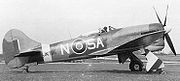 The Tempest V was in the hands of operational squadrons by April 1944; 3 Squadron
was the first to be fully equipped, closely followed by 486 (NZ) Squadron
(the only Article XV unit
to be equipped with the Tempest during the Second World War). A third unit—56 Squadron
—initially kept its Typhoons and was then temporarily equipped with Spitfire IXs until sufficient supplies of Tempests were available. By the end of April 1944, these units were based at RAF Newchurch
a new "Advanced Landing Ground" (ALG), where they formed 150 Wing, commanded by Wing Commander
Roland Beamont
. The new Wing was part of the Second Tactical Air Force (2nd TAF).
Most of the operations carried out by 150 Wing comprised high altitude fighter sweeps, offensive operations known as "Rangers" (long-range sorties inside enemy territory, specifically to attack ground vehicles) and anti-shipping reconnaissance. In June 1944, however, the first German V-1 flying bombs were launched against London and the Tempest's excellent low-altitude performance made it one of the preferred tools for dealing with the small fast-flying unmanned missiles. 150 Wing was transferred back to the ADGB
, where the Tempest squadrons racked up a considerable percentage of the total RAF kills over the flying bombs (638 of a total of 1,846 destroyed by aircraft).
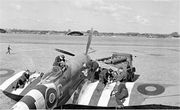 In September 1944 Tempest units, based at forward airfields in England, supported Operation Market Garden
, the Airborne
attempt to seize a bridgehead over the Rhine. On 21 September 1944, as the V1 threat had receded, the Tempest squadrons were redeployed to the 2nd TAF, effectively trading places with the Mustang III squadrons of 122 Wing, which became part of the ADGB units deployed on bomber escort duties. 122 Wing now consisted of 3 Sqn., 56 Sqn., 80 Sqn.
, 274 Sqn.
(to March 1945), and 486(NZ)Sqn. From 1 October 1944 122 Wing was based at B.80 Volkel Air Base
near Uden
, in the Netherlands
. In February 1945 33
and 222 Sqns.
of 135 Wing converted from Spitfire Mk IXs and, in March, were joined by 274 Sqn. 135 Wing was based at B.77 Gilze-Rijen airfield in Holland.
The Tempest's primary role was to carry out "armed reconnaissance" operations deep behind enemy front lines. The Tempest was particularly well suited to the role because of its high speed at low to medium altitudes, its long range when equipped with two 45 gallon drop tanks, the good firepower of the four 20mm cannon and the good pilot visibility. Armed reconnaissance missions were usually flown by two sections (eight aircraft), flying in Finger-four
formations, which would cross the front-lines at altitudes of 7,000 to 8,000 feet: once the Tempests reached their allocated target area the lead section dropped to 4,000 feet or lower to search for targets to strafe, while the other section flew cover 1,000 feet higher and down-sun. After the first section had carried out several attacks it would swap places with the second section and the attacks would continue until ammunition had been exhausted, after which the Tempests would return to base at 8,000 feet. Because the most profitable targets were usually some 250 miles from base the Tempests usually carried two 45 gallon drop tanks which were turned on soon after take-off. Although there were fears that the empty tanks would explode if hit by flak the threat never eventuated and, because they could be difficult to jettison, they were routinely carried throughout an operation with little effect on performance, reducing maximum speed by 5 to 10 mph and range by 2%.
In December 1944 52 German fighters were downed and 89 train
s destroyed, for the loss of 20 Tempests. Following the Luftwaffes Operation Bodenplatte of 1 January 1945, 122 Wing bore the brunt of low to medium altitude fighter operations for the Second Tactical Air Force
. Spitfire XIVs
of 125 and 126 Wings often provided medium to high altitude cover for the Tempests. The Wing came under intense pressure, losing 47 pilots in January.
Tempests also scored a number of kills against the new German jets, including the Messerschmitt Me 262
. Hubert Lange, a Me 262 pilot, said: "the Messerschmitt Me 262's most dangerous opponent was the British Hawker Tempest — extremely fast at low altitudes, highly-manoeuvrable and heavily-armed." Some were destroyed with a tactic known to 135 Wing as the "Rat Scramble": Tempests on immediate alert took off when an Me 262 was reported to be airborne. They did not intercept the jet, but instead flew towards the Me 262 and Ar 234
base at Rheine-Hopsten
. The aim was to attack jets on their landing approach, when they were at their most vulnerable, travelling slowly, with flaps down and incapable of rapid acceleration. The Germans responded by creating a "flak lane" of over 150 quadruple 20 mm (.79 in) guns at Rheine-Hopsten, to protect the approaches. After seven Tempests were lost to flak at Rheine-Hopsten in a single week, the "Rat Scramble" was discontinued. For a while, in March 1945 a strict "No, repeat, No ground attacks" policy was imposed; this only applied for a few days.
In air-to-air combat the Tempest units achieved an estimated air combat success ratio of 7:1, accomplishing a 6:1 ratio against single seat enemy fighters. The top scoring Tempest pilot was Squadron Leader David C. "Foobs" Fairbanks DFC
, an American who joined the Royal Canadian Air Force
in 1941. By mid-1944, he was flying with 274 Squadron. When he was shot down and made a POW
in February 1945, he had destroyed 11 or 12 German aircraft (and one shared) to make him the highest scoring Tempest ace.

Fighter aircraft
A fighter aircraft is a military aircraft designed primarily for air-to-air combat with other aircraft, as opposed to a bomber, which is designed primarily to attack ground targets...
primarily used by the Royal Air Force
Royal Air Force
The Royal Air Force is the aerial warfare service branch of the British Armed Forces. Formed on 1 April 1918, it is the oldest independent air force in the world...
(RAF) in the Second World War
World War II
World War II, or the Second World War , was a global conflict lasting from 1939 to 1945, involving most of the world's nations—including all of the great powers—eventually forming two opposing military alliances: the Allies and the Axis...
. The Tempest was an improved derivative of the Hawker Typhoon
Hawker Typhoon
The Hawker Typhoon was a British single-seat fighter-bomber, produced by Hawker Aircraft. While the Typhoon was designed to be a medium-high altitude interceptor, and a direct replacement for the Hawker Hurricane, several design problems were encountered, and the Typhoon never completely satisfied...
, and one of the most powerful fighter aircraft used during the war.
Design and development
During development of the TyphoonHawker Typhoon
The Hawker Typhoon was a British single-seat fighter-bomber, produced by Hawker Aircraft. While the Typhoon was designed to be a medium-high altitude interceptor, and a direct replacement for the Hawker Hurricane, several design problems were encountered, and the Typhoon never completely satisfied...
the design team, under the leadership of Sydney Camm, were already planning design improvements, this process resulting in the Hawker P. 1012 (or Typhoon II).
Although the Typhoon was basically a good design, Camm and his design team were disappointed with the wing
Wing
A wing is an appendage with a surface that produces lift for flight or propulsion through the atmosphere, or through another gaseous or liquid fluid...
which proved to be too thick in its cross section
Cross section (geometry)
In geometry, a cross-section is the intersection of a figure in 2-dimensional space with a line, or of a body in 3-dimensional space with a plane, etc...
; this created problems with the airflow and inhibited the performance of the aircraft, especially at higher altitudes. The Typhoon's wing, using a NACA 4 digit series wing section
NACA airfoil
The NACA airfoils are airfoil shapes for aircraft wings developed by the National Advisory Committee for Aeronautics . The shape of the NACA airfoils is described using a series of digits following the word "NACA." The parameters in the numerical code can be entered into equations to precisely...
, had a maximum thickness to chord ratio of 19.5% (root) to 12% (tip). In March 1940, engineers were assigned to investigate the new low drag
Drag (physics)
In fluid dynamics, drag refers to forces which act on a solid object in the direction of the relative fluid flow velocity...
laminar flow
Laminar flow
Laminar flow, sometimes known as streamline flow, occurs when a fluid flows in parallel layers, with no disruption between the layers. At low velocities the fluid tends to flow without lateral mixing, and adjacent layers slide past one another like playing cards. There are no cross currents...
wing developed by NACA
NACA
- Organizations :* National Advisory Committee for Aeronautics, the forerunner of the U.S. federal agency NASA* National Association for Campus Activities, an organization for programmers of university and college activities...
in the United States, which had been used in the new North American
North American Aviation
North American Aviation was a major US aerospace manufacturer, responsible for a number of historic aircraft, including the T-6 Texan trainer, the P-51 Mustang fighter, the B-25 Mitchell bomber, the F-86 Sabre jet fighter, the X-15 rocket plane, and the XB-70, as well as Apollo Command and Service...
P-51 Mustang
P-51 Mustang
The North American Aviation P-51 Mustang was an American long-range, single-seat fighter and fighter-bomber used during World War II, the Korean War and in several other conflicts...
. A laminar flow wing adopted for the Tempest series had a maximum thickness to chord ratio of 14.5% at the root, tapering to 10% at the tip. The maximum thickness of the Tempest wing was set further back at 37.5% of the chord versus 30% for the Typhoon's wing.
The wingspan was originally greater than that of the Typhoon at 43 ft (13.1 m), but the wingtips were later "clipped" and the wing became shorter; 41 ft (12.5 m) versus 41 ft 7 in (12.7 m). The wing planform
Planform
In aviation, a planform is the shape and layout of a fixed-wing aircraft's fuselage and wing. Of all the myriad planforms used, they can typically be grouped into those used for low-speed flight, found on general aviation aircraft, and those used for high-speed flight, found on many military...
was changed to an elliptical
Elliptical wing
An elliptical wing is a wing planform shape that minimizes induced drag. Elliptical taper shortens the chord near the wingtips in such a way that all parts of the wing experience equivalent downwash, and lift at the wing tips is essentially zero, improving aerodynamic efficiency due to a greater...
shape to accommodate the 800 rounds of ammunition
Ammunition
Ammunition is a generic term derived from the French language la munition which embraced all material used for war , but which in time came to refer specifically to gunpowder and artillery. The collective term for all types of ammunition is munitions...
for the four 20 mm (.79 in) Hispano cannon
Hispano-Suiza HS.404
The Hispano-Suiza HS.404 was an autocannon widely used as both an aircraft and land weapon in the 20th century by British, American, French, and numerous other military services. The cannon is also referred to as Birkigt type 404, after its designer. Firing a 20 mm caliber projectile, it delivered...
s, which were moved back further into the wing. The new elliptical wing had greater area than the Typhoon's.
However, the new wing design sacrificed the leading edge fuel tanks of the Typhoon; to make up for this loss in capacity, Hawker engineers added a new 21 in (53 cm) fuel bay in front of the cockpit, with a 76 gal
Gallon
The gallon is a measure of volume. Historically it has had many different definitions, but there are three definitions in current use: the imperial gallon which is used in the United Kingdom and semi-officially within Canada, the United States liquid gallon and the lesser used United States dry...
(345 l) fuel tank. In addition, two inter-spar wing tanks, each of 28 gal (127 l), were fitted on either side of the centre-section and, starting with late model Tempest Vs, a 30 gal (136 l) tank was carried in the leading edge of the port wingroot, giving the Tempest a total internal fuel capacity of 162 gal (736 l). In service Tempests also carried two specially designed, streamlined, drop-tanks of 45 gal (204 l) giving a maximum of 360 gal (1,636 l) and an operational radius of 500 mi (805 km)
Another important feature of the new wing was Camm's proposal that radiator
Radiator (engine cooling)
Radiators are used for cooling internal combustion engines, mainly in automobiles but also in piston-engined aircraft, railway locomotives, motorcycles, stationary generating plant or any similar use of such an engine....
s for the new Napier Sabre IV
Napier Sabre
The Napier Sabre was a British H-24-cylinder, liquid cooled, sleeve valve, piston aero engine, designed by Major Frank Halford and built by Napier & Son during WWII...
engine were to be fitted into the leading edge
Leading edge
The leading edge is the part of the wing that first contacts the air; alternatively it is the foremost edge of an airfoil section. The first is an aerodynamic definition, the second a structural one....
of the wing inboard of the undercarriage
Undercarriage
The undercarriage or landing gear in aviation, is the structure that supports an aircraft on the ground and allows it to taxi, takeoff and land...
. This eliminated the distinctive "chin
Beard
A beard is the collection of hair that grows on the chin, cheeks and neck of human beings. Usually, only pubescent or adult males are able to grow beards. However, women with hirsutism may develop a beard...
" radiator associated with the Typhoon and improved aerodynamics
Aerodynamics
Aerodynamics is a branch of dynamics concerned with studying the motion of air, particularly when it interacts with a moving object. Aerodynamics is a subfield of fluid dynamics and gas dynamics, with much theory shared between them. Aerodynamics is often used synonymously with gas dynamics, with...
.
A further improvement of the Tempest wing over that of the Typhoon was the exceptional, flush riveted surface finish, essential on a high performance laminar flow airfoil
Airfoil
An airfoil or aerofoil is the shape of a wing or blade or sail as seen in cross-section....
. Fortunately for the pilots the new wing and airfoil, and the four-bladed propeller unit, eliminated the high frequency vibrations that had plagued the Typhoon.
The redesigned main undercarriage legs were longer and had a wider track (16 ft/5 m) to improve stability at the high landing speed of 110 mph (180 km/h), and to allow tip clearance
Tip clearance
Tip clearance is the distance between the tip of a rotating airfoil and a non moving part.* Gas turbine: Rotor blade and casing* Propeller : Propeller and structure** Ground tip clearance * Wind turbine: Blade and tower...
for a new de Havilland four-blade, 14 ft (4 m) diameter
Diameter
In geometry, a diameter of a circle is any straight line segment that passes through the center of the circle and whose endpoints are on the circle. The diameters are the longest chords of the circle...
propeller
Propeller (aircraft)
Aircraft propellers or airscrews convert rotary motion from piston engines or turboprops to provide propulsive force. They may be fixed or variable pitch. Early aircraft propellers were carved by hand from solid or laminated wood with later propellers being constructed from metal...
. The main undercarriage units were designed to incorporate a system of trunnions which shortened the legs as they retracted. The main wheels also needed new thin tyre
Tire
A tire or tyre is a ring-shaped covering that fits around a wheel rim to protect it and enable better vehicle performance by providing a flexible cushion that absorbs shock while keeping the wheel in close contact with the ground...
s in order to fit within the wing. Finally, the retractable tailwheel was fully enclosed by small doors.
Aircraft flight control systems
A conventional fixed-wing aircraft flight control system consists of flight control surfaces, the respective cockpit controls, connecting linkages, and the necessary operating mechanisms to control an aircraft's direction in flight...
and engine accessories. Both upper wingroots incorporated panels of non-slip coating. For the pilot a retractable foot stirrup under the starboard root trailing edge was linked to a pair of handholds which were covered by spring-loaded flaps. Through a system of linkages, when the canopy was open the stirrup was lowered and the flaps opened, providing easy access to the cockpit. As the canopy was closed the stirrup was raised into the fuselage and the flaps snapped shut.
The new design was finalised by October 1941 and the Air Ministry
Air Ministry
The Air Ministry was a department of the British Government with the responsibility of managing the affairs of the Royal Air Force, that existed from 1918 to 1964...
issued specification F.10/41 that had been written to fit the aircraft. A contract for two initial prototype
Prototype
A prototype is an early sample or model built to test a concept or process or to act as a thing to be replicated or learned from.The word prototype derives from the Greek πρωτότυπον , "primitive form", neutral of πρωτότυπος , "original, primitive", from πρῶτος , "first" and τύπος ,...
s was issued the next month. The aircraft was originally named the "Typhoon Mark II" but was renamed "Tempest" in January 1942 when more prototypes with various experimental configurations were ordered. The problems experienced with delivery of engines led the Air Ministry to ask for six prototypes with different engines so that if a delay hit one engine an alternative would be available. This gave the Mk I (aircraft HM599
Serial number
A serial number is a unique number assigned for identification which varies from its successor or predecessor by a fixed discrete integer value...
) with a Sabre IV
Napier Sabre
The Napier Sabre was a British H-24-cylinder, liquid cooled, sleeve valve, piston aero engine, designed by Major Frank Halford and built by Napier & Son during WWII...
, two Mk IIs (LA602 and LA607) with the Centaurus IV
Bristol Centaurus
|-See also:-Bibliography:*Bridgman, L, Jane's Fighting Aircraft of World War II. Crescent. ISBN 0-517-67964-7*Gunston, Bill. Development of Piston Aero Engines. Cambridge, England. Patrick Stephens Limited, 2006. ISBN 0-7509-4478-1...
, MK III (LA610) with a Griffon IIB
Rolls-Royce Griffon
The Rolls-Royce Griffon is a British 37-litre capacity, 60-degree V-12, liquid-cooled aero engine designed and built by Rolls-Royce Limited...
, Mk IV (LA614) with a Griffon 61
Rolls-Royce Griffon
The Rolls-Royce Griffon is a British 37-litre capacity, 60-degree V-12, liquid-cooled aero engine designed and built by Rolls-Royce Limited...
and the Mk V (HM595) with the Sabre II
Napier Sabre
The Napier Sabre was a British H-24-cylinder, liquid cooled, sleeve valve, piston aero engine, designed by Major Frank Halford and built by Napier & Son during WWII...
.
The first Tempest prototype, the Mark V, was first flown by Philip Lucas from Langley on 2 September 1942. This aircraft retained the Typhoon's framed canopy
Canopy (aircraft)
An aircraft canopy is the transparent enclosure over the cockpit of some types of aircraft. The function of the canopy is to provide a weatherproof and reasonably quiet environment for the aircraft's occupants. The canopy will be as aerodynamically shaped as possible to minimize drag.-History:Very...
, car
Čar
Čar is a village in the municipality of Bujanovac, Serbia. According to the 2002 census, the town has a population of 296 people.-References:...
-style door, the Sabre II engine, and "chin" radiator. It was quickly fitted with a bubble canopy
Bubble canopy
A bubble canopy is a canopy made like a soap bubble, which attempts to provide 360° vision to the pilot.-History:Bubble canopies have been in use since World War II. The British had already developed the "Malcolm hood", which was a bulged canopy, but the British Miles M.20 was one of the first...
like the later Typhoons and a modified tailfin
Fin
A fin is a surface used for stability and/or to produce lift and thrust or to steer while traveling in water, air, or other fluid media, . The first use of the word was for the limbs of fish, but has been extended to include other animal limbs and man-made devices...
that almost doubled the vertical tail surface area. The horizontal tailplanes and elevators
Elevator (aircraft)
Elevators are flight control surfaces, usually at the rear of an aircraft, which control the aircraft's orientation by changing the pitch of the aircraft, and so also the angle of attack of the wing. In simplified terms, they make the aircraft nose-up or nose-down...
were also increased in span and chord (these were also fitted to late production Typhoons.)
Test pilot
A test pilot is an aviator who flies new and modified aircraft in specific maneuvers, known as flight test techniques or FTTs, allowing the results to be measured and the design to be evaluated....
s found the Tempest a great improvement over the Typhoon in performance; in February 1943 the pilots from the A&AEE at Boscombe Down reported that they were impressed by "a manoeuverable and pleasant aircraft to fly with no major handling faults". The Air Ministry had already ordered 400 Tempests in August but production of the new Sabre IV engine ran into protracted problems and delays. The second prototype, the "Tempest Mark I" with the Sabre IV did not fly until 24 February 1943. This prototype also had at first the older Typhoon cockpit structure and vertical tailplane. Elimination of the "chin" radiator did much to improve performance and the Tempest Mark I was the fastest aircraft Hawker had built to that time, attaining a speed of 466 mph (750 km/h).
Continual problems with the Sabre IV meant that only one Mark I (HM599) was built; consequently Hawker went into production with the Sabre II engined "Tempest V". The first rolled off the production line on 21 June 1943. The first Tempest Vs delivered had the long-barrelled
Gun barrel
A gun barrel is the tube, usually metal, through which a controlled explosion or rapid expansion of gases are released in order to propel a projectile out of the end at a high velocity....
20 mm (.79 in) Hispano Mk II cannon. Later production aircraft used the short-barrelled 20 mm (.79 in) Hispano Mk V cannon
Hispano-Suiza HS.404
The Hispano-Suiza HS.404 was an autocannon widely used as both an aircraft and land weapon in the 20th century by British, American, French, and numerous other military services. The cannon is also referred to as Birkigt type 404, after its designer. Firing a 20 mm caliber projectile, it delivered...
, eliminating the protruding barrels—though these had not been as prominent as on the Typhoon.
The ultimate offshoot of the Typhoon and Tempest family was the Fury/Sea Fury.
Hawker Sea Fury
The Hawker Sea Fury was a British fighter aircraft developed for the Royal Navy by Hawker during the Second World War. The last propeller-driven fighter to serve with the Royal Navy, it was also one of the fastest production single piston-engined aircraft ever built.-Origins:The Hawker Fury was an...
Tempest Mark V
Bill Humble
William Humble MBE was a well-known pre-Second World War aviator, known as an air racer and for his aerobatic displays, he was also an officer in the Royal Air Force Special Reserve, and the Auxiliary Air Force. Although he qualified as a mining engineer the lure of flying proved too strong, and...
on 21 June 1943. Several of the early production aircraft underwent extensive service trials at Boscombe Down including clearances to be fitted with external stores, including 500 lb (227 kg) and 1,000 lb (454 kg) bombs and 3 in (76.2 mm) RP-3
RP-3
The RP-3 , was a British rocket used in the Second World War. Though primarily an air-to-ground weapon, it saw limited use in other roles. Its 60 lb warhead gave rise to the alternative name of the "60 lb rocket"; the 25 lb solid-shot armour piercing variant was referred to as the "25 lb rocket"...
rockets. Examination of captured Fw 190s brought about improvements in the windscreen/ side windows; by careful design and positioning of the frame structure blind spots were reduced to an absolute minimum.
During production of the first batch of 100 (JNxxx serialled) Tempest Vs changes were progressively introduced:
The rear fuselage fuselage
Fuselage
The fuselage is an aircraft's main body section that holds crew and passengers or cargo. In single-engine aircraft it will usually contain an engine, although in some amphibious aircraft the single engine is mounted on a pylon attached to the fuselage which in turn is used as a floating hull...
/empennage
Empennage
The empennage , also known as the tail or tail assembly, of most aircraft gives stability to the aircraft, in a similar way to the feathers on an arrow...
joint originally featured the 20 external reinforcing "fishplates" first seen fitted to the Typhoon
Hawker Typhoon
The Hawker Typhoon was a British single-seat fighter-bomber, produced by Hawker Aircraft. While the Typhoon was designed to be a medium-high altitude interceptor, and a direct replacement for the Hawker Hurricane, several design problems were encountered, and the Typhoon never completely satisfied...
. Sometime during this production batch the rear fuselage was modified and became detachable. The first Tempest Vs used long barrelled 20 mm (.79 in) Hispano Mk. IIs which projected ahead of the wing leading edges. These were later replaced by short barrelled Mk. Vs which were flush with the leading edges. "Five spoke" wheels, of a similar pattern to those of the Typhoon, were later replaced by a reinforced "four spoke" pattern.
Initially, Tempest Vs used a built-up rear spar pick-up/bulkhead assembly (just behind the cockpit) which was adapted from the Typhoon. Small blisters on the upper rear wing root fairing covered the securing bolts. This was later changed to a new forged, lightweight assembly which connected to new spar booms: the upper wing root blisters were replaced by small "teardrop" fairings under the wings. The new spar structure also allowed the wings to carry up to 2,000 lb (907 kg) of external stores. Also developed specifically for the Tempest by Hawker was a streamlined 45 gal (205 l) "drop tank" and carrier fairing; the redesigned wing incorporated the plumbing for these tanks, one to each wing. The ailerons were fitted with spring-loaded tabs which lightened the aerodynamic loads, making them easier for the pilot to use and dramatically improving the roll rate
Roll rate
Roll rate may refer to:* Roll Rate Analysis: involves comparing worst delinquency in a specified “previous x ” months with that in the “next x” months, and then calculating the percentage of accounts that maintain their worst delinquency, get better, or “roll forward” into the next delinquency...
above 250 mph (402 km/h). Different models of the Sabre II were introduced. The later versions were capable of producing over 2,400 hp (1,789 kW) on emergency boost for short periods of time.
As in all mass-produced aircraft, there may have been some overlap of these features as new components became available. In mid to late 1944 other features were introduced to both the Typhoon and Tempest: A Rebecca
Beam Approach Beacon System
A blind approach beacon system or beam approach beacon system is an automatic radar landing system developed in the early 1940s....
transponder unit was fitted, with the associated aerial appearing under the portside centre section. A small, elongated oval static port
Pitot-static system
A pitot-static system is a system of pressure-sensitive instruments that is most often used in aviation to determine an aircraft's airspeed, Mach number, altitude, and altitude trend. A pitot-static system generally consists of a pitot tube, a static port, and the pitot-static instruments...
appeared on the rear starboard fuselage, just above the red centre spot. This was apparently used to more accurately measure the aircraft's altitude.
Unusually, in spite of the Tempest V being the RAF's best low to medium altitude fighter, it was not equipped with the new Mk IIC gyroscopic gunsight
Gyro gunsight
A gyro gunsight is a modification of the non-magnifying reflector sight in which target lead and bullet drop are allowed for automatically, the sight incorporating a gyroscopic mechanism that computes the necessary deflections required to ensure a hit on the target...
, an asset which was fitted in RAF Spitfires and Mustangs from mid-1944 and one which considerably improved the chances of shooting down opposing aircraft. Tempest pilots continued to use the Mk.IIL reflector gunsight
Reflector sight
A reflector or reflex sight is a generally non-magnifying optical device that allows the user to look through a partially reflecting glass element and see an illuminated projection of an aiming point or some other image superimposed on the field of view...
until just after World War II, when the gyro-gunsight was introduced in Tempest IIs.
In December 1943, the US Army Air Forces Materiel Command tested the Tempest V JN729 and concluded with: The Tempest should prove to be a very excellent fighter airplane. It is easy to fly and exhibits very desirable fighter characteristics coupled with excellent performance.
Externally the Tempest V bore a strong resemblance to the Typhoon: the longer nose, thinner wings and larger tail unit, with a gracefully curved dorsal fin, enhanced the looks of the fighter, and were the most noticeable differences.
Radiator (engine cooling)
Radiators are used for cooling internal combustion engines, mainly in automobiles but also in piston-engined aircraft, railway locomotives, motorcycles, stationary generating plant or any similar use of such an engine....
s, with which they resembled Tempest IIs. This configuration proved to generate less drag than the standard "chin" radiator, contributing to an improvement in the maximum speed of some 11 to 14 mph. NV768 was later fitted with a ducted spinner, similar to that fitted to the Fw 190 V1.
Another experimental Tempest V was SN345, which was fitted with two Vickers
Vickers
Vickers was a famous name in British engineering that existed through many companies from 1828 until 1999.-Early history:Vickers was formed in Sheffield as a steel foundry by the miller Edward Vickers and his father-in-law George Naylor in 1828. Naylor was a partner in the foundry Naylor &...
47 mm "P" guns, one under each wing in a long "pod".
Tempest II
Hawker Tornado
-See also:-Bibliography:* Darling, Kev. Hawker Typhoon, Tempest and Sea Fury. Ramsgate, Marlborough, Wiltshire, UK: The Crowood Press Ltd., 2003. ISBN 1-86126-620-0....
allowed Sydney Camm and his design team to transfer the alternative engine proposals for the Tornado to the more advanced Typhoon II (later to be renamed "Tempest"). As a result the Tempest was designed from the outset to use the Bristol Centaurus
Bristol Centaurus
|-See also:-Bibliography:*Bridgman, L, Jane's Fighting Aircraft of World War II. Crescent. ISBN 0-517-67964-7*Gunston, Bill. Development of Piston Aero Engines. Cambridge, England. Patrick Stephens Limited, 2006. ISBN 0-7509-4478-1...
18 cylinder radial engine
Radial engine
The radial engine is a reciprocating type internal combustion engine configuration in which the cylinders point outward from a central crankshaft like the spokes on a wheel...
as an alternative to the liquid cooled engines which were also proposed. Two Centaurus powered Tempest Mk II prototypes were to be built.
The first Tempest Mark II, LA602, flew on 28 June 1943 powered by a Centaurus IV (2,520 hp/1,879 kW) driving a four-blade propeller. LA602 initially flew with a Typhoon-type fin and rudder unit. This was followed by the second, LA607, which first flew on 18 September 1943 and was assigned to engine development. Apart from the new engine and cowling, the Tempest II prototypes were similar to early series Tempest Vs. The main airframe difference was the addition of carburettor air intakes in the inner leading edges of both wings, with an oil cooler and air intake in the inner, starboard wing. LA607 was presented to the College of Aeronautics at Cranfield, Bedfordshire and is currently (2011) preserved at Fantasy of Flight
Fantasy of Flight
Fantasy of Flight is an aviation-related attraction in Polk City, Florida, USA that takes visitors back to the pioneering days of early flight, World War I, World War II and beyond. The attraction opened in November of 1995, and houses the world's largest private aircraft collection on display...
at Polk city, Florida
Florida
Florida is a state in the southeastern United States, located on the nation's Atlantic and Gulf coasts. It is bordered to the west by the Gulf of Mexico, to the north by Alabama and Georgia and to the east by the Atlantic Ocean. With a population of 18,801,310 as measured by the 2010 census, it...
.
The radial engine installation owed much to examinations of a captured Focke-Wulf Fw 190
Focke-Wulf Fw 190
The Focke-Wulf Fw 190 Würger was a German Second World War single-seat, single-engine fighter aircraft designed by Kurt Tank in the late 1930s. Powered by a radial engine, the 190 had ample power and was able to lift larger loads than its well-known counterpart, the Messerschmitt Bf 109...
, and was unprecedentedly clean and effective. One adopted feature was the use of individual exhaust stubs, laid out in a row down either side of the fuselage, rather than the front collector and large single exhaust used by the Centaurus powered Tornado. In spite of the promise of a more reliable powerplant than the Sabre, there were frustrating problems, including overheating, unreliable and leaking exhausts, insufficient crankshaft lubrication and propeller reduction gear seizures. There were also problems with vibration, but they were fixed by replacing the original "rigid" eight-point engine mounts with six-point rubber-packed shock mounts. In a further attempt to alleviate engine vibration, the four blade propeller was replaced with a five blade unit; eventually, a finely balanced four bladed unit was settled on.
Physically, the Tempest II was longer than the Tempest V (34 ft 5 in/10.5 m versus 33 ft 8 in/10.3 m) and 3 in (76 mm) lower. The weight of the heavier Centaurus engine (2,695 lb/1,222 kg versus 2,360 lb/1,070 kg) was offset by the absence of a heavy radiator unit, so that the Tempest II was only some 20 lb (9 kg) heavier overall. Performance was improved; maximum speed was 442 mph (711 km/h) at 15,200 ft (4,633 m) and climb rate to the same altitude took four and a half minutes compared with five minutes for the Tempest V. The service ceiling
Ceiling (aeronautics)
With respect to aircraft, a ceiling is the maximum density altitude an aircraft can reach under a set of conditions.The word ceiling can also refer to the height of the lowest obscuring cloud layer above the ground.-Service ceiling:...
was increased to 37,500 ft (11,430 m)
Gloster Meteor
The Gloster Meteor was the first British jet fighter and the Allies' first operational jet. It first flew in 1943 and commenced operations on 27 July 1944 with 616 Squadron of the Royal Air Force...
, and the company could not handle the additional load.
In 1943, the Tempest Mark II production contract was allocated to Bristol
Bristol Aeroplane Company
The Bristol Aeroplane Company, originally the British and Colonial Aeroplane Company, was both one of the first and one of the most important British aviation companies, designing and manufacturing both airframes and aero engines...
, and the switch delayed production even more. The first Tempest II was rolled off the line on 4 October 1944. With the end of the Second World War in sight, orders for the Tempest II were trimmed or cancelled; after 50 Tempest IIs had been built at Bristol's Banwell facility, production was stopped and shifted back to Hawker.
A total of 452 Tempest IIs were built, including 136 basic Mark IIs and 316 "Fighter Bomber Mark IIs" (FB II). They were built mostly by Hawker and generally with Centaurus V engines, and of that number, 300 were completed after the war. The Tempest II, despite its slightly improved performance and better reliability, never saw combat.
Tempest IIs produced during the war were intended for combat against Japan
Empire of Japan
The Empire of Japan is the name of the state of Japan that existed from the Meiji Restoration on 3 January 1868 to the enactment of the post-World War II Constitution of...
, and would have formed part of a proposed British Commonwealth
Commonwealth of Nations
The Commonwealth of Nations, normally referred to as the Commonwealth and formerly known as the British Commonwealth, is an intergovernmental organisation of fifty-four independent member states...
long range bomber force based on Okinawa, Tiger Force
Tiger Force (air)
Tiger Force, also known as the Very Long Range Bomber Force, was the name given to a World War II British Commonwealth long-range heavy bomber force, formed in 1945, from squadrons serving with RAF Bomber Command in Europe, for proposed use against targets in Japan...
. The Pacific War
Pacific War
The Pacific War, also sometimes called the Asia-Pacific War refers broadly to the parts of World War II that took place in the Pacific Ocean, its islands, and in East Asia, then called the Far East...
ended before they could be deployed.
The RAF passed 89 Tempest FB IIs to the Indian Air Force
Indian Air Force
The Indian Air Force is the air arm of the Indian armed forces. Its primary responsibility is to secure Indian airspace and to conduct aerial warfare during a conflict...
in 1947, while another 24 were passed on to the Pakistani Air Force.
Tempest VI
Various engineering refinements that had gone into the Tempest II were incorporated into the last Tempest variant, the "Tempest VI", which was fitted with a Napier Sabre V engine with 2,340 hp (1,700 kW). The more powerful Sabre V required a bigger radiator which displaced the oil cooler and carburettor air intake from the radiator's centre. Air for the carburettor was drawn through intakes on the leading edge of the inner wings, with the oil cooler being fitted behind the radiator. Most Tempest VIs were tropicalised with an air filter fitted in a fairing on the lower centre-section. Hundreds of Tempest VIs were ordered, though only 142 were built. The last piston-engined fighter in RAF service was a Tempest VI.For a long time it was thought that there were Tempest VIs converted for target towing: none of the service histories of the aircraft show TT conversions and no supporting photographic evidence has been found.
Drawing board designs
In 1944, in response to F.13/44 Sydney Camm started a design, the P.1027, for a slightly enlarged Tempest powered by a Rolls Royce R.46, which was projected to develop around 2,500–4,000 hp (1,864–2,983 kW). This engine would have driven eight-blade contra-rotatingContra-rotating
Contra-rotating, also referred to as coaxial contra-rotating, is a technique whereby parts of a mechanism rotate in opposite directions about a common axis, usually to minimise the effect of torque. Examples include some aircraft propellers, resulting in the maximum power of a single piston or...
propellers. The radiator was to be moved into a ventral bath under the rear fuselage and wing centre section: the wingspan was 41 ft (12.5 m) and the length was 37 ft 3 in (11.4 m). The design was soon dropped in favour of the P.1030, which featured wing leading edge radiators and larger overall dimensions of 42 ft (12.8 m) wingspan and 39 ft 9 in (12.1 m) long. Top speed was expected to be in the region of 508 mph (817 km/h), with a rate of climb of 6,400 ft/min (1,951 m/min). Service ceiling was projected to be 42,000 ft (12,802 m).
Both tenders were dropped when Camm decided to follow the more promising jet engine designs he was working on.
Tempest V in combat
No. 3 Squadron RAF
No 3 Squadron of the Royal Air Force operates the Typhoon F2, FGR4 and T3 from RAF Coningsby, Lincolnshire.No 3 Squadron, which celebrated its 95th anniversary over the weekend of 11-13 May 2007, is unique in the RAF for having two official crests....
was the first to be fully equipped, closely followed by 486 (NZ) Squadron
No. 486 Squadron RNZAF
486 Squadron was a fighter squadron of the Royal New Zealand Air Force during the Second World War. It was formed under Article XV of the Empire Air Training Scheme and served in Europe under the operational command of the Royal Air Force.Second World War....
(the only Article XV unit
Article XV squadrons
Article XV squadrons were Australian, Canadian, and New Zealand air force squadrons formed from graduates of the British Commonwealth Air Training Plan , during World War II....
to be equipped with the Tempest during the Second World War). A third unit—56 Squadron
No. 56 Squadron RAF
Number 56 Squadron is one of the oldest and most successful squadrons of the Royal Air Force, with battle honours from many of the significant air campaigns of both World War I and World War II...
—initially kept its Typhoons and was then temporarily equipped with Spitfire IXs until sufficient supplies of Tempests were available. By the end of April 1944, these units were based at RAF Newchurch
Newchurch, Kent
Newchurch is a village and civil parish in the Shepway District in Kent, England. The village is located on the Romney Marsh, west of Dymchurch...
a new "Advanced Landing Ground" (ALG), where they formed 150 Wing, commanded by Wing Commander
Wing Commander (rank)
Wing commander is a commissioned rank in the Royal Air Force and the air forces of many other Commonwealth countries...
Roland Beamont
Roland Beamont
Wing Commander Roland Prosper "Bee" Beamont CBE, DSO & Bar, DFC & Bar was a British fighter pilot and test pilot for the Royal Air Force during the Second World War, and the years that followed...
. The new Wing was part of the Second Tactical Air Force (2nd TAF).
Most of the operations carried out by 150 Wing comprised high altitude fighter sweeps, offensive operations known as "Rangers" (long-range sorties inside enemy territory, specifically to attack ground vehicles) and anti-shipping reconnaissance. In June 1944, however, the first German V-1 flying bombs were launched against London and the Tempest's excellent low-altitude performance made it one of the preferred tools for dealing with the small fast-flying unmanned missiles. 150 Wing was transferred back to the ADGB
Air Defence of Great Britain
The Air Defence of Great Britain was a RAF command comprising substantial Army and RAF elements responsible for the air defence of the British Isles...
, where the Tempest squadrons racked up a considerable percentage of the total RAF kills over the flying bombs (638 of a total of 1,846 destroyed by aircraft).
Operation Market Garden
Operation Market Garden was an unsuccessful Allied military operation, fought in the Netherlands and Germany in the Second World War. It was the largest airborne operation up to that time....
, the Airborne
First Allied Airborne Army
The First Allied Airborne Army was an Allied formation formed on 2 August 1944 by the order of General Dwight D. Eisenhower, the Supreme Allied Commander of the Allied Expeditionary Force. The formation was part of the Allied Expeditionary Force and controlled all Allied airborne forces in Western...
attempt to seize a bridgehead over the Rhine. On 21 September 1944, as the V1 threat had receded, the Tempest squadrons were redeployed to the 2nd TAF, effectively trading places with the Mustang III squadrons of 122 Wing, which became part of the ADGB units deployed on bomber escort duties. 122 Wing now consisted of 3 Sqn., 56 Sqn., 80 Sqn.
No. 80 Squadron RAF
No. 80 Squadron RAF was a Royal Flying Corps and Royal Air Force squadron active from 1917 until 1969. It was operative during both World War I and World War II.-Establishment and early service:...
, 274 Sqn.
No. 274 Squadron RAF
No. 274 Squadron RAF began to form as a patrol squadron, intended to fly Vickers Vimys, at Seaton Carew in November 1918 a few days before the end of World War I. The squadron formation was then cancelled. It was reformed on 15 June 1919 as a bomber squadron, flying Handley Page V/1500s, but...
(to March 1945), and 486(NZ)Sqn. From 1 October 1944 122 Wing was based at B.80 Volkel Air Base
Volkel Air Base
Volkel Air Base is a military airbase used by the Royal Netherlands Air Force - Dutch: Koninklijke Luchtmacht , and is located near the town of Uden, Noord-Brabant, in the Netherlands. It is home to three F-16 Fighting Falcon squadrons, 311, 312 and 313...
near Uden
Uden
Uden is a municipality and a town in the province of Noord-Brabant, Netherlands.- History :Uden was first recorded around 1190 as “Uthen”. However, earlier settlements have been found in the areas of the modern day Moleneind, Vorstenburg and Bitswijk and evidence of ice-age settlements has been...
, in the Netherlands
Netherlands
The Netherlands is a constituent country of the Kingdom of the Netherlands, located mainly in North-West Europe and with several islands in the Caribbean. Mainland Netherlands borders the North Sea to the north and west, Belgium to the south, and Germany to the east, and shares maritime borders...
. In February 1945 33
No. 33 Squadron RAF
No. 33 Squadron of the Royal Air Force operates the Puma HC.1 from RAF Benson, Oxfordshire.-Current role:The squadron is part of the RAF Support Helicopter force, which reports into the Joint Helicopter Command....
and 222 Sqns.
No. 222 Squadron RAF
-In World War I:The Squadron was formally formed at Thasos on 1 April 1918 from A squadron of the former No. 2 Wing, RNAS when the Royal Air Force was formed. Later, 6 April 1918 former Z Squadron of No. 2 Wing, RNAS was added to the strength. Renumbered No. 62 Wing and consisting of Nos...
of 135 Wing converted from Spitfire Mk IXs and, in March, were joined by 274 Sqn. 135 Wing was based at B.77 Gilze-Rijen airfield in Holland.
The Tempest's primary role was to carry out "armed reconnaissance" operations deep behind enemy front lines. The Tempest was particularly well suited to the role because of its high speed at low to medium altitudes, its long range when equipped with two 45 gallon drop tanks, the good firepower of the four 20mm cannon and the good pilot visibility. Armed reconnaissance missions were usually flown by two sections (eight aircraft), flying in Finger-four
Finger-four
The "Finger-four" formation , is a flight formation used by fighter aircraft. It consists of four aircraft, and four of these formations can be combined into a squadron formation.- Description :...
formations, which would cross the front-lines at altitudes of 7,000 to 8,000 feet: once the Tempests reached their allocated target area the lead section dropped to 4,000 feet or lower to search for targets to strafe, while the other section flew cover 1,000 feet higher and down-sun. After the first section had carried out several attacks it would swap places with the second section and the attacks would continue until ammunition had been exhausted, after which the Tempests would return to base at 8,000 feet. Because the most profitable targets were usually some 250 miles from base the Tempests usually carried two 45 gallon drop tanks which were turned on soon after take-off. Although there were fears that the empty tanks would explode if hit by flak the threat never eventuated and, because they could be difficult to jettison, they were routinely carried throughout an operation with little effect on performance, reducing maximum speed by 5 to 10 mph and range by 2%.
In December 1944 52 German fighters were downed and 89 train
Train
A train is a connected series of vehicles for rail transport that move along a track to transport cargo or passengers from one place to another place. The track usually consists of two rails, but might also be a monorail or maglev guideway.Propulsion for the train is provided by a separate...
s destroyed, for the loss of 20 Tempests. Following the Luftwaffes Operation Bodenplatte of 1 January 1945, 122 Wing bore the brunt of low to medium altitude fighter operations for the Second Tactical Air Force
RAF Second Tactical Air Force
The former RAF Second Tactical Air Force was one of three tactical air forces within the Royal Air Force during and after the Second World War...
. Spitfire XIVs
Supermarine Spitfire
The Supermarine Spitfire is a British single-seat fighter aircraft that was used by the Royal Air Force and many other Allied countries throughout the Second World War. The Spitfire continued to be used as a front line fighter and in secondary roles into the 1950s...
of 125 and 126 Wings often provided medium to high altitude cover for the Tempests. The Wing came under intense pressure, losing 47 pilots in January.
Tempests also scored a number of kills against the new German jets, including the Messerschmitt Me 262
Messerschmitt Me 262
The Messerschmitt Me 262 Schwalbe was the world's first operational jet-powered fighter aircraft. Design work started before World War II began, but engine problems prevented the aircraft from attaining operational status with the Luftwaffe until mid-1944...
. Hubert Lange, a Me 262 pilot, said: "the Messerschmitt Me 262's most dangerous opponent was the British Hawker Tempest — extremely fast at low altitudes, highly-manoeuvrable and heavily-armed." Some were destroyed with a tactic known to 135 Wing as the "Rat Scramble": Tempests on immediate alert took off when an Me 262 was reported to be airborne. They did not intercept the jet, but instead flew towards the Me 262 and Ar 234
Arado Ar 234
The Arado Ar 234 was the world's first operational jet-powered bomber, built by the German Arado company in the closing stages of World War II. Produced in very limited numbers, it was used almost entirely in the reconnaissance role, but in its few uses as a bomber it proved to be nearly impossible...
base at Rheine-Hopsten
Hopsten
Hopsten is a municipality in the district of Steinfurt, in North Rhine-Westphalia, Germany. It is situated approximately 15 km northeast of Rheine and 25 km southeast of Lingen.-Gallery:...
. The aim was to attack jets on their landing approach, when they were at their most vulnerable, travelling slowly, with flaps down and incapable of rapid acceleration. The Germans responded by creating a "flak lane" of over 150 quadruple 20 mm (.79 in) guns at Rheine-Hopsten, to protect the approaches. After seven Tempests were lost to flak at Rheine-Hopsten in a single week, the "Rat Scramble" was discontinued. For a while, in March 1945 a strict "No, repeat, No ground attacks" policy was imposed; this only applied for a few days.
In air-to-air combat the Tempest units achieved an estimated air combat success ratio of 7:1, accomplishing a 6:1 ratio against single seat enemy fighters. The top scoring Tempest pilot was Squadron Leader David C. "Foobs" Fairbanks DFC
Distinguished Flying Cross (United Kingdom)
The Distinguished Flying Cross is a military decoration awarded to personnel of the United Kingdom's Royal Air Force and other services, and formerly to officers of other Commonwealth countries, for "an act or acts of valour, courage or devotion to duty whilst flying in active operations against...
, an American who joined the Royal Canadian Air Force
Royal Canadian Air Force
The history of the Royal Canadian Air Force begins in 1920, when the air force was created as the Canadian Air Force . In 1924 the CAF was renamed the Royal Canadian Air Force and granted royal sanction by King George V. The RCAF existed as an independent service until 1968...
in 1941. By mid-1944, he was flying with 274 Squadron. When he was shot down and made a POW
Prisoner of war
A prisoner of war or enemy prisoner of war is a person, whether civilian or combatant, who is held in custody by an enemy power during or immediately after an armed conflict...
in February 1945, he had destroyed 11 or 12 German aircraft (and one shared) to make him the highest scoring Tempest ace.
Variants
- Typhoon Mk II : The original designation of the Hawker Tempest.
- Tempest Mk I : Prototype fitted with the Napier Sabre IV piston engine with oil coolers and radiators placed in the wing to reduce drag, one aircraft.
- Tempest Mk III : Prototype fitted with the Rolls-Royce Griffon piston engine.
- Tempest Mk IV : Tempest Mk III prototype re-engined with a Rolls-Royce Griffon 61 piston engine.
- Tempest Mk V : Single-seat fighter, fighter-bomber aircraft, powered by the Napier Sabre II piston engine, 801 built at Langley.
- Early series Tempest Mk V : The first 100 production aircraft were fitted with four long-barrel 20 mm (.79 in) Mark II Hispano cannons and continued to use some TyphoonHawker TyphoonThe Hawker Typhoon was a British single-seat fighter-bomber, produced by Hawker Aircraft. While the Typhoon was designed to be a medium-high altitude interceptor, and a direct replacement for the Hawker Hurricane, several design problems were encountered, and the Typhoon never completely satisfied...
components. - Mid to late series Tempest Mk V : The other 701 production aircraft were fitted with four short-barrel 20 mm Mark V Hispano cannons and other production line changes.
- Tempest TT Mk 5 : After the Second World War a number of Tempest Mk Vs were converted into target tugs.
- Early series Tempest Mk V : The first 100 production aircraft were fitted with four long-barrel 20 mm (.79 in) Mark II Hispano cannons and continued to use some Typhoon
- Tempest F Mk II : Single-seat fighter aircraft for the RAF, powered by a Bristol Centaurus radial piston engine, 402 built by Hawker at Langley and 50 by Bristol Aeroplane Company, Banwell.
- Tempest FB Mk II : Single-seat fighter-bomber with underwing pylons for bombs and rockets.
- Tempest F Mk VI : Single-seat fighter aircraft for the RAF engined with the Sabre V (2,340 hp), 142 built.
Operators
(One Tempest V, acquired postwar for trials.)Specifications (Tempest V)
See also
External links
- Vectorsite article
- The Hawker Tempest Page
- Hawker Tempest V Performance
- U.S report on Tempest V
- Hawker Tempest V recognition film
- Hawker Tempest profile, technical details and photos
- "Spinning Intake - Ingenious Napier Development of Sabre-Tempest Annular Radiator Installation," - A 1946 Flight article on the annular radiator version of the Tempest