

Empennage

Encyclopedia
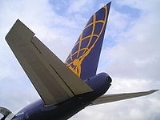
The empennage also known as the tail or tail assembly, of most aircraft
gives stability to the aircraft, in a similar way to the feathers on an arrow. Most aircraft feature empennage incorporating vertical and horizontal stabilising surfaces which stabilise the flight dynamics
of pitch and yaw, as well as housing control surfaces.
In spite of effective control surfaces, many early aircraft that lacked stabilising empennage were virtually unflyable. Today, only a few (often relatively unstable) heavier than air aircraft are able to fly without empennage ("tailess").
, the tailplane
and the part of the fuselage
to which these are attached. On an airliner this would be all the flying and control surfaces behind the rear pressure bulkhead
.
The front, usually fixed section of the tailplane is called the horizontal stabilizer
and is used to balance and share lifting loads of the mainplane dependent on centre of gravity considerations by limiting oscillations in pitch. The rear section is called the elevator
and is usually hinged to the horizontal stabilizer. The elevator is a movable airfoil
that controls changes in pitch, the up-and-down motion of the aircraft's nose. Some aircraft employ an all-moving stabilizer and elevators in one unit, known as a stabilator
.
The vertical tail structure (or fin
) has a fixed front section called the vertical stabilizer
, used to restrict side-to-side motion of the aircraft (yawing). The rear section of the vertical fin is the rudder
, a movable airfoil that is used to turn the aircraft in combination with the aileron
s.
Some aircraft are fitted with a tail assembly that is hinged to pivot in two axes forward of the fin and stabilizer, in an arrangement referred to as a movable tail. The entire empennage is rotated vertically to actuate the horizontal stabiliser, and sideways to actuate the fin.
The aircraft's cockpit voice recorder
and flight data recorder
are often located in the empennage, because the aft of the aircraft provides better protection for these in most aircraft crashes.
The trim device may be:
Multi-engined aircraft often have trim tabs on the rudder to reduce the pilot effort required to keep the aircraft straight in situations of asymmetrical thrust, such as single engine operations.
The overall shapes of individual tail surfaces (tailplane planforms, fin profiles) are similar to Wing planforms.
Some locations have been given special names:
Twin fins may be mounted at various points:
Unusual fin configurations include:
and X-tail designs. Here, diagonal tail surfaces act differentially to provide yaw control (in place of the rudder) and act together to provide pitch control (in place of the elevator).
 A tailless aircraft (often tail-less) traditionally has all its horizontal control surfaces on its main wing surface. It has no horizontal stabilizer - either tailplane or canard
foreplane (nor does it have a second wing in tandem
arrangement). A 'tailless' type usually still has a vertical stabilising fin (vertical stabilizer
) and control surface (rudder
). However, NASA
has recently adopted the 'tailless' description for the novel X-36 research aircraft which has a canard foreplane but no vertical fin.
The most successful tailless configuration has been the tailless delta
, especially for combat aircraft.
Aircraft
An aircraft is a vehicle that is able to fly by gaining support from the air, or, in general, the atmosphere of a planet. An aircraft counters the force of gravity by using either static lift or by using the dynamic lift of an airfoil, or in a few cases the downward thrust from jet engines.Although...
gives stability to the aircraft, in a similar way to the feathers on an arrow. Most aircraft feature empennage incorporating vertical and horizontal stabilising surfaces which stabilise the flight dynamics
Flight dynamics
Flight dynamics is the science of air vehicle orientation and control in three dimensions. The three critical flight dynamics parameters are the angles of rotation in three dimensions about the vehicle's center of mass, known as pitch, roll and yaw .Aerospace engineers develop control systems for...
of pitch and yaw, as well as housing control surfaces.
In spite of effective control surfaces, many early aircraft that lacked stabilising empennage were virtually unflyable. Today, only a few (often relatively unstable) heavier than air aircraft are able to fly without empennage ("tailess").
Structure
Structurally, the empennage consists of the entire tail assembly, including the finVertical stabilizer
The vertical stabilizers, vertical stabilisers, or fins, of aircraft, missiles or bombs are typically found on the aft end of the fuselage or body, and are intended to reduce aerodynamic side slip. It is analogical to a skeg on boats and ships.On aircraft, vertical stabilizers generally point upwards...
, the tailplane
Tailplane
A tailplane, also known as horizontal stabilizer , is a small lifting surface located on the tail behind the main lifting surfaces of a fixed-wing aircraft as well as other non-fixed wing aircraft such as helicopters and gyroplanes...
and the part of the fuselage
Fuselage
The fuselage is an aircraft's main body section that holds crew and passengers or cargo. In single-engine aircraft it will usually contain an engine, although in some amphibious aircraft the single engine is mounted on a pylon attached to the fuselage which in turn is used as a floating hull...
to which these are attached. On an airliner this would be all the flying and control surfaces behind the rear pressure bulkhead
Rear pressure bulkhead
The aft pressure bulkhead is a component of all large commercial aircraft. It is an airtight bulkhead located between the cabin and the tail of the aircraft. Its purpose is to seal the rear of the plane and thus maintain cabin pressure, and as such it is a vital part of the aircraft.Japan...
.
The front, usually fixed section of the tailplane is called the horizontal stabilizer
Stabilizer (aircraft)
In aviation, a stabilizer provides stability when the aircraft is flying straight, and the airfoil of the horizontal stabilizer balances the forces acting on the aircraft....
and is used to balance and share lifting loads of the mainplane dependent on centre of gravity considerations by limiting oscillations in pitch. The rear section is called the elevator
Elevator (aircraft)
Elevators are flight control surfaces, usually at the rear of an aircraft, which control the aircraft's orientation by changing the pitch of the aircraft, and so also the angle of attack of the wing. In simplified terms, they make the aircraft nose-up or nose-down...
and is usually hinged to the horizontal stabilizer. The elevator is a movable airfoil
Airfoil
An airfoil or aerofoil is the shape of a wing or blade or sail as seen in cross-section....
that controls changes in pitch, the up-and-down motion of the aircraft's nose. Some aircraft employ an all-moving stabilizer and elevators in one unit, known as a stabilator
Stabilator
A stabilator is an aircraft control surface that combines the functions of an elevator and a horizontal stabilizer...
.
The vertical tail structure (or fin
Fin
A fin is a surface used for stability and/or to produce lift and thrust or to steer while traveling in water, air, or other fluid media, . The first use of the word was for the limbs of fish, but has been extended to include other animal limbs and man-made devices...
) has a fixed front section called the vertical stabilizer
Vertical stabilizer
The vertical stabilizers, vertical stabilisers, or fins, of aircraft, missiles or bombs are typically found on the aft end of the fuselage or body, and are intended to reduce aerodynamic side slip. It is analogical to a skeg on boats and ships.On aircraft, vertical stabilizers generally point upwards...
, used to restrict side-to-side motion of the aircraft (yawing). The rear section of the vertical fin is the rudder
Rudder
A rudder is a device used to steer a ship, boat, submarine, hovercraft, aircraft or other conveyance that moves through a medium . On an aircraft the rudder is used primarily to counter adverse yaw and p-factor and is not the primary control used to turn the airplane...
, a movable airfoil that is used to turn the aircraft in combination with the aileron
Aileron
Ailerons are hinged flight control surfaces attached to the trailing edge of the wing of a fixed-wing aircraft. The ailerons are used to control the aircraft in roll, which results in a change in heading due to the tilting of the lift vector...
s.
Some aircraft are fitted with a tail assembly that is hinged to pivot in two axes forward of the fin and stabilizer, in an arrangement referred to as a movable tail. The entire empennage is rotated vertically to actuate the horizontal stabiliser, and sideways to actuate the fin.
The aircraft's cockpit voice recorder
Cockpit voice recorder
A cockpit voice recorder , often referred to as a "black box", is a flight recorder used to record the audio environment in the flight deck of an aircraft for the purpose of investigation of accidents and incidents...
and flight data recorder
Flight data recorder
A flight data recorder is an electronic device employed to record any instructions sent to any electronic systems on an aircraft. It is a device used to record specific aircraft performance parameters...
are often located in the empennage, because the aft of the aircraft provides better protection for these in most aircraft crashes.
Trim
In some aircraft trim devices are provided to eliminate the need for the pilot to maintain constant pressure on the elevator or rudder controls.The trim device may be:
- a trim tab on the rear of the elevators or rudder which act to change the aerodynamic load on the surface. Usually controlled by a cockpit wheel or crank.
- an adjustable stabilizer into which the stabilizer may be hinged at its spar and adjustably jacked a few degrees in incidence either up or down. Usually controlled by a cockpit crank.
- a bungeeBungee cordA bungee cord , also known as a shock cord, is an elastic cord composed of one or more elastic strands forming a core, usually covered in a woven cotton or polypropylene sheath...
trim system which uses a spring to provide an adjustable preload in the controls. Usually controlled by a cockpit lever. - an anti-servo tab used to trim some elevators and stabilators as well as increased control force feel. Usually controlled by a cockpit wheel or crank.
- a servo tabServo tabA servo tab is a small hinged device installed on an aircraft control surface to assist the movement of the control surface.-Servo tabs:...
used to move the main control surface, as well as act as a trim tab. Usually controlled by a cockpit wheel or crank.
Multi-engined aircraft often have trim tabs on the rudder to reduce the pilot effort required to keep the aircraft straight in situations of asymmetrical thrust, such as single engine operations.
Tail configurations
Aircraft empennage designs may be classified broadly according to the fin and tailplane configurations.The overall shapes of individual tail surfaces (tailplane planforms, fin profiles) are similar to Wing planforms.
Tailplanes
The tailplane comprises the tail-mounted fixed horizontal stabiliser and movable elevator. Besides its planform, it is characterised by:- Number of tailplanes - from 0 (TaillessTailless aircraftA tailless aircraft traditionally has all its horizontal control surfaces on its main wing surface. It has no horizontal stabilizer - either tailplane or canard foreplane . A 'tailless' type usually still has a vertical stabilising fin and control surface...
or canard) to 3 (Roe triplane) - Location of tailplane - mounted high, mid or low on the fuselage, fin or tail booms.
- Fixed stabiliser and movable elevator surfaces, or a single combined stabilatorStabilatorA stabilator is an aircraft control surface that combines the functions of an elevator and a horizontal stabilizer...
or flying tail. (General Dynamics F-111General Dynamics F-111The General Dynamics F-111 "Aardvark" was a medium-range interdictor and tactical strike aircraft that also filled the roles of strategic bomber, reconnaissance, and electronic warfare in its various versions. Developed in the 1960s by General Dynamics, it first entered service in 1967 with the...
)
Some locations have been given special names:
- Cruciform tailCruciform tailThe cruciform tail is an aircraft empennage configuration which, when viewed from the aircraft's front or rear, looks much like a cross. The usual arrangement is to have the horizontal stabilizer intersect the vertical tail somewhere near the middle, and above the top of the fuselage.Often this...
- The horizontal stabilizers are placed midway up the vertical stabilizer, giving the appearance of a crossCrossA cross is a geometrical figure consisting of two lines or bars perpendicular to each other, dividing one or two of the lines in half. The lines usually run vertically and horizontally; if they run obliquely, the design is technically termed a saltire, although the arms of a saltire need not meet...
when viewed from the front. Cruciform tails are often used to keep the horizontal stabilizers out of the engine wake, while avoiding many of the disadvantages of a T-tailT-tailthumb|right|Grob motor gliderA T-tail is an aircraft tail stabilizer configuration in which the horizontal surfaces are mounted to the top of the vertical stabilizer. Traditionally, the horizontal control surfaces are mounted to the fuselage at the base of the vertical stabilizer...
. Examples include the Hawker Sea HawkHawker Sea HawkThe Hawker Sea Hawk was a British single-seat jet fighter of the Fleet Air Arm , the air branch of the Royal Navy , built by Hawker Aircraft and its sister company, Armstrong Whitworth Aircraft. Although its origins stemmed from earlier Hawker piston-engined fighters, the Sea Hawk became the...
and Douglas A-4 Skyhawk. - T-tailT-tailthumb|right|Grob motor gliderA T-tail is an aircraft tail stabilizer configuration in which the horizontal surfaces are mounted to the top of the vertical stabilizer. Traditionally, the horizontal control surfaces are mounted to the fuselage at the base of the vertical stabilizer...
- The horizontal stabilizer is mounted on top of the fin, creating a "T" shape when viewed from the front. T-tails keep the stabilizers out of the engine wake, and give better pitch control. T-tails have a good glide ratio, and are more efficient on low speed aircraft. However, T-tails are more likely to enter a deep stall, and is more difficult to recover from a spin. T-tails must be stronger, and therefore heavier than conventional tails. T-tails also have a larger radar cross sectionRadar cross sectionRadar cross section is a measure of how detectable an object is with a radar. A larger RCS indicates that an object is more easily detected.An object reflects a limited amount of radar energy...
. Examples include the Gloster JavelinGloster JavelinThe Gloster Javelin was an "all-weather" interceptor aircraft that served with Britain's Royal Air Force in the late 1950s and most of the 1960s...
and McDonnell Douglas DC-9McDonnell Douglas DC-9The McDonnell Douglas DC-9 is a twin-engine, single-aisle jet airliner. It was first manufactured in 1965 with its maiden flight later that year. The DC-9 was designed for frequent, short flights. The final DC-9 was delivered in October 1982.The DC-9 was followed in subsequent modified forms by...
.
Fuselage mounted |
Cruciform |
T-tail |
Flying tailplane |
Fins
The fin comprises the fixed vertical stabiliser and rudder. Besides its profile, it is characterised by:- Number of fins - from none (McDonnell Douglas X-36) to three (Lockheed ConstellationLockheed ConstellationThe Lockheed Constellation was a propeller-driven airliner powered by four 18-cylinder radial Wright R-3350 engines. It was built by Lockheed between 1943 and 1958 at its Burbank, California, USA, facility. A total of 856 aircraft were produced in numerous models, all distinguished by a...
). - Location of fins - on the fuselage (over or under), tailplane, tail booms or wings
Twin fins may be mounted at various points:
- Twin tailTwin tailA twin tail is a specific type of vertical stabilizer arrangement found on the empennage of some aircraft. Two vertical stabilizers — often smaller on their own than a single conventional tail would be — are mounted at the outside of the aircraft's horizontal stabilizer...
A twin tail, also called an H-tail, consists of two small vertical stabilizers on either side of the horizontal stabilizer. Examples include the B-25 MitchellB-25 MitchellThe North American B-25 Mitchell was an American twin-engined medium bomber manufactured by North American Aviation. It was used by many Allied air forces, in every theater of World War II, as well as many other air forces after the war ended, and saw service across four decades.The B-25 was named...
and Avro LancasterAvro LancasterThe Avro Lancaster is a British four-engined Second World War heavy bomber made initially by Avro for the Royal Air Force . It first saw active service in 1942, and together with the Handley Page Halifax it was one of the main heavy bombers of the RAF, the RCAF, and squadrons from other...
. - Twin boomTwin boomTwin-boom aircraft have their tailplanes and vertical stabilizers mounted on the tail of either two fuselages or on two booms fixed to either both sides of the single fuselage, the wings or the engine nacelles.The reason for this design choice may be:...
A twin boom has two fuselages or booms, with a vertical stabilizer on each, and a horizontal stabilizer between them. Examples include the P-38 LightningP-38 LightningThe Lockheed P-38 Lightning was a World War II American fighter aircraft built by Lockheed. Developed to a United States Army Air Corps requirement, the P-38 had distinctive twin booms and a single, central nacelle containing the cockpit and armament...
and de Havilland VampireDe Havilland VampireThe de Havilland DH.100 Vampire was a British jet-engine fighter commissioned by the Royal Air Force during the Second World War. Following the Gloster Meteor, it was the second jet fighter to enter service with the RAF. Although it arrived too late to see combat during the war, the Vampire served...
. - Wing mounted: (midwing as on the F7U CutlassF7U CutlassThe Vought F7U Cutlass was a United States Navy carrier-based jet fighter and fighter-bomber of the early Cold War era. It was a highly unusual, semi-tailless design, allegedly based on aerodynamic data and plans captured from the German Arado company at the end of World War II, though Vought...
or on the wing tips as on the Handley Page ManxHandley Page Manx-See also:-Bibliography:* Barnes, Chris. "Tailess Experimental". Aeroplane Monthly, January 1980, Volume 8 No. 1. pp. 4—9.* Barnes, C. H. Handley Page Aircraft Since 1907. London: Putnam & Company, Ltd., 1987. ISBN 0-85177-803-8....
)
Tailplane mounted |
Twin tailboom |
Wing mounted |
Unusual fin configurations include:
- Triple fins - examples include the (Lockheed ConstellationLockheed ConstellationThe Lockheed Constellation was a propeller-driven airliner powered by four 18-cylinder radial Wright R-3350 engines. It was built by Lockheed between 1943 and 1958 at its Burbank, California, USA, facility. A total of 856 aircraft were produced in numerous models, all distinguished by a...
and E-2 HawkeyeE-2 HawkeyeThe Grumman E-2 Hawkeye is an American all-weather, aircraft carrier-capable tactical airborne early warning aircraft. This twin-turboprop aircraft was designed and developed during the late 1950s and early 1960s by the Grumman Aircraft Company for the United States Navy as a replacement for the... - Ventral fin, often in addition to a conventional fin (North American X-15North American X-15The North American X-15 rocket-powered aircraft/spaceplane was part of the X-series of experimental aircraft, initiated with the Bell X-1, that were made for the USAAF/USAF, NACA/NASA, and the USN. The X-15 set speed and altitude records in the early 1960s, reaching the edge of outer space and...
, Dornier Do 335Dornier Do 335The Dornier Do 335 Pfeil was a World War II heavy fighter built by the Dornier company. The two-seater trainer version was also called Ameisenbär . The Pfeils performance was much better than other twin-engine designs due to its unique "push-pull" layout and the much lower drag of the in-line...
)
Triple fins |
Ventral fin |
V and X tails
An alternative to the fin-and-tailplane approach is provided by the V-tailV-tail
In aircraft, a V-tail is an unconventional arrangement of the tail control surfaces that replaces the traditional fin and horizontal surfaces with two surfaces set in a V-shaped configuration when viewed from the front or rear of the aircraft...
and X-tail designs. Here, diagonal tail surfaces act differentially to provide yaw control (in place of the rudder) and act together to provide pitch control (in place of the elevator).
- V tail: A V-tail can be lighter than a conventional tail in some situations and produce less drag, as on the Fouga MagisterFouga MagisterThe Fouga Magister is a 1950s French two-seat jet trainer. The related CM.175 Zéphyr was a carrier-capable version for the French Navy....
trainer, Northrop Grumman RQ-4 Global Hawk RPV and X-37 spacecraft. A V-tail may also have a smaller radar signature.
- Inverted V tail:The unmanned Predator uses an inverted V-tail as does the Lazair.
- X tail: The Lockheed XFVLockheed XFV-See also:-References:NotesCitationsBibliography* Allen, Francis J. "Bolt upright: Convair's and Lockheed's VTOL fighters". Air Enthusiast , Volume 127, January/February 2007, pp. 13–20. ISSN 0143-5450....
featured an "X" tail, which was reinforced and fitted with a wheel on each surface so that the craft could sit on its tail and take off and land vertically.
- Pelikan: The Pelikan tailPelikan tailThe Pelikan tail is an experimental tail design for fighter jets. Originally conceived by Ralph Pelikan, who was hired by McDonnell Aircraft, later worked for McDonnell Douglas and after another merger, retired from Boeing. His design has not to date been incorporated into any publicly available...
is an all-flying variation on the V tail. It was proposed for the Boeing X-32Boeing X-32The Boeing X-32 was a multi-purpose jet fighter in the Joint Strike Fighter contest. It lost to the Lockheed Martin X-35 demonstrator which was further developed into the F-35 Lightning II.-Background:...
but abandoned, and has not yet been used on any aircraft. The design is said to have the advantages of greater pitch control and a smaller radar signature.
V-tail |
Inverted V-tail |
X-tail |
Pelikan tail |
Tailless
Canard (aeronautics)
In aeronautics, canard is an airframe configuration of fixed-wing aircraft in which the forward surface is smaller than the rearward, the former being known as the "canard", while the latter is the main wing...
foreplane (nor does it have a second wing in tandem
Tandem wing
thumb|right|QAC Quickie Q2A tandem wing aircraft usually involves two full-sized wings, both of which are full airfoils. Sometimes an aircraft of this configuration can look like a variation on the biplane, but is in fact very different. The forward wing is often technically a canard, fitted with...
arrangement). A 'tailless' type usually still has a vertical stabilising fin (vertical stabilizer
Vertical stabilizer
The vertical stabilizers, vertical stabilisers, or fins, of aircraft, missiles or bombs are typically found on the aft end of the fuselage or body, and are intended to reduce aerodynamic side slip. It is analogical to a skeg on boats and ships.On aircraft, vertical stabilizers generally point upwards...
) and control surface (rudder
Rudder
A rudder is a device used to steer a ship, boat, submarine, hovercraft, aircraft or other conveyance that moves through a medium . On an aircraft the rudder is used primarily to counter adverse yaw and p-factor and is not the primary control used to turn the airplane...
). However, NASA
NASA
The National Aeronautics and Space Administration is the agency of the United States government that is responsible for the nation's civilian space program and for aeronautics and aerospace research...
has recently adopted the 'tailless' description for the novel X-36 research aircraft which has a canard foreplane but no vertical fin.
The most successful tailless configuration has been the tailless delta
Delta wing
The delta wing is a wing planform in the form of a triangle. It is named for its similarity in shape to the Greek uppercase letter delta .-Delta-shaped stabilizers:...
, especially for combat aircraft.