

Gaelic football

Encyclopedia
Gaelic football commonly referred to as "football" or "Gaelic", or "Gah" is a form of football
played mainly in Ireland
. It is, together with hurling
, one of the two most popular spectator sports in the Republic of Ireland
.
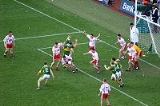
Gaelic football is played by teams of 15 on a rectangular grass pitch with H-shaped goals at each end. The primary object is to score by kicking or striking the ball with the hand and getting it through the goals. The team with the highest score at the end of the match wins. Players advance the ball up the field with a combination of carrying, soloing (dropping and then toe-kicking the ball upward into the hands), kicking, and hand-passing to their team-mates.
Statistics show the game drawing significantly more spectators than any other sport in the Republic of Ireland
recently; 2005 ESRI
figures indicate that it draws 34% of total attendances at sports events in Ireland, with the closest rival, hurling
drawing 23%.
Football is one of four Gaelic games
run by the Gaelic Athletic Association
, the largest sporting organisation in Ireland with more than 800,000 members. It has strict rules on player amateurism
and the pinnacle of the sport is the inter-county All-Ireland Football Final. The game is believed to have descended from ancient Irish football known as caid
which dates back to medieval times, although the modern rules were not set down until 1886.
Gaelic football is also played in countries outside Ireland, often although not solely played by members of the Irish diaspora
. It is increasing in popularity internationally. Teams from both London
and New York
compete in the annual All-Ireland Senior Football Championship
, the highest level of the game.
International rules football
, a hybrid
of Gaelic football and Australian rules football
, facilitates matches between Gaelic footballers and Australian-rules footballers. International rules is most prominently used for international representative matches
between Ireland
and Australia
.
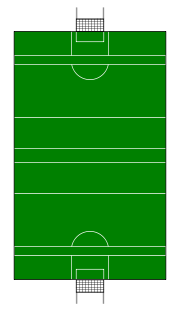 A Gaelic pitch is similar in some respects to a rugby
pitch but larger. The grass pitch is rectangular, stretching 130–145 meters long and 80–90 meters wide. There are H-shaped goalposts at each end, formed by two posts, which are usually 7 m high, set 6.5 m apart, and connected 2.5 m above the ground by a crossbar. A net extending in back of the goal is attached to the crossbar and lower goal posts. The same pitch is used for hurling
; the GAA, which organizes both sports, decided this to facilitate dual usage. Lines are marked at distances of 13 m, 20m and 45 m from each end-line. Shorter pitches and smaller goals are used by youth teams.
, who must wear a jersey colour different from that of his or her teammates.
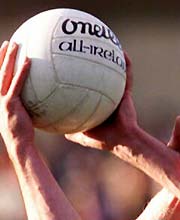
made of 18 stitched leather panels, similar in appearance to a traditional volleyball
, with a circumference of 69-74cm
(27-29'), weighing between 370-425g (13-15 oz) when dry. It may be kicked or hand passed. A hand pass is not a punch but rather a strike of the ball with the side of the closed fist, using the knuckle of the thumb.
.
Shoulder to shoulder contact and slapping the ball out of an opponent's hand are permitted, but the following are all fouls:
The referee is responsible for starting and stopping play, recording the score, awarding frees and booking and sending off players.
Linesmen are responsible for indicating the direction of line balls to the referee.
The fourth official is responsible for overseeing substitutions, and also indicating the amount of stoppage time (signaled to him by the referee) and the players substituted using an electronic board.
The umpires are responsible for judging the scoring. They indicate to the referee whether a shot was: wide (spread both arms), a 45 m kick (raise one arm), a point (wave white flag), square ball (cross arms) or a goal (wave green flag). A disallowed score is indicated by crossing the green and white flags.
Contrary to popular belief within the association, all officials are not obliged to indicate "any misdemeanours" to the referee, but are in fact only permitted to inform the referee of violent conduct they have witnessed which has occurred without the referee's knowledge. A linesman/umpire is not permitted to inform the referee of technical fouls such as a "double bounce" or an illegal pick up of the ball. Such decisions can only be made at the discretion of the referee.
played in Ireland and known collectively as caid
. Consequently, the name caid is used by some people to refer to present day Gaelic football.
The first record of any form of football being played in Ireland
comes from 1308, when John McCrocan, a spectator at a football game at Newcastle, County Dublin
was charged with accidentally stabbing a player named William Bernard.
The Statute of Galway
of 1527 allowed the playing of "foot balle" and archery
but banned "'hokie' — the hurling
of a little ball with sticks or staves" as well as other sports.
By the 17th century, the situation had changed considerably. The games had grown in popularity and were widely played. This was due to the patronage of the gentry. Now instead of opposing the games it was the gentry and the ruling class who were serving as patrons of the games. Games were organised between landlords with each team comprising 20 or more tenants. Wagers were commonplace with purses of up to 100 guineas
(Prior, 1997).
The earliest record of a recognized precursor to the modern game date from a match in County Meath in 1670, in which catching and kicking the ball was permitted.
However even "foot-ball" was banned by the severe Sunday Observance Act of 1695, which imposed a fine of one shilling
(a substantial amount at the time) for those caught playing sports. It proved difficult, if not impossible, for the authorities to enforce the Act and the earliest recorded inter-county match in Ireland was one between Louth
and Meath
, at Slane
, in 1712.
A six-a-side version was played in Dublin in the early 18th century, and 100 years later there were accounts of games played between County sides (Prior, 1997).
By the early 19th century, various football games, referred to collectively as caid, were popular in Kerry
, especially the Dingle Peninsula
. Father W. Ferris described two forms of caid: the "field game" in which the object was to put the ball through arch-like goals, formed from the boughs of two trees, and; the epic "cross-country game" which lasted the whole of a Sunday (after mass) and was won by taking the ball across a parish
boundary. "Wrestling", "holding" opposing players, and carrying the ball were all allowed.
During the 1860s and 1870s, Rugby football
started to become popular in Ireland. Trinity College, Dublin
was an early stronghold of Rugby, and the rules of the (English) Football Association were codified in 1863 and distributed widely. By this time, according to Gaelic football historian Jack Mahon, even in the Irish countryside, caid had begun to give way to a "rough-and-tumble game" which even allowed tripping. Association football
started to take hold, especially in Ulster
, in the 1880s.
Limerick was the stronghold of the native game around this time, and the Commercials Club, founded by employees of Cannock’s Drappery Store, was one of the first to impose a set of rules which was adapted by other clubs in the city. Of all the Irish pastimes the GAA set out to preserve and promote, it is fair to say that Gaelic football was in the worst shape at the time of the association’s foundation (GAA Museum, 2001).
Irish forms of football were not formally arranged into an organised playing code by the Gaelic Athletic Association
(GAA) until 1887. The GAA sought to promote traditional Irish sports, such as hurling
and to reject "foreign" (particularly English) imports. The first Gaelic football rules, showing the influence of hurling and a desire to differentiate from association football — for example in their lack of an offside rule — were drawn up by Maurice Davin
and published in the United Ireland magazine on February 7, 1887. The rules of the aforementioned Commercials Club became the basis for these official (Gaelic Football) rules who, unsurprisingly, won the inaugural All-Ireland Senior Football Final (representing County Limerick)
On Bloody Sunday in 1920
, during the Anglo-Irish War, a football match at Croke Park
was attacked by British
forces. 14 people were killed and 65 were injured. Among the dead was Tipperary footballer Michael Hogan, for whom the Hogan Stand at Croke Park (completed in 1924) was named.
Ladies' Gaelic football
has become increasingly popular with women since the 1970s.
The relationship between Gaelic football and Australian rules football
and the question of whether they have shared origins is a matter of historical controversy. Games are held between an Irish representative team and an Australian team, under compromise rules known as International rules football
.
The current President of the GAA is Christy Cooney of Youghal, County Cork.
year, 2000. Naturally many of the selections were hotly debated by fans around the country.
; easing the strictness with which this is interpreted is advocated by the Gaelic Players Association
. The basic unit of each game is organised at the club level, which is usually arranged on a parish
basis, with various local clubs playing to win the County Championship at various levels:
On a national level, the GAA county
is organised on the old Irish county system, producing 34 teams representing the original 32 counties that cover the island of Ireland, plus teams representing the Irish diaspora
in London
and New York
. There are also clubs in other parts of the USA
, Britain
, Asia
, Australasia
, continental Europe
and Canada
.
Though Ireland was partitioned between two states in 1920, Gaelic sports (like most cultural organisations and all religions) continue to be organized on an All-Ireland basis.
A team of 15 players plus substitutes is formed from the best players playing at club level.
Nearly all counties play against each other in a knock-out tournament known as the All Ireland Championship.
These modified knock-out games are organised on the four Irish provinces of Ulster
, Munster
, Leinster
and Connacht
.
In the past, the best team from each would play one of the others, at a stage known as the All-Ireland semi-finals, with the winning team from each game playing each other in the All-Ireland Final
.
A recent re-organisation now provides a 'back door' method of qualifying, with knocked out teams getting another chance to win back into the competition. This means that one team may defeat another team in an early stage of the championship, yet be defeated and knocked out of the tournament by the same team at a later stage.
County teams also compete in the National Football League, held every spring. The League is not as prestigious as the All-Ireland, but in recent years attendances have grown and interest, from the public and from players, has grown. This is due in part to the organisation of the league into the above format, the provision of the Division 2 final stages and the relatively new change of starting the league in February rather than November. Live matches are shown on the Irish-language TV station TG4 and also Setanta Ireland, with highlights shown on RTÉ2.
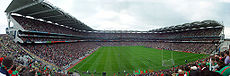 The final game of the inter-county series is the All-Ireland Final
which takes place on the third Sunday of September at Croke Park
.
Over the four Sundays of September, All-Ireland Finals in men's football, women's football, hurling and camogie take place in Croke Park
, the national stadium of the GAA, with the men's decider regularly attracting crowds of over 80,000. Guests who attend include the President of Ireland
, the Taoiseach
and leading dignitaries.
Two levels of the game are played at each All-Ireland, the Senior team and the Minor team (consisting of younger players, under the age of 18, who have played their own Minor All-Ireland competition).
The winning senior county football team receives the Sam Maguire cup
. The most successful county in the history of football is Kerry
, with 36 All-Ireland wins, followed by Dublin
, with 23 wins.
Football
Football may refer to one of a number of team sports which all involve, to varying degrees, kicking a ball with the foot to score a goal. The most popular of these sports worldwide is association football, more commonly known as just "football" or "soccer"...
played mainly in Ireland
Ireland
Ireland is an island to the northwest of continental Europe. It is the third-largest island in Europe and the twentieth-largest island on Earth...
. It is, together with hurling
Hurling
Hurling is an outdoor team game of ancient Gaelic origin, administered by the Gaelic Athletic Association, and played with sticks called hurleys and a ball called a sliotar. Hurling is the national game of Ireland. The game has prehistoric origins, has been played for at least 3,000 years, and...
, one of the two most popular spectator sports in the Republic of Ireland
Republic of Ireland
Ireland , described as the Republic of Ireland , is a sovereign state in Europe occupying approximately five-sixths of the island of the same name. Its capital is Dublin. Ireland, which had a population of 4.58 million in 2011, is a constitutional republic governed as a parliamentary democracy,...
.
Gaelic football is played by teams of 15 on a rectangular grass pitch with H-shaped goals at each end. The primary object is to score by kicking or striking the ball with the hand and getting it through the goals. The team with the highest score at the end of the match wins. Players advance the ball up the field with a combination of carrying, soloing (dropping and then toe-kicking the ball upward into the hands), kicking, and hand-passing to their team-mates.
Statistics show the game drawing significantly more spectators than any other sport in the Republic of Ireland
Republic of Ireland
Ireland , described as the Republic of Ireland , is a sovereign state in Europe occupying approximately five-sixths of the island of the same name. Its capital is Dublin. Ireland, which had a population of 4.58 million in 2011, is a constitutional republic governed as a parliamentary democracy,...
recently; 2005 ESRI
Economic and Social Research Institute
The Economic and Social Research Institute is a think tank in Dublin, Ireland. Its research focuses on Ireland's economic and social development in order to inform policy-making and societal understanding....
figures indicate that it draws 34% of total attendances at sports events in Ireland, with the closest rival, hurling
Hurling
Hurling is an outdoor team game of ancient Gaelic origin, administered by the Gaelic Athletic Association, and played with sticks called hurleys and a ball called a sliotar. Hurling is the national game of Ireland. The game has prehistoric origins, has been played for at least 3,000 years, and...
drawing 23%.
Football is one of four Gaelic games
Gaelic games
Gaelic games are sports played in Ireland under the auspices of the Gaelic Athletic Association. The two main games are Gaelic football and hurling...
run by the Gaelic Athletic Association
Gaelic Athletic Association
The Gaelic Athletic Association is an amateur Irish and international cultural and sporting organisation focused primarily on promoting Gaelic games, which include the traditional Irish sports of hurling, camogie, Gaelic football, handball and rounders...
, the largest sporting organisation in Ireland with more than 800,000 members. It has strict rules on player amateurism
Amateur
An amateur is generally considered a person attached to a particular pursuit, study, or science, without pay and often without formal training....
and the pinnacle of the sport is the inter-county All-Ireland Football Final. The game is believed to have descended from ancient Irish football known as caid
Caid (sport)
Caid is the name given to various ancient and traditional Irish football games. "Caid" is now used by people in some parts of Ireland to refer to modern Gaelic football.The word caid originally referred to the ball which was used...
which dates back to medieval times, although the modern rules were not set down until 1886.
Gaelic football is also played in countries outside Ireland, often although not solely played by members of the Irish diaspora
Irish diaspora
thumb|Night Train with Reaper by London Irish artist [[Brian Whelan]] from the book Myth of Return, 2007The Irish diaspora consists of Irish emigrants and their descendants in countries such as the United Kingdom, the United States, Canada, Australia, Argentina, New Zealand, Mexico, South Africa,...
. It is increasing in popularity internationally. Teams from both London
London GAA
The London County Board of the Gaelic Athletic Association or London GAA is one of the county boards outside Ireland, and is responsible for Gaelic games in London...
and New York
New York GAA
The New York County Board of the Gaelic Athletic Association , or New York GAA, is one of the county boards of the Gaelic Athletic Association outside Ireland, and is responsible for Gaelic games in the New York metropolitan area...
compete in the annual All-Ireland Senior Football Championship
All-Ireland Senior Football Championship
The All-Ireland Senior Football Championship, the premier competition in Gaelic football, is a series of games organised by the Gaelic Athletic Association and played during the summer and early autumn...
, the highest level of the game.
International rules football
International rules football
International rules football is a team sport consisting of a hybrid of football codes, which was developed to facilitate international representative matches between Australian rules football players and Gaelic football players....
, a hybrid
Hybrid sports
A hybrid sport is one which combines two or more sports in order to create a new sport, or to allow meaningful competition between players of those sports....
of Gaelic football and Australian rules football
Australian rules football
Australian rules football, officially known as Australian football, also called football, Aussie rules or footy is a sport played between two teams of 22 players on either...
, facilitates matches between Gaelic footballers and Australian-rules footballers. International rules is most prominently used for international representative matches
International Rules Series
The International Rules Series is a senior men's International rules football competition between the Australia international rules football team and the Ireland international rules football team...
between Ireland
Ireland international rules football team
The Ireland International rules football team is the representative team for Ireland in international rules football, a compromise between Gaelic football and Australian rules football...
and Australia
Australia international rules football team
This article concerns the men's team; for information on the Australian women's team, see Australia women's international rules football team....
.
Playing field
Rugby football
Rugby football is a style of football named after Rugby School in the United Kingdom. It is seen most prominently in two current sports, rugby league and rugby union.-History:...
pitch but larger. The grass pitch is rectangular, stretching 130–145 meters long and 80–90 meters wide. There are H-shaped goalposts at each end, formed by two posts, which are usually 7 m high, set 6.5 m apart, and connected 2.5 m above the ground by a crossbar. A net extending in back of the goal is attached to the crossbar and lower goal posts. The same pitch is used for hurling
Hurling
Hurling is an outdoor team game of ancient Gaelic origin, administered by the Gaelic Athletic Association, and played with sticks called hurleys and a ball called a sliotar. Hurling is the national game of Ireland. The game has prehistoric origins, has been played for at least 3,000 years, and...
; the GAA, which organizes both sports, decided this to facilitate dual usage. Lines are marked at distances of 13 m, 20m and 45 m from each end-line. Shorter pitches and smaller goals are used by youth teams.
Duration
The majority of adult football and all minor and under-21 matches last for 60 minutes, divided into two halves of 30 minutes, with the exception of senior inter-county games which last for 70 minutes (two halves of 35 minutes). Draws are decided by replays or by playing 20 minutes of extra time (two halves of 10 minutes). The under-12s have a half of 20 minutes or 25 minutes in some cases. Half-time lasts for about 15 minutes.Teams
Teams consist of fifteen players (a goalkeeper, two corner backs, a full back, two wing backs,a centre back, two mid fielders, two wing forwards, a centre forward, two corner forwards and a full forward) plus up to fifteen substitutes, of which five may be used. Each player is numbered 1–15, starting with the goalkeeperGoalkeeper
In many team sports which involve scoring goals, a goalkeeper is a designated player charged with directly preventing the opposing team from scoring by intercepting shots at goal...
, who must wear a jersey colour different from that of his or her teammates.
Ball
The game is played with a round leather footballFootball (ball)
A football is an inflated ball used to play one of the various sports known as football.The first balls were made of natural materials, such as an inflated pig bladder, sometimes inside a leather cover...
made of 18 stitched leather panels, similar in appearance to a traditional volleyball
Volleyball (ball)
A volleyball is a ball used to play indoor volleyball, beach volleyball, or other less common variations of the sport. Volleyballs are round and traditionally consist of eighteen nearly rectangular panels of synthetic or genuine leather, arranged in six identical sections of three panels each,...
, with a circumference of 69-74cm
CM
- Places :* Cameroon, which has the ISO and FIPS country code "CM"** .cm, the country code top-level domain for Cameroon* Chelmsford, which has the British post code "CM"- Science :* Centimetre a unit of length equal to one hundredth of a metre...
(27-29'), weighing between 370-425g (13-15 oz) when dry. It may be kicked or hand passed. A hand pass is not a punch but rather a strike of the ball with the side of the closed fist, using the knuckle of the thumb.
Technical fouls
The following are considered technical fouls ("fouling the ball"):- Bouncing the ball twice in a row (It may be soloed continuously)
- Changing hands: Throwing the ball from your right-hand to left or vice-versa (legal in the ladies' game)
- Going four steps without releasing, bouncing or soloing the ball (soloing involves kicking the ball into one's own hands)
- Hand passing a goal (the ball may be punched into the goal from up in the air, however)
- Picking the ball directly off the ground (it must be scooped up into the hands by the foot), however in ladies' Gaelic football the ball may be picked up directly
- Square ball is an often controversial rule: If, at the moment the ball enters the small square, there is already an attacking player inside the small rectangle, then a free out is awarded*
- Throwing the ball (it may be "hand-passed" by striking with the fist)
Scoring
If the ball goes over the crossbar, a point is scored and a white flag is raised by an umpire. A Point can be scored by either kicking the ball over the crossbar, or by fisting it over in which case the hand must be closed whilst striking the ball. If the ball goes below the crossbar, a goal, worth three points, is scored, and a green flag is raised by an umpire. A goal can only be scored by kicking the ball into the net, you cannot fist pass the ball into the net. However, a player can strike the ball into the net with a closed fist if the ball was played to him by another player or came in contact with the post/crossbar/ground prior to connection. The goal is guarded by a goalkeeper. Scores are recorded in the format Goal Total-Point Total. To determine the score-line goals must be converted to points and added to the other points. For example, in a match with a final score of Team A 0-21 Team B 4-8, Team A is the winner with 21 points, as Team B scored only 20 points (4 times 3, plus 8).Tackling
The level of tackling allowed is more robust than in association football, but less than rugbyRugby football
Rugby football is a style of football named after Rugby School in the United Kingdom. It is seen most prominently in two current sports, rugby league and rugby union.-History:...
.
Shoulder to shoulder contact and slapping the ball out of an opponent's hand are permitted, but the following are all fouls:
- Blocking a shot with the foot
- Pulling an opponent's jersey
- Pushing an opponent
- Sliding tackles
- Striking an opponent
- Touching the goalkeeper when he/she is inside the small rectangle
- Tripping
- Using both hands to tackle
- Wrestling the ball from an opponent's hands
Restarting play
- A match begins with the refereeRefereeA referee is the person of authority, in a variety of sports, who is responsible for presiding over the game from a neutral point of view and making on the fly decisions that enforce the rules of the sport...
throwing the ball up between the four mid fielders. - After an attacker has put the ball wide of the goals, scored a point or a goal, the goalkeeper may take a kick out from the ground at the 13m line. All players must be beyond the 20m line.
- After a defender has put the ball wide of the goals, an attacker may take a "45" from the ground on the 45m line, level with where the ball went wide.
- After a player has put the ball over the sideline, the other team may take a sideline kick at the point where the ball left the pitch. It may be kicked from the ground or the hands. The player who is taking the sideline kick must not pass the boundary line while taking.
- After a player has committed a foul, the other team may take a free kick (usually shortened to "free" in reports/commentaries) at the point where the foul was committed. It may be kicked from the ground or the hands.
- If a player has been fouled while passing the ball, the free may be taken from the point where the ball landed.
- After a defender has committed a foul inside the large rectangle, the other team may take a penalty kick from the ground from the center of the 11m line. Only the goalkeeper may guard the goals.
- If many players are struggling for the ball and it is not clear who was fouled first, the referee may choose to throw the ball up between two opposing players.
Officials
A football match is overseen by eight officials:- The referee
- Two linesmen
- Sideline official/Standby linesman (inter-county games only)
- Four umpires (two at each end)
The referee is responsible for starting and stopping play, recording the score, awarding frees and booking and sending off players.
Linesmen are responsible for indicating the direction of line balls to the referee.
The fourth official is responsible for overseeing substitutions, and also indicating the amount of stoppage time (signaled to him by the referee) and the players substituted using an electronic board.
The umpires are responsible for judging the scoring. They indicate to the referee whether a shot was: wide (spread both arms), a 45 m kick (raise one arm), a point (wave white flag), square ball (cross arms) or a goal (wave green flag). A disallowed score is indicated by crossing the green and white flags.
Contrary to popular belief within the association, all officials are not obliged to indicate "any misdemeanours" to the referee, but are in fact only permitted to inform the referee of violent conduct they have witnessed which has occurred without the referee's knowledge. A linesman/umpire is not permitted to inform the referee of technical fouls such as a "double bounce" or an illegal pick up of the ball. Such decisions can only be made at the discretion of the referee.
History
Gaelic football was first codified in 1887, although it has links to older varieties of footballFootball
Football may refer to one of a number of team sports which all involve, to varying degrees, kicking a ball with the foot to score a goal. The most popular of these sports worldwide is association football, more commonly known as just "football" or "soccer"...
played in Ireland and known collectively as caid
Caid (sport)
Caid is the name given to various ancient and traditional Irish football games. "Caid" is now used by people in some parts of Ireland to refer to modern Gaelic football.The word caid originally referred to the ball which was used...
. Consequently, the name caid is used by some people to refer to present day Gaelic football.
The first record of any form of football being played in Ireland
Ireland
Ireland is an island to the northwest of continental Europe. It is the third-largest island in Europe and the twentieth-largest island on Earth...
comes from 1308, when John McCrocan, a spectator at a football game at Newcastle, County Dublin
County Dublin
County Dublin is a county in Ireland. It is part of the Dublin Region and is also located in the province of Leinster. It is named after the city of Dublin which is the capital of Ireland. County Dublin was one of the first of the parts of Ireland to be shired by King John of England following the...
was charged with accidentally stabbing a player named William Bernard.
The Statute of Galway
Galway
Galway or City of Galway is a city in County Galway, Republic of Ireland. It is the sixth largest and the fastest-growing city in Ireland. It is also the third largest city within the Republic and the only city in the Province of Connacht. Located on the west coast of Ireland, it sits on the...
of 1527 allowed the playing of "foot balle" and archery
Archery
Archery is the art, practice, or skill of propelling arrows with the use of a bow, from Latin arcus. Archery has historically been used for hunting and combat; in modern times, however, its main use is that of a recreational activity...
but banned "'hokie' — the hurling
Hurling
Hurling is an outdoor team game of ancient Gaelic origin, administered by the Gaelic Athletic Association, and played with sticks called hurleys and a ball called a sliotar. Hurling is the national game of Ireland. The game has prehistoric origins, has been played for at least 3,000 years, and...
of a little ball with sticks or staves" as well as other sports.
By the 17th century, the situation had changed considerably. The games had grown in popularity and were widely played. This was due to the patronage of the gentry. Now instead of opposing the games it was the gentry and the ruling class who were serving as patrons of the games. Games were organised between landlords with each team comprising 20 or more tenants. Wagers were commonplace with purses of up to 100 guineas
Guinea (British coin)
The guinea is a coin that was minted in the Kingdom of England and later in the Kingdom of Great Britain and the United Kingdom between 1663 and 1813...
(Prior, 1997).
The earliest record of a recognized precursor to the modern game date from a match in County Meath in 1670, in which catching and kicking the ball was permitted.
However even "foot-ball" was banned by the severe Sunday Observance Act of 1695, which imposed a fine of one shilling
Shilling
The shilling is a unit of currency used in some current and former British Commonwealth countries. The word shilling comes from scilling, an accounting term that dates back to Anglo-Saxon times where it was deemed to be the value of a cow in Kent or a sheep elsewhere. The word is thought to derive...
(a substantial amount at the time) for those caught playing sports. It proved difficult, if not impossible, for the authorities to enforce the Act and the earliest recorded inter-county match in Ireland was one between Louth
County Louth
County Louth is a county of Ireland. It is part of the Border Region and is also located in the province of Leinster. It is named after the town of Louth. Louth County Council is the local authority for the county...
and Meath
County Meath
County Meath is a county in Ireland. It is part of the Mid-East Region and is also located in the province of Leinster. It is named after the ancient Kingdom of Mide . Meath County Council is the local authority for the county...
, at Slane
Slane
Slane is a village in County Meath, in Ireland. The village stands on a steep hillside on the left bank of the River Boyne at the intersection of the N2 and the N51 . In 2006 Slane's population was 1,099, having grown from 823 in 2002. The population of the village and the surrounding rural area...
, in 1712.
A six-a-side version was played in Dublin in the early 18th century, and 100 years later there were accounts of games played between County sides (Prior, 1997).
By the early 19th century, various football games, referred to collectively as caid, were popular in Kerry
County Kerry
Kerry means the "people of Ciar" which was the name of the pre-Gaelic tribe who lived in part of the present county. The legendary founder of the tribe was Ciar, son of Fergus mac Róich. In Old Irish "Ciar" meant black or dark brown, and the word continues in use in modern Irish as an adjective...
, especially the Dingle Peninsula
Dingle Peninsula
The Dingle Peninsula is the northernmost of the major peninsulae in County Kerry. Its ends beyond the town of Dingle at Dunmore Head, the westernmost point of Ireland.-Name:...
. Father W. Ferris described two forms of caid: the "field game" in which the object was to put the ball through arch-like goals, formed from the boughs of two trees, and; the epic "cross-country game" which lasted the whole of a Sunday (after mass) and was won by taking the ball across a parish
Parish
A parish is a territorial unit historically under the pastoral care and clerical jurisdiction of one parish priest, who might be assisted in his pastoral duties by a curate or curates - also priests but not the parish priest - from a more or less central parish church with its associated organization...
boundary. "Wrestling", "holding" opposing players, and carrying the ball were all allowed.
During the 1860s and 1870s, Rugby football
Rugby football
Rugby football is a style of football named after Rugby School in the United Kingdom. It is seen most prominently in two current sports, rugby league and rugby union.-History:...
started to become popular in Ireland. Trinity College, Dublin
Trinity College, Dublin
Trinity College, Dublin , formally known as the College of the Holy and Undivided Trinity of Queen Elizabeth near Dublin, was founded in 1592 by letters patent from Queen Elizabeth I as the "mother of a university", Extracts from Letters Patent of Elizabeth I, 1592: "...we...found and...
was an early stronghold of Rugby, and the rules of the (English) Football Association were codified in 1863 and distributed widely. By this time, according to Gaelic football historian Jack Mahon, even in the Irish countryside, caid had begun to give way to a "rough-and-tumble game" which even allowed tripping. Association football
Football (soccer)
Association football, more commonly known as football or soccer, is a sport played between two teams of eleven players with a spherical ball...
started to take hold, especially in Ulster
Ulster
Ulster is one of the four provinces of Ireland, located in the north of the island. In ancient Ireland, it was one of the fifths ruled by a "king of over-kings" . Following the Norman invasion of Ireland, the ancient kingdoms were shired into a number of counties for administrative and judicial...
, in the 1880s.
Limerick was the stronghold of the native game around this time, and the Commercials Club, founded by employees of Cannock’s Drappery Store, was one of the first to impose a set of rules which was adapted by other clubs in the city. Of all the Irish pastimes the GAA set out to preserve and promote, it is fair to say that Gaelic football was in the worst shape at the time of the association’s foundation (GAA Museum, 2001).
Irish forms of football were not formally arranged into an organised playing code by the Gaelic Athletic Association
Gaelic Athletic Association
The Gaelic Athletic Association is an amateur Irish and international cultural and sporting organisation focused primarily on promoting Gaelic games, which include the traditional Irish sports of hurling, camogie, Gaelic football, handball and rounders...
(GAA) until 1887. The GAA sought to promote traditional Irish sports, such as hurling
Hurling
Hurling is an outdoor team game of ancient Gaelic origin, administered by the Gaelic Athletic Association, and played with sticks called hurleys and a ball called a sliotar. Hurling is the national game of Ireland. The game has prehistoric origins, has been played for at least 3,000 years, and...
and to reject "foreign" (particularly English) imports. The first Gaelic football rules, showing the influence of hurling and a desire to differentiate from association football — for example in their lack of an offside rule — were drawn up by Maurice Davin
Maurice Davin
Maurice Davin was an Irish farmer who became co-founder of the Gaelic Athletic Association. He was also the first President of the GAA and the only man ever to serve two terms as president.He was born in Carrick-on-Suir, County Tipperary...
and published in the United Ireland magazine on February 7, 1887. The rules of the aforementioned Commercials Club became the basis for these official (Gaelic Football) rules who, unsurprisingly, won the inaugural All-Ireland Senior Football Final (representing County Limerick)
On Bloody Sunday in 1920
Bloody Sunday (1920)
Bloody Sunday was a day of violence in Dublin on 21 November 1920, during the Irish War of Independence. In total, 31 people were killed – fourteen British, fourteen Irish civilians and three republican prisoners....
, during the Anglo-Irish War, a football match at Croke Park
Croke Park
Croke Park in Dublin is the principal stadium and headquarters of the Gaelic Athletic Association , Ireland's biggest sporting organisation...
was attacked by British
Black and Tans
The Black and Tans was one of two newly recruited bodies, composed largely of British World War I veterans, employed by the Royal Irish Constabulary as Temporary Constables from 1920 to 1921 to suppress revolution in Ireland...
forces. 14 people were killed and 65 were injured. Among the dead was Tipperary footballer Michael Hogan, for whom the Hogan Stand at Croke Park (completed in 1924) was named.
Ladies' Gaelic football
Ladies' Gaelic football
Ladies' Gaelic football is a team sport for women, very similar to Gaelic football, and co-ordinated by the Ladies' Gaelic Football Association...
has become increasingly popular with women since the 1970s.
The relationship between Gaelic football and Australian rules football
Relationship between Gaelic football and Australian rules football
The relationship between Gaelic and Australian football is the subject of a controversy among historians. The question of whether the two codes of football, from Ireland and Australia respectively, have shared origins arises because it is clear even to casual observers that the two games are similar...
and the question of whether they have shared origins is a matter of historical controversy. Games are held between an Irish representative team and an Australian team, under compromise rules known as International rules football
International rules football
International rules football is a team sport consisting of a hybrid of football codes, which was developed to facilitate international representative matches between Australian rules football players and Gaelic football players....
.
The current President of the GAA is Christy Cooney of Youghal, County Cork.
Team of the Millennium
This was a team chosen in 1999 by a panel of GAA past presidents and journalists. The goal was to single out the best ever 15 players who had played the game in their respective positions, since the foundation of the GAA in 1884 up to the MillenniumMillennium
A millennium is a period of time equal to one thousand years —from the Latin phrase , thousand, and , year—often but not necessarily related numerically to a particular dating system....
year, 2000. Naturally many of the selections were hotly debated by fans around the country.
| Goalkeeper | |||
| Dan O'Keeffe (Kerry Kerry GAA The Kerry County Board of the Gaelic Athletic Association is one of the 32 county boards of the GAA in Ireland, and is responsible for Gaelic games in County Kerry... ) |
|||
| Right Corner Back | Full Back | Left Corner Back | |
| Enda Colleran Enda Colleran Enda Colleran was an Irish Gaelic football manager and player. He played football with his local club Tuam Stars and was a member of the Galway senior inter-county team from 1961 until 1971. Colleran captained Galway to back-to-back All-Ireland titles in 1965 and 1966 and later served as manager... (Galway Galway GAA The Galway County Boards of the Gaelic Athletic Association or Galway GAA is one of the 32 county boards of the GAA in Ireland, and is responsible for Gaelic games in County Galway. The county boards are also responsible for the Galway inter-county teams.Unlike all other counties in Ireland,... ) |
Joe Keohane Joe Keohane (footballer) Joe Keohane was an Irish sportsperson. He played Gaelic football with his local club John Mitchels and was a member of the Kerry senior inter-county team from 1936 until 1949... (Kerry Kerry GAA The Kerry County Board of the Gaelic Athletic Association is one of the 32 county boards of the GAA in Ireland, and is responsible for Gaelic games in County Kerry... ) |
Seán Flanagan Seán Flanagan Seán Flanagan was an Fianna Fáil politician and Gaelic footballer in Ireland. He served under Taoiseach Jack Lynch as Minister for Health and Minister for Lands .-Early life and education:... (Mayo Mayo GAA The Mayo County Board of the Gaelic Athletic Association or Mayo GAA is one of the 32 county boards of the GAA in Ireland, and is responsible for Gaelic games in County Mayo and the Mayo inter-county teams.-History:... ) |
|
| Right Half Back | Centre Back | Left Half Back | |
| Sean Murphy Seán Murphy (footballer) Dr. Seán Murphy is a retired Irish sportsperson. He played Gaelic football with his local club Dingle and was a member of the Kerry senior inter-county team from 1953 until 1961. Murphy is regarded as one of the greatest players of all-time.-Football career:Born in County Kerry, Murphy played... (Kerry Kerry GAA The Kerry County Board of the Gaelic Athletic Association is one of the 32 county boards of the GAA in Ireland, and is responsible for Gaelic games in County Kerry... ) |
J. J. O'Reilly (Cavan Cavan GAA The Cavan County Board of the Gaelic Athletic Association or Cavan GAA is one of the 32 county boards of the GAA in Ireland, and is responsible for Gaelic games in County Cavan... ) |
Martin O'Connell Martin O'Connell (footballer) Martin O'Connell is an Irish retired sportsperson. He played Gaelic football with his local club St. Michael's and was a member of the Meath senior inter-county team from 1984 util 1997... (Meath Meath GAA The Meath County Board of the Gaelic Athletic Association or Meath GAA is one of the 32 county boards of the GAA in Ireland, and is responsible for Gaelic games in County Meath, as well as for Meath inter-county teams.- Pre-1960s :... ) |
|
| Midfield | |||
| Mick O'Connell (Kerry Kerry GAA The Kerry County Board of the Gaelic Athletic Association is one of the 32 county boards of the GAA in Ireland, and is responsible for Gaelic games in County Kerry... ) |
Tommy Murphy Tommy Murphy (Gaelic Footballer) Tommy Murphy was a famous Gaelic footballer for County Laois, Ireland.Tommy Murphy was born in Graiguecullen, County Laois in 1921. He was educated in the nearby Knockbeg College in Carlow. Murphy played for the Laois Minors when he was just 15 and came to prominence in 1937 when he played his... (Laois Laois GAA The Laois County Board of the Gaelic Athletic Association or Laois GAA is one of the 32 county boards of the GAA in Ireland, and is responsible for Gaelic games in County Laois and the Laois inter-county teams.-History:... ) |
||
| Right Half Forward | Centre Forward | Left Half Forward | |
| Seán O'Neill Seán O'Neill Seán O'Neill is a retired Northern Irish sportsperson. He played Gaelic football with his local club John Mitchel and was a member of the Down senior inter-county team from the 1950s until the 1960s. O'Neill is one of only four Down players to win three All-Ireland titles... (Down Down GAA The Down County Board of the Gaelic Athletic Association or Down GAA is one of the 32 county boards of the GAA in Ireland, and is responsible for Gaelic games in County Down... ) |
Sean Purcell Seán Purcell Seán Purcell , nicknamed "The Master", was a famous Gaelic footballer for County Galway.Best known as a centre half forward, his versatility saw him used in virtually all outfield positions throughout an illustrious career. He was recognised by many football enthusiasts as one of the greatest... (Galway Galway GAA The Galway County Boards of the Gaelic Athletic Association or Galway GAA is one of the 32 county boards of the GAA in Ireland, and is responsible for Gaelic games in County Galway. The county boards are also responsible for the Galway inter-county teams.Unlike all other counties in Ireland,... ) |
Pat Spillane Pat Spillane Patrick Gerard Spillane , better known as Pat Spillane, is a retired Gaelic footballer and well known Irish sports pundit. He played Gaelic football with his local club Templenoe and was a member of the Kerry senior inter-county team from 1975 until 1991... (Kerry Kerry GAA The Kerry County Board of the Gaelic Athletic Association is one of the 32 county boards of the GAA in Ireland, and is responsible for Gaelic games in County Kerry... ) |
|
| Right Corner Forward | Full Forward | Left Corner Forward | |
| Mikey Sheehy Mikey Sheehy Mikey Sheehy is a retired Irish sportsperson. He played Gaelic football with his local club Austin Stacks and was a member of the Kerry senior inter-county team from 1974 until 1987. Sheehy is regarded as one of the greatest players of all-time.-Club:Sheehy played his club football with the... (Kerry Kerry GAA The Kerry County Board of the Gaelic Athletic Association is one of the 32 county boards of the GAA in Ireland, and is responsible for Gaelic games in County Kerry... ) |
Tommy Langan Tommy Langan Tommy Langan was an Irish Gaelic footballer from County Mayo. He played for the Ballycastle club and the Mayo GAA county team.-Playing career:... (Mayo Mayo GAA The Mayo County Board of the Gaelic Athletic Association or Mayo GAA is one of the 32 county boards of the GAA in Ireland, and is responsible for Gaelic games in County Mayo and the Mayo inter-county teams.-History:... ) |
Kevin Heffernan Kevin Heffernan (Gaelic footballer) -See also :* List of people on stamps of Ireland*Dublin GAA*Dublin GAA Honours*Dublin Senior Club Football Championship... (Dublin Dublin GAA Dublin County Board of the Gaelic Athletic Association , or Dublin GAA, is one of the 32 county boards of the GAA in Ireland, and is responsible for Gaelic games in County Dublin. The county board is also responsible for the Dublin inter-county teams... ) |
Leagues and team structure
All Gaelic sports are amateurAmateur
An amateur is generally considered a person attached to a particular pursuit, study, or science, without pay and often without formal training....
; easing the strictness with which this is interpreted is advocated by the Gaelic Players Association
Gaelic Players Association
The Gaelic Players Association The GPA was formed in 1999 when former IMG employee Donal O'Neill and a number of high profile inter-county players including Tyrone's Fergal Logan and Peter Canavan, Derry's Fergal McCusker and Dublin's Dessie Farrell were instrumental in the birth of the organisation...
. The basic unit of each game is organised at the club level, which is usually arranged on a parish
Parish (subnational entity)
A parish is an administrative division used by several countries. In the British Isles it is known as a civil parish to distinguish it from the ecclesiastical parish.-External links:* Editorial in The Guardian, 2011-05-16....
basis, with various local clubs playing to win the County Championship at various levels:
| Name | Description |
|---|---|
| Senior | the better adult clubs |
| Intermediate | clubs between Senior and Junior levels |
| Junior | weaker adult clubs, from small communities |
| Under-21 | under 21 |
| Minor | under 18 |
| Under-age | all ages from under-17 down to under-6 |
On a national level, the GAA county
GAA county
A Gaelic Athletic Association county is a geographic region within the Gaelic Athletic Association , controlled by a county board and originally based on the counties of Ireland as they were in 1884. While the counties of Ireland have changed since the foundation of that date, the GAA counties have...
is organised on the old Irish county system, producing 34 teams representing the original 32 counties that cover the island of Ireland, plus teams representing the Irish diaspora
Irish diaspora
thumb|Night Train with Reaper by London Irish artist [[Brian Whelan]] from the book Myth of Return, 2007The Irish diaspora consists of Irish emigrants and their descendants in countries such as the United Kingdom, the United States, Canada, Australia, Argentina, New Zealand, Mexico, South Africa,...
in London
London GAA
The London County Board of the Gaelic Athletic Association or London GAA is one of the county boards outside Ireland, and is responsible for Gaelic games in London...
and New York
New York GAA
The New York County Board of the Gaelic Athletic Association , or New York GAA, is one of the county boards of the Gaelic Athletic Association outside Ireland, and is responsible for Gaelic games in the New York metropolitan area...
. There are also clubs in other parts of the USA
North American GAA
The North American County Board of the Gaelic Athletic Association or North American GAA is one of the boards of the GAA outside Ireland, and is responsible for Gaelic games in the United States of America, excluding the New York metropolitan region, which is under the control of the New York GAA...
, Britain
British GAA
The British Council of the Gaelic Athletic Association or British GAA is the only provincial council of the Gaelic Athletic Association outside Ireland, and is responsible for Gaelic games in Great Britain...
, Asia
Asian GAA
The Asian County Board of the Gaelic Athletic Association , or Asian GAA is one of the county boards of the GAA outside Ireland, and is responsible for Gaelic games across Asia-Pacific & Gulf Regions other than Australia and New Zealand which are under the auspices of Australasia County board...
, Australasia
Australasia GAA
The Australasia County Board of the Gaelic Athletic Association , or Australasian GAA, or Gaelic Football & Hurling Association of Australasia is one of the county boards of the GAA outside Ireland, and is responsible for Gaelic games all across Australasia. It is also responsible for Australasian...
, continental Europe
Europe GAA
The European Board of the Gaelic Athletic Association or Europe GAA is one of the boards of the GAA outside Ireland, and is responsible for organizaning Gaelic Games in continental Europe...
and Canada
Canada GAA
The Canadian County Board of the Gaelic Athletic Association , or Canada GAA, is one of the county boards of the GAA outside Ireland, and is responsible for Gaelic games all across Canada. The county board is also responsible for Canadian inter county teams-History:Gaelic games have been played...
.
Though Ireland was partitioned between two states in 1920, Gaelic sports (like most cultural organisations and all religions) continue to be organized on an All-Ireland basis.
A team of 15 players plus substitutes is formed from the best players playing at club level.
Nearly all counties play against each other in a knock-out tournament known as the All Ireland Championship.
These modified knock-out games are organised on the four Irish provinces of Ulster
Ulster GAA
The Ulster Council is a Provincial council of the Gaelic Athletic Association sports of hurling, Gaelic football, camogie, and handball in the province of Ulster. The headquarters of the Ulster GAA is based in Armagh City....
, Munster
Munster GAA
The Munster Council is a Provincial council of the Gaelic Athletic Association sports of hurling, Gaelic football, camogie, rounders and handball in the province of Munster.-Constituent counties:*Cork*Clare*Kerry*Limerick*Tipperary*Waterford-Honours:...
, Leinster
Leinster GAA
The Leinster Council is a Provincial council of the Gaelic Athletic Association sports of hurling, Gaelic football, camogie, rounders and handball in the province of Leinster. The Leinster Council has been partnered with the European County Board to help develop Gaelic Games in Europe...
and Connacht
Connacht GAA
The Connacht Council are a Provincial council of the Gaelic Athletic Association sports of hurling, Gaelic football, camogie, rounders and handball in the province of Connacht.-Constituent counties:*Galway*Leitrim*Mayo*Roscommon*Sligo-Special counties:...
.
In the past, the best team from each would play one of the others, at a stage known as the All-Ireland semi-finals, with the winning team from each game playing each other in the All-Ireland Final
All-Ireland Senior Football Championship
The All-Ireland Senior Football Championship, the premier competition in Gaelic football, is a series of games organised by the Gaelic Athletic Association and played during the summer and early autumn...
.
A recent re-organisation now provides a 'back door' method of qualifying, with knocked out teams getting another chance to win back into the competition. This means that one team may defeat another team in an early stage of the championship, yet be defeated and knocked out of the tournament by the same team at a later stage.
County teams also compete in the National Football League, held every spring. The League is not as prestigious as the All-Ireland, but in recent years attendances have grown and interest, from the public and from players, has grown. This is due in part to the organisation of the league into the above format, the provision of the Division 2 final stages and the relatively new change of starting the league in February rather than November. Live matches are shown on the Irish-language TV station TG4 and also Setanta Ireland, with highlights shown on RTÉ2.
All-Ireland Final
All-Ireland Senior Football Championship
The All-Ireland Senior Football Championship, the premier competition in Gaelic football, is a series of games organised by the Gaelic Athletic Association and played during the summer and early autumn...
which takes place on the third Sunday of September at Croke Park
Croke Park
Croke Park in Dublin is the principal stadium and headquarters of the Gaelic Athletic Association , Ireland's biggest sporting organisation...
.
Over the four Sundays of September, All-Ireland Finals in men's football, women's football, hurling and camogie take place in Croke Park
Croke Park
Croke Park in Dublin is the principal stadium and headquarters of the Gaelic Athletic Association , Ireland's biggest sporting organisation...
, the national stadium of the GAA, with the men's decider regularly attracting crowds of over 80,000. Guests who attend include the President of Ireland
President of Ireland
The President of Ireland is the head of state of Ireland. The President is usually directly elected by the people for seven years, and can be elected for a maximum of two terms. The presidency is largely a ceremonial office, but the President does exercise certain limited powers with absolute...
, the Taoiseach
Taoiseach
The Taoiseach is the head of government or prime minister of Ireland. The Taoiseach is appointed by the President upon the nomination of Dáil Éireann, the lower house of the Oireachtas , and must, in order to remain in office, retain the support of a majority in the Dáil.The current Taoiseach is...
and leading dignitaries.
Two levels of the game are played at each All-Ireland, the Senior team and the Minor team (consisting of younger players, under the age of 18, who have played their own Minor All-Ireland competition).
The winning senior county football team receives the Sam Maguire cup
Sam Maguire Cup
The Sam Maguire Cup, often called The Sam , is the name of the cup that is awarded to winners of the All-Ireland Senior Football Championship, the premier "knockout" competition in the game of Gaelic football played in Ireland...
. The most successful county in the history of football is Kerry
Kerry GAA
The Kerry County Board of the Gaelic Athletic Association is one of the 32 county boards of the GAA in Ireland, and is responsible for Gaelic games in County Kerry...
, with 36 All-Ireland wins, followed by Dublin
Dublin GAA
Dublin County Board of the Gaelic Athletic Association , or Dublin GAA, is one of the 32 county boards of the GAA in Ireland, and is responsible for Gaelic games in County Dublin. The county board is also responsible for the Dublin inter-county teams...
, with 23 wins.
See also
- All-Ireland Senior Football ChampionshipAll-Ireland Senior Football ChampionshipThe All-Ireland Senior Football Championship, the premier competition in Gaelic football, is a series of games organised by the Gaelic Athletic Association and played during the summer and early autumn...
- All-Ireland Sevens FootballAll-Ireland Sevens FootballAll-Ireland Sevens Football Competitions are Seven-a-side national inter-club Gaelic Football tournaments held at senior, intermediate and Junior level at the Kilmacud Sevens,Ratoath Sevens and St. Judes Sevens respectively...
- Ladies' Gaelic footballLadies' Gaelic footballLadies' Gaelic football is a team sport for women, very similar to Gaelic football, and co-ordinated by the Ladies' Gaelic Football Association...
- List of footballers (Gaelic football)
- List of Gaelic football clubs
- Sport in IrelandSport in IrelandIn Ireland many sports, such as boxing, hockey, rowing, cricket, rugby union, Gaelic football and hurling, are organised in an all-island basis, with a single team representing the whole of Ireland in international competitions...