


Gluon

Encyclopedia
Gluons (ˈɡluːɒnz; ) are elementary particle
s which act as the exchange particles (or gauge boson
s) for the color force between quark
s, analogous to the exchange of photon
s in the electromagnetic force between two charged particle
s.
Since quarks make up the baryon
s, and the strong interaction
takes place between baryons, one could say that the color force is the source of the strong interaction, or that the strong interaction is like a residual color force which extends beyond the baryons, for example when proton
s and neutron
s are bound together in a nucleus
.
In technical terms, they are vector
gauge boson
s that mediate strong interaction
s of quark
s in quantum chromodynamics
(QCD). Unlike the electrically neutral
photon
of quantum electrodynamics
(QED), gluons themselves carry color charge
and therefore participate in the strong interaction in addition to mediating it, making QCD significantly harder to analyze than QED.
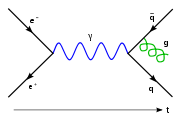 The gluon is a vector boson; like the photon
, it has a spin
of 1 (see Ellis–Karliner angle). While massive spin-1 particles have three polarization states, massless gauge bosons like the gluon have only two polarization states because gauge invariance requires the polarization to be transverse. In quantum field theory
, unbroken gauge invariance requires that gauge bosons have zero mass (experiment limits the gluon's mass to less than a few MeV/c2). The gluon has negative intrinsic parity
.
of QED or the three W and Z bosons
of the weak interaction
, there are eight independent types of gluon in QCD.
This may be difficult to understand intuitively. Quark
s carry three types of color charge
; antiquarks carry three types of anticolor. Gluons may be thought of as carrying both color and anticolor, but to correctly understand how they are combined, it is necessary to consider the mathematics of color charge in more detail.
, the states of particles may be added according to the principle of superposition
; that is, they may be in a "combined state" with a probability, if some particular quantity is measured, of giving several different outcomes. A relevant illustration in the case at hand would be a gluon with a color state described by:

This is read as "red–antiblue plus blue–antired". (The factor of the square root of two is required for normalization, a detail which is not crucial to understand in this discussion.) If one were somehow able to make a direct measurement of the color of a gluon in this state, there would be a 50% chance of it having red–antiblue color charge and a 50% chance of blue–antired color charge.
(Hadrons) observed in nature are "colorless", but more precisely they are in a "color singlet" state, which is mathematically analogous to a spin singlet state. Such states allow interaction with other color singlets, but not with other color states; because long-range gluon interactions do not exist, this illustrates that gluons in the singlet state do not exist either.
The color singlet state is:

In words, if one could measure the color of the state, there would be equal probabilities of it being red-antired, blue-antiblue, or green-antigreen.
These are equivalent to the Gell-Mann matrices
; the translation between the two is that red-antired is the upper-left matrix entry, red-antiblue is the left middle entry, blue-antigreen is the bottom middle entry, and so on. The critical feature of these particular eight states is that they are linearly independent, and also independent of the singlet state; there is no way to add any combination of states to produce any other. (It is also impossible to add them to make r, g, or b otherwise the forbidden singlet state could also be made.) There are many other possible choices, but all are mathematically equivalent, at least equally complex, and give the same physical results.
with SU(3) gauge symmetry. Quarks are introduced as spinor fields
in Nf flavor
s, each in the fundamental representation
(triplet, denoted 3) of the color gauge group, SU(3). The gluons are vector fields in the adjoint representation (octets, denoted 8) of color SU(3). For a general gauge group
, the number of force-carriers (like photons or gluons) is always equal to the dimension of the adjoint representation. For the simple case of SU(N), the dimension of this representation is .
In terms of group theory, the assertion that there are no color singlet gluons is simply the statement that quantum chromodynamics
has an SU(3) rather than a U(3) symmetry. There is no known a priori
reason for one group to be preferred over the other, but as discussed above, the experimental evidence supports SU(3).
s are confined within composite particles called hadron
s. This effectively limits the range of the strong interaction to meters, roughly the size of an atomic nucleus
. Beyond a certain distance, the energy of the flux tube binding two quarks increases linearly. At a large enough distance, it becomes energetically more favorable to pull a quark-antiquark pair out of the vacuum rather than increase the length of the flux tube.
Gluons also share this property of being confined within hadrons. One consequence is that gluons are not directly involved in the nuclear force
s between hadrons. The force mediators for these are other hadrons called meson
s.
Although in the normal phase of QCD single gluons may not travel freely, it is predicted that there exist hadron
s which are formed entirely of gluons — called glueball
s. There are also conjectures about other exotic hadron
s in which real gluons (as opposed to virtual
ones found in ordinary hadrons) would be primary constituents. Beyond the normal phase of QCD (at extreme temperatures and pressures), quark gluon plasma forms. In such a plasma there are no hadrons; quarks and gluons become free particles.
were observed at the electron-positron collider PETRA
. However, just before PETRA appeared on the scene, the PLUTO experiment at DORIS showed Y(9.46) decay event topologies very suggestive of a three-gluon decay.
By measuring the distribution of the Ellis–Karliner angle at the PETRA
electron–positron storage ring at DESY
, physicists determined that the gluon has spin
one rather than spin zero or spin two. Subsequent experiments at the LEP storage ring at CERN
confirmed this result.
Experimentally, confinement is verified by the failure of free quark searches. Free gluons have never been observed; however at Fermilab single production of top quarks has been statistically shown. Although there have been hints of exotic hadrons, no glueball has been observed either. Quark-gluon plasma
has been found recently at the Relativistic Heavy Ion Collider
(RHIC) at Brookhaven National Laboratory
(BNL).
Elementary particle
In particle physics, an elementary particle or fundamental particle is a particle not known to have substructure; that is, it is not known to be made up of smaller particles. If an elementary particle truly has no substructure, then it is one of the basic building blocks of the universe from which...
s which act as the exchange particles (or gauge boson
Gauge boson
In particle physics, gauge bosons are bosonic particles that act as carriers of the fundamental forces of nature. More specifically, elementary particles whose interactions are described by gauge theory exert forces on each other by the exchange of gauge bosons, usually as virtual particles.-...
s) for the color force between quark
Quark
A quark is an elementary particle and a fundamental constituent of matter. Quarks combine to form composite particles called hadrons, the most stable of which are protons and neutrons, the components of atomic nuclei. Due to a phenomenon known as color confinement, quarks are never directly...
s, analogous to the exchange of photon
Photon
In physics, a photon is an elementary particle, the quantum of the electromagnetic interaction and the basic unit of light and all other forms of electromagnetic radiation. It is also the force carrier for the electromagnetic force...
s in the electromagnetic force between two charged particle
Charged particle
In physics, a charged particle is a particle with an electric charge. It may be either a subatomic particle or an ion. A collection of charged particles, or even a gas containing a proportion of charged particles, is called a plasma, which is called the fourth state of matter because its...
s.
Since quarks make up the baryon
Baryon
A baryon is a composite particle made up of three quarks . Baryons and mesons belong to the hadron family, which are the quark-based particles...
s, and the strong interaction
Strong interaction
In particle physics, the strong interaction is one of the four fundamental interactions of nature, the others being electromagnetism, the weak interaction and gravitation. As with the other fundamental interactions, it is a non-contact force...
takes place between baryons, one could say that the color force is the source of the strong interaction, or that the strong interaction is like a residual color force which extends beyond the baryons, for example when proton
Proton
The proton is a subatomic particle with the symbol or and a positive electric charge of 1 elementary charge. One or more protons are present in the nucleus of each atom, along with neutrons. The number of protons in each atom is its atomic number....
s and neutron
Neutron
The neutron is a subatomic hadron particle which has the symbol or , no net electric charge and a mass slightly larger than that of a proton. With the exception of hydrogen, nuclei of atoms consist of protons and neutrons, which are therefore collectively referred to as nucleons. The number of...
s are bound together in a nucleus
Atomic nucleus
The nucleus is the very dense region consisting of protons and neutrons at the center of an atom. It was discovered in 1911, as a result of Ernest Rutherford's interpretation of the famous 1909 Rutherford experiment performed by Hans Geiger and Ernest Marsden, under the direction of Rutherford. The...
.
In technical terms, they are vector
Vector field
In vector calculus, a vector field is an assignmentof a vector to each point in a subset of Euclidean space. A vector field in the plane for instance can be visualized as an arrow, with a given magnitude and direction, attached to each point in the plane...
gauge boson
Gauge boson
In particle physics, gauge bosons are bosonic particles that act as carriers of the fundamental forces of nature. More specifically, elementary particles whose interactions are described by gauge theory exert forces on each other by the exchange of gauge bosons, usually as virtual particles.-...
s that mediate strong interaction
Strong interaction
In particle physics, the strong interaction is one of the four fundamental interactions of nature, the others being electromagnetism, the weak interaction and gravitation. As with the other fundamental interactions, it is a non-contact force...
s of quark
Quark
A quark is an elementary particle and a fundamental constituent of matter. Quarks combine to form composite particles called hadrons, the most stable of which are protons and neutrons, the components of atomic nuclei. Due to a phenomenon known as color confinement, quarks are never directly...
s in quantum chromodynamics
Quantum chromodynamics
In theoretical physics, quantum chromodynamics is a theory of the strong interaction , a fundamental force describing the interactions of the quarks and gluons making up hadrons . It is the study of the SU Yang–Mills theory of color-charged fermions...
(QCD). Unlike the electrically neutral
Electric charge
Electric charge is a physical property of matter that causes it to experience a force when near other electrically charged matter. Electric charge comes in two types, called positive and negative. Two positively charged substances, or objects, experience a mutual repulsive force, as do two...
photon
Photon
In physics, a photon is an elementary particle, the quantum of the electromagnetic interaction and the basic unit of light and all other forms of electromagnetic radiation. It is also the force carrier for the electromagnetic force...
of quantum electrodynamics
Quantum electrodynamics
Quantum electrodynamics is the relativistic quantum field theory of electrodynamics. In essence, it describes how light and matter interact and is the first theory where full agreement between quantum mechanics and special relativity is achieved...
(QED), gluons themselves carry color charge
Color charge
In particle physics, color charge is a property of quarks and gluons that is related to the particles' strong interactions in the theory of quantum chromodynamics . Color charge has analogies with the notion of electric charge of particles, but because of the mathematical complications of QCD,...
and therefore participate in the strong interaction in addition to mediating it, making QCD significantly harder to analyze than QED.
Properties
Photon
In physics, a photon is an elementary particle, the quantum of the electromagnetic interaction and the basic unit of light and all other forms of electromagnetic radiation. It is also the force carrier for the electromagnetic force...
, it has a spin
Spin (physics)
In quantum mechanics and particle physics, spin is a fundamental characteristic property of elementary particles, composite particles , and atomic nuclei.It is worth noting that the intrinsic property of subatomic particles called spin and discussed in this article, is related in some small ways,...
of 1 (see Ellis–Karliner angle). While massive spin-1 particles have three polarization states, massless gauge bosons like the gluon have only two polarization states because gauge invariance requires the polarization to be transverse. In quantum field theory
Quantum field theory
Quantum field theory provides a theoretical framework for constructing quantum mechanical models of systems classically parametrized by an infinite number of dynamical degrees of freedom, that is, fields and many-body systems. It is the natural and quantitative language of particle physics and...
, unbroken gauge invariance requires that gauge bosons have zero mass (experiment limits the gluon's mass to less than a few MeV/c2). The gluon has negative intrinsic parity
Parity (physics)
In physics, a parity transformation is the flip in the sign of one spatial coordinate. In three dimensions, it is also commonly described by the simultaneous flip in the sign of all three spatial coordinates:...
.
Numerology of gluons
Unlike the single photonPhoton
In physics, a photon is an elementary particle, the quantum of the electromagnetic interaction and the basic unit of light and all other forms of electromagnetic radiation. It is also the force carrier for the electromagnetic force...
of QED or the three W and Z bosons
W and Z bosons
The W and Z bosons are the elementary particles that mediate the weak interaction; their symbols are , and . The W bosons have a positive and negative electric charge of 1 elementary charge respectively and are each other's antiparticle. The Z boson is electrically neutral and its own...
of the weak interaction
Weak interaction
Weak interaction , is one of the four fundamental forces of nature, alongside the strong nuclear force, electromagnetism, and gravity. It is responsible for the radioactive decay of subatomic particles and initiates the process known as hydrogen fusion in stars...
, there are eight independent types of gluon in QCD.
This may be difficult to understand intuitively. Quark
Quark
A quark is an elementary particle and a fundamental constituent of matter. Quarks combine to form composite particles called hadrons, the most stable of which are protons and neutrons, the components of atomic nuclei. Due to a phenomenon known as color confinement, quarks are never directly...
s carry three types of color charge
Color charge
In particle physics, color charge is a property of quarks and gluons that is related to the particles' strong interactions in the theory of quantum chromodynamics . Color charge has analogies with the notion of electric charge of particles, but because of the mathematical complications of QCD,...
; antiquarks carry three types of anticolor. Gluons may be thought of as carrying both color and anticolor, but to correctly understand how they are combined, it is necessary to consider the mathematics of color charge in more detail.
Color charge and superposition
In quantum mechanicsQuantum mechanics
Quantum mechanics, also known as quantum physics or quantum theory, is a branch of physics providing a mathematical description of much of the dual particle-like and wave-like behavior and interactions of energy and matter. It departs from classical mechanics primarily at the atomic and subatomic...
, the states of particles may be added according to the principle of superposition
Quantum superposition
Quantum superposition is a fundamental principle of quantum mechanics. It holds that a physical system exists in all its particular, theoretically possible states simultaneously; but, when measured, it gives a result corresponding to only one of the possible configurations.Mathematically, it...
; that is, they may be in a "combined state" with a probability, if some particular quantity is measured, of giving several different outcomes. A relevant illustration in the case at hand would be a gluon with a color state described by:
This is read as "red–antiblue plus blue–antired". (The factor of the square root of two is required for normalization, a detail which is not crucial to understand in this discussion.) If one were somehow able to make a direct measurement of the color of a gluon in this state, there would be a 50% chance of it having red–antiblue color charge and a 50% chance of blue–antired color charge.
Color singlet states
It is often said that the stable strongly interacting particlesHadron
In particle physics, a hadron is a composite particle made of quarks held together by the strong force...
(Hadrons) observed in nature are "colorless", but more precisely they are in a "color singlet" state, which is mathematically analogous to a spin singlet state. Such states allow interaction with other color singlets, but not with other color states; because long-range gluon interactions do not exist, this illustrates that gluons in the singlet state do not exist either.
The color singlet state is:
In words, if one could measure the color of the state, there would be equal probabilities of it being red-antired, blue-antiblue, or green-antigreen.
Eight gluon colors
There are eight remaining independent color states, which correspond to the "eight types" or "eight colors" of gluons. Because states can be mixed together as discussed above, there are many ways of presenting these states, which are known as the "color octet". One commonly used list is: |
 |
|
 |
 |
|
 |
 |
|
 |
 |
These are equivalent to the Gell-Mann matrices
Gell-Mann matrices
The Gell-Mann matrices, named for Murray Gell-Mann, are one possible representation of the infinitesimal generators of the special unitary group called SU....
; the translation between the two is that red-antired is the upper-left matrix entry, red-antiblue is the left middle entry, blue-antigreen is the bottom middle entry, and so on. The critical feature of these particular eight states is that they are linearly independent, and also independent of the singlet state; there is no way to add any combination of states to produce any other. (It is also impossible to add them to make r, g, or b otherwise the forbidden singlet state could also be made.) There are many other possible choices, but all are mathematically equivalent, at least equally complex, and give the same physical results.
Group theory details
Technically, QCD is a gauge theoryGauge theory
In physics, gauge invariance is the property of a field theory in which different configurations of the underlying fundamental but unobservable fields result in identical observable quantities. A theory with such a property is called a gauge theory...
with SU(3) gauge symmetry. Quarks are introduced as spinor fields
Spinor
In mathematics and physics, in particular in the theory of the orthogonal groups , spinors are elements of a complex vector space introduced to expand the notion of spatial vector. Unlike tensors, the space of spinors cannot be built up in a unique and natural way from spatial vectors...
in Nf flavor
Flavour (particle physics)
In particle physics, flavour or flavor is a quantum number of elementary particles. In quantum chromodynamics, flavour is a global symmetry...
s, each in the fundamental representation
Fundamental representation
In representation theory of Lie groups and Lie algebras, a fundamental representation is an irreducible finite-dimensional representation of a semisimple Lie group...
(triplet, denoted 3) of the color gauge group, SU(3). The gluons are vector fields in the adjoint representation (octets, denoted 8) of color SU(3). For a general gauge group
Lie group
In mathematics, a Lie group is a group which is also a differentiable manifold, with the property that the group operations are compatible with the smooth structure...
, the number of force-carriers (like photons or gluons) is always equal to the dimension of the adjoint representation. For the simple case of SU(N), the dimension of this representation is .
In terms of group theory, the assertion that there are no color singlet gluons is simply the statement that quantum chromodynamics
Quantum chromodynamics
In theoretical physics, quantum chromodynamics is a theory of the strong interaction , a fundamental force describing the interactions of the quarks and gluons making up hadrons . It is the study of the SU Yang–Mills theory of color-charged fermions...
has an SU(3) rather than a U(3) symmetry. There is no known a priori
A priori and a posteriori (philosophy)
The terms a priori and a posteriori are used in philosophy to distinguish two types of knowledge, justifications or arguments...
reason for one group to be preferred over the other, but as discussed above, the experimental evidence supports SU(3).
Confinement
Since gluons themselves carry color charge, they participate in strong interactions. These gluon-gluon interactions constrain color fields to string-like objects called "flux tubes", which exert constant force when stretched. Due to this force, quarkQuark
A quark is an elementary particle and a fundamental constituent of matter. Quarks combine to form composite particles called hadrons, the most stable of which are protons and neutrons, the components of atomic nuclei. Due to a phenomenon known as color confinement, quarks are never directly...
s are confined within composite particles called hadron
Hadron
In particle physics, a hadron is a composite particle made of quarks held together by the strong force...
s. This effectively limits the range of the strong interaction to meters, roughly the size of an atomic nucleus
Atomic nucleus
The nucleus is the very dense region consisting of protons and neutrons at the center of an atom. It was discovered in 1911, as a result of Ernest Rutherford's interpretation of the famous 1909 Rutherford experiment performed by Hans Geiger and Ernest Marsden, under the direction of Rutherford. The...
. Beyond a certain distance, the energy of the flux tube binding two quarks increases linearly. At a large enough distance, it becomes energetically more favorable to pull a quark-antiquark pair out of the vacuum rather than increase the length of the flux tube.
Gluons also share this property of being confined within hadrons. One consequence is that gluons are not directly involved in the nuclear force
Nuclear force
The nuclear force is the force between two or more nucleons. It is responsible for binding of protons and neutrons into atomic nuclei. The energy released causes the masses of nuclei to be less than the total mass of the protons and neutrons which form them...
s between hadrons. The force mediators for these are other hadrons called meson
Meson
In particle physics, mesons are subatomic particles composed of one quark and one antiquark, bound together by the strong interaction. Because mesons are composed of sub-particles, they have a physical size, with a radius roughly one femtometer: 10−15 m, which is about the size of a proton...
s.
Although in the normal phase of QCD single gluons may not travel freely, it is predicted that there exist hadron
Hadron
In particle physics, a hadron is a composite particle made of quarks held together by the strong force...
s which are formed entirely of gluons — called glueball
Glueball
In particle physics, a glueball is a hypothetical composite particle. It consists solely of gluon particles, without valence quarks. Such a state is possible because gluons carry color charge and experience the strong interaction...
s. There are also conjectures about other exotic hadron
Exotic hadron
Exotic hadrons are subatomic particles made of quarks , but which do not fit into the usual scheme of hadrons. While bound by the strong interaction they are not predicted by the simple quark model...
s in which real gluons (as opposed to virtual
Virtual particle
In physics, a virtual particle is a particle that exists for a limited time and space. The energy and momentum of a virtual particle are uncertain according to the uncertainty principle...
ones found in ordinary hadrons) would be primary constituents. Beyond the normal phase of QCD (at extreme temperatures and pressures), quark gluon plasma forms. In such a plasma there are no hadrons; quarks and gluons become free particles.
Experimental observations
The first direct experimental evidence of gluons was found in 1979 when three-jet eventsThree jet event
In particle physics, a three-jet event is an event with many particles in final state that appear to be clustered in three jets. A single jet consists of particles that fly off in roughly the same direction. One can draw three cones from the interaction point, corresponding to the jets, and most...
were observed at the electron-positron collider PETRA
PETRA
PETRA is one of the particle accelerators at DESY in Hamburg, Germany. From 1978 to 1986 it was used to study electron–positron collisions. It was here that the TASSO collaboration found the first direct evidence for gluons in three jet events...
. However, just before PETRA appeared on the scene, the PLUTO experiment at DORIS showed Y(9.46) decay event topologies very suggestive of a three-gluon decay.
By measuring the distribution of the Ellis–Karliner angle at the PETRA
PETRA
PETRA is one of the particle accelerators at DESY in Hamburg, Germany. From 1978 to 1986 it was used to study electron–positron collisions. It was here that the TASSO collaboration found the first direct evidence for gluons in three jet events...
electron–positron storage ring at DESY
DESY
The DESY is the biggest German research center for particle physics, with sites in Hamburg and Zeuthen....
, physicists determined that the gluon has spin
Spin (physics)
In quantum mechanics and particle physics, spin is a fundamental characteristic property of elementary particles, composite particles , and atomic nuclei.It is worth noting that the intrinsic property of subatomic particles called spin and discussed in this article, is related in some small ways,...
one rather than spin zero or spin two. Subsequent experiments at the LEP storage ring at CERN
CERN
The European Organization for Nuclear Research , known as CERN , is an international organization whose purpose is to operate the world's largest particle physics laboratory, which is situated in the northwest suburbs of Geneva on the Franco–Swiss border...
confirmed this result.
Experimentally, confinement is verified by the failure of free quark searches. Free gluons have never been observed; however at Fermilab single production of top quarks has been statistically shown. Although there have been hints of exotic hadrons, no glueball has been observed either. Quark-gluon plasma
Quark-gluon plasma
A quark–gluon plasma or quark soup is a phase of quantum chromodynamics which exists at extremely high temperature and/or density. This phase consists of asymptotically free quarks and gluons, which are several of the basic building blocks of matter...
has been found recently at the Relativistic Heavy Ion Collider
Relativistic Heavy Ion Collider
The Relativistic Heavy Ion Collider is one of two existing heavy-ion colliders, and the only spin-polarized proton collider in the world. It is located at Brookhaven National Laboratory in Upton, New York and operated by an international team of researchers...
(RHIC) at Brookhaven National Laboratory
Brookhaven National Laboratory
Brookhaven National Laboratory , is a United States national laboratory located in Upton, New York on Long Island, and was formally established in 1947 at the site of Camp Upton, a former U.S. Army base...
(BNL).
See also
- QuarkQuarkA quark is an elementary particle and a fundamental constituent of matter. Quarks combine to form composite particles called hadrons, the most stable of which are protons and neutrons, the components of atomic nuclei. Due to a phenomenon known as color confinement, quarks are never directly...
- HadronHadronIn particle physics, a hadron is a composite particle made of quarks held together by the strong force...
- MesonMesonIn particle physics, mesons are subatomic particles composed of one quark and one antiquark, bound together by the strong interaction. Because mesons are composed of sub-particles, they have a physical size, with a radius roughly one femtometer: 10−15 m, which is about the size of a proton...
- Gauge bosonGauge bosonIn particle physics, gauge bosons are bosonic particles that act as carriers of the fundamental forces of nature. More specifically, elementary particles whose interactions are described by gauge theory exert forces on each other by the exchange of gauge bosons, usually as virtual particles.-...
- GlueballGlueballIn particle physics, a glueball is a hypothetical composite particle. It consists solely of gluon particles, without valence quarks. Such a state is possible because gluons carry color charge and experience the strong interaction...
- Exotic hadronExotic hadronExotic hadrons are subatomic particles made of quarks , but which do not fit into the usual scheme of hadrons. While bound by the strong interaction they are not predicted by the simple quark model...
s - Quark modelQuark modelIn physics, the quark model is a classification scheme for hadrons in terms of their valence quarks—the quarks and antiquarks which give rise to the quantum numbers of the hadrons....
- Quantum chromodynamicsQuantum chromodynamicsIn theoretical physics, quantum chromodynamics is a theory of the strong interaction , a fundamental force describing the interactions of the quarks and gluons making up hadrons . It is the study of the SU Yang–Mills theory of color-charged fermions...
- Standard ModelStandard ModelThe Standard Model of particle physics is a theory concerning the electromagnetic, weak, and strong nuclear interactions, which mediate the dynamics of the known subatomic particles. Developed throughout the mid to late 20th century, the current formulation was finalized in the mid 1970s upon...
- Three-jet events
- Deep inelastic scatteringDeep Inelastic ScatteringDeep inelastic scattering is the name given to a process used to probe the insides of hadrons , using electrons, muons and neutrinos. It provided the first convincing evidence of the reality of quarks, which up until that point had been considered by many to be a purely mathematical phenomenon...