

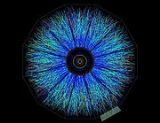
Quark-gluon plasma

Encyclopedia

Phase (matter)
In the physical sciences, a phase is a region of space , throughout which all physical properties of a material are essentially uniform. Examples of physical properties include density, index of refraction, and chemical composition...
of quantum chromodynamics
Quantum chromodynamics
In theoretical physics, quantum chromodynamics is a theory of the strong interaction , a fundamental force describing the interactions of the quarks and gluons making up hadrons . It is the study of the SU Yang–Mills theory of color-charged fermions...
(QCD) which exists at extremely high temperature
Temperature
Temperature is a physical property of matter that quantitatively expresses the common notions of hot and cold. Objects of low temperature are cold, while various degrees of higher temperatures are referred to as warm or hot...
and/or density
Density
The mass density or density of a material is defined as its mass per unit volume. The symbol most often used for density is ρ . In some cases , density is also defined as its weight per unit volume; although, this quantity is more properly called specific weight...
. This phase consists of asymptotically free quark
Quark
A quark is an elementary particle and a fundamental constituent of matter. Quarks combine to form composite particles called hadrons, the most stable of which are protons and neutrons, the components of atomic nuclei. Due to a phenomenon known as color confinement, quarks are never directly...
s and gluon
Gluon
Gluons are elementary particles which act as the exchange particles for the color force between quarks, analogous to the exchange of photons in the electromagnetic force between two charged particles....
s, which are several of the basic building blocks of matter. Experiments at CERN
CERN
The European Organization for Nuclear Research , known as CERN , is an international organization whose purpose is to operate the world's largest particle physics laboratory, which is situated in the northwest suburbs of Geneva on the Franco–Swiss border...
's Super Proton Synchrotron
Super Proton Synchrotron
The Super Proton Synchrotron is a particle accelerator of the synchrotron type at CERN. It is housed in a circular tunnel, in circumference, straddling the border of France and Switzerland near Geneva, Switzerland. The SPS was designed by a team led by John Adams, director-general of what was...
(SPS) first tried to create the QGP in the 1980s and 1990s: the results led CERN to announce indirect evidence for a "new state of matter" in 2000. Current experiments (2011) at the Brookhaven National Laboratory
Brookhaven National Laboratory
Brookhaven National Laboratory , is a United States national laboratory located in Upton, New York on Long Island, and was formally established in 1947 at the site of Camp Upton, a former U.S. Army base...
's Relativistic Heavy Ion Collider
Relativistic Heavy Ion Collider
The Relativistic Heavy Ion Collider is one of two existing heavy-ion colliders, and the only spin-polarized proton collider in the world. It is located at Brookhaven National Laboratory in Upton, New York and operated by an international team of researchers...
(RHIC) at Long Island (NY, USA) and, respectively, at CERN's recent LHC
LHC
LHC may refer to:* Large Hadron Collider, a particle accelerator and collider located on the Franco-Swiss border near Geneva, SwitzerlandLHC also may refer to:* La hora Chanante, a Spanish comedy television show...
collider at Geneva (Switzerland) are continuing this effort , by smashing relativistically accelerated gold atoms rsp. lead atoms onto each other
Although the results have yet to be independently verified as of February 2010, scientists at Brookhaven RHIC have tentatively claimed to have created a quark-gluon plasma with an approximate temperature of 4 trillion degrees Celsius.
As already mentioned, three new experiments running on CERN's Large Hadron Collider (LHC), on the spectrometers ALICE
A Large Ion Collider Experiment
ALICE is one of the six detector experiments at the Large Hadron Collider at CERN. The other five are: ATLAS, CMS, TOTEM, LHCb, and LHCf. ALICE is optimized to study heavy ion collisions. Pb-Pb nuclei collisions will be studied at a centre of mass energy of 2.76 TeV per nucleon...
, ATLAS
ATLAS experiment
ATLAS is one of the six particle detector experiments constructed at the Large Hadron Collider , a new particle accelerator at the European Organization for Nuclear Research in Switzerland...
and CMS
Compact Muon Solenoid
The Compact Muon Solenoid experiment is one of two large general-purpose particle physics detectors built on the proton-proton Large Hadron Collider at CERN in Switzerland and France. Approximately 3,600 people from 183 scientific institutes, representing 38 countries form the CMS collaboration...
, will continue studying properties of QGP. Starting in November 2010, CERN temporarily ceased colliding protons, and began colliding lead
Lead
Lead is a main-group element in the carbon group with the symbol Pb and atomic number 82. Lead is a soft, malleable poor metal. It is also counted as one of the heavy metals. Metallic lead has a bluish-white color after being freshly cut, but it soon tarnishes to a dull grayish color when exposed...
Ions for the ALICE experiment. They were looking to create a QGP and were expected to stop December 6, colliding again protons in January. Within the first week of colliding these lead ions, the LHC appears to have created multiple quark-gluon plasmas with temperatures in the tens of trillions of degrees.
General introduction
Quark–gluon plasma is a state of matterState of matter
States of matter are the distinct forms that different phases of matter take on. Solid, liquid and gas are the most common states of matter on Earth. However, much of the baryonic matter of the universe is in the form of hot plasma, both as rarefied interstellar medium and as dense...
in which the elementary particles that make up the hadrons of baryon
Baryon
A baryon is a composite particle made up of three quarks . Baryons and mesons belong to the hadron family, which are the quark-based particles...
ic matter are freed of their strong
Strong interaction
In particle physics, the strong interaction is one of the four fundamental interactions of nature, the others being electromagnetism, the weak interaction and gravitation. As with the other fundamental interactions, it is a non-contact force...
attraction for one another under extremely high energy densities
Energy density
Energy density is a term used for the amount of energy stored in a given system or region of space per unit volume. Often only the useful or extractable energy is quantified, which is to say that chemically inaccessible energy such as rest mass energy is ignored...
. These particles are the quark
Quark
A quark is an elementary particle and a fundamental constituent of matter. Quarks combine to form composite particles called hadrons, the most stable of which are protons and neutrons, the components of atomic nuclei. Due to a phenomenon known as color confinement, quarks are never directly...
s and gluon
Gluon
Gluons are elementary particles which act as the exchange particles for the color force between quarks, analogous to the exchange of photons in the electromagnetic force between two charged particles....
s that compose baryonic matter.
In normal matter quarks are confined; in the QGP quarks are deconfined
Deconfinement
In physics, deconfinement is the property of a phase in which certain particles are allowed to exist as free excitations, rather than only within bound states...
. In classical QCD quarks are the Fermionic components of mesons and baryons while the gluons are considered the Bosonic components of such particles. The gluons are the force carriers, or bosons, of the QCD color force, while the quarks by themselves are their Fermionic matter counterparts.
Although the experimental high temperatures and densities predicted as producing a quark-gluon plasma have been realized in the laboratory, the resulting matter does not behave as a quasi-ideal state of free quarks and gluons, but, rather, as an almost perfect dense fluid. Actually, the fact that the quark-gluon plasma will not yet be "free" at temperatures realized at present accelerators was predicted in 1984 as a consequence of the remnant effects of confinement.
Why this is referred to as "plasma"
A plasmaPlasma (physics)
In physics and chemistry, plasma is a state of matter similar to gas in which a certain portion of the particles are ionized. Heating a gas may ionize its molecules or atoms , thus turning it into a plasma, which contains charged particles: positive ions and negative electrons or ions...
is matter in which charge
Charge (physics)
In physics, a charge may refer to one of many different quantities, such as the electric charge in electromagnetism or the color charge in quantum chromodynamics. Charges are associated with conserved quantum numbers.-Formal definition:...
s are screened
Debye length
In plasma physics, the Debye length , named after the Dutch physicist and physical chemist Peter Debye, is the scale over which mobile charge carriers screen out electric fields in plasmas and other conductors. In other words, the Debye length is the distance over which significant charge...
due to the presence of other mobile charges; for example: Coulomb's Law
Coulomb's law
Coulomb's law or Coulomb's inverse-square law, is a law of physics describing the electrostatic interaction between electrically charged particles. It was first published in 1785 by French physicist Charles Augustin de Coulomb and was essential to the development of the theory of electromagnetism...
is modified to yield a distance-dependent charge. In a QGP, the color charge
Color charge
In particle physics, color charge is a property of quarks and gluons that is related to the particles' strong interactions in the theory of quantum chromodynamics . Color charge has analogies with the notion of electric charge of particles, but because of the mathematical complications of QCD,...
of the quark
Quark
A quark is an elementary particle and a fundamental constituent of matter. Quarks combine to form composite particles called hadrons, the most stable of which are protons and neutrons, the components of atomic nuclei. Due to a phenomenon known as color confinement, quarks are never directly...
s and gluon
Gluon
Gluons are elementary particles which act as the exchange particles for the color force between quarks, analogous to the exchange of photons in the electromagnetic force between two charged particles....
s is screened. The QGP has other analogies with a normal plasma. There are also dissimilarities because the color charge is non-abelian
Gauge theory
In physics, gauge invariance is the property of a field theory in which different configurations of the underlying fundamental but unobservable fields result in identical observable quantities. A theory with such a property is called a gauge theory...
, whereas the electric charge
Electric charge
Electric charge is a physical property of matter that causes it to experience a force when near other electrically charged matter. Electric charge comes in two types, called positive and negative. Two positively charged substances, or objects, experience a mutual repulsive force, as do two...
is abelian. Outside a finite volume of QGP the color electric field is not screened, so that volume of QGP must still be color-neutral. It will therefore, like a nucleus, have integer electric charge.
How the QGP is studied theoretically
One consequence of this difference is that the color chargeColor charge
In particle physics, color charge is a property of quarks and gluons that is related to the particles' strong interactions in the theory of quantum chromodynamics . Color charge has analogies with the notion of electric charge of particles, but because of the mathematical complications of QCD,...
is too large for perturbative
Perturbation theory (quantum mechanics)
In quantum mechanics, perturbation theory is a set of approximation schemes directly related to mathematical perturbation for describing a complicated quantum system in terms of a simpler one. The idea is to start with a simple system for which a mathematical solution is known, and add an...
computations which are the mainstay of QED
Quantum electrodynamics
Quantum electrodynamics is the relativistic quantum field theory of electrodynamics. In essence, it describes how light and matter interact and is the first theory where full agreement between quantum mechanics and special relativity is achieved...
. As a result, the main theoretical tools to explore the theory of the QGP is lattice gauge theory
Lattice gauge theory
In physics, lattice gauge theory is the study of gauge theories on a spacetime that has been discretized into a lattice. Gauge theories are important in particle physics, and include the prevailing theories of elementary particles: quantum electrodynamics, quantum chromodynamics and the Standard...
. The transition temperature (approximately ) was first predicted by lattice gauge theory. Since then lattice gauge theory has been used to predict many other properties of this kind of matter. The AdS/CFT correspondence
AdS/CFT correspondence
In physics, the AdS/CFT correspondence , sometimes called the Maldacena duality, is the conjectured equivalence between a string theory and gravity defined on one space, and a quantum field theory without gravity defined on the conformal boundary of this space, whose dimension is lower by one or more...
is a new interesting conjecture allowing insights in QGP.
How it is created in the lab
The QGP can be created by heating matter up to a temperatureTemperature
Temperature is a physical property of matter that quantitatively expresses the common notions of hot and cold. Objects of low temperature are cold, while various degrees of higher temperatures are referred to as warm or hot...
of , which amounts to per particle. This can be accomplished by colliding two large nuclei at high energy (note that is not the energy of the colliding beam). Lead
Lead
Lead is a main-group element in the carbon group with the symbol Pb and atomic number 82. Lead is a soft, malleable poor metal. It is also counted as one of the heavy metals. Metallic lead has a bluish-white color after being freshly cut, but it soon tarnishes to a dull grayish color when exposed...
and gold
Gold
Gold is a chemical element with the symbol Au and an atomic number of 79. Gold is a dense, soft, shiny, malleable and ductile metal. Pure gold has a bright yellow color and luster traditionally considered attractive, which it maintains without oxidizing in air or water. Chemically, gold is a...
nuclei
Atomic nucleus
The nucleus is the very dense region consisting of protons and neutrons at the center of an atom. It was discovered in 1911, as a result of Ernest Rutherford's interpretation of the famous 1909 Rutherford experiment performed by Hans Geiger and Ernest Marsden, under the direction of Rutherford. The...
have been used for such collisions at CERN
CERN
The European Organization for Nuclear Research , known as CERN , is an international organization whose purpose is to operate the world's largest particle physics laboratory, which is situated in the northwest suburbs of Geneva on the Franco–Swiss border...
SPS
Super Proton Synchrotron
The Super Proton Synchrotron is a particle accelerator of the synchrotron type at CERN. It is housed in a circular tunnel, in circumference, straddling the border of France and Switzerland near Geneva, Switzerland. The SPS was designed by a team led by John Adams, director-general of what was...
and BNL
Brookhaven National Laboratory
Brookhaven National Laboratory , is a United States national laboratory located in Upton, New York on Long Island, and was formally established in 1947 at the site of Camp Upton, a former U.S. Army base...
RHIC
Relativistic Heavy Ion Collider
The Relativistic Heavy Ion Collider is one of two existing heavy-ion colliders, and the only spin-polarized proton collider in the world. It is located at Brookhaven National Laboratory in Upton, New York and operated by an international team of researchers...
, respectively. The nuclei are accelerated to ultrarelativistic speeds
Ultrarelativistic limit
In physics, a particle is called ultrarelativistic when its speed is very close to the speed of light c.Max Planck showed that the relativistic expression for the energy of a particle whose rest mass is m and momentum is p is given by E^2 = m^2 c^4 + p^2 c^2...
and slammed into each other. Due to the relativistic speeds they are Lorentz contracted
Length contraction
In physics, length contraction – according to Hendrik Lorentz – is the physical phenomenon of a decrease in length detected by an observer of objects that travel at any non-zero velocity relative to that observer...
. Each nucleus has a small probability of a sufficiently head-on hit for a QGP, many nuclei just graze, but the numbers that do collide is sufficient for experiment, and in the case of a storage ring, those that miss are often recycled. When they do collide, the resulting hot volume called a "fireball" is created after a head-on collision. Once created, this fireball is expected to expand under its own pressure
Pressure
Pressure is the force per unit area applied in a direction perpendicular to the surface of an object. Gauge pressure is the pressure relative to the local atmospheric or ambient pressure.- Definition :...
, and cool while expanding. By carefully studying this flow, experimentalists put the theory to test.
How the QGP fits into the general scheme of physics
QCDQuantum chromodynamics
In theoretical physics, quantum chromodynamics is a theory of the strong interaction , a fundamental force describing the interactions of the quarks and gluons making up hadrons . It is the study of the SU Yang–Mills theory of color-charged fermions...
is one part of the modern theory of particle physics
Particle physics
Particle physics is a branch of physics that studies the existence and interactions of particles that are the constituents of what is usually referred to as matter or radiation. In current understanding, particles are excitations of quantum fields and interact following their dynamics...
called the Standard Model
Standard Model
The Standard Model of particle physics is a theory concerning the electromagnetic, weak, and strong nuclear interactions, which mediate the dynamics of the known subatomic particles. Developed throughout the mid to late 20th century, the current formulation was finalized in the mid 1970s upon...
. Other parts of this theory deal with electroweak interaction
Electroweak interaction
In particle physics, the electroweak interaction is the unified description of two of the four known fundamental interactions of nature: electromagnetism and the weak interaction. Although these two forces appear very different at everyday low energies, the theory models them as two different...
s and neutrino
Neutrino
A neutrino is an electrically neutral, weakly interacting elementary subatomic particle with a half-integer spin, chirality and a disputed but small non-zero mass. It is able to pass through ordinary matter almost unaffected...
s. The theory of electrodynamics
Quantum electrodynamics
Quantum electrodynamics is the relativistic quantum field theory of electrodynamics. In essence, it describes how light and matter interact and is the first theory where full agreement between quantum mechanics and special relativity is achieved...
has been tested and found correct to a few parts in a trillion. The theory of weak interactions
Electroweak interaction
In particle physics, the electroweak interaction is the unified description of two of the four known fundamental interactions of nature: electromagnetism and the weak interaction. Although these two forces appear very different at everyday low energies, the theory models them as two different...
has been tested and found correct to a few parts in a thousand. Perturbative aspects of QCD have been tested to a few percent. In contrast, non-perturbative aspects of QCD have barely been tested. The study of the QGP is part of this effort to consolidate the grand theory of particle physics.
The study of the QGP is also a testing ground for finite temperature field theory
Thermal quantum field theory
In theoretical physics, thermal quantum field theory or finite temperature field theory is a set of methods to calculate expectation values of physical observables of a quantum field theory at finite temperature....
, a branch of theoretical physics which seeks to understand particle physics under conditions of high temperature. Such studies are important to understand the early evolution of our universe: the first hundred microseconds or so. While this may seem esoteric, it is crucial to the physics goals of a new generation of observations of the universe (WMAP
Wilkinson Microwave Anisotropy Probe
The Wilkinson Microwave Anisotropy Probe — also known as the Microwave Anisotropy Probe , and Explorer 80 — is a spacecraft which measures differences in the temperature of the Big Bang's remnant radiant heat — the Cosmic Microwave Background Radiation — across the full sky. Headed by Professor...
and its successors). It is also of relevance to Grand Unification Theories
Grand unification theory
The term Grand Unified Theory, often abbreviated as GUT, refers to any of several similar candidate models in particle physics in which at high-energy, the three gauge interactions of the Standard Model which define the electromagnetic, weak, and strong interactions, are merged into one single...
or 'GUTS' which seek to unify the three fundamental forces of nature (excluding gravity).
Thermodynamics
The cross-over temperature from the normal hadronic to the QGP phase is about . This "crossover" may actually not be only a qualitative feature, but instead one may have to do with a true (second order) phase transition, e.g. of the universality class of the three-dimensional Ising model, as some theorists say, e.g. Frithjof Karsch and coworkers from the university of BielefeldBielefeld
Bielefeld is an independent city in the Ostwestfalen-Lippe Region in the north-east of North Rhine-Westphalia, Germany. With a population of 323,000, it is also the most populous city in the Regierungsbezirk Detmold...
. The phenomena involved
correspond to an energy density of a little less than . For relativistic
Relativistic particle
A relativistic particle is a particle which moves with a relativistic speed; that is, a speed comparable to the speed of light. This is achieved by photons to the extent that effects described by special relativity are able to describe those of such particles themselves...
matter, pressure and temperature are not independent variables, so the equation of state
Equation of state
In physics and thermodynamics, an equation of state is a relation between state variables. More specifically, an equation of state is a thermodynamic equation describing the state of matter under a given set of physical conditions...
is a relation between
the energy density and the pressure. This has been found through lattice computations
Lattice gauge theory
In physics, lattice gauge theory is the study of gauge theories on a spacetime that has been discretized into a lattice. Gauge theories are important in particle physics, and include the prevailing theories of elementary particles: quantum electrodynamics, quantum chromodynamics and the Standard...
, and compared to both perturbation theory
Perturbation theory
Perturbation theory comprises mathematical methods that are used to find an approximate solution to a problem which cannot be solved exactly, by starting from the exact solution of a related problem...
and string theory
String theory
String theory is an active research framework in particle physics that attempts to reconcile quantum mechanics and general relativity. It is a contender for a theory of everything , a manner of describing the known fundamental forces and matter in a mathematically complete system...
. This is still a matter of active research. Response functions such as the specific heat and various quark number susceptibilities are currently being computed.
Flow
The equation of state is an important input into the flow equations. The speed of soundSpeed of sound
The speed of sound is the distance travelled during a unit of time by a sound wave propagating through an elastic medium. In dry air at , the speed of sound is . This is , or about one kilometer in three seconds or approximately one mile in five seconds....
is currently under investigation in lattice computations. The mean free path
Mean free path
In physics, the mean free path is the average distance covered by a moving particle between successive impacts which modify its direction or energy or other particle properties.-Derivation:...
of quarks and gluons has been computed using perturbation theory
Perturbation theory
Perturbation theory comprises mathematical methods that are used to find an approximate solution to a problem which cannot be solved exactly, by starting from the exact solution of a related problem...
as well as string theory
String theory
String theory is an active research framework in particle physics that attempts to reconcile quantum mechanics and general relativity. It is a contender for a theory of everything , a manner of describing the known fundamental forces and matter in a mathematically complete system...
. Lattice computations
Lattice gauge theory
In physics, lattice gauge theory is the study of gauge theories on a spacetime that has been discretized into a lattice. Gauge theories are important in particle physics, and include the prevailing theories of elementary particles: quantum electrodynamics, quantum chromodynamics and the Standard...
have been slower here, although the first computations of transport coefficients
Viscosity
Viscosity is a measure of the resistance of a fluid which is being deformed by either shear or tensile stress. In everyday terms , viscosity is "thickness" or "internal friction". Thus, water is "thin", having a lower viscosity, while honey is "thick", having a higher viscosity...
have recently been concluded. These indicate that the mean free time
Mean free time
Molecules in a fluid constantly collide off each other. The mean free time of a molecule in a fluid is the average time between collisions. The mean free path of the molecule is the product of the average speed and the mean free time...
of quarks and gluons in the QGP may be comparable to the average interparticle spacing: hence the QGP is a liquid as far as its flow properties go. This is very much an active field of research, and these conclusions may evolve rapidly. The incorporation of dissipative phenomena into hydrodynamics is another recent development that is still in an active stage.
Excitation spectrum
Does the QGP really contain (almost) free quarks and gluons? The study of thermodynamic and flow properties would indicate that this is an over-simplification. Many ideas are currently being evolved and will be put to test in the near future.It has been hypothesized recently that some mesons built from heavy quarks (such as the
charm quark
Charm quark
The charm quark or c quark is the third most massive of all quarks, a type of elementary particle. Charm quarks are found in hadrons, which are subatomic particles made of quarks...
) do not dissolve until the temperature reaches about .
This has led to speculation that many other kinds of bound states may exist in the plasma. Some static properties of the plasma (similar to the Debye screening length
Debye length
In plasma physics, the Debye length , named after the Dutch physicist and physical chemist Peter Debye, is the scale over which mobile charge carriers screen out electric fields in plasmas and other conductors. In other words, the Debye length is the distance over which significant charge...
) constrain the excitation spectrum.
The Glasma hypothesis
Since 2008, there is a discussion about a hypothetical precursor state of the Quark-gluon plasma, the so-called "Glasma", where the dressed particles are condensed into some kind of glassy (or amorphous) state, below the genuine transition between the confined state and the plasma liquid. This would be analogeous to the formation of metallic glasses, or amorphous alloys of them, below the genuine onset of the liquid metallic state.An article by an author from the BNL
BNL
BNL may refer to:* Barenaked Ladies, a rock band from Canada* Banca Nazionale del Lavoro, an Italian bank* Block nested loop, an algorithm used to join data in a relational database* British National League, a defunct ice hockey league...
, serving as a starting point of the ongoing discussions, is available online: http://arxiv.org/abs/0806.1356.
Experimental situation
Those aspects of the QGP which are easiest to compute are not the ones which are the easiest to probe in experiments. While the balance of evidence points towards the QGP being the origin of the detailed properties of the fireball produced in the RHICRelativistic Heavy Ion Collider
The Relativistic Heavy Ion Collider is one of two existing heavy-ion colliders, and the only spin-polarized proton collider in the world. It is located at Brookhaven National Laboratory in Upton, New York and operated by an international team of researchers...
, this is the main barrier which prevents experimentalists from declaring a sighting of the QGP. For a summary see 2005 RHIC Assessment.
The important classes of experimental observations are
- Single particle spectraSingle particle spectrumThe single-particle spectrum is a distribution of a physical quantity such as energy or momentum. The study of particle spectra allows us to see the global picture of particle production....
(photons and dileptons) - Strangeness productionStrangeness productionStrangeness production is a signature and a diagnostic tool of quark-gluon plasma formation and properties. Unlike up and down quarks, from which everyday matter is made, strange quarks are formed in pair production processes in collisions between constituents of the plasma...
- Photon and muon rates (and J/ψ melting)
- Elliptic flowElliptic flowThe elliptic flow is described as one of the most important observations measured at the Relativistic Heavy Ion Collider . It is one of the strongest evidences for the Quark-gluon plasma discovery. It describes the azimuthal momentum space anisotropy of particle emission from non-central heavy-ion...
- Jet quenchingJet quenchingIn high-energy physics, jet quenching is a phenomenon that can occur in the collision of ultra-high-energy particles. In general, the collision of high-energy particles can produce jets of elementary particles that emerge from these collisions...
- Fluctuations
- Hanbury Brown and Twiss effect and Bose–Einstein correlations
Formation of quark matter
In April 2005, formation of quark matter was tentatively confirmed by results obtained at Brookhaven National LaboratoryBrookhaven National Laboratory
Brookhaven National Laboratory , is a United States national laboratory located in Upton, New York on Long Island, and was formally established in 1947 at the site of Camp Upton, a former U.S. Army base...
's Relativistic Heavy Ion Collider
Relativistic Heavy Ion Collider
The Relativistic Heavy Ion Collider is one of two existing heavy-ion colliders, and the only spin-polarized proton collider in the world. It is located at Brookhaven National Laboratory in Upton, New York and operated by an international team of researchers...
(RHIC). The consensus of the four RHIC research groups was that they had created a quark-gluon liquid
Liquid
Liquid is one of the three classical states of matter . Like a gas, a liquid is able to flow and take the shape of a container. Some liquids resist compression, while others can be compressed. Unlike a gas, a liquid does not disperse to fill every space of a container, and maintains a fairly...
of very low viscosity
Viscosity
Viscosity is a measure of the resistance of a fluid which is being deformed by either shear or tensile stress. In everyday terms , viscosity is "thickness" or "internal friction". Thus, water is "thin", having a lower viscosity, while honey is "thick", having a higher viscosity...
. However, contrary to what was at that time still the widespread assumption, it is yet unknown from theoretical predictions whether the QCD "plasma", especially close to the transition temperature, should behave like a gas or liquid. Authors favoring the weakly interacting interpretation derive their assumptions from the lattice QCD calculation, where the entropy density of quark-gluon plasma approaches the weakly interacting limit. However, since both energy density and correlation shows significant deviation from the weakly interacting limit, it has been pointed out by many authors that there is in fact no reason to assume a QCD "plasma" close to the transition point should be weakly interacting, like electromagnetic plasma (see, e.g.,). That being said, systematically improvable perturbative QCD quasiparticle models do a very good job of reproducing the lattice data for thermodynamical observables (pressure, entropy, quark susceptibility), including the aforementioned "significant deviation from the weakly interacting limit", down to temperatures on the order of 2 to 3 times the critical temperature for the transition.
See also
- HadronHadronIn particle physics, a hadron is a composite particle made of quarks held together by the strong force...
s (that is mesonMesonIn particle physics, mesons are subatomic particles composed of one quark and one antiquark, bound together by the strong interaction. Because mesons are composed of sub-particles, they have a physical size, with a radius roughly one femtometer: 10−15 m, which is about the size of a proton...
s and baryonBaryonA baryon is a composite particle made up of three quarks . Baryons and mesons belong to the hadron family, which are the quark-based particles...
s) and confinement - HadronizationHadronizationIn particle physics, hadronization is the process of the formation of hadrons out of quarks and gluons. This occurs after high-energy collisions in a particle collider in which free quarks or gluons are created. Due to postulated colour confinement, these cannot exist individually...
- List of plasma (physics) applications articles
- Neutron starNeutron starA neutron star is a type of stellar remnant that can result from the gravitational collapse of a massive star during a Type II, Type Ib or Type Ic supernova event. Such stars are composed almost entirely of neutrons, which are subatomic particles without electrical charge and with a slightly larger...
s - Plasma physicsPlasma (physics)In physics and chemistry, plasma is a state of matter similar to gas in which a certain portion of the particles are ionized. Heating a gas may ionize its molecules or atoms , thus turning it into a plasma, which contains charged particles: positive ions and negative electrons or ions...
- QCD matterQCD matterQuark matter or QCD matter refers to any of a number of theorized phases of matter whose degrees of freedom include quarks and gluons. These theoretical phases would occur at extremely high temperatures and densities, billions of times higher than can be produced in equilibrium in laboratories...
Quantum Chromodynamics matter - Quantum electrodynamicsQuantum electrodynamicsQuantum electrodynamics is the relativistic quantum field theory of electrodynamics. In essence, it describes how light and matter interact and is the first theory where full agreement between quantum mechanics and special relativity is achieved...
- Quantum chromodynamicsQuantum chromodynamicsIn theoretical physics, quantum chromodynamics is a theory of the strong interaction , a fundamental force describing the interactions of the quarks and gluons making up hadrons . It is the study of the SU Yang–Mills theory of color-charged fermions...
- Quantum hydrodynamicsQuantum hydrodynamicsQuantum hydrodynamics is most generally the study of hydrodynamic systems which demonstrate behavior implicit in quantum subsystems . They arise in semiclassical mechanics in the study of semiconductor devices, in which case being derived from the Wigner-Boltzmann equation...
- Relativistic plasmaRelativistic plasmaRelativistic plasmas in physics are plasmas for which relativistic corrections to a particle's mass and velocity are important. Such corrections typically become important when a significant number of electrons reach speeds greater than 0.86c .Such plasmas may be created either by heating a gas to...
- Strangeness productionStrangeness productionStrangeness production is a signature and a diagnostic tool of quark-gluon plasma formation and properties. Unlike up and down quarks, from which everyday matter is made, strange quarks are formed in pair production processes in collisions between constituents of the plasma...
- Strange matterStrange matterStrange matter is a particular form of quark matter, usually thought of as a "liquid" of up, down, and strange quarks. It is to be contrasted with nuclear matter, which is a liquid of neutrons and protons , and with non-strange quark matter, which is a quark liquid containing only up and down quarks...
External links
- The Relativistic Heavy Ion Collider at Brookhaven National Laboratory
- The Alice Experiment at CERN
- The Indian Lattice Gauge Theory Initiative
- Quark matter reviews: 2004 theory, 2004 experiment
- Quark-Gluon Plasma reviews: 2011 theory
- Lattice reviews: 2003, 2005
- BBC article mentioning Brookhaven results (2005)
- Physics News Update article on the quark-gluon liquid, with links to preprints
- Read for free : "Hadrons and Quark-Gluon Plasma" by Jean Letessier and Johann RafelskiJohann RafelskiJohann Rafelski is a German-American theoretical physicist and author. He is Professor of Physics at The University of Arizona in Tucson, guest scientist at CERN , and has been LMU-Excellent Guest Professor at the Ludwig Maximilian University of Munich in Munich, Germany.Rafelski’s current...
Cambridge University Press (2002) ISBN 0 521 38536 9, Cambridge, UK;