

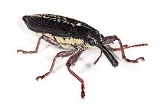
Weevil

Encyclopedia
A weevil is any beetle
from the Curculionoidea superfamily
. They are usually small, less than 6 millimetre (0.236220472440945 in), and herbivorous
. There are over 60,000 species in several families, mostly in the family Curculionidae
(the true weevils). Some other beetles, although not closely related, bear the name "weevil", such as the biscuit weevil
(Stegobium paniceum), which belongs to the family Anobiidae
.
Many weevils are damaging to crops. The grain or wheat weevil
(Sitophilus granarius) damages stored grain
. The boll weevil
(Anthonomus grandis) attacks cotton
crops. It lays its eggs inside cotton bolls, and the young weevils eat their way out.
Weevils are often found in dry foods including nuts and seeds, cereal and grain products, such as pancake mix. In the domestic setting, they are most likely to be observed when a bag of flour is opened. Their presence is often indicated by the granules of the infested item sticking together in strings, as if caught in a cobweb.
). E. C. Zimmerman
proposed a third division, the Heteromorphi, for several intermediate forms. Primitive weevils are distinguished by having straight antennae, while true weevils have elbowed (geniculate) antennae. The elbow occurs at the end of the scape
(first antennal segment) in true weevils, and the scape is usually much longer than the other antennal segments. Some exceptions occur. Nanophyini are primitive weevils (with very long trochanters
) but have long scapes and geniculate antennae. From the true weevils, Gonipterinae
and Ramphus have short scapes and little or no elbow.
The most recent classification system to family level was provided by Kuschel, with updates from Marvaldi et al., and was achieved using phylogenetic analyses. The accepted families are the primitive weevils, Anthribidae
, Attelabidae
, Belidae
, Brentidae
, Caridae
and Nemonychidae
, and the true weevils Curculionidae
. Most other weevil families were demoted to subfamilies or tribes. Weevil species radiation was shown to follow steps in plant evolution upon which the weevils feed. Weevils can vary in color from black to light brown.
Some of the features used to distinguish weevil families are:
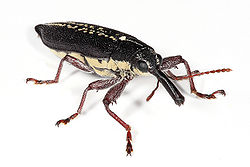 A phylogeny of the Curculionoidea based on 18S ribosomal DNA
and morphological data is suggested below:
Beetle
Coleoptera is an order of insects commonly called beetles. The word "coleoptera" is from the Greek , koleos, "sheath"; and , pteron, "wing", thus "sheathed wing". Coleoptera contains more species than any other order, constituting almost 25% of all known life-forms...
from the Curculionoidea superfamily
Taxonomic rank
In biological classification, rank is the level in a taxonomic hierarchy. Examples of taxonomic ranks are species, genus, family, and class. Each rank subsumes under it a number of less general categories...
. They are usually small, less than 6 millimetre (0.236220472440945 in), and herbivorous
Herbivore
Herbivores are organisms that are anatomically and physiologically adapted to eat plant-based foods. Herbivory is a form of consumption in which an organism principally eats autotrophs such as plants, algae and photosynthesizing bacteria. More generally, organisms that feed on autotrophs in...
. There are over 60,000 species in several families, mostly in the family Curculionidae
Curculionidae
Curculionidae is the family of the "true" weevils . It was formerly recognized in 1998 as the largest of any animal family, with over 40,000 species described worldwide at that time...
(the true weevils). Some other beetles, although not closely related, bear the name "weevil", such as the biscuit weevil
Drugstore beetle
The Drugstore beetle , also known as the Bread beetle or Biscuit beetle, is a tiny, brown beetle that can be found infesting a wide variety of products, and is among the most common non-weevils to be found there...
(Stegobium paniceum), which belongs to the family Anobiidae
Anobiidae
Anobiidae is a family of beetles. The larvae of a number of species tend to bore into wood, earning them the name "woodworm" or "wood borer". A few species are pests, causing damage to wooden furniture and house structures, notably the death watch beetle, Xestobium rufovillosum, and the common...
.
Many weevils are damaging to crops. The grain or wheat weevil
Wheat weevil
Wheat weevils , also known as grain weevils or granary weevils, occur all over the world and are a common pest in many places. They can cause significant damage to harvested grains that are being stored and may drastically decrease yields...
(Sitophilus granarius) damages stored grain
Cereal
Cereals are grasses cultivated for the edible components of their grain , composed of the endosperm, germ, and bran...
. The boll weevil
Boll weevil
The boll weevil is a beetle measuring an average length of six millimeters, which feeds on cotton buds and flowers. Thought to be native to Central America, it migrated into the United States from Mexico in the late 19th century and had infested all U.S. cotton-growing areas by the 1920s,...
(Anthonomus grandis) attacks cotton
Cotton
Cotton is a soft, fluffy staple fiber that grows in a boll, or protective capsule, around the seeds of cotton plants of the genus Gossypium. The fiber is almost pure cellulose. The botanical purpose of cotton fiber is to aid in seed dispersal....
crops. It lays its eggs inside cotton bolls, and the young weevils eat their way out.
Weevils are often found in dry foods including nuts and seeds, cereal and grain products, such as pancake mix. In the domestic setting, they are most likely to be observed when a bag of flour is opened. Their presence is often indicated by the granules of the infested item sticking together in strings, as if caught in a cobweb.
Taxonomy
Because there are so many species and such diversity, the higher classification of weevils is in a state of flux. Weevils are generally divided into two major divisions, the Orthoceri or primitive weevils, and the Gonatoceri or true weevils (CurculionidaeCurculionidae
Curculionidae is the family of the "true" weevils . It was formerly recognized in 1998 as the largest of any animal family, with over 40,000 species described worldwide at that time...
). E. C. Zimmerman
Elwood Zimmerman
Elwood Curtin Zimmerman was an American entomologist best known for his two multivolume series: Insects of Hawaii published by the University of Hawaii Press and Australian Weevils published by Australia's CSIRO.-Biography:During his school years...
proposed a third division, the Heteromorphi, for several intermediate forms. Primitive weevils are distinguished by having straight antennae, while true weevils have elbowed (geniculate) antennae. The elbow occurs at the end of the scape
Antenna (biology)
Antennae in biology have historically been paired appendages used for sensing in arthropods. More recently, the term has also been applied to cilium structures present in most cell types of eukaryotes....
(first antennal segment) in true weevils, and the scape is usually much longer than the other antennal segments. Some exceptions occur. Nanophyini are primitive weevils (with very long trochanters
Arthropod leg
The arthropod leg is a form of jointed appendage of arthropods, usually used for walking. Many of the terms used for arthropod leg segments are of Latin origin, and may be confused with terms for bones: coxa , trochanter , femur, tibia, tarsus, ischium, metatarsus, carpus, dactylus ,...
) but have long scapes and geniculate antennae. From the true weevils, Gonipterinae
Gonipterinae
Gonipterinae is a subfamily of weevils. The larvae and adults are usually found on eucalyptus trees, where they feed upon the foliage. The larvae are legless and slug-like in appearance...
and Ramphus have short scapes and little or no elbow.
The most recent classification system to family level was provided by Kuschel, with updates from Marvaldi et al., and was achieved using phylogenetic analyses. The accepted families are the primitive weevils, Anthribidae
Anthribidae
Anthribidae is a family of beetles also known as fungus weevils. The antennae are not elbowed, may occasionally be longer than the body and thread-like, and can be the longest of any members of Curculionoidea...
, Attelabidae
Attelabidae
The Attelabidae or leaf-rolling weevils are a widespread family of weevils. There are more than 2000 species. They are included within the primitive weevils, because of their straight antennae, which are inserted near the base of the rostrum...
, Belidae
Belidae
Belidae is a family of weevils, called belids or primitive weevils because they have straight antennae, unlike the "true weevils" or Curculionidae which have elbowed antennae...
, Brentidae
Brentidae
Brentidae is a cosmopolitan family of primarily xylophagous beetles also known as straight-snouted weevils. The concept of this family has been recently expanded with the inclusion of three groups formerly placed in the Curculionidae; the subfamilies Apioninae, Cyladinae, and Nanophyinae, as well...
, Caridae
Caridae
Caridae is a small Gondwanan family of weevils. They are considered part of the primitive weevil group, because they have straight rather than elbowed antennae. The insertion of the antennae on the rostrum cannot be seen from above. Caridae also lack spiracles on abdominal tergites 6 and 7. The...
and Nemonychidae
Nemonychidae
Nemonychidae is a small family of weevils, placed within the primitive weevil group because they have straight rather than elbowed antennae. They are often called pine flower weevils. As in the Anthribidae, the labrum appears as a separate segment to the clypeus, and the maxillary palps are long...
, and the true weevils Curculionidae
Curculionidae
Curculionidae is the family of the "true" weevils . It was formerly recognized in 1998 as the largest of any animal family, with over 40,000 species described worldwide at that time...
. Most other weevil families were demoted to subfamilies or tribes. Weevil species radiation was shown to follow steps in plant evolution upon which the weevils feed. Weevils can vary in color from black to light brown.
Some of the features used to distinguish weevil families are:
| Labrum visible as separate segment to clypeus | Anthribidae Anthribidae Anthribidae is a family of beetles also known as fungus weevils. The antennae are not elbowed, may occasionally be longer than the body and thread-like, and can be the longest of any members of Curculionoidea... , Nemonychidae Nemonychidae Nemonychidae is a small family of weevils, placed within the primitive weevil group because they have straight rather than elbowed antennae. They are often called pine flower weevils. As in the Anthribidae, the labrum appears as a separate segment to the clypeus, and the maxillary palps are long... |
| Antennae elbowed | most Curculionidae Curculionidae Curculionidae is the family of the "true" weevils . It was formerly recognized in 1998 as the largest of any animal family, with over 40,000 species described worldwide at that time... , Nanophyini (Apioninae) |
| Trochanters (segment between coxae and femora) as long or longer than coxae | Apioninae including Nanophyini |
| Fore tibia with comb of setae in apical groove opposite tarsal articulation | Belidae Belidae Belidae is a family of weevils, called belids or primitive weevils because they have straight antennae, unlike the "true weevils" or Curculionidae which have elbowed antennae... |
| Elytra striate (with longitudinal ridges or grooves) | Brentidae Brentidae Brentidae is a cosmopolitan family of primarily xylophagous beetles also known as straight-snouted weevils. The concept of this family has been recently expanded with the inclusion of three groups formerly placed in the Curculionidae; the subfamilies Apioninae, Cyladinae, and Nanophyinae, as well... , Curculionidae Curculionidae Curculionidae is the family of the "true" weevils . It was formerly recognized in 1998 as the largest of any animal family, with over 40,000 species described worldwide at that time... , Rhinorhynchinae |
| Rostrum short and broad | Anthribidae, some Curculionidae (some Brachycerinae including Ithycerus (New York weevil New York weevil The New York weevil is a species of primitive weevil; large for weevils , it is covered with fine bristles and has a regular pattern of light and dark spots... ), Scolytinae and Platypodinae). |
| Maxillary palps long and projecting (visible from above at tip of rostrum) | Anthribidae Anthribidae Anthribidae is a family of beetles also known as fungus weevils. The antennae are not elbowed, may occasionally be longer than the body and thread-like, and can be the longest of any members of Curculionoidea... , Nemonychidae |
| Abdominal tergites 6 and 7 without spiracles | Caridae Caridae Caridae is a small Gondwanan family of weevils. They are considered part of the primitive weevil group, because they have straight rather than elbowed antennae. The insertion of the antennae on the rostrum cannot be seen from above. Caridae also lack spiracles on abdominal tergites 6 and 7. The... |
| Gular suture (on ventral part of head) single not double | Attelabidae Attelabidae The Attelabidae or leaf-rolling weevils are a widespread family of weevils. There are more than 2000 species. They are included within the primitive weevils, because of their straight antennae, which are inserted near the base of the rostrum... , Brentidae, Curculionidae. |
Phylogeny
Ribosomal DNA
Ribosomal DNA codes for ribosomal RNA. The ribosome is an intracellular macromolecule that produces proteins or polypeptide chains. The ribosome itself consists of a composite of proteins and RNA. As shown in the figure, rDNA consists of a tandem repeat of a unit segment, an operon, composed of...
and morphological data is suggested below: