


Zori

Encyclopedia
Japan
Japan is an island nation in East Asia. Located in the Pacific Ocean, it lies to the east of the Sea of Japan, China, North Korea, South Korea and Russia, stretching from the Sea of Okhotsk in the north to the East China Sea and Taiwan in the south...
ese sandal
Sandal (footwear)
Sandals are an open type of outdoor footwear, consisting of a sole held to the wearer's foot by straps passing over the instep and, sometimes, around the ankle...
s made of rice straw or other plant fibers, cloth, lacquered wood, leather, rubber, or—increasingly—synthetic materials. Zōri are quite similar to flip-flops, which first appeared in New Zealand
New Zealand
New Zealand is an island country in the south-western Pacific Ocean comprising two main landmasses and numerous smaller islands. The country is situated some east of Australia across the Tasman Sea, and roughly south of the Pacific island nations of New Caledonia, Fiji, and Tonga...
and the United States
United States
The United States of America is a federal constitutional republic comprising fifty states and a federal district...
sometime around World War II as rubber imitations of the wooden thong sandals long worn in Japan.
The traditional forms of zōri are seen when worn with other traditional clothing; modern forms are fairly common, especially in summer. While geta
Geta (footwear)
Geta are a form of traditional Japanese footwear that resemble both clogs and flip-flops. They are a kind of sandal with an elevated wooden base held onto the foot with a fabric thong to keep the foot well above the ground. They are worn with traditional Japanese clothing such as kimono or yukata,...
are nowadays worn with the informal yukata
Yukata
A is a Japanese garment, a casual summer kimono usually made of cotton. People wearing yukata are a common sight in Japan at fireworks displays, bon-odori festivals, and other summer events. The yukata is also frequently worn after bathing at traditional Japanese inns...
, zōri are associated with the more formal kimono
Kimono
The is a Japanese traditional garment worn by men, women and children. The word "kimono", which literally means a "thing to wear" , has come to denote these full-length robes...
. The formality of the occasion affects the choice of kimono and zōri. The bulrush covered zōri that resemble tatami
Tatami
A is a type of mat used as a flooring material in traditional Japanese-style rooms. Traditionally made of rice straw to form the core , with a covering of woven soft rush straw, tatami are made in standard sizes, with the length exactly twice the width...
mats are not used with kimono, but are considered working wear or matched with casual Western or Japanese clothing, for example jinbei
Jinbei
200 px|thumb|Boy's stylish JinbeiA jinbei , sometimes referred to as hippari, is a kind of traditional Japanese clothing worn by men, women, boys, girls, and even babies during the summer. Women's jinbei have started to become popular in recent years.-Use:Jinbei are usually worn as a form of...
. Thus they rank close to the wooden geta.
Women's vinyl (plastic) zōri are formal, but less formal than fabric, sometimes brocade
Brocade
Brocade is a class of richly decorative shuttle-woven fabrics, often made in colored silks and with or without gold and silver threads. The name, related to the same root as the word "broccoli," comes from Italian broccato meaning "embossed cloth," originally past participle of the verb broccare...
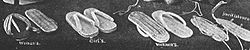
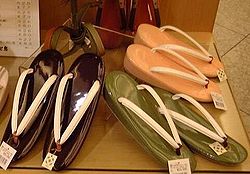
covered zōri, that are used with the most formal of kimono, for example, wedding and funeral wear. Men's zōri are often plastic straw imitation, with foam or cork soles. The hanao, or thongs, for men are often white or black. Women's zōri can also be of straw imitation, but the hanao are usually red, and they rank below colored vinyl or brocade zōri in formality. As formal wear, all plastic and fabric zōri for women require the use of white tabi
Tabi
are traditional Japanese socks. Ankle-high and with a separation between the big toe and other toes, they are worn by both men and women with zori, geta, and other traditional thonged footwear. Tabi are also essential with traditional clothing—kimono and other wafuku as well as being worn by...
socks. Men have more latitude, and can use the same imitation zōri with both informal (without tabi) and formal wear with tabi socks.
The hanao is attached symmetrically, so there is no difference between left and right shoe. The hanao of zōri can be made of velour-like material, as in the case of plastic straw imitation zōri. The hanao for more formal coloured vinyl zōri are either thin vinyl or brocade straps, or wider and padded vinyl or fabric straps. The fabric is often either the fabric used for the shoe, or chirimen, crepe-like Japanese silk or rayon fabric. Men's zōri might also feature leather or leather imitation hanao. The hanao wear and stretch easily, and the hanao fashion and the coordination of accessories sometimes calls for replacing the hanao. The hanao can be replaced through flaps of the sole.
Women's zōri are seldom flat, except for the straw imitation zōri. The soles come in different thicknesses and angles. There are even modern zōri that are left uncovered by fabric or vinyl, and the shoe, except for the inner sole, is black, hard plastic with a non-slip outer sole. Usually the outer sole is gray, genuine leather.
Like all Japanese sandals, zōri allow for free circulation of air around the feet, a feature that probably came about because of the humid climate that predominates throughout most of Japan
Japan
Japan is an island nation in East Asia. Located in the Pacific Ocean, it lies to the east of the Sea of Japan, China, North Korea, South Korea and Russia, stretching from the Sea of Okhotsk in the north to the East China Sea and Taiwan in the south...
. They are easily slipped on and off, which is important in a culture where shoes are constantly removed and put back on, and where tying shoelaces would be impractical in a tight kimono.