
All Topics  
Shakuhachi

 
Shakuhachi

   Email Print
   Bookmark   Link


Shakuhachi


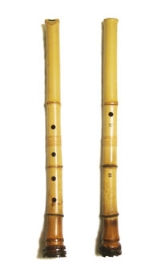
The is a Japan
Japan

Japan is an island country in East Asia. Located in the Pacific Ocean, it lies to the east of the Sea of Japan, People's Republic of China, North Korea, South Korea and Russia, stretching from the Sea of Okhotsk in the north to the East China Sea and Taiwan in the south....
ese end-blown
End-blown flute

The end-blown flute or rim-blown flute is a keyless woodwind instrument played by directing an airstream against the sharp edge of the upper end of a tube....
 flute
Flute

The flute is a musical instrument of the woodwind family. Unlike other woodwind instruments, a flute is a reedless wind instrument that produces its sound from the flow of air against an edge....
. Its name means "1.8 feet", referring to its size. It is traditionally made of bamboo
Bamboo

The bamboos are a group of woody perennial plant evergreen plants in the true grass family Poaceae, subfamily Bambusoideae, tribe Bambuseae....
, but versions now exist in wood and plastic. It was used by the monks of the Fuke school
Fuke Zen

Fuke Zen was a branch of Zen Buddhism which existed in Japan from the 13th century until the late 19th century. Fuke monks were noted for playing the shakuhachi flute as a form of meditation....
 of Zen
Zen

Zen is a school of Mahayana Buddhism, referred to in Chinese as Ch?n. Ch?n is itself derived from the Sanskrit Dhyana, which means "meditation" ....
 Buddhism
Buddhism

Buddhism is a family of beliefs and practices considered by most to be a religionand is based on the teachings attributed to Siddhartha Gautama, commonly known as "The Buddha" , who was born in what is today Nepal....
 in the practice of . Its soulful sound made it popular in Western 1980s pop music
Pop music

Pop music is a music genre that features a noticeable rhythmic element, melodies and hook , a mainstream style and a conventional structure.The term "pop music" was first used in 1926 in the sense of "having popular appeal" , but since the 1950s it has been used in the sense of a musical genre, originally characterized as a lighter alternat...
.

They are often made in the minor pentatonic scale
Pentatonic scale

A pentatonic scale is a musical scale with five pitch per octave in contrast to an heptatonic scale scale such as the major scale. Pentatonic scales are very common and are found all over the world, including but not limited to Celtic music, Hungarian folk music, West African music, African-American spiritual , Jazz, American blues music a...
.

name shakuhachi means "1.8 foot", from its size.


Discussion
Ask a question about 'Shakuhachi'
Start a new discussion about 'Shakuhachi'
Answer questions from other users
Full Discussion Forum


Encyclopedia


Shakuhachi
The is a Japan
Japan

Japan is an island country in East Asia. Located in the Pacific Ocean, it lies to the east of the Sea of Japan, People's Republic of China, North Korea, South Korea and Russia, stretching from the Sea of Okhotsk in the north to the East China Sea and Taiwan in the south....
ese end-blown
End-blown flute

The end-blown flute or rim-blown flute is a keyless woodwind instrument played by directing an airstream against the sharp edge of the upper end of a tube....
 flute
Flute

The flute is a musical instrument of the woodwind family. Unlike other woodwind instruments, a flute is a reedless wind instrument that produces its sound from the flow of air against an edge....
. Its name means "1.8 feet", referring to its size. It is traditionally made of bamboo
Bamboo

The bamboos are a group of woody perennial plant evergreen plants in the true grass family Poaceae, subfamily Bambusoideae, tribe Bambuseae....
, but versions now exist in wood and plastic. It was used by the monks of the Fuke school
Fuke Zen

Fuke Zen was a branch of Zen Buddhism which existed in Japan from the 13th century until the late 19th century. Fuke monks were noted for playing the shakuhachi flute as a form of meditation....
 of Zen
Zen

Zen is a school of Mahayana Buddhism, referred to in Chinese as Ch?n. Ch?n is itself derived from the Sanskrit Dhyana, which means "meditation" ....
 Buddhism
Buddhism

Buddhism is a family of beliefs and practices considered by most to be a religionand is based on the teachings attributed to Siddhartha Gautama, commonly known as "The Buddha" , who was born in what is today Nepal....
 in the practice of . Its soulful sound made it popular in Western 1980s pop music
Pop music

Pop music is a music genre that features a noticeable rhythmic element, melodies and hook , a mainstream style and a conventional structure.The term "pop music" was first used in 1926 in the sense of "having popular appeal" , but since the 1950s it has been used in the sense of a musical genre, originally characterized as a lighter alternat...
.

They are often made in the minor pentatonic scale
Pentatonic scale

A pentatonic scale is a musical scale with five pitch per octave in contrast to an heptatonic scale scale such as the major scale. Pentatonic scales are very common and are found all over the world, including but not limited to Celtic music, Hungarian folk music, West African music, African-American spiritual , Jazz, American blues music a...
.

Overview

The name shakuhachi means "1.8 foot", from its size. It is a compound of two words:

means "foot", an archaic unit of length equal to 30.3 centimeters (0.994 English foot) and subdivided in ten subunits, rather than twelve.

means "eight", here eight sun, or tenths of a shaku.

Thus, "shaku-hachi" means "one foot eight" (almost 55 centimeters), the standard length of a shakuhachi. Other shakuhachi vary in length from about 1.3 shaku up to 3.3 shaku. (The longer the shakuhachi, the lower its tuning.) Although the sizes differ, they are all still referred to generically as "shakuhachi".

Japaneseshakuhachisection
A recorder player blows into a duct, a narrow wind-way over a block called a "fipple
Fipple

Fipple Flute or Tubular Ducted Flute mouthpiece are commonly found on end-blown woodwind instruments such as the tin whistle and the recorder....
", and thus has limited pitch control. The shakuhachi player blows as one would blow across the top of an empty bottle (though the shakuhachi has a sharp edge to blow against) and has substantial pitch control. The five finger holes are tuned to a pentatonic scale
Pentatonic scale

A pentatonic scale is a musical scale with five pitch per octave in contrast to an heptatonic scale scale such as the major scale. Pentatonic scales are very common and are found all over the world, including but not limited to Celtic music, Hungarian folk music, West African music, African-American spiritual , Jazz, American blues music a...
 with no half-tones, but the player can bend each pitch as much as a whole tone or more, using techniques called meri and kari
Kari (music)

Kari, in shakuhachi music, is both a property of a note and a technique. To play a note kari means to play it with raised pitch , relative to playing the note meri....
, in which the blowing angle is adjusted to bend the pitch downward and upward, respectively. Pitches may also be lowered by shading or partially covering finger holes. Since most pitches can be achieved via several different fingering or blowing techniques on the shakuhachi, the timbre
Timbre

In music, timbre is the quality of a musical note or sound or tone that distinguishes different types of sound production, such as voices or musical instruments....
 of each possibility is taken into account when composing or playing. The shakuhachi has a range of two full octaves (the lower is called otsu, the upper, kan) and a partial third octave (dai-kan). The different octaves are produced using subtle variations of breath and embouchure
Embouchure

The embouchure is the use of facial muscles and the shaping of the lips to the mouthpiece of a wind instrument.The word is of French language origin and is related to the root bouche , 'mouth'....
.

A 1.8 shakuhachi produces D4 (D above Middle C, 293.66Hz) as its fundamental - the lowest note it produces with all five finger holes covered, and a normal blowing angle. In contrast, a 2.4 shakuhachi has a fundamental of A3 (A below Middle C, 220Hz). As the length increases, the spacing of the finger holes also increases, stretching both fingers and technique. Longer flutes often have offset finger holes, and very long flutes are almost always custom made to suit individual players. Some honkyoku
Honkyoku

Honkyoku are the pieces of shakuhachi or hocchiku music played by mendicant Japanese Zen monks called komuso. Komuso played honkyoku for Bodhi and alms as early as the 13th century....
, in particular those of the Nezasaha (Kimpu-ryu) school are intended to be played on these longer flutes.

Much of the shakuhachi's subtlety (and player's skill) lies in its rich tone colouring, and the ability for its variation. Different fingerings, embouchure
Embouchure

The embouchure is the use of facial muscles and the shaping of the lips to the mouthpiece of a wind instrument.The word is of French language origin and is related to the root bouche , 'mouth'....
s and amounts of meri can produce notes of the same pitch, but with subtle or dramatic differences in the tone colouring. The honkyoku
Honkyoku

Honkyoku are the pieces of shakuhachi or hocchiku music played by mendicant Japanese Zen monks called komuso. Komuso played honkyoku for Bodhi and alms as early as the 13th century....
 pieces rely heavily on this aspect of the instrument to enhance their subtlety and depth.

Shakuhachi are usually made from the root end of a bamboo
Bamboo

The bamboos are a group of woody perennial plant evergreen plants in the true grass family Poaceae, subfamily Bambusoideae, tribe Bambuseae....
 culm
Culm

This article is about the plant part. For other uses see Culm disambiguation.Culm, in botanical context, originally referred to a stem of any type of plant....
 and are extremely versatile instruments. Holes can be covered partially (1/3 covered, 1/2, 2/3, etc.) and pitch varied subtly or substantially by changing the blowing angle. Professional players can produce virtually any pitch they wish from the instrument, and play a wide repertoire of original Zen
Zen

Zen is a school of Mahayana Buddhism, referred to in Chinese as Ch?n. Ch?n is itself derived from the Sanskrit Dhyana, which means "meditation" ....
 music, ensemble music with koto
Koto (musical instrument)

The koto is a traditional Japanese string instrument musical instrument derived from the Chinese zither . The koto is the national instrument of Japan....
, biwa
Biwa

The biwa is a Japanese short-necked fretted lute, and a close variant of the Chinese pipa. The biwa is the chosen instrument of Benzaiten, goddess of music, eloquence, poetry, and education in Japanese Buddhism....
 and shamisen
Shamisen

The shamisen or samisen , also called sangen is a three-stringed musical instrument played with a plectrum called a bachi. The pronunciation in Japanese language is usually "shamisen" but sometimes "jamisen" rendaku ....
, folk music, jazz, and other modern pieces.

Due to the skill required, the time involved, and the range of quality in materials to craft bamboo shakuhachi, one can expect to pay from USD
United States dollar

The United States dollar is the unit of currency of the United States and was defined by the Coinage Act of 1792 to be between 371 and 416 grains of silver ....
 300 to USD 5,000 for a new or used flute. Because each piece of bamboo is unique, shakuhachi cannot be mass-produced, and craftsmen must spend much time finding the correct bore shape for each individual flute to result in correct pitch over all notes. Specimens of extremely high quality, with valuable inlays, or of historical significance can fetch USD 10,000 or more. Plastic or PVC
Polyvinyl chloride

Polyvinyl chloride, commonly abbreviated PVC, is the third most widely used thermoplastic polymer after polyethylene and polypropylene....
 shakuhachi have some advantages over their traditional bamboo counterparts: they are light weight, extremely durable, nearly impervious to heat and cold, and typically cost less than USD 100. Shakuhachi made of wood are also available, typically costing less than bamboo but more than synthetic materials. Nearly all players, however, prefer bamboo, citing tonal qualities, aesthetics, and tradition.

History


The bamboo flute first came to Japan
Japan

Japan is an island country in East Asia. Located in the Pacific Ocean, it lies to the east of the Sea of Japan, People's Republic of China, North Korea, South Korea and Russia, stretching from the Sea of Okhotsk in the north to the East China Sea and Taiwan in the south....
 from China
China

China is a Culture of China, an ancient civilization, and, depending on perspective, a national or multinational entity extending over a large area in East Asia....
. The shakuhachi proper, however, is quite distinct from its Chinese counterpart – the result of centuries of isolated evolution in Japan.

During the medieval period, shakuhachi were most notable for their role in the Fuke sect
Fuke Zen

Fuke Zen was a branch of Zen Buddhism which existed in Japan from the 13th century until the late 19th century. Fuke monks were noted for playing the shakuhachi flute as a form of meditation....
 of Zen Buddhist monks, known as komuso
Komuso

A was a mendicant monastic of the Fuke Zen school of Zen Buddhism. Komuso were characterised by the straw basket worn on the head, manifesting the absence of specific ego....
 ("priests of nothingness," or "emptiness monks"), who used the shakuhachi as a spiritual tool. Their songs (called "honkyoku
Honkyoku

Honkyoku are the pieces of shakuhachi or hocchiku music played by mendicant Japanese Zen monks called komuso. Komuso played honkyoku for Bodhi and alms as early as the 13th century....
") were paced according to the players' breathing and were considered meditation (suizen) as much as music.

Travel around Japan was restricted by the shogunate at this time, but the Fuke sect managed to wrangle an exemption from the Shogun, since their spiritual practice required them to move from place to place playing the shakuhachi and begging for alms (one famous song reflects this mendicant tradition, "Hi fu mi, hachi gaeshi", "One two three, pass the alms bowl"). They persuaded the Shogun to give them "exclusive rights" to play the instrument. In return, some were required to spy for the shogunate, and the Shogun sent several of his own spies out in the guise of Fuke monks as well. This was made easier by the wicker baskets that the Fuke wore over their heads, a symbol of their detachment from the world.

In response to these developments, several particularly difficult honkyoku pieces, e.g., Shika no tone, became well-known as "tests": if you could play them, you were a real Fuke. If you couldn't, you were probably a spy and might very well be killed if you were in unfriendly territory.

With the Meiji Restoration
Meiji Restoration

The , also known as the Meiji Ishin, Revolution, or Renewal, was a chain of events that led to enormous changes in Japan's political and social structure....
, beginning in 1868, the shogunate was abolished and so was the Fuke sect, in order to help identify and eliminate the shogun's holdouts. The very playing of the shakuhachi was officially forbidden for a few years. Non-Fuke folk traditions did not suffer greatly from this, since the tunes could be played just as easily on another pentatonic instrument. However, the honkyoku repertoire was known exclusively to the Fuke sect and transmitted by repetition and practice, and much of it was lost, along with many important documents.

When the Meiji government did permit the playing of shakuhachi again, it was only as an accompanying instrument to the koto
Koto (musical instrument)

The koto is a traditional Japanese string instrument musical instrument derived from the Chinese zither . The koto is the national instrument of Japan....
, shamisen
Shamisen

The shamisen or samisen , also called sangen is a three-stringed musical instrument played with a plectrum called a bachi. The pronunciation in Japanese language is usually "shamisen" but sometimes "jamisen" rendaku ....
, etc. It was not until later that honkyoku were allowed to be played publicly again as solo pieces.

Shakuhachi has traditionally been played almost exclusively by men in Japan, although this situation is rapidly changing. Many teachers of traditional shakuhachi music indicate that a majority of their students are women. The 2004 Big Apple Shakuhachi Festival in New York City hosted the first-ever concert of international women shakuhachi masters.

The first non-Japanese person to become a shakuhachi master is the American-Australian Riley Lee
Riley Lee

Riley Kelly Lee is an United States-born Australian-based shakuhachi player and teacher. In 1980 he became the first non-Japanese person to attain the rank of Dai Shihan in the shakuhachi tradition....
.

Lee was responsible for the World Shakuhachi Festival being held in Sydney, Australia over 5-8 July 2008, based at the Sydney Conservatorium of Music
Sydney Conservatorium of Music

The Sydney Conservatorium of Music is one of the oldest and most prestigious music schools in Australia. Located adjacent to the Sydney Royal Botanic Gardens, the Con incorporates a faculty of the University of Sydney, the community-based Conservatorium Open Academy and the Conservatorium High School....


Recordings


New recordings of shakuhachi music are relatively plentiful, especially on Japanese labels and increasingly so in North America, Europe, and Australia. Although the instrument is sometimes considered quaint and outdated in Japan, it is experiencing growth overseas. The primary genres of shakuhachi music are:

  • honkyoku
    Honkyoku

    Honkyoku are the pieces of shakuhachi or hocchiku music played by mendicant Japanese Zen monks called komuso. Komuso played honkyoku for Bodhi and alms as early as the 13th century....
     (traditional, solo)
  • sankyoku
    Sankyoku

    Sankyoku is a type of three-member Music of Japan ensemble. Formerly, it consisted of koto , shamisen, and kokyu but beginning in the 19th century it became much more common for the kokyu to be replaced by a shakuhachi....
     (ensemble, with koto and shamisen)
  • shinkyoku
    Shinkyoku

    Shinkyoku are modern musical compositions for shakuhachi. The term is commonly used to describe early post-Meiji period era compositions influenced by western music....
     (new music composed for shakuhachi and koto, commonly post-Meiji
    Meiji period

    The , or Meiji era, denotes the 45-year reign of the Meiji Emperor, running, in the Gregorian calendar, from 23 October 1868 to 30 July 1912. During this time, Japan started its modernization and rose to world power status....
     era compositions influenced by western music)


Shakuhachi are often used in modern film scores, particularly ones by James Horner
James Horner

James Roy Horner is an United States composer of orchestral and film music. He is noted for the integration of choral and electronic elements in many of his film scores, and for frequent use of Celtic music....
. Films in which it is featured prominently include: Legends of the Fall
Legends of the Fall

Legends of the Fall is an Academy Award-Winning, 1994 in film drama film based on the 1979 novella of the same title by Jim Harrison. It was directed by Edward Zwick and stars Brad Pitt, Anthony Hopkins and Aidan Quinn....
 and Braveheart
Braveheart

Braveheart is an Academy Award-Winning, 1995 historical action-drama movie film producer and Film director by Mel Gibson, who also starred in the title role....
 by James Horner
James Horner

James Roy Horner is an United States composer of orchestral and film music. He is noted for the integration of choral and electronic elements in many of his film scores, and for frequent use of Celtic music....
, Jurassic Park
Jurassic Park (film)

Jurassic Park is a 1993 in film science fiction film Thriller film directed by Steven Spielberg and based on the Jurassic Park by Michael Crichton....
 and its sequels by John Williams
John Williams

John Towner Williams is an United States composer, conducting and pianist. In a career that spans six decades, Williams has composed many of the most famous film scores in Hollywood history, including Star Wars music, Superman music, Born on the Fourth of July , Harry Potter music and all but two of Steven Spielberg's feature fil...
 and Don Davis, and The Last Samurai
The Last Samurai

The Last Samurai is a 2003 drama film/war film directed and co-produced by Edward Zwick, who also co-wrote the screenplay based on a story by John Logan ....
 by Hans Zimmer
Hans Zimmer

Hans Florian Zimmer is a Germany composer and Record producer. He is best known for his Academy Award, Grammy Award and Golden Globe Award-winning film scores....
 and Memoirs of a Geisha
Memoirs of a Geisha (film)

Memoirs of a Geisha is a 2005 film adaptation of Memoirs of a Geisha, produced by Steven Spielberg's Amblin Entertainment and directed by Rob Marshall....
 by John Williams
John Williams

John Towner Williams is an United States composer, conducting and pianist. In a career that spans six decades, Williams has composed many of the most famous film scores in Hollywood history, including Star Wars music, Superman music, Born on the Fourth of July , Harry Potter music and all but two of Steven Spielberg's feature fil...
.

Synthesized shakuhachi


The sound of the shakuhachi is also featured in western genres of music, from electronica to pop-rock to jazz music, especially after being commonly shipped as a "preset" instrument on various synthesizers and keyboards beginning in the 1980s. Here is a short list of well-known tracks from various musical genres where you can hear the sound of an electronic or emulated shakuhachi:

Year Artist or band Album Song, range, notes
1974 Tangerine Dream
Tangerine Dream

Tangerine Dream is a Germany electronic music group founded in 1967 by Edgar Froese. The band has undergone many personnel changes over the years, with Froese being the only continuous member....
Phaedra
Phaedra (album)

Phaedra is an album by the Germany electronic music group Tangerine Dream.This is the first Tangerine Dream album to feature their now classic Music sequencer-driven sound, which kicked off the whole Berlin School of electronic music genre....
"Sequent C' " [full 2:18 track]
1985 Tangerine Dream
Tangerine Dream

Tangerine Dream is a Germany electronic music group founded in 1967 by Edgar Froese. The band has undergone many personnel changes over the years, with Froese being the only continuous member....
Le Parc
Le Parc (album)

Le Parc is an album by Electronic music artists Tangerine Dream, which was released in May, 1985. Each track on the album is inspired by a particular park from somewhere around the world....
"Yellowstone Park" [0:00-0:05, 2:23-2:50]
1985 Tangerine Dream
Tangerine Dream

Tangerine Dream is a Germany electronic music group founded in 1967 by Edgar Froese. The band has undergone many personnel changes over the years, with Froese being the only continuous member....
Legend OST
Legend (Tangerine Dream soundtrack)

Legend is a soundtrack album released in 1986 by the German band Tangerine Dream for the North American theatrical version of the film Legend , issued a year earlier in Europe....
"Opening" [0:00-0:30]
1985 Tangerine Dream
Tangerine Dream

Tangerine Dream is a Germany electronic music group founded in 1967 by Edgar Froese. The band has undergone many personnel changes over the years, with Froese being the only continuous member....
Legend OST
Legend (Tangerine Dream soundtrack)

Legend is a soundtrack album released in 1986 by the German band Tangerine Dream for the North American theatrical version of the film Legend , issued a year earlier in Europe....
"Unicorn Theme" [0:00-0:10]
1985 Echo & the Bunnymen
Echo & the Bunnymen

Echo & the Bunnymen are an English post-punk group, formed in Liverpool in 1978. Their original lineup consisted of singer Ian McCulloch , guitarist Will Sergeant and bassist Les Pattinson, supplemented by a drum machine....
Songs to Learn & Sing

Songs to Learn & Sing is a compilation album by Echo & the Bunnymen which was released on 15 November 1985 and featured all of the singles the band had released up to that point....
"Bring On the Dancing Horses
Bring On the Dancing Horses

"Bring On the Dancing Horses" is a single by Echo & the Bunnymen which was released on 14 November 1985. It was the only new single to be included on their 1985 compilation album Songs to Learn & Sing....
"
1985 Wang Chung
Wang Chung (band)

Wang Chung are a UK New Wave music musical group.The group found their greatest success in the North America, with five Top 40 hits in the US, all charting between 1984 and 1987 ....
To Live and Die in L.A.

To Live and Die in L.A. is an United States thriller directed by William Friedkin and based on the novel written by former U.S. Secret Service agent Gerald Petievich, who co-wrote the screenplay with Friedkin....
 (OST)
To Live and Die in L.A. (soundtrack)

The To Live and Die in L.A. soundtrack is Wang Chung's third album and second on Geffen Records. Instead of following up on the success that Points on the Curve landed them, Wang Chung switched gears to produce an original motion picture soundtrack....
"Wake Up, Stop Dreaming" [???-???]
1986 Shriekback
Shriekback

Shriekback are a rock band formed in 1981 in Kentish Town by Barry Andrews , formerly of XTC and League of Gentlemen and Dave Allen , formerly of the Gang of Four , with Carl Marsh, formerly of Out On Blue Six soon added to the line-up....
Oil and Gold "Coelocanth" [entire song]
1986 Coil
Coil (band)

Coil were an English cross-genre, industrial music experimental music group formed in 1982 by John Balance—later credited as "Jhonn Balance"—and his partner Peter Christopherson, aka 'Sleazy'....
Horse Rotorvator
Horse Rotorvator

Horse Rotorvator is the second LP released by the United Kingdom industrial music group Coil ....
"The First Five Minutes After Death" [1:15-1:45, 2:38-3:38, 4:30-end] - morbid shakuhachi.
1986 Peter Gabriel
Peter Gabriel

Peter Brian Gabriel is a Grammy Award-winning, Academy Award-nominated England musician and songwriter. He first rose to fame as the lead vocals and flautist of the progressive rock group Genesis ....
So
So (album)

So is the fifth studio album by United Kingdom rock music musician Peter Gabriel, released in 1986. Many of its songs reflect a more conventional pop-writing style and became radio hits, others still retain Gabriel's dark, brooding sense of experimentalism....
"Sledgehammer
Sledgehammer (song)

"Sledgehammer" is a hit song by Peter Gabriel from his 1986 album So . It peaked at number one in Canada for four weeks on July 21, 1986, number one in the United States on July 26, 1986, and number four in the UK singles chart, thanks in part to a popular and influential music video....
" [0:00-0:16, 3:16-3:34]
1987 Coil
Coil (band)

Coil were an English cross-genre, industrial music experimental music group formed in 1982 by John Balance—later credited as "Jhonn Balance"—and his partner Peter Christopherson, aka 'Sleazy'....
Gold Is the Metal
Gold Is The Metal With The Broadest Shoulders

Gold Is the Metal with the Broadest Shoulders was the third album released by Coil in the year 1987. It is not a proper follow-up to 1986's Horse Rotorvator, but more a collection of outtakes and demos from the Scatology , Horse Rotorvator and Hellraiser soundtrack sessions....
"The First Five Minutes After Violent Death" [0:30-1:30, 2:45-3:45, etc.] - morbid shakuhachi.
1987 Coil
Coil (band)

Coil were an English cross-genre, industrial music experimental music group formed in 1982 by John Balance—later credited as "Jhonn Balance"—and his partner Peter Christopherson, aka 'Sleazy'....
Unnatural History III

Unnatural History III was the third in a series of three compilation albums by Coil . Unlike Stolen & Contaminated Songs and Gold Is The Metal With The Broadest Shoulders, Unnatural History III collects songs from more than a single era of Coil's work....
"Music for Commercials": Liqueur [0:41-1:26] Natural Gas [03:15-04:00]
1987 Roger Waters
Roger Waters

George Roger Waters is an England rock music musician. He is best known as the bass guitar player and one of the main songwriters in the English rock band Pink Floyd from 1964 to 1985....
Radio K.A.O.S.
Radio K.A.O.S.

Radio K.A.O.S. is a 1987 concept album/rock opera by former Pink Floyd bass guitarist and songwriter Roger Waters. It is his second solo album....
"Me or Him" [0:09-0:22, 1:27-1:35, 2:06-2:20, etc.]
1988 And Also The Trees
And also the trees

And Also The Trees are a Rock music band formed in 1979 in the United Kingdom. They are most notable for their poetic lyrics and evocative music which is strongly influenced by their native English countryside....
The Millpond Years "The Sandstone Man" [0:33-0:39, 3:25-4:36]
1988 Sade
Sade Adu

Helen Folasade Adu, Order of the British Empire, , better known as Sade , is a British people singer-songwriter, composer, and record producer....
Stronger Than Pride
Stronger Than Pride

Stronger Than Pride is the third studio album by the English group Sade , released in the United Kingdom on 14 May 1988 and in the United States on 4 June 1988 by Epic Records....
"Love Is Stronger Than Pride" [0:28-0:33, 2:08-2:14, 2:28-2:33, 3:08-3:30, etc.]
1989 The Sugarcubes
The Sugarcubes

The Sugarcubes were an Icelandic alternative rock musical band formed in 1986 and disbanded in 1992. They received critical and popular acclaim internationally....
 
(Björk
Björk

Bj?rk Gu?mundsd?ttir is an Icelandic singer-songwriter, composer, actor and record producer, whose work includes seven solo albums and two film soundtracks....
's ex-band)
Here Today, Tomorrow, Next Week!

Here Today, Tomorrow Next Week! was the second album released by the Icelandic alternative rock and roll-pop music band The Sugarcubes. The album was released in October 1989....
"Pump" [2:06-2:22]
1990 Enigma
Enigma (musical project)

'Enigma' is a German electronic music musical project founded by Michael Cretu, David Fairstein and Frank Peterson in 1990. Cretu, who based his recording studio A.R.T....
MCMXC a.D.
MCMXC a.D.

MCMXC a.D. is a concept album created by the musical project Enigma , spearheaded by Michael Cretu. It was Enigma's debut album and one of the most influential albums ever produced in the New Age music music genre....
"Sadeness (Principles of Lust, Part 1)
Sadeness (Part I)

"Sadeness " is a 1990 song created by the musical project Enigma . The single was the first of four singles released from MCMXC a.D....
" [1:14-1:54, 2:56-3:16]
1991 Klaus Schulze
Klaus Schulze

Klaus Schulze is a Germany electronic music composer and electronic musician. He also used the alias Richard Wahnfried. He was briefly a member of the electronic bands Tangerine Dream and Ash Ra Tempel before launching a solo career consisting of more than 40 albums lasting over 3 decades....
Beyond Recall
Beyond Recall

Beyond Recall is the twenty-third album by Klaus Schulze....
"Airlights" [0:00-0:05, 0:15-0:20, 0:40-0:50, 1:00-1:05, etc.]
1993 Dave Brubeck
Dave Brubeck

David Warren Brubeck , better known as Dave Brubeck, is an United States Jazz piano. Regarded as a jazz icon, he has written a number of jazz standards, including "In Your Own Sweet Way" and "The Duke"....
Late Night Brubeck "Koto Song" [4:30-9:50] - Bobby Militello
Bobby Militello

Robert Philip Militello, better known as Bobby Militello, Bob Militello, or Bobby M, is a United States jazz saxophonist and multi-instrumentalist....
's flute emulation
1993 Future Sound of London Cascade "Cascade 1" [2:05-6:25] + "Cascade 6" [1:40-2:15] - opener/closer tracks
1994 Future Sound of London Lifeforms
Lifeforms

Lifeforms is a 1994 double album by experimental electronica group The Future Sound of London. With time, it has become their best-known album and is considered to be an important and influential classic of avante garde electronic music....
"Little Brother" [4:00-5:13(end)] - closer track
1994 Klaus Schulze
Klaus Schulze

Klaus Schulze is a Germany electronic music composer and electronic musician. He also used the alias Richard Wahnfried. He was briefly a member of the electronic bands Tangerine Dream and Ash Ra Tempel before launching a solo career consisting of more than 40 albums lasting over 3 decades....
 as
Richard Wahnfried
Trancelation "The End - Someday" [2:17-2:36]
1995 Michael Bolton
Michael Bolton

Michael Bolton , is an United States singer-songwriter and a former heavy metal music singer, best known for his soft rock ballads and tenor vocals....
Greatest Hits (1985-1995)

Greatest Hits is an album by Michael Bolton....
"Can I Touch You... There?" [0:00-0:04, 3:26-3:50, 4:24-5:07]
1995 Juno Reactor
Juno Reactor

Juno Reactor are a musical and performing act known for the cinematic fusion of electronic, orchestral and global music. Central to the project is Ben Watkins, and his collaborations with a constantly changing ensemble of musicians from across the world, including percussionist Mabi Thobejane from South Africa along with countrymen Amampondo,...
Beyond the Infinite
Beyond the Infinite

Beyond the Infinite is the third album released by the multi-genre encompassing trance group Juno Reactor....
"Samurai" [scattered throughout]
1998 Symphony X
Symphony X

Symphony X is an American progressive metal band founded in New Jersey in 1994 by guitarist Michael Romeo. Their 1997 album The Divine Wings of Tragedy and their 2000 release V-The New Mythology Suite have given the band considerable attention within the progressive metal community....
Twilight in Olympus
Twilight in Olympus

Twilight in Olympus is the fourth studio album by progressive metal band Symphony X, which was released in 1998. It features eight tracks, two of which have become classics: Smoke and Mirrors and Through the Looking Glass, the latter an epic based on Through the Looking-Glass, the sequel to Alice's Adventures in Wonderland...
"Lady of the Snow" [0:00-0:26]
2001 John Zorn
John Zorn

John Zorn is an American avant-garde composer, orchestration, record producer, saxophonist and multi-instrumentalist. Zorn's recorded output is prolific with hundreds of album credits as a performer, composer, or producer....
The Gift
The Gift (John Zorn album)

The Gift is an album by John Zorn released in 2001. It is the third volume of his Music Romance Series and described as an album "for lovers only"....
"Samarkan" [0:00-6:39] actual instrument
2003 Linkin Park
Linkin Park

Linkin Park is an American Rock music band from Agoura Hills, California, California. Since its formation in 1996, the band has sold more than 50 million albums and won two Grammy Awards....
Meteora
Meteora (album)

Meteora is the second studio album by nu metal band Linkin Park, first released on March 25, 2003. Following the collaboration album Reanimation which featured remixes of their debut album Hybrid Theory....
"Nobody's Listening" [0:00-2:57]
2004 Autumn Tears
Autumn Tears

Autumn Tears is an USA Neoclassical band from Billerica, Massachusetts. They are sometimes considered darkwave or new age as well as the prior categorization....
Eclipse
Eclipse (Autumn Tears album)

Eclipse is the fourth studio album by the band Autumn Tears. It was their first album in four years, since Love Poems for Dying Children - Act III: Winter and the Broken Angel....
"At a Distance" [0:32-0:56, 1:19-2:15, 2:37-3:04, 3:47-4:15]


See also


  • embouchure
    Embouchure

    The embouchure is the use of facial muscles and the shaping of the lips to the mouthpiece of a wind instrument.The word is of French language origin and is related to the root bouche , 'mouth'....
  • hotchiku (a similar, less refined, end-blown bamboo flute)
  • shakuhachi musical notation
    Shakuhachi musical notation

    Shakuhachi musical notation refers to the systems of transcribing playing instructions for shakuhachi music. The shakuhachi in Japan dates back to approximately 700 AD, though similar predecessor bamboo flutes from China and Korea can be dated to ancient times....
shakuhachi players (category)
  • SILENZIOSA LUNA
    Silenziosa Luna

    Silenziosa Luna - ???? is an album of Italian composer Carlo Forlivesi. It was released in 2008 by ALM Records ."Silenziosa luna" is a quotation from Giacomo Leopardi's poem Canto notturno di un pastore errante dell'Asia....
     - ????
  • Quena
    Quena

    The quena is the traditional flute of the Andes. Usually made of bamboo, it has 6 finger holes and one thumb hole and is open on both ends. To produce sound, the player closes the top end of the pipe with the flesh between his chin and lower lip, and blows a stream of air downward, along the axis of the pipe, over an elliptical notch cut i...
     (a similar flute from South America)


External links


Shakuhachi info links
  • by shakuhachi performer and teacher Peter Hill
  • , traditional shakuhachi player & craftsman.
  • , Professional shakuhachi craftsman and performer. Photos of all aspects of traditional shakuhachi repairs and vintage restorations.
  • from Kakizakai Kaoru
  • from Phil Nyokai James
    Phil Nyokai James

    Phil Nyokai James is a professional shakuhachi teacher and performer as well as avant-garde composer. Born in New York in 1954, James studied shakuhachi with Ronnie Nyogetsu Reishin Seldin and Yoshio Kurahashi....


Shakuhachi groups links
  • — world shakuhachi discussion