
Home      Discussion      Topics      Dictionary      Almanac
Signup       Login
Memoirs of a Geisha

Memoirs of a Geisha

Overview
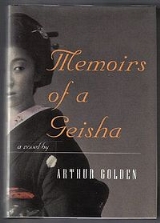
Memoirs of a Geisha is a novel by American author Arthur Golden
Arthur Golden
Arthur Golden is an American writer. He is the author of the bestselling novel Memoirs of a Geisha .Golden is a member of the Ochs-Sulzberger family . He was born in Chattanooga, Tennessee, grew up on Lookout Mountain, Georgia, and attended Lookout Mountain Elementary School in Lookout Mountain,...

, published in 1997. The novel, told in first person perspective
First-person narrative
First-person point of view is a narrative mode where a story is narrated by one character at a time, speaking for and about themselves. First-person narrative may be singular, plural or multiple as well as being an authoritative, reliable or deceptive "voice" and represents point of view in the...

, tells the fictional story of a geisha
Geisha
, Geiko or Geigi are traditional, female Japanese entertainers whose skills include performing various Japanese arts such as classical music and dance.-Terms:...

 working in Kyoto
Kyoto
is a city in the central part of the island of Honshū, Japan. It has a population close to 1.5 million. Formerly the imperial capital of Japan, it is now the capital of Kyoto Prefecture, as well as a major part of the Osaka-Kobe-Kyoto metropolitan area.-History:...

, Japan, before and after World War II
World War II
World War II, or the Second World War , was a global conflict lasting from 1939 to 1945, involving most of the world's nations—including all of the great powers—eventually forming two opposing military alliances: the Allies and the Axis...

. It contains many Japanese terms for aspects of the geisha culture, occasionally using the Kyoto counterparts.
Discussion
Ask a question about 'Memoirs of a Geisha'
Start a new discussion about 'Memoirs of a Geisha'
Answer questions from other users
Full Discussion Forum
 
Unanswered Questions
Quotations

A Memoirs of a Geisha (novel)|1997 novel by Arthur Golden|Arthur Golden

A Memoirs of a Geisha (film)|2005 film directed by Rob Marshall|Rob Marshall Category:Disambiguation pages|Memoirs of a Geisha

Encyclopedia
Memoirs of a Geisha is a novel by American author Arthur Golden
Arthur Golden
Arthur Golden is an American writer. He is the author of the bestselling novel Memoirs of a Geisha .Golden is a member of the Ochs-Sulzberger family . He was born in Chattanooga, Tennessee, grew up on Lookout Mountain, Georgia, and attended Lookout Mountain Elementary School in Lookout Mountain,...

, published in 1997. The novel, told in first person perspective
First-person narrative
First-person point of view is a narrative mode where a story is narrated by one character at a time, speaking for and about themselves. First-person narrative may be singular, plural or multiple as well as being an authoritative, reliable or deceptive "voice" and represents point of view in the...

, tells the fictional story of a geisha
Geisha
, Geiko or Geigi are traditional, female Japanese entertainers whose skills include performing various Japanese arts such as classical music and dance.-Terms:...

 working in Kyoto
Kyoto
is a city in the central part of the island of Honshū, Japan. It has a population close to 1.5 million. Formerly the imperial capital of Japan, it is now the capital of Kyoto Prefecture, as well as a major part of the Osaka-Kobe-Kyoto metropolitan area.-History:...

, Japan, before and after World War II
World War II
World War II, or the Second World War , was a global conflict lasting from 1939 to 1945, involving most of the world's nations—including all of the great powers—eventually forming two opposing military alliances: the Allies and the Axis...

. It contains many Japanese terms for aspects of the geisha culture, occasionally using the Kyoto counterparts.

Eight years later, in 2005, a film version
Memoirs of a Geisha (film)
Memoirs of a Geisha is a 2005 film adaptation of the novel of the same name, produced by Steven Spielberg's Amblin Entertainment and Spyglass Entertainment and by Douglas Wick's Red Wagon Productions. It was directed by Rob Marshall. It was released in the United States on December 9, 2005 by...

 starring Chinese actress Zhang Ziyi
Zhang Ziyi
Zhang Ziyi is a Chinese film actress. Zhang is coined by the media as one of the Four Young Dan actresses in the Film Industry in China, along with Zhao Wei, Xu Jinglei, and Zhou Xun...

 as the titular geisha was released.

Plot summary


The novel begins with an introductory note by the fictional translator, a New York University
New York University
New York University is a private, nonsectarian research university based in New York City. NYU's main campus is situated in the Greenwich Village section of Manhattan...

 professor named Jakob Haarhuis, who is the fictional author of the novel and has interviewed the retired geisha
Geisha
, Geiko or Geigi are traditional, female Japanese entertainers whose skills include performing various Japanese arts such as classical music and dance.-Terms:...

 Nitta Sayuri. She narrates in a flashback format with continuous references to the time between her career and the present.

Born Sakamoto Chiyo into the poverty-stricken fishing village of Yoroido on the coast of the Sea of Japan
Sea of Japan
The Sea of Japan is a marginal sea of the western Pacific Ocean, between the Asian mainland, the Japanese archipelago and Sakhalin. It is bordered by Japan, North Korea, Russia and South Korea. Like the Mediterranean Sea, it has almost no tides due to its nearly complete enclosure from the Pacific...

, she is sold into an okiya
Okiya
An is the lodging house in which a maiko or geisha lives during the length of her nenki, or contract or career as a geisha.A young woman's first step toward becoming a geisha is to be accepted into an okiya , a geisha house owned by the woman who will pay for her training. The proprietress of the...

 (a geisha boarding house) in Gion
Gion
is a district of Kyoto, Japan, originally developed in the Middle Ages, in front of Yasaka Shrine. The district was built to accommodate the needs of travelers and visitors to the shrine...

, the most prominent hanamachi
Hanamachi
A hanamachi is a Japanese courtesan and geisha district. The word's literal meaning is "flower street". Such districts would contain various okiya . Nowadays, the term hanamachi is commonly used in modern Japan to refer to the areas where modern-day okiya are still operating. In Kyoto's Gion...

 (geisha district) in Kyoto
Kyoto
is a city in the central part of the island of Honshū, Japan. It has a population close to 1.5 million. Formerly the imperial capital of Japan, it is now the capital of Kyoto Prefecture, as well as a major part of the Osaka-Kobe-Kyoto metropolitan area.-History:...

 when she is nine years old. Her mother is dying of what she suspects is bone cancer, and her father is very old and also believes death is coming. To Chiyo's dismay, her older sister Satsu is not sold into the Nitta okiya with her. Determined to run away, Chiyo remains in the okiya to begin training as a geisha, along with another young girl her age living in the same okiya, whom she (and everyone else) has nicknamed Pumpkin. The okiya is run by three women: the elderly and grumbling Granny, the money-obsessed Mother, the okiya's mistress, and Auntie, a failed geisha who trained alongside Mother as her "sister" and the only one of the three who is generally nice to Chiyo. It also houses just one geisha, the malicious Hatsumomo, who is also one of the most popular in Gion. Everyone is willing to overlook her cruelty (in particular towards Chiyo) because she serves as breadwinner for them, and Hatsumomo even uses Chiyo to her personal benefit, at one time blackmailing
Blackmail
In common usage, blackmail is a crime involving threats to reveal substantially true or false information about a person to the public, a family member, or associates unless a demand is met. It may be defined as coercion involving threats of physical harm, threat of criminal prosecution, or threats...

 her by withholding her sister Satsu's whereabouts. She makes Chiyo swear her loyalty to her, letting her take the blame for a ruined kimono
Kimono
The is a Japanese traditional garment worn by men, women and children. The word "kimono", which literally means a "thing to wear" , has come to denote these full-length robes...

 and even accusing her of stealing a brooch
Brooch
A brooch ; also known in ancient times as a fibula; is a decorative jewelry item designed to be attached to garments. It is usually made of metal, often silver or gold but sometimes bronze or some other material...

. These add to Chiyo's debts considerably, on top of the fees paid for her acceptance into the okiya, her lessons and food among others. This only strengthens Chiyo's desire to leave, and she manages to find her sister, who has been sold as a prostitute and is also desperate to run away. Days before her escape, however, Mother learns (from Chiyo) that Hatsumomo has been hosting a boyfriend in the okiya for some time now – something that is forbidden among geisha – and the okiya doors are locked at night as a consequence. Chiyo decides to escape via the roof, but fails and ends up breaking her arm, as well as immediately ceasing to be a geisha-in-training for dishonoring her okiya, reduced to being a maid.

A few years after this, Chiyo, crying in the street, is noticed by a man whom she immediately never forgets, giving her his handkerchief and money to buy shave ice
Shave ice
Shave ice or Hawaiian shave ice is an ice-based dessert made by shaving a block of ice. While the product can resemble a snow cone, snow cones are made with crushed, rather than shaved, ice....

. Despite the change being enough to facilitate her escape once and for all, she donates it to the Gion Shrine
Yasaka Shrine
', once called , is a Shinto shrine in the Gion District of Kyoto, Japan. Situated at the east end of Shijō-dōri , the shrine includes several buildings, including gates, a main hall and a stage.-History:...

, praying to become a geisha in the hopes of seeing him again. Several years pass and Pumpkin becomes a geisha on her own under Hatsumomo's tutelage, while Chiyo remains a maid. However, she is unexpectedly taken in as a protégé by Mameha, the owner of the kimono Hatsumomo previously made Chiyo ruin and one of the very top geisha in all of Japan. Mameha persuades Mother to reinvest into Chiyo's training, and Chiyo becomes the geisha Sayuri, with Mameha as her "older sister" (mentor).

After she embarrasses Hatsumomo in a joke during an informal party, the latter uses her influence to sabotage Sayuri by spreading rumors and trailing her and Mameha from party to party. Mameha insists that she must create a plan to keep Hatsumomo out forever lest Sayuri's career ultimately die, and so arranges for her mizuage
Mizuage
was a ceremony undergone by a Japanese maiko to signify her coming of age. When the older geisha considered the young maiko ready to come of age, the topknot of her hair was symbolically cut...

(portrayed as a deflowering "ceremony" for maiko as a step to becoming full-fledged geisha) to be bidden upon by several influential men, namely Nobu Toshikazu, the president of the Iwamura Eletric Company in the novel; and reputed mizuage specialist "Dr. Crab", dubbed so by Sayuri due to his appearance. From Sayuri's point of view, the Chairman does not recognize her, but treats her with kindness; and as he is Nobu's business partner with a relationship known across the country, he would never bid against him for her mizuage. Unfortunately, Hatsumomo somehow learns that Mameha has something going on (although Sayuri herself is still unaware at this point of the plan), and ruins the image Dr. Crab has of her. It takes some amount of convincing from Mameha and Sayuri's combined efforts to enlighten Dr. Crab on this matter. Ultimately, he wins the bid for Sayuri's mizuage, paying a record sum that is enough to more than repay all of Sayuri's debts to Mother. This leads the latter, who had already been considering adopting Pumpkin as her heiress, to adopt Sayuri instead, ultimately destroying the two girls' friendship – Pumpkin was looking forward to the adoption so that she could have some kind of security in her old age. Hatsumomo, on the other hand, starts to spiral downward, now that she is no longer in favor, and is eventually thrown out of the okiya.

Nobu, on the other hand, bids to become Sayuri's danna (principal patron with a role akin to a husband), but loses to an army general. This, Mother believes, is because of the current political climate – Japan is on the brink of entering World War II
World War II
World War II, or the Second World War , was a global conflict lasting from 1939 to 1945, involving most of the world's nations—including all of the great powers—eventually forming two opposing military alliances: the Allies and the Axis...

. When the war breaks out, many Geisha are evacuated to other cities to work in the factories. This is as good as a death sentence, as the factories require hard labor and are targets for bombs. Also, subsequently, the General is demoted and is unable to use any influence to send Sayuri to a safer spot. However, help unexpectedly arrives in the form of Nobu, who sends her far north to a kimono maker. Nonetheless, Sayuri and those close to her must endure a life of hard labor during the war that follows. After the end of the war, Nobu visits Sayuri and asks that she return to Gion, whose doors have opened again, to help entertain the new Deputy Minister Sato, whose aid can be instrumental in saving Iwamura Electric, the company the Chairman founded and Nobu runs, which was all but destroyed during the war.

Sayuri, Mameha and Pumpkin entertain the Minister together regularly. Some time after, Nobu formally begins proposals to become Sayuri's danna, leaving her in despair because this would mean the end of any hopes to a relationship with the Chairman. On a weekend trip to the Amami Islands
Amami Islands
The are a group of islands that is part of the Satsunan Islands, which are then part of the Nansei Islands. The islands are part of Kagoshima Prefecture, in the Kyūshū region of Japan...

 with Iwamura Electric, Sayuri devises a plan to humiliate herself with the Minister in front of Nobu, who, she is sure, will never forgive her for being with the Minister (whom Nobu despises despite his need of help from him). She arranges for Pumpkin to bring Nobu to a place where he will "stumble" upon Sayuri and the Minister making love. However, Pumpkin still harbors resentment towards Sayuri's adoption, and knows she is fond of the Chairman. She brings the Chairman to the theater instead of Nobu. Humiliated, Sayuri believes that her dream of being with the Chairman is lost forever, but afterwards, she receives a call to meet with Iwamura Electric. She is saddened as she anticipates meeting Nobu and discussing his patronage, but is surprised when the Chairman shows up rather than Nobu. Sayuri reveals that her acts in Amami were for personal reasons. The Chairman, in turn, expands on his feelings of debt toward and friendship with Nobu, and how he was not able to take away the woman his friend showed so much interest in. When he learned through Pumpkin that Sayuri's intention was for Nobu to see her with the Minister, he decided to tell Nobu what he had seen. The latter refuses to ever see Sayuri again, therefore freeing the Chairman to advance. She and the Chairman kiss, Sayuri's first kiss of true love.

The story ends with Sayuri recounting her subsequent life with the Chairman as her danna, and her eventual retirement as a geisha. She never freely admits that she has a son with the Chairman, but speaks of moving to New York City in order to avoid complications regarding inheritance of Iwamura Electric. The story concludes with a reflection on her life in New York and the important people in her life.

Controversy


After the Japanese edition of the novel was published, Arthur Golden was sued for breach of contract and defamation of character by Mineko Iwasaki
Mineko Iwasaki
, born , was Japan's number one geiko until her sudden retirement at the age of 29. Arthur Golden later used her story to write the book Memoirs of a Geisha.-Geisha:...

, a retired geisha he had interviewed for background information while writing the novel. The plaintiff asserted that Golden had agreed to protect her anonymity, due to the traditional code of silence about their clients, if she told him about her life as a geisha. However, Golden listed Iwasaki as a source in his acknowledgments for the novel, causing her to face a serious backlash, to the point of death threats. In his behalf, Arthur Golden countered that he had tapes of his conversations with Iwasaki. Eventually, in 2003, Golden's publisher settled with Iwasaki out of court for an undisclosed sum of money.

Iwasaki later went on to write her own autobiography, which shows a very different picture of twentieth-century geisha life than the one shown in Golden's novel. The book was published as Geisha, a Life in the U.S. and Geisha of Gion in the U.K.

Film version


In 2005, film director Rob Marshall
Rob Marshall
Rob Marshall is an American theater director, film director and choreographer. He is a six-time Tony Award nominee, Academy Award nominee, Golden Globe nominee and four-time Emmy winner whose most noted work is the 2002 Academy Award for Best Picture winner Chicago.-Life and career:Marshall was...

 made a film version of the novel. It stars the Chinese actresses Zhang Ziyi
Zhang Ziyi
Zhang Ziyi is a Chinese film actress. Zhang is coined by the media as one of the Four Young Dan actresses in the Film Industry in China, along with Zhao Wei, Xu Jinglei, and Zhou Xun...

 as Sayuri, Gong Li
Gong Li
Gong Li is a Chinese film actress. Gong first came into international prominence through close collaboration with Chinese director Zhang Yimou and is credited with helping to bring Chinese cinema to Europe and the United States....

 as Hatsumomo, and Michelle Yeoh
Michelle Yeoh
Michelle Yeoh Choo-Kheng is a Hong Kong-based Malaysian Chinese actress, well known for performing her own stunts in the action films that brought her to fame in the early 1990s....

 (who is Malaysian Chinese
Malaysian Chinese
Malaysian Chinese is a Malaysian of Chinese origin. Most are descendants of Chinese who arrived between the fifteenth and the mid-twentieth centuries. Within Malaysia, they are usually simply referred to as "Chinese" in all languages. The term Chinese Malaysian is also sometimes used to refer to...

) as Mameha; and Japanese actors Ken Watanabe
Ken Watanabe
is a Japanese stage, film, and television actor. To English-speaking audiences he is known for playing tragic hero characters, such as General Tadamichi Kuribayashi in Letters from Iwo Jima and Lord Katsumoto Moritsugu in The Last Samurai, for which he was nominated for the Academy Award for Best...

 as the Chairman, Suzuka Ohgo
Suzuka Ohgo
is an award-winning Japanese child actress. Besides acting, she is also attending school and has a variety of hobbies including classical ballet, Japanese tea ceremony, ikebana, rollerblading, snowboarding, playing the piano, and skiing. She is represented by CATAMARAN.-Biography:Ohgo began acting...

 as Sayuri's childhood incarnation Chiyo, and Youki Kudoh
Youki Kudoh
is a Japanese actress and singer. She won the award for best newcomer at the 6th Yokohama Film Festival for The Crazy Family. She also won the award for best actress at the 16th Hochi Film Award for War and Youth.-Filmography:-External links:* *...

 as the adult Pumpkin.

Filming was primarily done in California, and in some locations in Kyoto, including Kiyomizu-dera
Kiyomizu-dera
, officially is an independent Buddhist temple in eastern Kyoto. The temple is part of the Historic Monuments of Ancient Kyoto UNESCO World Heritage site...

 and Fushimi Inari-taisha
Fushimi Inari-taisha
is the head shrine of Inari, located in Fushimi-ku, Kyoto, Japan. The shrine sits at the base of a mountain also named Inari, and includes trails up the mountain to many smaller shrines....

. It was nominated for and won numerous awards, including nominations for six Academy Awards
78th Academy Awards
The 78th Academy Awards honored the best films of 2005 and were held on March 5, 2006, at the Kodak Theatre in Hollywood, California. They were hosted by The Daily Show host Jon Stewart, with Tom Kane making his first appearance as the show's announcer...

, three of which – Best Cinematography
Academy Award for Best Cinematography
The Academy Award for Best Cinematography is an Academy Award awarded each year to a cinematographer for work in one particular motion picture.-History:...

, Best Art Direction
Academy Award for Best Art Direction
The Academy Awards are the oldest awards ceremony for achievements in motion pictures. The Academy Award for Best Art Direction recognizes achievement in art direction on a film. The films below are listed with their production year, so the Oscar 2000 for best art direction went to a film from 1999...

 and Best Costume Design – were won.

Marshall was criticised in Japan for choosing a Chinese actress rather than a Japanese one for a role having so much to do with traditional Japanese culture.

See also


  • Geisha
    Geisha
    , Geiko or Geigi are traditional, female Japanese entertainers whose skills include performing various Japanese arts such as classical music and dance.-Terms:...

  • Oiran
    Oiran
    were courtesans in Japan. The oiran were considered a type of "woman of pleasure" or prostitute. However, they are distinguished from the yūjo in that they were entertainers, and many became celebrities of their times outside the pleasure districts...

  • Shirabyoshi
    Shirabyoshi
    were female dancers, prominent in the Japanese Imperial Court, who performed traditional Japanese dances dressed as men. The profession of shirabyōshi developed in the 12th century...