


Onsen

Encyclopedia
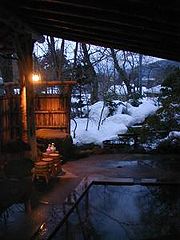
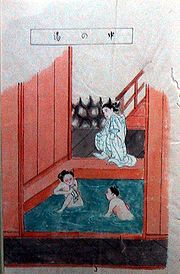
Hot spring
A hot spring is a spring that is produced by the emergence of geothermally heated groundwater from the Earth's crust. There are geothermal hot springs in many locations all over the crust of the earth.-Definitions:...
s in the Japanese language
Japanese language
is a language spoken by over 130 million people in Japan and in Japanese emigrant communities. It is a member of the Japonic language family, which has a number of proposed relationships with other languages, none of which has gained wide acceptance among historical linguists .Japanese is an...
, though the term is often used to describe the bathing facilities and inns around the hot springs. As a volcanically active country, Japan has thousands of onsen scattered along its length and breadth. Onsen were traditionally used as public bathing
Public bathing
Public baths originated from a communal need for cleanliness. The term public may confuse some people, as some types of public baths are restricted depending on membership, gender, religious affiliation, or other reasons. As societies have changed, public baths have been replaced as private bathing...
places and today play a central role in directing Japanese domestic tourism.
Onsen come in many types and shapes, including and indoor baths. Baths may be either public run by a municipality or often run as part of a hotel, ryokan or .
Onsen are a central feature of Japanese tourism often found out in the countryside but there are a number of popular establishments still found within major cities. They are a major tourist attraction drawing Japanese couples, families or company groups who want to get away from the hectic life of the city to relax. Japanese often talk of the virtues of for breaking down barriers and getting to know people in the relaxed homey atmosphere of a ryokan with an attached onsen. Japanese television channels often feature special programs about local onsens.
The presence of an onsen is often indicated on signs and maps by the symbol ♨ or the kanji
Kanji
Kanji are the adopted logographic Chinese characters hanzi that are used in the modern Japanese writing system along with hiragana , katakana , Indo Arabic numerals, and the occasional use of the Latin alphabet...
, (yu, meaning "hot water"). Sometimes the simpler hiragana
Hiragana
is a Japanese syllabary, one basic component of the Japanese writing system, along with katakana, kanji, and the Latin alphabet . Hiragana and katakana are both kana systems, in which each character represents one mora...
character ゆ (yu) is used, to be understandable to younger children.
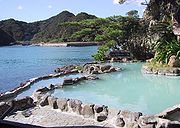
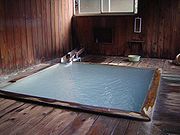
Sento
is a type of Japanese communal bath house where customers pay for entrance. Traditionally these bath houses have been quite utilitarian, with one large room separating the sexes by a tall barrier, and on both sides, usually a minimum of lined up faucets and a single large bath for the already...
, indoor public bath houses where the baths are filled with heated tap water. The legal definition of an onsen includes that its water must contain at least one of 19 designated chemical elements, including radon and metabolic acid and be 25 °C or warmer before being reheated. Stratifications exist for waters of different temperatures. Major onsen resort hotels often feature a wide variety of themed spa baths
Public bathing
Public baths originated from a communal need for cleanliness. The term public may confuse some people, as some types of public baths are restricted depending on membership, gender, religious affiliation, or other reasons. As societies have changed, public baths have been replaced as private bathing...
and artificial waterfalls in the bathing area .
Onsen water is believed to have healing powers derived from its mineral content. A particular onsen may feature several different baths, each with water with a different mineral composition. The outdoor bath tubs are most often made from Japanese cypress
Chamaecyparis obtusa
Chamaecyparis obtusa is a species of cypress native to central Japan.It is a slow-growing tree which grows to 35 m tall with a trunk up to 1 m in diameter. The bark is dark red-brown...
, marble
Marble
Marble is a metamorphic rock composed of recrystallized carbonate minerals, most commonly calcite or dolomite.Geologists use the term "marble" to refer to metamorphosed limestone; however stonemasons use the term more broadly to encompass unmetamorphosed limestone.Marble is commonly used for...
or granite
Granite
Granite is a common and widely occurring type of intrusive, felsic, igneous rock. Granite usually has a medium- to coarse-grained texture. Occasionally some individual crystals are larger than the groundmass, in which case the texture is known as porphyritic. A granitic rock with a porphyritic...
, while indoor tubs may be made with tile
Tile
A tile is a manufactured piece of hard-wearing material such as ceramic, stone, metal, or even glass. Tiles are generally used for covering roofs, floors, walls, showers, or other objects such as tabletops...
, acrylic glass
Acrylic glass
Poly is a transparent thermoplastic, often used as a light or shatter-resistant alternative to glass. It is sometimes called acrylic glass. Chemically, it is the synthetic polymer of methyl methacrylate...
or stainless steel
Stainless steel
In metallurgy, stainless steel, also known as inox steel or inox from French "inoxydable", is defined as a steel alloy with a minimum of 10.5 or 11% chromium content by mass....
. Different onsen also boast about their different waters or mineral compositions, plus what healing properties these may contain. Other services like massages may be offered.
Traditionally, men and women bathed together at the onsen and sentō but single-sex bathing has become legalized as the norm since the opening of Japan to the West during the Meiji period
Meiji period
The , also known as the Meiji era, is a Japanese era which extended from September 1868 through July 1912. This period represents the first half of the Empire of Japan.- Meiji Restoration and the emperor :...
. Mixed bathing
Mixed bathing
Mixed bathing is a term that refers to members of the opposite gender swimming together in the same pool. In ancient Rome, mixed bathing was never the rule in public installations, although it did occur in private facilities. Today, in Japan, the practice is not common...
persists at some special onsen (konyoku) in the rural areas of Japan, which usually also provide the option of separate "women-only" baths or different hours for the two sexes. Children of either sex may be seen in both the men's and the women's baths.
People often travel to onsen with work colleagues, friends, couples or their families.
Ensuring cleanliness
At an onsen, as at a sentōSento
is a type of Japanese communal bath house where customers pay for entrance. Traditionally these bath houses have been quite utilitarian, with one large room separating the sexes by a tall barrier, and on both sides, usually a minimum of lined up faucets and a single large bath for the already...
, all guests are expected to wash their bodies and rinse themselves thoroughly before entering the hot water. Bathing stations are equipped with stools, faucets, wooden buckets, and toiletries such as soap and shampoo; nearly all onsen also provide removable shower heads for bathing convenience. Entering the onsen while still dirty or with traces of soap on the body is socially unacceptable.
Swimsuits
Bathers are not normally allowed to wear swimsuits in the baths. However, some modern onsen with more of a waterpark atmosphere require their guests to wear a swimming suit in their mixed baths.Towels
Onsen guests generally bring a small towel with them to use as a wash cloth. The towel can also provide a modicum of modestyModesty
Standards of modesty are aspects of the culture of a country or people, at a given point in time, and is a measure against which an individual in society may be judged....
when walking between the washing area and the baths. Some onsen allow one to wear the towel into the baths, while others have posted signs prohibiting this, saying that it makes it harder to clean the bath. It is sometimes against the rules to immerse or dip towels in the onsen bath water, since this can be considered unclean. In this latter case, people normally set their towels off to the side of the water when enjoying the baths, or place their folded towels on top of their heads.
Noise
Onsen vary from quiet to noisy, some play piped music and often feature gushing fountainFountain
A fountain is a piece of architecture which pours water into a basin or jets it into the air either to supply drinking water or for decorative or dramatic effect....
s. Bathers will engage in conversation in this relaxed situation. There are usually prohibitions against rowdiness in the washing and bathing areas. A small amount of excess energy and splashing around is usually tolerated from children, however.
Tattoos
Many onsen ban bathers with tattooTattoo
A tattoo is made by inserting indelible ink into the dermis layer of the skin to change the pigment. Tattoos on humans are a type of body modification, and tattoos on other animals are most commonly used for identification purposes...
s, which in Japan are traditionally perceived as a badge of criminality—Yakuza
Yakuza
, also known as , are members of traditional organized crime syndicates in Japan. The Japanese police, and media by request of the police, call them bōryokudan , literally "violence group", while the yakuza call themselves "ninkyō dantai" , "chivalrous organizations". The yakuza are notoriously...
traditionally have elaborate tattoos. Despite this background reason, the rule is often enforced strictly against all, including foreigners, women, and even when tattoos are small and "peaceful".
Therapy
The volcanic nature of Japan provides plenty of springs. When the onsen's water contains distinctive minerals or chemicals, the onsen establishments display what type of onsen it is.Some examples of types of onsen include:
In Japan, it is said onsen have various medical effects. Japanese people believe that a good soak in proper onsen heals aches, pains and diseases, and visit onsen to treat the illnesses, such as arthralgia, chronic skin diseases, diabetes, constipation, menstrual disorders and so on.
These medical benefits have given onsen a central role in balneotherapy
Balneotherapy
Balneotherapy is the treatment of disease by bathing, usually practiced at spas. While it is considered distinct from hydrotherapy, there are some overlaps in practice and in underlying principles. Balneotherapy may involve hot or cold water, massage through moving water, relaxation or stimulation...
which is called . Onsen Therapy is a comprehensive bathing treatment conducted to maintain health, normalize dysfunctions and prevent illness.
Risks
Although millions of Japanese bathe in onsen every year with few noticeable side effects, there are still contraindications to onsen usage, such as high blood pressure or heart disease.In recent years, Legionella
Legionella
Legionella is a pathogenic Gram negative bacterium, including species that cause legionellosis or Legionnaires' disease, most notably L. pneumophila. It may be readily visualized with a silver stain....
bacteria have been found sporadically in onsen with poor sanitation. Revelations of poor sanitary practices at some onsen have led to improved regulation by hot spring communities to maintain their reputation.
There have been reports of infectious disease found in hot bodies of water worldwide, such as:
- Various NaegleriaNaegleriaNaegleria is a eukaryotic genus. The genus was named after French zoologist Mathieu Naegler.Species include:* Naegleria fowleri, which causes a rare and generally fatal disease in humans* Naegleria gruberi-External links:...
species. While studies have found the presence of Naegleria in hot spring waters, the worrisome Naegleria fowleriNaegleria fowleriNaegleria fowleri is a free-living excavate form of protist typically found in warm bodies of fresh water, such as ponds, lakes, rivers, and hot springs. It is also found in soil, near warm-water discharges of industrial plants, and unchlorinated swimming pools in an amoeboid or temporary...
amoeba has not been identified. Nevertheless, less than 5 cases have been seen historically in Japan, although not conclusively linked to onsen exposure.
Many onsen have posted notices for visitors, reminding anyone with open cuts, sores, or lesions to not bathe. Additionally, in recent years onsen are increasingly adding chlorine to their waters to prevent infection, although many onsen purists seek natural, unchlorinated onsen that instead does not recycle its water, cleaning baths daily. These precautions as well as proper onsen usage (i.e. not placing the head underwater, washing thoroughly before entering the bath) greatly reduces any overall risk to bathers.
Incidents
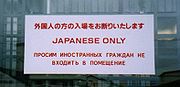
Otaru, Hokkaido
is a city and port in Shiribeshi, Hokkaido, Japan, northwest of Sapporo. The city faces the Ishikari Bay, and has long served as the main port of the bay. With its many historical buildings, Otaru is a popular tourist destination...
referred to incidents of rowdy Russian fishermen bothering other customers and causing lost businesses as reason to refuse service to anyone not Japanese. This issue was highlighted in February 2001, when naturalized-Japanese Debito Arudou and two co-plaintiffs sued Yunohana Onsen in Otaru, Hokkaidō
Otaru, Hokkaido
is a city and port in Shiribeshi, Hokkaido, Japan, northwest of Sapporo. The city faces the Ishikari Bay, and has long served as the main port of the bay. With its many historical buildings, Otaru is a popular tourist destination...
, for openly refusing service to customers because of their race. Yunohana Onsen lost the lawsuit in November 2002.
In another case of discrimination, Kurokawa Onsen Hotel in Kumamoto Prefecture
Kumamoto Prefecture
is a prefecture of Japan located on Kyushu Island. The capital is the city of Kumamoto.- History :Historically the area was called Higo Province; and the province was renamed Kumamoto during the Meiji Restoration. The creation of prefectures was part of the abolition of the feudal system...
ran into legal trouble when leprosy patients were refused entry. Leprosy
Leprosy
Leprosy or Hansen's disease is a chronic disease caused by the bacteria Mycobacterium leprae and Mycobacterium lepromatosis. Named after physician Gerhard Armauer Hansen, leprosy is primarily a granulomatous disease of the peripheral nerves and mucosa of the upper respiratory tract; skin lesions...
is not contagious once treated, and laws that used to force seclusion on leprosy patients have long been overturned.
Out of the thousands of onsen in operation in Japan, there have been few reports of businesses practicing discrimination of this kind.
Selected onsen
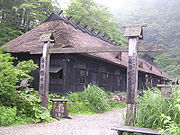
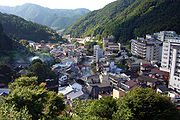
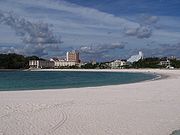
- AkagiAkagi, GunmaAkagi was a village located in Seta District, Gunma, Japan.On February 20, 2006 Akagi, along with the town of Ikaho, the villages of Komochi and Onogami, all from Kitagunma District, and the village of Kitatachibana, also from Seta District, was merged into the expanded city of Shibukawa.As of...
, GunmaGunma Prefectureis a prefecture of Japan located in the northwest corner of the Kantō region on Honshu island. Its capital is Maebashi.- History :The remains of a Paleolithic man were found at Iwajuku, Gunma Prefecture, in the early 20th century and there is a public museum there.Japan was without horses until... - Akayu, Yamagata
- Arima OnsenArima Onsenis an onsen, or hot springs in Kita-ku, Kobe, Japan. This Onsen is still a hidden treasure of modern Kobe, behind Mount Rokko. It attracts many Japanese who want tranquility with beautiful natural surroundings and yet easy access from the busy cities in Kansai metropolitan area including...
(:ja:有馬温泉), KobeKobe, pronounced , is the fifth-largest city in Japan and is the capital city of Hyōgo Prefecture on the southern side of the main island of Honshū, approximately west of Osaka...
, Hyōgo, one of the most famous onsen outside Japan, in Kobe - Asamushi OnsenAsamushi Onsenis an onsen resort in the city of Aomori, Aomori Prefecture.-Transportation:The resort is served by Asamushi-Onsen Station on the Tōhoku Main Line. Guests arriving by automobile can take Route 4; the trip from the center of Aomori takes about 30 minutes.-Resort:Two attractions include the Asamushi...
(:ja:浅虫温泉), AomoriAomori Prefectureis a prefecture of Japan located in the Tōhoku Region. The capital is the city of Aomori.- History :Until the Meiji Restoration, the area of Aomori prefecture was known as Mutsu Province.... - AsoAso, Kumamotois a city located in Kumamoto Prefecture, Japan.The city was formed on February 11, 2005 from the merger of the former town of Aso with the town of Ichinomiya, and the village of Namino, all from Aso District....
, Kumamoto, a famous Onsen area alongside Mount AsoMount Asois the largest active volcano in Japan, and is among the largest in the world. It stands in Aso Kujū National Park in Kumamoto Prefecture, on the island of Kyūshū. Its peak is 1592 m above sea level. Aso has one of the largest caldera in the world...
, an active volcano - Atami Onsen (:ja:熱海温泉), Atami, Shizuoka, major onsen resort town near Tokyo
- Dōgo OnsenDogo Onsenis a hot spring in the city of Matsuyama, Ehime Prefecture on the island of Shikoku, Japan.-History:Dōgo Onsen is one of the oldest onsen hot springs in Japan, with a history stretching back over 1,000 years. The springs are mentioned in the Man'yōshū is a hot spring in the city of Matsuyama,...
(:ja:道後温泉), EhimeEhime Prefectureis a prefecture in northwestern Shikoku, Japan. The capital is Matsuyama.-History:Until the Meiji Restoration, Ehime prefecture was known as Iyo Province... - Futamata, Hokkaidō
- GeroGero, Gifuis a city in Gifu Prefecture, Japan. The city is famous for its hot springs. The Hida River runs throughout the city.-History:The city was established on March 1, 2004 by the merger of the towns of Gero, Hagiwara, Kanayama and Osaka, and the village of Maze, all from Mashita...
, GifuGifu Prefectureis a prefecture located in the Chūbu region of central Japan. Its capital is the city of Gifu.Located in the center of Japan, it has long played an important part as the crossroads of Japan, connecting the east to the west through such routes as the Nakasendō...
- famous for its free open bath on riverbank of Hida RiverHida RiverThe has its source in Mount Norikura in Takayama, Gifu Prefecture, Japan. It flows from the northern to the southern section of the prefecture before emptying into the Kiso River in Minokamo.-River communities:... - Getō Onsen (:ja:夏油温泉), IwateIwate Prefectureis the second largest prefecture of Japan after Hokkaido. It is located in the Tōhoku region of Honshū island and contains the island's easternmost point. The capital is Morioka. Iwate has the lowest population density of any prefecture outside Hokkaido...
- Ginzan OnsenGinzan OnsenGinzan Onsen is an onsen area in Obanazawa, Yamagata Prefecture, Japan. Its name, meaning "silver mountain", It became nationally famous as the setting for the television drama Oshin.Fossils from the Miocene era have been found in the vicinity....
(:ja:銀山温泉), Obanazawa, Yamagata - Hakone, KanagawaKanagawa Prefectureis a prefecture located in the southern Kantō region of Japan. The capital is Yokohama. Kanagawa is part of the Greater Tokyo Area.-History:The prefecture has some archaeological sites going back to the Jōmon period...
, famous onsen resort town near Tokyo - HanamakiHanamaki, Iwateis a city located in Iwate Prefecture, Japan. As of March 31, 2011, the city has an estimated total population of 102,455, with a household number of 35,831. Hanamaki is most famous as the birthplace of Kenji Miyazawa and for its onsen. The city recently celebrated the 50th anniversary since its...
, Iwate - Hirayu Onsen (:ja:平湯温泉), Takayama, Gifu
- Hokkawa Onsen (:ja:北川温泉 (静岡県)), Shizuoka
- Ibusuki OnsenIbusuki Onsenis a group of hot springs in the east of Ibusuki, Kagoshima in Japan, which includes Surigahama Onsen, Yajigayu Onsen, and Nigatsuden Onsen.2,850,000 people visited in 2003, and 910,000 people stayed there.90% of the water is used for industry.-Access:...
, KagoshimaKagoshima Prefectureis a prefecture of Japan located on the island of Kyushu. The capital is the city of Kagoshima.- Geography :Kagoshima Prefecture is located at the southwest tip of Kyushu and includes a chain of islands stretching further to the southwest for a few hundred kilometers... - ItōIto, Shizuokais a city located on the eastern shore of the Izu Peninsula in Shizuoka, Japan. As of 2010, the city had an estimated population of 71,400 and the density of 578 persons per km². The total area was...
, ShizuokaShizuoka Prefectureis a prefecture of Japan located in the Chūbu region on Honshu island. The capital is the city of Shizuoka.- History :Shizuoka prefecture was formed from the former Tōtōmi, Suruga and Izu provinces.The area was the home of the first Tokugawa Shogun... - IwamuroIwamuro, Niigatawas a village located in the former Nishikanbara District, Niigata, Japan. The area is famous for onsen near Yahiko mountain. Farming remains the predominant industry in the area...
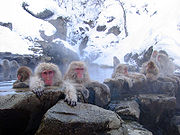
, Niigata, famous for onsen since the Edo periodEdo periodThe , or , is a division of Japanese history which was ruled by the shoguns of the Tokugawa family, running from 1603 to 1868. The political entity of this period was the Tokugawa shogunate.... - JigokudaniJigokudani Monkey ParkJigokudani Monkey Park is in Yamanouchi, Shimotakai District, Nagano Prefecture, Japan at . It is part of the Joshinetsu Kogen National Park , and is located in the valley of the Yokoyu-River, in the northern part of the prefecture...
, NaganoNagano Prefectureis a prefecture of Japan located in the Chūbu region of the island of Honshū. The capital is the city of Nagano.- History :Nagano was formerly known as the province of Shinano... - Jōzankei Onsen (:ja:定山渓温泉), Hokkaidō
- Kakeyu Onsen (:ja:下鹿教湯温泉), Nagano
- Kanzanji Onsen (:ja:舘山寺温泉), Shizuoka
- Kindaichi Onsen, Iwate
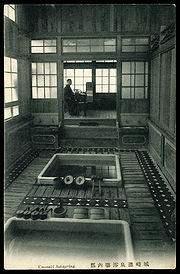
- KinosakiKinosaki, Hyogowas a town located in Kinosaki District, Hyōgo, Japan.On April 1, 2005 Kinosaki, along with the towns of Hidaka and Takeno, all from Kinosaki District, and the towns of Izushi and Tantō, both from Izushi District, was merged into the expanded city of Toyooka and no longer exists as an independent...
(:ja:城崎温泉), Hyōgo - Kinugawa Onsen, Tochigi
- Kurokawa Onsen Village, Kumamoto
- Kusatsu Onsen (:ja:草津温泉), Gunma, one of the most famous onsen outside Japan
- Nagaragawa OnsenNagaragawa OnsenThe are a group of onsen located along the banks of the Nagara River in Gifu, Gifu Prefecture, Japan. The source of the onsen are in the northern part of the city near the Mitabora Shinbutsu Onsen...
, GifuGifu, Gifuis a city located in the south-central portion of Gifu Prefecture, Japan, and serves as the prefectural capital. The city has played an important role in Japan's history because of its location in the middle of the country. During the Sengoku period, various warlords, including Oda Nobunaga, used...
, Gifu - SawatariNakanojo, Gunmais a town located in Agatsuma District, Gunma, Japan.As of July 1, 2011, the town has an estimated population of 17,931 and a population density of 40.8 persons per km². There are a total of 6,059 households in town. The total area is 439.28 km² and an elevation of 400 m above sea level. The town's...
, Gunma - ShimaNakanojo, Gunmais a town located in Agatsuma District, Gunma, Japan.As of July 1, 2011, the town has an estimated population of 17,931 and a population density of 40.8 persons per km². There are a total of 6,059 households in town. The total area is 439.28 km² and an elevation of 400 m above sea level. The town's...
, Gunma - NarukoNaruko, Miyagiis a former town located in Tamatsukuri District, Miyagi, Japan.On March 31, 2006, Naruko was merged with the town of Iwadeyama, from Tamatsukuri District, the towns of Kashimadai, Matsuyama and Sanbongi, all from Shida District, the town of Tajiri, from Tōda District, and the city of Furukawa to...
, MiyagiMiyagi Prefectureis a prefecture of Japan in the Tōhoku Region on Honshu island. The capital is Sendai.- History :Miyagi Prefecture was formerly part of the province of Mutsu. Mutsu Province, on northern Honshu, was one of the last provinces to be formed as land was taken from the indigenous Emishi, and became the... - Noboribetsu, Hokkaidō
- Nuruyu Onsen, KumamotoKumamoto Prefectureis a prefecture of Japan located on Kyushu Island. The capital is the city of Kumamoto.- History :Historically the area was called Higo Province; and the province was renamed Kumamoto during the Meiji Restoration. The creation of prefectures was part of the abolition of the feudal system...
- Nyūtō Onsen (:ja:乳頭温泉郷), AkitaAkita Prefectureis a prefecture of Japan located in the Tōhoku Region of northern Honshu, the main island of Japan. The capital is the city of Akita.- History :The area of Akita has been created from the ancient provinces of Dewa and Mutsu....
- Onneyu Onsen (:ja:温根湯温泉), Hokkaidō
- Sabakoyu OnsenSabakoyu OnsenThe Sabakoyu Onsen in Iizaka, Fukushima Prefecture, Japan is the oldest community onsen in the country. Sabakoyu Onsen was originally spelled 佐波来湯 when, according to legend, Yamato Takeru, prince of the Yamato dynasty and son of Keikō of Yamato, the 12th Emperor of Japan, visited the area and...
, FukushimaFukushima Prefectureis a prefecture of Japan located in the Tōhoku region on the island of Honshu. The capital is the city of Fukushima.-History:Until the Meiji Restoration, the area of Fukushima prefecture was known as Mutsu Province....
, the oldest community onsen in Japan - Sakunami Onsen, Miyagi
- Senami Onsen (:ja:瀬波温泉), NiigataNiigata Prefectureis a prefecture of Japan located on the island of Honshū on the coast of the Sea of Japan. The capital is the city of Niigata. The name "Niigata" literally means "new lagoon".- History :...
- ShimabaraShimabara, Nagasakiis a city located on the north-eastern tip of the Shimabara Peninsula, facing Ariake Bay in the east and Mount Unzen in the west, in Nagasaki Prefecture, Kyūshū, Japan.-History:...
, NagasakiNagasaki Prefectureis a prefecture of Japan located on the island of Kyūshū. The capital is the city of Nagasaki.- History :Nagasaki Prefecture was created by merging of the western half of the former province of Hizen with the island provinces of Tsushima and Iki... - Shimobe Onsen (:ja:下部温泉), YamanashiYamanashi Prefectureis a prefecture of Japan located in the Chūbu region of the island of Honshū. The capital is the city of Kōfu.-Pre-history to the 14th century:People have been living in the Yamanashi area for about 30,000 years...
- Shiobara Onsen (:ja:塩原温泉郷), TochigiTochigi Prefectureis a prefecture located in the Kantō region on the island of Honshū, Japan. The capital is the city of Utsunomiya.Nikkō, whose ancient Shintō shrines and Buddhist temples UNESCO has recognized by naming them a World Heritage Site, is in this prefecture...
- Shuzenji Onsen (:ja:修善寺温泉), Shizuoka
- Sōunkyo Onsen (:ja:層雲峡温泉), HokkaidōHokkaido, formerly known as Ezo, Yezo, Yeso, or Yesso, is Japan's second largest island; it is also the largest and northernmost of Japan's 47 prefectural-level subdivisions. The Tsugaru Strait separates Hokkaido from Honshu, although the two islands are connected by the underwater railway Seikan Tunnel...
- Sukayu Onsen, Aomori
- Sumatakyō Onsen (:ja:寸又峡温泉), Shizuoka
- SuwaSuwa, Naganois a city located in Nagano, Japan.As of October 1, 2010, the city had an estimated population of 51,084 and a density of 468.40 persons per km². The total area of the city is 109.06 km²....
, Nagano - Takanoyu OnsenTakanoyu OnsenTakanoyu Onsen is one of several hot spring resorts in the area of Yuzawa, a town in southern Akita Prefecture. The onsen is nestled in a small gorge along the banks of the Yakunai River...
, Akita - Takaragawa, Gunma, one of the largest konyoku roten-buro (outdoor mixed bath) in Japan
- TakarazukaTakarazuka, Hyogois a city located in Hyōgo Prefecture, Japan.- Geography :Takarazuka is nestled between the Rokko Range to the west and Nagao Range to the north with the Muko River running through the center of the city....
, HyōgoHyogo Prefectureis a prefecture of Japan located in the Kansai region on Honshū island. The capital is Kobe.The prefecture's name was previously alternately spelled as Hiogo.- History :... - TaraTara, Sagais a town and peninsula located in Fujitsu District, Saga, Japan.-Geography:Tara is bordered by Isahaya, Ōmura, Kashima and the Ariake Sea. On a clear day, it is possible to see the mountains across the sea. Tara includes Mount Tara and Mount Kyoga, which are two of the highest mountains in...
, SagaSaga Prefectureis located in the northwest part of the island of Kyūshū, Japan. It touches both the Sea of Japan and the Ariake Sea. The western part of the prefecture is a region famous for producing ceramics and porcelain, particularly the towns of Karatsu, Imari, and Arita... - Tōyako, HokkaidōToyako, Hokkaidois a town in Abuta District, Iburi Subprefecture, Hokkaidō, Japan. This town was formed on 23 March 2006 through the merger of the town Abuta and the village of Tōya...
, Hokkaidō - Tsukioka Onsen (:ja:月岡温泉), Niigata
- Tsurumaki Onsen (:ja:鶴巻温泉), Kanagawa
- Unazuki Onsen (:ja:宇奈月温泉), Kurobe, ToyamaToyama Prefectureis a prefecture of Japan located in the Hokuriku region on Honshū island. The capital is the city of Toyama.Toyama is the leading industrial prefecture on the Japan Sea coast, and has the industrial advantage of cheap electricity due to abundant water resources....
- Wakura OnsenWakura Onsenis a hot spring resort located on the edge of Nanao Bay at the base of the Noto Peninsula in Nanao, Ishikawa, Japan. It one of several well-known, high-end onsen resorts in Japan...
(:ja:和倉温泉), Nanao, IshikawaIshikawa Prefectureis a prefecture of Japan located in the Chūbu region on Honshū island. The capital is Kanazawa.- History :Ishikawa was formed from the merger of Kaga Province and the smaller Noto Province.- Geography :Ishikawa is on the Sea of Japan coast... - Yubara Onsen (:ja:湯原温泉), OkayamaOkayama Prefectureis a prefecture of Japan located in the Chūgoku region on Honshū island. The capital is the city of Okayama.- History :During the Meiji Restoration, the area of Okayama Prefecture was known as Bitchū Province, Bizen Province and Mimasaka Province.- Geography :...
, one of the largest co-ed baths at the foot of Yubara dam - Yudanaka Onsen (:ja:湯田中渋温泉郷), Nagano
- Yufuin, OitaOita Prefectureis a prefecture of Japan on Kyūshū Island. The prefectural capital is the city of Ōita.- History :Around the 6th century Kyushu consisted of four regions: Tsukushi-no-kuni 筑紫国, Hi-no-kuni 肥国, and Toyo no kuni...
, one of the most famous onsen outside Japan - Yugawara, Kanagawa
- Yunogo OnsenYunogo OnsenYunogo or Yunogo Onsen is a hot spring town located in Mimasaka city of Okayama Prefecture, Japan. The waters of the Yunogo hot springs are a mixture of sodium chloride and calcium chloride, with the amount of discharge at 540L/min...
, Okayama - Yunokawa Onsen, Hokkaidō
- YuzawaYuzawa, Niigatais an onsen town located in Minamiuonuma District in the mountains of the Chuetsu region of Niigata Prefecture, Japan.-Demographics:...
, Niigata - Zaō OnsenZao Onsenis a famous hot spring area on Mount Zaō in the northern part of Honshū, the main island of Japan. Records date back as far as 110 A.D. A wounded warrior is said to have drawn an arrow out of his body and cleaned the wound at a spring only to find that the injury healed miraculously quickly and...
, YamagataYamagata Prefecture-Fruit:Yamagata Prefecture is the largest producer of cherries and pears in Japan. A large quantity of other kinds of fruits such as grapes, apples, peaches, melons, persimmons and watermelons are also produced.- Demographics :... - Awara Onsen (:ja:芦原温泉), Awara, FukuiFukui Prefectureis a prefecture of Japan located in the Chūbu region on Honshū island. The capital is the city of Fukui.- Prehistory :The Kitadani Dinosaur Quarry, on the Sugiyama River within the city limits of Katsuyama, has yielded the Fukuiraptor kitadaniensis and Fukuisaurus tetoriensis as well as an unnamed...
- Awazu Onsen (:ja:粟津温泉), KomatsuKomatsu, Ishikawais a city located in Ishikawa Prefecture in the Hokuriku region of Japan.As of 2008, the city has an estimated population of 109,285 with a density of 294 persons per km². The total area is 371.13 km²....
, IshikawaIshikawa Prefectureis a prefecture of Japan located in the Chūbu region on Honshū island. The capital is Kanazawa.- History :Ishikawa was formed from the merger of Kaga Province and the smaller Noto Province.- Geography :Ishikawa is on the Sea of Japan coast... - Beppu OnsenBeppu Onsenis a group of hot springs in the city of Beppu, Ōita in Japan. Beppu Onsen is divided into eight major hot spring areas known as "Beppu Hatto".The most significant characteristic of Beppu's hot springs is the richness of its resources...
, Beppu, ŌitaOita Prefectureis a prefecture of Japan on Kyūshū Island. The prefectural capital is the city of Ōita.- History :Around the 6th century Kyushu consisted of four regions: Tsukushi-no-kuni 筑紫国, Hi-no-kuni 肥国, and Toyo no kuni...
, famous for its multi-coloured baths - Ikaho Onsen (:ja:伊香保温泉), Ikaho, Gunma
- Kaike Onsen (:ja:皆生温泉), Yonago, Tottori
- Katayamazu Onsen (:ja:片山津温泉), KagaKaga, Ishikawais a city located in the southwest of Ishikawa Prefecture, Japan.Created as an old temple town, the city was greatly developed by the Maeda clan in the early Edo period...
, IshikawaIshikawa Prefectureis a prefecture of Japan located in the Chūbu region on Honshū island. The capital is Kanazawa.- History :Ishikawa was formed from the merger of Kaga Province and the smaller Noto Province.- Geography :Ishikawa is on the Sea of Japan coast... - Kawayu Onsen (:ja:川湯温泉), Tanabe, WakayamaTanabe, Wakayamais the second biggest city in Wakayama Prefecture, Japan.As of 2008 , the city has an estimated population of 80,398 and a density of 78.3 persons per km². The total area is 1026.77 km². The city was founded on May 20, 1942.Tanabe is on the coast and surrounded by mountains...
- Misasa Onsen (:ja:三朝温泉), Misasa, TottoriTottori Prefectureis a prefecture of Japan located in the Chūgoku region. The capital is the city of Tottori. It is the least populous prefecture in Japan.- History :Before the Meiji Restoration, Tottori encompassed the old provinces of Hōki and Inaba...
- Nanki-Katsuura Onsen (:ja:南紀勝浦温泉), Nachikatsuura, WakayamaNachikatsuura, Wakayamais a town located in Higashimuro District, Wakayama, Japan.As of 2003, the town has an estimated population of 18,795 and a density of 102.45 persons per km². The total area is 183.45 km²....
- Nanki-Shirahama Onsen (:ja:南紀白浜温泉), Shirahama, WakayamaWakayama Prefectureis a prefecture of Japan located on the Kii Peninsula in the Kansai region on Honshū island. The capital is the city of Wakayama.- History :Present-day Wakayama is mostly the western part of the province of Kii.- 1953 Wakayama Prefecture flood disaster :...
- Ryujin Onsen (:ja:龍神温泉), Tanabe, WakayamaTanabe, Wakayamais the second biggest city in Wakayama Prefecture, Japan.As of 2008 , the city has an estimated population of 80,398 and a density of 78.3 persons per km². The total area is 1026.77 km². The city was founded on May 20, 1942.Tanabe is on the coast and surrounded by mountains...
, one of Japan's famous three beautifying onsen - Tsubame Onsen (:ja:燕温泉), Niigata - famous for its free open konyoku (mixed) onsen
- Yamanaka OnsenYamanaka Onsenis a city located in Kaga, Ishikawa Prefecture in Japan. It is in close proximity to Komatsu. It is famous for its onsen, or natural hot spring baths, and has many ryokan where guests can relax and enjoy the baths. The Daishoji River runs through the town, and it is a popular tourist spot for both...
(:ja:山中温泉), KagaKaga, Ishikawais a city located in the southwest of Ishikawa Prefecture, Japan.Created as an old temple town, the city was greatly developed by the Maeda clan in the early Edo period...
, IshikawaIshikawa Prefectureis a prefecture of Japan located in the Chūbu region on Honshū island. The capital is Kanazawa.- History :Ishikawa was formed from the merger of Kaga Province and the smaller Noto Province.- Geography :Ishikawa is on the Sea of Japan coast... - Yamashiro Onsen (:ja:山代温泉), KagaKaga, Ishikawais a city located in the southwest of Ishikawa Prefecture, Japan.Created as an old temple town, the city was greatly developed by the Maeda clan in the early Edo period...
, IshikawaIshikawa Prefectureis a prefecture of Japan located in the Chūbu region on Honshū island. The capital is Kanazawa.- History :Ishikawa was formed from the merger of Kaga Province and the smaller Noto Province.- Geography :Ishikawa is on the Sea of Japan coast... - Yumura Onsen (:ja:湯村温泉 (兵庫県)), (Shin'onsen), Hyōgo
- Yunomine Onsen (:ja:湯の峰温泉), Tanabe, WakayamaTanabe, Wakayamais the second biggest city in Wakayama Prefecture, Japan.As of 2008 , the city has an estimated population of 80,398 and a density of 78.3 persons per km². The total area is 1026.77 km². The city was founded on May 20, 1942.Tanabe is on the coast and surrounded by mountains...
, site of the UNESCO World Heritage Tsuboyu bath
See also the Japanese Wikipedia articles List of hot springs in Japan and Gallery of photographs of Japanese hot springs.
See also
- AshiyuAshiyuAn ' is a Japanese public bath where people can bathe their feet. The majority of ashiyu are free.- External links :*...
- BalneotherapyBalneotherapyBalneotherapy is the treatment of disease by bathing, usually practiced at spas. While it is considered distinct from hydrotherapy, there are some overlaps in practice and in underlying principles. Balneotherapy may involve hot or cold water, massage through moving water, relaxation or stimulation...
- FuroFurois a Japanese word for bath. Specifically it is used to refer to a type of bath which originated as a short, steep-sided wooden bathtub. Baths of this type are found all over Japan in houses, apartments and traditional Japanese inns but are now usually made out of a plastic or stainless steel.A...
- Public bathingPublic bathingPublic baths originated from a communal need for cleanliness. The term public may confuse some people, as some types of public baths are restricted depending on membership, gender, religious affiliation, or other reasons. As societies have changed, public baths have been replaced as private bathing...
- SaunaSaunaA sauna is a small room or house designed as a place to experience dry or wet heat sessions, or an establishment with one or more of these and auxiliary facilities....
- SentōSentois a type of Japanese communal bath house where customers pay for entrance. Traditionally these bath houses have been quite utilitarian, with one large room separating the sexes by a tall barrier, and on both sides, usually a minimum of lined up faucets and a single large bath for the already...
- Taiwanese hot springsTaiwanese hot springsTaiwan is part of the collision zone between the Yangtze Plate and Philippine Sea Plate. Eastern and southern Taiwan are the northern end of the Philippine Mobile Belt....
- Turkish bath
Further reading
- Hotta, Anne, and Yoko Ishiguro. A Guide to Japanese Hot Springs. New York: Kodansha America, 1986. ISBN 0870117203.
- Fujinami, Kōichi. Hot Springs in Japan. Tokyo: Board of Tourist Industry, Japanese Government RailwaysJapanese Government RailwaysThe Japanese Government Railways was the national railway system directly operated by the central government of Japan until 1949. It is a predecessor of Japanese National Railways and the Japan Railways Group.- Name :...
; Maruzen Company, Ltd., 1936. - Neff, Robert. Japan's Hidden Hot Springs. Rutland, Vermont: Charles E. Tuttle, 1995. ISBN 0804819491.
- Seki, Akihiko, and Elizabeth Heilman Brooke. The Japanese Spa: A Guide to Japan's Finest Ryokan and Onsen. Boston: Tuttle Publishing, 2005. ISBN 080483671X. Reprinted as Ryokan: Japan's Finest Spas and Inns, 2007. ISBN 0804838399.
External links
- OnsenJapan.net Interactive Google map with easy-to-read icons, pictures, and reviews
- Secret Onsen a database with more than 125 onsen all around Japan
- Onsen Blog Providing Onsen info from an onsen lover in Japan
- Onsen of Fukuoka Prefecture from official page of Fukuoka Prefecture Tourism Association
- Guide around Yudanaka Onsen, Shibu Onsen and Jigokudani Monkey park onsen
- Japan Onsen A mountain onsen guide for the Shin-etsu region of the Japan Alps
- Tanabe City Kumano Tourism Bureau Indepth information on onsen in Wakayama Prefecture