

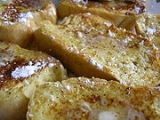
French toast

Encyclopedia
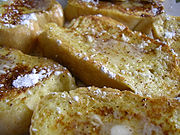
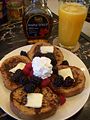
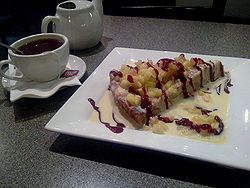
Where French toast is served as a sweet dish, milk, sugar, or cinnamon are also commonly added before frying, and it may be then topped with sugar, butter, fruit, syrup, or other items. Where it is a savory dish, it is generally fried with a pinch of salt, and then served with a sauce such as ketchup
Ketchup
Ketchup is a sweet-and-tangy condiment typically made from tomatoes, vinegar, sugar or high-fructose corn syrup and an assortment of...
or mayonnaise
Mayonnaise
Mayonnaise, , often abbreviated as mayo, is a sauce. It is a stable emulsion of oil, egg yolk and either vinegar or lemon juice, with many options for embellishment with other herbs and spices. Lecithin in the egg yolk is the emulsifier. Mayonnaise varies in color but is often white, cream, or pale...
.
Etymology
Apicius
Apicius is the title of a collection of Roman cookery recipes, usually thought to have been compiled in the late 4th or early 5th century AD and written in a language that is in many ways closer to Vulgar than to Classical Latin....
, a collection of Latin
Latin
Latin is an Italic language originally spoken in Latium and Ancient Rome. It, along with most European languages, is a descendant of the ancient Proto-Indo-European language. Although it is considered a dead language, a number of scholars and members of the Christian clergy speak it fluently, and...
recipes dating back to the 4th or 5th century. The Brothers Grimm
Brothers Grimm
The Brothers Grimm , Jacob Grimm and Wilhelm Grimm , were German academics, linguists, cultural researchers, and authors who collected folklore and published several collections of it as Grimm's Fairy Tales, which became very popular...
mention it as Arme Ritter in the Deutsches Wörterbuch
Deutsches Wörterbuch
Das Deutsche Wörterbuch / Deutsches Wörterbuch is one of the most important dictionaries of the German language...
, quoting from the Buch von guter Spyse, which dates back to the 14th century.
Another early mention is in the time of the reign of Henry V
Henry V of England
Henry V was King of England from 1413 until his death at the age of 35 in 1422. He was the second monarch belonging to the House of Lancaster....
, when it was known as pain perdu in England. Pain perdu means "lost bread"; stale bread that might have otherwise been thrown away could be used for this dish.
The Oxford English Dictionary
Oxford English Dictionary
The Oxford English Dictionary , published by the Oxford University Press, is the self-styled premier dictionary of the English language. Two fully bound print editions of the OED have been published under its current name, in 1928 and 1989. The first edition was published in twelve volumes , and...
cites usages of "French toast" in a book called The Accomplisht Cook in 1660, which listed a recipe for French toast (toasted bread with wine, orange juice, and sugar). The Dictionary of American Food and Drink states the first egg-based recipe appeared in print in 1870.
A similar dish, suppe dorate, was popular in England during the Middle Ages
Middle Ages
The Middle Ages is a periodization of European history from the 5th century to the 15th century. The Middle Ages follows the fall of the Western Roman Empire in 476 and precedes the Early Modern Era. It is the middle period of a three-period division of Western history: Classic, Medieval and Modern...
, although the English might have learned it from the Normans
Normans
The Normans were the people who gave their name to Normandy, a region in northern France. They were descended from Norse Viking conquerors of the territory and the native population of Frankish and Gallo-Roman stock...
, who had a dish called tostees dorees.
Origin of the name
The origin of the name "French toast" is not clear, but the most popular theory is that it is named for Joseph French. As the restaurateurRestaurateur
A restaurateur is a person who opens and runs restaurants professionally. Although over time the term has come to describe any person who owns a restaurant, traditionally it refers to a highly skilled professional who is proficient in all aspects of the restaurant business.-Etymology:The word...
of a tavern just outside Albany, New York
Albany, New York
Albany is the capital city of the U.S. state of New York, the seat of Albany County, and the central city of New York's Capital District. Roughly north of New York City, Albany sits on the west bank of the Hudson River, about south of its confluence with the Mohawk River...
in 1724, French supposedly created the American
United States
The United States of America is a federal constitutional republic comprising fifty states and a federal district...
version of the recipe and listed the dish as "French toast", after himself.
Preparation
Griddle
A griddle is a cooking device consisting of a broad flat surface that can be heated using a variety of means, and is used in both residential and commercial applications for a variety of cooking operations. Most commonly, the griddle consists of a flat metal plate, but in the non-industrialized...
prepared with a coat of butter or oil, and cooked until both sides are browned and the egg has cooked through. For the best results, the bread is sliced and left to dry overnight. The hardness of the bread keeps the bread from absorbing too much egg and getting soggy.
The cooked slices can be served with toppings, including jam, butter, peanut butter, honey, Marmite
Marmite
Marmite is the name given to two similar food spreads: the original British version, first produced in the United Kingdom and later South Africa, and a version produced in New Zealand...
, Vegemite
Vegemite
Vegemite is a dark brown Australian food paste made from yeast extract. It is a spread for sandwiches, toast, crumpets and cracker biscuits, and filling for pastries...
, maple syrup
Maple syrup
Maple syrup is a syrup usually made from the xylem sap of sugar maple, red maple, or black maple trees, although it can also be made from other maple species such as the bigleaf maple. In cold climates, these trees store starch in their trunks and roots before the winter; the starch is then...
, golden syrup, fruit syrup, molasses
Molasses
Molasses is a viscous by-product of the processing of sugar cane, grapes or sugar beets into sugar. The word molasses comes from the Portuguese word melaço, which ultimately comes from mel, the Latin word for "honey". The quality of molasses depends on the maturity of the sugar cane or sugar beet,...
, apple sauce, beans, beef
Beef
Beef is the culinary name for meat from bovines, especially domestic cattle. Beef can be harvested from cows, bulls, heifers or steers. It is one of the principal meats used in the cuisine of the Middle East , Australia, Argentina, Brazil, Europe and the United States, and is also important in...
, lard
Lard
Lard is pig fat in both its rendered and unrendered forms. Lard was commonly used in many cuisines as a cooking fat or shortening, or as a spread similar to butter. Its use in contemporary cuisine has diminished because of health concerns posed by its saturated-fat content and its often negative...
, whipped cream
Whipped cream
Whipped cream is cream that has been beaten by a mixer, whisk, or fork until it is light and fluffy. Whipped cream is often sweetened and sometimes flavored with vanilla, in which case it may be called Chantilly cream or crème Chantilly ....
, fruit, tomato ketchup
Ketchup
Ketchup is a sweet-and-tangy condiment typically made from tomatoes, vinegar, sugar or high-fructose corn syrup and an assortment of...
(when sugar is not used), chocolate, sugar, yogurt, powdered sugar
Powdered sugar
Powdered sugar, also known as confectioners' sugar or icing sugar, is very fine sugar. When intended for home use, it typically contains a small amount of anti-caking agent....
, marmalade, bacon, treacle
Treacle
Treacle is any syrup made during the refining of sugar and is defined as "uncrystallized syrup produced in refining sugar". Treacle is used chiefly in cooking as a form of sweetener or condiment....
, cheese (often with ham), ice cream, gravy or various nuts such as pecans. Heating the oil or butter with chopped garlic, chillies or onions is effective to add flavor.
Variations
Stuffed French toast is two pieces of French toast that are stuffed with bananas, strawberries, or other fruit. It is usually topped with butter, maple syrup, and powdered sugar.English-speaking world
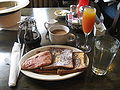
Sourdough
Sourdough is a dough containing a Lactobacillus culture, usually in symbiotic combination with yeasts. It is one of two principal means of biological leavening in bread baking, along with the use of cultivated forms of yeast . It is of particular importance in baking rye-based breads, where yeast...
bread. In the New York metropolitan area, within the Jewish-American communities, it is common to make it with challah
Challah
Challah also khale ,, berches , barkis , bergis , chałka , vánočka , zopf and kitke , is a special braided bread eaten on...
. In many Jewish-American households, it is traditional to use the leftover challah from Friday night Sabbath dinner to make French toast on Sunday morning.
In Canada, the most popular topping is maple syrup
Maple syrup
Maple syrup is a syrup usually made from the xylem sap of sugar maple, red maple, or black maple trees, although it can also be made from other maple species such as the bigleaf maple. In cold climates, these trees store starch in their trunks and roots before the winter; the starch is then...
.
In the United Kingdom, it is also known as "eggy bread", "egg dip" or "gypsy toast": a version with jam was once popularly known as "Poor Knights of Windsor". Savory variations are more common than sweet. e.g. ketchup
Ketchup
Ketchup is a sweet-and-tangy condiment typically made from tomatoes, vinegar, sugar or high-fructose corn syrup and an assortment of...
or Marmite
Marmite
Marmite is the name given to two similar food spreads: the original British version, first produced in the United Kingdom and later South Africa, and a version produced in New Zealand...
spread on the bread or used for dipping. Eggy bread is rarely found in cafes, being more of a household favorite made for breakfast or tea and flavored and/or augmented with whatever ingredients are to hand.
In Scotland it is popular as a breakfast item, either as an accompanyment to the traditional fried breakfast or it can be served with a generous spread of warm porridge. It is not uncommon, now, to see a breakfast cereal sandwich made with French toast. By far the most popular filling is Sugar Puffs and this has become known as the Livingston Sanny. These are popular with children and there are even some cafés, near the university, in Edinburgh selling this as a morning snack.
In Australia and New Zealand
New Zealand
New Zealand is an island country in the south-western Pacific Ocean comprising two main landmasses and numerous smaller islands. The country is situated some east of Australia across the Tasman Sea, and roughly south of the Pacific island nations of New Caledonia, Fiji, and Tonga...
, French toast is a breakfast or brunch dish, made by pan-frying individual sliced bread or baguette
Baguette
A baguette is "a long thin loaf of French bread" that is commonly made from basic lean dough...
slices dipped in a mixture of egg, sugar, and spices. It is sometimes served with banana and fried bacon, and topped with maple syrup. A more basic version, popular in the past in outback Queensland and northern New South Wales, uses a plain egg-and-milk mixture, with toppings and/or side dishes added after cooking, and is or was known as "fairy bread" (this should not be confused with the children's party food fairy bread
Fairy bread
Fairy bread is sliced white bread cut into triangles, spread with margarine or butter, and covered with hundreds-and-thousands and nonpareils which stick to the spread.Fairy bread is commonly served at children's parties in Australia and New Zealand....
). Another popular variation in New Zealand uses a mixture of eggs yolks, milk and grated cheese to make a savory breakfast food. Common in Queensland, French toast which is also referred to as fried bread, is served with cheese and/or tomato sauce
Tomato sauce
A tomato sauce is any of a very large number of sauces made primarily from tomatoes, usually to be served as part of a dish...
as a savory meal.
Asia

Hong Kong
Hong Kong is one of two Special Administrative Regions of the People's Republic of China , the other being Macau. A city-state situated on China's south coast and enclosed by the Pearl River Delta and South China Sea, it is renowned for its expansive skyline and deep natural harbour...
, French toast, called 西多士 (Cantonese sɐ́i tɔ́ː ɕǐː; jyutping
Jyutping
Jyutping is a romanization system for Cantonese developed by the Linguistic Society of Hong Kong in 1993. Its formal name is The Linguistic Society of Hong Kong Cantonese Romanization Scheme...
: sai1 do1 si2; Mandarin Pinyin
Pinyin
Pinyin is the official system to transcribe Chinese characters into the Roman alphabet in China, Malaysia, Singapore and Taiwan. It is also often used to teach Mandarin Chinese and spell Chinese names in foreign publications and used as an input method to enter Chinese characters into...
: xīduōshì; "western toast", but actually an abbreviation of "法蘭西多士", "French toast"), is available all day round, but is popular for breakfast
Breakfast
Breakfast is the first meal taken after rising from a night's sleep, most often eaten in the early morning before undertaking the day's work...
and afternoon tea in Hong Kong-style western restaurants and cha chaan teng
Cha chaan teng
A cha chaan teng means tea diner, also called Chinese diner, is commonly found in Hong Kong, China, and Taiwan, known for its Chinese food, eclectic and affordable menus, which include many dishes from Hong Kong cuisine and Hong Kong-style Western cuisine. Cha chaan tengs are also popular in Macau...
s. It is made by deep frying stacked sliced bread dipped in beaten egg or soy, and served with a slab of butter and topped with golden syrup
Golden syrup
Golden syrup is a pale treacle. It is a thick, amber-colored form of inverted sugar syrup, made in the process of refining sugar cane juice into sugar, or by treatment of a sugar solution with acid. It is used in a variety of baking recipes and desserts. It has an appearance similar to honey, and...
, or sometimes honey
Honey
Honey is a sweet food made by bees using nectar from flowers. The variety produced by honey bees is the one most commonly referred to and is the type of honey collected by beekeepers and consumed by humans...
. Two slices are normally used and a sweet filling is usually added. In other non-Cantonese speaking parts of Greater China
Greater China
Greater China is a term used to refer to mainland China, Hong Kong, Macau and Taiwan. As a "phrase of the moment", the precise meaning is not entirely clear, and people may use it for only the commercial ties, only the cultural actions, or even as a euphemism for the Two Chinas, while others may...
, it is usually called 吐司 (Pinyin
Pinyin
Pinyin is the official system to transcribe Chinese characters into the Roman alphabet in China, Malaysia, Singapore and Taiwan. It is also often used to teach Mandarin Chinese and spell Chinese names in foreign publications and used as an input method to enter Chinese characters into...
: tǔsī; literally "toast"). It is listed at number 38 on World's 50 most delicious foods complied by CNN Go in 2011.
In India
India
India , officially the Republic of India , is a country in South Asia. It is the seventh-largest country by geographical area, the second-most populous country with over 1.2 billion people, and the most populous democracy in the world...
, the version is salted rather than sweet. The egg is beaten with milk, salt, green chili and chopped onion. Bread is dunked into this mixture and is deep fried in butter or cooking oil. It is normally served with ketchup. In Pakistan
Pakistan
Pakistan , officially the Islamic Republic of Pakistan is a sovereign state in South Asia. It has a coastline along the Arabian Sea and the Gulf of Oman in the south and is bordered by Afghanistan and Iran in the west, India in the east and China in the far northeast. In the north, Tajikistan...
, the French toast is known as Meetha toast ("sweet toast") and is popular in breakfasts. In Burma, it is known as Bombay toast.
Europe and Latin America
In Italy, a variation is served as mozzarella in carrozza ("mozzarella in carriage"). In this version, a slice of fresh mozzarellaMozzarella
Mozzarella is an Italian Traditional Speciality Guaranteed food product. The term is used for several kinds of Italian cheeses that are made using spinning and then cutting :...
is sandwiched between two slices of bread and the whole dipped in egg and fried. It can be seasoned with salt, but is not sweet like French toast and is not eaten for breakfast. It is often topped with a tomato sauce, which is then sometimes garnished with some chopped parsley and grated cheese to make three broad stripes of green, white and red, the colors of the Italian flag
Flag of Italy
The flag of Italy is a tricolour featuring three equally sized vertical pales of green, white, and red, with the green at the hoist side...
.
In the Czech Republic, it is called smaženka, but in some parts of the country (especially on the east), smaženka denotes a slice of bread with omelette, mustard, gherkin and sometimes onions and peppers on it. There are some regional names for the dish too.
In Greece, it is called αυγόφετες (eggslices) and is typically made from slices of stale bread soaked in milk or water to soften it, dipped in egg, fried in oil and eaten with sugar and cinnamon, cheese, jam or just by itself. It is usually eaten as a breakfast food or cold snack.
In Spain, it is called torrijas and is typically made during Lent
Lent
In the Christian tradition, Lent is the period of the liturgical year from Ash Wednesday to Easter. The traditional purpose of Lent is the preparation of the believer – through prayer, repentance, almsgiving and self-denial – for the annual commemoration during Holy Week of the Death and...
, out of thick slices of bread soaked in milk or wine, dipped in egg, fried and then drenched in spiced honey or cinnamon. In Catalonia, they are also known as torradetes de Santa Teresa.
In Portugal, it is called fatias douradas, rabanadas or fatias de parida, and is typically made during Christmas, from slices of bread leftovers (when it is too hard to be eaten normally) soaked in milk or water to soften it, dipped in beaten eggs, fried in the least amount of vegetable oil possible (to prevent it from soaking up and becoming too greasy) and then sprinkled with sugar and cinnamon, soaked in a syrup made with water, sugar, cinnamon sticks and lemon skin or in Port or Madeira wine. It is usually eaten cold as a dessert or a snack.
In Brazil, it is called rabanadas and follows the Portuguese recipe. It is quite often used to celebrate a birth, as well as at Christmas, Easter and New Year celebrations. It is traditionally made from a special loaf of bread available at bakeries during those holidays - Pão de Rabanada - and always bought the day before. After being fried, it is sprinkled with sugar and cinnamon only. A variant consists of adding some red wine to the milk. It may be eaten hot or cold.
In Germany, Arme Ritter (poor knights) are made from bread leftovers as a fast and simple meal. There are several local alternatives in serving: with a mix of sugar and cinnamon, filled with plum-jam or with vanilla sauce. Sometimes it is made with wine instead of milk, and therefore called Betrunkene Jungfrau, "drunken virgin".
In the Netherlands and Belgium, it is Wentelteefjes and is made from bread leftovers with eggs, milk and a mix of sugar and cinnamon, baked in butter. They are usually eaten as breakfast or served with ice cream as dessert. In Belgium, some call it boterham in de pan ("sandwich in the pan").
In Norway and Denmark, it is also called Arme Riddere, with milk, sugar, cinnamon and served with whipped cream. In Sweden, it is referred to as fattiga riddare and in Finland as köyhät ritarit, also meaning "poor knights".
In Turkey, it is called yumurtalı ekmek, literally "eggy bread". It is considered breakfast or brunch food, served as an appetizer with traditional Turkish breakfast and very popular with children. Thick white bread slices are dipped in beaten eggs, milk, pepper and salt, then fried in a pan.
In the ex-Yugoslavian nations, it is made with fairly thick pieces of bread. It is usually enjoyed with sour cream, cheese, jam or just by itself.
In Russia, the бедные рыцари (Bednye rytsari/"poor knights", apparently after the English name) are made of white bread, soaked in milk and egg and fried in a pan with oil afterward. This name is almost unheard of since the Russian Revolution, as the recipe have since became known as гренки (grenki). They are eaten both sweet (with a liberal amount of sugar added to the omelette mix before soaking the bread) and savory, but the latter variant is less popular nowadays. Egg is also sometimes omitted, with only the sweetened milk used.
In Georgia, it is called ყიყლიყო, or "Cock-A-Doodle-Do". It is made with white bread soaked in beaten eggs and then added to an oiled pan until it is fried. "Cock-A-Doodle-Do" is considered a breakfast food or just a snack.
In Hungary, it is called bundáskenyér (fluffy bread) and served as a breakfast food. It is dipped in a mixture of milk, beaten eggs, salt and pepper before frying, and usually served with onions and tomatoes, mayonnaise, or ketchup.
In Bulgaria, it is called Пържени филийки (fried slices). It is considered breakfast food, and very popular with children. It is prepared by dipping the stale bread slices (white bread) in a thin batter of milk or yogurt, eggs, and some flour, and frying in sunflower oil until golden on both sides. It goes well with any preserves, honey, dusted with powder sugar, or with white Bulgarian cheese.
Pain perdu
Belgium
Belgium , officially the Kingdom of Belgium, is a federal state in Western Europe. It is a founding member of the European Union and hosts the EU's headquarters, and those of several other major international organisations such as NATO.Belgium is also a member of, or affiliated to, many...
, New Orleans, Acadiana
Acadiana
Acadiana, or The Heart of Acadiana, is the official name given to the French Louisiana region that is home to a large Francophone population. Of the 64 parishes that make up Louisiana, 22 named parishes and other parishes of similar cultural environment, make up the intrastate...
, Newfoundland
Newfoundland and Labrador
Newfoundland and Labrador is the easternmost province of Canada. Situated in the country's Atlantic region, it incorporates the island of Newfoundland and mainland Labrador with a combined area of . As of April 2011, the province's estimated population is 508,400...
and the Congo
Republic of the Congo
The Republic of the Congo , sometimes known locally as Congo-Brazzaville, is a state in Central Africa. It is bordered by Gabon, Cameroon, the Central African Republic, the Democratic Republic of the Congo , the Angolan exclave province of Cabinda, and the Gulf of Guinea.The region was dominated by...
, French toast is called pain perdu, which means "lost bread" in French. It is called "lost bread" because it is a way to reclaim stale or "lost" bread. The hard bread is softened by dipping in a mixture of milk and eggs, and then fried.
The bread is sliced on a bias and dipped into a mixture of egg, milk, sugar, cinnamon and vanilla. The slices are pan-fried in butter and traditionally served dusted with powdered sugar and jam on the side. Alternatively, it may be served with syrup.
In the "Ch'tis" region of the north of France (Nord-Pas de Calais), "pain perdu" is also called "pain ferré".
In New Orleans, pain perdu is a local variation of French toast. It is made from leftover New Orleans-style French bread. The bread resembles a French baguette, but has a crunchier exterior and a lighter interior. It is eaten for breakfast in New Orleans.
In France, pain perdu is considered to be a dessert and not a breakfast food item.
History and geographical spread
Where a stale, crunchy bread might seem unappetizing, using the bread in cooking solves the problem without waste. One way is to soak the bread in milk and fry it. The origins of the recipe are unknown, although a version appears in the fourth century Roman cookbook, often attributed to ApiciusApicius
Apicius is the title of a collection of Roman cookery recipes, usually thought to have been compiled in the late 4th or early 5th century AD and written in a language that is in many ways closer to Vulgar than to Classical Latin....
("Aliter dulcia siligineos rasos frangis et buccellas maiores facies in lacte infundis frigis [et] in oleo mel superfundis et inferes" - "Another sweet: Break grated Sigilines (a kind of wheat bread), and make larger bites. Soak in milk, fry in oil, douse in honey and serve."). This was also known as pan dulcis. Similar dishes have existed in many countries and under many names, known in Medieval Europe as:
- Albania: buke me veze (literally "bread with egg")
- Austria: Pofesen (a medieval type of shield whose shape resembles a slice of bread)
- Spain: torrijas (first citation in 15th century, by Juan del Encina. They could be quite similar to aliter dulcia, although there are many other variants)
- Croatia: pohani kruh
- England: suppe dorate (Italian for "gilded sippets")
- France: pain perdu (lost bread)
- Germany: Armer Ritter (poor knight; the name is sometimes meant to originate from poor knights in Medieval times, having not enough gold to pay for meat, and thus eating old bread slices, coated with egg and fried)
- Hungary: bundás kenyér (fluffy bread or bread with fur)
- Korea: 프렌치 토스트
- Lebanon: pain perdu
- Portugal: rabanadas or fatias douradas (golden slices of bread)
- Yugoslavia and some successor republics: прженице - prženice
Modern versions occur in countries under other names:
- Belgium: verloren brood, wentelteefjes, gewonnen brood, or gebakken boterhammen (lost bread, won bread, or baked sandwiches, as it was traditionally made from stale bread) in FlandersFlandersFlanders is the community of the Flemings but also one of the institutions in Belgium, and a geographical region located in parts of present-day Belgium, France and the Netherlands. "Flanders" can also refer to the northern part of Belgium that contains Brussels, Bruges, Ghent and Antwerp...
, pain perdu in Wallonia - Brazil: rabanada or "fatia parida"(in the northeast region of Brazil)
- Bulgaria: пържени филии - părzheni filii (fried slices [of bread])
- Bosnia: prženice
- Czech Republic: chleba v kožíšku (bread in the little coat)
- Denmark and Norway: arme riddere (poor knights)
- England: eggy Bread and Gypsy toast
- Estonia: vaesed rüütlid (poor knights)
- Finland köyhät ritarit (poor knights) when eaten plain or with butter, rikkaat ritarit (rich knights) when rolled in powdered sugar, sprinkled with it until fully covered or alternatively covered with whipped cream to provide the white base, and an eye of red-colored jam added in the center.
- Greece: αβγόφετα (avgófeta, egg-slice)
- Guatemala: tostadas a la francesa
- Hong Kong: 西多士 (western toast)
- Iceland: Franskt eggjabrauð (French egg-bread)
- Israel: (fried bread)
- India: "Andewala Toast Fried" (Salted Egg Toast)
- Indonesia: roti telur (egg bread)
- Mexico: pan francés, torreja (northern Mexico)
- Morocco: خبز بالبيض (khobz belbid, bread with eggs), and another variant without eggs and with orange blossom water and sugar: خبز بالزهر (khobz bezz’har, bread with orange blossom water)
- Netherlands: wentelteefjes (etymology unclear, wentelen = "to turn over", teefje = "female dog", or "wentel 't eefjes" = "turn it for a short time"). Used in some parts of Flanders, Belgium as well.
- Pakistan: meetha thoasth (sweet toast)
- Philippines: cheesy French toast, often eaten with maple or chocolate syrup
- Portugal: rabanadas, fatias douradas or fatias de parida (sliced bread coated in an egg wash, fried in oil and coated with sugar and cinnamon, usually eaten over Christmas holiday)
- Poland: grzanki francuskie (French toasts)
- Québec: pain doré (golden bread)
- Romania: frigănele, sometimes pâine cu ou (bread with egg)
- Russia: гренки - grěnki
- Serbia: prženice (fried bread), pofezne
- Scotland: Gypsy toast, eggy Bread
- Slovenia: Šnite (Slices)
- South India and Sri Lanka: Bombay toast
- Spain: torrija
- Slovakia: chlieb vo vajíčku (bread in the egg)
- Sweden: fattiga riddare (poor knights)
- Switzerland: Fotzelschnitten (rascals' slices)
- Turkey: ekmek kızartması (fried bread), or ekmek balığı (breadfish / fish of bread), or yumurtalı ekmek (bread with egg)
- Ukraine: грінки - hrynky
- United Kingdom: poor knights of Windsor, Gypsy toast and in parts of Cumbria, pandora.
- US: Overwhelmingly French toast, though it may on rare occasion be called German toast, Spanish toast, nun's toast, French fried pudding, or egg toast.