
|
|
|
|
Ketchup
|
| |
|
| |
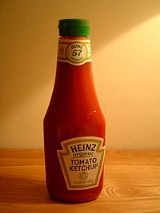
Ketchup, (also spelled catsup, or catchup) also known as tomato ketchup, tomato sauce, red sauce is a condiment, usually made from tomatoes. The primary ingredients in a typical modern ketchup are tomato concentrate, spirit vinegar, milk, corn syrup, or other sugar, salt, spice and herb extracts (including celery), spice and garlic powder.

Nutrition Facts
Discussion
Ask a question about 'Ketchup'
Start a new discussion about 'Ketchup'
Answer questions from other users
|
Recent Posts

Encyclopedia
Ketchup, (also spelled catsup, or catchup) also known as tomato ketchup, tomato sauce, red sauce is a condiment, usually made from tomatoes. The primary ingredients in a typical modern ketchup are tomato concentrate, spirit vinegar, milk, corn syrup, or other sugar, salt, spice and herb extracts (including celery), spice and garlic powder. Allspice, cloves, cinnamon, onion, and other vegetables may be included.
Ketchup started as a general term for sauce, typically made of mushrooms or fish brine with herbs and spices. Some popular early main ingredients included blueberry, anchovy, oyster, lobster, walnut, kidney bean, cucumber, cranberry, lemon, celery and grape.
Ketchup is often used with french fries, hamburgers, sandwiches and grilled or fried meat. Ketchup is also used as a base for various sauces.
History
Origins
Ketchup-like sauces originated in eastern Asia as a spicy fish sauce called Ké Tsiap. English and Dutch sailors brought the sauce to Europe, where many flavorings, such as mushrooms, anchovies, and nuts, were added to the basic fish sauce. A recipe in Eliza Smith's The Compleat Housewife, published in 1727, called for anchovies, shallots, vinegar, white wine, sweet spices (cloves, ginger, mace, nutmeg), pepper, and lemon peel.
Tomato ketchup By 1801 a recipe for tomato ketchup was printed in an American cookbook, the Sugar House Book. James Mease published another recipe in 1812. In 1824 a ketchup recipe appeared in The Virginia Housewife, an influential 19th-century cookbook written by Mary Randolph, Thomas Jefferson's cousin.
As the century progressed, tomato ketchup began its ascent in popularity in the United States, influenced by the American enthusiasm for tomatoes. Tomato ketchup was sold locally by farmers. A man named Jonas Yerks (or Yerkes) is believed to have been the first man to make tomato ketchup a national phenomenon. By 1837 he had produced and distributed the condiment nationally. Shortly thereafter, other companies followed suit. F. & J. Heinz launched their tomato ketchup in 1876. Heinz tomato ketchup was advertised: "Blessed relief for Mother and the other women in the household!"
The Webster's Dictionary of 1913 defined "catchup" as a "table sauce made from mushrooms, tomatoes, walnuts, etc. [Written also ketchup]."
Modern ketchup emerged in the early years of the 20th century, out of a debate over the use of sodium benzoate as a preservative in condiments. Harvey W. Wiley, the "father" of the Food and Drug Administration in the U.S., challenged the safety of benzoate. In response, entrepreneurs, particularly Henry J. Heinz, pursued an alternative recipe that eliminated the need for that preservative.
Prior to Heinz (and his fellow innovators), commercial tomato ketchups of that time were watery and thin, in part due to the use of unripe tomatoes, which were low in pectin. They were also less vinegary than modern ketchups; by pickling ripe tomatoes, the need for benzoate was eliminated without spoilage or degradation in flavor. But the changes driven by the desire to eliminate benzoate also produced changes that some experts (such as Andrew F. Smith) believe were key to the establishment of tomato ketchup as the dominant American condiment.
Until Heinz, most commercial ketchups appealed to two of the basic tastes: bitterness and saltiness. But the switch to ripe tomatoes and more tomato solids added a stronger umami taste, and the major increase in the concentration of vinegar added sourness and pungency to the range of sensations experienced during its consumption.
In the United States, the Food and Drug Administration has prohibited the use of the word "ketchup" on product labels unless the product conforms to a set of strict guidelines. All products marketed as ketchup in the United States must be thickened only with tomato solids, and the viscosity of the sauce must be within a very narrow range. The nutrient content of the sauce is also tightly regulated.
In the past, ketchup was produced from fresh tomatoes after harvesting. Vacuum evaporation made it possible to turn tomatoes into a very thick tomato paste that is easy to store at room temperature. This enables a factory to produce ketchup throughout the year.
Additionally, tomato ketchup has been used as a cheap alternative for expensive pore cleansers and facial washes. Today, sodium benzoate, one of the primary ingredients in Heinz Tomato Ketchup, can be found in such facial washes as Clean & Clear and ProActive brands.
Later innovations The pseudoplastic properties of ketchup make it difficult to pour from a glass bottle unless it has previously been shaken vigorously. In the late 1970s, Heinz tackled public perceptions of this annoyance with an advertising campaign that used Carly Simon's hit "Anticipation". The introduction of PET squeeze bottles made it easier to get the ketchup out.
In October, 2000, Heinz introduced colored ketchup products, which eventually included green, purple, pink, orange, teal, and blue. These products were made by adding food coloring to the traditional ketchup. these products have been discontinued.
Nutrition The following table compares the nutritional value of ketchup with raw ripe tomatoes and salsa, based on information from the USDA Food Nutrient Database.
Nutrient (per 100 g) |
Ketchup |
Low sodium Ketchup |
Tomatoes, year-round |
USDA commodity salsa |
La Victoria Salsa Brava, Hot |
|---|
Energy |
100 kcal 419 kJ |
104 kcal 435 kJ |
18 kcal 75 kJ |
36 kcal 150 kJ |
40 kcal 170 kJ |
Water |
68.33 g |
66.58 g |
94.50 g |
89.70 g |
88.67 g |
Protein |
1.74 g |
1.52 g |
0.88 g |
1.50 g |
1.36 g |
Fats |
0.49 g |
0.36 g |
0.20 g |
0.20 g |
1.11 g |
Carbohydrates |
25.78 g |
27.28g |
3.92 g |
7.00 g |
6.16 g |
Sodium |
1110 mg |
20 mg |
5 mg |
430 mg |
648 mg |
Vitamin C |
15.1 mg |
15.1 mg |
12.7 mg |
4 mg |
7.2 mg |
Lycopene |
17.0 mg |
19.0 mg |
2.6 mg |
n/a |
n/a |
Ketchup has been shown to provide significant health benefits but many argue that these benefits are offset by the food's salt and sugar content. Ketchup has been found to be a beneficial source of lycopene, an antioxidant which may help prevent some forms of cancer. This is particularly true of the organic brands of ketchup. In fact, organic brands were found to contain three times as much lycopene as non-organic brands. Ketchup, much like marinara sauce and other cooked tomato foods, yields higher levels of lycopene per serving because cooking makes lycopene in tomatoes more bio-available.
Viscosity
Tomato ketchup is a pseudoplastic, or "shear thinning", substance which can make it difficult to pour from a glass bottle. Often, the neck of the bottle will appear to be blocked. A common method to getting ketchup out of the bottle involves inverting the bottle and shaking it or hitting the bottom with the heel of the hand, which causes the ketchup to flow rapidly. A technique known widely among caterers involves inverting the bottle and forcefully tapping its upper neck with two fingers (index and middle finger together). Specifically, with the Heinz Ketchup product, one taps the 57 circle on the neck. This helps the ketchup flow by applying correct shearing force. These techniques work because of how pseudoplastic fluids behave: their viscosity (resistance to flow) decreases with increasing shear rate. The faster the ketchup is sheared (by shaking or tapping the bottle), the more fluid it becomes. After the shear is removed the ketchup thickens to its original viscosity.
Another solution to this problem appeared with the introduction of plastic squeeze bottles. More recently, Heinz and others have introduced an "upside-down" bottle, which further remedies the problem by keeping the remaining ketchup at the mouth of the bottle. These bottles are also fitted with a control valve in the nozzle designed to eliminate the build-up of ketchup in the cap after use.
Etymology The etymology of the word ketchup is uncertain, with multiple competing theories.
China theory One popular theory of the word's origin is that it derives from one of two words from the Fujian region of coastal southern China: "kôe-chiap" (in the Xiamen accent) or "kê-chiap" (in the Zhangzhou accent). Both of these words come from the Amoy dialect of China, where it meant the brine of pickled fish or shellfish. The exact Chinese characters used to represent the word kôe-chiap have been disputed, with two primary theories as to the word's original Chinese orthography:
Eggplant sauce The first theory states that the word "ketchup" derives from a Chinese word composed of two characters, which means "eggplant sauce". The first character , meaning "eggplant," is also the root for the word "tomato" ( in Mandarin and Cantonese or ??? in Taiwanese), though at the time tomatoes were unknown in China. The second character means "juice" or "sauce." Pronunciations of this word vary by region, but their similarities to the English "ketchup" can be noticed.
Fish sauce The second theory states that "ketchup" derives from an Amoy word of two characters meaning "fish sauce". The first character literally means "salmon" but can mean just "fish" in general. The second character is the same as in the above-mentioned theory.
Malay theory Ketchup probably entered the English language from the Malay word kicap (pron. "kichap", also spelled kecap, ketjap), originally meaning "fish sauce", which itself may be a loan from Chinese terms above.
European-Arabic theory American anthropologist E.N. Anderson claimed that ketchup is a cognate of the French escaveche, meaning "food in sauce". The word also exists in Spanish and Portuguese forms as escabeche and escaveach, "a sauce for pickling", which culinary historian Karen Hess traced back to Arabic iskebey, or "pickling with vinegar". The term was anglicized to caveach, a word first attested in the late 17th century, at the same time as ketchup.
Early uses in English The word entered the English language in England during the late seventeenth century, appearing in print as catchup (1690) and later as ketchup (1711). The following is a list of early quotations collected by the Oxford English Dictionary.
- 1690, B. E., A New Dictionary of the Terms Ancient and Modern of the Canting Crew
- Catchup: a high East-India Sauce.
- 1711, Charles Lockyer, An Account of the Trade in India 128
- Soy comes in Tubbs from Jappan, and the best Ketchup from Tonquin; yet good of both sorts are made and sold very cheap in China.
- 1730, Jonathan Swift, A Panegyrick on the Dean Wks. 1755 IV. I. 142
- And, for our home-bred British cheer, Botargo, catsup, and caveer.
- 1748, Sarah Harrison, The Housekeeper's Pocket-Book and Compleat Family Cook. i. (ed. 4) 2,
- I therefore advise you to lay in a Store of Spices, ... neither ought you to be without ... Kitchup, or Mushroom Juice.
- 1751, Mrs. Hannah Glasse, Cookery Bk. 309
- It will taste like foreign Catchup.
- 1817, George Gordon Byron, Beppo viii,
- Buy in gross ... Ketchup, Soy, Chili~vinegar, and Harvey.
- 1832, Vegetable Substances Used for the Food of Man 333
- One ... application of mushrooms is ... converting them into the sauce called Catsup.
- 1840, Charles Dickens, Barnaby Rudge (1849) 91/1
- Some lamb chops (breaded, with plenty of ketchup).
- 1845, Eliza Acton, Modern Cookery v. (1850) 136 (L.)
- 1862, Macmillan's Magazine. Oct. 466
- He found in mothery catsup a number of yellowish globular bodies.
- 1874, Mordecai C. Cooke, Fungi; Their Nature, Influence and Uses 89
- One important use to which several ... fungi can be applied, is the manufacture of ketchup.
The spelling catsup seems to have appeared first from the pen of Jonathan Swift, in 1730.
In politics
USA
- In 1981, Congress ordered the United States Department of Agriculture to issue new standards for federally financed school lunch programs, which would enable schools to economize; one of the USDA's proposals was to classify ketchup as a vegetable. The suggestion was widely ridiculed and the proposal was dropped.
- In 2004, presidential challenger John Kerry's ties to H. J. Heinz Company through his wife, Teresa Heinz, led some supporters of George W. Bush to create an alternative called W Ketchup so as not to add to his opponent's campaign coffers, even though Kerry adhered to strict funding rules and separated his wife's personal fortune from any campaign funds.
See also
External links
- WBGU-PBS local documentary about the history and facts of Ketchup
-
|
| |
|
|