

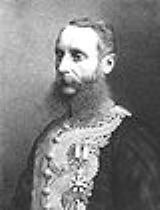
Frederick Weld

Encyclopedia
Sir Frederick Aloysius Weld, GCMG
(1823 – 1891), was a New Zealand
politician and a governor of various British colonies. He was the sixth Premier of New Zealand
, and later served as Governor
of Western Australia
, Governor
of Tasmania
, and Governor of the Straits Settlements.
, Dorset
, England
, on 9 May 1823. His mother, Christina Maria Clifford, was the daughter of Charles Clifford, 6th Baron Clifford of Chudleigh. Both of his parents were from old recusant
Catholic families.
His father, Humphrey Weld of Chideock
, was a member of the Weld-Blundell family
. Humphrey's brother Thomas
was founder of the Jesuit
college at Stonyhurst
. Weld's upbringing was strongly grounded in the Catholic
faith. His early years were spent with his parents in France
. Later, he received a good education, studying at Stonyhurst before attending the University of Fribourg
in Switzerland
, where he studied philosophy
, chemistry
, language
s and law
. He had originally intended to pursue a military career, but was convinced otherwise by his tutor at Fribourg. He instead decided to seek a career in the colonies, and arrived in Wellington
, New Zealand
, on 22 April 1844.
In New Zealand, he entered a partnership with his cousin, Sir Charles Clifford, 1st Baronet of Flaxbourne. The two established a number of sheep stations around the country, and Weld became relatively prosperous. Weld found a life of agricultural management to be too mundane, however, and soon became active in political concerns. One of his more significant campaigns was to ward against any potential discrimination against Catholics in New Zealand. He later became active in lobbying for representative government in New Zealand.
In 1848, Weld declined an offer by the governor, Sir George Grey
, of a seat on a proposed nominee council. In 1852 he visited England, where he published a pamphlet, Hints to Intending Sheep Farmers in New Zealand, which ran into three editions.
When the creation of the New Zealand Parliament was announced, Weld stood for election. He became a member of the 1st Parliament
as the representative of Wairau
, an electorate in the northeast of the South Island
. The main political division of the day was between "centralists" (favouring a strong central government) and "provincialists" (favouring strong regional governments). On this spectrum, Weld established himself as a moderate centralist, although he tended to oppose the extremes of either side.
Weld was also a member of the brief "cabinet" formed around James FitzGerald
. This represented an attempt by Parliament to assume direct responsibility for administering New Zealand. Acting Governor
Robert Wynyard
managed to block this move, however, and Weld's role as a "minister" came to an end. Despite the failure of the FitzGerald "cabinet", Weld was pleased that Catholics were able to participate fully in politics. The fact that Charles Clifford, also a Catholic, had become Speaker
was also encouraging to him.
Weld resigned from Parliament a short while before the end of its first term, returning to England for a brief time. When he returned, he was elected to the 2nd Parliament
, again representing Wairau. He briefly returned to England again to marry his second cousin Filumena Mary Anne Lisle Phillipps, daughter of Ambrose Lisle March Phillipps De Lisle
and a great grandchild of the 4th Baron Clifford of Chudleigh
like Weld, with whom he would have thirteen children.
's government, taking over responsibility for Native Affairs from William Richmond
. In this role, Weld had to contend with conflicts such as the First Taranaki War
. Although Weld disliked the prospect of war, and believed that Governor George Grey
had mishandled the situation, he believed strongly in the need to assert the power of the government, describing it as a "painful duty". Weld lost his ministerial position when the Stafford administration was defeated.
In 1864 (by which time Weld was representing Cheviot
, formed from the southern half of his old Wairau seat), the government of Frederick Whitaker
resigned due to disputes with the Governor. The point in question was who should bear responsibility for funding British troops stationed in New Zealand. Weld, believing that it was British ineptitude that caused conflict with the Māori in the first place, strongly objected to Grey's demands that Parliament should fund the troops. Weld instead believed that British troops should be removed from New Zealand altogether, and be replaced by local forces.
area. Weld's other success, the withdrawal of British troops from New Zealand, was also controversial, and generated considerable hostility from the Governor. In addition, the government's financial situation was precarious. A little less than a year after taking office, Weld's government resigned.
.
in September, 1869. He immediately embarked on a series of tours of the state, which saw travel about 1,200 miles (1,900 km) on horseback in his first six months in office. Impressed by the state's isolation, he urged the establishment of telegraph lines and improvements to transportation. In March, 1870, he sent John Forrest
to explore and survey a possible route for a telegraph line between Albany
and Adelaide
. This was later built, and by 1874, the state had more than 900 miles (1400 km) of operational telegraph line. Weld also oversaw the establishment of a steamship service along the coast, and the beginnings of a rail
system.
Weld saw his appointment to the governorship as a mandate to institute similar constitutional changes to that achieved in New Zealand. With the enthusiastic support of his Colonial Secretary
Frederick Barlee
, he set about promoting representative government. At the first opportunity, Weld introduced a Bill which provided for the election of 12 Members
of the Legislative Council
, to sit with six official and nominee members. The Bill was eventually passed on 1 June 1870. Barlee then began agitating for responsible government, and in 1874 the Legislative Council passed a resolution calling for it. Although Weld did not think that Western Australia was ready for responsible government, he accepted the situation and passed on the request to the Colonial Office
in London
. The Colonial Office were strongly against granting responsible government, and were critical of Weld for allowing the situation to arise. In 1874, Weld went on leave to New Zealand to look after his partnership affairs. On this return, he was transferred to the post of Governor of Tasmania, and the issue of responsible government was dropped until 1890.
, Penang
, and Singapore
. Louch (1966) writes of Weld's seven years in Singapore: "It was there with his wealth of experience that he found the fullest scope for his talents as a colonial administrator, and where he is best remembered now." He was created in the Order of St Michael and St George first CMG (1875), then KCMG (1880) and ultimately GCMG (1885).
He was a devout Catholic all his life, and the Pope
made him a knight of the Order of Pius IX
.
. He began to take personal interest in the development of the Malay States. In the middle of 1881, Weld visited the town of Taiping
, in Perak
. He found "the revenue increasing and everything going on excellent well..." but "labour for public works and roads and to develop other industries and sources of revenue besides tin-mining," he lamented, "is the great want". he also reported that:
"Water supply for Taiping from the hill (Maxwell Hill), the roads to Krian, which will connect Taiping town centre with Province Wellesley, and a rail and tramway from Taiping to the port (Port Weld
, which was named after him) are amongst the next most necessary works to be undertaken. the town of Taiping has been much improved since the fire, which took place rather more than a year ago; new streets have been laid out to considerable width, and a better class of houses has been built"
The construction of the Taiping - Port Weld railway was the beginning of a major transformation altering radically the landscape of the Malay Peninsula. It also brought the first influx of Indians (mainly Tamils) and Ceylonese to Perak
. Sir Frederick Weld was in Taiping again in 1883 where he "inspected everything". He spent time going down the Port Weld railway line, then in the course of construction, "on a truck behind the Engine". He also put into effect plans to build a telegraph line along the road linking Taiping with Province Wellesley. It was nearing completion after which a railway along the same route would be constructed.
once again, he contracted a serious illness, and returned to England. He died in Chideock
on 20 July 1891.
in Perak
was named after him, later changed to Kuala Sepetang.
Weld Road and Upper Weld Road in Singapore
and Weld Quay in Penang
are named after him.
Weld Road in Kuala Lumpur
was named after Weld in 1960. In 1982 it was renamed Jalan Raja Chulan after Raja Chulan
.
Weld Road in Swan View, a suburb of Perth
, Western Australia, is named after him.
Weld Street in Hobart
, Tasmania, is named after him.
Weld Valley in Tasmania
, is named after him.
Weld Hill in Kuala Lumpur
was named after Weld and subsequently renamed Bukit Makahmah. It is now the site of Menara Maybank.
Weld's Cone near Ward In Marlborugh, South Island, New Zealand.
Weld Quay or Pengkalan Weld in Penang, Malaysia was named after him.
The Weld Club
in Perth is named after him.
Order of St Michael and St George
The Most Distinguished Order of Saint Michael and Saint George is an order of chivalry founded on 28 April 1818 by George, Prince Regent, later George IV of the United Kingdom, while he was acting as Prince Regent for his father, George III....
(1823 – 1891), was a New Zealand
New Zealand
New Zealand is an island country in the south-western Pacific Ocean comprising two main landmasses and numerous smaller islands. The country is situated some east of Australia across the Tasman Sea, and roughly south of the Pacific island nations of New Caledonia, Fiji, and Tonga...
politician and a governor of various British colonies. He was the sixth Premier of New Zealand
Prime Minister of New Zealand
The Prime Minister of New Zealand is New Zealand's head of government consequent on being the leader of the party or coalition with majority support in the Parliament of New Zealand...
, and later served as Governor
Governor of Western Australia
The Governor of Western Australia is the representative in Western Australia of Australia's Monarch, Queen Elizabeth II. The Governor performs important constitutional, ceremonial and community functions, including:* presiding over the Executive Council;...
of Western Australia
Western Australia
Western Australia is a state of Australia, occupying the entire western third of the Australian continent. It is bounded by the Indian Ocean to the north and west, the Great Australian Bight and Indian Ocean to the south, the Northern Territory to the north-east and South Australia to the south-east...
, Governor
Governors of Tasmania
The Governor of Tasmania is the representative in the Australian state of Tasmania of Elizabeth II, Queen of Australia. The Governor performs the same constitutional and ceremonial functions at the state level as the Governor-General of Australia does at the national level.In accordance with the...
of Tasmania
Tasmania
Tasmania is an Australian island and state. It is south of the continent, separated by Bass Strait. The state includes the island of Tasmania—the 26th largest island in the world—and the surrounding islands. The state has a population of 507,626 , of whom almost half reside in the greater Hobart...
, and Governor of the Straits Settlements.
Early life
Weld was born near BridportBridport
Bridport is a market town in Dorset, England. Located near the coast at the western end of Chesil Beach at the confluence of the River Brit and its Asker and Simene tributaries, it originally thrived as a fishing port and rope-making centre...
, Dorset
Dorset
Dorset , is a county in South West England on the English Channel coast. The county town is Dorchester which is situated in the south. The Hampshire towns of Bournemouth and Christchurch joined the county with the reorganisation of local government in 1974...
, England
England
England is a country that is part of the United Kingdom. It shares land borders with Scotland to the north and Wales to the west; the Irish Sea is to the north west, the Celtic Sea to the south west, with the North Sea to the east and the English Channel to the south separating it from continental...
, on 9 May 1823. His mother, Christina Maria Clifford, was the daughter of Charles Clifford, 6th Baron Clifford of Chudleigh. Both of his parents were from old recusant
Recusancy
In the history of England and Wales, the recusancy was the state of those who refused to attend Anglican services. The individuals were known as "recusants"...
Catholic families.
His father, Humphrey Weld of Chideock
Chideock
Chideock is a village in south west Dorset, England, situated on the A35 trunk road between Bridport and Lyme Regis. The village has a population of 597 based on the 2001 census....
, was a member of the Weld-Blundell family
Weld-Blundell family
The Weld family, which became in its main branch the Weld-Blundell family, is an old English family that claims descent from Eadric the Wild and has branches in several parts of England and America. The main branch are descended from Humphrey Weld, Lord Mayor of London, whose grandson of the same...
. Humphrey's brother Thomas
Thomas Weld (cardinal)
Thomas Weld was a member of the Weld-Blundell family and an English Roman Catholic bishop and cardinal.-Life:...
was founder of the Jesuit
Society of Jesus
The Society of Jesus is a Catholic male religious order that follows the teachings of the Catholic Church. The members are called Jesuits, and are also known colloquially as "God's Army" and as "The Company," these being references to founder Ignatius of Loyola's military background and a...
college at Stonyhurst
Stonyhurst College
Stonyhurst College is a Roman Catholic independent school, adhering to the Jesuit tradition. It is located on the Stonyhurst Estate near the village of Hurst Green in the Ribble Valley area of Lancashire, England, and occupies a Grade I listed building...
. Weld's upbringing was strongly grounded in the Catholic
Roman Catholic Church
The Catholic Church, also known as the Roman Catholic Church, is the world's largest Christian church, with over a billion members. Led by the Pope, it defines its mission as spreading the gospel of Jesus Christ, administering the sacraments and exercising charity...
faith. His early years were spent with his parents in France
France
The French Republic , The French Republic , The French Republic , (commonly known as France , is a unitary semi-presidential republic in Western Europe with several overseas territories and islands located on other continents and in the Indian, Pacific, and Atlantic oceans. Metropolitan France...
. Later, he received a good education, studying at Stonyhurst before attending the University of Fribourg
University of Fribourg
The University of Fribourg is a university in the city of Fribourg, Switzerland.The roots of the University can be traced back to 1582, when the notable Jesuit Peter Canisius founded the Collège Saint-Michel in the City of Fribourg. In 1763, an Academy of law was founded by the state of Frobourg...
in Switzerland
Switzerland
Switzerland name of one of the Swiss cantons. ; ; ; or ), in its full name the Swiss Confederation , is a federal republic consisting of 26 cantons, with Bern as the seat of the federal authorities. The country is situated in Western Europe,Or Central Europe depending on the definition....
, where he studied philosophy
Philosophy
Philosophy is the study of general and fundamental problems, such as those connected with existence, knowledge, values, reason, mind, and language. Philosophy is distinguished from other ways of addressing such problems by its critical, generally systematic approach and its reliance on rational...
, chemistry
Chemistry
Chemistry is the science of matter, especially its chemical reactions, but also its composition, structure and properties. Chemistry is concerned with atoms and their interactions with other atoms, and particularly with the properties of chemical bonds....
, language
Language
Language may refer either to the specifically human capacity for acquiring and using complex systems of communication, or to a specific instance of such a system of complex communication...
s and law
Law
Law is a system of rules and guidelines which are enforced through social institutions to govern behavior, wherever possible. It shapes politics, economics and society in numerous ways and serves as a social mediator of relations between people. Contract law regulates everything from buying a bus...
. He had originally intended to pursue a military career, but was convinced otherwise by his tutor at Fribourg. He instead decided to seek a career in the colonies, and arrived in Wellington
Wellington
Wellington is the capital city and third most populous urban area of New Zealand, although it is likely to have surpassed Christchurch due to the exodus following the Canterbury Earthquake. It is at the southwestern tip of the North Island, between Cook Strait and the Rimutaka Range...
, New Zealand
New Zealand
New Zealand is an island country in the south-western Pacific Ocean comprising two main landmasses and numerous smaller islands. The country is situated some east of Australia across the Tasman Sea, and roughly south of the Pacific island nations of New Caledonia, Fiji, and Tonga...
, on 22 April 1844.
In New Zealand, he entered a partnership with his cousin, Sir Charles Clifford, 1st Baronet of Flaxbourne. The two established a number of sheep stations around the country, and Weld became relatively prosperous. Weld found a life of agricultural management to be too mundane, however, and soon became active in political concerns. One of his more significant campaigns was to ward against any potential discrimination against Catholics in New Zealand. He later became active in lobbying for representative government in New Zealand.
In 1848, Weld declined an offer by the governor, Sir George Grey
George Grey
George Grey may refer to:*Sir George Grey, 2nd Baronet , British politician*George Grey, 2nd Earl of Kent *Sir George Grey , Governor of Cape Colony, South Australia and New Zealand...
, of a seat on a proposed nominee council. In 1852 he visited England, where he published a pamphlet, Hints to Intending Sheep Farmers in New Zealand, which ran into three editions.
Member of Parliament
When the creation of the New Zealand Parliament was announced, Weld stood for election. He became a member of the 1st Parliament
1st New Zealand Parliament
The 1st New Zealand Parliament was a term of the Parliament of New Zealand. It opened on 24 May 1854, following New Zealand's first general election . It was dissolved on 15 September 1855 in preparation for that year's election...
as the representative of Wairau
Wairau (New Zealand electorate)
Wairau was a parliamentary electorate in the Marlborough Region of New Zealand, from 1853 to 1938.-History:Wairau was one of the original electorates for the first general election in 1853....
, an electorate in the northeast of the South Island
South Island
The South Island is the larger of the two major islands of New Zealand, the other being the more populous North Island. It is bordered to the north by Cook Strait, to the west by the Tasman Sea, to the south and east by the Pacific Ocean...
. The main political division of the day was between "centralists" (favouring a strong central government) and "provincialists" (favouring strong regional governments). On this spectrum, Weld established himself as a moderate centralist, although he tended to oppose the extremes of either side.
Weld was also a member of the brief "cabinet" formed around James FitzGerald
James FitzGerald
James Edward FitzGerald was a New Zealand politician. According to some historians, he should be considered the country's first Prime Minister, although a more conventional view is that neither he nor his successor should properly be given that title. He was a notable campaigner for New Zealand...
. This represented an attempt by Parliament to assume direct responsibility for administering New Zealand. Acting Governor
Governor-General of New Zealand
The Governor-General of New Zealand is the representative of the monarch of New Zealand . The Governor-General acts as the Queen's vice-regal representative in New Zealand and is often viewed as the de facto head of state....
Robert Wynyard
Robert Wynyard
Sir Robert Henry Wynyard was a New Zealand colonial administrator, serving at various times as Lieutenant Governor of New Ulster Province, Administrator of the Government, and was the first Superintendent of Auckland Province.-Lieutenant Governor of New Ulster:From 26 April 1851 to 7 March 1853,...
managed to block this move, however, and Weld's role as a "minister" came to an end. Despite the failure of the FitzGerald "cabinet", Weld was pleased that Catholics were able to participate fully in politics. The fact that Charles Clifford, also a Catholic, had become Speaker
Speaker of the New Zealand House of Representatives
In New Zealand the Speaker of the House of Representatives is the individual who chairs the country's legislative body, the New Zealand House of Representatives...
was also encouraging to him.
Weld resigned from Parliament a short while before the end of its first term, returning to England for a brief time. When he returned, he was elected to the 2nd Parliament
2nd New Zealand Parliament
The 2nd New Zealand Parliament was a term of the Parliament of New Zealand. It opened on 15 April 1856, following New Zealand's 1855 election. It was dissolved on 5 November 1860 in preparation for 1860–61 election...
, again representing Wairau. He briefly returned to England again to marry his second cousin Filumena Mary Anne Lisle Phillipps, daughter of Ambrose Lisle March Phillipps De Lisle
Ambrose Lisle March Phillipps De Lisle
Ambrose Lisle March Phillipps de Lisle was an English Catholic convert. He founded Mount St. Bernard Abbey, a Trappist abbey in Leicestershire and worked for the reconversion or reconciliation of Britain to Catholicism....
and a great grandchild of the 4th Baron Clifford of Chudleigh
Baron Clifford of Chudleigh
Baron Clifford of Chudleigh, of Chudleigh in the County of Devon, is a title in the Peerage of England. It was created in 1672 for Thomas Clifford...
like Weld, with whom he would have thirteen children.
Cabinet minister
In 1860, Weld was invited to join Edward StaffordEdward Stafford (politician)
Sir Edward Stafford, KCMG served as the third Premier of New Zealand on three occasions in the mid 19th century. His total time in office is the longest of any leader without a political party. He is described as pragmatic, logical, and clear-sighted.-Early life and career:Edward William Stafford...
's government, taking over responsibility for Native Affairs from William Richmond
William Richmond
Christopher William Richmond , generally called William Richmond, was a 19th century New Zealand politician. He held a number of Cabinet positions between 1856 and 1861. He worked as a lawyer and was appointed a senior judge who held condescending views of Māori.-Early life:Richmond was probably...
. In this role, Weld had to contend with conflicts such as the First Taranaki War
First Taranaki War
The First Taranaki War was an armed conflict over land ownership and sovereignty that took place between Māori and the New Zealand Government in the Taranaki district of New Zealand's North Island from March 1860 to March 1861....
. Although Weld disliked the prospect of war, and believed that Governor George Grey
George Grey
George Grey may refer to:*Sir George Grey, 2nd Baronet , British politician*George Grey, 2nd Earl of Kent *Sir George Grey , Governor of Cape Colony, South Australia and New Zealand...
had mishandled the situation, he believed strongly in the need to assert the power of the government, describing it as a "painful duty". Weld lost his ministerial position when the Stafford administration was defeated.
In 1864 (by which time Weld was representing Cheviot
Cheviot (New Zealand electorate)
Cheviot was a parliamentary electorate in the Canterbury Region of New Zealand, from 1859 to 1890.-History:Cheviot was formed partway through the term of the 2nd New Zealand Parliament. The first elections were held in 1859, and Edward Jollie was the first representative. Leonard Harper was the...
, formed from the southern half of his old Wairau seat), the government of Frederick Whitaker
Frederick Whitaker
Sir Frederick Whitaker, KCMG was an English-born New Zealand politician who served twice as the fifth Premier of New Zealand and six times as Attorney-General.-Early life:...
resigned due to disputes with the Governor. The point in question was who should bear responsibility for funding British troops stationed in New Zealand. Weld, believing that it was British ineptitude that caused conflict with the Māori in the first place, strongly objected to Grey's demands that Parliament should fund the troops. Weld instead believed that British troops should be removed from New Zealand altogether, and be replaced by local forces.
Premier of New Zealand
As Premier, Weld met with mixed success. In 1865 the capital was indeed moved to Wellington, and his proposals for Māori relations were adopted. These two things generated considerable bitterness, however – Aucklanders were angry about the change of capital, and Māori were angry about the confiscation of over a million acres (4,000 km²) of land in the WaikatoWaikato
The Waikato Region is a local government region of the upper North Island of New Zealand. It covers the Waikato, Hauraki, Coromandel Peninsula, the northern King Country, much of the Taupo District, and parts of Rotorua District...
area. Weld's other success, the withdrawal of British troops from New Zealand, was also controversial, and generated considerable hostility from the Governor. In addition, the government's financial situation was precarious. A little less than a year after taking office, Weld's government resigned.
Colonial governorships
Weld, suffering from poor health and stress, retired from politics in 1866, and returned to England the following year. However his health improved, and he began working again. In 1869 he published Notes on New Zealand Affairs, and in March of the same year he began a career as a British colonial governor with an appointment to the post of governor of Western AustraliaGovernor of Western Australia
The Governor of Western Australia is the representative in Western Australia of Australia's Monarch, Queen Elizabeth II. The Governor performs important constitutional, ceremonial and community functions, including:* presiding over the Executive Council;...
.
Governor of Western Australia
Weld arrived in Western AustraliaWestern Australia
Western Australia is a state of Australia, occupying the entire western third of the Australian continent. It is bounded by the Indian Ocean to the north and west, the Great Australian Bight and Indian Ocean to the south, the Northern Territory to the north-east and South Australia to the south-east...
in September, 1869. He immediately embarked on a series of tours of the state, which saw travel about 1,200 miles (1,900 km) on horseback in his first six months in office. Impressed by the state's isolation, he urged the establishment of telegraph lines and improvements to transportation. In March, 1870, he sent John Forrest
John Forrest
Sir John Forrest GCMG was an Australian explorer, the first Premier of Western Australia and a cabinet minister in Australia's first federal parliament....
to explore and survey a possible route for a telegraph line between Albany
Albany, Western Australia
Albany is a port city in the Great Southern region of Western Australia, some 418 km SE of Perth, the state capital. As of 2009, Albany's population was estimated at 33,600, making it the 6th-largest city in the state....
and Adelaide
Adelaide
Adelaide is the capital city of South Australia and the fifth-largest city in Australia. Adelaide has an estimated population of more than 1.2 million...
. This was later built, and by 1874, the state had more than 900 miles (1400 km) of operational telegraph line. Weld also oversaw the establishment of a steamship service along the coast, and the beginnings of a rail
Rail transport
Rail transport is a means of conveyance of passengers and goods by way of wheeled vehicles running on rail tracks. In contrast to road transport, where vehicles merely run on a prepared surface, rail vehicles are also directionally guided by the tracks they run on...
system.
Weld saw his appointment to the governorship as a mandate to institute similar constitutional changes to that achieved in New Zealand. With the enthusiastic support of his Colonial Secretary
Colonial Secretary of Western Australia
The Colonial Secretary of Western Australia was one of the most important and powerful public offices in Western Australia, in the time when Western Australia was a British colony. The Colonial Secretary was the representative of the British Colonial Office in Western Australia, and was usually...
Frederick Barlee
Frederick Barlee
Sir Frederick Palgrave Barlee KCMG was Colonial Secretary of Western Australia from 1855 to 1875; Lieutenant-Governor of the British Honduras from 1877 to 1882; and Administrator of Trinidad in 1884....
, he set about promoting representative government. At the first opportunity, Weld introduced a Bill which provided for the election of 12 Members
Members of the Western Australian Legislative Council
Following are lists of members of the Western Australian Legislative Council:Prior to responsible government:*1832–1870*1870–1872*1872–1874*1874–1880*1880–1884*1884–1889*1889–1890*1890–1894After responsible government:...
of the Legislative Council
Western Australian Legislative Council
The Legislative Council, or upper house, is one of the two chambers of parliament in the Australian state of Western Australia. Its central purpose is to act as a house of review for legislation passed through the lower house, the Legislative Assembly. It sits in Parliament House in the state...
, to sit with six official and nominee members. The Bill was eventually passed on 1 June 1870. Barlee then began agitating for responsible government, and in 1874 the Legislative Council passed a resolution calling for it. Although Weld did not think that Western Australia was ready for responsible government, he accepted the situation and passed on the request to the Colonial Office
Colonial Office
Colonial Office is the government agency which serves to oversee and supervise their colony* Colonial Office - The British Government department* Office of Insular Affairs - the American government agency* Reichskolonialamt - the German Colonial Office...
in London
London
London is the capital city of :England and the :United Kingdom, the largest metropolitan area in the United Kingdom, and the largest urban zone in the European Union by most measures. Located on the River Thames, London has been a major settlement for two millennia, its history going back to its...
. The Colonial Office were strongly against granting responsible government, and were critical of Weld for allowing the situation to arise. In 1874, Weld went on leave to New Zealand to look after his partnership affairs. On this return, he was transferred to the post of Governor of Tasmania, and the issue of responsible government was dropped until 1890.
Other colonial governorships
Weld was Governor of Tasmania from 1875 to 1880. He found the role much less taxing than in Western Australia, as Tasmania already had responsible government and his main duty was to preside at meetings of the Executive Council. From 1880 to 1887, he was Governor of the Straits Settlements, consisting of MalaccaMalacca
Malacca , dubbed The Historic State or Negeri Bersejarah among locals) is the third smallest Malaysian state, after Perlis and Penang. It is located in the southern region of the Malay Peninsula, on the Straits of Malacca. It borders Negeri Sembilan to the north and the state of Johor to the south...
, Penang
Penang
Penang is a state in Malaysia and the name of its constituent island, located on the northwest coast of Peninsular Malaysia by the Strait of Malacca. It is bordered by Kedah in the north and east, and Perak in the south. Penang is the second smallest Malaysian state in area after Perlis, and the...
, and Singapore
Singapore
Singapore , officially the Republic of Singapore, is a Southeast Asian city-state off the southern tip of the Malay Peninsula, north of the equator. An island country made up of 63 islands, it is separated from Malaysia by the Straits of Johor to its north and from Indonesia's Riau Islands by the...
. Louch (1966) writes of Weld's seven years in Singapore: "It was there with his wealth of experience that he found the fullest scope for his talents as a colonial administrator, and where he is best remembered now." He was created in the Order of St Michael and St George first CMG (1875), then KCMG (1880) and ultimately GCMG (1885).
He was a devout Catholic all his life, and the Pope
Pope
The Pope is the Bishop of Rome, a position that makes him the leader of the worldwide Catholic Church . In the Catholic Church, the Pope is regarded as the successor of Saint Peter, the Apostle...
made him a knight of the Order of Pius IX
Order of Pius IX
The Order of Pius IX , also referred as the Pian Order , is a Papal order of knighthood founded on 17 June 1847 by Pope Pius IX.-Classes:The Order comprises five classes:...
.
Malay States Administration
In 1880, Sir Frederick Weld arrived in the Straits SettlementsStraits Settlements
The Straits Settlements were a group of British territories located in Southeast Asia.Originally established in 1826 as part of the territories controlled by the British East India Company, the Straits Settlements came under direct British control as a crown colony on 1 April 1867...
. He began to take personal interest in the development of the Malay States. In the middle of 1881, Weld visited the town of Taiping
Taiping, Perak
Taiping is a town located in northern Perak, Malaysia. With a population of 191,104 , it is the second largest town in Perak after Ipoh, the state capital. Taiping took over Kuala Kangsar's role as the state capital from 1876 to 1937, but was then replaced by Ipoh...
, in Perak
Perak
Perak , one of the 13 states of Malaysia, is the second largest state in the Peninsular Malaysia bordering Kedah and Yala Province of Thailand to the north, Penang to the northwest, Kelantan and Pahang to the east, Selangor the Strait of Malacca to the south and west.Perak means silver in Malay...
. He found "the revenue increasing and everything going on excellent well..." but "labour for public works and roads and to develop other industries and sources of revenue besides tin-mining," he lamented, "is the great want". he also reported that:
"Water supply for Taiping from the hill (Maxwell Hill), the roads to Krian, which will connect Taiping town centre with Province Wellesley, and a rail and tramway from Taiping to the port (Port Weld
Kuala Sepetang
Kuala Sepetang is a coastal town located in Perak, Malaysia. The town was formerly known as Port Weld after a former Governor, Frederick Weld. It is a thriving fishing village, and the main jumping-off point to the river mouth community of Kuala Sangga, which is a Chinese fishing community at the...
, which was named after him) are amongst the next most necessary works to be undertaken. the town of Taiping has been much improved since the fire, which took place rather more than a year ago; new streets have been laid out to considerable width, and a better class of houses has been built"
The construction of the Taiping - Port Weld railway was the beginning of a major transformation altering radically the landscape of the Malay Peninsula. It also brought the first influx of Indians (mainly Tamils) and Ceylonese to Perak
Perak
Perak , one of the 13 states of Malaysia, is the second largest state in the Peninsular Malaysia bordering Kedah and Yala Province of Thailand to the north, Penang to the northwest, Kelantan and Pahang to the east, Selangor the Strait of Malacca to the south and west.Perak means silver in Malay...
. Sir Frederick Weld was in Taiping again in 1883 where he "inspected everything". He spent time going down the Port Weld railway line, then in the course of construction, "on a truck behind the Engine". He also put into effect plans to build a telegraph line along the road linking Taiping with Province Wellesley. It was nearing completion after which a railway along the same route would be constructed.
Later life
Weld finally retired from political life in 1887, although he remained active in other fields of work. In 1891, visiting the Straits SettlementsStraits Settlements
The Straits Settlements were a group of British territories located in Southeast Asia.Originally established in 1826 as part of the territories controlled by the British East India Company, the Straits Settlements came under direct British control as a crown colony on 1 April 1867...
once again, he contracted a serious illness, and returned to England. He died in Chideock
Chideock
Chideock is a village in south west Dorset, England, situated on the A35 trunk road between Bridport and Lyme Regis. The village has a population of 597 based on the 2001 census....
on 20 July 1891.
Places named after him
Port WeldKuala Sepetang
Kuala Sepetang is a coastal town located in Perak, Malaysia. The town was formerly known as Port Weld after a former Governor, Frederick Weld. It is a thriving fishing village, and the main jumping-off point to the river mouth community of Kuala Sangga, which is a Chinese fishing community at the...
in Perak
Perak
Perak , one of the 13 states of Malaysia, is the second largest state in the Peninsular Malaysia bordering Kedah and Yala Province of Thailand to the north, Penang to the northwest, Kelantan and Pahang to the east, Selangor the Strait of Malacca to the south and west.Perak means silver in Malay...
was named after him, later changed to Kuala Sepetang.
Weld Road and Upper Weld Road in Singapore
Singapore
Singapore , officially the Republic of Singapore, is a Southeast Asian city-state off the southern tip of the Malay Peninsula, north of the equator. An island country made up of 63 islands, it is separated from Malaysia by the Straits of Johor to its north and from Indonesia's Riau Islands by the...
and Weld Quay in Penang
Penang
Penang is a state in Malaysia and the name of its constituent island, located on the northwest coast of Peninsular Malaysia by the Strait of Malacca. It is bordered by Kedah in the north and east, and Perak in the south. Penang is the second smallest Malaysian state in area after Perlis, and the...
are named after him.
Weld Road in Kuala Lumpur
Kuala Lumpur
Kuala Lumpur is the capital and the second largest city in Malaysia by population. The city proper, making up an area of , has a population of 1.4 million as of 2010. Greater Kuala Lumpur, also known as the Klang Valley, is an urban agglomeration of 7.2 million...
was named after Weld in 1960. In 1982 it was renamed Jalan Raja Chulan after Raja Chulan
Raja Chulan
Raja Chulan was a member of the Perak royal family....
.
Weld Road in Swan View, a suburb of Perth
Perth, Western Australia
Perth is the capital and largest city of the Australian state of Western Australia and the fourth most populous city in Australia. The Perth metropolitan area has an estimated population of almost 1,700,000....
, Western Australia, is named after him.
Weld Street in Hobart
Hobart
Hobart is the state capital and most populous city of the Australian island state of Tasmania. Founded in 1804 as a penal colony,Hobart is Australia's second oldest capital city after Sydney. In 2009, the city had a greater area population of approximately 212,019. A resident of Hobart is known as...
, Tasmania, is named after him.
Weld Valley in Tasmania
Tasmania
Tasmania is an Australian island and state. It is south of the continent, separated by Bass Strait. The state includes the island of Tasmania—the 26th largest island in the world—and the surrounding islands. The state has a population of 507,626 , of whom almost half reside in the greater Hobart...
, is named after him.
Weld Hill in Kuala Lumpur
Kuala Lumpur
Kuala Lumpur is the capital and the second largest city in Malaysia by population. The city proper, making up an area of , has a population of 1.4 million as of 2010. Greater Kuala Lumpur, also known as the Klang Valley, is an urban agglomeration of 7.2 million...
was named after Weld and subsequently renamed Bukit Makahmah. It is now the site of Menara Maybank.
Weld's Cone near Ward In Marlborugh, South Island, New Zealand.
Weld Quay or Pengkalan Weld in Penang, Malaysia was named after him.
The Weld Club
Weld Club
The Weld Club is a gentlemen's club in Perth, Western Australia, founded in 1871 by members of the establishment of Perth. It was named after the then Governor of Western Australia, Sir Frederick Weld with the club building designed by Talbot Hobbs and constructed in 1892.-External links:*...
in Perth is named after him.