


Fire pot

Encyclopedia
A fire pot is a container, usually earthenware, for carrying fire. Fire pots have been used since prehistoric times to transport fire from one place to another, for warmth while on the move, for cooking, in religious ceremonies and even as weapons of war.
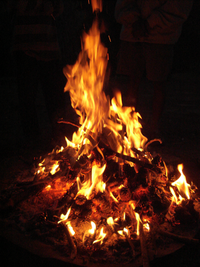 Fire, one of the four classical elements
was vital to the development of civilization
.
Once humans had learned to contain, control and sustain fires, they had an invaluable tool for cooking
food that would otherwise have been indigestible, for sharpening spears, for hollowing out canoe
s, for baking pottery
and for many other uses including simply keeping warm.
At first, humans would have relied on natural fires caused by lightning, learning to prolong the life of these fires by feeding fuel as the fire died down. But such fires would have been rare and would not have lasted long. At some point, humans discovered how to make fires by igniting tinder
from sparks caused by striking stones together, or by using a bow drill
or similar way of creating fire through friction.
Creating fire can be a tedious process. Eventually, humans began to use earthenware
vessels, or fire pots, in which slow-burning fires could by kept alight indefinitely by adding small quantities of fuel as needed. Nomadic people could carry these small fires with them, using them to start larger fires for their evening camps.
Fire pots were in use at least 10,000 years ago, as evidenced by finds in 1936-37 in Fells Cave
in the valley of the Rio Chico, not far from the Strait of Magellan. Fire pots appear to have been developed independently and at different times in many locations.
Semi-nomadic people, or people in contact with more settled people, would have made or acquired the more advanced forms of firepot. A portable clay fire pot is most useful while on the move, but it is most easily made by sedentary people accustomed to working with clay and kiln
s.
In Kashmir, in winter, people usually wear a "Phiran" or long woolen gown over their normal dress. To keep the inside of the Phiran warm, they sometimes use a Manann, a fire-pot made of clay. But with no insulation on its clay handles, the Manann is inconvenient.
A Kangdi is an improved version of the Manann, a semi-spherical clay pot enclosed in willow rushes, with handles also made of willow rushes. The pot holds burning coals that stay warm throughout the day. Throughout Kashmir in winter, it is common to see people with one hand holding their Kangdi inside their Phiran, doing the daily chores with the other.
 The fire pot was probably invented long after people discovered the value of cooking over fire.
Once fire-proof containers became available, such as iron pots, it was natural to design fire pots that both heated and supported the cooking vessel.
Over time, these developed into stoves, used both for cooking and heating.
, notably in Ilora and Oyo, an Adogan has a flat bottom with a carinated wall and an out-turned rim with three decorated lugs to support the cooking pot. A U-shaped hole is cut in one side to allow air to enter, and through which fuel is inserted.
or huoguo (Simplified Chinese: 火锅) is a traditional Chinese social meal. The literal Chinese translation is fire pot, as huo means fire, while guo refers to pot. The Chinese hot pot consists of a simmering metal pot of stock at the center of the dining table. While the hot pot is kept simmering, thinly sliced ingredients are placed into the pot and are cooked at the table. This type of cuisine is also referred to as "steamboat". In Western cooking, the fondue
is used in a similar way, although usually with different ingredients.
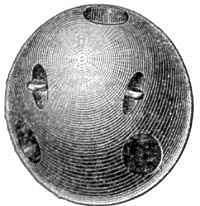 Small earthen pots filled with combustibles were used as early thermal weapons during the classical and medieval periods.
Containers made at first from clay, later from cast iron, known as 'carcasses
', were launched by a siege engine
, filled with pitch, Greek fire
or other incendiary mixtures. These fire pots could cause great damage to besieged cities with largely wooden construction.
A description of how to make military fire pots is given in Lucar, 1588, cited by Martin 1994:207-217
"Make great and small earthen pottes which must be but half baked, and like unto the picture in the mergent . . . . Fill every of those pottes halfe with grosse gunpowder pressed downe harde, and with one of the five severall mixtures next following in this Chapter, fill up the other half of those pottes: This done, cover the mouth of every potte with a peece of canvasse bound hard about the mouth of the potte, and well imbrued in melted brimstone. Also tie round about the middle of every potte a packthreed, and then hang upon the same packthreed round about the potte so many Gunmatches of a finger length as you wil, & when you wil throe any of these pottes among enemies, light the same gun-matches that they may so soone as the potte is broken with his fall uppon the ground, fire the mixture of the potte. Or rather put fire to the mixture at the mouth of the potte, & by so doing make the same to burn before you doe throe the potte from you, because it is a better and more surer way than the other: I meane than to fire the said mixture after the potte is broken with burning gunmatches. Moreover this is to be noted, that the small pottes do serve for to be throne out of one shippe into an other in fight uppon the sea, and that the great pottes are to be used in service uppon the lande for the defence of townes, fortes, walles, and gates, and to burne such things as the enemies shall throe into ditches for to fill up the same ditches, and also to destroy emenies in their trenches and campes"
By the mid-17th century, fire pots had largely been replaced by shells
filled with explosives, which may be seen as the direct descendants of military fire pots.
.
Fire pots have been used in religious ceremonies for thousands of years
.
It would be inappropriate, and probably impossible, to cover all religious uses of fire pots in this article, but
a few examples are relevant.
 A Censer
is any type of vessel made for burning incense
. They range from simple earthenware bowls to intricately carved silver or gold vessels, small table top objects a few centimetres tall to as many as several metres high. In many cultures, burning incense has spiritual and religious connotations, and this influences the design and decoration of the censer.
Before a Buddhist tantric
ritual, an assisting monk may swing a censer or thurible
as he passes to 'purify' the room. This is a container usually made of metal that hangs form three chains. Inside it, powdered incense that has been put on a smoldering bit of charcoal burns slowly, and the smoke escapes through pierced openings in the closed lid. One tradition says that during one of the Buddha's sermons a monk heedlessly swatted a mosquito. The Tathagatha is said to have ordered that, in the future, incense ought to be lit in order to keep the flies away, so that people could more easily concentrate on Dharma
teachings, but also to prevent the needless taking of lives.
Censers are used in the Roman Catholic, Anglo-Catholic, Old Catholic and Eastern Orthodox sects of the Christian religion during important rituals such as benedictions, processions and important masses
.
, God instructs Abraham
to cut a heifer, a she goat, a ram, a turtledove, and a young pigeon into halves. When it got dark, "a smoking fire pot and a flaming torch passed between the pieces", and later God made a covenant with Abraham granting him and his heirs extensive lands between the River of Egypt
(either the Nile
or the Wadi el Arish in the Sinai) and the Euphrates
.
Texts from Mari
in northern Mesopotamia
from about the same period say that parties entering into a covenant would seal the agreement by cutting a donkey in half and then walking between the severed pieces. One interpretation of the ceremony described in Genesis 15 is that God made an unconditional covenant when God alone (symbolized by the fire pot, or the fire in it) passed between the two halves of the slaughtered animals.
(香道 - Way of Fragrance) is the Japanese art of appreciating incense, and involves using incense within a structure of codified conduct. Participants sit near one another and take turns smelling incense from a censer as they pass it around the group. Participants comment on and make observations about the incense, and play games to guess the incense material.
with a fire pot on the head in the Mariamman
or Durga
temple rituals. Today it is danced with a pot decorated with flowers on the head and is known as 'Aatta Karagam' and symbolises joy and merriment. In earlier times, the clay pot, or Karagam, was considered the residence of the local deity during the festival
, which played a crucial role in community bonding. It is not clear whether the pot ever contained fire, or was so named because it was carried over fire by fire walkers.

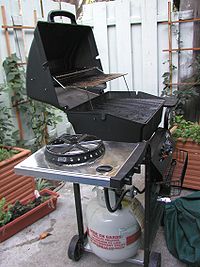 Although the fire pot and its ancestor the fire pit are still in use in their original forms, successive technical refinements have led to many modern descendants whose origin in the simple clay container might be hard to guess.
Some have been driven by the need to adapt to new fuels, such as charcoal
, oil
, coal
, coke
, kerosene
, propane
, electricity
and microwaves. Others have been made possible through discovery of new materials such as iron
, bronze
, ceramic
s and asbestos
. Always the motive would have been to improve the design, to make a device for managing fire that was cheaper, more robust, more convenient, more capable of meeting new demands. Often improvements made for industrial purposes found their way into improved cooking devices, and vice-versa.
An incomplete list of fire pot descendants includes:
Early Times
Fire (classical element)
Fire has been an important part of all cultures and religions from pre-history to modern day and was vital to the development of civilization. It has been regarded in many different contexts throughout history, but especially as a metaphysical constant of the world.-Greek and Roman tradition:Fire...
was vital to the development of civilization
Civilization
Civilization is a sometimes controversial term that has been used in several related ways. Primarily, the term has been used to refer to the material and instrumental side of human cultures that are complex in terms of technology, science, and division of labor. Such civilizations are generally...
.
Once humans had learned to contain, control and sustain fires, they had an invaluable tool for cooking
Cooking
Cooking is the process of preparing food by use of heat. Cooking techniques and ingredients vary widely across the world, reflecting unique environmental, economic, and cultural traditions. Cooks themselves also vary widely in skill and training...
food that would otherwise have been indigestible, for sharpening spears, for hollowing out canoe
Canoe
A canoe or Canadian canoe is a small narrow boat, typically human-powered, though it may also be powered by sails or small electric or gas motors. Canoes are usually pointed at both bow and stern and are normally open on top, but can be decked over A canoe (North American English) or Canadian...
s, for baking pottery
Pottery
Pottery is the material from which the potteryware is made, of which major types include earthenware, stoneware and porcelain. The place where such wares are made is also called a pottery . Pottery also refers to the art or craft of the potter or the manufacture of pottery...
and for many other uses including simply keeping warm.
At first, humans would have relied on natural fires caused by lightning, learning to prolong the life of these fires by feeding fuel as the fire died down. But such fires would have been rare and would not have lasted long. At some point, humans discovered how to make fires by igniting tinder
Tinder
Tinder is easily combustible material used to ignite fires by rudimentary methods. A small fire consisting of tinder is then used to ignite kindling. Anything that can be ignited by a match can be considered tinder; or by more rigorous definition, anything that begins to glow under a shower of...
from sparks caused by striking stones together, or by using a bow drill
Bow drill
The bow drill is an ancient tool. While it was usually used to make fire, it was also used for primitive woodworking and dentistry. It consists of a bearing block or handhold, a spindle or drill, a hearth or fireboard, and a simple bow...
or similar way of creating fire through friction.
Creating fire can be a tedious process. Eventually, humans began to use earthenware
Earthenware
Earthenware is a common ceramic material, which is used extensively for pottery tableware and decorative objects.-Types of earthenware:Although body formulations vary between countries and even between individual makers, a generic composition is 25% ball clay, 28% kaolin, 32% quartz, and 15%...
vessels, or fire pots, in which slow-burning fires could by kept alight indefinitely by adding small quantities of fuel as needed. Nomadic people could carry these small fires with them, using them to start larger fires for their evening camps.
Fire pots were in use at least 10,000 years ago, as evidenced by finds in 1936-37 in Fells Cave
in the valley of the Rio Chico, not far from the Strait of Magellan. Fire pots appear to have been developed independently and at different times in many locations.
Semi-nomadic people, or people in contact with more settled people, would have made or acquired the more advanced forms of firepot. A portable clay fire pot is most useful while on the move, but it is most easily made by sedentary people accustomed to working with clay and kiln
Kiln
A kiln is a thermally insulated chamber, or oven, in which a controlled temperature regime is produced. Uses include the hardening, burning or drying of materials...
s.
Kangdi
A Kangdi is a traditional earthen fire pot from Kashmir, used to warm the hands or feet.In Kashmir, in winter, people usually wear a "Phiran" or long woolen gown over their normal dress. To keep the inside of the Phiran warm, they sometimes use a Manann, a fire-pot made of clay. But with no insulation on its clay handles, the Manann is inconvenient.
A Kangdi is an improved version of the Manann, a semi-spherical clay pot enclosed in willow rushes, with handles also made of willow rushes. The pot holds burning coals that stay warm throughout the day. Throughout Kashmir in winter, it is common to see people with one hand holding their Kangdi inside their Phiran, doing the daily chores with the other.
Cooking
Once fire-proof containers became available, such as iron pots, it was natural to design fire pots that both heated and supported the cooking vessel.
Over time, these developed into stoves, used both for cooking and heating.
Adogan
An earthenware fire-pot or indigenous stove found in West Africa, notably in Ilora and Oyo, an Adogan has a flat bottom with a carinated wall and an out-turned rim with three decorated lugs to support the cooking pot. A U-shaped hole is cut in one side to allow air to enter, and through which fuel is inserted.
Chinese Hot pot
Hot potHot pot
Hot pot , less commonly Chinese fondue or steamboat, refers to several East Asian varieties of stew, consisting of a simmering metal pot of stock at the center of the dining table. While the hot pot is kept simmering, ingredients are placed into the pot and are cooked at the table...
or huoguo (Simplified Chinese: 火锅) is a traditional Chinese social meal. The literal Chinese translation is fire pot, as huo means fire, while guo refers to pot. The Chinese hot pot consists of a simmering metal pot of stock at the center of the dining table. While the hot pot is kept simmering, thinly sliced ingredients are placed into the pot and are cooked at the table. This type of cuisine is also referred to as "steamboat". In Western cooking, the fondue
Fondue
Fondue is a Swiss dish of melted cheese served in a communal pot over a spirit lamp , and eaten by dipping long-stemmed forks with bread into the cheese...
is used in a similar way, although usually with different ingredients.
Warfare
Containers made at first from clay, later from cast iron, known as 'carcasses
Carcass (projectile)
A carcass was an early form of incendiary bomb or shell, intended to set targets on fire. It comprised an external casing, usually of cast iron, filled with a highly flammable mixture, and having three to five holes through which the burning filling could blaze outward...
', were launched by a siege engine
Siege engine
A siege engine is a device that is designed to break or circumvent city walls and other fortifications in siege warfare. Some have been operated close to the fortifications, while others have been used to attack from a distance. From antiquity, siege engines were constructed largely of wood and...
, filled with pitch, Greek fire
Greek fire
Greek fire was an incendiary weapon used by the Byzantine Empire. The Byzantines typically used it in naval battles to great effect as it could continue burning while floating on water....
or other incendiary mixtures. These fire pots could cause great damage to besieged cities with largely wooden construction.
A description of how to make military fire pots is given in Lucar, 1588, cited by Martin 1994:207-217
"Make great and small earthen pottes which must be but half baked, and like unto the picture in the mergent . . . . Fill every of those pottes halfe with grosse gunpowder pressed downe harde, and with one of the five severall mixtures next following in this Chapter, fill up the other half of those pottes: This done, cover the mouth of every potte with a peece of canvasse bound hard about the mouth of the potte, and well imbrued in melted brimstone. Also tie round about the middle of every potte a packthreed, and then hang upon the same packthreed round about the potte so many Gunmatches of a finger length as you wil, & when you wil throe any of these pottes among enemies, light the same gun-matches that they may so soone as the potte is broken with his fall uppon the ground, fire the mixture of the potte. Or rather put fire to the mixture at the mouth of the potte, & by so doing make the same to burn before you doe throe the potte from you, because it is a better and more surer way than the other: I meane than to fire the said mixture after the potte is broken with burning gunmatches. Moreover this is to be noted, that the small pottes do serve for to be throne out of one shippe into an other in fight uppon the sea, and that the great pottes are to be used in service uppon the lande for the defence of townes, fortes, walles, and gates, and to burne such things as the enemies shall throe into ditches for to fill up the same ditches, and also to destroy emenies in their trenches and campes"
By the mid-17th century, fire pots had largely been replaced by shells
Shell (projectile)
A shell is a payload-carrying projectile, which, as opposed to shot, contains an explosive or other filling, though modern usage sometimes includes large solid projectiles properly termed shot . Solid shot may contain a pyrotechnic compound if a tracer or spotting charge is used...
filled with explosives, which may be seen as the direct descendants of military fire pots.
Religion and the Arts
There is an element of mystery in fire, which at times has led to fire worshipFire worship
Worship or deification of fire is known from various religions. Fire has been an important part of human culture since the Lower Paleolithic...
.
Fire pots have been used in religious ceremonies for thousands of years
.
It would be inappropriate, and probably impossible, to cover all religious uses of fire pots in this article, but
a few examples are relevant.
Censers
Censer
Censers are any type of vessels made for burning incense. These vessels vary greatly in size, form, and material of construction. They may consist of simple earthenware bowls or fire pots to intricately carved silver or gold vessels, small table top objects a few centimetres tall to as many as...
is any type of vessel made for burning incense
Incense
Incense is composed of aromatic biotic materials, which release fragrant smoke when burned. The term "incense" refers to the substance itself, rather than to the odor that it produces. It is used in religious ceremonies, ritual purification, aromatherapy, meditation, for creating a mood, and for...
. They range from simple earthenware bowls to intricately carved silver or gold vessels, small table top objects a few centimetres tall to as many as several metres high. In many cultures, burning incense has spiritual and religious connotations, and this influences the design and decoration of the censer.
Before a Buddhist tantric
Vajrayana
Vajrayāna Buddhism is also known as Tantric Buddhism, Tantrayāna, Mantrayāna, Secret Mantra, Esoteric Buddhism and the Diamond Vehicle...
ritual, an assisting monk may swing a censer or thurible
Thurible
A thurible is a metal censer suspended from chains, in which incense is burned during worship services. It is used in the Catholic Church as well as in Anglican, Eastern Orthodox, Oriental Orthodox, Armenian Apostolic, some Lutheran, Old Catholic, and in various Gnostic Churches. It is also used...
as he passes to 'purify' the room. This is a container usually made of metal that hangs form three chains. Inside it, powdered incense that has been put on a smoldering bit of charcoal burns slowly, and the smoke escapes through pierced openings in the closed lid. One tradition says that during one of the Buddha's sermons a monk heedlessly swatted a mosquito. The Tathagatha is said to have ordered that, in the future, incense ought to be lit in order to keep the flies away, so that people could more easily concentrate on Dharma
Dharma
Dharma means Law or Natural Law and is a concept of central importance in Indian philosophy and religion. In the context of Hinduism, it refers to one's personal obligations, calling and duties, and a Hindu's dharma is affected by the person's age, caste, class, occupation, and gender...
teachings, but also to prevent the needless taking of lives.
Censers are used in the Roman Catholic, Anglo-Catholic, Old Catholic and Eastern Orthodox sects of the Christian religion during important rituals such as benedictions, processions and important masses
Mass (liturgy)
"Mass" is one of the names by which the sacrament of the Eucharist is called in the Roman Catholic Church: others are "Eucharist", the "Lord's Supper", the "Breaking of Bread", the "Eucharistic assembly ", the "memorial of the Lord's Passion and Resurrection", the "Holy Sacrifice", the "Holy and...
.
Early Jewish Symbol of God
In Genesis 15, a chapter of the BibleBible
The Bible refers to any one of the collections of the primary religious texts of Judaism and Christianity. There is no common version of the Bible, as the individual books , their contents and their order vary among denominations...
, God instructs Abraham
Abraham
Abraham , whose birth name was Abram, is the eponym of the Abrahamic religions, among which are Judaism, Christianity and Islam...
to cut a heifer, a she goat, a ram, a turtledove, and a young pigeon into halves. When it got dark, "a smoking fire pot and a flaming torch passed between the pieces", and later God made a covenant with Abraham granting him and his heirs extensive lands between the River of Egypt
Brook of Egypt
The Brook of Egypt is the name used in some English translations of the Bible for the Hebrew Nachal Mitzrayim used for the river defining the westernmost border of the Land of Israel. Popular Bible commentaries identify it with Wadi El-Arish although the identification is problematic...
(either the Nile
Nile
The Nile is a major north-flowing river in North Africa, generally regarded as the longest river in the world. It is long. It runs through the ten countries of Sudan, South Sudan, Burundi, Rwanda, Democratic Republic of the Congo, Tanzania, Kenya, Ethiopia, Uganda and Egypt.The Nile has two major...
or the Wadi el Arish in the Sinai) and the Euphrates
Euphrates
The Euphrates is the longest and one of the most historically important rivers of Western Asia. Together with the Tigris, it is one of the two defining rivers of Mesopotamia...
.
Texts from Mari
Mari, Syria
Mari was an ancient Sumerian and Amorite city, located 11 kilometers north-west of the modern town of Abu Kamal on the western bank of Euphrates river, some 120 km southeast of Deir ez-Zor, Syria...
in northern Mesopotamia
Mesopotamia
Mesopotamia is a toponym for the area of the Tigris–Euphrates river system, largely corresponding to modern-day Iraq, northeastern Syria, southeastern Turkey and southwestern Iran.Widely considered to be the cradle of civilization, Bronze Age Mesopotamia included Sumer and the...
from about the same period say that parties entering into a covenant would seal the agreement by cutting a donkey in half and then walking between the severed pieces. One interpretation of the ceremony described in Genesis 15 is that God made an unconditional covenant when God alone (symbolized by the fire pot, or the fire in it) passed between the two halves of the slaughtered animals.
Japanese Kodo Ceremony
KōdōKodo
-In Japan:* The kōdō, Japanese incense ceremony.* Kodo , a taiko drumming group based in Japan.* The Kodo Group, a yakuza criminal organization...
(香道 - Way of Fragrance) is the Japanese art of appreciating incense, and involves using incense within a structure of codified conduct. Participants sit near one another and take turns smelling incense from a censer as they pass it around the group. Participants comment on and make observations about the incense, and play games to guess the incense material.
Sakthi Karagam
Sakthi Karagam is a dance performed in Tamil NaduTamil Nadu
Tamil Nadu is one of the 28 states of India. Its capital and largest city is Chennai. Tamil Nadu lies in the southernmost part of the Indian Peninsula and is bordered by the union territory of Pondicherry, and the states of Kerala, Karnataka, and Andhra Pradesh...
with a fire pot on the head in the Mariamman
Mariamman
Māri ,Tulu, also known as Mariamman , both meaning "Mother Mari", spelt also Maariamma , or simply Amman or Aatha is the South Indian Hindu goddess of disease and rain. She is the main South Indian mother goddess, predominant in the rural areas of Tamil Nadu, Karnataka, Andhra Pradesh and...
or Durga
Durga
For the 1985 Hindi Film of Rajesh Khanna see DurgaaIn Hinduism, Durga ; ; meaning "the inaccessible" or "the invincible"; , durga) or Maa Durga "one who can redeem in situations of utmost distress" is a form of Devi, the supremely radiant goddess, depicted as having eighteen arms, riding a lion...
temple rituals. Today it is danced with a pot decorated with flowers on the head and is known as 'Aatta Karagam' and symbolises joy and merriment. In earlier times, the clay pot, or Karagam, was considered the residence of the local deity during the festival
, which played a crucial role in community bonding. It is not clear whether the pot ever contained fire, or was so named because it was carried over fire by fire walkers.
Descendants of the Fire Pot
Some have been driven by the need to adapt to new fuels, such as charcoal
Charcoal
Charcoal is the dark grey residue consisting of carbon, and any remaining ash, obtained by removing water and other volatile constituents from animal and vegetation substances. Charcoal is usually produced by slow pyrolysis, the heating of wood or other substances in the absence of oxygen...
, oil
Oil
An oil is any substance that is liquid at ambient temperatures and does not mix with water but may mix with other oils and organic solvents. This general definition includes vegetable oils, volatile essential oils, petrochemical oils, and synthetic oils....
, coal
Coal
Coal is a combustible black or brownish-black sedimentary rock usually occurring in rock strata in layers or veins called coal beds or coal seams. The harder forms, such as anthracite coal, can be regarded as metamorphic rock because of later exposure to elevated temperature and pressure...
, coke
Coke (fuel)
Coke is the solid carbonaceous material derived from destructive distillation of low-ash, low-sulfur bituminous coal. Cokes from coal are grey, hard, and porous. While coke can be formed naturally, the commonly used form is man-made.- History :...
, kerosene
Kerosene
Kerosene, sometimes spelled kerosine in scientific and industrial usage, also known as paraffin or paraffin oil in the United Kingdom, Hong Kong, Ireland and South Africa, is a combustible hydrocarbon liquid. The name is derived from Greek keros...
, propane
Propane
Propane is a three-carbon alkane with the molecular formula , normally a gas, but compressible to a transportable liquid. A by-product of natural gas processing and petroleum refining, it is commonly used as a fuel for engines, oxy-gas torches, barbecues, portable stoves, and residential central...
, electricity
Electricity
Electricity is a general term encompassing a variety of phenomena resulting from the presence and flow of electric charge. These include many easily recognizable phenomena, such as lightning, static electricity, and the flow of electrical current in an electrical wire...
and microwaves. Others have been made possible through discovery of new materials such as iron
Iron
Iron is a chemical element with the symbol Fe and atomic number 26. It is a metal in the first transition series. It is the most common element forming the planet Earth as a whole, forming much of Earth's outer and inner core. It is the fourth most common element in the Earth's crust...
, bronze
Bronze
Bronze is a metal alloy consisting primarily of copper, usually with tin as the main additive. It is hard and brittle, and it was particularly significant in antiquity, so much so that the Bronze Age was named after the metal...
, ceramic
Ceramic
A ceramic is an inorganic, nonmetallic solid prepared by the action of heat and subsequent cooling. Ceramic materials may have a crystalline or partly crystalline structure, or may be amorphous...
s and asbestos
Asbestos
Asbestos is a set of six naturally occurring silicate minerals used commercially for their desirable physical properties. They all have in common their eponymous, asbestiform habit: long, thin fibrous crystals...
. Always the motive would have been to improve the design, to make a device for managing fire that was cheaper, more robust, more convenient, more capable of meeting new demands. Often improvements made for industrial purposes found their way into improved cooking devices, and vice-versa.
An incomplete list of fire pot descendants includes:
- BrazierBrazierA brazier is a container for fire, generally taking the form of an upright standing or hanging metal bowl or box. Used for holding burning coal as well as fires, a brazier allows for a source of light, heat, or cooking...
: A standing or hanging metal bowl or box containing the fire, with perforations for ventilation. A HibachiHibachiThe is a traditional Japanese heating device. It consists of a round, cylindrical or a box-shaped open-topped container, made from or lined with a heatproof material and designed to hold burning charcoal....
is a type of brazier. - StoveStoveA stove is an enclosed heated space. The term is commonly taken to mean an enclosed space in which fuel is burned to provide heating, either to heat the space in which the stove is situated or to heat the stove itself, and items placed on it...
: An enclosed space containing the fire, with dampers and regulators to adjust the draft and thus control the heat. A stove allows for cleaner, hotter and more efficient use of fuel than a fire pot or brazier. - OvenOvenAn oven is a thermally insulated chamber used for the heating, baking or drying of a substance. It is most commonly used for cooking. Kilns, and furnaces are special-purpose ovens...
: An enclosed compartment of a stove, separate from the fire, used for heating, baking or drying. Ovens may have their origin in the practice of enclosing food in clay or leaves before placing it in the fire, still used in KaluaKaluaKālua is a traditional Hawaiian cooking method that utilizes an imu, a type of underground oven. The word kālua, which literally means "to cook in an underground oven", may also be used to describe the food cooked in this manner, such as kālua pig or kālua turkey, which are commonly served at luau...
, the traditional cuisine of HawaiiCuisine of HawaiiModern Hawaiian cuisine is a fusion of many cuisines brought by multiethnic immigrants to the Hawaiian Islands, particularly of American, Chinese, Filipino, Japanese, Korean, Polynesian and Portuguese origins, including plant and animal food sources imported from around the world for agricultural...
. Ovens make it practical to cook slowly, heating the food throughout, and are the basis of many types of cuisine. Ovens enable potteryPotteryPottery is the material from which the potteryware is made, of which major types include earthenware, stoneware and porcelain. The place where such wares are made is also called a pottery . Pottery also refers to the art or craft of the potter or the manufacture of pottery...
and today are used in many industrial processes. - BoilerBoilerA boiler is a closed vessel in which water or other fluid is heated. The heated or vaporized fluid exits the boiler for use in various processes or heating applications.-Materials:...
: A closed vessel in which water is heated. The discovery that boilers could build up explosive pressure if too well sealed led to the invention of the steam engineSteam engineA steam engine is a heat engine that performs mechanical work using steam as its working fluid.Steam engines are external combustion engines, where the working fluid is separate from the combustion products. Non-combustion heat sources such as solar power, nuclear power or geothermal energy may be...
, a pivotal technology in the Industrial RevolutionIndustrial RevolutionThe Industrial Revolution was a period from the 18th to the 19th century where major changes in agriculture, manufacturing, mining, transportation, and technology had a profound effect on the social, economic and cultural conditions of the times...
. - BarbecueBarbecueBarbecue or barbeque , used chiefly in the United States, Canada, the United Kingdom, New Zealand and Australia is a method and apparatus for cooking meat, poultry and occasionally fish with the heat and hot smoke of a fire, smoking wood, or hot coals of...
: A device for cooking on a grill over a box containing burning wood, charcoal or, more recently, propane or natural gas.