

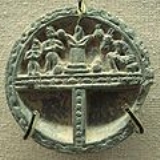
Fire worship

Encyclopedia
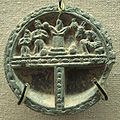
Fire
Fire is the rapid oxidation of a material in the chemical process of combustion, releasing heat, light, and various reaction products. Slower oxidative processes like rusting or digestion are not included by this definition....
(also pyrodulia, pyrolatry or pyrolatria) is known from various religions. Fire has been an important part of human
Homo (genus)
Homo is the genus that includes modern humans and species closely related to them. The genus is estimated to be about 2.3 to 2.4 million years old, evolving from australopithecine ancestors with the appearance of Homo habilis....
culture since the Lower Paleolithic
Lower Paleolithic
The Lower Paleolithic is the earliest subdivision of the Paleolithic or Old Stone Age. It spans the time from around 2.5 million years ago when the first evidence of craft and use of stone tools by hominids appears in the current archaeological record, until around 300,000 years ago, spanning the...
. The earliest known traces of controlled fire were found at Gesher Benot Ya‘aqov, Israel
Israel
The State of Israel is a parliamentary republic located in the Middle East, along the eastern shore of the Mediterranean Sea...
and dated to an age of 790,000 years, and religious or animist notions connected to fire must be assumed to reach back to such early pre-Homo sapiens times. In the animal kingdom, the controlled use of fire is restricted to human species. As fire has also destructive capabilities, the worshipping of fire is necessarily ambiguous. This is indicated in proverb
Proverb
A proverb is a simple and concrete saying popularly known and repeated, which expresses a truth, based on common sense or the practical experience of humanity. They are often metaphorical. A proverb that describes a basic rule of conduct may also be known as a maxim...
s such as "Fire is a good servant but a bad master".
Indo-European religions
In Indo-EuropeanIndo-European
Indo-European may refer to:* Indo-European languages** Aryan race, a 19th century and early 20th century term for those peoples who are the native speakers of Indo-European languages...
languages, there were two concepts regarding fire: that of an animate type called *egni- (cf. English ignite from Latin ignis, and Russian ogon), and an inanimate type *paewr- (cf. English - fire, Greek pyr, Sanskrit pu). A similar distinction existed for water
Water
Water is a chemical substance with the chemical formula H2O. A water molecule contains one oxygen and two hydrogen atoms connected by covalent bonds. Water is a liquid at ambient conditions, but it often co-exists on Earth with its solid state, ice, and gaseous state . Water also exists in a...
.
Archaeologically, the earliest evidence for Indo-Iranian fire worship is found at the transition from the Sintashta-Petrovka to the Fedorovo culture around 1500 BC, together with first evidence of cremation
Cremation
Cremation is the process of reducing bodies to basic chemical compounds such as gasses and bone fragments. This is accomplished through high-temperature burning, vaporization and oxidation....
. While cremation became ubiquitous in Hinduism, it came to be disavowed in Zoroastrianism.
Although the term "fire-worshippers" is primarily associated with Zoroastrians
Zoroastrianism
Zoroastrianism is a religion and philosophy based on the teachings of prophet Zoroaster and was formerly among the world's largest religions. It was probably founded some time before the 6th century BCE in Greater Iran.In Zoroastrianism, the Creator Ahura Mazda is all good, and no evil...
, the idea that Zoroastrians worship fire is originally from anti-Zoroastrian polemic. Instead, fire — even in a Fire temple
Fire temple
A fire temple in Zoroastrianism is the place of worship for Zoroastrians. Zoroastrians revere fire in any form. In the Zoroastrian religion, fire , together with clean water , are agents of ritual purity...
(the Zoroastrian terms are more prosaic and simply mean "house of fire") — is considered to be an agent of purity and as a symbol of righteousness and truth. In the present day this is explained to be because fire burns ever-upwards and cannot itself be polluted. Nonetheless, Sadeh
Sadeh
Sadé or Sada Jashn-e Sada/Sadé , also transliterated as Sadeh, is an ancient Iranian tradition celebrated 50 days before Nowruz. Sadeh in Persian means "hundred" and refers to one hundred days and nights past the end of summer...
and Chaharshanbe Suri
Chaharshanbe Suri
The last Wednesday of the Iranian year known as Chahar Shanbeh Soori , the eve of which is marked by special customs and rituals, most notably jumping over fire...
are both fire-related festivals celebrated throughout Greater Iran
Greater Iran
Greater Iran refers to the regions that have significant Iranian cultural influence. It roughly corresponds to the territory on the Iranian plateau and its bordering plains, stretching from Iraq, the Caucasus, and Turkey in the west to the Indus River in the east...
and date back to when Zoroastrianism was still the predominant religion of the region.
In Vedic disciplines of Hinduism
Hinduism
Hinduism is the predominant and indigenous religious tradition of the Indian Subcontinent. Hinduism is known to its followers as , amongst many other expressions...
, fire is a central element in the Yajna
Yajna
In Hinduism, yajna is a ritual of sacrifice derived from the practice of Vedic times. It is performed to please the gods or to attain certain wishes...
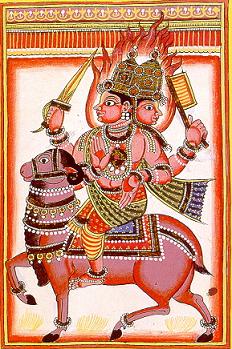
ceremony, with Agni
Agni
Agni is a Hindu deity, one of the most important of the Vedic gods. He is the god of fire and the acceptor of sacrifices. The sacrifices made to Agni go to the deities because Agni is a messenger from and to the other gods...
, "fire", playing the role as mediator between the worshipper and the other gods. Related concepts are the Agnihotra
Agnihotra
Agnihotra is a Vedic yajña performed in orthodox Hindu communities. It is mentioned in the Atharvaveda and described in detail in the Yajurveda Samhita and the Shatapatha Brahmana . The Vedic form of the ritual is still performed Nambudiri Brahmins of Kerala and by a small number of Vaidiki...
ritual, the invocation of the healing properties of fire; the Agnicayana
Agnicayana
The Atiratra Agnicayana or Athirathram ; the piling of the altar of Agni is a Śrauta ritual of the Vedic religion, the predecessor of modern day Hinduism which is considered to be the greatest ritual as per the Vedic ritual hierarchy. It is also the world's oldest surviving ritual...
ritual, which is the building of a fire altar to Agni; and Agnistoma, which is one of the seven Somayajnas. In the Vaishnav branch of Hinduism
Hinduism
Hinduism is the predominant and indigenous religious tradition of the Indian Subcontinent. Hinduism is known to its followers as , amongst many other expressions...
, Agni or Fire is considered the tongue of the Supreme Lord Narayana, hence all the sacrifices done even to any demigod ultimately is a sacrifice to the Supreme Lord Narayana.
Fire worship in Graeco-Roman tradition had two separate forms: fire of the hearth
Hearth
In common historic and modern usage, a hearth is a brick- or stone-lined fireplace or oven often used for cooking and/or heating. For centuries, the hearth was considered an integral part of a home, often its central or most important feature...
and fire of the forge
Forge
A forge is a hearth used for forging. The term "forge" can also refer to the workplace of a smith or a blacksmith, although the term smithy is then more commonly used.The basic smithy contains a forge, also known as a hearth, for heating metals...
. Hearth worship was maintained in Rome by the Vestal Virgins, who served the goddess Vesta
Vesta (mythology)
Vesta was the virgin goddess of the hearth, home, and family in Roman religion. Vesta's presence was symbolized by the sacred fire that burned at her hearth and temples...
, protector of the home, who had a sacred flame as the symbol of her presence in the city (cf. Sacred fire of Vesta
Sacred fire of Vesta
The sacred fire of Vesta was a holy fire in Ancient Rome. The Vestal Virgins were selected by lot and served for thirty years, tending the holy fire and performing other rituals connected to domestic life—among them were the ritual sweeping of the temple on June 15 and the preparation of...
). The Greek equivalent of the goddess was Hestia
Hestia
In Greek mythology Hestia , first daughter of Cronus and Rhea , is the virgin goddess of the hearth, architecture, and of the right ordering of domesticity and the family. She received the first offering at every sacrifice in the household. In the public domain, the hearth of the prytaneum...
, whose worship is less well attested. The fire of the forge was associated with the Greek god Hephaestus
Hephaestus
Hephaestus was a Greek god whose Roman equivalent was Vulcan. He is the son of Zeus and Hera, the King and Queen of the Gods - or else, according to some accounts, of Hera alone. He was the god of technology, blacksmiths, craftsmen, artisans, sculptors, metals, metallurgy, fire and volcanoes...
and the Roman equivalent Vulcan
Vulcan (mythology)
Vulcan , aka Mulciber, is the god of beneficial and hindering fire, including the fire of volcanoes in ancient Roman religion and Roman Neopaganism. Vulcan is usually depicted with a thunderbolt. He is known as Sethlans in Etruscan mythology...
. These two seem to have served both as craft-guild patrons and as protectors against accidental fires in cities. Also associated with fire is the titanic god
Titan (mythology)
In Greek mythology, the Titans were a race of powerful deities, descendants of Gaia and Uranus, that ruled during the legendary Golden Age....
Prometheus
Prometheus
In Greek mythology, Prometheus is a Titan, the son of Iapetus and Themis, and brother to Atlas, Epimetheus and Menoetius. He was a champion of mankind, known for his wily intelligence, who stole fire from Zeus and gave it to mortals...
, who stole fire for humans from the gods. Most forms of worship in Graeco-Roman religion involved either cooking or burning completely an animal on a fire made on an altar
Altar
An altar is any structure upon which offerings such as sacrifices are made for religious purposes. Altars are usually found at shrines, and they can be located in temples, churches and other places of worship...
in front of a temple
Temple
A temple is a structure reserved for religious or spiritual activities, such as prayer and sacrifice, or analogous rites. A templum constituted a sacred precinct as defined by a priest, or augur. It has the same root as the word "template," a plan in preparation of the building that was marked out...
(see hecatomb
Hecatomb
In Ancient Greece, a Hecatomb was a sacrifice to the gods of 100 cattle . Hecatombs were offered to Greek gods Apollo, Athena, and Hera, during special religious ceremonies....
).
In Norse mythology
Norse mythology
Norse mythology, a subset of Germanic mythology, is the overall term for the myths, legends and beliefs about supernatural beings of Norse pagans. It flourished prior to the Christianization of Scandinavia, during the Early Middle Ages, and passed into Nordic folklore, with some aspects surviving...
, Surtr
Surtr
In Norse mythology, Surtr or Surt is an eldjötunn. Surtr is attested in the Poetic Edda, compiled in the 13th century from earlier traditional sources, and the Prose Edda, written in the 13th century by Snorri Sturluson...
is associated with fire itself, because he is a fire giant who rules over Muspelheim
Muspelheim
In Norse mythology, Muspelheim , also called Múspell, is a realm of fire. This realm is one of the Nine Worlds and it is home to the fire jötunn or the Sons of Muspell, and Surtr, their ruler. It is fire; and the land to the North, Niflheim, is ice...
, the world of eternal flame. His name translates to "black" or "the swarthy one". It is quite obvious that J. R. R. Tolkien
J. R. R. Tolkien
John Ronald Reuel Tolkien, CBE was an English writer, poet, philologist, and university professor, best known as the author of the classic high fantasy works The Hobbit, The Lord of the Rings, and The Silmarillion.Tolkien was Rawlinson and Bosworth Professor of Anglo-Saxon at Pembroke College,...
was inspired by Sutr when he wrote about his Balrog
Balrog
Balrogs are fictional demonic beings who appear in J. R. R. Tolkien's Middle-earth legendarium. Such creatures first appeared in print in his novel The Lord of the Rings, though they figured in earlier writings that posthumously appeared in The Silmarillion and other books.Balrogs are described as...
in the Lord of the Rings epic. This name was inspired by the Proto-norse word balrók meaning "fire-god" or "fire-power". In swedish, bål means large fire or bonfire and rök means smoke.
Celtic mythology
Celtic mythology
Celtic mythology is the mythology of Celtic polytheism, apparently the religion of the Iron Age Celts. Like other Iron Age Europeans, the early Celts maintained a polytheistic mythology and religious structure...
had Belenus
Belenus
In Celtic mythology, Bel, Belenos was a deity worshipped in Gaul, Cisalpine Gaul, and Celtic areas of Austria, Britain and Spain. He is particularly associated with Cornwall, West Cornwall being anciently called Belerion, the place of Bel...
, whose name, "shining one", associated him with fire.
In Slavic mythology
Slavic mythology
Slavic mythology is the mythological aspect of the polytheistic religion that was practised by the Slavs before Christianisation.The religion possesses many common traits with other religions descended from the Proto-Indo-European religion....
, Svarog
Svarog
Svarog is a Slavic deity known primarily from the Hypatian Codex, a Slavic translation of the Chronicle of John Malalas. Svarog is there identified with Hephaestus, the god of the blacksmith in ancient Greek religion, and as the father of Dažbog, a Slavic solar deity...
, meaning "bright and clear", was the spirit of fire.
Semitic religions
Fire is an element of theophanyTheophany
Theophany, from the Ancient Greek , meaning "appearance of God"), refers to the appearance of a deity to a human or other being, or to a divine disclosure....
in the Hebrew Bible
Hebrew Bible
The Hebrew Bible is a term used by biblical scholars outside of Judaism to refer to the Tanakh , a canonical collection of Jewish texts, and the common textual antecedent of the several canonical editions of the Christian Old Testament...
's burning bush
Burning bush
The burning bush is an object described by the Book of Exodus as being located on Mount Sinai; according to the narrative, the bush was on fire, but was not consumed by the flames, hence the name...
, pillar of fire
Pillar of Fire (theophany)
A Pillar of Fire was one of the manifestations of the presence of the God of Israel in the Torah. According to Exodus, the pillar of fire provided light so that Jews could travel by night during the Exodus from Egypt . The pillar of fire is traditionally paired with the manifestation of the divine...
, and the Eternal flame
Eternal flame
An eternal flame is a flame or torch that burns day and night for an indefinite period. The flame that burned constantly at Delphi was an archaic feature, "alien to the ordinary Greek temple"....
of the Menorah.
The highest form of sacrifice is the Korban Olah
Korban Olah
Korban olah or olah was a twice-daily animal sacrifice offered on the altar in the temple in Jerusalem that was completely consumed by fire.The skin of the animal, however, was not burnt but given to the priests respective of their priestly division...
, performed twice-daily, which is an animal sacrifice
Animal sacrifice
Animal sacrifice is the ritual killing of an animal as part of a religion. It is practised by many religions as a means of appeasing a god or gods or changing the course of nature...
completely consumed by fire.
In the New Testament
New Testament
The New Testament is the second major division of the Christian biblical canon, the first such division being the much longer Old Testament....
, the Holy Spirit
Holy Spirit
Holy Spirit is a term introduced in English translations of the Hebrew Bible, but understood differently in the main Abrahamic religions.While the general concept of a "Spirit" that permeates the cosmos has been used in various religions Holy Spirit is a term introduced in English translations of...
is manifested as "tongues of flame".
The Qarmatians
Qarmatians
The Qarmatians were a Shi'a Ismaili group centered in eastern Arabia, where they attempted to established a utopian republic in 899 CE. They are most famed for their revolt against the Abbasid Caliphate...
, a branch of Ismailism (in turn a branch of Shia Islam) claimed to have found the Mahdi
Mahdi
In Islamic eschatology, the Mahdi is the prophesied redeemer of Islam who will stay on Earth for seven, nine or nineteen years- before the Day of Judgment and, alongside Jesus, will rid the world of wrongdoing, injustice and tyranny.In Shia Islam, the belief in the Mahdi is a "central religious...
in the 10th century CE and appointed him caliph
Caliph
The Caliph is the head of state in a Caliphate, and the title for the ruler of the Islamic Ummah, an Islamic community ruled by the Shari'ah. It is a transcribed version of the Arabic word which means "successor" or "representative"...
, but later deposed him because of an ensuing power struggle. Among his so-called heretical beliefs were fire worship and book burning
Book burning
Book burning, biblioclasm or libricide is the practice of destroying, often ceremoniously, books or other written material and media. In modern times, other forms of media, such as phonograph records, video tapes, and CDs have also been ceremoniously burned, torched, or shredded...
of religious texts.
Modern times
Fire continues to be a part of many human religions and cultures. For example, it is used in cremationCremation
Cremation is the process of reducing bodies to basic chemical compounds such as gasses and bone fragments. This is accomplished through high-temperature burning, vaporization and oxidation....
and bonfire
Bonfire
A bonfire is a controlled outdoor fire used for informal disposal of burnable waste material or as part of a celebration. Celebratory bonfires are typically designed to burn quickly and may be very large...
s; candle
Candle
A candle is a solid block or cylinder of wax with an embedded wick, which is lit to provide light, and sometimes heat.Today, most candles are made from paraffin. Candles can also be made from beeswax, soy, other plant waxes, and tallow...
s are used in various religious ceremonies; eternal flame
Eternal flame
An eternal flame is a flame or torch that burns day and night for an indefinite period. The flame that burned constantly at Delphi was an archaic feature, "alien to the ordinary Greek temple"....
s are used to remind of notable occasions; and the Olympic Flame
Olympic Flame
The Olympic Flame or Olympic Torch is a symbol of the Olympic Games. Commemorating the theft of fire from the Greek god Zeus by Prometheus, its origins lie in ancient Greece, where a fire was kept burning throughout the celebration of the ancient Olympics. The fire was reintroduced at the 1928...
burns for the duration of the games
Olympic Games
The Olympic Games is a major international event featuring summer and winter sports, in which thousands of athletes participate in a variety of competitions. The Olympic Games have come to be regarded as the world’s foremost sports competition where more than 200 nations participate...
.
Holy fire
Holy Fire
The Holy Fire is described by Orthodox Christians as a miracle that occurs every year at the Church of the Holy Sepulchre in Jerusalem on Holy Saturday, the day preceding Orthodox Easter. It is considered by many to be the longest-attested annual miracle in the Christian world...
in the Church of the Holy Sepulchre
Church of the Holy Sepulchre
The Church of the Holy Sepulchre, also called the Church of the Resurrection by Eastern Christians, is a church within the walled Old City of Jerusalem. It is a few steps away from the Muristan....
in Jerusalem
Jerusalem in Christianity
For Christians, Jerusalem's place in the ministry of Jesus and the Apostolic Age gives it great importance, in addition to its place in the Old Testament, the Hebrew Bible.-Jerusalem in the New Testament and early Christianity:...
has been consecutively documented since 1106 A.D. It is considered by many to be the longest-attested annual miracle in the Christian world.
See also
- Black Sun (mythology)Black Sun (mythology)The Black Sun in Mesoamerican mythology has many mystical meanings, among them it is connected to the god Quetzalcoatl and his penetration in the Underworld through the west door after his diurnal passage on the sky. Amidst the Mexicas there were two suns, the young day sun and the ancient sun,...
- Bonfire of the VanitiesBonfire of the VanitiesBonfire of the Vanities refers to the burning of objects that are deemed to be occasions of sin. The most infamous one took place on 7 February 1497, when supporters of the Dominican priest Girolamo Savonarola collected and publicly burned thousands of objects like cosmetics, art, and books in...
- Book burningBook burningBook burning, biblioclasm or libricide is the practice of destroying, often ceremoniously, books or other written material and media. In modern times, other forms of media, such as phonograph records, video tapes, and CDs have also been ceremoniously burned, torched, or shredded...
- CremationCremationCremation is the process of reducing bodies to basic chemical compounds such as gasses and bone fragments. This is accomplished through high-temperature burning, vaporization and oxidation....
- Immolation (disambiguation)
- LightningLightningLightning is an atmospheric electrostatic discharge accompanied by thunder, which typically occurs during thunderstorms, and sometimes during volcanic eruptions or dust storms...
, thunder god - Nature worshipNature worshipNature worship describes a variety of religious, spiritual and devotional practices that focus on natural phenomenon. A nature deity can be in charge of nature, the biosphere, the cosmos or the universe. Nature worship can be found in panentheism, pantheism, deism, polytheism, animism, totemism,...
- PyromaniaPyromaniaPyromania in more extreme circumstances can be an impulse control disorder to deliberately start fires to relieve tension or for gratification or relief. The term pyromania comes from the Greek word πῦρ . Pyromania and pyromaniacs are distinct from arson, the pursuit of personal, monetary or...
- Sun worship