


Fashion design

Encyclopedia
Fashion design is the art
of the application of design
and aesthetics
or natural beauty to clothing
and accessories
. Fashion design is influenced by cultural and social latitudes, and has varied over time and place. Fashion designers work in a number of ways in designing clothing and accessories. Some work alone or as part of a team. They attempt to satisfy consumer desire for aesthetically designed clothing; and, because of the time required to bring a garment onto the market, must at times anticipate changing consumer tastes.
Fashion designers attempt to design clothes which are functional as well as aesthetically pleasing. They must consider who is likely to wear a garment and the situations in which it will be worn. They have a wide range and combinations of materials to work with and a wide range of colors, patterns and styles to choose from. Though most clothing worn for everyday wear fall within a narrow range of conventional styles, unusual garments are usually sought for special occasions, such as evening wear or party dress
es.
Some clothes are made specifically for an individual, as in the case of haute couture
. Today, most clothing is designed for the mass market
, especially casual and every-day wear.
, Justice, or Juicy
are likely to be designed by a team of individual designers under the direction of a designer director.
who was the first designer to have his label
sewn into the garments that he created. Before the former draper
set up his maison couture (fashion house) in Paris
, clothing design and creation was handled by largely anonymous seamstresses, and high fashion descended from that worn at royal courts. Worth's success was such that he was able to dictate to his customers what they should wear, instead of following their lead as earlier dressmakers had done. The term couturier was in fact first created in order to describe him. While all articles of clothing from any time period are studied by academics as costume design, only clothing created after 1858 could be considered as fashion design.
It was during this period that many design houses began to hire artists to sketch or paint designs for garments. The images were shown to clients, which was much cheaper than producing an actual sample garment in the workroom. If the client liked their design, they ordered it and the resulting garment made money for the house. Thus, the tradition of designers sketching out garment designs instead of presenting completed garments on models to customers began as an economy.
basis (French
for high-fashion), with each garment being created for a specific client. A couture garment is made to order for an individual customer, and is usually made from high-quality, expensive fabric, sewn with extreme attention to detail and finish, often using time-consuming, hand-executed techniques. Look and fit take priority over the cost of materials and the time it takes to make.
. This takes place on a city-wide basis and occurs twice a year. The main seasons of Fashion Week
include, spring/summer, fall/winter, resort, swim and bridal.
There is a type of design called "kutch" design originated from the German word "kitschig" meaning "ugly" or "not aesthetically pleasing." Kitsch can also refer to "wearing or displaying something that is therefore no longer in fashion." Often, high-waisted trousers, associated with the 1980s, are considered a "kitsch" fashion statement.
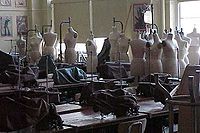
 There are a number of well known art schools and design schools world wide that offer degrees in fashion design and fashion design technology. Some colleges also offer Masters of Fashion courses. Though it is not a requirement to have a Masters level, it is recommended by those already working in the industry to study at this level. The most notable of design schools in Europe include London College of Fashion
, Central Saint Martins College of Art and Design
, University of Westminster
and Kingston University
in London
, and the Edinburgh College of Art
in Scotland. Limerick School of Art and Design
, Griffith College and the National College of Art and Design
offer reputable BA of Fashion Design courses in Ireland. Istituto Marangoni
, Domus Academy, Politecnico of Milan, NABA - Nuova Accademia di Belle Arti Milano, Istituto Europeo di Design
, University Iuav of Venice
in Italy
, the Fashion Federation PARIS] European Fashion Accreditation www.Fashion-Board.com, Antwerp Fashion Academy in Belgium
. There is Parsons The New School for Design
, Creative Business House, Fashion Institute of Technology
and the Pratt Institute
in New York City
. Elsewhere in the United States there is the Academy of Art University
in San Francisco, Savannah College of Art and Design
, Virginia Commonwealth University
, Otis College of Art & Design, and Fashion Institute of Design & Merchandising
in Los Angeles
, School of the Art Institute of Chicago and Columbia College Chicago
in Chicago
. The National Institute of Fashion Technology
in India, Haryana Technical Institute Rohtak in India, Shih Chien University
in Hong Kong, RMIT University
in Melbourne, Fu Jen Catholic University
in Taiwan and the Asian University chain, Raffles College of Design and Commerce
, all have reputable fashion design courses.
The only Ivy League
University having a Fashion Design undergraduate program is Cornell University
in Ithaca, NY. The program is offered by the department of Fiber Science & Apparel Design]. Cornell University
also offers a Ph.D. program in apparel design. An updated list of fashion design masters and Ph.D programs can be found at ITAA.org. The programs are intended to address the needs of academia, industry and research by considering apparel design as an applied science that embraces design, technology, physical sciences, the humanities and social sciences in order to meet the human needs for clothing. There are many universities that offer fashion design throughout the United States. The major incorporating fashion design may have alternative names like Apparel and Textiles or Apparel and Textile Design and may be housed in departments such as Art and Art History or Family and Consumer Studies.
"The designers are most stratified in the French system of fashion [...] Fashion ensures the functioning of a system of dominant and subordinate positions within a social order. Fashion is ideological in that it is also part of the process in which particular social groups, in this case elite designers, establish, sustain and reproduce positions of power and relations of dominance and subordination. The positions of dominance and subordination appear natural and legitimate, not only to those in positions of dominance, but also to those in subordinate positions. Fashion and the medium of fashion, that is clothing, offer means to make inequalities of socioeconomic status appear legitimate, and, therefore, acceptable."
A "mythical conception of a designer as a 'creative genius' disconnected from social conditions" is central for the working of the fashion system and for the reproduction of fashion as ideology. Creativity is socially constructed and not an innate given, i.e. many may be gifted but no one can become a famous designer without being legitimized by the fashion system and its gatekeepers.
The star system is as essential for the fashion industry as for any Culture industry
. "Genre and the star system are attempts to produce something analogous to brand names in cultural industries. [...] Stars are indispensable because it is part of the ideology of creativity that creative works must have an identifiable author."
, China
, Bangladesh
, South Korea
, Spain
, Germany
, Brazil
and India
. Five countries have established an international reputation in fashion: France
, Italy
, the United Kingdom
, the United States
, and Japan
.
, where a substantial percentage of high fashion clothing manufactured in the US is actually made. There are also burgeoning industries in Miami, Chicago
, Dallas, and especially San Francisco. American fashion design is dominated by a clean-cut, urban, casual style; reflecting the athletic, health-conscious lifestyles of American city-dwellers. A designer who helped to set the trend in the United States for sport-influenced day wear throughout the 1940s and 50's was Claire McCardell
. Many of her designs have been revived in recent decades.
and stylish, defined by its sophistication, cut, and smart accessories. Although the Global Language Monitor
placed it 3rd in the Media, after Milan
and New York
, French fashion is internationally acclaimed.
is Italy's capital of fashion. Most of the older Italian couturiers are in Rome
. However, Milan
and Florence
are the Italian fashion capitals, and it is the exhibition venue for their collections. Italian fashion features casual elegance and luxurious fabrics.
. The Swiss look is casual elegant and luxurious with a slight touch of quirkiness. With it being highly influenced by the dance club scene.
fashion houses are in Tokyo
. The Japanese look is loose and unstructured (often resulting from complicated cutting), colours tend to the sombre and subtle, and richly textured fabrics. Famous Japanese designers are Yohji Yamamoto
, Kenzo
, Issey Miyake
(masterful drape and cut), and Comme des Garçons
's Rei Kawakubo
, who developed a new way of cutting (comparable to Madeleine Vionnet
's innovation in the 1930s).
Art
Art is the product or process of deliberately arranging items in a way that influences and affects one or more of the senses, emotions, and intellect....
of the application of design
Design
Design as a noun informally refers to a plan or convention for the construction of an object or a system while “to design” refers to making this plan...
and aesthetics
Aesthetics
Aesthetics is a branch of philosophy dealing with the nature of beauty, art, and taste, and with the creation and appreciation of beauty. It is more scientifically defined as the study of sensory or sensori-emotional values, sometimes called judgments of sentiment and taste...
or natural beauty to clothing
Clothing
Clothing refers to any covering for the human body that is worn. The wearing of clothing is exclusively a human characteristic and is a feature of nearly all human societies...
and accessories
Fashion accessory
Fashion accessories are decorative items that supplement and complement clothes, such as jewelery, gloves, handbags, hats, belts, scarves, wigs, watches, sunglasses, pins, stockings, bow ties, hand fans, leg warmers, leggings, neckties, suspenders, and tights....
. Fashion design is influenced by cultural and social latitudes, and has varied over time and place. Fashion designers work in a number of ways in designing clothing and accessories. Some work alone or as part of a team. They attempt to satisfy consumer desire for aesthetically designed clothing; and, because of the time required to bring a garment onto the market, must at times anticipate changing consumer tastes.
Fashion designers attempt to design clothes which are functional as well as aesthetically pleasing. They must consider who is likely to wear a garment and the situations in which it will be worn. They have a wide range and combinations of materials to work with and a wide range of colors, patterns and styles to choose from. Though most clothing worn for everyday wear fall within a narrow range of conventional styles, unusual garments are usually sought for special occasions, such as evening wear or party dress
Dress
A dress is a garment consisting of a skirt with an attached bodice or with a matching bodice giving the effect of a one-piece garment.Dress may also refer to:*Clothing in general*Costume, fancy dress...
es.
Some clothes are made specifically for an individual, as in the case of haute couture
Haute couture
Haute couture refers to the creation of exclusive custom-fitted clothing. Haute couture is made to order for a specific customer, and it is usually made from high-quality, expensive fabric and sewn with extreme attention to detail and finished by the most experienced and capable seamstresses,...
. Today, most clothing is designed for the mass market
Mass market
The mass market is a general business term describing the largest group of consumers for a specified industry product. It is the opposite extreme of the term niche market.-General:...
, especially casual and every-day wear.
Structure
Fashion designers can work in a number of ways. Fashion designers may work full-time for one fashion company, known as 'in-house designers' which owns the designs. They may work alone or as part of a team. Freelance designers work for themselves, selling their designs to fashion houses, directly to shops, or to clothing manufacturers. The garments bear the buyer's label. Some fashion designers set up their own labels, under which their designs are marketed. Some fashion designers are self-employed and design for individual clients. Other high-fashion designers cater to specialty stores or high-fashion department stores. These designers create original garments, as well as those that follow established fashion trends. Most fashion designers, however, work for apparel manufacturers, creating designs of men’s, women’s, and children’s fashions for the mass market. Large designer brands which have a 'name' as their brand such as Abercrombie & FitchAbercrombie & Fitch
Abercrombie & Fitch is an American retailer that focuses on casual wear for consumers aged 18 to 22. It has over 300 locations in the United States, and is expanding internationally....
, Justice, or Juicy
Juicy Couture
Juicy Couture is a contemporary line of both casual and dressy apparel based in Arleta, Los Angeles, California founded by Pamela Skaist-Levy and Gela Nash-Taylor in 1996...
are likely to be designed by a team of individual designers under the direction of a designer director.
Designing a garment
Fashion designers work in different ways. Some sketch their ideas on paper, while others drape fabric on a dress form. When a designer is completely satisfied with the fit of the toile (or muslin), he or she will consult a professional pattern maker who then makes the finished, working version of the pattern out of card. The pattern maker's job is very precise and painstaking. The fit of the finished garment depends on their accuracy. Finally, a sample garment is made up and tested on a model to make sure it is an operational outfit.History
Fashion design is generally considered to have started in the 19th century with Charles Frederick WorthCharles Frederick Worth
Charles Frederick Worth , widely considered the Father of Haute couture, was an English fashion designer of the 19th century, whose works were produced in Paris.-Career:...
who was the first designer to have his label
Label
A label is a piece of paper, polymer, cloth, metal, or other material affixed to a container or article, on which is printed a legend, information concerning the product, addresses, etc. A label may also be printed directly on the container or article....
sewn into the garments that he created. Before the former draper
Draper
Draper is the now largely obsolete term for a wholesaler, or especially retailer, of cloth, mainly for clothing, or one who works in a draper's shop. A draper may additionally operate as a cloth merchant or a haberdasher. The drapers were an important trade guild...
set up his maison couture (fashion house) in Paris
Paris
Paris is the capital and largest city in France, situated on the river Seine, in northern France, at the heart of the Île-de-France region...
, clothing design and creation was handled by largely anonymous seamstresses, and high fashion descended from that worn at royal courts. Worth's success was such that he was able to dictate to his customers what they should wear, instead of following their lead as earlier dressmakers had done. The term couturier was in fact first created in order to describe him. While all articles of clothing from any time period are studied by academics as costume design, only clothing created after 1858 could be considered as fashion design.
It was during this period that many design houses began to hire artists to sketch or paint designs for garments. The images were shown to clients, which was much cheaper than producing an actual sample garment in the workroom. If the client liked their design, they ordered it and the resulting garment made money for the house. Thus, the tradition of designers sketching out garment designs instead of presenting completed garments on models to customers began as an economy.
Types of fashion
The garments produced by clothing manufacturers fall into three main categories, although these may be split up into additional, more specific categories:Haute couture
Until the 1950s, fashion clothing was predominately designed and manufactured on a made-to-measure or haute coutureHaute couture
Haute couture refers to the creation of exclusive custom-fitted clothing. Haute couture is made to order for a specific customer, and it is usually made from high-quality, expensive fabric and sewn with extreme attention to detail and finished by the most experienced and capable seamstresses,...
basis (French
French language
French is a Romance language spoken as a first language in France, the Romandy region in Switzerland, Wallonia and Brussels in Belgium, Monaco, the regions of Quebec and Acadia in Canada, and by various communities elsewhere. Second-language speakers of French are distributed throughout many parts...
for high-fashion), with each garment being created for a specific client. A couture garment is made to order for an individual customer, and is usually made from high-quality, expensive fabric, sewn with extreme attention to detail and finish, often using time-consuming, hand-executed techniques. Look and fit take priority over the cost of materials and the time it takes to make.
Ready-to-wear
Ready-to-wear clothes are a cross between haute couture and mass market. They are not made for individual customers, but great care is taken in the choice and cut of the fabric. Clothes are made in small quantities to guarantee exclusivity, so they are rather expensive. Ready-to-wear collections are usually presented by fashion houses each season during a period known as Fashion WeekFashion Week
A fashion week is a fashion industry event, lasting approximately one week, which allows fashion designers, brands or "houses" to display their latest collections in runway shows and buyers and the media to take a look at the latest trends. Most importantly, these events let the industry know...
. This takes place on a city-wide basis and occurs twice a year. The main seasons of Fashion Week
Fashion Week
A fashion week is a fashion industry event, lasting approximately one week, which allows fashion designers, brands or "houses" to display their latest collections in runway shows and buyers and the media to take a look at the latest trends. Most importantly, these events let the industry know...
include, spring/summer, fall/winter, resort, swim and bridal.
Mass market
Currently the fashion industry relies more on mass market sales. The mass market caters for a wide range of customers, producing ready set by the famous names in fashion. They often wait around a season to make sure a style is going to catch on before producing their own versions of the original look. In order to save money and time, they use cheaper fabrics and simpler production techniques which can easily be done by machine. The end product can therefore be sold much more cheaply.There is a type of design called "kutch" design originated from the German word "kitschig" meaning "ugly" or "not aesthetically pleasing." Kitsch can also refer to "wearing or displaying something that is therefore no longer in fashion." Often, high-waisted trousers, associated with the 1980s, are considered a "kitsch" fashion statement.
Income
Median annual wages for salaried fashion designers were $61,160 in May 2008. The middle 50 percent earned between $42,150 and $87,120. The lowest 10 percent earned less than $32,150, and the highest 10 percent earned more than $124,780.. Median annual earnings were $52,860 (£28,340) in apparel, piece goods, and notions - the industry employing the largest numbers of fashion designers.Fashion education
London College of Fashion
London College of Fashion is a constituent college of the University of the Arts London, offering undergraduate, postgraduate, short courses and business-training in fashion, make-up, beauty-therapy and lifestyle industries...
, Central Saint Martins College of Art and Design
Central Saint Martins College of Art and Design
Central Saint Martins College of Art and Design is a constituent college of the University of the Arts London. The school has an outstanding international reputation, and is considered one of the world's leading art and design institutions...
, University of Westminster
University of Westminster
The University of Westminster is a public research university located in London, United Kingdom. Its origins go back to the foundation of the Royal Polytechnic Institution in 1838, and it was awarded university status in 1992.The university's headquarters and original campus are based on Regent...
and Kingston University
Kingston University
Kingston University is a public research university located in Kingston upon Thames, southwest London, United Kingdom. It was originally founded in 1899 as Kingston Technical Institute, a polytechnic, and became a university in 1992....
in London
London
London is the capital city of :England and the :United Kingdom, the largest metropolitan area in the United Kingdom, and the largest urban zone in the European Union by most measures. Located on the River Thames, London has been a major settlement for two millennia, its history going back to its...
, and the Edinburgh College of Art
Edinburgh College of Art
Edinburgh College of Art is an art school in Edinburgh, Scotland, providing tertiary education in art and design disciplines for over two thousand students....
in Scotland. Limerick School of Art and Design
Limerick School of Art and Design
Limerick School of Art and Design or LSAD is an art college in Limerick City in Ireland. The school is one of the five constituent schools of Limerick Institute of Technology and operates on two of LIT's campuses in Limerick City, located on Clare Street and George's Quay; both are about 2KM from...
, Griffith College and the National College of Art and Design
National College of Art and Design
The National College of Art and Design is a national art and design school in Dublin, Ireland.-History:Situated on Thomas Street, the NCAD started as a private drawing school and has become a national institution educating over 1,500 day and evening students as artists, designers and art educators...
offer reputable BA of Fashion Design courses in Ireland. Istituto Marangoni
Istituto Marangoni
Istituto Marangoni - more commonly known as La Maranga - is a fashion institute with campuses in Milan, London, and Paris. It was founded and granted the status of 'Professional Art School' on December 17, 1935. Under the Ministerial Decree of 13 February 1951, the status of the school was raised...
, Domus Academy, Politecnico of Milan, NABA - Nuova Accademia di Belle Arti Milano, Istituto Europeo di Design
Istituto Europeo di Design
The Istituto Europeo di Design is a design school that attracts students from over 90 different countries to its one and three year/four undergraduate, masters courses and advanced training courses....
, University Iuav of Venice
University Iuav of Venice
Iuav University of Venice is a university located in Venice, northern Italy. It was founded in 1926 and is organized in 3 faculties....
in Italy
Italy
Italy , officially the Italian Republic languages]] under the European Charter for Regional or Minority Languages. In each of these, Italy's official name is as follows:;;;;;;;;), is a unitary parliamentary republic in South-Central Europe. To the north it borders France, Switzerland, Austria and...
, the Fashion Federation PARIS] European Fashion Accreditation www.Fashion-Board.com, Antwerp Fashion Academy in Belgium
Belgium
Belgium , officially the Kingdom of Belgium, is a federal state in Western Europe. It is a founding member of the European Union and hosts the EU's headquarters, and those of several other major international organisations such as NATO.Belgium is also a member of, or affiliated to, many...
. There is Parsons The New School for Design
Parsons The New School for Design
Parsons The New School For Design, known colloquially as Parsons, is the art and design college of The New School university. It is located in New York City's Greenwich Village, and has produced artists and designers such as Marc Jacobs, Dean and Dan Caten, Norman Rockwell, Donna Karan, Jane...
, Creative Business House, Fashion Institute of Technology
Fashion Institute of Technology
The Fashion Institute of Technology, generally known as FIT, is a State University of New York college of art, business, design, and technology connected to the fashion industry, with an urban campus located on West 27th Street between Seventh and Eighth Avenues in the Chelsea neighborhood of...
and the Pratt Institute
Pratt Institute
Pratt Institute is a private art college in New York City located in Brooklyn, New York, with satellite campuses in Manhattan and Utica. Pratt is one of the leading undergraduate art schools in the United States and offers programs in Architecture, Graphic Design, History of Art and Design,...
in New York City
New York City
New York is the most populous city in the United States and the center of the New York Metropolitan Area, one of the most populous metropolitan areas in the world. New York exerts a significant impact upon global commerce, finance, media, art, fashion, research, technology, education, and...
. Elsewhere in the United States there is the Academy of Art University
Academy of Art University
The Academy of Art University , a for-profit university owned by the Stephens Institute, was founded in San Francisco, California in 1929 by Richard S. Stephens...
in San Francisco, Savannah College of Art and Design
Savannah College of Art and Design
SCAD, the Savannah College of Art and Design, is a private, accredited and degree-granting university with locations in Savannah and Atlanta, Georgia, Hong Kong, and Lacoste, France.-History:...
, Virginia Commonwealth University
Virginia Commonwealth University
Virginia Commonwealth University is a public university located in Richmond, Virginia. It comprises two campuses in the Downtown Richmond area, the product of a merger between the Richmond Professional Institute and the Medical College of Virginia in 1968...
, Otis College of Art & Design, and Fashion Institute of Design & Merchandising
Fashion Institute of Design & Merchandising
FIDM, Fashion Institute of Design & Merchandising, is a specialized for-profit private college located in California dedicated to educating students for the Fashion, Entertainment, Beauty, Interior Design, and Graphic Design industries....
in Los Angeles
Los Ángeles
Los Ángeles is the capital of the province of Biobío, in the commune of the same name, in Region VIII , in the center-south of Chile. It is located between the Laja and Biobío rivers. The population is 123,445 inhabitants...
, School of the Art Institute of Chicago and Columbia College Chicago
Columbia College Chicago
Columbia College Chicago is one of the largest art colleges in the United States with nearly 12,000 students pursuing degrees within 120 undergraduate and graduate programs...
in Chicago
Chicago
Chicago is the largest city in the US state of Illinois. With nearly 2.7 million residents, it is the most populous city in the Midwestern United States and the third most populous in the US, after New York City and Los Angeles...
. The National Institute of Fashion Technology
National Institute of Fashion Technology
National Institute of Fashion Technology is a prestigious fashion institute in India. It was set up in 1986 under the aegis of the Ministry of Textiles, Government of India and is a premier institution in design, management and technology, developing professionals leadership positions in the...
in India, Haryana Technical Institute Rohtak in India, Shih Chien University
Shih Chien University
Shih Chien University is a private university in Taiwan,It has two campuses, one in Dazhi, Zhongshan District, Taipei, and the other in Neimen District, Kaohsiung....
in Hong Kong, RMIT University
RMIT University
RMIT University is an Australian public university located in Melbourne, Victoria. It has two branches, referred to as RMIT University in Australia and RMIT International University in Vietnam....
in Melbourne, Fu Jen Catholic University
Fu Jen Catholic University
Fu Jen Catholic University is a co-educational Catholic university located in Xinzhuang District, New Taipei City, Republic of China...
in Taiwan and the Asian University chain, Raffles College of Design and Commerce
Raffles College of Design and Commerce
Raffles College of Design and Commerce is a private higher education provider based in Sydney, Australia founded in 1978, making it one of the longest-established art schools in Sydney. Raffles College is located in North Sydney and occupies 8 floors of a central office building in the business...
, all have reputable fashion design courses.
The only Ivy League
Ivy League
The Ivy League is an athletic conference comprising eight private institutions of higher education in the Northeastern United States. The conference name is also commonly used to refer to those eight schools as a group...
University having a Fashion Design undergraduate program is Cornell University
Cornell University
Cornell University is an Ivy League university located in Ithaca, New York, United States. It is a private land-grant university, receiving annual funding from the State of New York for certain educational missions...
in Ithaca, NY. The program is offered by the department of Fiber Science & Apparel Design]. Cornell University
Cornell University
Cornell University is an Ivy League university located in Ithaca, New York, United States. It is a private land-grant university, receiving annual funding from the State of New York for certain educational missions...
also offers a Ph.D. program in apparel design. An updated list of fashion design masters and Ph.D programs can be found at ITAA.org. The programs are intended to address the needs of academia, industry and research by considering apparel design as an applied science that embraces design, technology, physical sciences, the humanities and social sciences in order to meet the human needs for clothing. There are many universities that offer fashion design throughout the United States. The major incorporating fashion design may have alternative names like Apparel and Textiles or Apparel and Textile Design and may be housed in departments such as Art and Art History or Family and Consumer Studies.
Areas of Fashion Design
| Area | Brief | Market |
|---|---|---|
| Women's Day wear | Practical, comfortable, fashionable | Haute couture, ready-to-wear, mass market |
| Women's Evening wear | Glamorous, sophisticated, apt for the occasion | Haute couture, ready-to-wear, mass market |
| Women's Lingerie | Glamorous, comfortable, washable | Haute Couture, ready-to-wear, mass market |
| Men's Day wear | Casual, practical, comfortable | Tailoring, ready-to-wear, mass market |
| Men's Evening wear | Smart, elegant, formal, apt for the occasion | Tailoring, ready-to-wear, mass market |
| Kidswear | Trendy or Classy, practical, washable, functional | Ready-to-wear, mass market |
| Girls' Wear | Pretty, colorful, practical, washable, inexpensive | Ready-to-wear, mass market |
| Teenager Girl Wear | Colorful,comfortable,glamorous,pretty, | Ready-to-wear, mass market |
| Sportswear | Comfortable, practical, well-ventilated, washable, functional | Ready-to-wear, mass market |
| Knitwear | Right weight and color for the season | Ready-to-wear, mass market |
| Outerwear | Stylish, warm, right weight and color for the season | Ready-to-wear, mass market |
| Bridal wear | Sumptuous, glamorous, classic | Haute couture, ready-to-wear, mass market |
| Accessories | Striking, fashionable | Haute couture, ready-to-wear, mass market |
Star system
Designers work within a hierarchical system."The designers are most stratified in the French system of fashion [...] Fashion ensures the functioning of a system of dominant and subordinate positions within a social order. Fashion is ideological in that it is also part of the process in which particular social groups, in this case elite designers, establish, sustain and reproduce positions of power and relations of dominance and subordination. The positions of dominance and subordination appear natural and legitimate, not only to those in positions of dominance, but also to those in subordinate positions. Fashion and the medium of fashion, that is clothing, offer means to make inequalities of socioeconomic status appear legitimate, and, therefore, acceptable."
A "mythical conception of a designer as a 'creative genius' disconnected from social conditions" is central for the working of the fashion system and for the reproduction of fashion as ideology. Creativity is socially constructed and not an innate given, i.e. many may be gifted but no one can become a famous designer without being legitimized by the fashion system and its gatekeepers.
The star system is as essential for the fashion industry as for any Culture industry
Culture industry
Culture industry is a term coined by critical theorists Theodor Adorno and Max Horkheimer , who argued in the chapter of their book Dialectic of Enlightenment, 'The Culture Industry: Enlightenment as Mass Deception' ; that popular culture is akin to a factory producing standardized cultural goods...
. "Genre and the star system are attempts to produce something analogous to brand names in cultural industries. [...] Stars are indispensable because it is part of the ideology of creativity that creative works must have an identifiable author."
World fashion industry
Fashion today is a global industry, and most major countries have a fashion industry. Some countries are major manufacturing centers, notably PhilippinesPhilippines
The Philippines , officially known as the Republic of the Philippines , is a country in Southeast Asia in the western Pacific Ocean. To its north across the Luzon Strait lies Taiwan. West across the South China Sea sits Vietnam...
, China
China
Chinese civilization may refer to:* China for more general discussion of the country.* Chinese culture* Greater China, the transnational community of ethnic Chinese.* History of China* Sinosphere, the area historically affected by Chinese culture...
, Bangladesh
Bangladesh
Bangladesh , officially the People's Republic of Bangladesh is a sovereign state located in South Asia. It is bordered by India on all sides except for a small border with Burma to the far southeast and by the Bay of Bengal to the south...
, South Korea
South Korea
The Republic of Korea , , is a sovereign state in East Asia, located on the southern portion of the Korean Peninsula. It is neighbored by the People's Republic of China to the west, Japan to the east, North Korea to the north, and the East China Sea and Republic of China to the south...
, Spain
Spain
Spain , officially the Kingdom of Spain languages]] under the European Charter for Regional or Minority Languages. In each of these, Spain's official name is as follows:;;;;;;), is a country and member state of the European Union located in southwestern Europe on the Iberian Peninsula...
, Germany
Germany
Germany , officially the Federal Republic of Germany , is a federal parliamentary republic in Europe. The country consists of 16 states while the capital and largest city is Berlin. Germany covers an area of 357,021 km2 and has a largely temperate seasonal climate...
, Brazil
Brazil
Brazil , officially the Federative Republic of Brazil , is the largest country in South America. It is the world's fifth largest country, both by geographical area and by population with over 192 million people...
and India
India
India , officially the Republic of India , is a country in South Asia. It is the seventh-largest country by geographical area, the second-most populous country with over 1.2 billion people, and the most populous democracy in the world...
. Five countries have established an international reputation in fashion: France
French fashion
Fashion has been an important industry and cultural export of France since the seventeenth century, and modern "haute couture" originated in Paris in the 1860s...
, Italy
Italian fashion
Italy is one of the leading countries in fashion design, alongside others such as France, USA, Great Britain and Japan. Fashion has always been an important part of the country's cultural life and society, and Italians are well known for their attention to dressing-up well; "la bella figura", or...
, the United Kingdom
United Kingdom
The United Kingdom of Great Britain and Northern IrelandIn the United Kingdom and Dependencies, other languages have been officially recognised as legitimate autochthonous languages under the European Charter for Regional or Minority Languages...
, the United States
Fashion in the United States
Apart from professional business attire, fashion in the United States is eclectic and predominantly informal. While Americans' diverse cultural roots are reflected in their clothing, particularly those of recent immigrants, cowboy hats and boots and leather motorcycle jackets are emblematic of...
, and Japan
Japanese fashion
Japan began to emulate Western fashion during the middle of the 19th century. By the beginning of the 21st century it had altered into what is known today as 'street fashion'. The term 'street fashion' is used to describe fashion where the wearer customizes outfits by adopting a mixture of current...
.
American fashion design
The majority of American fashion houses are based in New York, although there are also a significant number in Los AngelesLos Ángeles
Los Ángeles is the capital of the province of Biobío, in the commune of the same name, in Region VIII , in the center-south of Chile. It is located between the Laja and Biobío rivers. The population is 123,445 inhabitants...
, where a substantial percentage of high fashion clothing manufactured in the US is actually made. There are also burgeoning industries in Miami, Chicago
Chicago
Chicago is the largest city in the US state of Illinois. With nearly 2.7 million residents, it is the most populous city in the Midwestern United States and the third most populous in the US, after New York City and Los Angeles...
, Dallas, and especially San Francisco. American fashion design is dominated by a clean-cut, urban, casual style; reflecting the athletic, health-conscious lifestyles of American city-dwellers. A designer who helped to set the trend in the United States for sport-influenced day wear throughout the 1940s and 50's was Claire McCardell
Claire McCardell
Claire McCardell was an American fashion designer in the arena of ready-to-wear clothing in the 20th century. From the 1930s to the 1950s, she was known for designing functional, affordable, and stylish women’s sportswear within the constraints of mass-production, and is today acknowledged as the...
. Many of her designs have been revived in recent decades.
British fashion design
London has long been the capital of the UK fashion industry and has a wide range of foreign designs which have integrated with modern British styles. Typical British design is smart but innovative yet recently has become more and more unconventional, fusing traditional styles with modern techniques. Vintage styles play an important role in the British fashion and styling industry. Stylists regularly 'mix and match' the old with the new, which gives British style that unique, bohemian aesthetic that many of the other fashion capitals try to imitate. Irish fashion (both design and styling) is also heavily influenced by fashion trends from Britain.French fashion design
Most French fashion houses are in Paris, which is the capital of French fashion. Traditionally, French fashion is chicChic (style)
Chic , meaning 'stylish' or 'smart', is an element of fashion.-Etymology:Chic is a French word, established in English since at least the 1870s...
and stylish, defined by its sophistication, cut, and smart accessories. Although the Global Language Monitor
Global Language Monitor
The Global Language Monitor is an Austin, Texas-based company that collectively documents, analyzes and tracks trends in language usage worldwide, with a particular emphasis upon the English language...
placed it 3rd in the Media, after Milan
Milan
Milan is the second-largest city in Italy and the capital city of the region of Lombardy and of the province of Milan. The city proper has a population of about 1.3 million, while its urban area, roughly coinciding with its administrative province and the bordering Province of Monza and Brianza ,...
and New York
New York
New York is a state in the Northeastern region of the United States. It is the nation's third most populous state. New York is bordered by New Jersey and Pennsylvania to the south, and by Connecticut, Massachusetts and Vermont to the east...
, French fashion is internationally acclaimed.
Italian fashion design
MilanMilan
Milan is the second-largest city in Italy and the capital city of the region of Lombardy and of the province of Milan. The city proper has a population of about 1.3 million, while its urban area, roughly coinciding with its administrative province and the bordering Province of Monza and Brianza ,...
is Italy's capital of fashion. Most of the older Italian couturiers are in Rome
Rome
Rome is the capital of Italy and the country's largest and most populated city and comune, with over 2.7 million residents in . The city is located in the central-western portion of the Italian Peninsula, on the Tiber River within the Lazio region of Italy.Rome's history spans two and a half...
. However, Milan
Milan
Milan is the second-largest city in Italy and the capital city of the region of Lombardy and of the province of Milan. The city proper has a population of about 1.3 million, while its urban area, roughly coinciding with its administrative province and the bordering Province of Monza and Brianza ,...
and Florence
Florence
Florence is the capital city of the Italian region of Tuscany and of the province of Florence. It is the most populous city in Tuscany, with approximately 370,000 inhabitants, expanding to over 1.5 million in the metropolitan area....
are the Italian fashion capitals, and it is the exhibition venue for their collections. Italian fashion features casual elegance and luxurious fabrics.
Swiss fashion design
Most of the Swiss fashion houses are in ZürichZürich
Zurich is the largest city in Switzerland and the capital of the canton of Zurich. It is located in central Switzerland at the northwestern tip of Lake Zurich...
. The Swiss look is casual elegant and luxurious with a slight touch of quirkiness. With it being highly influenced by the dance club scene.
Japanese fashion design
Most JapaneseCulture of Japan
The culture of Japan has evolved greatly over the millennia, from the country's prehistoric Jōmon period to its contemporary hybrid culture, which combines influences from Asia, Europe and North America...
fashion houses are in Tokyo
Tokyo
, ; officially , is one of the 47 prefectures of Japan. Tokyo is the capital of Japan, the center of the Greater Tokyo Area, and the largest metropolitan area of Japan. It is the seat of the Japanese government and the Imperial Palace, and the home of the Japanese Imperial Family...
. The Japanese look is loose and unstructured (often resulting from complicated cutting), colours tend to the sombre and subtle, and richly textured fabrics. Famous Japanese designers are Yohji Yamamoto
Yohji Yamamoto
Yōji Yamamoto , is an award winning Japanese fashion designer based in Tokyo and Paris. Yohji is considered to be among the master tailors whose work is thought to be of fashion genius and he has been described by Julie Gilhart, fashion director for Barney's New York as probably the only designer...
, Kenzo
Kenzo Takada
Kenzo Takada is a Japanese fashion designer. He is also the founder of Kenzo, a worldwide brand of perfumes, skincare products and clothes....
, Issey Miyake
Issey Miyake
is a Japanese fashion designer. He is known for his technology-driven clothing designs, exhibitions and fragrances.-Life and career:Miyake was born 22 April 1938 in Hiroshima, Japan. As a seven year-old, he witnessed and survived the atomic bomb dropped on Hiroshima on August 6, 1945. He studied...
(masterful drape and cut), and Comme des Garçons
Comme des Garçons
Comme des Garçons, written コム・デ・ギャルソン in Japanese and French for "Like Boys," is a Japanese fashion label headed by Rei Kawakubo, who owns the company with her husband Adrian Joffe....
's Rei Kawakubo
Rei Kawakubo
is a Japanese fashion designer, founder of Comme des Garçons.She is untrained as a fashion designer, but studied fine arts and literature at Keio University. After graduation, Kawakubo worked in a textile company and began working as a freelance stylist in 1967....
, who developed a new way of cutting (comparable to Madeleine Vionnet
Madeleine Vionnet
This article is about the haute couture designer. For the fashion label, see Vionnet Madeleine Vionnet was a French fashion designer...
's innovation in the 1930s).
Fashion design terms
- A fashion designer conceives garment combinations of line, proportion, color, and texture. While sewing and pattern-making skills are beneficial, they are not a pre-requisite of successful fashion design. Most fashion designers are formally trained or apprenticed.
- A technical designer works with the design team and the factories overseas to ensure correct garment construction, appropriate fabric choices and a good fit. The technical designer fits the garment samples on a fit model, and decides which fit and construction changes to make before mass producing the garment.
- A pattern makerPattern (sewing)In sewing and fashion design, a pattern is an original garment from which other garments of a similar style are copied, or the paper or cardboard templates from which the parts of a garment are traced onto fabric before cutting out and assembling .Patternmaking, pattern making or pattern cutting is...
(or pattern cutter) drafts the shapes and sizes of a garment's pieces. This may be done manually with paper and measuring tools or by using a CAD computer software program. Another method is to drape fabric directly onto a dress form. The resulting pattern pieces can be constructed to produce the intended design of the garment and required size. Formal training is usually required for working as a pattern marker. - A tailorTailorA tailor is a person who makes, repairs, or alters clothing professionally, especially suits and men's clothing.Although the term dates to the thirteenth century, tailor took on its modern sense in the late eighteenth century, and now refers to makers of men's and women's suits, coats, trousers,...
makes custom designed garments made to the client's measure; especially suits (coat and trousers, jacket and skirt, et cetera). Tailors usually undergo an apprenticeship or other formal training. - A textile designer designs fabric weaves and prints for clothes and furnishings. Most textile designers are formally trained as apprentices and in school.
- A stylistWardrobe stylistA wardrobe stylist is the job title of someone who selects the clothing for published editorial features, print or television advertising campaigns, music videos, concert performances, and any public appearances made by celebrities, models or other public figures...
co-ordinates the clothes, jewelry, and accessories used in fashion photography and catwalk presentations. A stylist may also work with an individual client to design a coordinated wardrobe of garments. Many stylists are trained in fashion design, the history of fashion and historical costume, and have a high level of expertise in the current fashion market and future market trends. However, some simply have a strong aesthetic sense for pulling great looks together. - A fashion buyer selects and buys the mix of clothing available in retail shops, department stores and chain stores. Most fashion buyers are trained in business and/or fashion studies.
- A seamstress sews ready to wear or mass produced clothing by hand or with a sewing machine, either in a garment shop or as a sewing machine operator in a factory. She (or he) may not have the skills to make (design and cut) the garments, or to fit them on a model.
- A teacher of fashion designTeacherA teacher or schoolteacher is a person who provides education for pupils and students . The role of teacher is often formal and ongoing, carried out at a school or other place of formal education. In many countries, a person who wishes to become a teacher must first obtain specified professional...
teaches the art and craft of fashion design in art or fashion school. - A custom clothier makes custom-made garments to order, for a given customer.
- A dressmakerDressmakerA dressmaker is a person who makes custom clothing for women, such as dresses, blouses, and evening gowns. Also called a mantua-maker or a modiste.-Notable dressmakers:*Cristobal Balenciaga*Charles Frederick Worth...
specializes in custom-made women's clothes: day, cocktail, and evening dresses, business clothes and suits, trousseaus, sports clothes, and lingerie. - An illustratorIllustrationAn illustration is a displayed visualization form presented as a drawing, painting, photograph or other work of art that is created to elucidate or dictate sensual information by providing a visual representation graphically.- Early history :The earliest forms of illustration were prehistoric...
draws and paints clothing designs for commercial use. - A fashion forecaster predicts what colours, styles and shapes will be popular ("on-trend") before the garments are on sale in stores.
- A model wears and displays clothes at fashion shows and in photographs.
- A fit modelFit modelA fitting model is a person who is used by a fashion designer or clothing manufacturer to check the fit, drape and visual appearance of a design on a 'real' human being, effectively acting as a live mannequin. A person is selected to work as a fitting model primarily on criteria matching the...
aids the fashion designer by wearing and commenting on the fit of clothes during their design and pre-manufacture. Fit models need to be a particular size for this purpose. - A fashion journalistFashion journalismFashion journalism is an umbrella term used to describe all aspects of published fashion media. It includes fashion writers, fashion critics or fashion reporters...
writes fashion articles describing the garments presented or fashion trends, for magazines or newspapers. - An alterations specialist (alterationist) adjusts the fit of completed garments, usually ready-to-wear, and sometimes re-styles them. NOTE: despite tailors altering garments to fit the client, not all alterationists are tailors.
- An Image Consultant, wardrobe consultant or fashion advisor recommends styles and colors that are flattering to the client.