


Crop wild relative

Encyclopedia
Taxon
|thumb|270px|[[African elephants]] form a widely-accepted taxon, the [[genus]] LoxodontaA taxon is a group of organisms, which a taxonomist adjudges to be a unit. Usually a taxon is given a name and a rank, although neither is a requirement...
.
Overview
The wild relatives of crop plants constitute an increasingly important resource for improving agricultural production and for maintaining sustainable agro-ecosystems. With the advent of climate change and greater ecosystem instability CWRs are likely to prove a critical resource in ensuring food security for the new millennium. It was Nikolai VavilovNikolai Vavilov
Nikolai Ivanovich Vavilov was a prominent Russian and Soviet botanist and geneticist best known for having identified the centres of origin of cultivated plants...
, a Russian Botanist who first realized the importance of crop wild relatives in the early 20th century. Genetic material from CWRs has been utilized by humans for thousands of years to improve the quality and yield of crops. Farmers have used traditional breeding methods for millennia , wild maize
Maize
Maize known in many English-speaking countries as corn or mielie/mealie, is a grain domesticated by indigenous peoples in Mesoamerica in prehistoric times. The leafy stalk produces ears which contain seeds called kernels. Though technically a grain, maize kernels are used in cooking as a vegetable...
(Zea mexicana) is routinely grown alongside maize to promote natural crossing and improve yields. More recently, plant breeders have utilised CWR genes to improve a wide range of crops like rice
Rice
Rice is the seed of the monocot plants Oryza sativa or Oryza glaberrima . As a cereal grain, it is the most important staple food for a large part of the world's human population, especially in East Asia, Southeast Asia, South Asia, the Middle East, and the West Indies...
(Oryza sativa), tomato
Tomato
The word "tomato" may refer to the plant or the edible, typically red, fruit which it bears. Originating in South America, the tomato was spread around the world following the Spanish colonization of the Americas, and its many varieties are now widely grown, often in greenhouses in cooler...
(Solanum lycopersicum) and grain legumes.
CWRs have contributed many useful genes to crop plants, and modern varieties of most major crops now contain genes from their wild relatives.
Therefore CWRs are wild plants related to socio-economically important species including food, fodder and forage crops, medicinal plants, condiments, ornamental, and forestry species, as well as plants used for industrial purposes, such as oils and fibres, and to which they can contribute beneficial traits.
A CWR can be defined as "... a wild plant taxon
Taxon
|thumb|270px|[[African elephants]] form a widely-accepted taxon, the [[genus]] LoxodontaA taxon is a group of organisms, which a taxonomist adjudges to be a unit. Usually a taxon is given a name and a rank, although neither is a requirement...
that has an indirect use derived from its relatively close genetic relationship to a crop...”
Conservation of crop wild relatives
Food security
Food security refers to the availability of food and one's access to it. A household is considered food-secure when its occupants do not live in hunger or fear of starvation. According to the World Resources Institute, global per capita food production has been increasing substantially for the past...
, and maintaining a healthy environment.
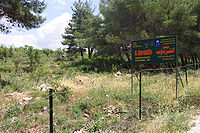
The natural populations of many CWRs are increasingly at risk. They are threatened by habitat loss through the destruction and degradation of natural environment or their conversion to other uses. Deforestation is leading to the loss of many populations of important wild relatives of fruit, nut, and industrial crops. Populations of wild relatives of cereal crops that occur in arid or semi-arid lands are being severely reduced by over grazing and resulting desertification. The growing industrialization of agriculture is drastically reducing the occurrence of CWRs within the traditional agro-ecosystems. The wise conservation and use of CWRs are essential elements for increasing food security, eliminating poverty, and maintaining the environment.
Grains
- WheatWheatWheat is a cereal grain, originally from the Levant region of the Near East, but now cultivated worldwide. In 2007 world production of wheat was 607 million tons, making it the third most-produced cereal after maize and rice...
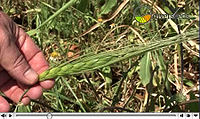
- Einkorn wheatEinkorn wheatthumbnail|150px|left|Wild einkorn, Karadag, central TurkeyEinkorn wheat can refer either to the wild species of wheat, Triticum boeoticum , or to the domesticated form, Triticum monococcum... - BarleyBarleyBarley is a major cereal grain, a member of the grass family. It serves as a major animal fodder, as a base malt for beer and certain distilled beverages, and as a component of various health foods...
- Wild BarleyBarleyBarley is a major cereal grain, a member of the grass family. It serves as a major animal fodder, as a base malt for beer and certain distilled beverages, and as a component of various health foods... - OatsOATSOATS - Open Source Assistive Technology Software - is a source code repository or "forge" for assistive technology software. It was launched in 2006 with the goal to provide a one-stop “shop” for end users, clinicians and open-source developers to promote and develop open source assistive...
- A. byzantinaOATSOATS - Open Source Assistive Technology Software - is a source code repository or "forge" for assistive technology software. It was launched in 2006 with the goal to provide a one-stop “shop” for end users, clinicians and open-source developers to promote and develop open source assistive...
Vegetables
Note: Many different vegetables share one common ancestor, particularly in the BrassicaBrassica
Brassica is a genus of plants in the mustard family . The members of the genus may be collectively known either as cabbages, or as mustards...
family and plants. Many vegetables are also hybrids of different species, again this is particularly true of Brassicas
Brassica
Brassica is a genus of plants in the mustard family . The members of the genus may be collectively known either as cabbages, or as mustards...
.
- LettuceLettuceLettuce is a temperate annual or biennial plant of the daisy family Asteraceae. It is most often grown as a leaf vegetable. It is eaten either raw, notably in salads, sandwiches, hamburgers, tacos, and many other dishes, or cooked, as in Chinese cuisine in which the stem becomes just as important...
- Lactuca sativa - CabbageCabbageCabbage is a popular cultivar of the species Brassica oleracea Linne of the Family Brassicaceae and is a leafy green vegetable...
- Brassica oleraceaBrassica oleraceaBrassica oleracea, or wild cabbage, is a species of Brassica native to coastal southern and western Europe, where its tolerance of salt and lime and its intolerance of competition from other plants typically restrict its natural occurrence to limestone sea cliffs, like the chalk cliffs on both...
(“Wild Cabbage") - LeekLeekThe leek, Allium ampeloprasum var. porrum , also sometimes known as Allium porrum, is a vegetable which belongs, along with the onion and garlic, to family Amaryllidaceae, subfamily Allioideae...
- Allium ampeloprasumAllium ampeloprasumAllium ampeloprasum is a member of the onion genus Allium. The wild plant is commonly known as Wild Leek - not to be confused with the N. American Allium tricoccum of the same name. Its native range is S. Europe to W...
(“Wild Leek") - OnionOnionThe onion , also known as the bulb onion, common onion and garden onion, is the most widely cultivated species of the genus Allium. The genus Allium also contains a number of other species variously referred to as onions and cultivated for food, such as the Japanese bunching onion The onion...
- Allium cepa - TurnipTurnipThe turnip or white turnip is a root vegetable commonly grown in temperate climates worldwide for its white, bulbous taproot. Small, tender varieties are grown for human consumption, while larger varieties are grown as feed for livestock...
- Brassica rapaBrassica rapaBrassica rapa L. , commonly known as turnip, turnip rape, field mustard or turnip mustard is a plant widely cultivated as a leaf vegetable , a root vegetable , and an oilseed .In the 18th century the turnip and... - Brocolli - Brassica oleraceaBrassica oleraceaBrassica oleracea, or wild cabbage, is a species of Brassica native to coastal southern and western Europe, where its tolerance of salt and lime and its intolerance of competition from other plants typically restrict its natural occurrence to limestone sea cliffs, like the chalk cliffs on both...
- RutabagaRutabagaThe rutabaga, swede , turnip or yellow turnip is a root vegetable that originated as a cross between the cabbage and the turnip; see Triangle of U...
- Brassica napus - CarrotCarrotThe carrot is a root vegetable, usually orange in colour, though purple, red, white, and yellow varieties exist. It has a crisp texture when fresh...
- Daucus Carota (“Wild Carrot”)
Fruits
- StrawberryStrawberryFragaria is a genus of flowering plants in the rose family, Rosaceae, commonly known as strawberries for their edible fruits. Although it is commonly thought that strawberries get their name from straw being used as a mulch in cultivating the plants, the etymology of the word is uncertain. There...
- Fragaria × ananassa - Alpine Strawberry - Fragaria vesca
- CherryCherryThe cherry is the fruit of many plants of the genus Prunus, and is a fleshy stone fruit. The cherry fruits of commerce are usually obtained from a limited number of species, including especially cultivars of the wild cherry, Prunus avium....
- Prunus aviumPrunus aviumPrunus avium, commonly called wild cherry, sweet cherry, bird cherry, or gean, is a species of cherry, native to Europe, west Turkey, northwest Africa, and western Asia, from the British Isles south to Morocco and Tunisia, north to the Trondheimsfjord region in Norway and east to the Caucasus, and... - OrangeOrange (fruit)An orange—specifically, the sweet orange—is the citrus Citrus × sinensis and its fruit. It is the most commonly grown tree fruit in the world....
- a hybrid between PomeloPomeloThe pomelo is a citrus fruit native to Southeast Asia. It is usually pale green to yellow when ripe, with sweet white flesh and very thick albedo . It is the largest citrus fruit, 15–25 cm in diameter, and usually weighing 1–2 kg...
and MandarinsMandarin orangeThe orange, also known as the ' or mandarine , is a small citrus tree with fruit resembling other oranges. Mandarin oranges are usually eaten plain or in fruit salads... - BananaBananaBanana is the common name for herbaceous plants of the genus Musa and for the fruit they produce. Bananas come in a variety of sizes and colors when ripe, including yellow, purple, and red....
- A hybrid between Musa acuminataMusa acuminataMusa acuminata is a species of wild banana native to Southeast Asia. It is the progenitor of modern edible bananas, along with Musa balbisiana. First cultivated by humans around 8000 years ago, it is one of the earliest examples of domesticated plants.-Taxonomy and nomenclature:Musa acuminata...
and Musa balbisianaMusa balbisianaMusa balbisiana is a species of wild banana native to South Asia. It is one of the ancestors of modern cultivated bananas along with Musa acuminata. It grows lush leaves in clumps and grows with a more upright habit than most cultivated bananas. Flowers grow in inflorescences coloured red to... - AppleAppleThe apple is the pomaceous fruit of the apple tree, species Malus domestica in the rose family . It is one of the most widely cultivated tree fruits, and the most widely known of the many members of genus Malus that are used by humans. Apple grow on small, deciduous trees that blossom in the spring...
- mostly Malus sieversiiMalus sieversiiMalus sieversii is a wild apple native to the mountains of Central Asia in southern Kazakhstan, eastern Uzbekistan, Kyrgyzstan, Tajikistan, Northern Afghanistan and Xinjiang, China. It has recently been shown to be the sole ancestor of most cultivars of the domesticated apple...
, but with some cultivars perhaps belonging to Malus sylvestrisMalus sylvestrisMalus sylvestris, the European wild apple, is a species of Malus , native to Europe from as far south as Spain, Italy and Greece to as far north as Scandinavia and Russia. Its scientific name means "forest apple", and the truly wild tree has thorns.In the past, M. sylvestris was thought to be an...
or being a hybrid of the two. - PearPearThe pear is any of several tree species of genus Pyrus and also the name of the pomaceous fruit of these trees. Several species of pear are valued by humans for their edible fruit, but the fruit of other species is small, hard, and astringent....
- Pyrus communis - PlumPrunus domesticaPrunus domestica is a Prunus species with many varieties. These are often called "plums" in common English, though not all plums belong to this species. Its hybrid parentage is believed to be Prunus spinosa and Prunus cerasifera var. divaricata...
- A hybrid between Prunus spinosaPrunus spinosaPrunus spinosa is a species of Prunus native to Europe, western Asia, and locally in northwest Africa. It is also locally naturalised in New Zealand and eastern North America....
and Prunus cerasifera
External links
- CWR Global Portal
- European Crop Wild Relative Diversity Assessment and Conservation Forum
- CWR Gap Analysis Portal Source on reliable information on where and what to conserve ex-situ, regarding CWR
- http://www.diverseeds.eu/uploads/media/Crop_Wild_Relatives_ver2.mp4 A short video on emmer wheat.
- Short DIVERSEEDS video on crop wild relatives in the fertile cresent in Israel