

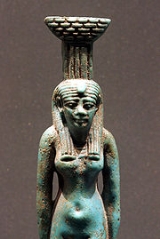
Nephthys

Encyclopedia
In Egyptian mythology
, Nephthys is a member of the Great Ennead
of Heliopolis
, a daughter of Nut
and Geb
. Nephthys was typically paired with her sister Isis
in funerary rites because of their role as protectors of the mummy and the god Osiris
and as the sister-wife of Seth.
Nephthys is regarded as the mother of the funerary-deity Anubis
(Inpu) in some myths. Alternatively Anubis appears as the son of Bastet or Isis
.
Nephthys was known in some ancient Egyptian temple
theologies and cosmologies as the "Useful Goddess" or the "Excellent Goddess". These late Ancient Egyptian temple texts describe a goddess who represented divine assistance and protective guardianship.
Less well understood than her sister Isis
, Nephthys was no less important in Egyptian Religion
as confirmed by the work of E. Hornung, along with the work of several noted scholars.
As the primary "nursing mother" of the incarnate Pharaonic-god, Horus
, Nephthys also was considered to be the nurse of the reigning Pharaoh
himself. Though other goddesses could assume this role, Nephthys was most usually portrayed in this function. In contrast Nephthys is sometimes featured as a rather ferocious and dangerous divinity, capable of incinerating the enemies of the Pharaoh
with her fiery breath.
New Kingdom
Ramesside Pharaohs, in particular, were enamored of Mother Nephthys, as is attested in various stelae and a wealth of inscriptions at Karnak and Luxor, where Nephthys was a member of that great city's Ennead and her altars were present in the massive complex.
Nephthys was one of the few national goddesses to serve as tutelary deity of her own district, or nome, in Ancient Egyptian history. Upper Egyptian Nome VII and its city, Hwt-Sekhem, were considered (at least by Greco-Roman times) to be the domain of Nephthys.
 Nephthys is the Greek form of an epithet (transliterated as Nebet-het, and Nebt-het, from Egyptian hieroglyphs
).The origin of the goddess Nephthys is unclear but the literal translation of her name is usually given as "Lady of the House," which has caused some to mistakenly identify her with the notion of a "housewife," or as the primary lady who ruled a domestic household. This is a pervasive error repeated in many commentaries concerning this deity. Her name means quite specifically, "Lady of the [Temple] Enclosure" which associates her with the role of priestess.
This title which may be more of an epithet
describing her function than a given name probably indicates the association of Nephthys with one particular temple or some specific aspect of the Egyptian temple ritual. Along with her sister Isis, Nephthys represented the temple pylon
or trapezoidal tower gateway entrance to the temple which also displayed the flagstaff. This entrance way symbolised the horizon or akhet
.
, Nephthys appears as a goddess of the Heliopolitan Ennead
. She is the sister of Isis and companion of the war-like deity, Set
. As sister of Isis
and especially Osiris
, Nephthys is a protective goddess who symbolizes the death experience, just as Isis represented the (re-)birth experience.
"Ascend and descend; descend with Nephthys, sink into darkness with the Night-bark. Ascend and descend; ascend with Isis, rise with the Day-bark."
Pyramid Text Utterance 222 line 210.
In the funerary role, Nephthys often was depicted as a bird of prey called a kite
, or as a woman with falcon wings, usually outstretched as a symbol of protection. Nephthys's association with the kite or the Egyptian hawk (and its piercing, mournful cries) evidently reminded the ancients of the lamentations usually offered for the dead by wailing women. In this capacity, it is easy to see how Nephthys could be associated with death and putrefaction in the Pyramid Texts
. She was, almost without fail, depicted as crowned by the hieroglyphics signifying her name, which were a combination of signs for the sacred temple enclosure (hwt), along with the sign for neb, or mistress (Lady), on top of the enclosure sign.
Nephthys was clearly viewed as a morbid-but-crucial force of heavenly transition, i.e., the Pharaoh becomes strong for his journey to the afterlife through the intervention of Isis and Nephthys. The same divine power could be applied later to all of the dead, who were advised to consider Nephthys a necessary companion. According to the Pyramid Texts
, Nephthys, along with Isis, was a force before whom demons trembled in fear, and whose magical spells were necessary for navigating the various levels of Duat
, as the region of the afterlife was termed.
It should here be noted that Nephthys was not necessarily viewed as the polar opposite of Isis, but rather as a different reflection of the same reality: eternal life in transition. Thus, Nephthys was also seen in the Pyramid Texts as a supportive cosmic force occupying the night-bark on the journey of Ra
, the majestic sun god, particularly when he entered Duat
at the transitional time of dusk, or twilight. Isis was Ra's companion at the coming of dawn.
, recent Egyptological research has called this into question. Levai notes that while Plutarch
’s De Iside et Osiride mentions the deity's marriage, there is very little specifically linking Nephthys and Set in the original early Egyptian sources. She argues that the later evidence suggests that:
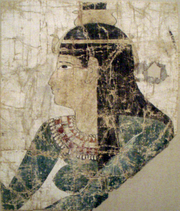
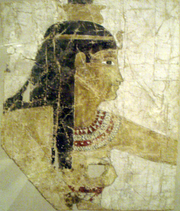 Nephthys plays an important role in the Osirian myth-cycle.
It is Nephthys who assists Isis in gathering and mourning the dismembered portions of the body of Osiris, after his murder by the envious Set. Nephthys also serves as the nursemaid and watchful guardian of the infant Horus. The Pyramid Texts
refer to Isis as the "birth-mother" and to Nephthys as the "nursing-mother" of Horus. Nephthys was attested as one of the four "Great Chiefs" ruling in the Osirian cult-center of Busiris, in the Delta (cf. The Book of the Dead, Theban Recension) and she appears to have occupied an honorary position at the holy city of Abydos
. No cult is attested for her there, though she certainly figured as a goddess of great importance in the annual rites conducted, wherein two chosen females or priestesses played the roles of Isis and Nephthys and performed the elaborate 'Lamentations of Isis and Nephthys'. There, at Abydos, Nephthys joined Isis as a mourner in the shrine known as the Osireion (cf.Byron Esely Shafer, Dieter Arnold, Temples in Ancient Egypt, p. 112, 2005). These "Festival Songs of Isis and Nephthys" were ritual elements of many such Osirian rites in major ancient Egyptian cult-centers.
As a mortuary goddess (along with Isis, Neith, and Serqet), Nephthys was one of the protectresses of the Canopic jar
s of the Hapi. Hapi, one of the Sons of Horus, guarded the embalmed lungs. Thus we find Nephthys endowed with the epithet, "Nephthys of the Bed of Life," ( cf. tomb of Tuthmosis III, Dynasty XVIII) in direct reference to her regenerative priorities on the embalming table. In the city of Memphis, Nephthys was duly honored with the title "Queen of the Embalmer's Shop," and there associated with the jackal
-headed god Anubis
as patron.
Nephthys was also considered a festive deity whose rites could mandate the liberal consumption of beer. In various reliefs at Edfu, Dendera, and Behbeit, Nephthys is depicted receiving lavish beer-offerings from the Pharaoh, which she would "return", using her power as a beer-goddess "that [the pharaoh] may have joy with no hangover." Elsewhere at Edfu, for example, Nephthys is a goddess who gives the Pharaoh power to see "that which is hidden by moonlight." This fits well with more general textual themes that consider Nephthys to be a goddess whose unique domain was darkness, or the perilous edges of the desert.
Nephthys could also appear as one of the goddesses who assists at childbirth. One ancient Egyptian myth preserved in the Papyrus Westcar recounts the story of Isis, Nephthys, Meskhenet, and Heqet as traveling dancers in disguise, assisting the wife of a priest of Amun-Re as she prepares to bring forth sons who are destined for fame and fortune.
Nephthys's healing skills and status as direct counterpart of Isis, steeped, as her sister in "words of power," are evidenced by the abundance of faience
amulets carved in her likeness, and by her presence in a variety of magical papyri that sought to summon her famously altruistic qualities to the aid of mortals.
, a temple of Nephthys called the "House of Nephthys of Ramesses-Meriamun" was built or refurbished in the town of Sepermeru
, midway between Oxyrhynchos
and Herakleopolis, on the outskirts of the Fayyum and quite near to the modern site of Deshasheh. Here, as Papyrus Wilbour notes in its wealth of taxation records and land assessments, the temple of Nephthys was a specific foundation by Ramesses II, located in close proximity to (or within) the precinct of the enclosure of Set. To be certain, the House of Nephthys was one of fifty individual, land-owning temples delineated for this portion of the Middle Egyptian district in Papyrus Wilbour. The fields and other holdings belonging to Nephthys's temple were under the authority of two Nephthys-prophets (named Penpmer and Merybarse) and one (mentioned) wa'ab priest of the goddess.
While certainly affiliated with the "House of Set," the Nephthys temple at Sepermeru and its apportioned lands (several acres) clearly were under administration distinct from the Set institution. The Nephthys temple was a unique establishment in its own right, an independent entity. According to Papyrus Wilbour, another "House of Nephthys of Ramesses-Meriamun" seems to have existed to the north, in the town of Su, closer to the Fayyum region.
Another temple of Nephthys seems to have existed in the town of Punodjem. The Papyrus Bologna records a complaint lodged by a prophet of the temple of Set in that town regarding undue taxation in his regard. After making an introductory appeal to "Re-Horakhte, Set, and Nephthys" for the ultimate resolution of this issue by the royal Vizier, the prophet (named Pra'emhab) laments his workload. He notes his obvious administration of the "House of Set" and adds: "I am also responsible for the ship, and I am responsible likewise for the House of Nephthys, along with a heap of other temples."
As "Nephthys of Ramesses-Meriamun," the goddess and her shrines were under the particular endorsement of Ramesses II
. The foundations of the Set and Nephthys temples at Sepermeru finally were discovered and identified in the 1980s, and the Nephthys temple was a self-sustaining temple complex within the Set enclosure.
There can be little doubt that a cult of Nephthys existed in the temple and great town of Herakleopolis, north of Sepermeru. A near life-sized statue of Nephthys (currently housed in the Louvre
) boasts a curiously altered inscription. The basalt image originally was stationed at Medinet-Habu, as part of the cultic celebration of the Pharaonic "Sed-Festival," but was transferred at some point to Herakleopolis and the temple of Herishef. The cult-image's inscription originally pertained to "Nephthys, Foremost of the Sed [Festival] in the Booth of Annals" (at Medinet-Habu), but was re-inscribed or re-dedicated to "Nephthys, Foremost of the [Booths of] Herakleopolis." A "prophet of Nephthys" is indeed attested for the town of Herakleopolis in the 30th Dynasty
.
Bird. This role may have stemmed from an early association in her native Heliopolis, which was renowned for its "House of the Bennu" temple. In this role, Nephthys was given the name "Nephthys-Kheresket," and a wealth of temple texts from Edfu, Dendara, Philae, Kom Ombo, El Qa'la, Esna, and others corroborate the late identification of Nephthys as the supreme goddess of Upper Egyptian Nome VII, where another shrine existed in honor of the Bennu
. Nephthys also was the goddess of the "Mansion of the Sistrum
" in Hwt-Sekhem (Gr. Diospolis Parva), the chief city of Nome VII. There, Nephthys was the primary protectress of the resident Osirian relic, of the Bennu Bird, and of the local Horus/Osiris manifestation, the god Neferhotep.
Nephthys was most widely and usually worshipped in ancient Egypt as part of a consortium of temple deities. Therefore, it should not surprise us that her cult images could likely be found as part of the divine entourage in temples at Kharga, Kellis, Deir el-Hagar, Koptos, Dendereh, Philae, Sebennytos, Busiris, Shenhur, El Qa'la, Letopolis, Heliopolis, Abydos, Thebes, Dakleh Oasis, and indeed throughout Egypt. In most cases, Nephthys found her typical place as part of a triad alongside Osiris and Isis, or Isis and Horus, or Isis and Min, or as part of a quartet of deities. It is perhaps, in this way that Nephthys best fulfilled her role as an important national deity whose ideal function was to provide powerful assistance to her associates in a great variety of temple cults—a truly "Useful" and "Excellent" goddess, as her primary epithets reflect.
Egyptian mythology
Ancient Egyptian religion was a complex system of polytheistic beliefs and rituals which were an integral part of ancient Egyptian society. It centered on the Egyptians' interaction with a multitude of deities who were believed to be present in, and in control of, the forces and elements of nature...
, Nephthys is a member of the Great Ennead
Ennead
The Ennead was a group ofnine deities in Egyptian mythology. The Ennead were worshipped at Heliopolis and consisted of the god Atum, his children Shu and Tefnut, their children Geb and Nut and their children Osiris, Isis, Horus, Set and Nephthys.-Terminology:Egyptian mythology established multiple...
of Heliopolis
Heliopolis (ancient)
Heliopolis was one of the oldest cities of ancient Egypt, the capital of the 13th Lower Egyptian nome that was located five miles east of the Nile to the north of the apex of the Nile Delta...
, a daughter of Nut
Nut (goddess)
In the Ennead of Egyptian mythology, Nut was the goddess of the sky.-Goddess of the sky:...
and Geb
Geb
Geb was the Egyptian god of the Earth and a member of the Ennead of Heliopolis. It was believed in ancient Egypt that Geb's laughter was earthquakes and that he allowed crops to grow. The name was pronounced as such from the Greek period onward,...
. Nephthys was typically paired with her sister Isis
Isis
Isis or in original more likely Aset is a goddess in Ancient Egyptian religious beliefs, whose worship spread throughout the Greco-Roman world. She was worshipped as the ideal mother and wife as well as the matron of nature and magic...
in funerary rites because of their role as protectors of the mummy and the god Osiris
Osiris
Osiris is an Egyptian god, usually identified as the god of the afterlife, the underworld and the dead. He is classically depicted as a green-skinned man with a pharaoh's beard, partially mummy-wrapped at the legs, wearing a distinctive crown with two large ostrich feathers at either side, and...
and as the sister-wife of Seth.
Nephthys is regarded as the mother of the funerary-deity Anubis
Anubis
Anubis is the Greek name for a jackal-headed god associated with mummification and the afterlife in ancient Egyptian religion. In the ancient Egyptian language, Anubis is known as Inpu . According to the Akkadian transcription in the Amarna letters, Anubis' name was vocalized as Anapa...
(Inpu) in some myths. Alternatively Anubis appears as the son of Bastet or Isis
Isis
Isis or in original more likely Aset is a goddess in Ancient Egyptian religious beliefs, whose worship spread throughout the Greco-Roman world. She was worshipped as the ideal mother and wife as well as the matron of nature and magic...
.
Nephthys was known in some ancient Egyptian temple
Egyptian temple
Egyptian temples were built for the official worship of the gods and commemoration of pharaohs in Ancient Egypt and in regions under Egyptian control. These temples were seen as houses for the gods or kings to whom they were dedicated...
theologies and cosmologies as the "Useful Goddess" or the "Excellent Goddess". These late Ancient Egyptian temple texts describe a goddess who represented divine assistance and protective guardianship.
Less well understood than her sister Isis
Isis
Isis or in original more likely Aset is a goddess in Ancient Egyptian religious beliefs, whose worship spread throughout the Greco-Roman world. She was worshipped as the ideal mother and wife as well as the matron of nature and magic...
, Nephthys was no less important in Egyptian Religion
Egyptian religion
Egyptian religion may refer to:* Modern Religion in Egypt* Ancient Egyptian religion...
as confirmed by the work of E. Hornung, along with the work of several noted scholars.
As the primary "nursing mother" of the incarnate Pharaonic-god, Horus
Horus
Horus is one of the oldest and most significant deities in the Ancient Egyptian religion, who was worshipped from at least the late Predynastic period through to Greco-Roman times. Different forms of Horus are recorded in history and these are treated as distinct gods by Egyptologists...
, Nephthys also was considered to be the nurse of the reigning Pharaoh
Pharaoh
Pharaoh is a title used in many modern discussions of the ancient Egyptian rulers of all periods. The title originates in the term "pr-aa" which means "great house" and describes the royal palace...
himself. Though other goddesses could assume this role, Nephthys was most usually portrayed in this function. In contrast Nephthys is sometimes featured as a rather ferocious and dangerous divinity, capable of incinerating the enemies of the Pharaoh
Pharaoh
Pharaoh is a title used in many modern discussions of the ancient Egyptian rulers of all periods. The title originates in the term "pr-aa" which means "great house" and describes the royal palace...
with her fiery breath.
New Kingdom
New Kingdom
The New Kingdom of Egypt, also referred to as the Egyptian Empire is the period in ancient Egyptian history between the 16th century BC and the 11th century BC, covering the Eighteenth, Nineteenth, and Twentieth Dynasties of Egypt....
Ramesside Pharaohs, in particular, were enamored of Mother Nephthys, as is attested in various stelae and a wealth of inscriptions at Karnak and Luxor, where Nephthys was a member of that great city's Ennead and her altars were present in the massive complex.
Nephthys was one of the few national goddesses to serve as tutelary deity of her own district, or nome, in Ancient Egyptian history. Upper Egyptian Nome VII and its city, Hwt-Sekhem, were considered (at least by Greco-Roman times) to be the domain of Nephthys.
Etymology
Egyptian hieroglyphs
Egyptian hieroglyphs were a formal writing system used by the ancient Egyptians that combined logographic and alphabetic elements. Egyptians used cursive hieroglyphs for religious literature on papyrus and wood...
).The origin of the goddess Nephthys is unclear but the literal translation of her name is usually given as "Lady of the House," which has caused some to mistakenly identify her with the notion of a "housewife," or as the primary lady who ruled a domestic household. This is a pervasive error repeated in many commentaries concerning this deity. Her name means quite specifically, "Lady of the [Temple] Enclosure" which associates her with the role of priestess.
This title which may be more of an epithet
Epithet
An epithet or byname is a descriptive term accompanying or occurring in place of a name and having entered common usage. It has various shades of meaning when applied to seemingly real or fictitious people, divinities, objects, and binomial nomenclature. It is also a descriptive title...
describing her function than a given name probably indicates the association of Nephthys with one particular temple or some specific aspect of the Egyptian temple ritual. Along with her sister Isis, Nephthys represented the temple pylon
Pylon (architecture)
Pylon is the Greek term for a monumental gateway of an Egyptian temple It consists of two tapering towers, each surmounted by a cornice, joined by a less elevated section which enclosed the entrance between them. The entrance was generally about half the height of the towers...
or trapezoidal tower gateway entrance to the temple which also displayed the flagstaff. This entrance way symbolised the horizon or akhet
Akhet (hieroglyph and season)
The Egyptian language word Akhet is both a hieroglyph and an Ancient Egyptian season.The two uses for akhet:* In ancient Egyptian, the place where the sun rises and sets; often translated as "horizon" or "mountain of light". It is included in names like "Akhet Khufu" and Akhetaten...
.
Function
At the time of the Fifth Dynasty Pyramid TextsPyramid Texts
The Pyramid Texts are a collection of ancient Egyptian religious texts from the time of the Old Kingdom. The pyramid texts are possibly the oldest known religious texts in the world. Written in Old Egyptian, the pyramid texts were carved on the walls and sarcophagi of the pyramids at Saqqara during...
, Nephthys appears as a goddess of the Heliopolitan Ennead
Ennead
The Ennead was a group ofnine deities in Egyptian mythology. The Ennead were worshipped at Heliopolis and consisted of the god Atum, his children Shu and Tefnut, their children Geb and Nut and their children Osiris, Isis, Horus, Set and Nephthys.-Terminology:Egyptian mythology established multiple...
. She is the sister of Isis and companion of the war-like deity, Set
Set (mythology)
Set was in Ancient Egyptian religion, a god of the desert, storms, and foreigners. In later myths he was also the god of darkness, and chaos...
. As sister of Isis
Isis
Isis or in original more likely Aset is a goddess in Ancient Egyptian religious beliefs, whose worship spread throughout the Greco-Roman world. She was worshipped as the ideal mother and wife as well as the matron of nature and magic...
and especially Osiris
Osiris
Osiris is an Egyptian god, usually identified as the god of the afterlife, the underworld and the dead. He is classically depicted as a green-skinned man with a pharaoh's beard, partially mummy-wrapped at the legs, wearing a distinctive crown with two large ostrich feathers at either side, and...
, Nephthys is a protective goddess who symbolizes the death experience, just as Isis represented the (re-)birth experience.
"Ascend and descend; descend with Nephthys, sink into darkness with the Night-bark. Ascend and descend; ascend with Isis, rise with the Day-bark."
Pyramid Text Utterance 222 line 210.
In the funerary role, Nephthys often was depicted as a bird of prey called a kite
Kite (bird)
Kites are raptors with long wings and weak legs which spend a great deal of time soaring. Most feed mainly on carrion but some take various amounts of live prey.They are birds of prey which, along with hawks and eagles, are from the family Accipitridae....
, or as a woman with falcon wings, usually outstretched as a symbol of protection. Nephthys's association with the kite or the Egyptian hawk (and its piercing, mournful cries) evidently reminded the ancients of the lamentations usually offered for the dead by wailing women. In this capacity, it is easy to see how Nephthys could be associated with death and putrefaction in the Pyramid Texts
Pyramid Texts
The Pyramid Texts are a collection of ancient Egyptian religious texts from the time of the Old Kingdom. The pyramid texts are possibly the oldest known religious texts in the world. Written in Old Egyptian, the pyramid texts were carved on the walls and sarcophagi of the pyramids at Saqqara during...
. She was, almost without fail, depicted as crowned by the hieroglyphics signifying her name, which were a combination of signs for the sacred temple enclosure (hwt), along with the sign for neb, or mistress (Lady), on top of the enclosure sign.
Nephthys was clearly viewed as a morbid-but-crucial force of heavenly transition, i.e., the Pharaoh becomes strong for his journey to the afterlife through the intervention of Isis and Nephthys. The same divine power could be applied later to all of the dead, who were advised to consider Nephthys a necessary companion. According to the Pyramid Texts
Pyramid Texts
The Pyramid Texts are a collection of ancient Egyptian religious texts from the time of the Old Kingdom. The pyramid texts are possibly the oldest known religious texts in the world. Written in Old Egyptian, the pyramid texts were carved on the walls and sarcophagi of the pyramids at Saqqara during...
, Nephthys, along with Isis, was a force before whom demons trembled in fear, and whose magical spells were necessary for navigating the various levels of Duat
Duat
In Egyptian mythology, Duat is the underworld. The Duat is a vast area under the Earth, connected with Nun, the waters of the primordial abyss. The Duat is the realm of the god Osiris and the residence of other gods and supernatural beings...
, as the region of the afterlife was termed.
It should here be noted that Nephthys was not necessarily viewed as the polar opposite of Isis, but rather as a different reflection of the same reality: eternal life in transition. Thus, Nephthys was also seen in the Pyramid Texts as a supportive cosmic force occupying the night-bark on the journey of Ra
Ra
Ra is the ancient Egyptian sun god. By the Fifth Dynasty he had become a major deity in ancient Egyptian religion, identified primarily with the mid-day sun...
, the majestic sun god, particularly when he entered Duat
Duat
In Egyptian mythology, Duat is the underworld. The Duat is a vast area under the Earth, connected with Nun, the waters of the primordial abyss. The Duat is the realm of the god Osiris and the residence of other gods and supernatural beings...
at the transitional time of dusk, or twilight. Isis was Ra's companion at the coming of dawn.
Nephthys and Set
Though it commonly has been assumed that Nepthys was married to SetSet (mythology)
Set was in Ancient Egyptian religion, a god of the desert, storms, and foreigners. In later myths he was also the god of darkness, and chaos...
, recent Egyptological research has called this into question. Levai notes that while Plutarch
Plutarch
Plutarch then named, on his becoming a Roman citizen, Lucius Mestrius Plutarchus , c. 46 – 120 AD, was a Greek historian, biographer, essayist, and Middle Platonist known primarily for his Parallel Lives and Moralia...
’s De Iside et Osiride mentions the deity's marriage, there is very little specifically linking Nephthys and Set in the original early Egyptian sources. She argues that the later evidence suggests that:
while Nephthys’s marriage to Set was a part of Egyptian mythology, it was not a part of the myth of the murder and resurrection of Osiris. She was not paired with Set the villain, but with Set’s other aspect, the benevolent figure who was the killer of Apophis. This was the aspect of Set worshiped in the western oases during the Roman period, where he is depicted with Nephthys as co-ruler.
The saving sister of Osiris
It is Nephthys who assists Isis in gathering and mourning the dismembered portions of the body of Osiris, after his murder by the envious Set. Nephthys also serves as the nursemaid and watchful guardian of the infant Horus. The Pyramid Texts
Pyramid Texts
The Pyramid Texts are a collection of ancient Egyptian religious texts from the time of the Old Kingdom. The pyramid texts are possibly the oldest known religious texts in the world. Written in Old Egyptian, the pyramid texts were carved on the walls and sarcophagi of the pyramids at Saqqara during...
refer to Isis as the "birth-mother" and to Nephthys as the "nursing-mother" of Horus. Nephthys was attested as one of the four "Great Chiefs" ruling in the Osirian cult-center of Busiris, in the Delta (cf. The Book of the Dead, Theban Recension) and she appears to have occupied an honorary position at the holy city of Abydos
Abydos, Egypt
Abydos is one of the most ancient cities of Upper Egypt, and also of the eight Upper Nome, of which it was the capital city. It is located about 11 kilometres west of the Nile at latitude 26° 10' N, near the modern Egyptian towns of el-'Araba el Madfuna and al-Balyana...
. No cult is attested for her there, though she certainly figured as a goddess of great importance in the annual rites conducted, wherein two chosen females or priestesses played the roles of Isis and Nephthys and performed the elaborate 'Lamentations of Isis and Nephthys'. There, at Abydos, Nephthys joined Isis as a mourner in the shrine known as the Osireion (cf.Byron Esely Shafer, Dieter Arnold, Temples in Ancient Egypt, p. 112, 2005). These "Festival Songs of Isis and Nephthys" were ritual elements of many such Osirian rites in major ancient Egyptian cult-centers.
As a mortuary goddess (along with Isis, Neith, and Serqet), Nephthys was one of the protectresses of the Canopic jar
Canopic jar
Canopic jars were used by the Ancient Egyptians during the mummification process to store and preserve the viscera of their owner for the afterlife. They were commonly either carved from limestone or were made of pottery...
s of the Hapi. Hapi, one of the Sons of Horus, guarded the embalmed lungs. Thus we find Nephthys endowed with the epithet, "Nephthys of the Bed of Life," ( cf. tomb of Tuthmosis III, Dynasty XVIII) in direct reference to her regenerative priorities on the embalming table. In the city of Memphis, Nephthys was duly honored with the title "Queen of the Embalmer's Shop," and there associated with the jackal
Jackal
Although the word jackal has been historically used to refer to many small- to medium-sized species of the wolf genus of mammals, Canis, today it most properly and commonly refers to three species: the black-backed jackal and the side-striped jackal of sub-Saharan Africa, and the golden jackal of...
-headed god Anubis
Anubis
Anubis is the Greek name for a jackal-headed god associated with mummification and the afterlife in ancient Egyptian religion. In the ancient Egyptian language, Anubis is known as Inpu . According to the Akkadian transcription in the Amarna letters, Anubis' name was vocalized as Anapa...
as patron.
Nephthys was also considered a festive deity whose rites could mandate the liberal consumption of beer. In various reliefs at Edfu, Dendera, and Behbeit, Nephthys is depicted receiving lavish beer-offerings from the Pharaoh, which she would "return", using her power as a beer-goddess "that [the pharaoh] may have joy with no hangover." Elsewhere at Edfu, for example, Nephthys is a goddess who gives the Pharaoh power to see "that which is hidden by moonlight." This fits well with more general textual themes that consider Nephthys to be a goddess whose unique domain was darkness, or the perilous edges of the desert.
Nephthys could also appear as one of the goddesses who assists at childbirth. One ancient Egyptian myth preserved in the Papyrus Westcar recounts the story of Isis, Nephthys, Meskhenet, and Heqet as traveling dancers in disguise, assisting the wife of a priest of Amun-Re as she prepares to bring forth sons who are destined for fame and fortune.
Nephthys's healing skills and status as direct counterpart of Isis, steeped, as her sister in "words of power," are evidenced by the abundance of faience
Egyptian faience
Egyptian faience is a non-clay based ceramic displaying surface vitrification which creates a bright lustre of various blue-green colours. Having not been made from clay it is often not classed as pottery. It is called "Egyptian faience" to distinguish it from faience, the tin glazed pottery...
amulets carved in her likeness, and by her presence in a variety of magical papyri that sought to summon her famously altruistic qualities to the aid of mortals.
New Kingdom cults of Nephthys
The Ramesside Pharaohs were particularly devoted to Set's prerogatives and, in the 19th DynastyNineteenth dynasty of Egypt
The Nineteenth Dynasty of ancient Egypt was one of the periods of the Egyptian New Kingdom. Founded by Vizier Ramesses I, whom Pharaoh Horemheb chose as his successor to the throne, this dynasty is best known for its military conquests in Palestine, Lebanon, and Syria.The warrior kings of the...
, a temple of Nephthys called the "House of Nephthys of Ramesses-Meriamun" was built or refurbished in the town of Sepermeru
Sepermeru
Sepermeru was a town of ancient Egypt situated roughly midway between the city of Heracleopolis to the north and Oxyrhynchus to the south in what was considered the XIX Upper Egyptian nome....
, midway between Oxyrhynchos
Oxyrhynchus
Oxyrhynchus is a city in Upper Egypt, located about 160 km south-southwest of Cairo, in the governorate of Al Minya. It is also an archaeological site, considered one of the most important ever discovered...
and Herakleopolis, on the outskirts of the Fayyum and quite near to the modern site of Deshasheh. Here, as Papyrus Wilbour notes in its wealth of taxation records and land assessments, the temple of Nephthys was a specific foundation by Ramesses II, located in close proximity to (or within) the precinct of the enclosure of Set. To be certain, the House of Nephthys was one of fifty individual, land-owning temples delineated for this portion of the Middle Egyptian district in Papyrus Wilbour. The fields and other holdings belonging to Nephthys's temple were under the authority of two Nephthys-prophets (named Penpmer and Merybarse) and one (mentioned) wa'ab priest of the goddess.
While certainly affiliated with the "House of Set," the Nephthys temple at Sepermeru and its apportioned lands (several acres) clearly were under administration distinct from the Set institution. The Nephthys temple was a unique establishment in its own right, an independent entity. According to Papyrus Wilbour, another "House of Nephthys of Ramesses-Meriamun" seems to have existed to the north, in the town of Su, closer to the Fayyum region.
Another temple of Nephthys seems to have existed in the town of Punodjem. The Papyrus Bologna records a complaint lodged by a prophet of the temple of Set in that town regarding undue taxation in his regard. After making an introductory appeal to "Re-Horakhte, Set, and Nephthys" for the ultimate resolution of this issue by the royal Vizier, the prophet (named Pra'emhab) laments his workload. He notes his obvious administration of the "House of Set" and adds: "I am also responsible for the ship, and I am responsible likewise for the House of Nephthys, along with a heap of other temples."
As "Nephthys of Ramesses-Meriamun," the goddess and her shrines were under the particular endorsement of Ramesses II
Ramesses II
Ramesses II , referred to as Ramesses the Great, was the third Egyptian pharaoh of the Nineteenth dynasty. He is often regarded as the greatest, most celebrated, and most powerful pharaoh of the Egyptian Empire...
. The foundations of the Set and Nephthys temples at Sepermeru finally were discovered and identified in the 1980s, and the Nephthys temple was a self-sustaining temple complex within the Set enclosure.
There can be little doubt that a cult of Nephthys existed in the temple and great town of Herakleopolis, north of Sepermeru. A near life-sized statue of Nephthys (currently housed in the Louvre
Louvre
The Musée du Louvre – in English, the Louvre Museum or simply the Louvre – is one of the world's largest museums, the most visited art museum in the world and a historic monument. A central landmark of Paris, it is located on the Right Bank of the Seine in the 1st arrondissement...
) boasts a curiously altered inscription. The basalt image originally was stationed at Medinet-Habu, as part of the cultic celebration of the Pharaonic "Sed-Festival," but was transferred at some point to Herakleopolis and the temple of Herishef. The cult-image's inscription originally pertained to "Nephthys, Foremost of the Sed [Festival] in the Booth of Annals" (at Medinet-Habu), but was re-inscribed or re-dedicated to "Nephthys, Foremost of the [Booths of] Herakleopolis." A "prophet of Nephthys" is indeed attested for the town of Herakleopolis in the 30th Dynasty
Thirtieth dynasty of Egypt
The Thirtieth Dynasty of ancient Egypt followed Nectanebo I's deposition of Nefaarud II, the son of Hakor. This dynasty is often considered part of the Late Period....
.
Chief goddess of Nome VII
Nephthys was considered the unique protectress of the Sacred Phoenix, or the BennuBennu
The Bennu bird serves as the Egyptian correspondence to the phoenix, and is said to be the soul of the Sun-God Ra.-Egyptian description:...
Bird. This role may have stemmed from an early association in her native Heliopolis, which was renowned for its "House of the Bennu" temple. In this role, Nephthys was given the name "Nephthys-Kheresket," and a wealth of temple texts from Edfu, Dendara, Philae, Kom Ombo, El Qa'la, Esna, and others corroborate the late identification of Nephthys as the supreme goddess of Upper Egyptian Nome VII, where another shrine existed in honor of the Bennu
Bennu
The Bennu bird serves as the Egyptian correspondence to the phoenix, and is said to be the soul of the Sun-God Ra.-Egyptian description:...
. Nephthys also was the goddess of the "Mansion of the Sistrum
Sistrum
A sistrum is a musical instrument of the percussion family, chiefly associated with ancient Iraq and Egypt. It consists of a handle and a U-shaped metal frame, made of brass or bronze and between 76 and 30 cm in width...
" in Hwt-Sekhem (Gr. Diospolis Parva), the chief city of Nome VII. There, Nephthys was the primary protectress of the resident Osirian relic, of the Bennu Bird, and of the local Horus/Osiris manifestation, the god Neferhotep.
Nephthys was most widely and usually worshipped in ancient Egypt as part of a consortium of temple deities. Therefore, it should not surprise us that her cult images could likely be found as part of the divine entourage in temples at Kharga, Kellis, Deir el-Hagar, Koptos, Dendereh, Philae, Sebennytos, Busiris, Shenhur, El Qa'la, Letopolis, Heliopolis, Abydos, Thebes, Dakleh Oasis, and indeed throughout Egypt. In most cases, Nephthys found her typical place as part of a triad alongside Osiris and Isis, or Isis and Horus, or Isis and Min, or as part of a quartet of deities. It is perhaps, in this way that Nephthys best fulfilled her role as an important national deity whose ideal function was to provide powerful assistance to her associates in a great variety of temple cults—a truly "Useful" and "Excellent" goddess, as her primary epithets reflect.