
All Topics  
Khepri


   Email Print
   Bookmark   Link


Khepri


This article is about the Egyptian god. For the type of robot, see Khepera mobile robot
Khepera mobile robot

The Khepera is a small Differential wheeled robot autonomous robot that was developed at the LAMI laboratory of Prof. Jean-Daniel Nicoud at EPFL in the mid 1990s....
.


In Egyptian mythology
Egyptian mythology

Ancient Egyptian religion encompasses the various religious beliefs and rituals practiced in ancient Egypt over at least 3,000 years, from the Predynastic Egypt until the adoption of Coptic Christianity in the early centuries Common Era....
, Khepri (also spelled Khepera, Kheper, Chepri, Khepra) is the name of a major god
God

God is a deity in theism and deism religions and other belief systems, representing either the sole deity in monotheism, or a principal deity in polytheism....
. Khepri is associated with the dung beetle
Dung beetle

Dung beetles are beetles that feed partly or exclusively on feces. All of these species belong to the superfamily Scarabaeoidea; most of them to the subfamilies Scarabaeinae and Aphodiinae of the family Scarabaeidae....
 (kheper), whose behavior of maintaining spherical balls of dung represents the forces which move the sun. Khepri gradually came to be considered as an embodiment of the sun itself, and therefore was a solar deity
Solar deity

A Solar Deity , is a deity who represents the sun, or an aspect of it. People have worshiped these for all of recorded history. Hence, many beliefs have formed around this worship, such as the "missing sun" found in many cultures ....
.


Discussion
Ask a question about 'Khepri'
Start a new discussion about 'Khepri'
Answer questions from other users
Full Discussion Forum


Encyclopedia


This article is about the Egyptian god. For the type of robot, see Khepera mobile robot
Khepera mobile robot

The Khepera is a small Differential wheeled robot autonomous robot that was developed at the LAMI laboratory of Prof. Jean-Daniel Nicoud at EPFL in the mid 1990s....
.


In Egyptian mythology
Egyptian mythology

Ancient Egyptian religion encompasses the various religious beliefs and rituals practiced in ancient Egypt over at least 3,000 years, from the Predynastic Egypt until the adoption of Coptic Christianity in the early centuries Common Era....
, Khepri (also spelled Khepera, Kheper, Chepri, Khepra) is the name of a major god
God

God is a deity in theism and deism religions and other belief systems, representing either the sole deity in monotheism, or a principal deity in polytheism....
. Khepri is associated with the dung beetle
Dung beetle

Dung beetles are beetles that feed partly or exclusively on feces. All of these species belong to the superfamily Scarabaeoidea; most of them to the subfamilies Scarabaeinae and Aphodiinae of the family Scarabaeidae....
 (kheper), whose behavior of maintaining spherical balls of dung represents the forces which move the sun. Khepri gradually came to be considered as an embodiment of the sun itself, and therefore was a solar deity
Solar deity

A Solar Deity , is a deity who represents the sun, or an aspect of it. People have worshiped these for all of recorded history. Hence, many beliefs have formed around this worship, such as the "missing sun" found in many cultures ....
. To explain where the sun goes at night, such pushing was extended to the underworld
Duat

In Egyptian mythology, Duat is the underworld.This was the region through which the sun god Ra traveled from west to east during the night, and where he battled Apep....
, Khepri's pushing of the sun being ceaseless.

Since the scarab beetle lays its eggs in the bodies of various dead animals, including other scarabs, and in dung, from which they emerge having been born, the ancient Egyptians believed that scarab beetles were created from dead matter. Because of this, they also associated the Khepri with rebirth, renewal, and resurrection. Indeed, his name (kheper in Egyptian
Egyptian language

Egyptian is a branch of the Afro-Asiatic languages language family along with the Chadic languages, Berber languages, Semitic languages, Cushitic languages and possibly Omotic languages languages....
) means to come into being. As a result of this, when the rival cult of the sun-god Ra
Ra

Ra is an ancient Egyptian Solar deity . By the Fifth dynasty of Egypt he became a major deity in ancient Egyptian religion, identified primarily with the noon, with other deities representing other positions of the sun....
 gained significance, Khepri was identified as the aspect of Ra which constitutes only the dawn
Dawn

Dawn is the twilight before sunrise. It is recognized by the presence of weak sunlight, while the sun itself is still below the horizon. Dawn should not be confused with sunrise, which is the moment when the leading edge of the sun itself appears above the horizon....
ing sun (i.e the sun when it comes into being).

Subsequently, when Ra and Atum
Atum

Atum is an important deity in Egyptian mythology, whose cult centred on the city of Heliopolis . His name is thought to be derived from the word 'tem' which means to complete or finish....
 became identified as one another, Khepri, which was Ra's young form, became conflated with Nefertum, which was Atum's. This led to a cosmogony
Cosmogony

Cosmogony, or cosmogeny, is any theory concerning the coming into existence or origin of the universe, or about how reality came to be. The word comes from the Greek ??s??????a , from ??s??? "cosmos, the world", and the root of ?????a? / ?????a "to be born, come about"....
 where Ra, as Khepri, a beetle, resulted from the Ogdoad
Ogdoad

In Egyptian mythology, the Ogdoad were eight deities worshipped in Hermopolis during what is called the Old Kingdom, the third through sixth dynasties, dated between 2686 to 2134 B.C....
's activities, and emerged from a (blue) lotus flower, only to immediately transform into Nefertum, a youth, who, after growing up, masturbated
Masturbation

Masturbation refers to sexual stimulation, especially of one's own sex organ , often to the point of orgasm. The stimulation can be performed manually, by other types of bodily contact , by use of objects or tools, or by some combination of these methods....
 the Ennead
Ennead

Ennead , an ancient Greek translation of the Egyptian word, Pesedjet, consists of a grouping of nine deity, most often appearing in the context of Egyptian mythology....
 into existence.

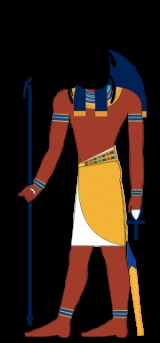
Khepri was principally depicted as a whole scarab beetle, though in some tomb paintings and funerary papyri
Papyrus

Papyrus is a thick paper material produced from the pith of the papyrus plant, Cyperus papyrus, a wetland Cyperaceae that was once abundant in the Nile Delta of Egypt....
 he is represented as a human male with a scarab as a head. He is also depicted as a scarab in a solar barque held aloft by Nun
Naunet

"Nu " redirects here. For other uses, see Nu.In Egyptian mythology, Nu is the deification of the primordial watery abyss. In the Ogdoad cosmogony, the name means abyss....
. When represented as a scarab beetle, he was typically depicted pushing the sun across the sky every day, as well as rolling it safely through the Egyptian underworld every night. As an aspect of Ra, he is particularly prevalent in the funerary literature of the New Kingdom
New Kingdom

The New Kingdom, sometimes referred to as the Egyptian Empire, is the period in ancient Egyptian History of Ancient Egypt between the 16th century BC and the 11th century BC, covering the Eighteenth dynasty of Egypt, Nineteenth dynasty of Egypt, and Twentieth dynasty of Egypt....
, when many Ramesside
Ramesside Period

The Ramesside Period encompasses the Nineteenth dynasty of Egypt and Twentieth dynasty of Egypt of Ancient Egypt. It is named after "Ramesses", the name taken by the majority of the rulers of Egypt dating to this period of time....
 tombs in the Valley of the Kings
Valley of the Kings

The Valley of the Kings is a valley in Egypt where, for a period of nearly 500 years from the 16th century BC to 11th century BC, tombs were constructed for the Pharaoh and powerful nobles of the Conventional Egyptian chronology#New Kingdom ....
 were decorated with depictions Ra as a sun-disc, containing images of Khepri, the dawning sun, and Atum, the setting sun.