

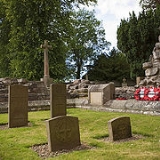
Dryburgh Abbey

Encyclopedia
Dryburgh Abbey, near Dryburgh
on the banks of the River Tweed
in the Scottish
Borders
, was nominally founded on 10 November (Martinmas) 1150 in an agreement between Hugh de Morville, Lord of Lauderdale
and Constable of Scotland, and the Premonstratensian
canons regular
from Alnwick Abbey
in Northumberland
. The arrival of the canons along with their first abbot, Roger, took place on 13 December 1152.
It was burned by English
troops in 1322, after which it was restored only to be again burned by Richard II in 1385, but it flourished in the fifteenth century. It was finally destroyed in 1544, briefly to survive until the Scottish Reformation
, when it was given to the Earl of Mar
by James VI of Scotland.
The 12th Earl of Buchan
bought the land in 1786. Sir Walter Scott
and Douglas Haig
are buried in its grounds.
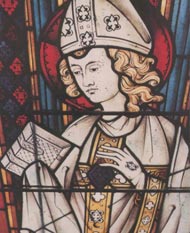 The Premonstratensian order was founded by St Norbert of Xanten
who was firstly a canon at Xanten Cathedral. Unhappy with the way of life of his fellow canons, he left the Rhine lands for the diocese
of Laon
, in the north of France
where the reforming Bishop Bartholomew was transforming his see into one that was more apostolic. Bartholomew persuaded Norbert to form a canonical order at Prémontré
, in Aisne
in 1120 and while the order was Augustinian in form, the canons wore the white habit and not the black. They followed an austere monastic life, but had a duty to preach and teach to those on the outside of the monastery walls. The order spread rapidly across Europe with the Abbot of Prémontré becoming Abbot-General for all of the daughter-houses. Even before the first Abbot-General Hugh of Fosse died, one hundred and twenty abbots attended the annual general chapter. The Premonstratensians took on many of the methods of the Cistercians including land management and the use of lay-brothers to undertake the labour intensive work of the communes.
with its royal patronage, Hugh de Morville, although a very wealthy noble, could not endow Dryburgh on the same scale as that of a monarch. However, it seems that King David I of Scotland
was not unsympathetic to the monastery; it is recorded in a charter that as well as confirming various donations from de Morville's wife, Beatrice de Beauchamp, the king allowed the abbey to take freely, timber from his forests for the building work. Hugh gave the lands of Dryburgh containing the forests, grasslands and accompanying waters; the fishings from Berwick; the churches with their lands at Mertoun and Channelkirk in his lordship of Lauderdale and Asby in Westmoreland; and the earnings from the mills of Saltoun and Lauder. Beatrice gave the income from the church at Bozeat
, Northamptonshire
to the abbey as well as lands at Roxburgh that she bought solely for the purpose of gifting.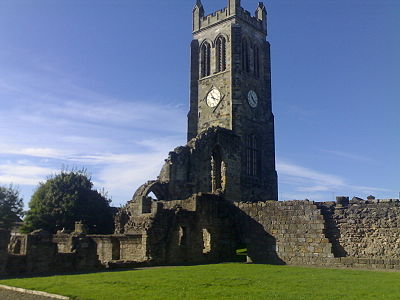 Hugh, in around 1162, like some other magnates of the period, turned his back on worldly affairs and entered the abbey-church, adopting the habit of the canons. He gave his elder son, Richard, his large Scottish estates while his younger son, Hugh, received those in England. Hugh, the senior, died at Dryburgh Abbey that same year.
Following Hugh's death, his son Richard carried on as patron to the abbey. However, in c. 1170 he founded the hospital of St Leonard near his castle at Lauder and then sometime between 1169 and 1187, the abbey of Kilwinning
in the lordship of Cunningham. Although Kilwinning Abbey
was built on a grand scale, it was inadequately provided for and so Richard ensured that some of the expense of its construction and upkeep was met from his holdings in Lauderdale; indeed a long running argument broke out between Kilwinning and Dryburgh over the former's share of the tythes from the church of Lauder. Richard de Morville's establishment of this second monastery ensured that both establishments would remain in a state of relative poverty.
, the earl of Ulster
installed a colony at Carrickfergus and a second at Drumcross but neither flourished in the longer term and this is put down more to the constant political convulsions throughout 13th century Ulster rather than any problems at the mother house.
, the abbey of Dryburgh commenced on a rebuilding programme on a grander scale, but building in stone against a background of an insecure income soon ensured that the construction work would not be completed quickly. Also at this time, the monastery became embroiled in a series of legal proceedings regarding land ownership and tythe revenues resulting, in April 1221, in the Pope's legate having to spend some time at Dryburgh to adjudicate. The construction effort was protracted and endured into the 1240s and with debts continuing to mount to the point that David de Bernham
, Bishop of St Andrews gave Abbott John permission on 21 April 1242 to appoint his canons as vicars to the supporting churches stating
Pope Innocent IV granted to the abbey in 1246, on the anniversary of its consecration, an indulgence lasting forty days intended to attract visitors who would hopefully be generous with their alms-giving. Additionally, he also provided a suspension of the requirements to create pensions and benefices that might deplete the abbey's revenues, and importantly, safeguarded the monastery, its property and the canons themselves against legal redress.
Abbott John was blamed for ineffectual financial management and was required to resign and, on 13 January 1255 Pope Alexander IV
wrote to the Bishop of St Andrews (position vacant at the time) and to Nicholas de Prenderlathe, abbot of Jedburgh
demanding that most of the abbey's income be diverted to paying off debts while only a basic level of income was to be retained for day to day expenses. Slow improvement in the abbeys finances took place over the next forty or so years in a period of relative stability. However this improvement was only relative; Dryburgh's neighbouring monasteries with their much more extensive grazing lands provided the main source of a much greater income.
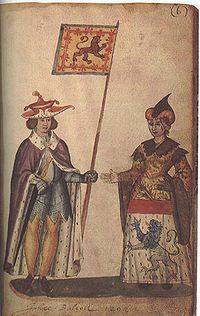 Hugh de Morville's line had died out in 1196 on the death of his grandson, William, and the estates passed to his sister, Helen, whose husband was Lochlann, Lord of Galloway
. The semi-independent Lords of Galloway
were much wealthier than those such as the de Morvilles but even they could not lavish large amounts on all of their dependencies. Lochlann was already benefactor to four religious houses in Galloway that included his own Cistercian establishment of Glenluce Abbey
as well as being associated with Holyrood Abbey
in Edinburgh
and the Cumbria
n abbey of Holmcultram
and the priory of St Bees.
Dryburgh being one of many establishments who sought the generosity of the Galloway lords got a further setback in 1234 when Alan, the last of the line of Galloway lords, died. His property was to be split between three daughters and their husbands. The lands previously held by the de Morvilles were divided again and in the 1250s were held by Helen of Galloway with her husband, Roger de Quincy, the Earl of Winchester, and Dervorguilla of Galloway
with her husband, John I de Balliol, Lord of Barnard Castle and Gainford. These new owners in Lauderdale diluted the available patronage yet again as they themselves had pre-existing commitments however the de Quincys did provide a fishing in Mertoun Loch, a burgage
at Haddington
and lands at Gledswood near Bemerside. Devorguilla's main concern however was her own foundation at Sweetheart Abbey, but she was at Dryburgh in 1281 to settle her lands in England on her son, John Balliol
, the future king. Balliol came to the throne of Scotland on St Andrews Day, 1292 but his reign was short and he abdicated in July 1296 following the defeats of the Scots at Berwick and Dunbar at the hands of King Edward I of England
. This heralded the end of a long period of stability in the borderlands.
, and so on 2 September Edward ordered that lands belonging to the abbey of Dryburgh be restored. From this point up to the year 1316, very few records of the abbey exist, however it is known that Sir Henry de Percy, one of the senior members of the English occupying force placed himself and his cortege at Dryburgh in 1310. Despite the abbey's affiliation with the Balliol family who remained resolutely at odds with the Bruce monarchy, the abbot and canons, before 21 October 1316, expelled two of their rank for refusing to acknowledge Robert as their king; a grateful King Edward II of England
rewarded them by providing them with the rent and fishery of the abbey at Berwick.
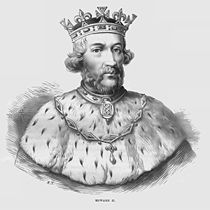
Evidence is lacking on Robert's participation as a patron of Dryburgh. He certainly used the abbey as a base in July 1316 while conducting raiding expeditions into Northumberland. In retaliation for Bruce's raids in July 1322, Edward II of England
took his army north in August only getting as far as Edinburgh. The English army retreated through Lauderdale and looted and burned both the abbeys of Melrose and Dryburgh. Melrose Abbey's reconstruction was generously provided for by Robert while Dryburgh's needs seem to have been ignored. It is unclear why Bruce chose to be so ungenerous towards the canons of Dryburgh; Melrose was gifted £2000 by Robert while Dryburgh received the confirmation of a pre-existing rent of 20 shillings per annum
Walter Stewart, 6th High Steward of Scotland
and Bruce's son-in-law was not unsympathetic to the abbey though and transferred to it his entitlements from Maxton church, and its lands and provided 4 acres (16,187.4 m²) of land belonging to himself. In 1326, Bishop John de Lindsay of Glasgow endorsed the abbey's possession of the church and allowed the canons to use its considerable income to help fund the rebuilding process. Bruce's brother-in -law, Sir Andrew Murray
a Guardian of Scotland during the exile of King David II
may also have given holdings in his Smailholm lands Added to these were gifts from lesser donors; people like Patrick de Dunbar, earl of Marsh who gave a handful of possessions while Sir William Abernethy gave lands in Saltoun and various other minor nobles added further packets of land. Robert the Bruce died in June 1329 and in August 1332 Edward Balliol
, son of the ousted King John, returned to Scotland with an army provided by the disinherited Scottish landowners and defeated the Scottish army at the Battle of Dupplin Moor
, near Perth
and had himself crowned king of Scots at Scone
. In December, Balliol was attacked at his castle at Annan in Galloway by John Randolph, 3rd Earl of Moray
and Sir Archibald Douglas and was forced to flee into England. With the support of King Edward III of England
, Balliol was restored to the Scottish crown but at the price of having to make Edward his overlord and ceding to him the sheriffdom
s of Berwick, Dumfries
, Edinburgh, Peebles
and Selkirk, including the forests of Ettrick
and Jedburgh
Dryburgh found itself once again under English domination. However, this did not adversely affect the abbey; Sir Wiliam de Felton, the new Sheriff of Roxburgh and Keeper of Roxburgh Castle
, bought and granted to the abbey a significant burgage in Roxburgh.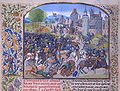 In 1334, Balliol was forced to Berwick for protection and the English were slowly finding their authority in the Lothians slipping away and only managed to hold power in the garrisoned centres and so in mid July 1335, Edward III marched his army to Glasgow where he met with Balliol and his army and together they advanced to Perth. In October, following his campaign, Edward moved to Dryburgh Abbey where he expected the Scots to present him with their terms of surrender but this did not happen. David II returned from France in 1342 and more of the lands held by Edward III were won back into Scottish control so that by 1346, the county of Roxburgh and the western parts of the county of Berwick were in the charge of the Bruce party. Patronage for the canons was once again provided by Scottish lords when it is recorded that Sir John Maxwell gave the income from the Pencaitland church, in East Lothian. The Scottish lordship changed again when David was captured at the Battle of Neville's Cross
and an English garrison took command at Roxburgh putting the central lands of Tweeddale and all of Teviotdale firmly back under the control of England and it was to remain so for over twenty years. On the 20 January 1356 Abbot Andrew of Dryburgh along with the Abbots of Melrose, Jedburgh and Kelso witnessed Edward Balliols resignation. With the English victory over the French in September 1356, Scotland lost its continental ally and forced her back to the negotiating table for the release of David II from hostage. The treaty for the Scottish king's release was agreed on 3 October 1357 and four days later David was back in Scotland; under the terms of the treaty, 100,000 merks were to be paid to England over 10 years and England would retain its occupied lands until the ransom was paid in full.
to launch his army on a hugely damaging incursion through the Borders to Edinburgh which he burned. On the way he ordered the sacking of Dryburgh, Melrose and Newbattle. It was while Richard was in Newbattle Wood in August 1385 that he took reprisals against all those in Teviotdale who had returned to the Scottish cause.
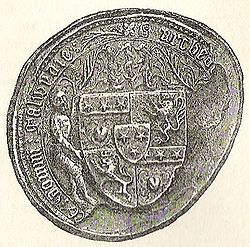 The damage caused to Dryburgh was great and influential nobles seemed to have played a significant part in its restoration—in the closing years of the 1380s it seems that Robert Stewart, Earl of Fife, Archibald Douglas, 3rd Earl of Douglas and Walter Trail
, Bishop of St Andrews all had roles in assisting the abbey to extricate itself from this disaster. King Robert III, in a charter dated 9 March 1391, granted to the canons all of the very substantial income-rich possessions of the Cistercian nuns
of Southberwick which had been destroyed by Edward II in 1385. The family of the Black Douglases continued with their support and in around 1420 Archibald, fourth earl of Douglas gave Dryburgh the income from the possessions of Smailholme parish church. The fifth earl
continued the grant of Smailholm
and went further in 1429 by asking the pope to formally confirm this together with the inclusion of the hospitals of St Leonards of Lauder and Smailholme. In 1443, the canons suffered once again when fire destroyed the abbey, evidently by accident yet eighteen years later in 1461, the abbey is recorded as requesting protection from Pope Pius II
inferring that the canons were finding it difficult to finance the repairs.
. The election of Walter Dewer as abbot in 1461 was seemingly the last prelate to be elected by the canons, but it was under his abbacy that alienation of the monastery lands began. The rest of the 15th century was characterised by contests for the abbacy from either indigenous canons and from outside, expulsions, papal refusals or royal intervention.
rewarded clerics who gave him good service by providing them with commendatorships. The first commendator of Dryburgh Abbey was Andrew Forman
, the Bishop of Moray
in 1509. Forman’s primary role was in the service of James IV as a diplomat and was employed by the king extensively in Europe but accumulated much wealth from his religious and other appointments. He received the commendatorships of the abbey of Culross in 1492 although he stepped down the following year after being provided with a large pension from the abbey. In June 1497 he was prior of Pittenweem, received the rectory of Cottingham from King Henry VII of England
in May 1501, was commendator of Kelso (although he was unable to firmly establish his provision), as well as the Keeper of Darnaway Castle, Chamberlain of Moray and Custumar North of the Spey in 1511.
Forman gave up his rights to Dryburgh sometime after becoming Archbishop of St Andrews
and was succeeded by James Ogilvie
, another secular cleric and diplomat who received the temporalities of the abbey in August 1516. He held the commendatorship for only a short time, dying in 1518.
David Hamilton, Bishop of Argyll
, and the younger brother of James, Lord Hamilton, Earl of Arran
, was the next to be proposed to the Abbey by John Stewart, Duke of Albany
and became commendator in May 1519. He died in 1523.
The next to be provided to the abbey was James Stewart, a canon from Glasgow cathedral. Although named in a letter from Albany to Cardinal Accolti, Cardinal Protector for Scotland in Rome
, Albany actually gave the commendatorship to the Earl of Lennox
who in turn sold or gifted his right to it to Stewart who then borrowed from money lenders in Paris to purchase the confirming papal bulls. Stewart received the temporalities of the abbey on 6 October 1526 until his death 1539.
Pope Paul III
received King James V
’s recommendation of Thomas Erskine as the next commendator in November 1539 but was not confirmed until April 1541 due to a contesting provision. In 1541, hostilities between Scotland and England resumed but Dryburgh remained untouched until 7 November 1544 when Edward Seymour
, earl of Hertford, burned the town of Dryburgh and its abbey. He returned in 1545 and again set fire to the abbey. Erskine was captured at Dover when the Scottish warship he was aboard foundered while on route to France prompting Marie de Guise
, widow of James V, to call for his release. Erskine was ransomed for £500 and Dryburgh would have been expected to provide amply to the settlement and it may have been the need to obtain funds that, in July 1548, he resigned his commendatorship to his brother John.
Like most of his commendatory forebears, John Erskine
took very little interest in the spiritual side of the abbey but was an important personage in the politics of Scotland during the reigns of James V, Mary, Queen of Scots, and James VI. John was commendator until 1556 when he stepped down in favour of his nephew, David Erskine.
David Erskine received the bulls confirming his office in July 1556 and set about quickly alienating the possessions of the abbey by granting lands to important local families. Erskine took part in the kidnapping of James VI known as the Raid of Ruthven
but when the king escaped from his imprisonment in Ruthven castle, he and his accomplices fled to England. Erskine’s was deprived of his lands and the commendatorship of Dryburgh Abbey was given to William Stewart
William Stewart held the commendatorship for just over a year when in 1585 David Erskine found favour once more with James VI and all of his possessions and appellations were reinstated.
In June 1600, Erskine wrote to a relative saying that all the canons had now died and marked the ending of the monastery. In 1604, the remaining possessions of the abbey were integrated into the Lordship of Cardross of John Erskine, 2nd Earl of Mar. Henry Erskine, Mar’s son received the titular title of commendator of Dryburgh Abbey.
Dryburgh
Dryburgh is a village in the Scottish Borders region of Scotland, famous for the ruined Dryburgh Abbey.-The Temple of the Muses:This circular nine columned gazebo stands since 1817 on Bass Hill, a mound overlooking the River Tweed at the west end of the village...
on the banks of the River Tweed
River Tweed
The River Tweed, or Tweed Water, is long and flows primarily through the Borders region of Great Britain. It rises on Tweedsmuir at Tweed's Well near where the Clyde, draining northwest, and the Annan draining south also rise. "Annan, Tweed and Clyde rise oot the ae hillside" as the Border saying...
in the Scottish
Scotland
Scotland is a country that is part of the United Kingdom. Occupying the northern third of the island of Great Britain, it shares a border with England to the south and is bounded by the North Sea to the east, the Atlantic Ocean to the north and west, and the North Channel and Irish Sea to the...
Borders
Scottish Borders
The Scottish Borders is one of 32 local government council areas of Scotland. It is bordered by Dumfries and Galloway in the west, South Lanarkshire and West Lothian in the north west, City of Edinburgh, East Lothian, Midlothian to the north; and the non-metropolitan counties of Northumberland...
, was nominally founded on 10 November (Martinmas) 1150 in an agreement between Hugh de Morville, Lord of Lauderdale
Hugh de Morville, Lord of Cunningham and Lauderdale
Hugh de Morville was a Norman knight who made his fortune in the service of David fitz Malcolm, Prince of the Cumbrians and King of Scots .His parentage is said by some to be unclear, but G. W. S...
and Constable of Scotland, and the Premonstratensian
Premonstratensian
The Order of Canons Regular of Prémontré, also known as the Premonstratensians, the Norbertines, or in Britain and Ireland as the White Canons , are a Catholic religious order of canons regular founded at Prémontré near Laon in 1120 by Saint Norbert, who later became Archbishop of Magdeburg...
canons regular
Canons Regular
Canons Regular are members of certain bodies of Canons living in community under the Augustinian Rule , and sharing their property in common...
from Alnwick Abbey
Alnwick Abbey
Alnwick Abbey was founded as a Premonstratensian monastery in 1147 by Eustace fitz John near Alnwick, England, as a daughter house of Newhouse Abbey in Lincolnshire. It was dissolved in 1535, refounded in 1536 and finally suppressed in 1539. It was granted to the Sadler and Winnington...
in Northumberland
Northumberland
Northumberland is the northernmost ceremonial county and a unitary district in North East England. For Eurostat purposes Northumberland is a NUTS 3 region and is one of three boroughs or unitary districts that comprise the "Northumberland and Tyne and Wear" NUTS 2 region...
. The arrival of the canons along with their first abbot, Roger, took place on 13 December 1152.
It was burned by English
England
England is a country that is part of the United Kingdom. It shares land borders with Scotland to the north and Wales to the west; the Irish Sea is to the north west, the Celtic Sea to the south west, with the North Sea to the east and the English Channel to the south separating it from continental...
troops in 1322, after which it was restored only to be again burned by Richard II in 1385, but it flourished in the fifteenth century. It was finally destroyed in 1544, briefly to survive until the Scottish Reformation
Scottish Reformation
The Scottish Reformation was Scotland's formal break with the Papacy in 1560, and the events surrounding this. It was part of the wider European Protestant Reformation; and in Scotland's case culminated ecclesiastically in the re-establishment of the church along Reformed lines, and politically in...
, when it was given to the Earl of Mar
Earl of Mar
The Mormaer or Earl of Mar is a title that has been created seven times, all in the Peerage of Scotland. The first creation of the earldom was originally the provincial ruler of the province of Mar in north-eastern Scotland...
by James VI of Scotland.
The 12th Earl of Buchan
Earl of Buchan
The Mormaer or Earl of Buchan was originally the provincial ruler of the medieval province of Buchan. Buchan was the first Mormaerdom in the High Medieval Kingdom of the Scots to pass into the hands of a non-Scottish family in the male line. The earldom had three lines in its history, not counting...
bought the land in 1786. Sir Walter Scott
Walter Scott
Sir Walter Scott, 1st Baronet was a Scottish historical novelist, playwright, and poet, popular throughout much of the world during his time....
and Douglas Haig
Douglas Haig, 1st Earl Haig
Field Marshal Douglas Haig, 1st Earl Haig, KT, GCB, OM, GCVO, KCIE, ADC, was a British senior officer during World War I. He commanded the British Expeditionary Force from 1915 to the end of the War...
are buried in its grounds.
The Premonstratensian order
Xanten
Xanten is a historic town in the North Rhine-Westphalia state of Germany, located in the district of Wesel.Xanten is known for the Archaeological Park or archaeological open air museum , its medieval picturesque city centre with Xanten Cathedral and many museums, its large man-made lake for...
who was firstly a canon at Xanten Cathedral. Unhappy with the way of life of his fellow canons, he left the Rhine lands for the diocese
Diocese
A diocese is the district or see under the supervision of a bishop. It is divided into parishes.An archdiocese is more significant than a diocese. An archdiocese is presided over by an archbishop whose see may have or had importance due to size or historical significance...
of Laon
Laon
Laon is the capital city of the Aisne department in Picardy in northern France.-History:The hilly district of Laon, which rises a hundred metres above the otherwise flat Picardy plain, has always held strategic importance...
, in the north of France
France
The French Republic , The French Republic , The French Republic , (commonly known as France , is a unitary semi-presidential republic in Western Europe with several overseas territories and islands located on other continents and in the Indian, Pacific, and Atlantic oceans. Metropolitan France...
where the reforming Bishop Bartholomew was transforming his see into one that was more apostolic. Bartholomew persuaded Norbert to form a canonical order at Prémontré
Prémontré
Prémontré is a commune in the Aisne department in Picardy in northern France.-Population:-Sights:The remains of Prémontré Abbey, the mother house of the Premonstratensian Order, are located in Prémontré.-References:*...
, in Aisne
Aisne
Aisne is a department in the northern part of France named after the Aisne River.- History :Aisne is one of the original 83 departments created during the French Revolution on 4 March 1790. It was created from parts of the former provinces of Île-de-France, Picardie, and Champagne.Most of the old...
in 1120 and while the order was Augustinian in form, the canons wore the white habit and not the black. They followed an austere monastic life, but had a duty to preach and teach to those on the outside of the monastery walls. The order spread rapidly across Europe with the Abbot of Prémontré becoming Abbot-General for all of the daughter-houses. Even before the first Abbot-General Hugh of Fosse died, one hundred and twenty abbots attended the annual general chapter. The Premonstratensians took on many of the methods of the Cistercians including land management and the use of lay-brothers to undertake the labour intensive work of the communes.
Abbey endowments
Unlike the situation at nearby Melrose AbbeyMelrose Abbey
Melrose Abbey is a Gothic-style abbey in Melrose, Scotland. It was founded in 1136 by Cistercian monks, on the request of King David I of Scotland. It was headed by the Abbot or Commendator of Melrose. Today the abbey is maintained by Historic Scotland...
with its royal patronage, Hugh de Morville, although a very wealthy noble, could not endow Dryburgh on the same scale as that of a monarch. However, it seems that King David I of Scotland
David I of Scotland
David I or Dabíd mac Maíl Choluim was a 12th-century ruler who was Prince of the Cumbrians and later King of the Scots...
was not unsympathetic to the monastery; it is recorded in a charter that as well as confirming various donations from de Morville's wife, Beatrice de Beauchamp, the king allowed the abbey to take freely, timber from his forests for the building work. Hugh gave the lands of Dryburgh containing the forests, grasslands and accompanying waters; the fishings from Berwick; the churches with their lands at Mertoun and Channelkirk in his lordship of Lauderdale and Asby in Westmoreland; and the earnings from the mills of Saltoun and Lauder. Beatrice gave the income from the church at Bozeat
Bozeat
Bozeat is a village and civil parish in the Wellingborough borough of Northamptonshire, England, about south of Wellingborough on the A509 road, near Wollaston...
, Northamptonshire
Northamptonshire
Northamptonshire is a landlocked county in the English East Midlands, with a population of 629,676 as at the 2001 census. It has boundaries with the ceremonial counties of Warwickshire to the west, Leicestershire and Rutland to the north, Cambridgeshire to the east, Bedfordshire to the south-east,...
to the abbey as well as lands at Roxburgh that she bought solely for the purpose of gifting.
Following Hugh's death, his son Richard carried on as patron to the abbey. However, in c. 1170 he founded the hospital of St Leonard near his castle at Lauder and then sometime between 1169 and 1187, the abbey of Kilwinning
Kilwinning
Kilwinning is a historic town in North Ayrshire, Scotland. It is known as The Crossroads of Ayrshire. The 2001 Census recorded it as having a population of 15,908.-History:...
in the lordship of Cunningham. Although Kilwinning Abbey
Kilwinning Abbey
Kilwinning Abbey is a ruined abbey located in the centre of the town of Kilwinning, North Ayrshire.-The establishment of the Abbey:The ancient name of the town is 'Segdoune' or 'Saigtown', probably derived from 'Sanctoun', meaning the 'town of the saint'. Saint Winnings festival was on 21 January...
was built on a grand scale, it was inadequately provided for and so Richard ensured that some of the expense of its construction and upkeep was met from his holdings in Lauderdale; indeed a long running argument broke out between Kilwinning and Dryburgh over the former's share of the tythes from the church of Lauder. Richard de Morville's establishment of this second monastery ensured that both establishments would remain in a state of relative poverty.
Daughter houses
Dryburgh Abbey, despite this underfunding, managed to attract a continuous flow of novices to bolster the numbers of canons, so much so that by closing years of the 12th century the abbey was overcrowded necessitating the establishment of colonies. John de CourcyJohn de Courcy
John de Courcy was a Anglo-Norman knight who arrived in Ireland in 1176. From then until his expulsion in 1204, he conquered a considerable territory, endowed religious establishments, built abbeys for both the Benedictines and the Cistercians and built strongholds at Dundrum Castle in County...
, the earl of Ulster
Ulster
Ulster is one of the four provinces of Ireland, located in the north of the island. In ancient Ireland, it was one of the fifths ruled by a "king of over-kings" . Following the Norman invasion of Ireland, the ancient kingdoms were shired into a number of counties for administrative and judicial...
installed a colony at Carrickfergus and a second at Drumcross but neither flourished in the longer term and this is put down more to the constant political convulsions throughout 13th century Ulster rather than any problems at the mother house.
Mounting debt
At the beginning of the 13th century, like its near neighbour Melrose AbbeyMelrose Abbey
Melrose Abbey is a Gothic-style abbey in Melrose, Scotland. It was founded in 1136 by Cistercian monks, on the request of King David I of Scotland. It was headed by the Abbot or Commendator of Melrose. Today the abbey is maintained by Historic Scotland...
, the abbey of Dryburgh commenced on a rebuilding programme on a grander scale, but building in stone against a background of an insecure income soon ensured that the construction work would not be completed quickly. Also at this time, the monastery became embroiled in a series of legal proceedings regarding land ownership and tythe revenues resulting, in April 1221, in the Pope's legate having to spend some time at Dryburgh to adjudicate. The construction effort was protracted and endured into the 1240s and with debts continuing to mount to the point that David de Bernham
David de Bernham
David de Bernham was Chamberlain of King Alexander II of Scotland and subsequently, Bishop of St. Andrews. He was elected to the see in June 1239, and finally consecrated, after some difficulties, in January, 1240. He died in 1253, and was buried at Nenthorn, near Kelso.-References:*Dowden, John,...
, Bishop of St Andrews gave Abbott John permission on 21 April 1242 to appoint his canons as vicars to the supporting churches stating
… since they have been burdened by grinding debts both on account of construction of the monastery and also on account of other and various necessities.
Pope Innocent IV granted to the abbey in 1246, on the anniversary of its consecration, an indulgence lasting forty days intended to attract visitors who would hopefully be generous with their alms-giving. Additionally, he also provided a suspension of the requirements to create pensions and benefices that might deplete the abbey's revenues, and importantly, safeguarded the monastery, its property and the canons themselves against legal redress.
Abbott John was blamed for ineffectual financial management and was required to resign and, on 13 January 1255 Pope Alexander IV
Pope Alexander IV
Pope Alexander IV was Pope from 1254 until his death.Born as Rinaldo di Jenne, in Jenne , he was, on his mother's side, a member of the de' Conti di Segni family, the counts of Segni, like Pope Innocent III and Pope Gregory IX...
wrote to the Bishop of St Andrews (position vacant at the time) and to Nicholas de Prenderlathe, abbot of Jedburgh
Abbot of Jedburgh
The Abbot of Jedburgh was the head of the Augustinian canons of Jedburgh Abbey, Roxburghshire. It was founded by King David I of Scotland in 1138, and David's grandson and successor Máel Coluim IV ensured its promotion to the status of abbey before 1156...
demanding that most of the abbey's income be diverted to paying off debts while only a basic level of income was to be retained for day to day expenses. Slow improvement in the abbeys finances took place over the next forty or so years in a period of relative stability. However this improvement was only relative; Dryburgh's neighbouring monasteries with their much more extensive grazing lands provided the main source of a much greater income.
Changing patronage
Lochlann, Lord of Galloway
Lochlann , also known by his French name Roland, was the son and successor of Uchtred, Lord of Galloway as the "Lord" or "sub-king" of eastern Galloway....
. The semi-independent Lords of Galloway
Lords of Galloway
The Lords, or Kings of Galloway ruled over Galloway, in south west Scotland, for a large part of the High Middle Ages.Many regions of Scotland, including Galloway and Moray, periodically had kings or subkings, similar to those in Ireland during the Middle Ages. The Scottish monarch was seen as...
were much wealthier than those such as the de Morvilles but even they could not lavish large amounts on all of their dependencies. Lochlann was already benefactor to four religious houses in Galloway that included his own Cistercian establishment of Glenluce Abbey
Glenluce Abbey
Glenluce Abbey, near to Glenluce, Scotland, was a Cistercian monastery called also Abbey of Luce or Vallis Lucis and founded around 1190 by Rolland or Lochlann, Lord of Galloway and Constable of Scotland...
as well as being associated with Holyrood Abbey
Holyrood Abbey
Holyrood Abbey is a ruined abbey of the Canons Regular in Edinburgh, Scotland. The abbey was founded in 1128 by King David I of Scotland. During the 15th century, the abbey guesthouse was developed into a royal residence, and after the Scottish Reformation the Palace of Holyroodhouse was expanded...
in Edinburgh
Edinburgh
Edinburgh is the capital city of Scotland, the second largest city in Scotland, and the eighth most populous in the United Kingdom. The City of Edinburgh Council governs one of Scotland's 32 local government council areas. The council area includes urban Edinburgh and a rural area...
and the Cumbria
Cumbria
Cumbria , is a non-metropolitan county in North West England. The county and Cumbria County Council, its local authority, came into existence in 1974 after the passage of the Local Government Act 1972. Cumbria's largest settlement and county town is Carlisle. It consists of six districts, and in...
n abbey of Holmcultram
Holmcultram Abbey
Holmcultram Abbey was a Cistercian monastery founded in 1150 in what is now the village of Abbeytown in Cumbria in England but at the time of foundation was in territory in the possession of David I of Scotland, who together with his son, Henry, founded it in 1150...
and the priory of St Bees.
Dryburgh being one of many establishments who sought the generosity of the Galloway lords got a further setback in 1234 when Alan, the last of the line of Galloway lords, died. His property was to be split between three daughters and their husbands. The lands previously held by the de Morvilles were divided again and in the 1250s were held by Helen of Galloway with her husband, Roger de Quincy, the Earl of Winchester, and Dervorguilla of Galloway
Dervorguilla of Galloway
Dervorguilla of Galloway was a 'lady of substance' during the 13th century, wife from 1223 of John, 5th Baron de Balliol, and mother of the future king John I of Scotland. The name Dervorguilla or Devorgilla was a Latinization of the Gaelic Dearbhfhorghaill...
with her husband, John I de Balliol, Lord of Barnard Castle and Gainford. These new owners in Lauderdale diluted the available patronage yet again as they themselves had pre-existing commitments however the de Quincys did provide a fishing in Mertoun Loch, a burgage
Burgage
Burgage is a medieval land term used in England and Scotland, well established by the 13th century. A burgage was a town rental property , owned by a king or lord. The property usually, and distinctly, consisted of a house on a long and narrow plot of land, with the narrow end facing the street...
at Haddington
Haddington, East Lothian
The Royal Burgh of Haddington is a town in East Lothian, Scotland. It is the main administrative, cultural and geographical centre for East Lothian, which was known officially as Haddingtonshire before 1921. It lies about east of Edinburgh. The name Haddington is Anglo-Saxon, dating from the 6th...
and lands at Gledswood near Bemerside. Devorguilla's main concern however was her own foundation at Sweetheart Abbey, but she was at Dryburgh in 1281 to settle her lands in England on her son, John Balliol
John of Scotland
John Balliol , known to the Scots as Toom Tabard , was King of Scots from 1292 to 1296.-Early life:Little of John's early life is known. He was born between 1248 and 1250 at an unknown location, possibilities include Galloway, Picardy and Barnard Castle, County Durham...
, the future king. Balliol came to the throne of Scotland on St Andrews Day, 1292 but his reign was short and he abdicated in July 1296 following the defeats of the Scots at Berwick and Dunbar at the hands of King Edward I of England
Edward I of England
Edward I , also known as Edward Longshanks and the Hammer of the Scots, was King of England from 1272 to 1307. The first son of Henry III, Edward was involved early in the political intrigues of his father's reign, which included an outright rebellion by the English barons...
. This heralded the end of a long period of stability in the borderlands.
Wars of Scottish Independence
The abbotts of Dryburgh, Jedburgh, Melrose and Kelso all submitted to Edward I on 28 August 1296 at an event later to be described as the Ragman RollsRagman Rolls
Ragman Rolls refers to the collection of instruments by which the nobility and gentry of Scotland subscribed allegiance to King Edward I of England, during the time between the Conference of Norham in May 1291 and the final award in favor of Baliol in November 1292; and again in 1296...
, and so on 2 September Edward ordered that lands belonging to the abbey of Dryburgh be restored. From this point up to the year 1316, very few records of the abbey exist, however it is known that Sir Henry de Percy, one of the senior members of the English occupying force placed himself and his cortege at Dryburgh in 1310. Despite the abbey's affiliation with the Balliol family who remained resolutely at odds with the Bruce monarchy, the abbot and canons, before 21 October 1316, expelled two of their rank for refusing to acknowledge Robert as their king; a grateful King Edward II of England
Edward II of England
Edward II , called Edward of Caernarfon, was King of England from 1307 until he was deposed by his wife Isabella in January 1327. He was the sixth Plantagenet king, in a line that began with the reign of Henry II...
rewarded them by providing them with the rent and fishery of the abbey at Berwick.
Evidence is lacking on Robert's participation as a patron of Dryburgh. He certainly used the abbey as a base in July 1316 while conducting raiding expeditions into Northumberland. In retaliation for Bruce's raids in July 1322, Edward II of England
Edward II of England
Edward II , called Edward of Caernarfon, was King of England from 1307 until he was deposed by his wife Isabella in January 1327. He was the sixth Plantagenet king, in a line that began with the reign of Henry II...
took his army north in August only getting as far as Edinburgh. The English army retreated through Lauderdale and looted and burned both the abbeys of Melrose and Dryburgh. Melrose Abbey's reconstruction was generously provided for by Robert while Dryburgh's needs seem to have been ignored. It is unclear why Bruce chose to be so ungenerous towards the canons of Dryburgh; Melrose was gifted £2000 by Robert while Dryburgh received the confirmation of a pre-existing rent of 20 shillings per annum
Walter Stewart, 6th High Steward of Scotland
Walter Stewart, 6th High Steward of Scotland
Walter Stewart was the 6th hereditary High Steward of Scotland. He was also the father of King Robert II of Scotland.-Biography:...
and Bruce's son-in-law was not unsympathetic to the abbey though and transferred to it his entitlements from Maxton church, and its lands and provided 4 acres (16,187.4 m²) of land belonging to himself. In 1326, Bishop John de Lindsay of Glasgow endorsed the abbey's possession of the church and allowed the canons to use its considerable income to help fund the rebuilding process. Bruce's brother-in -law, Sir Andrew Murray
Sir Andrew Murray
Sir Andrew Murray , also known as Sir Andrew Moray or Sir Andrew Murray of Bothwell, was a Scottish military leader who commanded resistance forces loyal to David II of Scotland against Edward Balliol and Edward III of England during the Second War of Scottish Independence...
a Guardian of Scotland during the exile of King David II
David II of Scotland
David II was King of Scots from 7 June 1329 until his death.-Early life:...
may also have given holdings in his Smailholm lands Added to these were gifts from lesser donors; people like Patrick de Dunbar, earl of Marsh who gave a handful of possessions while Sir William Abernethy gave lands in Saltoun and various other minor nobles added further packets of land. Robert the Bruce died in June 1329 and in August 1332 Edward Balliol
Edward Balliol
Edward Balliol was a claimant to the Scottish throne . With English help, he briefly ruled the country from 1332 to 1336.-Life:...
, son of the ousted King John, returned to Scotland with an army provided by the disinherited Scottish landowners and defeated the Scottish army at the Battle of Dupplin Moor
Battle of Dupplin Moor
The Battle of Dupplin Moor was fought between supporters of the infant David II, the son of Robert the Bruce, and rebels supporting the Balliol claim in 1332. It was a significant battle of the Second War of Scottish Independence.-Background:...
, near Perth
Perth, Scotland
Perth is a town and former city and royal burgh in central Scotland. Located on the banks of the River Tay, it is the administrative centre of Perth and Kinross council area and the historic county town of Perthshire...
and had himself crowned king of Scots at Scone
Scone, Scotland
Scone is a village in Perth and Kinross, Scotland. The medieval village of Scone, which grew up around the monastery and royal residence, was abandoned in the early 19th century when the residents were removed and a new palace was built on the site by the Earl of Mansfield...
. In December, Balliol was attacked at his castle at Annan in Galloway by John Randolph, 3rd Earl of Moray
John Randolph, 3rd Earl of Moray
John Randolph, 3rd Earl of Moray was an important figure in the reign of David II of Scotland, and was for a time joint Regent of Scotland.-Family:...
and Sir Archibald Douglas and was forced to flee into England. With the support of King Edward III of England
Edward III of England
Edward III was King of England from 1327 until his death and is noted for his military success. Restoring royal authority after the disastrous reign of his father, Edward II, Edward III went on to transform the Kingdom of England into one of the most formidable military powers in Europe...
, Balliol was restored to the Scottish crown but at the price of having to make Edward his overlord and ceding to him the sheriffdom
Sheriffdom
A sheriffdom is a judicial district in Scotland.Since 1 January 1975 there have been six sheriffdoms. Previously sheriffdoms were composed of groupings of counties...
s of Berwick, Dumfries
Dumfries
Dumfries is a market town and former royal burgh within the Dumfries and Galloway council area of Scotland. It is near the mouth of the River Nith into the Solway Firth. Dumfries was the county town of the former county of Dumfriesshire. Dumfries is nicknamed Queen of the South...
, Edinburgh, Peebles
Peebles
Peebles is a burgh in the committee area of Tweeddale, in the Scottish Borders, lying on the River Tweed. According to the 2001 Census, the population was 8,159.-History:...
and Selkirk, including the forests of Ettrick
Ettrick, Scotland
Ettrick is a small village and civil parish in the Scottish Borders area of Scotland, located around south-west of the town of Selkirk.-Local area:...
and Jedburgh
Jedburgh
Jedburgh is a town and former royal burgh in the Scottish Borders and historically in Roxburghshire.-Location:Jedburgh lies on the Jed Water, a tributary of the River Teviot, it is only ten miles from the border with England and is dominated by the substantial ruins of Jedburgh Abbey...
Dryburgh found itself once again under English domination. However, this did not adversely affect the abbey; Sir Wiliam de Felton, the new Sheriff of Roxburgh and Keeper of Roxburgh Castle
Roxburgh Castle
Roxburgh Castle was a castle sited near Kelso, in the Borders region of Scotland, in the former Roxburghshire.-History:The castle was founded by King David I. In 1174 it was surrendered to England after the capture of William I at Alnwick, and was often in English hands thereafter. The Scots made...
, bought and granted to the abbey a significant burgage in Roxburgh.
Battle of Neville's Cross
The Battle of Neville's Cross took place to the west of Durham, England on 17 October 1346.-Background:In 1346, England was embroiled in the Hundred Years' War with France. In order to divert his enemy Philip VI of France appealed to David II of Scotland to attack the English from the north in...
and an English garrison took command at Roxburgh putting the central lands of Tweeddale and all of Teviotdale firmly back under the control of England and it was to remain so for over twenty years. On the 20 January 1356 Abbot Andrew of Dryburgh along with the Abbots of Melrose, Jedburgh and Kelso witnessed Edward Balliols resignation. With the English victory over the French in September 1356, Scotland lost its continental ally and forced her back to the negotiating table for the release of David II from hostage. The treaty for the Scottish king's release was agreed on 3 October 1357 and four days later David was back in Scotland; under the terms of the treaty, 100,000 merks were to be paid to England over 10 years and England would retain its occupied lands until the ransom was paid in full.
Borderland partition
David II's liberation from hostage in 1357 did not come without conditions, one of which was that Edward would hold on to the lands in the southeast of the country; this ensured that Dryburgh and the other border abbeys stayed in English held territory. David allowed the abbeys to keep their Scottish possessions and did not interfere with the canons and monks from receiving the income from those. Dryburgh's records had all been lost at this time and it is only from what is known at Melrose that Dryburgh's position can be traced. The wool export trade and the resultant customs duty was important to David and so the Border abbeys who produced large amounts of wool were encouraged to use the Scottish ports and at the expense of Edward's Berwick. The 1360s and 1370s saw the English hold over the Border areas diminish until it was basically the castles at Berwick, Jedburgh and Roxburgh with the county of Berwick and the eastern part of the county of Roxburgh still in their grip. Pressure on these bastions intensified during 1384 and 1385 and Scottish raiding parties moved deep into England forcing Richard IIRichard II of England
Richard II was King of England, a member of the House of Plantagenet and the last of its main-line kings. He ruled from 1377 until he was deposed in 1399. Richard was a son of Edward, the Black Prince, and was born during the reign of his grandfather, Edward III...
to launch his army on a hugely damaging incursion through the Borders to Edinburgh which he burned. On the way he ordered the sacking of Dryburgh, Melrose and Newbattle. It was while Richard was in Newbattle Wood in August 1385 that he took reprisals against all those in Teviotdale who had returned to the Scottish cause.
Turning point
Walter Trail
Walter Trail was a late 14th century Bishop of St. Andrews. He appears as an official in the Bishopric of Glasgow in 1378, as a Magister Artium and a Licentiate in Canon and civil law. In 1380, he is a doctor in Canon and Civil Law, as well as a Papal chaplain and auditor. In this year, Pope...
, Bishop of St Andrews all had roles in assisting the abbey to extricate itself from this disaster. King Robert III, in a charter dated 9 March 1391, granted to the canons all of the very substantial income-rich possessions of the Cistercian nuns
Cistercian nuns
Cistercian nuns are female members of the Cistercian Order, a religious order belonging to the Roman Catholic branch of the Catholic Church.-History:...
of Southberwick which had been destroyed by Edward II in 1385. The family of the Black Douglases continued with their support and in around 1420 Archibald, fourth earl of Douglas gave Dryburgh the income from the possessions of Smailholme parish church. The fifth earl
Archibald Douglas, 5th Earl of Douglas
Archibald Douglas was a Scottish nobleman and General, son of Archibald Douglas, 4th Earl of Douglas and Margaret Stewart, eldest daughter of Robert III...
continued the grant of Smailholm
Smailholm, Scottish Borders
Smailholm is a small village in the old county of Roxburghshire in south-east Scotland. It is situated at and straddles the B6397 Gordon to Kelso road. The village is almost equidistant from both, standing 6 miles NW of the abbey town of Kelso...
and went further in 1429 by asking the pope to formally confirm this together with the inclusion of the hospitals of St Leonards of Lauder and Smailholme. In 1443, the canons suffered once again when fire destroyed the abbey, evidently by accident yet eighteen years later in 1461, the abbey is recorded as requesting protection from Pope Pius II
Pope Pius II
Pope Pius II, born Enea Silvio Piccolomini was Pope from August 19, 1458 until his death in 1464. Pius II was born at Corsignano in the Sienese territory of a noble but decayed family...
inferring that the canons were finding it difficult to finance the repairs.
The final century
The abbey lost the patronage of Robert Stewart, Duke of Albany on his death in 1420, and in 1455 with the forfeiture of the lands of the Black Douglases, they lost a major benefactor and protector in James Douglas, 9th Earl of DouglasJames Douglas, 9th Earl of Douglas
James Douglas, 9th Earl of Douglas, 3rd Earl of Avondale KG was a Scottish nobleman, last of the 'Black' earls of Douglas. He was a twin, the older by a few minutes, the younger was Archibald Douglas, Earl of Moray....
. The election of Walter Dewer as abbot in 1461 was seemingly the last prelate to be elected by the canons, but it was under his abbacy that alienation of the monastery lands began. The rest of the 15th century was characterised by contests for the abbacy from either indigenous canons and from outside, expulsions, papal refusals or royal intervention.
Commendators
King James IVJames IV of Scotland
James IV was King of Scots from 11 June 1488 to his death. He is generally regarded as the most successful of the Stewart monarchs of Scotland, but his reign ended with the disastrous defeat at the Battle of Flodden Field, where he became the last monarch from not only Scotland, but also from all...
rewarded clerics who gave him good service by providing them with commendatorships. The first commendator of Dryburgh Abbey was Andrew Forman
Andrew Forman
Andrew Forman was a Scottish diplomat and prelate who became Bishop of Moray in 1501, Archbishop of Bourges in France, in 1513, Archbishop of St Andrews in 1514 as well as the headship of several monasteries....
, the Bishop of Moray
Bishop of Moray
The Bishop of Moray or Bishop of Elgin was the ecclesiastical head of the Diocese of Moray in northern Scotland, one of Scotland's 13 medieval bishoprics...
in 1509. Forman’s primary role was in the service of James IV as a diplomat and was employed by the king extensively in Europe but accumulated much wealth from his religious and other appointments. He received the commendatorships of the abbey of Culross in 1492 although he stepped down the following year after being provided with a large pension from the abbey. In June 1497 he was prior of Pittenweem, received the rectory of Cottingham from King Henry VII of England
Henry VII of England
Henry VII was King of England and Lord of Ireland from his seizing the crown on 22 August 1485 until his death on 21 April 1509, as the first monarch of the House of Tudor....
in May 1501, was commendator of Kelso (although he was unable to firmly establish his provision), as well as the Keeper of Darnaway Castle, Chamberlain of Moray and Custumar North of the Spey in 1511.
Forman gave up his rights to Dryburgh sometime after becoming Archbishop of St Andrews
Archbishop of St Andrews
The Bishop of St. Andrews was the ecclesiastical head of the Diocese of St Andrews and then, as Archbishop of St Andrews , the Archdiocese of St Andrews.The name St Andrews is not the town or church's original name...
and was succeeded by James Ogilvie
James Ogilvie
James Ogilvie [Ogilvy] was a late medieval Scottish prelate. After the death of William Elphinstone , the bishopric of Aberdeen became vacant. Ogilvy was nominated for the vacancy by John Stewart, Duke of Albany...
, another secular cleric and diplomat who received the temporalities of the abbey in August 1516. He held the commendatorship for only a short time, dying in 1518.
David Hamilton, Bishop of Argyll
Bishop of Argyll
The Bishop of Argyll or Bishop of Lismore was the ecclesiastical head of the Diocese of Argyll, one of Scotland's 13 medieval bishoprics. It was created in 1200, when the western half of the territory of the Bishopric of Dunkeld was formed into the new diocese. The bishops were based at Lismore...
, and the younger brother of James, Lord Hamilton, Earl of Arran
James Hamilton, 1st Earl of Arran
James Hamilton, 1st Earl of Arran and 2nd Lord Hamilton was a Scottish nobleman and first cousin of James IV of Scotland.-Biography:...
, was the next to be proposed to the Abbey by John Stewart, Duke of Albany
John Stewart, 2nd Duke of Albany
John Stewart, Duke of Albany was Regent of the Kingdom of Scotland, Duke of Albany in peerage of Scotland and Count of Auvergne and Lauraguais in France.-Early life:...
and became commendator in May 1519. He died in 1523.
The next to be provided to the abbey was James Stewart, a canon from Glasgow cathedral. Although named in a letter from Albany to Cardinal Accolti, Cardinal Protector for Scotland in Rome
Rome
Rome is the capital of Italy and the country's largest and most populated city and comune, with over 2.7 million residents in . The city is located in the central-western portion of the Italian Peninsula, on the Tiber River within the Lazio region of Italy.Rome's history spans two and a half...
, Albany actually gave the commendatorship to the Earl of Lennox
Earl of Lennox
The Mormaer of Lennox or Earl of Lennox was the ruler of the long-lasting provincial Mormaerdom/Earldom of Lennox in the Medieval Kingdom of the Scots. The first Mormaer is usually regarded as Ailin I , but the genealogy of the Mormaers gives earlier names...
who in turn sold or gifted his right to it to Stewart who then borrowed from money lenders in Paris to purchase the confirming papal bulls. Stewart received the temporalities of the abbey on 6 October 1526 until his death 1539.
Pope Paul III
Pope Paul III
Pope Paul III , born Alessandro Farnese, was Pope of the Roman Catholic Church from 1534 to his death in 1549. He came to the papal throne in an era following the sack of Rome in 1527 and rife with uncertainties in the Catholic Church following the Protestant Reformation...
received King James V
James V of Scotland
James V was King of Scots from 9 September 1513 until his death, which followed the Scottish defeat at the Battle of Solway Moss...
’s recommendation of Thomas Erskine as the next commendator in November 1539 but was not confirmed until April 1541 due to a contesting provision. In 1541, hostilities between Scotland and England resumed but Dryburgh remained untouched until 7 November 1544 when Edward Seymour
Edward Seymour, 1st Earl of Hertford
Sir Edward Seymour, 1st Baron Beauchamp of Hache and 1st Earl of Hertford, KG was the son of Edward Seymour, 1st Duke of Somerset, by his second wife Anne Stanhope....
, earl of Hertford, burned the town of Dryburgh and its abbey. He returned in 1545 and again set fire to the abbey. Erskine was captured at Dover when the Scottish warship he was aboard foundered while on route to France prompting Marie de Guise
Mary of Guise
Mary of Guise was a queen consort of Scotland as the second spouse of King James V. She was the mother of Mary, Queen of Scots, and served as regent of Scotland in her daughter's name from 1554 to 1560...
, widow of James V, to call for his release. Erskine was ransomed for £500 and Dryburgh would have been expected to provide amply to the settlement and it may have been the need to obtain funds that, in July 1548, he resigned his commendatorship to his brother John.
Like most of his commendatory forebears, John Erskine
John Erskine, 17th Earl of Mar
John Erskine, 17th Earl of Mar , regent of Scotland, was a son of John, 5th Lord Erskine, who was guardian of King James V, and afterwards of Mary, Queen of Scots....
took very little interest in the spiritual side of the abbey but was an important personage in the politics of Scotland during the reigns of James V, Mary, Queen of Scots, and James VI. John was commendator until 1556 when he stepped down in favour of his nephew, David Erskine.
David Erskine received the bulls confirming his office in July 1556 and set about quickly alienating the possessions of the abbey by granting lands to important local families. Erskine took part in the kidnapping of James VI known as the Raid of Ruthven
Raid of Ruthven
The Raid of Ruthven was a political conspiracy in Scotland which took place on 22 August 1582. It was composed of several Presbyterian nobles, led by William Ruthven, 1st Earl of Gowrie, who abducted King James VI of Scotland. He was seized while staying at the castle of Ruthven , and kept under...
but when the king escaped from his imprisonment in Ruthven castle, he and his accomplices fled to England. Erskine’s was deprived of his lands and the commendatorship of Dryburgh Abbey was given to William Stewart
William Stewart held the commendatorship for just over a year when in 1585 David Erskine found favour once more with James VI and all of his possessions and appellations were reinstated.
In June 1600, Erskine wrote to a relative saying that all the canons had now died and marked the ending of the monastery. In 1604, the remaining possessions of the abbey were integrated into the Lordship of Cardross of John Erskine, 2nd Earl of Mar. Henry Erskine, Mar’s son received the titular title of commendator of Dryburgh Abbey.
Routine of the canons
The daily routine of the canons were made up of religious services, agricultural duties, household functions, copying books and reading. In detail, this would have been:
- The canonical hour of Matins
MatinsMatins is the early morning or night prayer service in the Roman Catholic, Anglican, Lutheran and Eastern Orthodox liturgies of the canonical hours. The term is also used in some Protestant denominations to describe morning services.The name "Matins" originally referred to the morning office also...
was held in the early morning when the canons were wakened by the dormitory bell. They would proceed to the church for the first service of the day following which they returned to bed.- The Prime
Prime (liturgy)Prime, or the First Hour, is a fixed time of prayer of the traditional Divine Office , said at the first hour of daylight , between the morning Hour of Lauds and the 9 a.m. Hour of Terce. It is part of the Christian liturgies of Eastern Christianity, but in the Latin Rite it was suppressed by the...
service was held at 6 a.m. when the canons were re-awakened and summoned to church for mass; they would remain in private prayers until the bell announcing the daily meeting in the chapter house.- The community would assemble in the cloister then proceed to the chapter house where a lesson from the rules of the order was read. Any transgressors were held to account for their actions and any punishments carried out by the prior.
- In winter, at the hour of Tierce
TerceTerce, or Third Hour, is a fixed time of prayer of the Divine Office of almost all the Christian liturgies. It consists mainly of psalms and is said at 9 a.m. Its name comes from Latin and refers to the third hour of the day after dawn....
, or 9 a.m., following on from the meeting of the chapter, the canons would proceed in pairs to the church for the singing of hymns. In summer, there was a longer interval before Tierce so that the abbey duties could be performed. The summer Tierce was a high mass.- High mass was performed at the hour of Sext
SextSext, or Sixth Hour, is a fixed time of prayer of the Divine Office of almost all the traditional Christian liturgies. It consists mainly of psalms and is said at noon...
, or mid-day, in winter.- The community ate at 1 p.m. where only two dishes were served except on certain occasions when an additional sweet dish, called a pittance was provided. If someone was late for the meal then unless he had an adequate excuse, he would have to sit at the most remote of the tables and perhaps with no wine or ale.
- After the dinner, some canons rested while others conversed until the hour of Nones
None (liturgy)None , or the Ninth Hour, is a fixed time of prayer of the Divine Office of almost all the traditional Christian liturgies. It consists mainly of psalms and is said around 3 p.m...
, or 3 p.m. when the canons proceeded to church for another service after which, the community were required to wash their hands and wait in the cloister until summoned to the refectory to drink.- At 6 p.m. the canons attended Vespers
VespersVespers is the evening prayer service in the Western Catholic, Eastern Catholic, and Eastern Orthodox, Anglican, and Lutheran liturgies of the canonical hours...
.- The Compline
ComplineCompline is the final church service of the day in the Christian tradition of canonical hours. The English word Compline is derived from the Latin completorium, as Compline is the completion of the working day. The word was first used in this sense about the beginning of the 6th century by St...
, the last of the day's worship was held after 7 p.m. followed by a light supper and then bed.- There were no sheets on the dormitory beds and the canons were required to sleep in their habit
- in the Autumn, the agricultural canons would leave for the fields early in the morning and occasionally would not return until after vespers. They had to recite their prayers at the appointed hours as they toiled, however.
List of abbots
Abbots
Commendators
|