

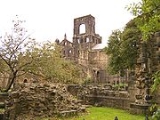
Kirkstall Abbey

Encyclopedia
Kirkstall Abbey is a ruined Cistercian monastery in Kirkstall
north-west of Leeds city centre
in West Yorkshire
. It is set in a public park on the north bank of the River Aire
. It was founded c.1152. It was disestablished during the Dissolution of the Monasteries
under the auspices of Henry VIII
.
The picturesque ruins
have been drawn and painted by artists such as J.M.W. Turner, Thomas Girtin
and John Sell Cotman
.
Kirkstall Abbey was acquired by Leeds Corporation as a gift from Colonel North
and opened to the public in the late 19th century. The gatehouse became a museum.
, 2nd Lord of Bowland
, promised to dedicate an abbey to the Virgin Mary should he survive a serious illness. He recovered and agreed to give the Abbot of Fountains Abbey
land at Barnoldswick
in Lancashire
on which to found a daughter abbey. Abbot
Alexander with twelve Cistercian monks from Fountains went to Barnoldswick and after demolishing the existing church attempted to build the abbey on Henry de Lacy's land. They stayed for six years but found the place inhospitable. Abbot Alexander set about finding a more suitable place for the abbey and came across a site in the heavily wooded Aire Valley occupied by hermits.
Alexander sought help from de Lacy who was sympathetic and helped acquire the land from William de Poitou. The monks moved from Barnoldswick to Kirkstall displacing the hermits, some of whom joined the abbey, the rest being paid to move. The buildings were mostly completed between 1152 when the monks arrived in Kirkstall and the end of Alexander's abbacy in 1182. Millstone Grit
for building came from Bramley Fall on the opposite side of the river.
 The English Cistercian houses, of which there are remains at Fountains
, Rievaulx
, Kirkstall, Tintern
and Netley
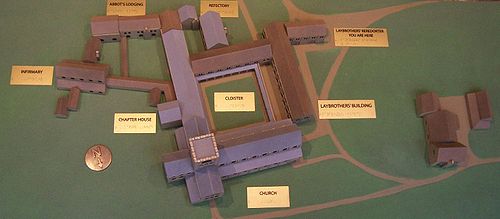
were mainly arranged after the same plan, with slight local variations. As an example, below is the groundplan of Kirkstall Abbey, one of the best preserved.
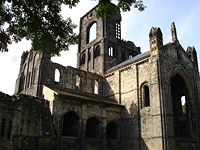 The church is of the Cistercian type, with a short chancel
(3), and transept
s (4) with three eastward chapel
s to each, divided by solid walls. The building is plain, the windows are unornamented, and the nave
(1) has no triforium
. The cloister
to the south (5) occupies the whole length of the nave. On the east side stands the two-aisled chapter-house (7), between which and the south transept is a small sacristy
, and on the other side two small apartments, one of which was probably the parlour
(8). Beyond this is the calefactory or day-room of the monks. Above this whole range of building runs the monks' dormitory, opening by stairs into the south transept of the church.
On the south side of the cloister (5) there are the remains of the old refectory, running, as in Benedictine houses, from east to west, and the new refectory (12), which, with the increase of the inmates of the house, superseded it, stretching, as is usual in Cistercian houses, from north to south. Adjacent to this apartment are the remains of the kitchen, pantry and buttery. The arches of the lavatory are to be seen near the refectory entrance. The western side of the cloister is occupied by vaulted cellars, supporting on the upper story the dormitory of the lay brothers (9).
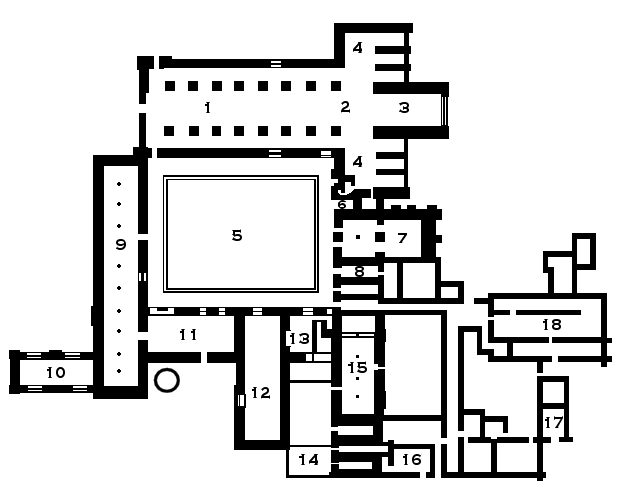
Extending from the south-east angle of the main group of buildings are the walls and foundations of a secondary group of buildings (17, 18). These have been identified as the hospitium or the abbot's house, but they occupy the position in which the infirmary is more usually found. The hall was a very spacious apartment, measuring 83 ft. in length by 48 ft. 9 inches in breadth, which was divided by two rows of columns. The fish-ponds lay between the monastery and the river to the south. The abbey mill was situated about 80 yards to the north-west. The millpool may be distinctly traced, together with the goit or mill stream.
 On 22 November 1539 the abbey was surrendered to Henry VIII
's commissioners in the Dissolution of the monasteries. It was awarded to Thomas Cranmer
in 1542, but reverted back to the crown when Cranmer was executed in 1556. Sir Robert Savile purchased the estate in 1584, and it remained in his family's hands for almost a hundred years. In 1671 it passed into the hands of the Brudenell family, Earls of Cardigan. Much of the stone was removed for re-use in other buildings in the area, including the steps leading to Leeds Bridge
.
During the 18th century the picturesque ruins attracted artists of the Romantic movement
and were painted by artists including J. M. W. Turner, John Sell Cotman and Thomas Girtin. In 1889 the abbey was sold to Colonel John North
, who presented it to Leeds City Council
. The Council undertook a major restoration project and the abbey was opened to the public in 1895.

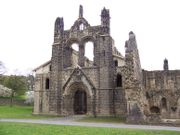 The abbey is a Grade I listed building and Scheduled Ancient Monument. After a £5.5 million renovation programme there is a new visitor centre with interactive exhibits which illustrates the history of the abbey and the lives of the monks. Entry to the Abbey itself is via the visitor centre – free of charge, but with a donation box. Occasionally, guided tours are available (free of charge).
The Leeds Shakespeare Festival, performed by the British Shakespeare Company
, took place annually in the cloisters from 1995 until 2009. The abbey grounds are a public park, and are used for occasional events such as the annual Kirkstall Festival and the Kirkstall Fantasia open-air concerts.
On the other side of the main road, the grade II* listed former abbey gatehouse now forms the Abbey House Museum
.
 The Abbey was also used on 19 March 2011 for the live BBC Three
event Frankenstein's Wedding... Live in Leeds
. A live music drama starring Andrew Gower and Lacey Turner
as fiancees Victor Frankenstein and Elizabeth Lavenza.
On 10 and 11 September 2011 the Kaiser Chiefs
played two concerts at Kirkstall Abbey to a maximum audience of 10,000 on each day.
Kirkstall
Kirkstall is a suburb of north-west Leeds, West Yorkshire, England, on the eastern side of the River Aire. To the west is Bramley, to the east is Headingley and to the north is West Park. Kirkstall is around from the city centre and is close to the University of Leeds and Leeds Metropolitan...
north-west of Leeds city centre
Leeds City Centre
Leeds city centre is the central business district of Leeds, England. It is within the Leeds Central parliamentary constituency, represented by Hilary Benn as MP since a by-election in 1999...
in West Yorkshire
West Yorkshire
West Yorkshire is a metropolitan county within the Yorkshire and the Humber region of England with a population of 2.2 million. West Yorkshire came into existence as a metropolitan county in 1974 after the passage of the Local Government Act 1972....
. It is set in a public park on the north bank of the River Aire
River Aire
The River Aire is a major river in Yorkshire, England of length . Part of the river is canalised, and is known as the Aire and Calder Navigation....
. It was founded c.1152. It was disestablished during the Dissolution of the Monasteries
Dissolution of the Monasteries
The Dissolution of the Monasteries, sometimes referred to as the Suppression of the Monasteries, was the set of administrative and legal processes between 1536 and 1541 by which Henry VIII disbanded monasteries, priories, convents and friaries in England, Wales and Ireland; appropriated their...
under the auspices of Henry VIII
Henry VIII of England
Henry VIII was King of England from 21 April 1509 until his death. He was Lord, and later King, of Ireland, as well as continuing the nominal claim by the English monarchs to the Kingdom of France...
.
The picturesque ruins
Ruins
Ruins are the remains of human-made architecture: structures that were once complete, as time went by, have fallen into a state of partial or complete disrepair, due to lack of maintenance or deliberate acts of destruction...
have been drawn and painted by artists such as J.M.W. Turner, Thomas Girtin
Thomas Girtin
Thomas Girtin was an English painter and etcher. A friend and rival of J. M. W. Turner, Girtin played a key role in establishing watercolour as a reputable art form.-Biography:...
and John Sell Cotman
John Sell Cotman
John Sell Cotman was an English marine and landscape painter, etcher, illustrator and author, one of the leading lights of the Norwich school of artists.-Early life and work:...
.
Kirkstall Abbey was acquired by Leeds Corporation as a gift from Colonel North
John Thomas North
John Thomas North was a British investor and businessman. North was born in Leeds, Yorkshire, the son of a coal merchant and a churchwarden. At the age of fifteen he was apprenticed to millwrights and engineers before working for several years as a mechanic. He moved to Chile in South America...
and opened to the public in the late 19th century. The gatehouse became a museum.
Foundation
Henry de Lacy (1070, Halton, – 1123), Lord of the manor of PontefractPontefract
Pontefract is an historic market town in West Yorkshire, England. Traditionally in the West Riding, near the A1 , the M62 motorway and Castleford. It is one of the five towns in the metropolitan borough of the City of Wakefield and has a population of 28,250...
, 2nd Lord of Bowland
Lordship of Bowland
The Lordship of Bowland, an ancient English title connected with the Forest of Bowland in the northwest of England, was once thought lost and was only recently rediscovered. It disappeared from sight in 1885 when the estates of the Towneleys, one of Lancashire’s great aristocratic families, were...
, promised to dedicate an abbey to the Virgin Mary should he survive a serious illness. He recovered and agreed to give the Abbot of Fountains Abbey
Fountains Abbey
Fountains Abbey is near to Aldfield, approximately two miles southwest of Ripon in North Yorkshire, England. It is a ruined Cistercian monastery, founded in 1132. Fountains Abbey is one of the largest and best preserved Cistercian houses in England. It is a Grade I listed building and owned by the...
land at Barnoldswick
Barnoldswick
Barnoldswick is a town and civil parish within the West Craven area of the Borough of Pendle in Lancashire, England just outside the Yorkshire Dales National Park and the Forest of Bowland Area of Outstanding Natural Beauty. The town is built in the shadow of Weets Hill, and Stock Beck, a...
in Lancashire
Lancashire
Lancashire is a non-metropolitan county of historic origin in the North West of England. It takes its name from the city of Lancaster, and is sometimes known as the County of Lancaster. Although Lancaster is still considered to be the county town, Lancashire County Council is based in Preston...
on which to found a daughter abbey. Abbot
Abbot
The word abbot, meaning father, is a title given to the head of a monastery in various traditions, including Christianity. The office may also be given as an honorary title to a clergyman who is not actually the head of a monastery...
Alexander with twelve Cistercian monks from Fountains went to Barnoldswick and after demolishing the existing church attempted to build the abbey on Henry de Lacy's land. They stayed for six years but found the place inhospitable. Abbot Alexander set about finding a more suitable place for the abbey and came across a site in the heavily wooded Aire Valley occupied by hermits.
Alexander sought help from de Lacy who was sympathetic and helped acquire the land from William de Poitou. The monks moved from Barnoldswick to Kirkstall displacing the hermits, some of whom joined the abbey, the rest being paid to move. The buildings were mostly completed between 1152 when the monks arrived in Kirkstall and the end of Alexander's abbacy in 1182. Millstone Grit
Millstone Grit
Millstone Grit is the name given to any of a number of coarse-grained sandstones of Carboniferous age which occur in the Northern England. The name derives from its use in earlier times as a source of millstones for use principally in watermills...
for building came from Bramley Fall on the opposite side of the river.
The buildings
Fountains Abbey
Fountains Abbey is near to Aldfield, approximately two miles southwest of Ripon in North Yorkshire, England. It is a ruined Cistercian monastery, founded in 1132. Fountains Abbey is one of the largest and best preserved Cistercian houses in England. It is a Grade I listed building and owned by the...
, Rievaulx
Rievaulx
Rievaulx is a small village and civil parish near Helmsley in North Yorkshire and is located in what was the inner court of Rievaulx Abbey, close to the River Rye. The inner court of the monastery contained buildings such as the brewhouse, bakehouse and guesthouse. Its name originated as Rye +...
, Kirkstall, Tintern
Tintern
Tintern is a village on the west bank of the River Wye in Monmouthshire, Wales, close to the border with England, about 5 miles north of Chepstow...
and Netley
Netley
Netley, sometimes called Netley Abbey, is a village on the south coast of Hampshire, England, situated on the east side of the city of Southampton...
were mainly arranged after the same plan, with slight local variations. As an example, below is the groundplan of Kirkstall Abbey, one of the best preserved.
Chancel
In church architecture, the chancel is the space around the altar in the sanctuary at the liturgical east end of a traditional Christian church building...
(3), and transept
Transept
For the periodical go to The Transept.A transept is a transverse section, of any building, which lies across the main body of the building. In Christian churches, a transept is an area set crosswise to the nave in a cruciform building in Romanesque and Gothic Christian church architecture...
s (4) with three eastward chapel
Chapel
A chapel is a building used by Christians as a place of fellowship and worship. It may be part of a larger structure or complex, such as a church, college, hospital, palace, prison or funeral home, located on board a military or commercial ship, or it may be an entirely free-standing building,...
s to each, divided by solid walls. The building is plain, the windows are unornamented, and the nave
Nave
In Romanesque and Gothic Christian abbey, cathedral basilica and church architecture, the nave is the central approach to the high altar, the main body of the church. "Nave" was probably suggested by the keel shape of its vaulting...
(1) has no triforium
Triforium
A triforium is a shallow arched gallery within the thickness of inner wall, which stands above the nave of a church or cathedral. It may occur at the level of the clerestory windows, or it may be located as a separate level below the clerestory. It may itself have an outer wall of glass rather than...
. The cloister
Cloister
A cloister is a rectangular open space surrounded by covered walks or open galleries, with open arcades on the inner side, running along the walls of buildings and forming a quadrangle or garth...
to the south (5) occupies the whole length of the nave. On the east side stands the two-aisled chapter-house (7), between which and the south transept is a small sacristy
Sacristy
A sacristy is a room for keeping vestments and other church furnishings, sacred vessels, and parish records.The sacristy is usually located inside the church, but in some cases it is an annex or separate building...
, and on the other side two small apartments, one of which was probably the parlour
Parlour
Parlour , from the French word parloir, from parler , denotes an "audience chamber". In parts of the United Kingdom and the United States, parlours are common names for certain types of food service houses, restaurants or special service areas, such as tattoo parlors...
(8). Beyond this is the calefactory or day-room of the monks. Above this whole range of building runs the monks' dormitory, opening by stairs into the south transept of the church.
On the south side of the cloister (5) there are the remains of the old refectory, running, as in Benedictine houses, from east to west, and the new refectory (12), which, with the increase of the inmates of the house, superseded it, stretching, as is usual in Cistercian houses, from north to south. Adjacent to this apartment are the remains of the kitchen, pantry and buttery. The arches of the lavatory are to be seen near the refectory entrance. The western side of the cloister is occupied by vaulted cellars, supporting on the upper story the dormitory of the lay brothers (9).
- NaveNaveIn Romanesque and Gothic Christian abbey, cathedral basilica and church architecture, the nave is the central approach to the high altar, the main body of the church. "Nave" was probably suggested by the keel shape of its vaulting...
- TowerTowerA tower is a tall structure, usually taller than it is wide, often by a significant margin. Towers are distinguished from masts by their lack of guy-wires....
- PresbyteryPresbytery (architecture)The presbytery is the name for an area in a church building which is reserved for the clergy.In the oldest church it is separated by short walls, by small columns and pilasters in the Renaissance ones; it can also be raised, being reachable by a few steps, usually with railings....
- North and south transepts
- CloisterCloisterA cloister is a rectangular open space surrounded by covered walks or open galleries, with open arcades on the inner side, running along the walls of buildings and forming a quadrangle or garth...
- Library (part of east range, with 7 & 8)
- Chapter houseChapter houseA chapter house or chapterhouse is a building or room attached to a cathedral or collegiate church in which meetings are held. They can also be found in medieval monasteries....
(part of east range, with 6 & 8) - ParlourParlourParlour , from the French word parloir, from parler , denotes an "audience chamber". In parts of the United Kingdom and the United States, parlours are common names for certain types of food service houses, restaurants or special service areas, such as tattoo parlors...
(part of east range, with 6 & 7) - Lay brothers' dormitory
- ReredorterReredorterThe reredorter was a communal toilet found in mediaeval monasteries in Western Europe and later also in some New World monasteries. It was normally attached to the south end or the east side of the monks' dormitory on the east of the main cloister with seats arranged on the first floor of the...
- The Lane/ malt house
- RefectoryRefectoryA refectory is a dining room, especially in monasteries, boarding schools and academic institutions. One of the places the term is most often used today is in graduate seminaries...
- Warming houseWarming houseThe warming house was an important room or building in a mediaeval monastery in Western Europe. It was here that a communal fire was kept so that the monks could warm themselves after long hours of study in the cloister or other work...
- (unknown)
- Novices' quarter
- Abbot's lodgings
- Visiting abbot's lodgings
- Infirmary
Extending from the south-east angle of the main group of buildings are the walls and foundations of a secondary group of buildings (17, 18). These have been identified as the hospitium or the abbot's house, but they occupy the position in which the infirmary is more usually found. The hall was a very spacious apartment, measuring 83 ft. in length by 48 ft. 9 inches in breadth, which was divided by two rows of columns. The fish-ponds lay between the monastery and the river to the south. The abbey mill was situated about 80 yards to the north-west. The millpool may be distinctly traced, together with the goit or mill stream.
Dissolution and later history
Henry VIII of England
Henry VIII was King of England from 21 April 1509 until his death. He was Lord, and later King, of Ireland, as well as continuing the nominal claim by the English monarchs to the Kingdom of France...
's commissioners in the Dissolution of the monasteries. It was awarded to Thomas Cranmer
Thomas Cranmer
Thomas Cranmer was a leader of the English Reformation and Archbishop of Canterbury during the reigns of Henry VIII, Edward VI and, for a short time, Mary I. He helped build a favourable case for Henry's divorce from Catherine of Aragon which resulted in the separation of the English Church from...
in 1542, but reverted back to the crown when Cranmer was executed in 1556. Sir Robert Savile purchased the estate in 1584, and it remained in his family's hands for almost a hundred years. In 1671 it passed into the hands of the Brudenell family, Earls of Cardigan. Much of the stone was removed for re-use in other buildings in the area, including the steps leading to Leeds Bridge
Leeds Bridge
Leeds Bridge is a historic river crossing in Leeds, England. The present cast iron road bridge dates from 1730. It is Grade II listed.The medieval town of Leeds centred on 13th century burgess building plots either side of a wide road from the river crossing called Bridge Gate, now Briggate...
.
During the 18th century the picturesque ruins attracted artists of the Romantic movement
Romanticism
Romanticism was an artistic, literary and intellectual movement that originated in the second half of the 18th century in Europe, and gained strength in reaction to the Industrial Revolution...
and were painted by artists including J. M. W. Turner, John Sell Cotman and Thomas Girtin. In 1889 the abbey was sold to Colonel John North
John Thomas North
John Thomas North was a British investor and businessman. North was born in Leeds, Yorkshire, the son of a coal merchant and a churchwarden. At the age of fifteen he was apprenticed to millwrights and engineers before working for several years as a mechanic. He moved to Chile in South America...
, who presented it to Leeds City Council
Leeds City Council
Leeds City Council is the local authority for the City of Leeds metropolitan district of West Yorkshire, England.-History:The city council was established in 1974, with the first elections being held in advance in 1973...
. The Council undertook a major restoration project and the abbey was opened to the public in 1895.
The abbey today
The Leeds Shakespeare Festival, performed by the British Shakespeare Company
British Shakespeare Company
The British Shakespeare Company was a British open-air touring Shakespeare Company. Founded by Robert J. Williamson in 1994 , it was renamed in 2005...
, took place annually in the cloisters from 1995 until 2009. The abbey grounds are a public park, and are used for occasional events such as the annual Kirkstall Festival and the Kirkstall Fantasia open-air concerts.
On the other side of the main road, the grade II* listed former abbey gatehouse now forms the Abbey House Museum
Abbey House Museum
Abbey House Museum in Kirkstall, Leeds, West Yorkshire, England is housed in the gatehouse of the ruined Kirkstall Abbey, a grade II* listed building....
.
BBC Three
BBC Three is a television network from the BBC broadcasting via digital cable, terrestrial, IPTV and satellite platforms. The channel's target audience includes those in the 16-34 year old age group, and has the purpose of providing "innovative" content to younger audiences, focusing on new talent...
event Frankenstein's Wedding... Live in Leeds
Frankenstein's Wedding
Frankenstein's Wedding is a live musical drama based on Mary Shelley's novel Frankenstein. The show was broadcast live on BBC Three on the 19 March 2011 from Kirkstall Abbey. -Summary:...
. A live music drama starring Andrew Gower and Lacey Turner
Lacey Turner
Lacey Amelia Turner is an award-winning English actress. She is best known for portraying the role of Stacey Slater on the BBC soap opera EastEnders, a role for which she has won 33 awards...
as fiancees Victor Frankenstein and Elizabeth Lavenza.
On 10 and 11 September 2011 the Kaiser Chiefs
Kaiser Chiefs
Kaiser Chiefs are an English indie rock band from Leeds who formed in 1996. They were named after the South African football club Kaizer Chiefs....
played two concerts at Kirkstall Abbey to a maximum audience of 10,000 on each day.
External links
- Visitor information
- Kirkstall Abbey official website
- Kirkstall Abbey on Kirkstall Online community website - history,description and photographs, predating recent restoration project
- Kirkstall Abbey Photogallery, July 2003