

Darmstadt University of Technology

Encyclopedia
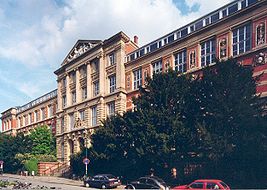
Darmstadt
Darmstadt is a city in the Bundesland of Hesse in Germany, located in the southern part of the Rhine Main Area.The sandy soils in the Darmstadt area, ill-suited for agriculture in times before industrial fertilisation, prevented any larger settlement from developing, until the city became the seat...
, Germany
Germany
Germany , officially the Federal Republic of Germany , is a federal parliamentary republic in Europe. The country consists of 16 states while the capital and largest city is Berlin. Germany covers an area of 357,021 km2 and has a largely temperate seasonal climate...
(Note, that while Darmstadt University of Technology is occasionally used in English translations, its official English name is also "Technische Universität Darmstadt"). It is well known internationally for its achievements in the areas of engineering
Engineering
Engineering is the discipline, art, skill and profession of acquiring and applying scientific, mathematical, economic, social, and practical knowledge, in order to design and build structures, machines, devices, systems, materials and processes that safely realize improvements to the lives of...
, political science
Political science
Political Science is a social science discipline concerned with the study of the state, government and politics. Aristotle defined it as the study of the state. It deals extensively with the theory and practice of politics, and the analysis of political systems and political behavior...
, and computer science
Computer science
Computer science or computing science is the study of the theoretical foundations of information and computation and of practical techniques for their implementation and application in computer systems...
. Historically, it was the first university in the world (in 1882/83) to set up a chair for and offer a course in electrical engineering
Electrical engineering
Electrical engineering is a field of engineering that generally deals with the study and application of electricity, electronics and electromagnetism. The field first became an identifiable occupation in the late nineteenth century after commercialization of the electric telegraph and electrical...
.
History
On October 10, 1877 Ludwig IV, Großherzog von Hessen und bei Rhein (Grand Duke of Hesse), named the Polytechnic School Technische HochschuleTechnische Hochschule
Technische Hochschule is what an Institute of Technology used to be called in German-speaking countries, as well as in the Netherlands, before most of them changed their name to Technische Universität or Technische Universiteit in the 1970s and in the...
zu Darmstadt (Darmstadt Polytechnic) and thereby raised the status of this educational institution to that of a university so that the Abitur
Abitur
Abitur is a designation used in Germany, Finland and Estonia for final exams that pupils take at the end of their secondary education, usually after 12 or 13 years of schooling, see also for Germany Abitur after twelve years.The Zeugnis der Allgemeinen Hochschulreife, often referred to as...
(diploma from German secondary school qualifying for university admission or matriculation) became the basis for admission. In 1899 the TH Darmstadt was granted the right to award doctorates.
Early beginnings
The University's history is varied: its early phases began with the Höhere Gewerbschule (Higher Trade School), which was founded in 1836 and received its own building near the 'Altes Pädagog' on Kapellplatz in 1844, followed by the Technische Schule (Technical School) in 1864 and the Großherzoglich Hessische Polytechnische Schule (Grand Ducal Hessian Polytechnic) in 1868. At that time, heated discussions were continually held in political circles on the issue as to whether such a poor state as the Grand Duchy of HesseHesse
Hesse or Hessia is both a cultural region of Germany and the name of an individual German state.* The cultural region of Hesse includes both the State of Hesse and the area known as Rhenish Hesse in the neighbouring Rhineland-Palatinate state...
could afford a technically-oriented higher educational institution, or even a polytechnic. After the foundation of the TH Darmstadt in 1877, student numbers kept on being so low that in the years from 1881 to 1882 there were long debates in public about closing down the University. In this difficult situation, the local government and the University made the courageous decision to set up the first chair of electrical engineering
Electrical engineering
Electrical engineering is a field of engineering that generally deals with the study and application of electricity, electronics and electromagnetism. The field first became an identifiable occupation in the late nineteenth century after commercialization of the electric telegraph and electrical...
worldwide. Thus the School of Electrical Engineering came into being as the sixth faculty of the TH Darmstadt, which was a novelty in academia, because until then no other polytechnic or university had had its own Faculty of Electrical Engineering. This forward-looking higher education policy paved the way for Darmstadt to take up a leading position in the rapidly developing field of Electrical Engineering, which in turn led to a continuously rising number of students, so that the closure of the TH Darmstadt never was demanded again.
First steps as a university
In 1895 new buildings were opened in Hochschulstrasse: the 'Alte Hauptgebäude' (the 'Old Main Building' of the University) and an institute building directly opposite. During the two decades before the World War IWorld War I
World War I , which was predominantly called the World War or the Great War from its occurrence until 1939, and the First World War or World War I thereafter, was a major war centred in Europe that began on 28 July 1914 and lasted until 11 November 1918...
, all disciplines of the university underwent diversification and expansion. New disciplines such as Paper Making and Cellulose Chemistry were introduced, and as early as 1913 a Chair of Aeronautics
Aeronautics
Aeronautics is the science involved with the study, design, and manufacturing of airflight-capable machines, or the techniques of operating aircraft and rocketry within the atmosphere...
and Flight Mechanics was set up.
Meanwhile, the political climate had become stormier, and a growing political polarization exploded in Darmstadt over the question of foreign students. The TH Darmstadt had an extraordinarily large number of foreign students. In 1906, for instance, as many as three quarters of the Electrical Engineering students were from abroad, mainly from states of eastern Europe.
After the World War I
World War I
World War I , which was predominantly called the World War or the Great War from its occurrence until 1939, and the First World War or World War I thereafter, was a major war centred in Europe that began on 28 July 1914 and lasted until 11 November 1918...
there was an urgent need for reform of the education system at the TH Darmstadt, which was seen as a prerequisite for meeting the requirements of a modern industrial society. Intense discussions were held on the aim of extending the curriculum
Curriculum
See also Syllabus.In formal education, a curriculum is the set of courses, and their content, offered at a school or university. As an idea, curriculum stems from the Latin word for race course, referring to the course of deeds and experiences through which children grow to become mature adults...
beyond the purely technical education in order to prepare the engineer for his leading role in society. A concrete step in this direction was taken in 1924, when the 'General Faculty', which until then had combined all the non-technical subjects, was divided into a Department of Mathematics and Natural Science and a Department of Cultural Studies and Political Science. Moreover, the measures taken to provide students with knowledge outside their own narrow field of study included the upgrading of Economics and the creation of professorships in Political Science, History of Technology and Sociology.
Restart after WW II
Allies
In everyday English usage, allies are people, groups, or nations that have joined together in an association for mutual benefit or to achieve some common purpose, whether or not explicit agreement has been worked out between them...
before it was reopened in 1946. In spite of the difficult post-war situation, university staff and students alike managed to settle down to university work in the severely damaged buildings, which had to be used as a makeshift solution.
As early as 1947 the TH Darmstadt played host to the first 'Internationaler Kongress für Ingenieurausbildung - IKIA' (International Congress on Engineering Education), at which the participants discussed the moral responsibility of the technical intelligentsia and of the scientific elite in politics and society. In view of the disastrous consequences of the war, the participants committed themselves henceforth to do research and teaching in engineering and scientific disciplines solely for the peaceful development of mankind.
The post-war period of reconstruction was largely based on a major development programme in the sixties, by means of which universities and the state reacted to the continuously rising numbers of students. Since almost no land was available in the city centre for new construction projects, the decision was taken in 1963 to use the 'Lichtwiese' (a former airfield on the outskirts of the city) as a site for building extensions to the TH. Thus in the late sixties and in the early seventies numerous buildings, including a new student cafeteria, were erected there and ultimately became the university's second campus.
University reforms in the 1970s
After 1968 the university reform, having been initiated by the student movement, was beginning to take shape both at a national and a regional level. It aimed at creating clear university structures and the involvement of all university members in decision-making processes. In 1970 the 'Hessisches Hochschulgesetz' (Higher Education Laws of the Federal State of Hesse) came into force. These gave the TH Darmstadt, along with other Hessian universities and polytechnics, a new structure based on the introduction of a presidential statute and a unified administration as well as the subdivision of the University structure into schools.In the mid 1970s there was another rapid rise in student numbers. Staff development, however, lagged far behind, resulting in inevitable restrictions on admission imposed either by the central government or by the University. Regardless of the staff's heavy workload, the TH Darmstadt managed to set the course for the future, as evidenced by the School of Information Science, established in 1974, the 'Zentrum für Interdisziplinäre Technikforschung – ZIT' (Centre for Interdisciplinary Studies on Technology), founded in 1987, and the School of Materials Science, established in 1989. This School, which offers a new course of studies has been housed in a new building on the Lichtwiese since 1996.
Renaming and Autonomy
By the end of the 20th century, the TH Darmstadt had had the legal status of a university, and had been offering a correspondingly wide range of subjects, for over a hundred years. For these reasons, and also with the objective of sharpening public awareness of the university's status at home and abroad, the TH Darmstadt was renamed Technische Universität Darmstadt (also its official English name is Technische Universität Darmstadt albeit often called Darmstadt University of Technology) on October 1, 1997. This name change was partly prompted by misunderstandings that had occurred in English-speaking countries, where 'Technische Hochschule' had often been mistakenly transliterated as 'Technical High School', providing a totally misleading connotation.On January 1, 2005, the TU Darmstadt became the first public German university to be given administrative autonomy. New administrative structures were put into place, and their success is being evaluated. For instance, the university can now autonomously administer its budget and buildings. Also, the university can hire professors and negotiate their salaries by itself (formerly this was done by the State of Hesse
Hesse
Hesse or Hessia is both a cultural region of Germany and the name of an individual German state.* The cultural region of Hesse includes both the State of Hesse and the area known as Rhenish Hesse in the neighbouring Rhineland-Palatinate state...
).
Faculties
There are 13 faculties which altogether offer about 40 courses of studies. Thus the TU Darmstadt offers a broad range of academic science to students and scientists. However, some faculties are rather small (especially those dealing with economics, politics, law and social sciences) and while degrees can be gained in most of these smaller faculties, they are basically retained to provide a broader outlook (for both the students and the institution itself) to what would otherwise be an exclusively science-and-technology-centered focus.The faculties are:
|
|
Academic Profile
The close cooperation between science and economy is an indispensable prerequisite for success. For that reason students are encouraged to learn how to put scientific ideas and principles into effect and to demonstrate in their essays and dissertations how to tackle, analyse and solve problems, e.g. in the areas of industrial processes and practices.Research projects at the University are initiated and financed to a large extent by industrial and commercial concerns. Moreover, the University's successful collaboration with local companies is also based on a twofold strategy: the appointment of distinguished scientists and engineers to the post of professor at the University and the University's commitment to management development in companies.
The University offers a wide range of subjects, not only in the traditional fields of natural and engineering sciences, but also in those of social and human sciences, which was one of the main reasons for renaming the TH Darmstadt 'Technische Universität Darmstadt' in the autumn of 1997. The subjects of these major areas of human knowledge add to the teacher training for the teaching profession both at secondary schools and vocational schools and furthermore make Industrial Engineering as taught in Darmstadt an attractive course of study. The creation of new degree courses leading to bachelor's and master's degrees is also based on these academic standards and follows the European standardization of academic education.
Research
The principle of the indivisibility of teaching and research is common to all German universities. Mention must be made, however, that research at the TU Darmstadt has had a long and particularly successful tradition to date. Thus research is being carried out at more than two hundred institutes as well as at the Zentrum für Wissenschaftliches Rechnen - DZWR (Centre of Scientific Computing), where the focus is on interdisciplinary work, and at the Zentrum für Interdisziplinäre Technikforschung - ZIT (Centre of Interdisciplinary Studies of Technology). Moreover, at the TU Darmstadt there are several Sonderforschungsbereiche - SFB (collaborative research units) as well as several Graduiertenkollegs (programmes of lectures for postgraduates planned and run by experienced members of the University's research and teaching staff), all of whom profit from financial support and expert advice provided by the Deutsche ForschungsgemeinschaftDeutsche Forschungsgemeinschaft
The Deutsche Forschungsgemeinschaft is an important German research funding organization and the largest such organization in Europe.-Function:...
- DFG (National Science Council). In the Mathematics
Mathematics
Mathematics is the study of quantity, space, structure, and change. Mathematicians seek out patterns and formulate new conjectures. Mathematicians resolve the truth or falsity of conjectures by mathematical proofs, which are arguments sufficient to convince other mathematicians of their validity...
Department, the theory of Formal concept analysis
Formal concept analysis
Formal concept analysis is a principled way of automatically deriving an ontology from a collection of objects and their properties. The term was introduced by Rudolf Wille in 1984, and builds on applied lattice and order theory that was developed by Birkhoff and others in the 1930s.-Intuitive...
has been developed with an extensive on-going programme and annual conferences.
The scientific infrastructure provided by the University has attracted a considerable number of national and international research institutions to the Wissenschaftsstadt Darmstadt
Darmstadt
Darmstadt is a city in the Bundesland of Hesse in Germany, located in the southern part of the Rhine Main Area.The sandy soils in the Darmstadt area, ill-suited for agriculture in times before industrial fertilisation, prevented any larger settlement from developing, until the city became the seat...
(Darmstadt - City of Science), who on their part collaborate with the TU Darmstadt on many projects. Among them are, for example, the Deutsche Kunststoffinstitut - DKI (German Institute of Plastics Materials), the Technologiezentrum Darmstadt - TZD of the Deutsche Telekom
Deutsche Telekom
Deutsche Telekom AG is a telecommunications company headquartered in Bonn, Germany. It is the largest telecommunications company in Europe....
(Research and Technology Institute of the Deutsche Telekom), the Gesellschaft für Schwerionenforschung
Gesellschaft für Schwerionenforschung
The GSI Helmholtz Centre for Heavy Ion Research GmbH in the Wixhausen suburb of Darmstadt, Germany is a federally and state co-funded heavy ion research center. The current director of GSI is Horst Stöcker who succeeded Walter F...
- GSI (Heavy-Ion Research Institute) at Wixhausen, the Fraunhofer Institute for Secure Information Technology SIT ( collaboration in the Center for Advanced Security Research Darmstadt - CASED
CASED
The Center for Advanced Security Research Darmstadt is a LOEWE Center for IT security research and development with an interdisciplinary and cross-organizational approach. It was founded in July 2008 by TU Darmstadt, the Fraunhofer Institute for Secure Information Technology and the Darmstadt...
), the European Space Operations Centre - ESOC, the European Organization for Meteorological Satellites - EUMETSAT, and the Fraunhofer Institute for Structural Durability and the Fraunhofer Institute for Computer Graphics. The collaboration with the University ranges from joint research projects to bearing joint responsibility for decisions taken at managerial level of the scientific institutions.
Research Profile
In July 2010, TU Darmstadt defined five Research Clusters which characterize its research profile:- Thermo-Fluids and Combustion Engineering
- New Materials
- Nuclear and Radiation Science
- Integrated Product and Production Technology
- Future Internet
TU Darmstadt understands Research Clusters as comprehensive academic networks with high international visibility.
In addition, TU Damstadt has installed two research priority areas:
- Computational Engineering
- Urban Research
Research Priority Areas are understood as coordinated research activities with significant visibility in TU Darmstadt’s research profile.
International Life
With more than 20%, the percentage of foreign students at the TU Darmstadt is clearly higher than the average of German universities of 8%, though at times, especially early in its history, almost a quarter of its students were foreigners, especially from Eastern EuropeEastern Europe
Eastern Europe is the eastern part of Europe. The term has widely disparate geopolitical, geographical, cultural and socioeconomic readings, which makes it highly context-dependent and even volatile, and there are "almost as many definitions of Eastern Europe as there are scholars of the region"...
.
Scientific co-operation on a contractual base is maintained with more than 65 partner universities all over the world.
The University also participates in Erasmus Mundus
Erasmus Mundus
The European Union's Erasmus Mundus programme aims to enhance quality in higher educationthrough scholarships and academic co-operation between Europe and the rest of the world.Erasmus Mundus comprises three Actions:-Erasmus Mundus Joint Programmes:...
programme of European Commission
European Commission
The European Commission is the executive body of the European Union. The body is responsible for proposing legislation, implementing decisions, upholding the Union's treaties and the general day-to-day running of the Union....
offering MUNDUS URBANO master course International Cooperation and Urban Development. http://www.mundus-urbano.eu/
The university is member of different European networks, such as TIME
Top Industrial Managers for Europe
Top Industrial Managers for Europe is a network of more than fifty engineering schools and faculties and technical universities....
network. The European Credit transfer system ECTS
European Credit Transfer and Accumulation System
This page describes ECTS-credits. For information about the ECTS grading system go to ECTS grading scale.European Credit Transfer and Accumulation System is a standard for comparing the study attainment and performance of students of higher education across the European Union and other...
has been introduced for almost all courses of study.
The student group IDEA (International Darmstadt Exchange Alumni) provides an interesting programme for all international Students of the University. At the beginning of each term there is an integration week organised.
Knowledge Transfer
In order to put innovative ideas and research results more quickly into effect the Innovationsgesellschaft Darmstadt mbH (Darmstadt Society for Innovations, Ltd) was founded. The founder-members involved in drawing up the project of a Technologie- und Innovationszentrum - TIZ (Centre of Technology and Innovation), which was completed in spring 1999, consist of the TU Darmstadt, the City of Darmstadt, the Darmstadt Chamber of Commerce and Industry, the Administrative district of Darmstadt-Dieburg, the Sparkasse Darmstadt (Darmstadt savings bank) and the Sparkasse Dieburg (Dieburg savings bank), the Fachhochschule Darmstadt(Darmstadt University of Applied Sciences), and the Zentrum für Graphische Datenverarbeitung - ZGDV (Computer Graphics Center). The Center's infrastructure enables young entrepreneurs to rent business premises and to benefit from a consultancy service not only in matters of introducing new technologies but also in matters of accountancy and law at prices that are within their means.In the meantime a number of young scientists, former students and researchers at the TU Darmstadt who have made up their mind to become independent businessmen, use the TIZ in Darmstadt as their base. Offering this form of knowledge and technology transfer, the University contributes to the economic development of Southern Hesse.
Notable faculty and alumni
- Günter BehnischGünter BehnischGünter Behnisch was a German architect, born in Lockwitz, near Dresden. He was one of the most prominent architects representing deconstructivism....
(* 1922), architect (Olympic Stadium (Munich)Olympic Stadium (Munich)Olympiastadion is a stadium located in Munich, Germany. Situated at the heart of the Olympiapark München in northern Munich, the stadium was built as the main venue for the 1972 Summer Olympics....
) - Hanns-Peter BoehmHanns-Peter BoehmHanns-Peter Boehm is a German chemist and professor emeritus at Ludwig-Maximilians-Universität in Munich, Germany. Boehm is considered a pioneer of graphene research.- Biography :...
(*1928), chemist and a pioneer of grapheneGrapheneGraphene is an allotrope of carbon, whose structure is one-atom-thick planar sheets of sp2-bonded carbon atoms that are densely packed in a honeycomb crystal lattice. The term graphene was coined as a combination of graphite and the suffix -ene by Hanns-Peter Boehm, who described single-layer...
research - Kurt Heinrich Debus (* 1908), rocket scientist and first Kennedy Space CenterKennedy Space CenterThe John F. Kennedy Space Center is the NASA installation that has been the launch site for every United States human space flight since 1968. Although such flights are currently on hiatus, KSC continues to manage and operate unmanned rocket launch facilities for America's civilian space program...
director - Mikhail Dolivo-Dobrovolsky (1862–1919), inventor of the three-phase electrical motor
- Paul FriedländerPaul Friedländer (chemist)Paul Friedländer was a German chemist best known for his research on derivates of indigo and isolation of Tyrian purple from Murex brandaris.-Life and work:...
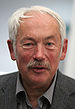
(1857–1923), chemist - Peter GrünbergPeter GrünbergPeter Andreas Grünberg is a German physicist, and Nobel Prize in Physics laureate for his discovery with Albert Fert of giant magnetoresistance which brought about a breakthrough in gigabyte hard disk drives.-Biography:...
(* 1939), physicist, discoverer of the Giant magnetoresistance effect, Nobel laureate (2007) - Gerhard HennigeGerhard HennigeGerhard Hennige is a former German track and field athlete and Olympic medal winner, among the world's best at the 400 meter hurdles from 1966 to 1971....
(* 1940), Olympic medal winner - Gerhard HerzbergGerhard HerzbergGerhard Heinrich Friedrich Otto Julius Herzberg, was a pioneering physicist and physical chemist, who won the Nobel Prize for Chemistry in 1971, "for his contributions to the knowledge of electronic structure and geometry of molecules, particularly free radicals". Herzberg's main work concerned...
(1904–1999), chemist, physicist and Nobel laureate (1971) - Karl KüpfmüllerKarl KüpfmüllerKarl Küpfmüller was a German electrical engineer, who was prolific in the areas of communications technology, measurement and control engineering, acoustics, communication theory and theoretical electro-technology....
(1897–1977), electrical engineer - Ernst NeufertErnst NeufertErnst Neufert was a German architect who is known as an assistant of Walter Gropius, as a teacher and member of various standardization organizations, and especially for his essential handbook Architects' Data.- Life :...
(1900–1986), architect - Bert RürupBert RürupHans-Adalbert Rürup is a German economist and former chairman of the German Council of Economic Experts. He was formerly a professor of economics at the Darmstadt University of Technology. , he is president of the International School of Management .-References:...
(* 1943), former chairman of the German Council of Economic ExpertsGerman Council of Economic ExpertsThe German Council of Economic Experts or ' is a group of economists set up in 1963 to advise the German government and Parliament on economic policy issues. Every year the Council prepares the annual report which is published before or by November 15... - Frank SchimmelfennigFrank SchimmelfennigFrank Schimmelfennig is a professor of European politics at the Center for Comparative and International Studies at the Swiss Federal Institute of Technology in Zurich, Switzerland.-Academic career:...
(* 1963), political scientist - Bernhard SchlinkBernhard SchlinkBernhard Schlink is a German jurist and writer. He was born in Bethel, Germany, to a German father and a Swiss mother, the youngest of four children. Both his parents were theology students, although his father lost his job as a Professor of Theology due to the Nazis, and had to settle on being a...
(* 1944), former judge and writer (The ReaderThe ReaderThe Reader is a novel by German law professor and judge Bernhard Schlink, published in Germany in 1995 and in the United States in 1997...
) - Ernst SchröderErnst SchröderErnst Schröder was a German mathematician mainly known for his work on algebraic logic. He is a major figure in the history of mathematical logic , by virtue of summarizing and extending the work of George Boole, Augustus De Morgan, Hugh MacColl, and especially Charles Peirce...
(1841–1902), mathematician - Gerhard SesslerGerhard SesslerGerhard M. Sessler is a German inventor and scientist. Sessler invented together with James E. West the foil electret microphone at Bell Laboratories 1962 and the silicon microphone in 1983.He received his Ph.D. from the University of Göttingen in 1959...
(* 1931), electrical engineer and inventor of the Electret microphoneElectret microphoneAn electret microphone is a type of condenser microphone, which eliminates the need for a polarizing power supply by using a permanently charged material.... - Rudolf WilleRudolf WilleRudolf Wille is a German Mathematician and was Professor of General Algebra from 1970 to 2003 at Technische Universität Darmstadt...
(* 1937), mathematician - Hermann ZapfHermann ZapfHermann Zapf is a German typeface designer who lives in Darmstadt, Germany. He is married to calligrapher and typeface designer Gudrun Zapf von Hesse....
(* 1918), typeface designer (PalatinoPalatinoPalatino is the name of a large typeface family that began as an old style serif typeface designed by Hermann Zapf initially released in 1948 by the Linotype foundry.In 1999, Zapf revised Palatino for Linotype and Microsoft, called Palatino Linotype...
, OptimaOptimaOptima is a humanist sans-serif typeface designed by Hermann Zapf between 1952 and 1955 for the D. Stempel AG foundry, Frankfurt, Germany.-Characteristics:...
, ZapfinoZapfinoZapfino is a calligraphic typeface designed for Linotype by typeface designer Hermann Zapf in 1998. It is based on an alphabet Zapf originally penned in 1944...
) - Eduard ZintlEduard ZintlEduard Zintl was a German chemist.After his family moved from Weiden and Bayreuth to Munich and after he had finished school he was drafted for military service during World War I. At the age of 21 he started studying at the University of Munich with Otto Hönigschmid. He got his PhD at the age of...
(1898–1941), chemist and discoverer of the Zintl phaseZintl phaseIn chemistry a Zintl phase is the product of a reaction between*group 1 or group 2 and*post transition metals or metalloids from group 13, 14, 15 or 16....
- Franz-Josef KemperFranz-Josef KemperFranz-Josef Kemper is a German athlete, Olympic participant and official. He achieved his greatest success as a middle-distance runner in the 1960s and 1970s....
(* 1945), sociologist and track-and-field athlete - El LissitzkyEl Lissitzky, better known as El Lissitzky , was a Russian artist, designer, photographer, typographer, polemicist and architect. He was an important figure of the Russian avant garde, helping develop suprematism with his mentor, Kazimir Malevich, and designing numerous exhibition displays and propaganda works...
(1890–1941), architect and designer - Ernst MayErnst MayErnst May was a German architect and city planner.May successfully applied urban design techniques to the city of Frankfurt am Main during Germany's Weimar period, and in 1930 less successfully exported those ideas to Soviet Union cities, newly created under Stalinist rule...
(1886–1970), architect and city planner (New Frankfurt) - Fritz von OpelFritz von OpelFritz Adam Hermann Opel, since 1918 von Opel , was the only child of Wilhelm von Opel, and a grandson of Adam Opel, founder of the Opel Company...
(1899–1971), rocket pioneer - Karl PlaggeKarl PlaggeMajor Karl Plagge was a German officer and Nazi Party member who during World War II used his position as a staff officer in the Heer to employ and protect some 1,240 Jews — 500 men, the others women and children, in order to give them a better chance to survive the nearly total annihilation of...
(1897–1957), Righteous Among the NationsRighteous Among the NationsRighteous among the Nations of the world's nations"), also translated as Righteous Gentiles is an honorific used by the State of Israel to describe non-Jews who risked their lives during the Holocaust to save Jews from extermination by the Nazis.... - Chaim WeizmannChaim WeizmannChaim Azriel Weizmann, , was a Zionist leader, President of the Zionist Organization, and the first President of the State of Israel. He was elected on 1 February 1949, and served until his death in 1952....
(1874–1952), chemist and first president of IsraelIsraelThe State of Israel is a parliamentary republic located in the Middle East, along the eastern shore of the Mediterranean Sea...
Points of interest
- Botanischer Garten der TU DarmstadtBotanischer Garten der TU DarmstadtThe Botanischer Garten der TU Darmstadt , also known as the Botanischer Garten Darmstadt, is a botanical garden maintained by the Darmstadt University of Technology...
, the university's botanical gardenBotanical gardenA botanical garden The terms botanic and botanical, and garden or gardens are used more-or-less interchangeably, although the word botanic is generally reserved for the earlier, more traditional gardens. is a well-tended area displaying a wide range of plants labelled with their botanical names...
Australia/Pacifica
- Australia
- University of New South WalesUniversity of New South WalesThe University of New South Wales , is a research-focused university based in Kensington, a suburb in Sydney, New South Wales, Australia...
, Sydney - Curtin University of TechnologyCurtin University of TechnologyCurtin University is an Australian university based in Perth, Western Australia, with additional campuses in regional Western Australia and at Miri , Sydney and Singapore...
, Perth
- University of New South Wales
- New Zealand
- University of CanterburyUniversity of CanterburyThe University of Canterbury , New Zealand's second-oldest university, operates its main campus in the suburb of Ilam in the city of Christchurch, New Zealand...
, Christchurch
- University of Canterbury
Asia
- Pakistan
- University of Engineering and Technology, Lahore
- Allama Iqbal Open UniversityAllama Iqbal Open UniversityAllama Iqbal Open University , founded in 1974, is a university in Islamabad, Pakistan. It is one of the world's largest universities by enrollment, with 1,121,038 students in the year 2010 whereas Course Enrollment of these students are 3,305,948 -History:Allama Iqbal Open University was...
, Islamabad
- China
- Tsinghua UniversityTsinghua UniversityTsinghua University , colloquially known in Chinese as Qinghua, is a university in Beijing, China. The school is one of the nine universities of the C9 League. It was established in 1911 under the name "Tsinghua Xuetang" or "Tsinghua College" and was renamed the "Tsinghua School" one year later...
, Beijing - Tongji UniversityTongji UniversityTongji University , colloquially known as Tongji , located in Shanghai, has more than 30,000 students and 8,000 staff members . It offers degree programs at both undergraduate and postgraduate levels...
, Shanghai
- Tsinghua University
- India
- Indian Institute of Technology, Kanpur
- Indian Institute of Technology, Kharagpur
- Indian Institute of Technology, Bombay
- Indian Institute of Technology, Madras
- Indian Institute of Sciences, Bangalore
- Tata Institute of Fundamental ResearchTata Institute of Fundamental ResearchThe Tata Institute of Fundamental Research is a research institution in India dedicated to basic research in mathematics and the sciences. It is a Deemed University and works under the umbrella of the Department of Atomic Energy of the Government of India. It is located at Navy Nagar, Colaba, Mumbai...
, Bombay
- Japan
- Tokyo University, Tokyo
- Nihon UniversityNihon UniversityNihon University is the largest university in Japan. Akiyoshi Yamada, the minister of justice, founded Nihon Law School in October 1889....
, Tokyo - Tohoku UniversityTohoku University, abbreviated to , located in the city of Sendai, Miyagi Prefecture in the Tōhoku Region, Japan, is a Japanese national university. It is the third oldest Imperial University in Japan and is a member of the National Seven Universities...
, Sendai
- Korea
- Seoul National UniversitySeoul National UniversitySeoul National University , colloquially known in Korean as Seoul-dae , is a national research university in Seoul, Korea, ranked 24th in the world in publications in an analysis of data from the Science Citation Index, 7th in Asia and 42nd in the world by the 2011 QS World University Rankings...
, Seoul - Ewha Womans UniversityEwha Womans UniversityEwha Womans University is a private women's university in central Seoul, South Korea. It is one of the city's largest institutions of higher learning and currently the world's largest female educational institute. It is one of the best-known universities in South Korea, and often considered to...
, Seoul
- Seoul National University
- Mongolia
- Mongolian University of Technology and Science, Ulaanbaatar
- Russian Federation
- Yakutsk State UniversityYakutsk State UniversityAmmosov North-Eastern Federal UniversityNEFU in figuresThe total number of employees - 3,622.The faculty • NEFU all together – 1,239 peoplePh.D...
- University for International Law and Economics, Moscow
- University of Economics and Finances, St. Petersburg
- Moscow Technical State University, Moscow
- Yakutsk State University
- Sri Lanka
- University of ColomboUniversity of ColomboThe University of Colombo is a public research university located primarily in Colombo, Sri Lanka...
, Colombo
- University of Colombo
- Vietnam
- University of Transport and Communication, Hanoi
South East Asia
- Indonesia
- Institute of Technology Trisakti, Jakarta
- Tenth of November Institute of TechnologyTenth of November Institute of TechnologyInstitut Teknologi Sepuluh Nopember or ITS is a public university in Surabaya, East Java, Indonesia, focused in the higher education of science, engineering and technology. ITS took its name from the Battle of Surabaya which reached its peak on November 10, 1945. The day is also commemorated as...
, Surabaya - Institute of Technology Bandung, Bandung
- Malaysia
- University of MalayaUniversity of MalayaThe University of Malaya is located on a campus near the centre of Kuala Lumpur, and is the oldest university in Malaysia. It was founded in 1905 as a public-funded tertiary institution...
- University of Malaya
- Singapore
- National University of SingaporeNational University of SingaporeThe National University of Singapore is Singapore's oldest university. It is the largest university in the country in terms of student enrollment and curriculum offered....
- Nanyang Technological UniversityNanyang Technological UniversityNanyang Technological University is one of the two largest public universities in Singapore with the biggest campus in Singapore and the world's largest engineering college. Its lush 200-hectare Yunnan Garden campus was the Youth Olympic Village of the world's first 2010 Summer Youth Olympics in...
- National University of Singapore
- Taiwan R.O.C.
- National Cheng Kung UniversityNational Cheng Kung UniversityNational Cheng Kung University is a national university in Tainan City, Taiwan. Its abbreviation is NCKU. In Chinese, its name is shortened to 成大...
, Tainan
- National Cheng Kung University
- Thailand
- Chulalongkorn UniversityChulalongkorn UniversityChulalongkorn University is the oldest university in Thailand and is the country's highest ranked university. It now has nineteen faculties and institutes. Regarded as the best and most selective university in Thailand, it consistently attracts top students from around the country...
, Bangkok - Sirindhorn International Institute of TechnologySirindhorn International Institute of TechnologySirindhorn International Institute of Technology is a semi-autonomous institute of technology established in 1992 within Thammasat University. It is located in Pathum Thani, Thailand...
, Thammasat UniversityThammasat UniversityThammasat University , or in brief TU , is Thailand's second oldest university. Officially established on 27 June 1934, the university was originally named by founder Pridi Banomyong, University of Moral Science and Politics , reflecting the political fervor of the time...
, Bangkok
- Chulalongkorn University
North America
- USA
- Virginia Tech, Blacksburg
- Worcester Polytechnic InstituteWorcester Polytechnic InstituteWorcester Polytechnic Institute is a private university located in Worcester, Massachusetts, in the United States.Founded in 1865 in Worcester, WPI was one of the United States' first engineering and technology universities...
, Worcester - State University of New York, Buffalo
- University of California, BerkeleyUniversity of California, BerkeleyThe University of California, Berkeley , is a teaching and research university established in 1868 and located in Berkeley, California, USA...
- University of Illinois, Urbana-Champaign
- University of Colorado, Boulder
- Tulane UniversityTulane UniversityTulane University is a private, nonsectarian research university located in New Orleans, Louisiana, United States...
, New Orleans
- Canada
- University of British ColumbiaUniversity of British ColumbiaThe University of British Columbia is a public research university. UBC’s two main campuses are situated in Vancouver and in Kelowna in the Okanagan Valley...
, Vancouver - University of SaskatchewanUniversity of SaskatchewanThe University of Saskatchewan is a Canadian public research university, founded in 1907, and located on the east side of the South Saskatchewan River in Saskatoon, Saskatchewan, Canada. An "Act to establish and incorporate a University for the Province of Saskatchewan" was passed by the...
, Saskatoon - University of OttawaUniversity of OttawaThe University of Ottawa is a bilingual, research-intensive, non-denominational, international university in Ottawa, Ontario. It is one of the oldest universities in Canada. It was originally established as the College of Bytown in 1848 by the Missionary Oblates of Mary Immaculate...
, Ottawa
- University of British Columbia
- Mexico
- Universidad Autónoma de Nuevo LeónUniversidad Autónoma de Nuevo LeónThe Autonomous University of Nuevo León is a public university with seven campuses across the Northern state of Nuevo León, Mexico. Founded as University of Nuevo León on 25 September 1933, it is the oldest and largest university in the state in terms of student population and it is currently...
, Monterrey
- Universidad Autónoma de Nuevo León
South America
- Argentina
- Universidad Católica Argentina, Buenos Aires
- Brazil
- Universidade Estadual de CampinasUniversidade Estadual de CampinasUniversidade Estadual de Campinas is one of the three public universities of the Brazilian state of São Paulo, along both USP and UNESP....
, São Paulo state - Pontifícia Universidade Católica, Rio de Janeiro
- Universidade Federal do ParanáUniversidade Federal do ParanáFederal University of Paraná is a university headquartered in Curitiba, Paraná, Brazil.Established on December 19, 1912 and initially named as Universidade do Paraná , the Universidade Federal do Paraná – UFPR is regarded as the oldest Brazilian university.In 1920, the federal government split...
, Curitiba - Universidade de São PauloUniversity of São PauloUniversidade de São Paulo is a public university in the Brazilian state of São Paulo. It is the largest Brazilian university and one of the country's most prestigious...
- Universidade Metodista de Piracicaba, Piracicaba
- Universidade Estadual de Campinas
- Colombia
- Universidad Nacional de ColombiaNational University of ColombiaThe Universidad Nacional de Colombia , also called UNAL or just UN, is a public, national, coeducational, research university, located primarily in Bogotá, Medellín, Manizales and Palmira, Colombia...
, Bogotá
- Universidad Nacional de Colombia
Middle East
- Iran
- Sharif University of TechnologySharif University of TechnologySharif University of Technology is a university of higher education in technology, engineering and physical sciences in Tehran. Sharif University of Technology is one of the most prestigious universities in the country, and is considered Iran's MIT...
, Tehran
- Sharif University of Technology
- Israel
- Ben Gurion University of the Negev, Beersheva
- Turkey
- Middle East Technical UniversityMiddle East Technical UniversityMiddle East Technical University is a public technical university located in Ankara, Turkey...
, Ankara - Sabanci UniversitySabanci UniversitySabancı University is a private research institution located in Istanbul, Turkey. Founded in 1996. SU is a small and highly focused university with 2861 undergraduates and 624 graduates, maintaining a strong emphasis on social and natural sciences...
, Istanbul
- Middle East Technical University
See also
Affiliated Research Institutions:- CASEDCASEDThe Center for Advanced Security Research Darmstadt is a LOEWE Center for IT security research and development with an interdisciplinary and cross-organizational approach. It was founded in July 2008 by TU Darmstadt, the Fraunhofer Institute for Secure Information Technology and the Darmstadt...
- UKP LabUbiquitous Knowledge Processing LabUbiquitous Knowledge Processing Lab is a research lab in the Department of Computer Science at the Technische Universität Darmstadt. It was founded in 2006 by Prof. Dr...