

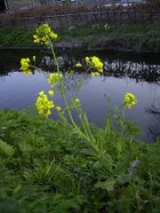
Brassica

Encyclopedia
Brassica is a genus of plants in the mustard
family (Brassicaceae
). The members of the genus may be collectively known either as cabbages, or as mustards. Crops from this genus are sometimes called cole crops, which is derived from the Latin caulis, meaning stem or cabbage.
This genus
is remarkable for containing more important agricultural and horticultural crops than any other genus. It also includes a number of weed
s, both wild taxa and escapees from cultivation. It includes over 30 wild species and hybrids, and numerous additional cultivar
s and hybrids of cultivated origin. Most are annual
s or biennial
s, but some are small shrubs. Due to their agricultural importance, Brassica plants have been the subject of much scientific interest. Six particularly important species (Brassica carinata, B. juncea, B. oleracea, B. napus, B. nigra and B. rapa) are derived by combining the chromosome
s from three earlier species, as described by the Triangle of U
theory.
The genus is native in the wild in western Europe
, the Mediterranean
and temperate regions of Asia
. In addition to the cultivated species, which are grown worldwide, many of the wild species grow as weeds, especially in North America
, South America
, and Australia
.
, turnips), stems (kohlrabi), leaves (cabbage
, kale
), flowers (cauliflower
, broccoli
), and seeds (many, including mustard seed
, and oil-producing rapeseed
). Some forms with white or purple foliage or flowerheads are also sometimes grown for ornament.
Brassica species are sometimes used as food plants by the larva
e of a number of Lepidoptera
species—see List of Lepidoptera that feed on Brassica.
and soluble fiber
and contain multiple nutrients with potent anticancer properties: 3,3'-diindolylmethane
, sulforaphane
and selenium
. Boiling reduces the level of anticancer compounds, but steaming
, microwaving
, and stir frying
do not result in significant loss. Steaming the vegetable for three to four minutes is recommended to maximize sulforaphane.
Brassica vegetables are rich in indole-3-carbinol
, a chemical which boosts DNA repair in cells and appears to block the growth of cancer cells. They are also a good source of carotenoids, with broccoli
having especially high levels. Researchers at the University of California at Berkeley have recently discovered that 3,3'-diindolylmethane in Brassica vegetables is a potent modulator of the innate immune response system with potent antiviral, antibacterial and anticancer activity; however, it also is an antiandrogen
.
These vegetables also contain goitrogen
s, which suppress thyroid function. This can induce hypothyroidism and goiter.
Mustard plant
Mustards are several plant species in the genera Brassica and Sinapis whose small mustard seeds are used as a spice and, by grinding and mixing them with water, vinegar or other liquids, are turned into the condiment known as mustard or prepared mustard...
family (Brassicaceae
Brassicaceae
Brassicaceae, a medium sized and economically important family of flowering plants , are informally known as the mustards, mustard flowers, the crucifers or the cabbage family....
). The members of the genus may be collectively known either as cabbages, or as mustards. Crops from this genus are sometimes called cole crops, which is derived from the Latin caulis, meaning stem or cabbage.
This genus
Genus
In biology, a genus is a low-level taxonomic rank used in the biological classification of living and fossil organisms, which is an example of definition by genus and differentia...
is remarkable for containing more important agricultural and horticultural crops than any other genus. It also includes a number of weed
Weed
A weed in a general sense is a plant that is considered by the user of the term to be a nuisance, and normally applied to unwanted plants in human-controlled settings, especially farm fields and gardens, but also lawns, parks, woods, and other areas. More specifically, the term is often used to...
s, both wild taxa and escapees from cultivation. It includes over 30 wild species and hybrids, and numerous additional cultivar
Cultivar
A cultivar'Cultivar has two meanings as explained under Formal definition. When used in reference to a taxon, the word does not apply to an individual plant but to all those plants sharing the unique characteristics that define the cultivar. is a plant or group of plants selected for desirable...
s and hybrids of cultivated origin. Most are annual
Annual plant
An annual plant is a plant that usually germinates, flowers, and dies in a year or season. True annuals will only live longer than a year if they are prevented from setting seed...
s or biennial
Biennial plant
A biennial plant is a flowering plant that takes two years to complete its biological lifecycle. In the first year the plant grows leaves, stems, and roots , then it enters a period of dormancy over the colder months. Usually the stem remains very short and the leaves are low to the ground, forming...
s, but some are small shrubs. Due to their agricultural importance, Brassica plants have been the subject of much scientific interest. Six particularly important species (Brassica carinata, B. juncea, B. oleracea, B. napus, B. nigra and B. rapa) are derived by combining the chromosome
Chromosome
A chromosome is an organized structure of DNA and protein found in cells. It is a single piece of coiled DNA containing many genes, regulatory elements and other nucleotide sequences. Chromosomes also contain DNA-bound proteins, which serve to package the DNA and control its functions.Chromosomes...
s from three earlier species, as described by the Triangle of U
Triangle of U
The Triangle of U is a theory about the evolution and relationships between members of the plant genus Brassica. The theory states that the genomes of three ancestral species of Brassica combined to create three of the common contemporary vegetables and oilseed crop species...
theory.
The genus is native in the wild in western Europe
Europe
Europe is, by convention, one of the world's seven continents. Comprising the westernmost peninsula of Eurasia, Europe is generally 'divided' from Asia to its east by the watershed divides of the Ural and Caucasus Mountains, the Ural River, the Caspian and Black Seas, and the waterways connecting...
, the Mediterranean
Mediterranean climate
A Mediterranean climate is the climate typical of most of the lands in the Mediterranean Basin, and is a particular variety of subtropical climate...
and temperate regions of Asia
Asia
Asia is the world's largest and most populous continent, located primarily in the eastern and northern hemispheres. It covers 8.7% of the Earth's total surface area and with approximately 3.879 billion people, it hosts 60% of the world's current human population...
. In addition to the cultivated species, which are grown worldwide, many of the wild species grow as weeds, especially in North America
North America
North America is a continent wholly within the Northern Hemisphere and almost wholly within the Western Hemisphere. It is also considered a northern subcontinent of the Americas...
, South America
South America
South America is a continent situated in the Western Hemisphere, mostly in the Southern Hemisphere, with a relatively small portion in the Northern Hemisphere. The continent is also considered a subcontinent of the Americas. It is bordered on the west by the Pacific Ocean and on the north and east...
, and Australia
Australia
Australia , officially the Commonwealth of Australia, is a country in the Southern Hemisphere comprising the mainland of the Australian continent, the island of Tasmania, and numerous smaller islands in the Indian and Pacific Oceans. It is the world's sixth-largest country by total area...
.
Food
Almost all parts of some species or other have been developed for food, including the root (rutabagaRutabaga
The rutabaga, swede , turnip or yellow turnip is a root vegetable that originated as a cross between the cabbage and the turnip; see Triangle of U...
, turnips), stems (kohlrabi), leaves (cabbage
Cabbage
Cabbage is a popular cultivar of the species Brassica oleracea Linne of the Family Brassicaceae and is a leafy green vegetable...
, kale
Kale
Kale is very high in beta carotene, vitamin K, vitamin C, lutein, zeaxanthin, and reasonably rich in calcium. Kale, as with broccoli and other brassicas, contains sulforaphane , a chemical with potent anti-cancer properties. Boiling decreases the level of sulforaphane; however, steaming,...
), flowers (cauliflower
Cauliflower
Cauliflower is one of several vegetables in the species Brassica oleracea, in the family Brassicaceae. It is an annual plant that reproduces by seed...
, broccoli
Broccoli
Broccoli is a plant in the cabbage family, whose large flower head is used as a vegetable.-General:The word broccoli, from the Italian plural of , refers to "the flowering top of a cabbage"....
), and seeds (many, including mustard seed
Mustard seed
Mustard seeds are the small round seeds of various mustard plants. The seeds are usually about 1 or 2 mm in diameter. Mustard seeds may be colored from yellowish white to black. They are important spices in many regional foods. The seeds can come from three different plants: black mustard , brown...
, and oil-producing rapeseed
Rapeseed
Rapeseed , also known as rape, oilseed rape, rapa, rappi, rapaseed is a bright yellow flowering member of the family Brassicaceae...
). Some forms with white or purple foliage or flowerheads are also sometimes grown for ornament.
Brassica species are sometimes used as food plants by the larva
Larva
A larva is a distinct juvenile form many animals undergo before metamorphosis into adults. Animals with indirect development such as insects, amphibians, or cnidarians typically have a larval phase of their life cycle...
e of a number of Lepidoptera
Lepidoptera
Lepidoptera is a large order of insects that includes moths and butterflies . It is one of the most widespread and widely recognizable insect orders in the world, encompassing moths and the three superfamilies of butterflies, skipper butterflies, and moth-butterflies...
species—see List of Lepidoptera that feed on Brassica.
Medicine
Brassica vegetables are highly regarded for their nutritional value. They provide high amounts of vitamin CVitamin C
Vitamin C or L-ascorbic acid or L-ascorbate is an essential nutrient for humans and certain other animal species. In living organisms ascorbate acts as an antioxidant by protecting the body against oxidative stress...
and soluble fiber
Dietary fiber
Dietary fiber, dietary fibre, or sometimes roughage is the indigestible portion of plant foods having two main components:* soluble fiber that is readily fermented in the colon into gases and physiologically active byproducts, and* insoluble fiber that is metabolically inert, absorbing water as it...
and contain multiple nutrients with potent anticancer properties: 3,3'-diindolylmethane
3,3'-Diindolylmethane
3,3′-Diindolylmethane or DIM is a compound derived from the digestion of indole-3-carbinol, found in cruciferous vegetables such as broccoli, Brussels sprouts, cabbage and kale. The reputation of Brassica vegetables as healthy foods rests in part on the activities of...
, sulforaphane
Sulforaphane
Sulforaphane is an organosulfur compound that exhibits anticancer, antidiabetic, and antimicrobial properties in experimental models. It is obtained from cruciferous vegetables such as broccoli, Brussels sprouts or cabbages. The enzyme myrosinase transforms glucoraphanin, a glucosinolate, into...
and selenium
Selenium
Selenium is a chemical element with atomic number 34, chemical symbol Se, and an atomic mass of 78.96. It is a nonmetal, whose properties are intermediate between those of adjacent chalcogen elements sulfur and tellurium...
. Boiling reduces the level of anticancer compounds, but steaming
Steaming
Steaming is a method of cooking using steam. Steaming is considered a healthy cooking technique and capable of cooking almost all kinds of food.-Method:...
, microwaving
Microwave oven
A microwave oven is a kitchen appliance that heats food by dielectric heating, using microwave radiation to heat polarized molecules within the food...
, and stir frying
Stir frying
Stir frying is an umbrella term used to describe two Chinese cooking techniques for preparing food in a wok: chǎo and bào . The term stir-fry was introduced into the English language by Buwei Yang Chao, in her book How to Cook and Eat in Chinese, to describe the chǎo technique...
do not result in significant loss. Steaming the vegetable for three to four minutes is recommended to maximize sulforaphane.
Brassica vegetables are rich in indole-3-carbinol
Indole-3-carbinol
Indole-3-carbinol is produced by the breakdown of the glucosinolate glucobrassicin, which can be found at relatively high levels in cruciferous vegetables. Indole-3-carbinol is the subject of on-going Biomedical research into its possible anticarcinogenic, antioxidant, and anti-atherogenic effects...
, a chemical which boosts DNA repair in cells and appears to block the growth of cancer cells. They are also a good source of carotenoids, with broccoli
Broccoli
Broccoli is a plant in the cabbage family, whose large flower head is used as a vegetable.-General:The word broccoli, from the Italian plural of , refers to "the flowering top of a cabbage"....
having especially high levels. Researchers at the University of California at Berkeley have recently discovered that 3,3'-diindolylmethane in Brassica vegetables is a potent modulator of the innate immune response system with potent antiviral, antibacterial and anticancer activity; however, it also is an antiandrogen
Antiandrogen
Antiandrogens, or androgen antagonists, first discovered in the 1960s, prevent androgens from expressing their biological effects on responsive tissues. Antiandrogens alter the androgen pathway by blocking the appropriate receptors, competing for binding sites on the cell's surface, or affecting...
.
These vegetables also contain goitrogen
Goitrogen
Goitrogens are substances that suppress the function of the thyroid gland by interfering with iodine uptake, which can, as a result, cause an enlargement of the thyroid, i.e., a goitre.-Goitrogenic drugs and chemicals:...
s, which suppress thyroid function. This can induce hypothyroidism and goiter.
Species
There is some disagreement among botanists on the classification and status of Brassica species and subspecies. The following is an abbreviated list, with an emphasis on economically important species.- B. carinataBrassica carinataBrassica carinata is a member of the Triangle of U species in the agriculturally significant Brassica genus...
: Abyssinian mustard or Abyssinian cabbage, used to produce biodieselBiodieselBiodiesel refers to a vegetable oil- or animal fat-based diesel fuel consisting of long-chain alkyl esters. Biodiesel is typically made by chemically reacting lipids with an alcohol.... - B. elongata: elongated mustard
- B. fruticulosa: Mediterranean cabbage
- B. junceaBrassica junceaBrassica juncea, also known as mustard greens, Indian mustard, Chinese mustard, and leaf mustard, is a species of mustard plant. Subvarieties include southern giant curled mustard, which resembles a headless cabbage such as kale, but with a distinct horseradish-mustard flavor...
: Indian mustard, brown and leaf mustards, Sarepta mustard - B. napus: rapeseedRapeseedRapeseed , also known as rape, oilseed rape, rapa, rappi, rapaseed is a bright yellow flowering member of the family Brassicaceae...
, canolaCanolaCanola refers to a cultivar of either Rapeseed or Field Mustard . Its seeds are used to produce edible oil suitable for consumption by humans and livestock. The oil is also suitable for use as biodiesel.Originally, Canola was bred naturally from rapeseed in Canada by Keith Downey and Baldur R...
, rutabagaRutabagaThe rutabaga, swede , turnip or yellow turnip is a root vegetable that originated as a cross between the cabbage and the turnip; see Triangle of U...
(swede/Swedish turnip/swede turnip) - B. narinosa: broadbeaked mustard
- B. nigraBrassica nigraBrassica nigra is an annual weedy plant cultivated for its seeds, which are commonly used as a spice.-Description:...
: black mustard - B. oleraceaBrassica oleraceaBrassica oleracea, or wild cabbage, is a species of Brassica native to coastal southern and western Europe, where its tolerance of salt and lime and its intolerance of competition from other plants typically restrict its natural occurrence to limestone sea cliffs, like the chalk cliffs on both...
: kaleKaleKale is very high in beta carotene, vitamin K, vitamin C, lutein, zeaxanthin, and reasonably rich in calcium. Kale, as with broccoli and other brassicas, contains sulforaphane , a chemical with potent anti-cancer properties. Boiling decreases the level of sulforaphane; however, steaming,...
, cabbageCabbageCabbage is a popular cultivar of the species Brassica oleracea Linne of the Family Brassicaceae and is a leafy green vegetable...
, broccoliBroccoliBroccoli is a plant in the cabbage family, whose large flower head is used as a vegetable.-General:The word broccoli, from the Italian plural of , refers to "the flowering top of a cabbage"....
, cauliflowerCauliflowerCauliflower is one of several vegetables in the species Brassica oleracea, in the family Brassicaceae. It is an annual plant that reproduces by seed...
, kai-lanKai-lanKai-lan, also known as Chinese broccoli, is a leaf vegetable featuring thick, flat, glossy blue-green leaves with thick stems and a small number of tiny, almost vestigial flower heads similar to those of broccoli. Broccoli and kai-lan belong to the same species Brassica oleracea, but kai-lan is in...
, Brussels sproutBrussels sproutThe Brussels sprout is a cultivar of wild cabbage grown for its edible buds. The leafy green vegetables are typically 2.5–4 cm in diameter and look like miniature cabbages. The sprout is Brassica oleracea, in the "gemmifera" group of the family Brassicaceae...
s, kohlrabi - B. perviridis: tender green, mustard spinach
- B. rapaBrassica rapaBrassica rapa L. , commonly known as turnip, turnip rape, field mustard or turnip mustard is a plant widely cultivated as a leaf vegetable , a root vegetable , and an oilseed .In the 18th century the turnip and...
(syn B. campestris): Chinese cabbageChinese cabbageChinese cabbage can refer to two distinct varieties of Chinese leaf vegetables used often in Chinese cuisine. These vegetables are both related to the Western cabbage, and are of the same species as the common turnip...
, turnip, rapiniRapiniRapini Rapini Rapini (also known as Broccoli Rabe (or Raap or Raab), Broccoletti, Broccoli di Rape, Cime di Rapa, Rape, Rappi, Friarielli (in Naples) is a common vegetable in the cuisines of southern Italy (in particular Basilicata , Puglia, and Sicily), Galicia (northwestern Spain), and China...
, komatsunaKomatsunaKomatsuna is a type of leaf vegetable. It is a variant of the same species as the common turnip. It is grown commercially in Japan, Taiwan and Korea; the name is from Japanese . It is also known as Japanese Mustard Spinach and is usually stir-fried, pickled, boiled and added to soups or used fresh... - B. rupestris: brown mustard
- B. septiceps: seventop turnip
- B. tournefortiiBrassica tournefortiiThe mustard species Brassica tournefortii is known by the common names Asian mustard, African mustard, and Sahara mustard, and is well-known as an invasive species, especially in California....
: Asian mustard
Deprecated species names
- B. kaber (wild mustard or charlock)—see Sinapis arvensisSinapis arvensisSinapis arvensis is an annual or winter annual plant of the genus Sinapis, belonging to the family Brassicaceae. It is commonly known as Field mustard, Wild mustard or charlock.-Etymology:...
- B. alba or B. hirta (white or yellow mustard)—see Sinapis albaWhite MustardWhite mustard is an annual plant of the family Brassicaceae. It is sometimes also referred to as Brassica alba or B. hirta...
- B. geniculata (hoary mustard)—see Hirschfeldia incanaHirschfeldia incanaHirschfeldia incana is a species of flowering plant in the mustard family known by many common names, including Shortpod mustard, Buchanweed, Hoary mustard and Mediterranean mustard. It is the only species in the monotypic genus Hirschfeldia, which is closely related to Brassica...
Genome sequencing and genetics
Bayer Cropscience (in collaboration with BGI-Shenzhen, China, Keygene N.V., the Netherlands and the University of Queensland, Australia) announced it had sequenced the entire genome of rapeseed/canola (Brassica napus) and its constituent genomes present in B. rapa and B. oleracea in 2009. The B. rapa genome is currently being sequenced by the Multinational Brassica Genome Project. This also represents the A genome component of the amphidiploid crop species B. napus and B. juncea.See also
- Cruciferous vegetablesCruciferous vegetablesVegetables of the family Brassicaceae are called cruciferous vegetables. The vegetables are widely cultivated, with many genera, species, and cultivars being raised for food production such as cauliflower, cabbage, cress, bok choy, broccoli and similar green leaf vegetables...
for more edible plants of the Brassicaceae family. - Gene nomenclatureGene nomenclatureGene nomenclature is the scientific naming of genes, the units of heredity in living organisms. An international committee published recommendations for genetic symbols and nomenclature in 1957. The need to develop formal guidelines for human gene names and symbols was recognized in the 1960s and...
- Mustard plantMustard plantMustards are several plant species in the genera Brassica and Sinapis whose small mustard seeds are used as a spice and, by grinding and mixing them with water, vinegar or other liquids, are turned into the condiment known as mustard or prepared mustard...
- Triangle of UTriangle of UThe Triangle of U is a theory about the evolution and relationships between members of the plant genus Brassica. The theory states that the genomes of three ancestral species of Brassica combined to create three of the common contemporary vegetables and oilseed crop species...