
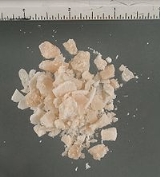
Crack cocaine is the freebase form of
cocaineCocaine is a crystalline tropane alkaloid that is obtained from the leaves of the coca plant. The name comes from "coca" in addition to the alkaloid suffix -ine, forming cocaine. It is a stimulant of the central nervous system, an appetite suppressant, and a topical anesthetic...
that can be smoked. It may also be termed
rock,
hard,
iron,
cavvy,
base, or just
crack; it is the most addictive form of cocaine. Crack rocks offer a short but intense
highEuphoria is medically recognized as a mental and emotional condition in which a person experiences intense feelings of well-being, elation, happiness, ecstasy, excitement and joy...
to smokers. Crack appeared primarily in
impoverishedPoverty is defined as the state of one who lacks a usual or socially acceptable amount of money or material possessions. According to the U.S. Census Bureau data released Tuesday September 13th, 2011, the nation's poverty rate rose to 15.1% in 2010, up from 14.3% in 2009 and to its highest level...
inner-city neighborhoods in
New YorkNew York is the most populous city in the United States and the center of the New York Metropolitan Area, one of the most populous metropolitan areas in the world. New York exerts a significant impact upon global commerce, finance, media, art, fashion, research, technology, education, and...
,
Los AngelesLos Ángeles is the capital of the province of Biobío, in the commune of the same name, in Region VIII , in the center-south of Chile. It is located between the Laja and Biobío rivers. The population is 123,445 inhabitants...
, and Miami in late 1984 and 1985. Its rise to popularity can be attributed to the discovery that baking soda (
sodium bicarbonateSodium bicarbonate or sodium hydrogen carbonate is the chemical compound with the formula Na HCO3. Sodium bicarbonate is a white solid that is crystalline but often appears as a fine powder. It has a slightly salty, alkaline taste resembling that of washing soda . The natural mineral form is...
, NaHCO
3) was a low cost and simple replacement for the ether used in preparation of free base cocaine. The name "crack" refers to the sound generated during its manufacture and when smoked.
Appearance and characteristics
In purer forms, crack rocks appear as off-white nuggets with jagged edges, with a slightly higher density than candle wax. Purer forms of crack resemble a hard brittle plastic, in crystalline form (snaps when broken). A crack rock acts as a
local anestheticA local anesthetic is a drug that causes reversible local anesthesia, generally for the aim of having local analgesic effect, that is, inducing absence of pain sensation, although other local senses are often affected as well...
(see:
cocaineCocaine is a crystalline tropane alkaloid that is obtained from the leaves of the coca plant. The name comes from "coca" in addition to the alkaloid suffix -ine, forming cocaine. It is a stimulant of the central nervous system, an appetite suppressant, and a topical anesthetic...
), numbing the tongue or mouth only where directly placed. When smoked, crack can leave the tongue numb where the smoke enters the mouth. Purer forms of crack will sink in water or melt at the edges when near a flame (crack vaporizes at 90 °C, 194 °F).
Crack cocaine as sold on the streets may be adulterated or "buffed" to increase bulk. According to Cpl. Kent Dahl, with Red Deer RCMP Federal Drugs, Canada, white substances mimicking the appearance of cocaine are added to increase bulk. Use of toxic adulterants such as
levamisoleLevamisole is an anthelminthic and immunomodulator belonging to a class of synthetic imidazothiazole derivatives. It was discovered at Janssen Pharmaceutica in 1966...
has been documented.
Chemistry
Crack
cocaineCocaine is a crystalline tropane alkaloid that is obtained from the leaves of the coca plant. The name comes from "coca" in addition to the alkaloid suffix -ine, forming cocaine. It is a stimulant of the central nervous system, an appetite suppressant, and a topical anesthetic...
, often nicknamed "
crack" after the sound made during its manufacture and when smoked, appeared primarily in impoverished inner-city neighborhoods in
New YorkNew York is the most populous city in the United States and the center of the New York Metropolitan Area, one of the most populous metropolitan areas in the world. New York exerts a significant impact upon global commerce, finance, media, art, fashion, research, technology, education, and...
,
Los AngelesLos Ángeles is the capital of the province of Biobío, in the commune of the same name, in Region VIII , in the center-south of Chile. It is located between the Laja and Biobío rivers. The population is 123,445 inhabitants...
, and Miami in late 1984 and 1985. Because of the dangers for manufacturers of using
etherEthers are a class of organic compounds that contain an ether group — an oxygen atom connected to two alkyl or aryl groups — of general formula R–O–R'. A typical example is the solvent and anesthetic diethyl ether, commonly referred to simply as "ether"...
to produce pure freebase cocaine, producers began to omit the step of removing the freebase precipitate from the
ammoniaAmmonia is a compound of nitrogen and hydrogen with the formula . It is a colourless gas with a characteristic pungent odour. Ammonia contributes significantly to the nutritional needs of terrestrial organisms by serving as a precursor to food and fertilizers. Ammonia, either directly or...
mixture. Typically, filtration processes are also omitted. The end result is that the cut, in addition to the ammonium salt (NH
4Cl), remains in the freebase cocaine after the mixture has evaporated. The "rock" that is thus formed also contains a small amount of water.
Sodium bicarbonateSodium bicarbonate or sodium hydrogen carbonate is the chemical compound with the formula Na HCO3. Sodium bicarbonate is a white solid that is crystalline but often appears as a fine powder. It has a slightly salty, alkaline taste resembling that of washing soda . The natural mineral form is...
(NaHCO
3, common baking soda) is a base used in preparation of crack, although other
weak baseIn chemistry, a weak base is a chemical base that does not ionize fully in an aqueous solution. As Brønsted–Lowry bases are proton acceptors, a weak base may also be defined as a chemical base in which protonation is incomplete. This results in a relatively low pH compared to strong bases...
s may substitute for it. The net reaction when using sodium bicarbonate is
- Coc-H+Cl− + NaHCO3 → Coc + H2O + CO2 + NaCl
With
Ammonium bicarbonateAmmonium bicarbonate, a compound with formulaNH4, also called bicarbonate of ammonia, ammonium hydrogen carbonate, hartshorn, AmBic or powdered baking ammonia, is the bicarbonate salt of ammonia....
:
- Coc-H+Cl− + NH4HCO3 → Coc + NH4Cl
Ammonium chloride NH4Cl is an inorganic compound with the formula NH4Cl. It is a white crystalline salt that is highly soluble in water. Solutions of ammonium chloride are mildly acidic. Sal ammoniac is a name of natural, mineralogical form of ammonium chloride...
+ CO2 + H2O
With
Ammonium carbonateAmmonium carbonate is a commercial salt with the chemical formula 2CO3. It is used when crushed as a smelling salt. It can be crushed when needed in order to revive someone who has fainted...
:
- 2(Coc-H+Cl−) + (NH4)2CO3 → 2 Coc + 2 NH4Cl + CO2 + H2O
Crack cocaine is usually purchased already in rock form, although it is not uncommon for some users to "wash up" or "cook" the cocaine into crack themselves. This process is done with baking soda (sodium bicarbonate), water, and a spoon. Once mixed and heated, the bicarbonate breaks down into carbon dioxide and sodium carbonate, which then reacts with the hydrochloride of the cocaine molecule, leaving cocaine as an oily free base. Once separated from the hydrochloride, the cocaine alkaloid floats to the top of the now leftover liquid. It is at this point that the oil is picked up rapidly, usually with a pin or long thin object. This pulls the oil up and spins it, allowing air to set and dry the oil, and allows the user and/or maker to roll the oil into the rock-like shape.
Crack vaporizes near temperature 90 °C (194 °F), much lower than the cocaine hydrochloride melting point of 190 °C (374 °F).
Whereas cocaine hydrochloride cannot be smoked (burns with no effect),
crack cocaine when smoked allows for quick absorption into the blood stream, and reaches the brain in 8 seconds.
Users obtain an intense high much more quickly thusly than with the normal method of insufflating ("sniffing" or "snorting") powder cocaine. Crack cocaine can also be injected intravenously with the same effect as powder cocaine. However, whereas powder cocaine dissolves in water, crack must be dissolved in an acidic solution such as lemon juice or white vinegar.
Psychological effects
Crack cocaine is a substance that affects the brain chemistry of the user: causing
euphoriaEuphoria is medically recognized as a mental and emotional condition in which a person experiences intense feelings of well-being, elation, happiness, ecstasy, excitement and joy...
, supreme confidence, loss of appetite, insomnia, alertness, increased energy, a craving for more cocaine,
and potential paranoia (ending after use).
Its initial effect is to release a large amount of
dopamineDopamine is a catecholamine neurotransmitter present in a wide variety of animals, including both vertebrates and invertebrates. In the brain, this substituted phenethylamine functions as a neurotransmitter, activating the five known types of dopamine receptors—D1, D2, D3, D4, and D5—and their...
, a brain chemical inducing feelings of
euphoriaEuphoria is medically recognized as a mental and emotional condition in which a person experiences intense feelings of well-being, elation, happiness, ecstasy, excitement and joy...
. The high usually lasts from 5–10 minutes, after which time dopamine levels in the brain plummet, leaving the user feeling
depressedDepression is a state of low mood and aversion to activity that can affect a person's thoughts, behaviour, feelings and physical well-being. Depressed people may feel sad, anxious, empty, hopeless, helpless, worthless, guilty, irritable, or restless...
and low. When cocaine is dissolved and injected, the absorption into the bloodstream is at least as rapid as the absorption of the drug which occurs when crack cocaine is smoked, and similar
euphoriaEuphoria is medically recognized as a mental and emotional condition in which a person experiences intense feelings of well-being, elation, happiness, ecstasy, excitement and joy...
may be experienced.
A typical response among users is to have another hit of the drug; however, the levels of dopamine in the brain take a long time to replenish themselves, and each hit taken in rapid succession leads to progressively less intense highs. However, a person might binge for 3 or more days without sleep, while partying with hits from the pipe.
Use of cocaine in a binge, during which the drug is taken repeatedly and at increasingly high doses, leads to a state of increasing irritability, restlessness, and paranoia.
This may result in a full-blown paranoid psychosis, in which the individual loses touch with reality and experiences auditory hallucinations.
Stimulant drug abuse (particularly amphetamine and cocaine) can lead to
delusional parasitosisDelusional parasitosis is a form of psychosis whose victims acquire a strong delusional belief that they are infested with parasites, whereas in reality no such parasites are present...
(aka Ekbom's Syndrome: a mistaken belief they are infested with parasites). For example, excessive cocaine use can lead to
formicationFormication is the medical term for a sensation that resembles that of insects crawling on the skin. It is one specific form of a set of sensations known as paresthesia, which also include the more common prickling, tingling sensation of "pins and needles"...
, nicknamed "cocaine bugs" or "coke bugs," where the affected people believe they have, or feel, parasites crawling under their skin.
(Similar delusions may also be associated with high fever or in connection with alcohol withdrawal, sometimes accompanied by visual hallucinations of insects.)
People experiencing these hallucinations might scratch themselves to the extent of serious skin damage and bleeding, especially when they are delirious.
Physiological effects
The short-term physiological effects of cocaine include constricted blood vessels, dilated pupils, and increased temperature, heart rate, and blood pressure. Large amounts (several hundred milligrams or more) intensify the user's high, but may also lead to bizarre, erratic, and violent behavior.
Large amounts can induce tremors,
vertigoVertigo is a type of dizziness, where there is a feeling of motion when one is stationary. The symptoms are due to a dysfunction of the vestibular system in the inner ear...
, muscle twitches,
paranoiaParanoia [] is a thought process believed to be heavily influenced by anxiety or fear, often to the point of irrationality and delusion. Paranoid thinking typically includes persecutory beliefs, or beliefs of conspiracy concerning a perceived threat towards oneself...
, or, with repeated doses, a toxic reaction closely resembling
amphetamineAmphetamine or amfetamine is a psychostimulant drug of the phenethylamine class which produces increased wakefulness and focus in association with decreased fatigue and appetite.Brand names of medications that contain, or metabolize into, amphetamine include Adderall, Dexedrine, Dextrostat,...
poisoning. Some users of cocaine report feelings of restlessness, irritability, and anxiety. In rare instances, sudden death can occur on the first use of cocaine or unexpectedly thereafter.
Cocaine-related deaths are often a result of
cardiac arrestCardiac arrest, is the cessation of normal circulation of the blood due to failure of the heart to contract effectively...
or seizures followed by respiratory arrest.
An appreciable tolerance to cocaine’s high may develop, with many addicts reporting that they seek but fail to achieve as much pleasure as they did from their first experience.
Some users will frequently increase their doses to intensify and prolong the euphoric effects. While tolerance to the high can occur, users might also become more sensitive (sensitization) to cocaine's anesthetic and convulsant effects, without increasing the dose taken: this increased sensitivity may explain some deaths occurring after apparently low doses of cocaine.
Addiction
Crack cocaine is popularly thought to be the most addictive form of cocaine, and one of the most addictive forms of any drug. However, this claim has been contested: Morgan and Zimmer wrote that available data indicated that "...smoking cocaine by itself does not increase markedly the likelihood of dependence.... The claim that cocaine is much more addictive when smoked must be reexamined." They argued that cocaine users who are already prone to abuse are most likely to "move toward a more efficient mode of ingestion" (that is, smoking).
The intense desire to recapture the initial high is what is so addictive for many users. On the other hand, Reinarman et al. wrote that the nature of crack addiction depends on the social context in which it is used and the psychological characteristics of users, pointing out that many heavy crack users go for days or weeks without using the drugs.
Health issues
Because crack also refers to non-pure (or fake) versions of rock cocaine, the health issues also include risks beyond smoking cocaine. However, crack usage is less dangerous than
speedballingSpeedball is a term commonly referring to the hazardous intravenous use of heroin or morphine and cocaine together in the same syringe. The speedball can also be taken by insufflation. The original speedball used cocaine hydrochloride mixed with morphine sulfate, as opposed to heroin...
or "snowballing" (mixing cocaine with
heroin), which can lead to more fatalities than either drug used on its own.
When large amounts of dopamine are released by crack consumption, it becomes easier for the brain to generate motivation for other activities. The activity also releases a large amount of adrenaline into the body, which tends to increase heart rate
and blood pressure, leading to long-term cardiovascular problems. It is suggested by research that smoking crack or freebase cocaine has additional health issues beyond other methods of taking cocaine. Many of these issues relate specifically to the release of
methylecgonidineMethylecgonidine is a chemical intermediate derived from ecgonine or cocaine.Methylecgonidine is a pyrolysis product formed when crack cocaine is smoked, making this substance a useful biomarker to specifically test for use of crack cocaine, as opposed to powder cocaine which does not form...
, and the specific effect of methylecgonidine on the heart, lungs, and liver.
- Toxic adulterant
An adulterant is a chemical substance which should not be contained within other substances for legal or other reasons. Adulterants may be intentionally added to more expensive substances to increase visible quantities and reduce manufacturing costs or for some other deceptive or malicious purpose...
s: As noted previously, virtually any substance may have been added in order to expand the volume of a batch, or appear to be pure crack. Occasionally, highly toxic substances are used, with an indefinite range of corresponding short and long-term health risks. For example, if candle wax or macadamia are procured (as a form of fake crack) they will burn in a crack pipe producing a noxious smoke.
- Smoking problems: The task of introducing the drug into the body further presents a series of health risks. Crack cannot be snorted like regular cocaine, so smoking is the most common consumption method. Crack has a melting point of around , and the smoke does not remain potent for long. Therefore, crack pipes are generally very short, to minimise the time between evaporating and losing strength. This often causes cracked and blistered lips, colloquially "crack lip", from having a very hot pipe pressed against the lips. The use of "convenience store crack pipes" - glass tubes which originally contained small artificial roses
A love rose consists of a glass tube with a paper or plastic rose inside of it, and a bit of cork or foil on the ends to keep the rose from falling out. While ostensibly intended as romantic gifts, their primary known use is as a crack pipe by users of crack cocaine...
- may also create this condition. These 4-inch (10-cm) pipes are not durable and will quickly develop breaks; users will typically continue to use the pipe even though it has been broken to a shorter length. The hot pipe might burn the lips, tongue, or fingers, especially when shared with other people quickly taking another hit from the already hot short pipe.
- Pure or large doses: Because the quality of crack can vary greatly, some people might smoke larger amounts of diluted crack, unaware that a similar hit of a new batch of purer crack could cause an overdose: triggering heart problems or rendering the user unconscious.
- Pathogens on pipes: When pipes are shared, unless users rotate and push the pipe to the burnt, sterilized end, any bacteria or viruses from the previous user's mouth can be transferred: tuberculosis
Tuberculosis, MTB, or TB is a common, and in many cases lethal, infectious disease caused by various strains of mycobacteria, usually Mycobacterium tuberculosis. Tuberculosis usually attacks the lungs but can also affect other parts of the body...
can be spread by saliva. In terms of harm reduction, mouth pieces (lengths of tubing added to the end of the glass pipe) should be used and not shared.
- Pathogens in needles/spoons: When crack is cooked down, as in a spoon with vinegar or lemon juice, for injecting with a syringe, diseases can be spread. Blood-borne disease
A blood-borne disease is one that can be spread through contamination by blood.The most common examples are HIV, hepatitis B, hepatitis C and viral hemorrhagic fevers....
such as HIVHuman immunodeficiency virus is a lentivirus that causes acquired immunodeficiency syndrome , a condition in humans in which progressive failure of the immune system allows life-threatening opportunistic infections and cancers to thrive...
can be passed through a shared needle (or shared spoon if the needle is emptied into the spoon). From a harm reduction perspective, clean injection equipment should always be used and never shared. Ascorbic acid is safer for use than vinegar.
As a comparison, studies have shown that long-term insufflation (snorting) of cocaine in powder form can, after extensive use, destroy tissues in the nasal cavity,
and has been known to create
deviated septaNasal septum deviation is a common physical disorder of the nose, involving a displacement of the nasal septum.-Causes:It is most frequently caused by impact trauma, such as by a blow to the face. It can also be a congenital disorder, caused by compression of the nose during childbirth...
, potentially collapsing the nose.
- Addiction is widely considered a health issue. Many governments have made access to clean equipment and education regarding safer practices difficult, as the use of cocaine is illegal.
Effects in pregnancy and nursing
"Crack baby" is a term for a child born to a mother who used crack cocaine during her pregnancy. The notion that cocaine use during
pregnancyPregnancy refers to the fertilization and development of one or more offspring, known as a fetus or embryo, in a woman's uterus. In a pregnancy, there can be multiple gestations, as in the case of twins or triplets...
poses a threat to the
fetusA fetus is a developing mammal or other viviparous vertebrate after the embryonic stage and before birth.In humans, the fetal stage of prenatal development starts at the beginning of the 11th week in gestational age, which is the 9th week after fertilization.-Etymology and spelling variations:The...
is now widely discredited. Studies show that prenatal cocaine exposure (independent of other effects such as, for example, alcohol, tobacco, or physical environment) has no appreciable effect on childhood growth and development.
However, the official opinion of the
National Institute on Drug AbuseThe National Institute on Drug Abuse is a United States federal-government research institute whose mission is to "lead the Nation in bringing the power of science to bear on drug abuse and addiction."-History:...
of the United States warns about health risks while cautioning against stereotyping:
Many recall that "crack babies," or babies born to mothers who used crack cocaine while pregnant, were at one time written off by many as a lost generation. They were predicted to suffer from severe, irreversible damage, including reduced intelligence and social skills. It was later found that this was a gross exaggeration. However, the fact that most of these children appear normal should not be overinterpreted as indicating that there is no cause for concern. Using sophisticated technologies, scientists are now finding that exposure to cocaine during fetal development may lead to subtle, yet significant, later deficits in some children, including deficits in some aspects of cognitive performance, information-processing, and attention to tasks—abilities that are important for success in school.
Some people previously believed that crack cocaine caused infant death as
SIDSSudden infant death syndrome is marked by the sudden death of an infant that is unexpected by medical history, and remains unexplained after a thorough forensic autopsy and a detailed death scene investigation. An infant is at the highest risk for SIDS during sleep, which is why it is sometimes...
, but when investigators began looking at the incidence of SIDS in the children of women who used crack cocaine, they found it to be no higher than in children of women who smoked cigarettes.
There are also warnings about the threat of
breastfeedingBreastfeeding is the feeding of an infant or young child with breast milk directly from female human breasts rather than from a baby bottle or other container. Babies have a sucking reflex that enables them to suck and swallow milk. It is recommended that mothers breastfeed for six months or...
: "It is likely that cocaine will reach the baby through breast milk."
The
March of DimesThe March of Dimes Foundation is a United States nonprofit organization that works to improve the health of mothers and babies.-Organization:...
advises the following regarding cocaine use during pregnancy:
Cocaine use during pregnancy can affect a pregnant woman and her unborn baby in many ways. During the early months of pregnancy, it may increase the risk of miscarriage. Later in pregnancy, it can trigger preterm labor (labor that occurs before 37 weeks of pregnancy) or cause the baby to grow poorly. As a result, cocaine-exposed babies are more likely than unexposed babies to be born with low birthweight (less than 5.5 lb (2.5 kg)). Low-birthweight babies are 20 times more likely to die in their first month of life than normal-weight babies, and face an increased risk of lifelong disabilities such as mental retardation and cerebral palsy. Cocaine-exposed babies also tend to have smaller heads, which generally reflect smaller brains. Some studies suggest that cocaine-exposed babies are at increased risk of birth defects, including urinary-tract defects and, possibly, heart defects. Cocaine also may cause an unborn baby to have a stroke, irreversible brain damage, or a heart attack.
Canada
As a Schedule I substance, crack is not differentiated from cocaine and other
cocaCoca, Erythroxylum coca, is a plant in the family Erythroxylaceae, native to western South America. The plant plays a significant role in many traditional Andean cultures...
products in the
Criminal Code of CanadaThe Criminal Code or Code criminel is a law that codifies most criminal offences and procedures in Canada. Its official long title is "An Act respecting the criminal law"...
. However, the court may weigh the socio-economic factors of crack usage in sentencing. As a guideline, Schedule I drugs carry a maximum 7 year prison sentence for possession for an indictable offense, up to life imprisonment for trafficking and production. A summary conviction on possession carries a $1000–$2000 fine and/or 6 months to a year imprisonment.
United States
Cocaine is listed as a Schedule I drug in the United Nations 1961
Single Convention on Narcotic DrugsThe Single Convention on Narcotic Drugs of 1961 is an international treaty to prohibit production and supply of specific drugs and of drugs with similar effects except under licence for specific purposes, such as medical treatment and research...
, making it illegal for non-state-sanctioned production, manufacture, export, import, distribution, trade, use and possession.
In the United States cocaine is a Schedule II drug under the
Controlled Substances ActThe Controlled Substances Act was enacted into law by the Congress of the United States as Title II of the Comprehensive Drug Abuse Prevention and Control Act of 1970. The CSA is the federal U.S. drug policy under which the manufacture, importation, possession, use and distribution of certain...
since it has high abuse potential but also carries a medicinal purpose. Under the DEA listing of schedule I substances, crack is not considered separate from cocaine since they are essentially the same drug compound in different forms.
There has been some controversy over the disproportionate sentences
mandatedA mandatory sentence is a court decision setting where judicial discretion is limited by law. Typically, people convicted of certain crimes must be punished with at least a minimum number of years in prison...
by the
Federal Sentencing GuidelinesThe Federal Sentencing Guidelines are rules that set out a uniform sentencing policy for individuals and organizations convicted of felonies and serious misdemeanors in the United States federal courts system...
for crack cocaine (versus powder cocaine) since 1986. Whereas there was a 5-year minimum sentence for trafficking 500g of powdered cocaine, the same sentence could be imposed for mere possession of 5 grams of crack cocaine, a 100:1 ratio. There is no mandatory minimum sentence for mere possession of powder cocaine. The
United States Sentencing CommissionThe United States Sentencing Commission is an independent agency of the judicial branch of the federal government of the United States. It is responsible for articulating the sentencing guidelines for the United States federal courts...
long recommended that this disparity be rectified and existing sentences reduced. Some claim that this disparity amounts to
institutional racismInstitutional racism describes any kind of system of inequality based on race. It can occur in institutions such as public government bodies, private business corporations , and universities . The term was coined by Black Power activist Stokely Carmichael in the late 1960s...
, as crack cocaine is more common in inner-city black communities, and powder cocaine in white suburban communities.
The
Supreme CourtThe Supreme Court of the United States is the highest court in the United States. It has ultimate appellate jurisdiction over all state and federal courts, and original jurisdiction over a small range of cases...
ruled in
Kimbrough v. United StatesIn Kimbrough v. United States, 552 U.S. 85 , the Supreme Court confirmed that federal district judges have discretion to impose sentences outside the range dictated by the Federal Sentencing Guidelines in cases involving conduct related to possession, distribution, and manufacture of crack...
(2007) that the Guidelines for cocaine are advisory only, and that a judge may consider the disparity between the Guidelines' treatment of crack and powder cocaine offenses when sentencing a
defendantA defendant or defender is any party who is required to answer the complaint of a plaintiff or pursuer in a civil lawsuit before a court, or any party who has been formally charged or accused of violating a criminal statute...
. The
Fair Sentencing ActThe Fair Sentencing Act of 2010 was an Act of Congress signed into law by U.S. President Barack Obama on August 3, 2010. Similar bills were introduced in several U.S. Congresses before its passage in 2010...
reduced the disparity between United States federal criminal penalties for crack cocaine and powder cocaine offenses from a 100:1 ratio to an 18:1 ratio (based on the number of grams of cocaine in possession) and eliminated the five-year mandatory minimum sentence for simple possession of crack cocaine, among other provisions.
Europe
In the United Kingdom crack is a
Class A drug. In the
NetherlandsThe Netherlands is a constituent country of the Kingdom of the Netherlands, located mainly in North-West Europe and with several islands in the Caribbean. Mainland Netherlands borders the North Sea to the north and west, Belgium to the south, and Germany to the east, and shares maritime borders...
it is a List 1 drug of the
Opium LawThe Opium Law is the section of the Dutch law which covers nearly all psychotropic drugs. All non-psychotropic, but prescription-only drugs are covered by the Medicine Act.- Origin and history :...
.
See also
- CIA and Contras cocaine trafficking in the US
- Cocaine paste ("paco")
- Crack epidemic
- Oxi, a similar drug made from cocaine paste
- Related numbing (analgesic
An analgesic is any member of the group of drugs used to relieve pain . The word analgesic derives from Greek an- and algos ....
) medicines: proparacaine, tetracaineTetracaine is a potent local anesthetic of the ester group...
, lidocaineLidocaine , Xylocaine, or lignocaine is a common local anesthetic and antiarrhythmic drug. Lidocaine is used topically to relieve itching, burning and pain from skin inflammations, injected as a dental anesthetic or as a local anesthetic for minor surgery.- History :Lidocaine, the first amino...
, procaineProcaine is a local anesthetic drug of the amino ester group. It is used primarily to reduce the pain of intramuscular injection of penicillin, and it was also used in dentistry. Owing to the ubiquity of the trade name Novocain, in some regions procaine is referred to generically as novocaine...
, hexylcaine, bupivacaineBupivacaine is a local anaesthetic drug belonging to the amino amide group. AstraZeneca commonly markets it under various trade names, including Marcain, Marcaine, Sensorcaine and Vivacaine.-Indications:...
, benoxinate, mepivacaineMepivacaine is a local anesthetic of the amide type. Mepivacaine has a reasonably rapid onset and medium duration of action and is marketed under various trade names including Carbocaine and Polocaine.Mepivacaine became available in the United States in the 1960s.Mepivacaine is used in any...
, prilocainePrilocaine is a local anesthetic of the amino amide type first prepared by Claes Tegner and Nils Lofgren. In its injectable form , it is often used in dentistry. It is also often combined with lidocaine as a preparation for dermal anesthesia , for treatment of conditions like paresthesia...
, etidocaineEtidocaine, marketed under the trade name Duranest, is a local anesthetic given by injection during surgical procedures and labor and delivery. Etidocaine has a long duration of activity, and the main disadvantage of using during dentistry is increased bleeding during surgery....
, benzocaineBenzocaine is a local anesthetic commonly used as a topical pain reliever, or in cough drops. It is the active ingredient in many over-the-counter anesthetic ointments...
, chloroprocaineChloroprocaine is a local anesthetic given by injection during surgical procedures and labor and delivery. Chloroprocaine constricts blood vessels resulting in reduced blood loss; this is in contrast to other local anesthetics e.g. lidocaine, which do not do such...
, propoxycainePropoxycaine is a local anesthetic....
, dyclonineDyclonine is an oral anaesthetic found in Sucrets, an over the counter throat lozenge. It is also found in some varieties of the Cepacol sore throat spray. It is a bactericidal and fungicidal local anesthetic, used topically as the hydrochloride salt....
, dibucaine, and pramoxine.
- Substance abuse
A substance-related disorder is an umbrella term used to describe several different conditions associated with several different substances .A substance related disorder is a condition in which an individual uses or abuses a...
- War on Drugs
The War on Drugs is a campaign of prohibition and foreign military aid and military intervention being undertaken by the United States government, with the assistance of participating countries, intended to both define and reduce the illegal drug trade...
Further reading
External links