

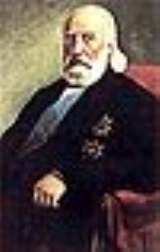
Constantine Kanaris

Encyclopedia
Constantine Kanaris or Canaris (1793 or 1795September 2, 1877) was a Greek
Prime Minister
, admiral
and politician
who in his youth was also a freedom fighter, pirate, privateer
and merchantman.
, close to the island of Chios
, in the Aegean
. His exact year of birth is unknown. The official records of the Hellenic Navy
indicate 1795 but modern Greek historians believe that 1793 is more probable.
Constantine was left an orphan at a young age. Having to support himself, he chose to became a seaman like most members of his family since the beginning of the 18th century. He was hired as a boy on the brig of his uncle Dimitris Bourekas.
(1821–1829). Unlike most other prominent figures of the War, he had never been initiated in to the Filiki Eteria
(Friendly Society), which played a significant role in the revolution against the Ottoman Empire
, primarily by secret recruitment of supporters against the Empire.
By early 1821, it had gained enough support to declare a revolution. This declaration seems to have surprised Constantine, who was absent at Odessa. He returned to Psara
in haste and was there when the island joined the Revolution on April 10, 1821.
The island formed its own fleet of ships and the famed seamen of Psara, already known for their successful naval combats against pirates and their well-equipped ships, proved to be effective at full naval war. Constantine soon distinguished himself as a fire ship
captain.
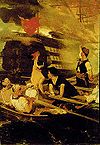 Notably at Chios
, where on the night of June 6/June 7, 1822 forces under his command destroyed the flagship of the Turkish admiral Nasuhzade Ali Pasha (or Kara-Ali Pasha) in revenge for the Chios Massacre
. The admiral was holding a celebration, while Kanaris and his men managed to place a fire ship next to it. When the flagship's powder store caught fire, all men aboard were instantly killed. The Ottoman casualties comprised 2000 men, both naval officers and common sailors, as well as Kara-Ali himself.
Constantine led three further successful attacks against the Turkish fleet in 1822–1824. He was famously said to have encouraged himself by murmuring "Konstantí, you are going to die" every time he was approaching a Turkish warship on the fire boat he was about to detonate.
Egypt
was technically a province of the Ottoman Empire
at the time but its viceroy Mohammad Ali (1769–1849), had earned enough power to act independently from the Sultan and had formed his own army and naval fleet. It was headed by his adoptive son Ibrahim Pasha
(1789–1848). The latter had hired a number of veteran French officers - who had served under Emperor Napoleon I
and were discharged from the French army following his defeat - to help organise the new army. By 1824, it counted 100,000 men and was both better organised and better equipped than the Sultan's army.
Sultan Mahmud II
offered to the viceroy the command of Crete
, if he agreed to send part of this army against the Greeks. They quickly reached an agreement. The Egyptian army, under the personal command of Ibrahim Pasha, started a campaign in both land and sea against the Greeks.
The Egyptian fleet managed to capture Psara on June 21, 1824. A part of the population managed to flee the island, but those who didn't were either sold into slavery or slaughtered. The island was deserted and surviving islanders were scattered through what is now Southern Greece.
After the destruction of his home island, Constantine continued to lead his men into attacks against the Turks, until the Battle of Navarino
of October 20, 1827. Then the Turkish-Egyptian fleet was destroyed by the combined naval forces of Britain
, France
and Russia
.
Following the end of the war and the independence of Greece, Constantine became an officer of the new Greek Navy, reaching the rank of Admiral, and later became a prominent politician.
the first Head of State of independent Greece. Kanaris served as Minister in various governments and then as Prime Minister
, in the provisional government, from March 11-April 11, 1844. He served a second term (October 27, 1848December 24, 1849), and as Navy Minister in Mavrokordatos' 1854 cabinet.
In 1862, he was one of the few War of Independence veterans that helped in the bloodless revolution that deposed King Otto of Greece
and put Prince William of Denmark on the Greek throne as King George I of Greece
. Under George I, he served as a prime minister for a third term (March 17 April 28, 1864), fourth term (August 7, 1864February 9, 1865) and fifth and last term (June 7September 14, 1877).
Kanaris died on 2 September 1877 whilst still serving in office as Prime Minister. Following his death his government remained in power until September 14, 1877 without agreeing on a replacement at its head. He was buried in the First Cemetery of Athens
, where most Greek prime ministers and celebrated figures are also buried. After his death he was honored as a national hero.
To honour Kanaris, the Hellenic Navy named, in 18 December 1941, a Hunt III type destroyer after him. The Kanaris L51, the former HMS Hatherleigh, was transferred to Greece from the Royal Navy on July 1, 1972. A destroyer, the HNS Kanaris (D-212)
(formerly USS Stickell (DD-888)), and on November 29, 2002 a frigate FFG Kanaris (F 464) (an Elli (F 450)
class frigate) were also named after him.
Wilhelm Canaris
, a German Admiral, speculated that he might be a descendant of Constantine Kanaris. An official genealogical family history that was researched in 1938 showed that he was unrelated and that his family was from Italy.
Greece
Greece , officially the Hellenic Republic , and historically Hellas or the Republic of Greece in English, is a country in southeastern Europe....
Prime Minister
Prime minister
A prime minister is the most senior minister of cabinet in the executive branch of government in a parliamentary system. In many systems, the prime minister selects and may dismiss other members of the cabinet, and allocates posts to members within the government. In most systems, the prime...
, admiral
Admiral
Admiral is the rank, or part of the name of the ranks, of the highest naval officers. It is usually considered a full admiral and above vice admiral and below admiral of the fleet . It is usually abbreviated to "Adm" or "ADM"...
and politician
Politician
A politician, political leader, or political figure is an individual who is involved in influencing public policy and decision making...
who in his youth was also a freedom fighter, pirate, privateer
Privateer
A privateer is a private person or ship authorized by a government by letters of marque to attack foreign shipping during wartime. Privateering was a way of mobilizing armed ships and sailors without having to spend public money or commit naval officers...
and merchantman.
Early life
He was born and grew up on the island of PsaraPsara
Psara is a Greek island in the Aegean Sea. Together with the small uninhabited island of Antipsara it forms the municipality of Psara. It is part of the Chios peripheral unit, which is part of the North Aegean Periphery. The only town of the island and seat of the municipality is also called...
, close to the island of Chios
Chios
Chios is the fifth largest of the Greek islands, situated in the Aegean Sea, seven kilometres off the Asia Minor coast. The island is separated from Turkey by the Chios Strait. The island is noted for its strong merchant shipping community, its unique mastic gum and its medieval villages...
, in the Aegean
Aegean Sea
The Aegean Sea[p] is an elongated embayment of the Mediterranean Sea located between the southern Balkan and Anatolian peninsulas, i.e., between the mainlands of Greece and Turkey. In the north, it is connected to the Marmara Sea and Black Sea by the Dardanelles and Bosporus...
. His exact year of birth is unknown. The official records of the Hellenic Navy
Hellenic Navy
The Hellenic Navy is the naval force of Greece, part of the Greek Armed Forces. The modern Greek navy has its roots in the naval forces of various Aegean Islands, which fought in the Greek War of Independence...
indicate 1795 but modern Greek historians believe that 1793 is more probable.
Constantine was left an orphan at a young age. Having to support himself, he chose to became a seaman like most members of his family since the beginning of the 18th century. He was hired as a boy on the brig of his uncle Dimitris Bourekas.
Military career
Constantine gained his fame during the Greek War of IndependenceGreek War of Independence
The Greek War of Independence, also known as the Greek Revolution was a successful war of independence waged by the Greek revolutionaries between...
(1821–1829). Unlike most other prominent figures of the War, he had never been initiated in to the Filiki Eteria
Filiki Eteria
thumb|right|200px|The flag of the Filiki Eteria.Filiki Eteria or Society of Friends was a secret 19th century organization, whose purpose was to overthrow Ottoman rule over Greece and to establish an independent Greek state. Society members were mainly young Phanariot Greeks from Russia and local...
(Friendly Society), which played a significant role in the revolution against the Ottoman Empire
Ottoman Empire
The Ottoman EmpireIt was usually referred to as the "Ottoman Empire", the "Turkish Empire", the "Ottoman Caliphate" or more commonly "Turkey" by its contemporaries...
, primarily by secret recruitment of supporters against the Empire.
By early 1821, it had gained enough support to declare a revolution. This declaration seems to have surprised Constantine, who was absent at Odessa. He returned to Psara
Psara
Psara is a Greek island in the Aegean Sea. Together with the small uninhabited island of Antipsara it forms the municipality of Psara. It is part of the Chios peripheral unit, which is part of the North Aegean Periphery. The only town of the island and seat of the municipality is also called...
in haste and was there when the island joined the Revolution on April 10, 1821.
The island formed its own fleet of ships and the famed seamen of Psara, already known for their successful naval combats against pirates and their well-equipped ships, proved to be effective at full naval war. Constantine soon distinguished himself as a fire ship
Fire ship
A fire ship, used in the days of wooden rowed or sailing ships, was a ship filled with combustibles, deliberately set on fire and steered into an enemy fleet, in order to destroy ships, or to create panic and make the enemy break formation. Ships used as fire ships were usually old and worn out or...
captain.
Chios
Chios is the fifth largest of the Greek islands, situated in the Aegean Sea, seven kilometres off the Asia Minor coast. The island is separated from Turkey by the Chios Strait. The island is noted for its strong merchant shipping community, its unique mastic gum and its medieval villages...
, where on the night of June 6/June 7, 1822 forces under his command destroyed the flagship of the Turkish admiral Nasuhzade Ali Pasha (or Kara-Ali Pasha) in revenge for the Chios Massacre
Chios Massacre
The Chios Massacre refers to the slaughter of tens of thousands of Greeks on the island of Chios by Ottoman troops during the Greek War of Independence in 1822. Greeks from neighbouring islands arrived on Chios and encouraged the Chians to join the struggle for independence. In response, Ottoman...
. The admiral was holding a celebration, while Kanaris and his men managed to place a fire ship next to it. When the flagship's powder store caught fire, all men aboard were instantly killed. The Ottoman casualties comprised 2000 men, both naval officers and common sailors, as well as Kara-Ali himself.
Constantine led three further successful attacks against the Turkish fleet in 1822–1824. He was famously said to have encouraged himself by murmuring "Konstantí, you are going to die" every time he was approaching a Turkish warship on the fire boat he was about to detonate.
Egypt
Egypt
Egypt , officially the Arab Republic of Egypt, Arabic: , is a country mainly in North Africa, with the Sinai Peninsula forming a land bridge in Southwest Asia. Egypt is thus a transcontinental country, and a major power in Africa, the Mediterranean Basin, the Middle East and the Muslim world...
was technically a province of the Ottoman Empire
Ottoman Empire
The Ottoman EmpireIt was usually referred to as the "Ottoman Empire", the "Turkish Empire", the "Ottoman Caliphate" or more commonly "Turkey" by its contemporaries...
at the time but its viceroy Mohammad Ali (1769–1849), had earned enough power to act independently from the Sultan and had formed his own army and naval fleet. It was headed by his adoptive son Ibrahim Pasha
Ibrahim Pasha of Egypt
Ibrahim Pasha was the eldest son of Muhammad Ali, the Wāli and unrecognised Khedive of Egypt and Sudan. He served as a general in the Egyptian army that his father established during his reign, taking his first command of Egyptian forces was when he was merely a teenager...
(1789–1848). The latter had hired a number of veteran French officers - who had served under Emperor Napoleon I
Napoleon I of France
Napoleon Bonaparte was a French military and political leader during the latter stages of the French Revolution.As Napoleon I, he was Emperor of the French from 1804 to 1815...
and were discharged from the French army following his defeat - to help organise the new army. By 1824, it counted 100,000 men and was both better organised and better equipped than the Sultan's army.
Sultan Mahmud II
Mahmud II
Mahmud II was the 30th Sultan of the Ottoman Empire from 1808 until his death in 1839. He was born in the Topkapi Palace, Istanbul, the son of Sultan Abdulhamid I...
offered to the viceroy the command of Crete
Crete
Crete is the largest and most populous of the Greek islands, the fifth largest island in the Mediterranean Sea, and one of the thirteen administrative regions of Greece. It forms a significant part of the economy and cultural heritage of Greece while retaining its own local cultural traits...
, if he agreed to send part of this army against the Greeks. They quickly reached an agreement. The Egyptian army, under the personal command of Ibrahim Pasha, started a campaign in both land and sea against the Greeks.
The Egyptian fleet managed to capture Psara on June 21, 1824. A part of the population managed to flee the island, but those who didn't were either sold into slavery or slaughtered. The island was deserted and surviving islanders were scattered through what is now Southern Greece.
After the destruction of his home island, Constantine continued to lead his men into attacks against the Turks, until the Battle of Navarino
Battle of Navarino
The naval Battle of Navarino was fought on 20 October 1827, during the Greek War of Independence in Navarino Bay , on the west coast of the Peloponnese peninsula, in the Ionian Sea. A combined Ottoman and Egyptian armada was destroyed by a combined British, French and Russian naval force...
of October 20, 1827. Then the Turkish-Egyptian fleet was destroyed by the combined naval forces of Britain
United Kingdom
The United Kingdom of Great Britain and Northern IrelandIn the United Kingdom and Dependencies, other languages have been officially recognised as legitimate autochthonous languages under the European Charter for Regional or Minority Languages...
, France
France
The French Republic , The French Republic , The French Republic , (commonly known as France , is a unitary semi-presidential republic in Western Europe with several overseas territories and islands located on other continents and in the Indian, Pacific, and Atlantic oceans. Metropolitan France...
and Russia
Russia
Russia or , officially known as both Russia and the Russian Federation , is a country in northern Eurasia. It is a federal semi-presidential republic, comprising 83 federal subjects...
.
Following the end of the war and the independence of Greece, Constantine became an officer of the new Greek Navy, reaching the rank of Admiral, and later became a prominent politician.
Political career
Constantine Kanaris was one of the few with the personal confidence of Ioannis KapodistriasIoannis Kapodistrias
Count Ioannis Antonios Kapodistrias |Academy of Athens]] Critical Observations about the 6th-Grade History Textbook"): "3.2.7. Σελ. 40: Δεν αναφέρεται ότι ο Καποδίστριας ήταν Κερκυραίος ευγενής." "...δύο ιστορικούς της Aκαδημίας κ.κ...
the first Head of State of independent Greece. Kanaris served as Minister in various governments and then as Prime Minister
Prime Minister of Greece
The Prime Minister of Greece , officially the Prime Minister of the Hellenic Republic , is the head of government of the Hellenic Republic and the leader of the Greek cabinet. The current interim Prime Minister is Lucas Papademos, a former Vice President of the European Central Bank, following...
, in the provisional government, from March 11-April 11, 1844. He served a second term (October 27, 1848December 24, 1849), and as Navy Minister in Mavrokordatos' 1854 cabinet.
In 1862, he was one of the few War of Independence veterans that helped in the bloodless revolution that deposed King Otto of Greece
Otto of Greece
Otto, Prince of Bavaria, then Othon, King of Greece was made the first modern King of Greece in 1832 under the Convention of London, whereby Greece became a new independent kingdom under the protection of the Great Powers .The second son of the philhellene King Ludwig I of Bavaria, Otto ascended...
and put Prince William of Denmark on the Greek throne as King George I of Greece
George I of Greece
George I was King of Greece from 1863 to 1913. Originally a Danish prince, George was only 17 years old when he was elected king by the Greek National Assembly, which had deposed the former king Otto. His nomination was both suggested and supported by the Great Powers...
. Under George I, he served as a prime minister for a third term (March 17 April 28, 1864), fourth term (August 7, 1864February 9, 1865) and fifth and last term (June 7September 14, 1877).
Kanaris died on 2 September 1877 whilst still serving in office as Prime Minister. Following his death his government remained in power until September 14, 1877 without agreeing on a replacement at its head. He was buried in the First Cemetery of Athens
First Cemetery of Athens
The First Cemetery of Athens is the official cemetery of the City of Athens and the first to be built. It opened in 1837 and soon became a luxurious cemetery for famous Greek people and foreigners....
, where most Greek prime ministers and celebrated figures are also buried. After his death he was honored as a national hero.
To honour Kanaris, the Hellenic Navy named, in 18 December 1941, a Hunt III type destroyer after him. The Kanaris L51, the former HMS Hatherleigh, was transferred to Greece from the Royal Navy on July 1, 1972. A destroyer, the HNS Kanaris (D-212)
USS Stickell (DD-888)
USS Stickell was a of the United States Navy. She was named for Lieutenant John H. Stickell USNR , who was killed in action at Jaluit Atoll in the Marshall Islands on 13 December 1943 and posthumously awarded the Navy Cross....
(formerly USS Stickell (DD-888)), and on November 29, 2002 a frigate FFG Kanaris (F 464) (an Elli (F 450)
F-450 Elli
Greek frigate Elli is the lead ship of the Greek of frigates and the third Hellenic Navy ship by that name. The class is based on the Royal Netherlands Navy's and was built in a Dutch shipyard; however, unlike later members of its class in the Hellenic Navy, it was not originally in Dutch...
class frigate) were also named after him.
Family
In 1817, he married Despina Maniatis, a Maniot woman. They had seven children:- Nikolaos Kanaris, (1818–1848) - a member of a military expeditionary force to Beirut, killed there in 1848.
- Themistocles Kanaris, (1819–1851) - a member of a military expeditionary force to Egypt, killed there in 1851.
- Thrasyvoulos Kanaris, (1820–1898) - Admiral.
- Miltiades Kanaris, (1822–1899) - Admiral, member of the Greek Parliament for many years, Naval Minister three times in 1864, 1871, and 1878.
- Lykourgos Kanaris, (1826–1865) - Lawyer
- Maria Kanari, (1828–1847) - married A. Balambano.
- Aristides Kanaris, (1831–1863) - officer killed in the uprising of 1863.
Wilhelm Canaris
Wilhelm Canaris
Wilhelm Franz Canaris was a German admiral, head of the Abwehr, the German military intelligence service, from 1935 to 1944 and member of the German Resistance.- Early life and World War I :...
, a German Admiral, speculated that he might be a descendant of Constantine Kanaris. An official genealogical family history that was researched in 1938 showed that he was unrelated and that his family was from Italy.