

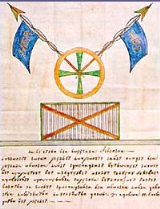
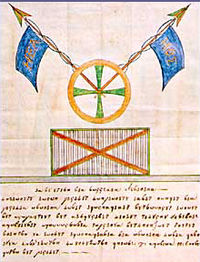
Filiki Eteria

Encyclopedia
Ottoman Empire
The Ottoman EmpireIt was usually referred to as the "Ottoman Empire", the "Turkish Empire", the "Ottoman Caliphate" or more commonly "Turkey" by its contemporaries...
rule over Greece
Greece
Greece , officially the Hellenic Republic , and historically Hellas or the Republic of Greece in English, is a country in southeastern Europe....
and to establish an independent Greek state. Society members were mainly young Phanariot Greeks from Russia
Russian Empire
The Russian Empire was a state that existed from 1721 until the Russian Revolution of 1917. It was the successor to the Tsardom of Russia and the predecessor of the Soviet Union...
and local chieftains from Greece. One of the leaders of the society was Alexander Ypsilantis
Alexander Ypsilantis (1792-1828)
Alexander Ypsilantis, Ypsilanti, or Alexandros Ypsilantis was a member of a prominent Phanariot Greek family, a prince of the Danubian Principalities, a senior officer of the Imperial Russian cavalry during the Napoleonic Wars, and a leader of the Filiki Eteria, a secret organization that...
. In the spring of 1821 the society initiated the Greek War of Independence
Greek War of Independence
The Greek War of Independence, also known as the Greek Revolution was a successful war of independence waged by the Greek revolutionaries between...
.
Translations and transliterations
The direct translation of the word "Filiki" is "Friendly" and the direct translation of the word "Eteria" is "Society" (also "Company" or "Association"). The name of Filiki Eteria has been transliterated in numerous publications with combinations of Filiki, Filike, Philiki, Philike with Eteria, Etairia, Etaireia, Etereia, Hetairia.Foundation
In the context of ardent desire for independence from Turkish occupation, and with the explicit influence of similar secret societies elsewhere in Europe, three Greeks came together in 1814 in OdessaOdessa
Odessa or Odesa is the administrative center of the Odessa Oblast located in southern Ukraine. The city is a major seaport located on the northwest shore of the Black Sea and the fourth largest city in Ukraine with a population of 1,029,000 .The predecessor of Odessa, a small Tatar settlement,...
to decide the constitution for a secret organization in freemasonic
Freemasonry
Freemasonry is a fraternal organisation that arose from obscure origins in the late 16th to early 17th century. Freemasonry now exists in various forms all over the world, with a membership estimated at around six million, including approximately 150,000 under the jurisdictions of the Grand Lodge...
fashion. Its purpose was to unite all Greeks in an armed organization to overthrow Ottoman rule. The three founders were Nikolaos Skoufas
Nikolaos Skoufas
Nikolaos Skoufas - member of the Filiki Eteria , a Greek conspiratorial organization against the Ottoman Empire....
from the Arta
Arta Prefecture
Arta is one of the regional units of Greece. It is part of the Epirus region. Its capital is the town of Arta.-Geography:The regional unit of Arta is located north of the Ambracian Gulf. The main mountain ranges are the Athamanika in the northeast, the Pindus in the east, and Valtou in the...
province, Emmanuil Xanthos
Emmanuil Xanthos
Emmanuel Xanthos was a founder of the Filiki Eteria , a Greek conspiratorial organization against the Ottoman Empire....
from Patmos
Patmos
Patmos is a small Greek island in the Aegean Sea. One of the northernmost islands of the Dodecanese complex, it has a population of 2,984 and an area of . The highest point is Profitis Ilias, 269 meters above sea level. The Municipality of Patmos, which includes the offshore islands of Arkoi ,...
and Athanasios Tsakalov
Athanasios Tsakalov
Athanasios Tsakalov was a member of the Filiki Eteria , a Greek patriotic organization against Ottoman rule.Tsakalov was an Epirote born in Ioannina, in the Epirus province of Greece. In young age he left Greece to be with his father in Russia...
from Ioannina
Ioannina
Ioannina , often called Jannena within Greece, is the largest city of Epirus, north-western Greece, with a population of 70,203 . It lies at an elevation of approximately 500 meters above sea level, on the western shore of lake Pamvotis . It is located within the Ioannina municipality, and is the...
. Soon after they initiated a fourth member, Panagiotis Anagnostopoulos
Panagiotis Anagnostopoulos
Panagiotis Anagnostopoulos was a Greek revolutionary leader during the Greek War of Independence and a member of Filiki Eteria.He was born in Andritsaina around 1790 and was descended from a poor family...
from Andritsaina
Andritsaina
Andritsaina is a town and a former municipality in Elis, West Greece, Greece. Since the 2011 local government reform it is part of the municipality Andritsaina-Krestena, of which it is a municipal unit...
.
Skoufas liaised with Konstantinos Rados who was initiated into Carbonarism. Xanthos was initiated in to a Freemasonic
Freemasonry
Freemasonry is a fraternal organisation that arose from obscure origins in the late 16th to early 17th century. Freemasonry now exists in various forms all over the world, with a membership estimated at around six million, including approximately 150,000 under the jurisdictions of the Grand Lodge...
Lodge at Lefkada
Lefkada
Lefkada, or Leucas or Leucadia , is a Greek island in the Ionian Sea on the west coast of Greece, connected to the mainland by a long causeway and floating bridge. The principal town of the island and seat of the municipality is Lefkada . It is situated on the northern part of the island,...
("Society of Free Builders of Saint Mavra"), while Tsakalov was a founding member of the Hellenoglosso Xenodocheio
Hellenoglosso Xenodocheio
The Ellinoglosso Xenodocheio , was a secret organization established in Paris in 1814, whose purpose was to educate the Greeks and prepare the struggle against Ottoman rule over Greece. Two of its founders were the Macedonian Grigorios Zalykis and the Epirote Athanasios Tsakalov...
(Greek: Ελληνόγλωσσο Ξενοδοχείο, meaning Greek-speaking Hotel) an earlier but unsuccessful society for the liberation of Greece.
At the start, between 1814 and 1816, there were roughly twenty members. During 1817, the society initiated members from the diaspora Greeks of Russia and the Danubian Principalities
Danubian Principalities
Danubian Principalities was a conventional name given to the Principalities of Moldavia and Wallachia, which emerged in the early 14th century. The term was coined in the Habsburg Monarchy after the Treaty of Küçük Kaynarca in order to designate an area on the lower Danube with a common...
of Moldavia
Moldavia
Moldavia is a geographic and historical region and former principality in Eastern Europe, corresponding to the territory between the Eastern Carpathians and the Dniester river...
and Wallachia
Wallachia
Wallachia or Walachia is a historical and geographical region of Romania. It is situated north of the Danube and south of the Southern Carpathians...
. The lord (hospodar) of Moldavia Michael Soutzos
Michael Soutzos
Michael Soutzos , was a member of the Soutzos family of Phanariotes, he was the nephew of Mihai Suţu; he was in turn a Prince of Moldavia, between 12 June 1819 and 29 March 1821....
himself, became a member. Massive initiations began only in 1818 and by early 1821, when the Society had expanded to almost all regions of Greece and throughout Greek communities abroad, the membership numbered in thousands. Among its members were tradesmen, clergy, Russian
Russian Empire
The Russian Empire was a state that existed from 1721 until the Russian Revolution of 1917. It was the successor to the Tsardom of Russia and the predecessor of the Soviet Union...
consuls, Ottoman
Ottoman Empire
The Ottoman EmpireIt was usually referred to as the "Ottoman Empire", the "Turkish Empire", the "Ottoman Caliphate" or more commonly "Turkey" by its contemporaries...
officials from Phanar
Phanariotes
Phanariots, Phanariotes, or Phanariote Greeks were members of those prominent Greek families residing in Phanar , the chief Greek quarter of Constantinople, where the Ecumenical Patriarchate is situated.For all their cosmopolitanism and often Western education, the Phanariots were...
, Serbs
Serbs
The Serbs are a South Slavic ethnic group of the Balkans and southern Central Europe. Serbs are located mainly in Serbia, Montenegro and Bosnia and Herzegovina, and form a sizable minority in Croatia, the Republic of Macedonia and Slovenia. Likewise, Serbs are an officially recognized minority in...
one of them the revolutionary Karageorge and many non-Greeks. Members included primary instigators of the revolution, notably Theodoros Kolokotronis
Theodoros Kolokotronis
Theodoros Kolokotronis was a Greek Field Marshal and one of the leaders of the Greek War of Independence against the Ottoman Empire....
, Odysseas Androutsos
Odysseas Androutsos
Odysseas Androutsos ; was a hero of the Greek War of Independence.-Early life:He was born in Ithaca in 1788, however his family was from the village of Livanates in Phthiotis prefecture...
, Dimitris Plapoutas
Dimitris Plapoutas
Dimitris Koliopoulos Plapoutas was a Greek general who fought during the Greek War of Independence against the rule of the Ottoman Empire....
and the metropolitan bishop Germanos of Patras
Germanos of Patras
Germanos was an Orthodox Metropolitan of Patras.Germanos was born in Dimitsana, northwestern Arcadia, Peloponnese...
.
Hierarchy and initiation
Filiki Eteria was strongly influenced by Carbonarism and FreemasonryFreemasonry
Freemasonry is a fraternal organisation that arose from obscure origins in the late 16th to early 17th century. Freemasonry now exists in various forms all over the world, with a membership estimated at around six million, including approximately 150,000 under the jurisdictions of the Grand Lodge...
. The team of leaders was called the "Invisible Authority" (Αόρατος Αρχή) and from the start it was shrouded in mystery, secrecy and glamour. It was generally believed that a lot of important personalities were members, not only eminent Greeks, but also notable foreigners such as the Tsar of Russia Alexander I
Alexander I of Russia
Alexander I of Russia , served as Emperor of Russia from 23 March 1801 to 1 December 1825 and the first Russian King of Poland from 1815 to 1825. He was also the first Russian Grand Duke of Finland and Lithuania....
. The reality was that initially, the Invisible Authority comprised only the three founders. From 1815 until 1818, five more were added to the Invisible Authority, and after the death of Skoufas' another three more. In 1818, the Invisible Authority was renamed to the "Authority of Twelve Apostles" and each Apostle shouldered the responsibility of a separate region.
The organisational structure was pyramid-like with the "Invisible Authority" coordinating from the top. No one knew or had the right to ask who created the organisation. Commands were unquestionably carried out and members did not have the right to make decisions. Members of the society came together in what was called a "Temple" with four levels of initiation
Initiation
Initiation is a rite of passage ceremony marking entrance or acceptance into a group or society. It could also be a formal admission to adulthood in a community or one of its formal components...
: a) Brothers (αδελφοποιητοί) or Vlamides (βλάμηδες), b) the Recommended (συστημένοι), γ) the Priests (ιερείς) and d) the Shepherds (ποιμένες). The Priests were charged with the duty of initiation.
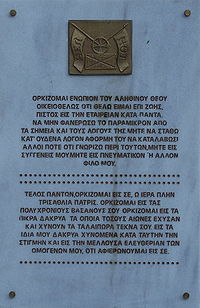
When the above was administered the Priest then uttered the words of acceptance of the novice as a new member:
Afterwards the initiated were considered neophyte members of the society, with all the rights and obligations of his rank. The Priest immediately had the obligation to reveal all the marks of recognition between the Vlamides or Brothers. Vlamides and Recommended were unaware of the revolutionary aims of the organisation. They only knew that there existed a society that tried hard for the general good of the nation, which included in its ranks important personalities. This myth was propagated deliberately, in order to stimulate the morale of members and also to make proselytism easier.
Change of Leadership

In 1818, the seat of Filiki Eteria had migrated from Odessa to Constantinople
Istanbul
Istanbul , historically known as Byzantium and Constantinople , is the largest city of Turkey. Istanbul metropolitan province had 13.26 million people living in it as of December, 2010, which is 18% of Turkey's population and the 3rd largest metropolitan area in Europe after London and...
, and Skoufas' death had been a serious loss. The remaining founders attempted to find a major personality to take over the reins, one who would add prestige and fresh impetus to the society. In early 1818, they had a meeting with John Capodistria, who not only refused, but later wrote that he considered Filiki Eteria guilty for the havoc that was foreboded in Greece. Alexandros Ypsilantis was contacted and asked to assume leadership of Filiki Eteria, which he did in April 1820. He began active preparations for a revolt and with the setting up of a military unit for the purpose that he named the Sacred Band
Sacred Band (1821)
The Sacred Band was a battalion founded by Alexander Ypsilantis at the beginning of the Greek War of Independence, in February 1821 in Wallachia, now part of Romania.-Origin and structure:...
. The society especially wanted to take advantage of the involvement of significant Turkish forces, including the pasha of the Moreas, against Ali Pasha
Ali Pasha
Ali Pasha of Tepelena or of Yannina, surnamed Aslan, "the Lion", or the "Lion of Yannina", Ali Pashë Tepelena was an Ottoman Albanian ruler of the western part of Rumelia, the Ottoman Empire's European territory which was also called Pashalik of Yanina. His court was in Ioannina...
.
Further reading
- Vournas Tasos, Friendly Society: her illegal organisational and persecution by the foreigners, Tolides Bros, (Athens 1982).
- Metropolitan of Old Patras Germanos, Memoirs, (Introductory note, index, ref. Ioanna Yiannaropoulos – Tassos Gritsopoulos), (Athens 1975).
- Yannis Kordatos, Rigas Feraios and Balkan Federation, (Athens, 1974)
- Xanthos Em., Memoirs for the Friendly Society, (facsimile reprint of 1834 ed), Vergina, (Athens 1996)
- Michaletos, Ioannis, "The History of a Greek Secret Society: Structure and Rites of the Philiki Etaireia" (http://www.balkanalysis.com/blog/2007/11/05/the-history-of-a-greek-secret-society-structure-and-rites-of-the-philiki-etaireia/)