

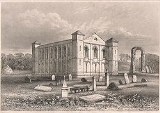
Coldingham Priory

Encyclopedia
Coldingham Priory was a house of Benedictine
monks. It lies on the south-east coast of Scotland
, in the village of Coldingham
, Berwickshire
. Coldingham Priory was founded in the reign of David I of Scotland
, although his older brother and predecessor King Edgar of Scotland
had granted the land of Coldingham to the Church of Durham
in 1098, and a church was constructed by him and presented in 1100. The first prior of Coldingham
is on record by the year 1147, although it is likely that the foundation was much earlier. The earlier Columba
n Abbey was founded by St. Æbbe
sometime circa 640 AD. Although the monastery
was largely destroyed by Oliver Cromwell
in 1648, there are still extant remains of the priory, the choir
of which forms the present parish church
of Coldingham and is serviced by the Church of Scotland
.
, the daughter of King Æthelfrith of Bernicia
, (the first king of Northumbria from c.604) and Acha, a daughter of Ælla of Deira
. In 616, she and her family were forced to flee with her family to Dál Riata
following the death of her father at the Battle of the River Idle which was fought against Rædwald of East Anglia
. The defeat led to the succession of Æbbe's uncle, Edwin of Northumbria
.
At the court of Eochaid Buide
she and her brothers converted to Christianity. King Eochaid's father, Áedán mac Gabráin
had been a contemporary of St. Columba, and his grandfather, Conall mac Comgaill
, had given the saint leave to build his mission on Iona
. (It is interesting to note that Eochaid's father, Áedán had been comprehensively defeated by the forces of Æthelfrith at the Battle of Degsastan
in 603AD.)
Following the defeat of Edwin at the Battle of Hatfield Chase
in 633 against Penda of Mercia
and Cadwallon ap Cadfan
, and the subsequent despoliation of Northumbria, Æbbe's brother Oswald
gained control of the kingdom by 635 AD, enabling the return of his family.
 In c.635 King Oswald introduced Columban monks to the island of Lindisfarne, opposite his fortress of Bebbanburg
, in order to Christianise his mainly pagan peoples. Under these auspices, Æbbe first founded a monastery at Ebchester
, then at what Bede
refers to as Urbs Coludi (Sax. Coldingaham). It is uncertain when these establishments were founded although Æbbe first appears in records of the Lindisfarne by 642 AD, the date of her brother's death. Oswald was succeeded by a younger brother, Oswiu
. Both brothers were given the title of Bretwalda
by Bede
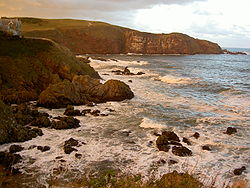
. The abbey was sited on what is now called Kirk-Hill, but is commonly called the Brugh (a corruption of Sax. burh- fort), on the headland at present day St. Abbs
, separated from the world by a deep trench and a high palisade. This religious house lasted for about 40 years and was a double monastery of both monks and nuns governed by Æbbe. Saint Cuthbert arrived at Coldingham in 661 to instruct the community, and performed acts of miraculous mortification to combat lust that eventually led to his canonisation. In 671 St. Æthelthryth
, to escape the lustful advances of her husband (Æbbe's nephew), Ecgfrith of Northumbria
took the veil as a nun, under the tutelage of St Wilfrid. Æthelthryth was later to found Ely Cathedral
.
The community at Coldingham were not renowned for their moral propriety, and Æbbe presumably had difficulties maintaining discipline. Whilst visiting Northumbria the Abbot of Iona, St Adomnán
prophesied the house's destruction. The abbey at Coldingham burnt down circa 683 AD soon after Æbbe's death and was deserted by the time of Bede's writings in the early eighth century. Whatever Æbbe's failures in her rule, she herself is remembered as a religieuse of great piety who helped to spread Christianity in Northumbria and beyond. Her feast day is on 25th August.
All that remains today at the Kirk-hill is the trench, a few grassy mounds and the ruin of a 14th century church erected by monks of the later priory.
St. Æbbe the Younger is a semi-mythological abbess of Coldingham. In 870 AD a raiding party of Danes
landed at the coast near the house and sacked it. Legend has it that faced with the dishonour that St Æbbe and her sisters expected, they mutilated themselves by cutting off their noses and lips. The nuns made themselves as unappealing as possible to the marauders, thereby foregoing rape and accepting martyr's deaths. The story is somewhat unreliable as there are no near contemporary accounts, and it is first recorded by Mathew Paris some 250 years later.
had gained control of Scotland from his uncle Domnall Bán. The son of Máel Coluim mac Donnchada, he attacked and deposed King Domnall with the backing of William Rufus of England
. According to a charter of 1095, he was given the "land of Lothian" by the English king before securing possession of Scotland-proper. Following his takeover of Lothian and Scotland, in 1098 he confirmed possession of the lands of Coldingham by the monks of Durham, and attended the consecration of the new church to St. Mary in 1100. In the following years the brethren of Coldingham were to gain many charters of land, so that within fifty years they were able to assume the dignity of a Priory
.
.
the barony of Coldingham, previously the possession of the Priory, was erected as a temporal lordship, under the Great Seal
, dated October 16, 1621, upon John Stewart, second son of Francis Stewart, 1st Earl of Bothwell, who was the last Commendator of Coldingham Priory. He personally received from the Crown a charter dated October 19, 1621, of the lands and baronies belonging to the Priory, united into one barony. Feu charters in the hands of many of the small proprietors in the neighbourhood were originally granted by him, either as Commendator or Lord. John Stewart disponed these lands and the barony on June 16, 1622 to Francis Stewart, eldest son of the Earl.
Negotiations subsequently took place between the Earl of Home and the Stewarts for the Earl's acquisition of the Barony and its possessions. These apparently failed through the Earl's inability to provide the purchase price.
It is an interesting reflection on feudal superiors to note that in a petition to King Charles I
dated April 4, 1636 the feuars and tenants still refer to themselves as "the vassals of the Abbacy of Coldingham". In this petition the vassals plead the oppression of the Stewarts and ask for the King to become the only superior Lord of Coldingham.
In Cromwell
's time the Homes of Renton seem to have taken the barony of Coldingham from the Stewarts in lieu of debt, as Harry Home, natural son of John Home of Renton apprised the barony and its lands on November 26, 1656 from Robert Stewart, lawful son of the now deceased Francis Stewart. Harry Home subsequently assigned his right to Alexander Home, eldest lawful son of said John Home of Renton, the Precept by Oliver Cromwell
being dated at Edinburgh, August 10, 1658
In 1857 there were about 70 'heritors' or feuholders in the barony. Today, of course, there are may more, all converted into freeholders with the abolition of feudal land tenure by the Scottish Parliament
in November 2005.
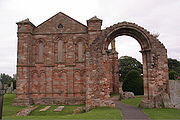 Today the ruins are in a very poor state, badly eroded, overgrown and at risk of collapse. With the help of the Heritage Lottery Fund
the site will be rejuvenated: the ruins conserved, footpaths reinstated and a wasteland transformed into a community garden with a monastic theme, concentrating on plants with culinary, medicinal, and aromatic properties. There will be interpretation for the first time, explaining the hundreds of years of history contained within its walls, while a year-long education programme will engage schools and community groups in many diverse activities relating to the Priory and its conservation.
A partnership consisting of Historic Scotland
, Scottish Borders Council, Scottish Natural Heritage
, Archaeology Scotland, the Friends of Coldingham Priory, and the Tweed Forum has been awarded a grant of £237,500 from HLF to conserve the ruins of Coldingham Priory and encourage community use of this fascinating site.
Benedictine
Benedictine refers to the spirituality and consecrated life in accordance with the Rule of St Benedict, written by Benedict of Nursia in the sixth century for the cenobitic communities he founded in central Italy. The most notable of these is Monte Cassino, the first monastery founded by Benedict...
monks. It lies on the south-east coast of Scotland
Scotland
Scotland is a country that is part of the United Kingdom. Occupying the northern third of the island of Great Britain, it shares a border with England to the south and is bounded by the North Sea to the east, the Atlantic Ocean to the north and west, and the North Channel and Irish Sea to the...
, in the village of Coldingham
Coldingham
Coldingham is a historic village in Berwickshire, Scottish Borders, on Scotland's southeast coastline, north of Eyemouth.As early as AD 660, Coldingham was the site of a religious establishment of high order, when it is recorded that Etheldreda, the queen of Egfrid, became a nun at the Abbey of...
, Berwickshire
Berwickshire
Berwickshire or the County of Berwick is a registration county, a committee area of the Scottish Borders Council, and a lieutenancy area of Scotland, on the border with England. The town after which it is named—Berwick-upon-Tweed—was lost by Scotland to England in 1482...
. Coldingham Priory was founded in the reign of David I of Scotland
David I of Scotland
David I or Dabíd mac Maíl Choluim was a 12th-century ruler who was Prince of the Cumbrians and later King of the Scots...
, although his older brother and predecessor King Edgar of Scotland
Edgar of Scotland
Edgar or Étgar mac Maíl Choluim , nicknamed Probus, "the Valiant" , was king of Alba from 1097 to 1107...
had granted the land of Coldingham to the Church of Durham
Durham Cathedral
The Cathedral Church of Christ, Blessed Mary the Virgin and St Cuthbert of Durham is a cathedral in the city of Durham, England, the seat of the Anglican Bishop of Durham. The Bishopric dates from 995, with the present cathedral being founded in AD 1093...
in 1098, and a church was constructed by him and presented in 1100. The first prior of Coldingham
Prior of Coldingham
The Prior of Coldingham was the head of the Benedictine monastic community of Coldingham Priory in Berwickshire. Coldingham Priory was founded in the reign of David I of Scotland, although his older brother and predecessor King Edgar of Scotland had granted the land of Coldingham to the Church of...
is on record by the year 1147, although it is likely that the foundation was much earlier. The earlier Columba
Columba
Saint Columba —also known as Colum Cille , Colm Cille , Calum Cille and Kolban or Kolbjørn —was a Gaelic Irish missionary monk who propagated Christianity among the Picts during the Early Medieval Period...
n Abbey was founded by St. Æbbe
Aebbe the Elder
Saint Æbbe the Elder founded monasteries at Ebchester and St Abb's Head near Coldingham in Scotland.-Early life:Æbbe was a princess, the daughter of King Æthelfrith of Bernicia and Acha of Deira. Æthelfrith had invaded the neighbouring kingdom of Deira in 604. Assuming the throne, he united Deira...
sometime circa 640 AD. Although the monastery
Monastery
Monastery denotes the building, or complex of buildings, that houses a room reserved for prayer as well as the domestic quarters and workplace of monastics, whether monks or nuns, and whether living in community or alone .Monasteries may vary greatly in size – a small dwelling accommodating only...
was largely destroyed by Oliver Cromwell
Oliver Cromwell
Oliver Cromwell was an English military and political leader who overthrew the English monarchy and temporarily turned England into a republican Commonwealth, and served as Lord Protector of England, Scotland, and Ireland....
in 1648, there are still extant remains of the priory, the choir
Choir
A choir, chorale or chorus is a musical ensemble of singers. Choral music, in turn, is the music written specifically for such an ensemble to perform.A body of singers who perform together as a group is called a choir or chorus...
of which forms the present parish church
Parish church
A parish church , in Christianity, is the church which acts as the religious centre of a parish, the basic administrative unit of episcopal churches....
of Coldingham and is serviced by the Church of Scotland
Church of Scotland
The Church of Scotland, known informally by its Scots language name, the Kirk, is a Presbyterian church, decisively shaped by the Scottish Reformation....
.
Early life
Æbbe was born c. 615 AD into both royal houses of NorthumbriaNorthumbria
Northumbria was a medieval kingdom of the Angles, in what is now Northern England and South-East Scotland, becoming subsequently an earldom in a united Anglo-Saxon kingdom of England. The name reflects the approximate southern limit to the kingdom's territory, the Humber Estuary.Northumbria was...
, the daughter of King Æthelfrith of Bernicia
Æthelfrith of Northumbria
Æthelfrith was King of Bernicia from c. 593 until c. 616; he was also, beginning c. 604, the first Bernician king to also rule Deira, to the south of Bernicia. Since Deira and Bernicia were the two basic components of what would later be defined as Northumbria, Æthelfrith can be considered, in...
, (the first king of Northumbria from c.604) and Acha, a daughter of Ælla of Deira
Aella of Deira
Ælla , is the first certain king of Deira. One of his sons was Edwin of Northumbria and his daughter Acha married Æthelfrith of Bernicia....
. In 616, she and her family were forced to flee with her family to Dál Riata
Dál Riata
Dál Riata was a Gaelic overkingdom on the western coast of Scotland with some territory on the northeast coast of Ireland...
following the death of her father at the Battle of the River Idle which was fought against Rædwald of East Anglia
Raedwald of East Anglia
Rædwald ; also Raedwald or Redwald, was a 7th century king of East Anglia, a long-lived Anglo-Saxon kingdom which today includes the English counties of Norfolk and Suffolk. He was the son of Tytila of East Anglia and a member of the Wuffingas dynasty , who were the first rulers of the East Angles...
. The defeat led to the succession of Æbbe's uncle, Edwin of Northumbria
Edwin of Northumbria
Edwin , also known as Eadwine or Æduini, was the King of Deira and Bernicia – which later became known as Northumbria – from about 616 until his death. He converted to Christianity and was baptised in 627; after he fell at the Battle of Hatfield Chase, he was venerated as a saint.Edwin was the son...
.
At the court of Eochaid Buide
Eochaid Buide
Eochaid Buide was king of Dál Riata from around 608 until 629. "Buide" refers to the colour yellow, as in the colour of his hair.He was a younger son of Áedán mac Gabráin and became his father's chosen heir upon the death of his elder brothers...
she and her brothers converted to Christianity. King Eochaid's father, Áedán mac Gabráin
Áedán mac Gabráin
Áedán mac Gabráin was a king of Dál Riata from circa 574 until his death, perhaps on 17 April 609. The kingdom of Dál Riata was situated in modern Argyll and Bute, Scotland, and parts of County Antrim, Ireland...
had been a contemporary of St. Columba, and his grandfather, Conall mac Comgaill
Conall mac Comgaill
Conall mac Comgaill was king of Dál Riata from about 558 until 574.He was a son of Comgall mac Domangairt. It is said that he gave Iona to Saint Columba. The Duan Albanach says that he reigned "without dissension", but there is a report of an expedition by Conall and Colmán Bec mac Diarmato of the...
, had given the saint leave to build his mission on Iona
Iona
Iona is a small island in the Inner Hebrides off the western coast of Scotland. It was a centre of Irish monasticism for four centuries and is today renowned for its tranquility and natural beauty. It is a popular tourist destination and a place for retreats...
. (It is interesting to note that Eochaid's father, Áedán had been comprehensively defeated by the forces of Æthelfrith at the Battle of Degsastan
Battle of Degsastan
The Battle of Degsastan was fought c. 603 between king Æthelfrith of Bernicia and the Gaels under Áedán mac Gabráin, king of Dál Riada. Æthelfrith carried the day, winning a decisive victory, although his brother Theodbald was killed. We know almost nothing else about the battle, not even where...
in 603AD.)
Following the defeat of Edwin at the Battle of Hatfield Chase
Battle of Hatfield Chase
The Battle of Hatfield Chase was fought on October 12, 633 at Hatfield Chase near Doncaster, Yorkshire, in Anglo-Saxon England between the Northumbrians under Edwin and an alliance of the Welsh of Gwynedd under Cadwallon ap Cadfan and the Mercians under Penda. The site was a marshy area about 8...
in 633 against Penda of Mercia
Penda of Mercia
Penda was a 7th-century King of Mercia, the Anglo-Saxon kingdom in what is today the English Midlands. A pagan at a time when Christianity was taking hold in many of the Anglo-Saxon kingdoms, Penda took over the Severn Valley in 628 following the Battle of Cirencester before participating in the...
and Cadwallon ap Cadfan
Cadwallon ap Cadfan
Cadwallon ap Cadfan was the King of Gwynedd from around 625 until his death in battle. The son and successor of Cadfan ap Iago, he is best remembered as the King of the Britons who invaded and conquered Northumbria, defeating and killing its king, Edwin, prior to his own death in battle against...
, and the subsequent despoliation of Northumbria, Æbbe's brother Oswald
Oswald of Northumbria
Oswald was King of Northumbria from 634 until his death, and is now venerated as a Christian saint.Oswald was the son of Æthelfrith of Bernicia and came to rule after spending a period in exile; after defeating the British ruler Cadwallon ap Cadfan, Oswald brought the two Northumbrian kingdoms of...
gained control of the kingdom by 635 AD, enabling the return of his family.
Abbess Æbbe
Bamburgh Castle
Bamburgh Castle is an imposing castle located on the coast at Bamburgh in Northumberland, England. It is a Grade I listed building.-History:...
, in order to Christianise his mainly pagan peoples. Under these auspices, Æbbe first founded a monastery at Ebchester
Ebchester
Ebchester is a village in County Durham, in England. It is situated to the north of Consett and to the south east of Whittonstall.The parish church, which is dedicated to St. Ebba is of ambiguous origin, being of partly Norman construction with a foundation, described as being pre-Conquest...
, then at what Bede
Bede
Bede , also referred to as Saint Bede or the Venerable Bede , was a monk at the Northumbrian monastery of Saint Peter at Monkwearmouth, today part of Sunderland, England, and of its companion monastery, Saint Paul's, in modern Jarrow , both in the Kingdom of Northumbria...
refers to as Urbs Coludi (Sax. Coldingaham). It is uncertain when these establishments were founded although Æbbe first appears in records of the Lindisfarne by 642 AD, the date of her brother's death. Oswald was succeeded by a younger brother, Oswiu
Oswiu of Northumbria
Oswiu , also known as Oswy or Oswig , was a King of Bernicia. His father, Æthelfrith of Bernicia, was killed in battle, fighting against Rædwald, King of the East Angles and Edwin of Deira at the River Idle in 616...
. Both brothers were given the title of Bretwalda
Bretwalda
Bretwalda is an Old English word, the first record of which comes from the late 9th century Anglo-Saxon Chronicle. It is given to some of the rulers of Anglo-Saxon kingdoms from the 5th century onwards who had achieved overlordship of some or all of the other Anglo-Saxon kingdoms...
by Bede
Bede
Bede , also referred to as Saint Bede or the Venerable Bede , was a monk at the Northumbrian monastery of Saint Peter at Monkwearmouth, today part of Sunderland, England, and of its companion monastery, Saint Paul's, in modern Jarrow , both in the Kingdom of Northumbria...
. The abbey was sited on what is now called Kirk-Hill, but is commonly called the Brugh (a corruption of Sax. burh- fort), on the headland at present day St. Abbs
St. Abbs
St. Abbs , historically known as Coldingham Shore, is a small fishing village located on the south east coast of Scotland, in the Berwickshire area of Scottish Borders....
, separated from the world by a deep trench and a high palisade. This religious house lasted for about 40 years and was a double monastery of both monks and nuns governed by Æbbe. Saint Cuthbert arrived at Coldingham in 661 to instruct the community, and performed acts of miraculous mortification to combat lust that eventually led to his canonisation. In 671 St. Æthelthryth
Æthelthryth
Æthelthryth is the proper name for the popular Anglo-Saxon saint often known, particularly in a religious context, as Etheldreda or by the pet form of Audrey...
, to escape the lustful advances of her husband (Æbbe's nephew), Ecgfrith of Northumbria
Ecgfrith of Northumbria
King Ecgfrith was the King of Northumbria from 670 until his death. He ruled over Northumbria when it was at the height of its power, but his reign ended with a disastrous defeat in which he lost his life.-Early life:...
took the veil as a nun, under the tutelage of St Wilfrid. Æthelthryth was later to found Ely Cathedral
Ely Cathedral
Ely Cathedral is the principal church of the Diocese of Ely, in Cambridgeshire, England, and is the seat of the Bishop of Ely and a suffragan bishop, the Bishop of Huntingdon...
.
The community at Coldingham were not renowned for their moral propriety, and Æbbe presumably had difficulties maintaining discipline. Whilst visiting Northumbria the Abbot of Iona, St Adomnán
Adomnán of Iona
Saint Adomnán of Iona was abbot of Iona , hagiographer, statesman and clerical lawyer; he was the author of the most important Vita of Saint Columba and promulgator of the "Law of Innocents", lex innocentium, also called Cáin Adomnáin, "Law of Adomnán"...
prophesied the house's destruction. The abbey at Coldingham burnt down circa 683 AD soon after Æbbe's death and was deserted by the time of Bede's writings in the early eighth century. Whatever Æbbe's failures in her rule, she herself is remembered as a religieuse of great piety who helped to spread Christianity in Northumbria and beyond. Her feast day is on 25th August.
All that remains today at the Kirk-hill is the trench, a few grassy mounds and the ruin of a 14th century church erected by monks of the later priory.
The Dark Ages
There are few references to the house at Coldingham from its destruction until its revival in the 11th c., excepting tales of a later superior also called Æbbe. It is likely that the house was reformed as community of nuns at some point in the eighth or ninth centuries, as by the formation of the Benedictine priory in 1100 AD there was a thriving cult of St. Æbbe at the site. The house appears to have moved from its original site at St. Abb's Head to its present location around this timeSt. Æbbe the Younger
- see also main article: Aebbe the YoungerAebbe the YoungerFor the earlier Abbess of Coldingham, see Æbbe the Elder.Saint Æbbe of Coldingham [also Ebbe, Aebbe, Abb], sometimes styled as "the Younger", was an Abbess of Coldingham Priory in south-east Scotland. There are several local Scottish legends associated with Æbbe...
St. Æbbe the Younger is a semi-mythological abbess of Coldingham. In 870 AD a raiding party of Danes
Norsemen
Norsemen is used to refer to the group of people as a whole who spoke what is now called the Old Norse language belonging to the North Germanic branch of Indo-European languages, especially Norwegian, Icelandic, Faroese, Swedish and Danish in their earlier forms.The meaning of Norseman was "people...
landed at the coast near the house and sacked it. Legend has it that faced with the dishonour that St Æbbe and her sisters expected, they mutilated themselves by cutting off their noses and lips. The nuns made themselves as unappealing as possible to the marauders, thereby foregoing rape and accepting martyr's deaths. The story is somewhat unreliable as there are no near contemporary accounts, and it is first recorded by Mathew Paris some 250 years later.
Founding of the Priory Church
In 1097, Étgar mac Maíl CholuimEdgar of Scotland
Edgar or Étgar mac Maíl Choluim , nicknamed Probus, "the Valiant" , was king of Alba from 1097 to 1107...
had gained control of Scotland from his uncle Domnall Bán. The son of Máel Coluim mac Donnchada, he attacked and deposed King Domnall with the backing of William Rufus of England
England
England is a country that is part of the United Kingdom. It shares land borders with Scotland to the north and Wales to the west; the Irish Sea is to the north west, the Celtic Sea to the south west, with the North Sea to the east and the English Channel to the south separating it from continental...
. According to a charter of 1095, he was given the "land of Lothian" by the English king before securing possession of Scotland-proper. Following his takeover of Lothian and Scotland, in 1098 he confirmed possession of the lands of Coldingham by the monks of Durham, and attended the consecration of the new church to St. Mary in 1100. In the following years the brethren of Coldingham were to gain many charters of land, so that within fifty years they were able to assume the dignity of a Priory
Priory
A priory is a house of men or women under religious vows that is headed by a prior or prioress. Priories may be houses of mendicant friars or religious sisters , or monasteries of monks or nuns .The Benedictines and their offshoots , the Premonstratensians, and the...
.
The Priory
The Priory became the caput for the Barony of Coldingham, the Prior being the feudal lord. On January 2, 1392 Sir Robert de Lawedre of The Bass was a witness to a Royal Charter to the Priory of Coldingham confirming them in all of their ancient possessions, and signed at LinlithgowLinlithgow
Linlithgow is a Royal Burgh in West Lothian, Scotland. An ancient town, it lies south of its two most prominent landmarks: Linlithgow Palace and Linlithgow Loch, and north of the Union Canal....
.
Reformation and the end of Monasticism
Following the century of the ReformationScottish Reformation
The Scottish Reformation was Scotland's formal break with the Papacy in 1560, and the events surrounding this. It was part of the wider European Protestant Reformation; and in Scotland's case culminated ecclesiastically in the re-establishment of the church along Reformed lines, and politically in...
the barony of Coldingham, previously the possession of the Priory, was erected as a temporal lordship, under the Great Seal
Great Seal of Scotland
The Great Seal of Scotland allows the monarch to authorise official documents without having to sign each document individually. Wax is melted in a metal mould or matrix and impressed into a wax figure that is attached by cord or ribbon to documents that the monarch wishes to make official...
, dated October 16, 1621, upon John Stewart, second son of Francis Stewart, 1st Earl of Bothwell, who was the last Commendator of Coldingham Priory. He personally received from the Crown a charter dated October 19, 1621, of the lands and baronies belonging to the Priory, united into one barony. Feu charters in the hands of many of the small proprietors in the neighbourhood were originally granted by him, either as Commendator or Lord. John Stewart disponed these lands and the barony on June 16, 1622 to Francis Stewart, eldest son of the Earl.
Negotiations subsequently took place between the Earl of Home and the Stewarts for the Earl's acquisition of the Barony and its possessions. These apparently failed through the Earl's inability to provide the purchase price.
It is an interesting reflection on feudal superiors to note that in a petition to King Charles I
Charles I of England
Charles I was King of England, King of Scotland, and King of Ireland from 27 March 1625 until his execution in 1649. Charles engaged in a struggle for power with the Parliament of England, attempting to obtain royal revenue whilst Parliament sought to curb his Royal prerogative which Charles...
dated April 4, 1636 the feuars and tenants still refer to themselves as "the vassals of the Abbacy of Coldingham". In this petition the vassals plead the oppression of the Stewarts and ask for the King to become the only superior Lord of Coldingham.
In Cromwell
Oliver Cromwell
Oliver Cromwell was an English military and political leader who overthrew the English monarchy and temporarily turned England into a republican Commonwealth, and served as Lord Protector of England, Scotland, and Ireland....
's time the Homes of Renton seem to have taken the barony of Coldingham from the Stewarts in lieu of debt, as Harry Home, natural son of John Home of Renton apprised the barony and its lands on November 26, 1656 from Robert Stewart, lawful son of the now deceased Francis Stewart. Harry Home subsequently assigned his right to Alexander Home, eldest lawful son of said John Home of Renton, the Precept by Oliver Cromwell
Oliver Cromwell
Oliver Cromwell was an English military and political leader who overthrew the English monarchy and temporarily turned England into a republican Commonwealth, and served as Lord Protector of England, Scotland, and Ireland....
being dated at Edinburgh, August 10, 1658
In 1857 there were about 70 'heritors' or feuholders in the barony. Today, of course, there are may more, all converted into freeholders with the abolition of feudal land tenure by the Scottish Parliament
Scottish Parliament
The Scottish Parliament is the devolved national, unicameral legislature of Scotland, located in the Holyrood area of the capital, Edinburgh. The Parliament, informally referred to as "Holyrood", is a democratically elected body comprising 129 members known as Members of the Scottish Parliament...
in November 2005.
Today
Heritage Lottery Fund
The Heritage Lottery Fund is a fund established in the United Kingdom under the National Lottery etc. Act 1993. The Fund opened for applications in 1994. It uses money raised through the National Lottery to transform and sustain the UK’s heritage...
the site will be rejuvenated: the ruins conserved, footpaths reinstated and a wasteland transformed into a community garden with a monastic theme, concentrating on plants with culinary, medicinal, and aromatic properties. There will be interpretation for the first time, explaining the hundreds of years of history contained within its walls, while a year-long education programme will engage schools and community groups in many diverse activities relating to the Priory and its conservation.
A partnership consisting of Historic Scotland
Historic Scotland
Historic Scotland is an executive agency of the Scottish Government, responsible for historic monuments in Scotland.-Role:As its website states:...
, Scottish Borders Council, Scottish Natural Heritage
Scottish Natural Heritage
Scottish Natural Heritage is a Scottish public body. It is responsible for Scotland's natural heritage, especially its natural, genetic and scenic diversity. It advises the Scottish Government and acts as a government agent in the delivery of conservation designations, i.e...
, Archaeology Scotland, the Friends of Coldingham Priory, and the Tweed Forum has been awarded a grant of £237,500 from HLF to conserve the ruins of Coldingham Priory and encourage community use of this fascinating site.
See also
- List of places in the Scottish Borders
- List of places in East Lothian
- List of places in Edinburgh
- List of places in Midlothian
- List of places in West Lothian
- List of places in Scotland
- ColdinghamColdinghamColdingham is a historic village in Berwickshire, Scottish Borders, on Scotland's southeast coastline, north of Eyemouth.As early as AD 660, Coldingham was the site of a religious establishment of high order, when it is recorded that Etheldreda, the queen of Egfrid, became a nun at the Abbey of...
- Coldingham BayColdingham BayColdingham Bay is an inlet in the North Sea coast, just over three km north of the town of Eyemouth in the Scottish Borders area of Scotland. It is situated at grid reference and is easily reached by a minor road which leaves the B6438 road at Coldingham....
- Coldingham LochColdingham LochColdingham Loch is a loch in the parish of Coldingham, in the Scottish Borders area of Scotland, in the former Berwickshire, between Coldingham Moor and St Abb's Head. The loch is a natural spring-fed loch, about from the sea and about above sea level; it is used for fly fishing for rainbow...
- Prior of ColdinghamPrior of ColdinghamThe Prior of Coldingham was the head of the Benedictine monastic community of Coldingham Priory in Berwickshire. Coldingham Priory was founded in the reign of David I of Scotland, although his older brother and predecessor King Edgar of Scotland had granted the land of Coldingham to the Church of...
- St Abb's HeadSt Abb's HeadSt. Abb's Head is a rocky promontory at the village of St. Abbs, Berwickshire, Scottish Borders, and a National Nature Reserve administered by the National Trust of Scotland...
- St. AbbsSt. AbbsSt. Abbs , historically known as Coldingham Shore, is a small fishing village located on the south east coast of Scotland, in the Berwickshire area of Scottish Borders....