

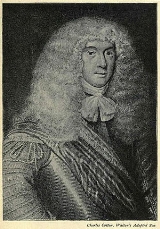
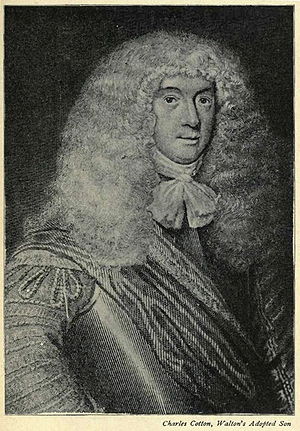
Charles Cotton

Encyclopedia
England
England is a country that is part of the United Kingdom. It shares land borders with Scotland to the north and Wales to the west; the Irish Sea is to the north west, the Celtic Sea to the south west, with the North Sea to the east and the English Channel to the south separating it from continental...
poet
Poet
A poet is a person who writes poetry. A poet's work can be literal, meaning that his work is derived from a specific event, or metaphorical, meaning that his work can take on many meanings and forms. Poets have existed since antiquity, in nearly all languages, and have produced works that vary...
and writer
Writer
A writer is a person who produces literature, such as novels, short stories, plays, screenplays, poetry, or other literary art. Skilled writers are able to use language to portray ideas and images....
, best known for translating the work of Michel de Montaigne
Michel de Montaigne
Lord Michel Eyquem de Montaigne , February 28, 1533 – September 13, 1592, was one of the most influential writers of the French Renaissance, known for popularising the essay as a literary genre and is popularly thought of as the father of Modern Skepticism...
from the French
French language
French is a Romance language spoken as a first language in France, the Romandy region in Switzerland, Wallonia and Brussels in Belgium, Monaco, the regions of Quebec and Acadia in Canada, and by various communities elsewhere. Second-language speakers of French are distributed throughout many parts...
, for his contributions to The Compleat Angler, and for the highly influential The Compleat Gamester which has been attributed to him.
Early life
He was born at Beresford Hall on the border of DerbyshireDerbyshire
Derbyshire is a county in the East Midlands of England. A substantial portion of the Peak District National Park lies within Derbyshire. The northern part of Derbyshire overlaps with the Pennines, a famous chain of hills and mountains. The county contains within its boundary of approx...
and Staffordshire
Staffordshire
Staffordshire is a landlocked county in the West Midlands region of England. For Eurostat purposes, the county is a NUTS 3 region and is one of four counties or unitary districts that comprise the "Shropshire and Staffordshire" NUTS 2 region. Part of the National Forest lies within its borders...
. His father, Charles Cotton the Elder, was a friend of Ben Jonson
Ben Jonson
Benjamin Jonson was an English Renaissance dramatist, poet and actor. A contemporary of William Shakespeare, he is best known for his satirical plays, particularly Volpone, The Alchemist, and Bartholomew Fair, which are considered his best, and his lyric poems...
, John Selden
John Selden
John Selden was an English jurist and a scholar of England's ancient laws and constitution and scholar of Jewish law...
, Sir Henry Wotton
Henry Wotton
Sir Henry Wotton was an English author and diplomat. He is often quoted as saying, "An ambassador is an honest gentleman sent to lie abroad for the good of his country." -Life:The son of Thomas Wotton , brother of Edward Wotton, 1st Baron Wotton, and grandnephew of the diplomat...
and Izaak Walton
Izaak Walton
Izaak Walton was an English writer. Best known as the author of The Compleat Angler, he also wrote a number of short biographies which have been collected under the title of Walton's Lives.-Biography:...
. The son was apparently not sent to university, but was tutored by Ralph Rawson, one of the fellows ejected from Brasenose College, Oxford
Brasenose College, Oxford
Brasenose College, originally Brazen Nose College , is one of the constituent colleges of the University of Oxford in the United Kingdom. As of 2006, it has an estimated financial endowment of £98m...
, in 1648. Cotton travelled in France
France
The French Republic , The French Republic , The French Republic , (commonly known as France , is a unitary semi-presidential republic in Western Europe with several overseas territories and islands located on other continents and in the Indian, Pacific, and Atlantic oceans. Metropolitan France...
and perhaps in Italy
Italy
Italy , officially the Italian Republic languages]] under the European Charter for Regional or Minority Languages. In each of these, Italy's official name is as follows:;;;;;;;;), is a unitary parliamentary republic in South-Central Europe. To the north it borders France, Switzerland, Austria and...
, and at the age of twenty-eight he succeeded to an estate greatly encumbered by lawsuits during his father's lifetime. The rest of his life was spent chiefly in country pursuits, but from his Voyage to Ireland in Burlesque (1670) we know that he held a captain's commission and served in Ireland
Ireland
Ireland is an island to the northwest of continental Europe. It is the third-largest island in Europe and the twentieth-largest island on Earth...
.
Fishing
His friendship with Izaak WaltonIzaak Walton
Izaak Walton was an English writer. Best known as the author of The Compleat Angler, he also wrote a number of short biographies which have been collected under the title of Walton's Lives.-Biography:...
began about 1655, and contradicts the assumptions about Cotton's character based on his coarse burlesques of Virgil
Virgil
Publius Vergilius Maro, usually called Virgil or Vergil in English , was an ancient Roman poet of the Augustan period. He is known for three major works of Latin literature, the Eclogues , the Georgics, and the epic Aeneid...
and Lucian
Lucian
Lucian of Samosata was a rhetorician and satirist who wrote in the Greek language. He is noted for his witty and scoffing nature.His ethnicity is disputed and is attributed as Assyrian according to Frye and Parpola, and Syrian according to Joseph....
. Walton's initials made into a cipher with Cotton's own were placed over the door of Cotton's fishing cottage on the Dove
River Dove, Derbyshire
The River Dove is the principal river of the southwestern Peak District, in the Midlands of England and is around in length. It rises on Axe Edge Moor near Buxton and flows generally south to its confluence with the River Trent at Newton Solney. From there, its waters reach the North Sea via the...
near Hartington
Hartington
Hartington is a village in the Derbyshire Peak District, England, lying on the River Dove close to the Staffordshire border. According to the 2001 census, the parish of Hartington Town Quarter, which also includes Pilsbury, had a population of 345...
. Cotton contributed a second section "Instructions how to angle for a trout
Trout
Trout is the name for a number of species of freshwater and saltwater fish belonging to the Salmoninae subfamily of the family Salmonidae. Salmon belong to the same family as trout. Most salmon species spend almost all their lives in salt water...
or grayling
Grayling (genus)
Thymallus is a genus of freshwater fish in the salmon family of order Salmoniformes; it is the only genus of subfamily Thymallinae. The type species is T. thymallus, the grayling. The genus's five distinct species are generically called graylings, but without qualification this also refers...
in a clear stream", to Walton's The Compleat Angler; the additions consisted of twelve chapters on fishing in clear water, which he understood largely but not exclusively to be fly fishing
Fly fishing
Fly fishing is an angling method in which an artificial 'fly' is used to catch fish. The fly is cast using a fly rod, reel, and specialized weighted line. Casting a nearly weightless fly or 'lure' requires casting techniques significantly different from other forms of casting...
.
Marriages
In 1656 he married his cousin Isabella Hutchinson, the daughter of Charles HutchinsonCharles Hutchinson
Charles Hutchinson for Nottingham during the second and third Parliaments of King William III of England He was the 5th son of Sir Thomas Hutchinson by his second wife Lady Catherine Stanhope of Selford and his first son by Lady Catherine. She was the daughter of Sir John Stanhope, she was also...
, M.P. for Nottingham
Nottingham
Nottingham is a city and unitary authority in the East Midlands of England. It is located in the ceremonial county of Nottinghamshire and represents one of eight members of the English Core Cities Group...
. She was a half-sister of Col. John Hutchinson
John Hutchinson (Colonel)
Colonel John Hutchinson was one of the Puritan leaders, and a prominent Roundhead in the English Civil War to the extent of being the 13th of 39 Commissioners to sign the death-warrant of King Charles I.-Biography:...
; They had one child, Catherine Cotton, who married Sir Kingsmill Lucy, 2nd bt. her mother Isebella (Hutchinson) Cotton, died in 1670. At the request of his wife's sister, Miss Stanhope Hutchinson, he undertook the translation of Pierre Corneille
Pierre Corneille
Pierre Corneille was a French tragedian who was one of the three great seventeenth-century French dramatists, along with Molière and Racine...
's Horace
Horace (play)
Horace is a 1972 television play written by Roy Minton and directed by Alan Clarke, first broadcast as part of BBC One's Play for Today series on 21 March 1972.-Plot:Diabetic Horace is mentally impaired and works in a joke shop...
in 1671. In 1675, he married the dowager Countess of Ardglass; she had a jointure
Jointure
Jointure is, in law, a provision for a wife after the death of her husband. As defined by Sir Edward Coke, it is "a competent livelihood of freehold for the wife, of lands or tenements, to take effect presently in possession or profit after the death of her husband for the life of the wife at...
of £1500 a year, but he did not have the power to spend it.

Writings
The 1674 first edition of The Compleat Gamester is attributed to Cotton (by publishers of later editions, to which additional, post-Cotton material was added in 1709 and 1725, along with some updates to the rules Cotton had described earlier. The book was considered the "standard" English-languageEnglish language
English is a West Germanic language that arose in the Anglo-Saxon kingdoms of England and spread into what was to become south-east Scotland under the influence of the Anglian medieval kingdom of Northumbria...
reference work on the playing of games – especially gambling
Gambling
Gambling is the wagering of money or something of material value on an event with an uncertain outcome with the primary intent of winning additional money and/or material goods...
games, and including billiards, card game
Card game
A card game is any game using playing cards as the primary device with which the game is played, be they traditional or game-specific. Countless card games exist, including families of related games...
s, dice
Dice
A die is a small throwable object with multiple resting positions, used for generating random numbers...
, horse racing
Horse racing
Horse racing is an equestrian sport that has a long history. Archaeological records indicate that horse racing occurred in ancient Babylon, Syria, and Egypt. Both chariot and mounted horse racing were events in the ancient Greek Olympics by 648 BC...
and cock fighting, among others – until the publication of Edmond Hoyle
Edmond Hoyle
Edmond Hoyle was a writer best known for his works on the rules and play of card games. The phrase "according to Hoyle" came into the language as a reflection of his generally-perceived authority on the subject; since that time, use of the phrase has expanded into general use in situations in...
's Mr. Hoyle's Games Complete in 1750, which outsold Cotton's then-obsolete work.
At Cotton's death in 1687 he was insolvent and left his estates to his creditors. He was buried in St James's Church
St James's Church, Piccadilly
St James’s Church, Piccadilly is an Anglican church on Piccadilly in the centre of London, UK. It was designed and built by Sir Christopher Wren....
, Piccadilly
Piccadilly
Piccadilly is a major street in central London, running from Hyde Park Corner in the west to Piccadilly Circus in the east. It is completely within the city of Westminster. The street is part of the A4 road, London's second most important western artery. St...
, on February 16, 1687.
Cotton's reputation as a burlesque
Burlesque
Burlesque is a literary, dramatic or musical work intended to cause laughter by caricaturing the manner or spirit of serious works, or by ludicrous treatment of their subjects...
writer may account for the neglect with which the rest of his poems have been treated. Their excellence was not, however, overlooked by good critics. Coleridge
Samuel Taylor Coleridge
Samuel Taylor Coleridge was an English poet, Romantic, literary critic and philosopher who, with his friend William Wordsworth, was a founder of the Romantic Movement in England and a member of the Lake Poets. He is probably best known for his poems The Rime of the Ancient Mariner and Kubla...
praises the purity and unaffectedness of his style in Biographia Literaria, and Wordsworth
William Wordsworth
William Wordsworth was a major English Romantic poet who, with Samuel Taylor Coleridge, helped to launch the Romantic Age in English literature with the 1798 joint publication Lyrical Ballads....
(Preface, 1815) gave a copious quotation from the "Ode to Winter". The "Retirement" is printed by Walton in the second part of the Compleat Angler.
He was a Derbyshire
Derbyshire
Derbyshire is a county in the East Midlands of England. A substantial portion of the Peak District National Park lies within Derbyshire. The northern part of Derbyshire overlaps with the Pennines, a famous chain of hills and mountains. The county contains within its boundary of approx...
man: his father moved there from the South England to live on his wife's estates. The Peak district is no longer associated with trout
Trout
Trout is the name for a number of species of freshwater and saltwater fish belonging to the Salmoninae subfamily of the family Salmonidae. Salmon belong to the same family as trout. Most salmon species spend almost all their lives in salt water...
fishing. In Cotton's day, the inaccessibility of good fishing spots was physical as well as legal. The opening chapters of his section of the Compleat Angler draw Cotton and his friend across a savage and mountainous landscape. The friend, who will be taught fly-fishing, expresses doubt as to whether they are still in Christendom.
"What do I think? Why, I think it is the steepest place that ever sure men and horses went down; and that, if there be any safety at all, the safest way is to alight..." says the pupil. After he picked his way down, they reach a bridge. "Do you ... travel with wheelbarrows in this country" he asks. "Because this bridge certainly was made for nothing else; why, a mouse can hardly go over it: it is not two fingers broad."
They come at length to the sheltered valley in which stands Cotton's house and fishing hut. It is the first description of paradise in fishing history. "It stands in a kind of peninsula, with a delicate clear river about it." There Cotton and his friend breakfast on ale and a pipe of tobacco to give them the strength to wield their rods. For a trout river, he says, a rod of five or six yards should be long enough. In fact, "longer, though never so neatly and artificially made, it ought not to be, if you intend to fish at ease".
Though he used a line of carefully tapered horse-hair that can hardly have weighed anything, Cotton’s rod, of solid wood, must have been heavy. His description of the sport does not resemble modern techniques of fly-casting, which began with the arrival of heavy dressed-silk lines 200 years later. On windy days, he advises his guest to fish the pools because in the rapids, where the gorge of the Dove is narrower, the wind will be too strong to fish in.
Some of Cotton's advice and preferences remain those of a real fisherman. He tells his guest to fish 'fine and far off"; and he argues for small and neat flies, carefully dressed, over the bushy productions of London tackle-dealers. The flies which catch fish will always look wrong to the untrained eye, because they look too small and too delicate.
Cotton's dressings are made with bear hair and camel
Camel
A camel is an even-toed ungulate within the genus Camelus, bearing distinctive fatty deposits known as humps on its back. There are two species of camels: the dromedary or Arabian camel has a single hump, and the bactrian has two humps. Dromedaries are native to the dry desert areas of West Asia,...
's under fur; with the soft bristles from inside a black hog’s ear; and from dog’s tails. "What a heap of trumpery is here!" cries his visitor, when Cotton’s dubbing bag is opened. "Certainly never an angler in Europe has his shop half so well-finished as you have."
Cotton replies with the touchiness of a true obsessive: "Let me tell you, here are some colours, contemptible as they seem here, that are very hard to be got; and scarce any one of them, which, if it should be lost, I should not miss and be concerned about the loss of it too, once in the year."
Cotton devotes a whole chapter to collection of flies for every month of the year. Few of them have modern analogues. But he had looked closely at the world around him with the acuity and open-mindedness which distinguishes a great fly fisherman. Here is his stonefly:
His body is long and pretty thick, and as broad at the tail, almost, as at the middle; his colour is a very fine brown, ribbed with yellow and much yellower on the belly than on the back: he has two or three little whisks also at the tag of his tail, and two little horns upon his head: his wings, when full grown, are double, and flat down upon his back, of the same colour but rather darker than his body and longer than it...
On a calm day you shall see the still-deeps continually all over circles by the fishes rising, who will gorge themselves with these flies, will they purge again out of their gills.
In Montana, the fish still rise to stoneflies until the water is “continually all over circles”, but in the UK it is an anachronism. Cotton’s Derbyshire is more remote from modern England and closer to the wilderness than Montana or Alaska are now. He is quite unashamed of bait fishing, whether with flies or with grubs. He kills fish until weary. “I have in this very river that runs by us, in three or four hours taken thirty, five and thirty, and forty of the best trouts in the river.” And he concludes his advice with a note of earthy practicality not to be found as the sport becomes more refined: a recipe for fresh trout boiled with beer and horseradish. It is excellent, by the way.
Here is a man who loves nothing more than that his friends should share his delight. In the gorge of the Dove he has made a private garden “with a delicate clear river about it.” where the world is reduced to its simplest and best essentials.
His masterpiece in translation, the Essays of M. de Montaigne (1685–1686, 1693, 1700, etc.), has often been reprinted, and still maintains its reputation; his other works include The Scarronides, or Virgil Travestie (1664–1670), a gross burlesque of the first and fourth books of the Aeneid, which ran through fifteen editions; Burlesque upon Burlesque, ... being some of Lucian's Dialogues newly put into English fustian (1675); The Moral Philosophy of the Stoicks (1667), from the French of Guillaume du Vair
Guillaume du Vair
Guillaume du Vair was a French author and lawyer.He was born in Paris. After taking holy orders, he exercised only legal functions for most of his career. However, from 1617 till his death he was Bishop of Lisieux. His reputation is that of a lawyer, a statesman and a man of letters...
; The History of the Life of the Duke d'Espernon (1670), from the French of G Girard; the Commentaries (1674) of Blaise de Montluc
Blaise de Lasseran-Massencôme, seigneur de Montluc
Blaise de Lasseran-Massencôme, seigneur de Montluc was a marshal of France.He was born at the family seat near Condom in the modern département of Gers. Despite being the eldest son of a good family, he had, like most gentlemen of Gascony, to rely on his sword. He was the brother of Jean de...
; the Planter's Manual (1675), a practical book on arboriculture
Arboriculture
Arboriculture is the cultivation, management, and study of individual trees, shrubs, vines, and other perennial woody plants. It is both a practice and a science....
, in which he was an expert; The Wonders of the Peake (1681); the Compleat Gamester and The Fair one of Tunis, both dated 1674, are also assigned to Cotton.
If this sounds dry and unattractive to a modern ear, here is his epitaph for "M.H.", a prostitute (spacing, spelling and capitalization as originally printed):
Epitaph upon M.H
In this cold Monument lies one,
That I know who has lain upon,
The happier He : her Sight would charm,
And Touch have kept King David warm.
Lovely, as is the dawning East ,
Was this Marble's frozen Guest ;
As soft, and Snowy, as that Down
Adorns the Blow-balls frizled Crown;
As straight and slender as the Crest,
Or Antlet of the one beam'd Beast;
Pleasant as th' odorous Month of May :
As glorious, and as light as Day .
Whom I admir'd, as soon as knew,
And now her Memory pursue
With such a superstitious Lust,
That I could fumble with her Dust.
She all Perfections had, and more,
Tempting, as if design'd a Whore ,
For so she was; and since there are
Such, I could wish them all as fair.
Pretty she was, and young, and wise,
And in her Calling so precise,
That Industry had made her prove
The sucking School-Mistress of Love :
And Death , ambitious to become
Her Pupil , left his Ghastly home,
And, seeing how we us'd her here,
The raw-bon'd Rascal ravisht her.
Who, pretty Soul, resign'd her Breath,
To seek new Letchery in Death.
More information
William OldysWilliam Oldys
William Oldys was an English antiquarian and bibliographer.The illegitimate son of Dr William Oldys, chancellor of Lincoln, London was probably his place of birth. His father had held the office of advocate of the admiralty, but lost it in 1693 because he would not prosecute as traitors and...
contributed a life of Cotton to Hawkins's edition (1760) of the Compleat Angler. His Lyrical Poems were edited by J. R. Tutin in 1903, from an original edition of 1689. Cotton's translation of Montaigne was edited in 1892, and in a more elaborate form in 1902, by W. C. Hazlitt
William Hazlitt
William Hazlitt was an English writer, remembered for his humanistic essays and literary criticism, and as a grammarian and philosopher. He is now considered one of the great critics and essayists of the English language, placed in the company of Samuel Johnson and George Orwell. Yet his work is...
, who omitted or relegated to the notes the passages in which Cotton interpolates his own matter, and supplied Cotton's omissions.