

No. 2 Squadron RAF

Encyclopedia
No. 2 Squadron of the Royal Air Force
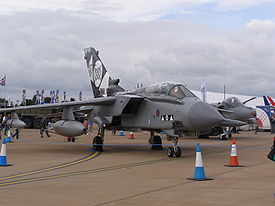
is currently one of two RAF squadrons (the other is No. 13 Squadron RAF) operating in the reconnaissance
role with the Tornado GR4A and GR4 and is based at RAF Marham
, Norfolk
.
No. II Squadron holds claim to being "the oldest heavier-than-air flying machine squadron in the world", along with No. 3 Squadron RAF
. Its traditional Army Co-Operation role is reflected in its title, its motto Hereward
("Guardian of the Army"), and the Wake knot
in its crest. Its unofficial nickname is "Shiny Two".
and 3 Sqn
, 2 Sqn was a founder member of the Royal Flying Corps
. The squadron's first commander was Major C J Burke
. The squadron was the first to fly the English Channel into France. Starting a role which continues to this day, the squadron spent World War I
on reconnaissance duties in France flying, amongst other aircraft, the B.E.2. The squadron was based at Montrose, Angus
during the early years of the twentieth century. At Montrose the ghost story of Desmond Arthur
spread around the flying corps. Although its principal role was not air to air combat, it still had one flying ace
among its ranks in Arthur William Hammond
. It also numbered the first aviation Victoria Cross
winners in its ranks, in Second Lieutenant Rhodes-Moorhouse and Lieutenant Alan Arnett McLeod
.
in the early 1920s. After time in China during 1927 the squadron re-equipped with the Armstrong Whitworth Atlas
again on Army Co-operation work.
At the outbreak of World War II
the unit was flying Lysanders
. In France until the Dunkirk evacuation
, the squadron equipped with fighters - the Tomahawk
in 1940, the Mustang
in 1942 and Spitfire
Mk 14s in 1944
In July 1944, assigned to the 2nd Tactical Air Force, II (AC) Sqn returned to France, and the reconnaissance role, with Spitfire PR Mk 11s.
in Germany
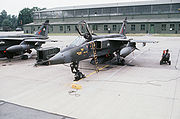
as part of the Army of Occupation, flying various fighter types, including latterly Phantoms
and then Jaguars
. Along with much of the RAF, II (AC) Sqn withdrew from Germany in the early 1990s - moving to RAF Marham
with its Tornado GR1As
. These were upgraded to the latest GR4 standard, with which the squadron deployed at part of Operation Telic
over Iraq
in 2003.
Royal Air Force
The Royal Air Force is the aerial warfare service branch of the British Armed Forces. Formed on 1 April 1918, it is the oldest independent air force in the world...
is currently one of two RAF squadrons (the other is No. 13 Squadron RAF) operating in the reconnaissance
Reconnaissance
Reconnaissance is the military term for exploring beyond the area occupied by friendly forces to gain information about enemy forces or features of the environment....
role with the Tornado GR4A and GR4 and is based at RAF Marham
RAF Marham
Royal Air Force Station Marham, more commonly known as RAF Marham, is a Royal Air Force station; a military airbase, near the village of Marham in the English county of Norfolk, East Anglia....
, Norfolk
Norfolk
Norfolk is a low-lying county in the East of England. It has borders with Lincolnshire to the west, Cambridgeshire to the west and southwest and Suffolk to the south. Its northern and eastern boundaries are the North Sea coast and to the north-west the county is bordered by The Wash. The county...
.
No. II Squadron holds claim to being "the oldest heavier-than-air flying machine squadron in the world", along with No. 3 Squadron RAF
No. 3 Squadron RAF
No 3 Squadron of the Royal Air Force operates the Typhoon F2, FGR4 and T3 from RAF Coningsby, Lincolnshire.No 3 Squadron, which celebrated its 95th anniversary over the weekend of 11-13 May 2007, is unique in the RAF for having two official crests....
. Its traditional Army Co-Operation role is reflected in its title, its motto Hereward
Hereward the Wake
Hereward the Wake , known in his own times as Hereward the Outlaw or Hereward the Exile, was an 11th-century leader of local resistance to the Norman conquest of England....
("Guardian of the Army"), and the Wake knot
Carrick bend
The Carrick bend is a knot used for joining two lines. It is particularly appropriate for very heavy rope or cable that is too large and stiff to easily be formed into other common bends. It will not jam even after carrying a significant load or being soaked with water...
in its crest. Its unofficial nickname is "Shiny Two".
Foundation until Armistice
Formed on 13 May 1912, along with 1 SqnNo. 1 Squadron RAF
No. 1 Squadron is a squadron of the Royal Air Force. It operated the Harrier GR9 from RAF Cottesmore until 28 January 2011.The squadron motto is In omnibus princeps , appropriate for the RAF's oldest squadron and one that has been involved in almost every major British military operation since...
and 3 Sqn
No. 3 Squadron RAF
No 3 Squadron of the Royal Air Force operates the Typhoon F2, FGR4 and T3 from RAF Coningsby, Lincolnshire.No 3 Squadron, which celebrated its 95th anniversary over the weekend of 11-13 May 2007, is unique in the RAF for having two official crests....
, 2 Sqn was a founder member of the Royal Flying Corps
Royal Flying Corps
The Royal Flying Corps was the over-land air arm of the British military during most of the First World War. During the early part of the war, the RFC's responsibilities were centred on support of the British Army, via artillery co-operation and photographic reconnaissance...
. The squadron's first commander was Major C J Burke
Charles Burke (British Army officer)
Lieutenant-Colonel Charles James Burke DSO was an officer in the Royal Irish Regiment and the Royal Flying Corps and a military aviation pioneer....
. The squadron was the first to fly the English Channel into France. Starting a role which continues to this day, the squadron spent World War I
World War I
World War I , which was predominantly called the World War or the Great War from its occurrence until 1939, and the First World War or World War I thereafter, was a major war centred in Europe that began on 28 July 1914 and lasted until 11 November 1918...
on reconnaissance duties in France flying, amongst other aircraft, the B.E.2. The squadron was based at Montrose, Angus
Montrose, Angus
Montrose is a coastal resort town and former royal burgh in Angus, Scotland. It is situated 38 miles north of Dundee between the mouths of the North and South Esk rivers...
during the early years of the twentieth century. At Montrose the ghost story of Desmond Arthur
Desmond Arthur
Lieutenant Desmond Arthur was an Irish aviator in the Royal Flying Corps. Following his crash in Scotland's first fatal aircraft accident his name is connected to a ghost believed to haunt the airfield at RAF Montrose in Montrose, Angus, Scotland...
spread around the flying corps. Although its principal role was not air to air combat, it still had one flying ace
Flying ace
A flying ace or fighter ace is a military aviator credited with shooting down several enemy aircraft during aerial combat. The actual number of aerial victories required to officially qualify as an "ace" has varied, but is usually considered to be five or more...
among its ranks in Arthur William Hammond
Arthur William Hammond
Lieutenant Arthur William Hammond was a World War I flying ace credited with five aerial victories.-References:...
. It also numbered the first aviation Victoria Cross
Victoria Cross
The Victoria Cross is the highest military decoration awarded for valour "in the face of the enemy" to members of the armed forces of various Commonwealth countries, and previous British Empire territories....
winners in its ranks, in Second Lieutenant Rhodes-Moorhouse and Lieutenant Alan Arnett McLeod
Alan Arnett McLeod
Alan Arnett McLeod VC was a Canadian recipient of the Victoria Cross, the highest and most prestigious award for gallantry in the face of the enemy that can be awarded to British and Commonwealth forces. Alan McLeod grew up in Stonewall, Manitoba, the son of a doctor. He enrolled in The 34th Fort...
.
Between the World Wars
The squadron gained the AC in its title in the inter-war years, flying Army Co-operation (AC) sorties during the troubles around the partition of IrelandPartition of Ireland
The partition of Ireland was the division of the island of Ireland into two distinct territories, now Northern Ireland and the Republic of Ireland . Partition occurred when the British Parliament passed the Government of Ireland Act 1920...
in the early 1920s. After time in China during 1927 the squadron re-equipped with the Armstrong Whitworth Atlas
Armstrong Whitworth Atlas
|-See also:-External links:* *...
again on Army Co-operation work.
At the outbreak of World War II
World War II
World War II, or the Second World War , was a global conflict lasting from 1939 to 1945, involving most of the world's nations—including all of the great powers—eventually forming two opposing military alliances: the Allies and the Axis...
the unit was flying Lysanders
Westland Lysander
The Westland Lysander was a British army co-operation and liaison aircraft produced by Westland Aircraft used immediately before and during the Second World War...
. In France until the Dunkirk evacuation
Battle of Dunkirk
The Battle of Dunkirk was a battle in the Second World War between the Allies and Germany. A part of the Battle of France on the Western Front, the Battle of Dunkirk was the defence and evacuation of British and allied forces in Europe from 26 May–4 June 1940.After the Phoney War, the Battle of...
, the squadron equipped with fighters - the Tomahawk
Curtiss P-40
The Curtiss P-40 Warhawk was an American single-engine, single-seat, all-metal fighter and ground attack aircraft that first flew in 1938. The P-40 design was a modification of the previous Curtiss P-36 Hawk which reduced development time and enabled a rapid entry into production and operational...
in 1940, the Mustang
P-51 Mustang
The North American Aviation P-51 Mustang was an American long-range, single-seat fighter and fighter-bomber used during World War II, the Korean War and in several other conflicts...
in 1942 and Spitfire
Supermarine Spitfire
The Supermarine Spitfire is a British single-seat fighter aircraft that was used by the Royal Air Force and many other Allied countries throughout the Second World War. The Spitfire continued to be used as a front line fighter and in secondary roles into the 1950s...
Mk 14s in 1944
In July 1944, assigned to the 2nd Tactical Air Force, II (AC) Sqn returned to France, and the reconnaissance role, with Spitfire PR Mk 11s.
Post World War II
The squadron spent much of the Cold WarCold War
The Cold War was the continuing state from roughly 1946 to 1991 of political conflict, military tension, proxy wars, and economic competition between the Communist World—primarily the Soviet Union and its satellite states and allies—and the powers of the Western world, primarily the United States...
in Germany
Germany
Germany , officially the Federal Republic of Germany , is a federal parliamentary republic in Europe. The country consists of 16 states while the capital and largest city is Berlin. Germany covers an area of 357,021 km2 and has a largely temperate seasonal climate...
as part of the Army of Occupation, flying various fighter types, including latterly Phantoms
F-4 Phantom II
The McDonnell Douglas F-4 Phantom II is a tandem two-seat, twin-engined, all-weather, long-range supersonic jet interceptor fighter/fighter-bomber originally developed for the United States Navy by McDonnell Aircraft. It first entered service in 1960 with the U.S. Navy. Proving highly adaptable,...
and then Jaguars
SEPECAT Jaguar
The SEPECAT Jaguar is an Anglo-French jet ground attack aircraft, originally used by the British Royal Air Force and the French Armée de l'Air in the close air support and nuclear strike role, and still in service with several export customers, notably the Indian Air Force and the Royal Air Force...
. Along with much of the RAF, II (AC) Sqn withdrew from Germany in the early 1990s - moving to RAF Marham
RAF Marham
Royal Air Force Station Marham, more commonly known as RAF Marham, is a Royal Air Force station; a military airbase, near the village of Marham in the English county of Norfolk, East Anglia....
with its Tornado GR1As
Panavia Tornado
The Panavia Tornado is a family of twin-engine, variable-sweep wing combat aircraft, which was jointly developed and manufactured by the United Kingdom, West Germany and Italy...
. These were upgraded to the latest GR4 standard, with which the squadron deployed at part of Operation Telic
Operation Telic
Operation TELIC was the codename under which all British military operations in Iraq were conducted between the start of the Invasion of Iraq on 19 March 2003 and the withdrawal of the last remaining British forces on 22 May 2011...
over Iraq
Iraq
Iraq ; officially the Republic of Iraq is a country in Western Asia spanning most of the northwestern end of the Zagros mountain range, the eastern part of the Syrian Desert and the northern part of the Arabian Desert....
in 2003.
Aircraft operated
- 1912 - Bristol BoxkiteBristol Boxkite-Military operators:* Australian Flying Corps** Central Flying School AFC at Point Cook, Victoria.* Union Defence Forces - South African Air Force Kingdom of Spain* Royal Flying Corps* Royal Naval Air Service** No. 3 Squadron RFC-References:...
- 1912 - Breguet G.3 biplaneBreguet Type IIIThis article is about the Breguet aircraft of 1910-1913. For the unrelated aircraft of the same designation flown in World War I, see Breguet Bre.4 and Breguet Bre.5.This article is about the Breguet aircraft of 1910-1913...
- 1912 - Royal Aircraft Factory B.E.1
- 1912 - Farman S.7 Longhorn
- 1912 - Royal Aircraft Factory B.E.2
- 1912 - Henry Farman BiplaneFarman MF.7|-See also:-External links:* Contemporary technical description of the MF.7 with photographs and drawings....
- 1912 - Royal Aircraft Factory B.E.2a
- 1914 - Farman S.11 Shorthorn
- 1914 - Royal Aircraft Factory R.E.1Royal Aircraft Factory R.E.1The Royal Aircraft Factory R.E.1 was an experimental two-seat single-engined biplane from before World War I, intended to develop reconnaissance aircraft.-Design and development:...
- 1914 - Royal Aircraft Factory B.E.2c
- 1914 - Royal Aircraft Factory R.E.5Royal Aircraft Factory R.E.5|-See also:...
- 1915 - Vickers FB.5
- 1915 - Royal Aircraft Factory B.E.2b
- 1915 - Bristol ScoutBristol ScoutThe Bristol Scout was a simple, single seat, rotary-engined biplane originally intended as a civilian racing aircraft. Like other similar fast, light aircraft of the period - it was acquired by the RNAS and the RFC as a "scout", or fast reconnaissance type...
- 1916 - Royal Aircraft Factory B.E.2d
- 1917 - Royal Aircraft Factory B.E.2e
- 1917 - Armstrong Whitworth F.K.8Armstrong Whitworth F.K.8The Armstrong Whitworth F.K.8 was a British two-seat general-purpose biplane built by Armstrong Whitworth during the First World War. The type served alongside the better known R.E.8 until the end of the war, at which point 694 F.K.8s remained on RAF charge....
- 1920 - Bristol F.2b FighterBristol F.2 FighterThe Bristol F.2 Fighter was a British two-seat biplane fighter and reconnaissance aircraft of the First World War flown by the Royal Flying Corps. It is often simply called the Bristol Fighter or popularly the "Brisfit" or "Biff". Despite being a two-seater, the F.2B proved to be an agile aircraft...
- 1929 - Armstrong Whitworth AtlasArmstrong Whitworth Atlas|-See also:-External links:* *...
- 1933 - Hawker Audax
- 1937 - Hawker HectorHawker Hector-See also:-Bibliography:* Air Transport Auxiliary Ferry Pilots Notes . Elvington, York, UK: Yorkshire Air Museum, 1996. ISBN 0-9512379-8-5....
- 1938 - Westland Lysander IWestland LysanderThe Westland Lysander was a British army co-operation and liaison aircraft produced by Westland Aircraft used immediately before and during the Second World War...
- 1940 - Westland Lysander IIWestland LysanderThe Westland Lysander was a British army co-operation and liaison aircraft produced by Westland Aircraft used immediately before and during the Second World War...
- 1940 - Westland Lysander IIIWestland LysanderThe Westland Lysander was a British army co-operation and liaison aircraft produced by Westland Aircraft used immediately before and during the Second World War...
- 1941 - Curtiss Tomahawk I
- 1941 - Curtiss Tomahawk II
- 1942 - North American Mustang IP-51 MustangThe North American Aviation P-51 Mustang was an American long-range, single-seat fighter and fighter-bomber used during World War II, the Korean War and in several other conflicts...
- 1944 - North American Mustang IAP-51 MustangThe North American Aviation P-51 Mustang was an American long-range, single-seat fighter and fighter-bomber used during World War II, the Korean War and in several other conflicts...
- 1944 - North American Mustang IIP-51 MustangThe North American Aviation P-51 Mustang was an American long-range, single-seat fighter and fighter-bomber used during World War II, the Korean War and in several other conflicts...
- 1944 - Vickers-Supermarine Spitfire XIVSupermarine SpitfireThe Supermarine Spitfire is a British single-seat fighter aircraft that was used by the Royal Air Force and many other Allied countries throughout the Second World War. The Spitfire continued to be used as a front line fighter and in secondary roles into the 1950s...
- 1945 - Vickers-Supermarine Spitfire XISupermarine SpitfireThe Supermarine Spitfire is a British single-seat fighter aircraft that was used by the Royal Air Force and many other Allied countries throughout the Second World War. The Spitfire continued to be used as a front line fighter and in secondary roles into the 1950s...
- 1946 - Vickers-Supermarine Spitfite PR19Supermarine SpitfireThe Supermarine Spitfire is a British single-seat fighter aircraft that was used by the Royal Air Force and many other Allied countries throughout the Second World War. The Spitfire continued to be used as a front line fighter and in secondary roles into the 1950s...
- 1950 - Gloster Meteor FR9Gloster MeteorThe Gloster Meteor was the first British jet fighter and the Allies' first operational jet. It first flew in 1943 and commenced operations on 27 July 1944 with 616 Squadron of the Royal Air Force...
- 1951 - Gloster Meteor PR10Gloster MeteorThe Gloster Meteor was the first British jet fighter and the Allies' first operational jet. It first flew in 1943 and commenced operations on 27 July 1944 with 616 Squadron of the Royal Air Force...
- 1956 - Supermarine Swift FR5Supermarine SwiftThe Supermarine Swift was a British single-seat jet fighter of the Royal Air Force , built by Supermarine during the 1950s. After a protracted development period, the Swift entered service as an interceptor, but, due to a spate of accidents, its service life was short...
- 1961 - Hawker Hunter FR10Hawker HunterThe Hawker Hunter is a subsonic British jet aircraft developed in the 1950s. The single-seat Hunter entered service as a manoeuvrable fighter aircraft, and later operated in fighter-bomber and reconnaissance roles in numerous conflicts. Two-seat variants remained in use for training and secondary...
- 1970 - McDonell-Douglas Phantom FGR2F-4 Phantom IIThe McDonnell Douglas F-4 Phantom II is a tandem two-seat, twin-engined, all-weather, long-range supersonic jet interceptor fighter/fighter-bomber originally developed for the United States Navy by McDonnell Aircraft. It first entered service in 1960 with the U.S. Navy. Proving highly adaptable,...
- 1976 - SEPECAT Jaguar GR1SEPECAT JaguarThe SEPECAT Jaguar is an Anglo-French jet ground attack aircraft, originally used by the British Royal Air Force and the French Armée de l'Air in the close air support and nuclear strike role, and still in service with several export customers, notably the Indian Air Force and the Royal Air Force...
- 1988 - Tornado GR1APanavia TornadoThe Panavia Tornado is a family of twin-engine, variable-sweep wing combat aircraft, which was jointly developed and manufactured by the United Kingdom, West Germany and Italy...
- ???? - Tornado GR4/4A
Commanders
The following officers have had command of 2 Squadron:- 13 May 1912 CaptainFlight LieutenantFlight lieutenant is a junior commissioned rank in the Royal Air Force and the air forces of many Commonwealth countries. It ranks above flying officer and immediately below squadron leader. The name of the rank is the complete phrase; it is never shortened to "lieutenant"...
H R M Brooke-PophamRobert Brooke-PophamAir Chief Marshal Sir Henry Robert Moore Brooke-Popham, GCVO, KCB, CMG, DSO, AFC, was a senior commander in the Royal Air Force. During World War I he served in the Royal Flying Corps as wing commander and senior staff officer... - 20 May 1912 Major C J BurkeCharles Burke (British Army officer)Lieutenant-Colonel Charles James Burke DSO was an officer in the Royal Irish Regiment and the Royal Flying Corps and a military aviation pioneer....
- 10 November 1914 Major G W P Dawes
- 8 March 1915 Major T I Webb-BowenTom Webb-BowenAir Vice-Marshal Sir Tom Ince Webb-Bowen KCB, CMG, RAF was a senior commander in the Royal Air Force during the first half of the 20th century.-RAF career:...
- 2 June 1915 Major J H W BeckeJohn BeckeBrigadier-General John Harold Whitworth Becke CMG DSO AFC was an infantry officer in the Second Boer War and commander in the Royal Flying Corps during World War I. He transferred to the RAF on its creation on 1 April 1918 as a temporary Brigadier-General...
- 3 November 1915 Major C F de S.Murphy
- 9 April 1916 Major R A Cooper
- 16 August 1917 Major W R Snow
- 28 August 1918 Major P G Ross-Hume
- 12 November 1919 Squadron LeaderSquadron LeaderSquadron Leader is a commissioned rank in the Royal Air Force and the air forces of many countries which have historical British influence. It is also sometimes used as the English translation of an equivalent rank in countries which have a non-English air force-specific rank structure. In these...
B F More - 18 June 1920 Squadron Leader F W Stent
- 16 August 1920 Squadron Leader A J Butler MC
- 15 May 1922 Squadron Leader L F Forbes
- 2 March 1925 Squadron Leader R E SaulRichard SaulAir Vice-Marshal Richard Ernest Saul CB, DFC, RAF was a pilot during World War I and a senior Royal Air Force commander during World War II.- Earlier Years :Saul was born in Dublin, Ireland, in 1891...
- 9 January 1927 Squadron Leader W Sowrey DFC MC
- 1 April 1928 Squadron Leader H M Probyn
- 29 September 1930 Squadron Leader S E Toomer DFC MC
- 12 January 1933 Squadron Leader P F Fullard DSO MC AFC
- 1 December 1933 Squadron Leader J H Green
- 20 July 1935 Squadron Leader N L Despoer
- 21 April 1938 Squadron Leader W A Opie
- 29 April 1939 Squadron Leader A J W GeddesAndrew James Wray GeddesAir Commodore Andrew James Wray Geddes CBE DSO RAF was the senior Royal Air Force officer during World War II who led the planning for Operation Manna, the air drop of food supplies to the starving population of the Netherlands.- External links :*...
(Wing CommanderWing Commander (rank)Wing commander is a commissioned rank in the Royal Air Force and the air forces of many other Commonwealth countries...
from 1 March 1940) - 24 December 1941 Wing Commander P J A Riddell
- 8 February 1943 Wing Commander P W Stansfeld
- 29 June 1943 Squadron Leader B O C Egan-Wyer
- 25 August 1943 Squadron Leader M J Gray DFC
- 7 September 1944 Squadron Leader C A Maitland DFC
- 25 March 1945 Squadron Leader R J F Mitchell DFC
- 24 April 1946 Squadron Leader D W Barlow DFC
- 15 December 1946 Squadron Leader G Collinson
- 28 October 1948 Squadron Leader W A Newenham DFC
- 6 February 1950 Squadron Leader L H Bartlett DSO
- 1 November 1950 Squadron Leader R M Pugh AFC
- 29 May 1953 Squadron Leader R H G Weighill DFC
- 31 August 1955 Flight LieutenantFlight LieutenantFlight lieutenant is a junior commissioned rank in the Royal Air Force and the air forces of many Commonwealth countries. It ranks above flying officer and immediately below squadron leader. The name of the rank is the complete phrase; it is never shortened to "lieutenant"...
M C Newman - 15 November 1955 Squadron Leader R S Mortley AFC
- 12 May 1958 Squadron Leader C A Wade
- 16 September 1960 Squadron Leader C S MacDonald
- 15 February 1962 Squadron Leader D L F Thornton
- 13 December 1964 Squadron Leader N J R Walpole
- 16 June 1967 Squadron Leader T Barrett
- 11 November 1969 Squadron Leader R J M David
- 7 December 1971 Wing Commander B A Stead
- 2 December 1972 Wing Commander D H Warren
- 8 May 1975 Wing Commander D C Ferguson
- 1 April 1976 Wing Commander R A F WilsonAndrew Wilson (RAF officer)Air Chief Marshal Sir Ronald Andrew Fellowes Wilson KCB AFC FRAes RAF often known as Sir Andrew Wilson and sometimes known informally as Sir Sandy Wilson is a retired senior Royal Air Force officer.-RAF career:...
- 6 January 1978 Wing Commander R Fowler AFC
- 4 May 1980 Wing Commander T G ThornTim ThornAir Commodore Timothy Gane Thorn AFC FRAeS, often known as Tim Thorn and nicknamed "Tiger", is a retired member of the Royal Air Force and up to January 2010 was a pilot and flying instructor at 6 Air Experience Flight at RAF Benson, Oxfordshire....
AFC - 18 January 1983 Wing Commander F J Hoare AFC
- 31 May 1985 Wing Commander G E StirrupJock StirrupAir Chief Marshal Graham Eric "Jock" Stirrup, Baron Stirrup, GCB, AFC, FRAeS, FCMI, RAF, is a former senior Royal Air Force commander, who was the Chief of the Defence Staff from 2006 until his retirement in late 2010. He is also a Crossbench member of the House of Lords.As a junior RAF officer,...
- 13 March 1987 Wing Commander P O SturleyPhilip SturleyAir Marshal Philip Oliver Sturley CB MBE BSc FRAeS RAF was a senior commander in the Royal Air Force. On 30 January 1998 Sturley took up the post of Air Officer Commanding No. 38 Group. From 2000 to 2003, Sturley was Assistant Chief of the Air Staff. In May 2005 he was appointed as President of...
- 1 January 1989 Wing Commander A Threadgould
- 1 July 1991 Wing Commander B C Holding
- 21 July 1993 Wing Commander R J Hounslow
- 6 December 1993 Wing Commander C M NickolsChris NickolsAir Marshal Christopher Mark Nickols CB CBE MA is a senior officer in the Royal Air Force who is currently Chief of Defence Intelligence.-RAF career:...
- 26 April 1996 Wing Commander R F GarwoodRichard GarwoodAir Marshal Richard Frank Garwood CB CBE DFC is a Royal Air Force officer, currently serving as Deputy Commander-in-Chief Operations at Air Command....
DFC - 27 November 1998 Wing Commander Steve J Hillier DFC
- 15 September 2000 Wing Commander R M Poole
- 2 May 2003 Wing Commander S Cockram
- 25 September 2005 Wing Commander A Hine
- 19 May 2008 Wing Commander J Turner DFC
Accolades
- 2nd Lt William Rhodes-MoorhouseWilliam Barnard Rhodes-MoorhouseWilliam Barnard Rhodes-Moorhouse VC, born William Barnard Moorhouse, was an English recipient of the Victoria Cross, the highest and most prestigious award for gallantry in the face of the enemy that can be awarded to British and Commonwealth forces...
, of 2 Sqn, was the first British airman to be awarded the Victoria CrossVictoria CrossThe Victoria Cross is the highest military decoration awarded for valour "in the face of the enemy" to members of the armed forces of various Commonwealth countries, and previous British Empire territories....
, during a raid on KortrijkKortrijkKortrijk ; , ; ) is a Belgian city and municipality located in the Flemish province West Flanders...
, BelgiumBelgiumBelgium , officially the Kingdom of Belgium, is a federal state in Western Europe. It is a founding member of the European Union and hosts the EU's headquarters, and those of several other major international organisations such as NATO.Belgium is also a member of, or affiliated to, many...
on 26 April 1915. - No 2 Sqn became the first RFC squadron to cross the Channel to France, at the outbreak of World War IWorld War IWorld War I , which was predominantly called the World War or the Great War from its occurrence until 1939, and the First World War or World War I thereafter, was a major war centred in Europe that began on 28 July 1914 and lasted until 11 November 1918...