

No. 5 Squadron RAF

Encyclopedia
No. 5 Squadron of the Royal Air Force
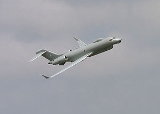
is the operator of the new Sentinel R1
Airborne STand-Off Radar (ASTOR) aircraft and is based at RAF Waddington
.
, it was formed at Farnborough on 26 July 1913, and following the outbreak of the First World War
deployed to France on 15 August, equipped with a variety of aircraft types to carry out reconnaissance
for the BEF. It flew its first missions on 21 August and on the next day, an Avro 504
of 5 Squadron was the first British aircraft to be shot down, its crew of pilot Second Lieutenant
Vincent Waterfall and navigator Lt Charles George Gordon Bayly being killed.
No 5 Squadron standardised on the BE.2
, specialising as observers for artillery, re-equipping with the RE.8
in May 1917, and working closely with the Canadian Corps
, through to the end of the war and into 1919, when it moved into Germany as part of the Army of Occupation. (Its association with the Canadian Corps lead the incorporation of a Maple Leaf in the squadron's badge when it was approved in June 1937.)
Thereafter in 1920, the squadron was reformed at Quetta
, India (now part of Pakistan
). There it continued working in Army Air Cooperation for operations on the North West Frontier. From 1920 until 1941 they had a succession of aircraft: Bristol Fighter
s, Westland Wapiti
s, Hawker Hart
s and Hawker Audaxs. In 1942 they received American built Mohawk
s and became escorts to Blenheim bombers over north west Burma. These were replaced in turn by Hawker Hurricane
s and P-47 Thunderbolt
s. No. 5 Squadron converted to Tempest II
s in February 1946, but disbanded on 1 August 1947.
On 11 February 1949 it reformed Wales for target-towing but in 1951, the squadron moved to Germany to fly the de Havilland Vampire
and its successor the Venom
. The squadron was part of the defence cuts of 1957 but was restored in 1959 as a Night Fighter squadron at RAF Laarbruch
, Germany, first flying the Gloster Meteor NF.11
before re-equipping with the delta winged Gloster Javelin
. It moved to RAF Binbrook
in 1965 with the English Electric Lightning
interceptor keeping these until 1987. From then until 2003, when it was disbanded at RAF Coningsby
, No.5 Squadron flew the Tornado F3 and with this aircraft it was the first RAF squadron (accompanied by No. 29 Squadron) to be deployed as part the UK's contribution to the Gulf War
. It reformed on 1 April 2004.
The first production Sentinel R1
made its maiden flight on May 26, 2004. The ASTOR system officially entered service with the No. 5 Squadron on 1 December 2008. Full Operating Capability is expected by the end of 2010.
The new radar-equipped aircraft provides battlefield and ground surveillance for the British Army
in a similar role to the American JSTARS aircraft.
From 2009, the squadron also operated four Shadow R1 aircraft, based on the Beechcraft King Air 350
. These were transferred to No. 14 Squadron RAF
in 2011.
Royal Air Force
The Royal Air Force is the aerial warfare service branch of the British Armed Forces. Formed on 1 April 1918, it is the oldest independent air force in the world...
is the operator of the new Sentinel R1
Raytheon Sentinel
|-See also:-References:* Winchester, Jim. "Aircraft of the RAF Part 5 - Raytheon Sentinel R1". Air International, Volume 75 No.3, September 2008. pp.54-57.-External links:* * * *...
Airborne STand-Off Radar (ASTOR) aircraft and is based at RAF Waddington
RAF Waddington
RAF Waddington is a Royal Air Force station in Lincolnshire, England.-Formation:Waddington opened as a Royal Flying Corps flying training station in 1916 until 1920, when the station went into care and maintenance....
.
History
As No. 5 Squadron Royal Flying CorpsRoyal Flying Corps
The Royal Flying Corps was the over-land air arm of the British military during most of the First World War. During the early part of the war, the RFC's responsibilities were centred on support of the British Army, via artillery co-operation and photographic reconnaissance...
, it was formed at Farnborough on 26 July 1913, and following the outbreak of the First World War
World War I
World War I , which was predominantly called the World War or the Great War from its occurrence until 1939, and the First World War or World War I thereafter, was a major war centred in Europe that began on 28 July 1914 and lasted until 11 November 1918...
deployed to France on 15 August, equipped with a variety of aircraft types to carry out reconnaissance
Reconnaissance
Reconnaissance is the military term for exploring beyond the area occupied by friendly forces to gain information about enemy forces or features of the environment....
for the BEF. It flew its first missions on 21 August and on the next day, an Avro 504
Avro 504
The Avro 504 was a World War I biplane aircraft made by the Avro aircraft company and under licence by others. Production during the War totalled 8,970 and continued for almost 20 years, making it the most-produced aircraft of any kind that served in World War I, in any military capacity, during...
of 5 Squadron was the first British aircraft to be shot down, its crew of pilot Second Lieutenant
Second Lieutenant
Second lieutenant is a junior commissioned officer military rank in many armed forces.- United Kingdom and Commonwealth :The rank second lieutenant was introduced throughout the British Army in 1871 to replace the rank of ensign , although it had long been used in the Royal Artillery, Royal...
Vincent Waterfall and navigator Lt Charles George Gordon Bayly being killed.
No 5 Squadron standardised on the BE.2
Royal Aircraft Factory BE.2
The Royal Aircraft Factory B.E.2 was a British single-engine two-seat biplane which was in service with the Royal Flying Corps from 1912 until the end of World War I. The "Bleriot" in its designation refers to the fact that, like the Bleriot types it was of tractor configuration, with the...
, specialising as observers for artillery, re-equipping with the RE.8
Royal Aircraft Factory R.E.8
The Royal Aircraft Factory R.E.8 was a British two-seat biplane reconnaissance and bomber aircraft of the First World War designed by John Kenworthy. Intended as a replacement for the vulnerable B.E.2, the R.E.8 was more difficult to fly, and was regarded with great suspicion at first in the Royal...
in May 1917, and working closely with the Canadian Corps
Canadian Corps
The Canadian Corps was a World War I corps formed from the Canadian Expeditionary Force in September 1915 after the arrival of the 2nd Canadian Division in France. The corps was expanded by the addition of the 3rd Canadian Division in December 1915 and the 4th Canadian Division in August 1916...
, through to the end of the war and into 1919, when it moved into Germany as part of the Army of Occupation. (Its association with the Canadian Corps lead the incorporation of a Maple Leaf in the squadron's badge when it was approved in June 1937.)
Thereafter in 1920, the squadron was reformed at Quetta
Quetta
is the largest city and the provincial capital of the Balochistan Province of Pakistan. Known as the "Fruit Garden of Pakistan" due to the diversity of its plant and animal wildlife, Quetta is home to the Hazarganji Chiltan National Park, which contains some of the rarest species of wildlife in the...
, India (now part of Pakistan
Pakistan
Pakistan , officially the Islamic Republic of Pakistan is a sovereign state in South Asia. It has a coastline along the Arabian Sea and the Gulf of Oman in the south and is bordered by Afghanistan and Iran in the west, India in the east and China in the far northeast. In the north, Tajikistan...
). There it continued working in Army Air Cooperation for operations on the North West Frontier. From 1920 until 1941 they had a succession of aircraft: Bristol Fighter
Bristol F.2 Fighter
The Bristol F.2 Fighter was a British two-seat biplane fighter and reconnaissance aircraft of the First World War flown by the Royal Flying Corps. It is often simply called the Bristol Fighter or popularly the "Brisfit" or "Biff". Despite being a two-seater, the F.2B proved to be an agile aircraft...
s, Westland Wapiti
Westland Wapiti
The Westland Wapiti was a British two-seat general purpose military single-engined biplane of the 1920s. It was designed and built by Westland Aircraft Works to replace the Airco DH.9A in Royal Air Force service....
s, Hawker Hart
Hawker Hart
The Hawker Hart was a British two-seater biplane light bomber of the Royal Air Force , which had a prominent role during the RAF's inter-war period. The Hart was designed during the 1920s by Sydney Camm and built by Hawker Aircraft...
s and Hawker Audaxs. In 1942 they received American built Mohawk
P-36 Hawk
The Curtiss P-36 Hawk, also known as the Curtiss Hawk Model 75, was an American-designed and built fighter aircraft of the 1930s and 40s. A contemporary of both the Hawker Hurricane and Messerschmitt Bf 109, it was one of the first of a new generation of combat aircraft—a sleek monoplane design...
s and became escorts to Blenheim bombers over north west Burma. These were replaced in turn by Hawker Hurricane
Hawker Hurricane
The Hawker Hurricane is a British single-seat fighter aircraft that was designed and predominantly built by Hawker Aircraft Ltd for the Royal Air Force...
s and P-47 Thunderbolt
P-47 Thunderbolt
Republic Aviation's P-47 Thunderbolt, also known as the "Jug", was the largest, heaviest, and most expensive fighter aircraft in history to be powered by a single reciprocating engine. It was heavily armed with eight .50-caliber machine guns, four per wing. When fully loaded, the P-47 weighed up to...
s. No. 5 Squadron converted to Tempest II
Hawker Tempest
The Hawker Tempest was a British fighter aircraft primarily used by the Royal Air Force in the Second World War. The Tempest was an improved derivative of the Hawker Typhoon, and one of the most powerful fighter aircraft used during the war....
s in February 1946, but disbanded on 1 August 1947.
On 11 February 1949 it reformed Wales for target-towing but in 1951, the squadron moved to Germany to fly the de Havilland Vampire
De Havilland Vampire
The de Havilland DH.100 Vampire was a British jet-engine fighter commissioned by the Royal Air Force during the Second World War. Following the Gloster Meteor, it was the second jet fighter to enter service with the RAF. Although it arrived too late to see combat during the war, the Vampire served...
and its successor the Venom
De Havilland Venom
The de Havilland DH 112 Venom was a British postwar single-engined jet aircraft developed from the de Havilland Vampire. It served with the Royal Air Force as a single-seat fighter-bomber and two-seat night fighter....
. The squadron was part of the defence cuts of 1957 but was restored in 1959 as a Night Fighter squadron at RAF Laarbruch
RAF Laarbruch
The former Royal Air Force Station Laarbruch, more commonly known as RAF Laarbruch ICAO EDUL was a Royal Air Force station, a military airbase, located in Germany on its border with the Netherlands...
, Germany, first flying the Gloster Meteor NF.11
Gloster Meteor
The Gloster Meteor was the first British jet fighter and the Allies' first operational jet. It first flew in 1943 and commenced operations on 27 July 1944 with 616 Squadron of the Royal Air Force...
before re-equipping with the delta winged Gloster Javelin
Gloster Javelin
The Gloster Javelin was an "all-weather" interceptor aircraft that served with Britain's Royal Air Force in the late 1950s and most of the 1960s...
. It moved to RAF Binbrook
RAF Binbrook
RAF Binbrook was a Bomber Command station during World War II. After the war it was amongst others the home of the Central Fighter Establishment...
in 1965 with the English Electric Lightning
English Electric Lightning
The English Electric Lightning is a supersonic jet fighter aircraft of the Cold War era, noted for its great speed and unpainted natural metal exterior finish. It is the only all-British Mach 2 fighter aircraft. The aircraft was renowned for its capabilities as an interceptor; Royal Air Force ...
interceptor keeping these until 1987. From then until 2003, when it was disbanded at RAF Coningsby
RAF Coningsby
RAF Coningsby , is a Royal Air Force station in Lincolnshire, England. It has been commanded by Group Captain Martin Sampson since 10 December 2010.-Operational units:...
, No.5 Squadron flew the Tornado F3 and with this aircraft it was the first RAF squadron (accompanied by No. 29 Squadron) to be deployed as part the UK's contribution to the Gulf War
Gulf War
The Persian Gulf War , commonly referred to as simply the Gulf War, was a war waged by a U.N.-authorized coalition force from 34 nations led by the United States, against Iraq in response to Iraq's invasion and annexation of Kuwait.The war is also known under other names, such as the First Gulf...
. It reformed on 1 April 2004.
The first production Sentinel R1
Raytheon Sentinel
|-See also:-References:* Winchester, Jim. "Aircraft of the RAF Part 5 - Raytheon Sentinel R1". Air International, Volume 75 No.3, September 2008. pp.54-57.-External links:* * * *...
made its maiden flight on May 26, 2004. The ASTOR system officially entered service with the No. 5 Squadron on 1 December 2008. Full Operating Capability is expected by the end of 2010.
The new radar-equipped aircraft provides battlefield and ground surveillance for the British Army
British Army
The British Army is the land warfare branch of Her Majesty's Armed Forces in the United Kingdom. It came into being with the unification of the Kingdom of England and Scotland into the Kingdom of Great Britain in 1707. The new British Army incorporated Regiments that had already existed in England...
in a similar role to the American JSTARS aircraft.
From 2009, the squadron also operated four Shadow R1 aircraft, based on the Beechcraft King Air 350
Beechcraft Super King Air
The Beechcraft Super King Air family is part of a line of twin-turboprop aircraft produced by the Beech Aircraft Corporation . The King Air line comprises a number of model series that fall into two families: the Model 90 series, Model 100 series , Model 200 series and Model 300 series...
. These were transferred to No. 14 Squadron RAF
No. 14 Squadron RAF
No. 14 Squadron of the Royal Air Force currently operates the Beechcraft Shadow R1 in the ISTAR role from RAF Waddington.-World War I:...
in 2011.