


Boat building

Encyclopedia
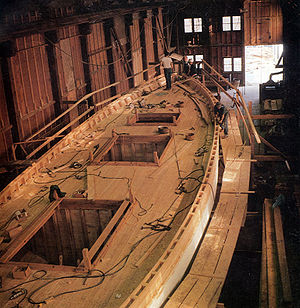
Engineering
Engineering is the discipline, art, skill and profession of acquiring and applying scientific, mathematical, economic, social, and practical knowledge, in order to design and build structures, machines, devices, systems, materials and processes that safely realize improvements to the lives of...
, is concerned with constructing the hulls
Hull (watercraft)
A hull is the watertight body of a ship or boat. Above the hull is the superstructure and/or deckhouse, where present. The line where the hull meets the water surface is called the waterline.The structure of the hull varies depending on the vessel type...
of boat
Boat
A boat is a watercraft of any size designed to float or plane, to provide passage across water. Usually this water will be inland or in protected coastal areas. However, boats such as the whaleboat were designed to be operated from a ship in an offshore environment. In naval terms, a boat is a...
s and, for sailboat
Sailboat
A sailboat or sailing boat is a boat propelled partly or entirely by sails. The term covers a variety of boats, larger than small vessels such as sailboards and smaller than sailing ships, but distinctions in the size are not strictly defined and what constitutes a sailing ship, sailboat, or a...
s, the mast
Mast (sailing)
The mast of a sailing vessel is a tall, vertical, or near vertical, spar, or arrangement of spars, which supports the sails. Large ships have several masts, with the size and configuration depending on the style of ship...
s, spar
Spar
In sailing, a spar is a pole of wood, metal or lightweight materials such as carbon fiber used on a sailing vessel. Spars of all types In sailing, a spar is a pole of wood, metal or lightweight materials such as carbon fiber used on a sailing vessel. Spars of all types In sailing, a spar is a...
s and rigging
Rigging
Rigging is the apparatus through which the force of the wind is used to propel sailboats and sailing ships forward. This includes masts, yards, sails, and cordage.-Terms and classifications:...
.
Parts
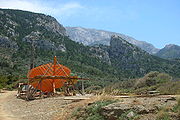
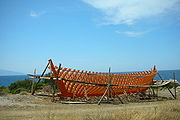
- BowBow (ship)The bow is a nautical term that refers to the forward part of the hull of a ship or boat, the point that is most forward when the vessel is underway. Both of the adjectives fore and forward mean towards the bow...
- the front and generally sharp end of the hull. It is designed to reduce the resistance of the hull cutting through water and should be tall enough to prevent water from easily washing over the top of the hull. - BulkheadBulkhead (partition)A bulkhead is an upright wall within the hull of a ship or within the fuselage of an airplane. Other kinds of partition elements within a ship are decks and deckheads.-Etymology:...
- the internal walls of the hull - ChinesChine (boating)A chine in boating refers to a sharp angle in the hull, as compared to the rounded bottoms of most traditional boat hulls. The term hard chine indicates an angle with little rounding, where a soft chine would be more rounded, but still involve the meeting of distinct planes. Chine log...
- are long, longitudinal strips on hydroplaningPlaning (sailing)Planing is the mode of operation for a waterborne craft in which its weight is predominantly supported by hydrodynamic lift, rather than hydrostatic lift .-History:...
hulls that deflect downwards the spray that is produced by the hull when it travels at speed in the water. The term also refers to distinct changes in angle of the hull sections, where the bottom blends into the sides of a flat bottomed skiff, for instance. A hull may have 2 or more chines to allow an approximation of a round bottomed shape with flat panels. It also refers to the longitudinal members inside the hull which support the edges of these panels. - DeckDeck (ship)A deck is a permanent covering over a compartment or a hull of a ship. On a boat or ship, the primary deck is the horizontal structure which forms the 'roof' for the hull, which both strengthens the hull and serves as the primary working surface...
- the top surface of the hull keeps water and weather out of the hull and allows the crew to stand safely and operate the boat more easily. It stiffens an enclosed hull. - Garboard - the strake immediately adjacent to the keel.
- GunwaleGunwaleThe gunwale is a nautical term describing the top edge of the side of a boat.Wale is the same word as the skin injury, a wheal, which, too, forms a ridge. Originally the gunwale was the "Gun ridge" on a sailing warship. This represented the strengthening wale or structural band added to the design...
- The upper longitudinal structural member of the hull. - KeelKeelIn boats and ships, keel can refer to either of two parts: a structural element, or a hydrodynamic element. These parts overlap. As the laying down of the keel is the initial step in construction of a ship, in British and American shipbuilding traditions the construction is dated from this event...
- the main central member along the length of the bottom of the boat. It is an important part of the boat's structureStructureStructure is a fundamental, tangible or intangible notion referring to the recognition, observation, nature, and permanence of patterns and relationships of entities. This notion may itself be an object, such as a built structure, or an attribute, such as the structure of society...
which also has a strong influence on its turning performance and, in sailing boats, resists the sideways pressure of the wind - KeelsonKelsonThe kelson or keelson is the member which, particularly in a wooden vessel, lies parallel with its keel but above the transverse members such as timbers, frames or in a larger vessel, floors...
- an internal beam fixed to the top of the keel to strengthen the joint of the upper members of the boat to the keel - RudderRudderA rudder is a device used to steer a ship, boat, submarine, hovercraft, aircraft or other conveyance that moves through a medium . On an aircraft the rudder is used primarily to counter adverse yaw and p-factor and is not the primary control used to turn the airplane...
- a steering device at the rear of the hull created by a turnable blade on a verticalVertical directionIn astronomy, geography, geometry and related sciences and contexts, a direction passing by a given point is said to be vertical if it is locally aligned with the gradient of the gravity field, i.e., with the direction of the gravitational force at that point...
axisRotationA rotation is a circular movement of an object around a center of rotation. A three-dimensional object rotates always around an imaginary line called a rotation axis. If the axis is within the body, and passes through its center of mass the body is said to rotate upon itself, or spin. A rotation... - SheerDeck (ship)A deck is a permanent covering over a compartment or a hull of a ship. On a boat or ship, the primary deck is the horizontal structure which forms the 'roof' for the hull, which both strengthens the hull and serves as the primary working surface...
- the generally curved shape of the top of the hull. The sheer is traditionally lowest amidships to maximize freeboard at the ends of the hull. Sheers can be reverse, higher in the middle, to maximize space inside or straight or a combination of shapes. - Stem - a continuation of the keel upwards at the front of the hull
- SternSternThe stern is the rear or aft-most part of a ship or boat, technically defined as the area built up over the sternpost, extending upwards from the counter rail to the taffrail. The stern lies opposite of the bow, the foremost part of a ship. Originally, the term only referred to the aft port section...
- the back of the boat - StrakeStrakeA strake is part of the shell of the hull of a boat or ship which, in conjunction with the other strakes, keeps the sea out and the vessel afloat...
- a strip of material running longitudinally along the vessel's side, bilgeBilgeThe bilge is the lowest compartment on a ship where the two sides meet at the keel. The word was coined in 1513.-Bilge water:The word is sometimes also used to describe the water that collects in this compartment. Water that does not drain off the side of the deck drains down through the ship into...
or bottom - TransomTransom (nautical)In naval architecture, a transom is the surface that forms the stern of a vessel. Transoms may be flat or curved and they may be vertical, raked forward, also known as a retroussé or reverse transom, angling forward from the waterline to the deck, or raked aft, often simply called "raked", angling...
- a wide, flat, sometimes vertical board at the rear of the hull, which, on small power boats, is often designed to carry an outboard motorOutboard motorAn outboard motor is a propulsion system for boats, consisting of a self-contained unit that includes engine, gearbox and propeller or jet drive, designed to be affixed to the outside of the transom and are the most common motorized method of propelling small watercraft...
. Transoms increase width and also buoyancy at the stern.
Construction materials and methods
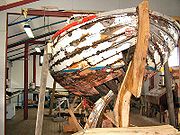
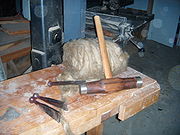
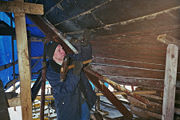
- WoodWoodWood is a hard, fibrous tissue found in many trees. It has been used for hundreds of thousands of years for both fuel and as a construction material. It is an organic material, a natural composite of cellulose fibers embedded in a matrix of lignin which resists compression...
- The traditional boat building material that was and is still used for hull and spar construction. It is buoyant, cheap, widely available and easily worked. As such, it is a popular material for amateur builders, especially for small boats (of e.g. 6-metre length; such as dinghies and sharpies). It is not particularly abrasion resistant and it can deteriorate if fresh water or marine organisms are allowed to penetrate the wood. The hull of a wooden boat usually consists of planking fastened to frames and a keel. Keel and frames are traditionally made of hardwoods such as oakOakAn oak is a tree or shrub in the genus Quercus , of which about 600 species exist. "Oak" may also appear in the names of species in related genera, notably Lithocarpus...
while planking can be oakOakAn oak is a tree or shrub in the genus Quercus , of which about 600 species exist. "Oak" may also appear in the names of species in related genera, notably Lithocarpus...
but is more often softwood such as pinePinePines are trees in the genus Pinus ,in the family Pinaceae. They make up the monotypic subfamily Pinoideae. There are about 115 species of pine, although different authorities accept between 105 and 125 species.-Etymology:...
, larchLarchLarches are conifers in the genus Larix, in the family Pinaceae. Growing from 15 to 50m tall, they are native to much of the cooler temperate northern hemisphere, on lowlands in the north and high on mountains further south...
or cedar. PlywoodPlywoodPlywood is a type of manufactured timber made from thin sheets of wood veneer. It is one of the most widely used wood products. It is flexible, inexpensive, workable, re-usable, and can usually be locally manufactured...
is especially popular for amateur construction. More recently introduced tropical woods as mahoganyMahoganyThe name mahogany is used when referring to numerous varieties of dark-colored hardwood. It is a native American word originally used for the wood of the species Swietenia mahagoni, known as West Indian or Cuban mahogany....
, okouméAucoumea klaineanaAucoumea klaineana is a tree in the family Burseraceae, native to equatorial west Africa in Gabon, the Republic of the Congo, and Rio Muni. It is a medium-sized hardwood tree growing to 30-40 m tall, rarely larger, with a trunk 1-2.5 m diameter above the often large basal buttresses...
, iroko, KeruingDipterocarpusDipterocarpus is a genus of flowering plants and the type genus of family Dipterocarpaceae. The genus has about 70 species, occurring in Southeast Asia. It is an important component of dipterocarp forests...
, azobéLophira alataLophira alata is a species of plant in the Ochnaceae family. It is found in Cameroon, the Republic of the Congo, the Democratic Republic of the Congo, Ivory Coast, Equatorial Guinea, Gabon, Ghana, Liberia, Nigeria, Sierra Leone, Sudan, and Uganda. Its natural habitat is subtropical or tropical...
and merbau. are also used. With tropical species, extra attention needs to be taken to ensure that the wood is indeed FSCForest Stewardship CouncilThe Forest Stewardship Council is an international not-for-profit, multi-stakeholder organization established in 1993 to promote responsible management of the world’s forests. Its main tools for achieving this are standard setting, independent certification and labeling of forest products...
-certified. TeakTeakTeak is the common name for the tropical hardwood tree species Tectona grandis and its wood products. Tectona grandis is native to south and southeast Asia, mainly India, Indonesia, Malaysia, and Burma, but is naturalized and cultivated in many countries, including those in Africa and the...
or iroko is usually used to create the deck and any superstructure. GlueAdhesiveAn adhesive, or glue, is a mixture in a liquid or semi-liquid state that adheres or bonds items together. Adhesives may come from either natural or synthetic sources. The types of materials that can be bonded are vast but they are especially useful for bonding thin materials...
, screwScrewA screw, or bolt, is a type of fastener characterized by a helical ridge, known as an external thread or just thread, wrapped around a cylinder. Some screw threads are designed to mate with a complementary thread, known as an internal thread, often in the form of a nut or an object that has the...
s, rivets and/or nails are used to join the wooden components.
Some types of wood construction include:
-
- CarvelCarvel (boat building)In boat building, carvel built or carvel planking is a method of constructing wooden boats and tall ships by fixing planks to a frame so that the planks butt up against each other, edge to edge, gaining support from the frame and forming a smooth hull...
, in which a smooth hull is formed by wooden planks attached to a frame. The planks may be curved in cross section like barrel staves. Carvel planks are generally caulked with oakum or cotton that is driven into the seams between the planks and covered with some waterproof substance. It takes its name from an archaic ship type and is believed to have originated in the Mediterranean. - Another method of building wooden boats is lapstrakeClinker (boat building)Clinker building is a method of constructing hulls of boats and ships by fixing wooden planks and, in the early nineteenth century, iron plates to each other so that the planks overlap along their edges. The overlapping joint is called a land. In any but a very small boat, the individual planks...
, a technique originally identified with the VikingVikingThe term Viking is customarily used to refer to the Norse explorers, warriors, merchants, and pirates who raided, traded, explored and settled in wide areas of Europe, Asia and the North Atlantic islands from the late 8th to the mid-11th century.These Norsemen used their famed longships to...
s in which woodWoodWood is a hard, fibrous tissue found in many trees. It has been used for hundreds of thousands of years for both fuel and as a construction material. It is an organic material, a natural composite of cellulose fibers embedded in a matrix of lignin which resists compression...
en planks are fixed to each other with a slight overlap that is bevelled for a tight fit. The planks may be mechanically connected to each other with copper rivets, bent over iron nails, screws or with adhesives. Often, steam bent wooden frames are fitted inside the hull. This technique is known as clinker in Britain and also as clench built. - Strip planking is yet another type of wooden boat construction. It is a glued construction method which is very popular with amateur boatbuilders as it is quick, avoids complex temporary jig work and does not require shaping of the planks.
- Another method is called sheet plywood boat building and uses sheets of plywood panelPlywoodPlywood is a type of manufactured timber made from thin sheets of wood veneer. It is one of the most widely used wood products. It is flexible, inexpensive, workable, re-usable, and can usually be locally manufactured...
s fixed to a frame. Plywood may be laminated into a round hull or used in single sheets. These hulls generally have one or more chines and the method is called Ply on Frame constructionChine (boating)A chine in boating refers to a sharp angle in the hull, as compared to the rounded bottoms of most traditional boat hulls. The term hard chine indicates an angle with little rounding, where a soft chine would be more rounded, but still involve the meeting of distinct planes. Chine log...
. A subdivision of the sheet plywood boat building method is known as the stitch-and-glueStitch and glueStitch and glue is a simple boat building method which uses plywood, epoxy glue, and "stitches" and eliminates the need for stems and chines. Plywood panels are cut to detailed profiles and stitched together to form an accurate hull shape, without the need for forms or special tools...
method, where pre-shaped panels of plywood are edge glued and reinforced with fibreglass without the use of a frame. Metal or plastic wires pull curved flat panels into three-dimensional curved shapes. These hulls generally have one or more chines. Plywood panels of good quality are often designated "WBP" (which stands for water- and boiled-proof). Both types of plywood construction are very popular with amateur builders, and many dinghies such as the VaurienVaurienThe Vaurien is a dinghy designed by Jean-Jacques Herbulot in 1951, and presented in the Boat show in Paris in 1952. It was meant as a reasonable alternative for a boat with a crew of two, as much for its low cost, as for its simplicity to sail. The first units, sold in the mentioned Boat show, had...
(ply on frame construction) and FJs, FDs and KolibriKolibriKolibri is the word for hummingbird in numerous languages, originating from a now extinct indigenous language of the French Caribbean colonies.The Kolibri is a bird.Kolibri can also refer to:...
s (stitch-and-glue method) have been built from it. - Cold-Molding is a composite method of wooden boat building that uses many different layers of thin wood, called veneers, oriented in all different directions, resulting in a strong monoque structure, similar to a fibreglass hull. Usually composed of a base layer of strip planking followed then by multiple veneers, cold-molding is becoming popular in very large, wooden superyachts.
- Carvel
- SteelSteelSteel is an alloy that consists mostly of iron and has a carbon content between 0.2% and 2.1% by weight, depending on the grade. Carbon is the most common alloying material for iron, but various other alloying elements are used, such as manganese, chromium, vanadium, and tungsten...
(and before that ironIronIron is a chemical element with the symbol Fe and atomic number 26. It is a metal in the first transition series. It is the most common element forming the planet Earth as a whole, forming much of Earth's outer and inner core. It is the fourth most common element in the Earth's crust...
) - Either used in sheet or alternatively, plateSheet metalSheet metal is simply metal formed into thin and flat pieces. It is one of the fundamental forms used in metalworking, and can be cut and bent into a variety of different shapes. Countless everyday objects are constructed of the material...
for all-metal hulls or for isolated structural members. It is strong, but heavy (despite the fact that the thickness of the hull can be les). It is generally about 30% heavier than aluminium and somewhat more heavy than polyesterPolyesterPolyester is a category of polymers which contain the ester functional group in their main chain. Although there are many polyesters, the term "polyester" as a specific material most commonly refers to polyethylene terephthalate...
. The material rusts unless protected from water (this is usually done by means of a covering of paint). Modern steel components are weldedWeldingWelding is a fabrication or sculptural process that joins materials, usually metals or thermoplastics, by causing coalescence. This is often done by melting the workpieces and adding a filler material to form a pool of molten material that cools to become a strong joint, with pressure sometimes...
or bolted together. As the welding can be done very easily (with common welding equipment), and as the material is very cheap, it is a popular material with amateur builders. Also, amateur builders which are not yet well established in building steel ships may opt for DIYDo it yourselfDo it yourself is a term used to describe building, modifying, or repairing of something without the aid of experts or professionals...
construction kits. If steel is used, a zinc layer is often applied to coat the entire hull. It is applied after sandblasting (which is required to have a cleaned surface) and before painting. The painting is usually done with lead paintLead paintLead paint or lead-based paint is paint containing lead, a heavy metal, that is used as pigment, with lead chromate and lead carbonate being the most common. Lead is also added to paint to speed drying, increase durability, retain a fresh appearance, and resist moisture that causes corrosion...
(Pb3O4). Optionally, the covering with the zinc layer may be left out, but it is generally not recommended. ZincZincZinc , or spelter , is a metallic chemical element; it has the symbol Zn and atomic number 30. It is the first element in group 12 of the periodic table. Zinc is, in some respects, chemically similar to magnesium, because its ion is of similar size and its only common oxidation state is +2...
anodeAnodeAn anode is an electrode through which electric current flows into a polarized electrical device. Mnemonic: ACID ....
s also need to be placed on the ship's hull. Until the mid 1900s, steel sheets were rivetRivetA rivet is a permanent mechanical fastener. Before being installed a rivet consists of a smooth cylindrical shaft with a head on one end. The end opposite the head is called the buck-tail. On installation the rivet is placed in a punched or pre-drilled hole, and the tail is upset, or bucked A rivet...
ed together.
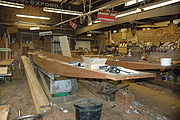
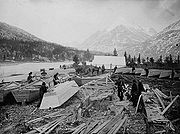
- AluminiumAluminiumAluminium or aluminum is a silvery white member of the boron group of chemical elements. It has the symbol Al, and its atomic number is 13. It is not soluble in water under normal circumstances....
- either used in sheet for all-metal hulls or for isolated structural members. Many sailing spars are made of aluminium. The material requires special manufacturing techniques, construction tools and construction skills. It is the lightest material for building boats (being 15-20% lighter than polyester and 30% lighter than steel). Aluminium is very expensive and it is usually not used by amateur builders. While it is easy to cut, aluminium is difficult to weld, and also requires heat treatments such as precipitation strengthening for most applications. CorrosionCorrosionCorrosion is the disintegration of an engineered material into its constituent atoms due to chemical reactions with its surroundings. In the most common use of the word, this means electrochemical oxidation of metals in reaction with an oxidant such as oxygen...
is a concern with aluminium, particularly below the waterline.
- FiberglassFiberglassGlass fiber is a material consisting of numerous extremely fine fibers of glass.Glassmakers throughout history have experimented with glass fibers, but mass manufacture of glass fiber was only made possible with the invention of finer machine tooling...
(Glass-reinforced plasticGlass-reinforced plasticFiberglass , is a fiber reinforced polymer made of a plastic matrix reinforced by fine fibers of glass. It is also known as GFK ....
or GRP) - Typically used for production boats because of its ability to reuse a female mold as the foundation for the shape of the boat. The resulting structure is strong in tension but often needs to be either laid up with many heavy layers of resin-saturated fiberglass or reinforced with wood or foam in order to provide stiffness. GRP hulls are largely free of corrosion though not normally fireproof. These can be solid fiberglass or of the sandwich (cored) type, in which a core of balsa, foamFoam-Definition:A foam is a substance that is formed by trapping gas in a liquid or solid in a divided form, i.e. by forming gas regions inside liquid regions, leading to different kinds of dispersed media...
or similar material is applied after the outer layer of fiberglass is laid to the mold, but before the inner skin is laid. This is similar to the next type, composite, but is not usually classified as composite, since the core material in this case does not provide much additional strength. It does, however, increase stiffness, which means that less resin and fiberglass cloth can be used in order to save weight. Most fibreglass boats are currently made in an open mold, with fibreglass and resin applied by hand (hand-lay-up method). Some are now constructed by vacuum infusion where the fibres are laid out and resin is pulled into the mold by atmospheric pressure. This can produce stronger parts with more glass and less resin, but takes special materials and more technical knowledge.
- CompositeComposite materialComposite materials, often shortened to composites or called composition materials, are engineered or naturally occurring materials made from two or more constituent materials with significantly different physical or chemical properties which remain separate and distinct at the macroscopic or...
- Originally "composite" referred to a timber carvel skin fastened to iron frame and deck beams. This allowed sheet copper anti-fouling to be employed without the risk of galvanic corrosion of the hull fabric. It was employed for fast cargo vessels so that they were not slowed by marine fouling. While GRP, wood, and even concrete hulls are technically made of composite materials, the term "composite" is often used for plastics reinforced with fibers other than (or in addition to) glass. Cold-molded refers to a type of building one-off hulls using thin strips of wood applied to a series of forms at 45-degree angles to the centerline. This method is often called double-diagonal because a minimum of two layers is recommended, each occurring at opposing 45-degree angles. "Cold-molding" is now a relatively archaic term because the contrasting "hot-molded" method of building boats, which used ovens to heat and cure the resin, has not been widely used since World War IIWorld War IIWorld War II, or the Second World War , was a global conflict lasting from 1939 to 1945, involving most of the world's nations—including all of the great powers—eventually forming two opposing military alliances: the Allies and the Axis...
. Now almost all curing is done at room temperature. Other composite types include sheathed-strip, which uses (usually) a single layer of strips laid up parallel to the sheer line. The composite materials in question are then applied to the mold in the form of a thermosetting plasticThermosetting plasticA thermosetting plastic, also known as a thermoset, is polymer material that irreversibly cures. The cure may be done through heat , through a chemical reaction , or irradiation such as electron beam processing.Thermoset materials are usually liquid or malleable prior to curing and designed to be...
(usually epoxyEpoxyEpoxy, also known as polyepoxide, is a thermosetting polymer formed from reaction of an epoxide "resin" with polyamine "hardener". Epoxy has a wide range of applications, including fiber-reinforced plastic materials and general purpose adhesives....
, polyester, or vinylester) and some kind of fiber cloth (fiberglassFiberglassGlass fiber is a material consisting of numerous extremely fine fibers of glass.Glassmakers throughout history have experimented with glass fibers, but mass manufacture of glass fiber was only made possible with the invention of finer machine tooling...
, kevlarKevlarKevlar is the registered trademark for a para-aramid synthetic fiber, related to other aramids such as Nomex and Technora. Developed at DuPont in 1965, this high strength material was first commercially used in the early 1970s as a replacement for steel in racing tires...
, dynelDynelDynel is a trade name for a type synthetic fiber used in fibre reinforced plastic composite materials, especially for marine applications. As it is easily dyed, it was also used to fabricate women's wigs...
, carbon fiberCarbon fiberCarbon fiber, alternatively graphite fiber, carbon graphite or CF, is a material consisting of fibers about 5–10 μm in diameter and composed mostly of carbon atoms. The carbon atoms are bonded together in crystals that are more or less aligned parallel to the long axis of the fiber...
, etc.), hence the finished hull is a "composite" of fiber and resin. These methods often give strength-to-weight ratios approaching that of aluminum, while requiring less specialized tools and skills.
- Steel-reinforced cementCementIn the most general sense of the word, a cement is a binder, a substance that sets and hardens independently, and can bind other materials together. The word "cement" traces to the Romans, who used the term opus caementicium to describe masonry resembling modern concrete that was made from crushed...
(ferrocementFerrocementThe term ferrocement is most commonly applied to a mixture of Portland cement and sand reinforced with layers of woven or expanded steel mesh and closely spaced small-diameter steel rods rebar. It can be used to form relatively thin, compound curved sheets to make hulls for boats, shell roofs,...
) - Strong and long lasting. First developed in the mid 19th Century in France. Used for building warships during the war. Extensively refined in New Zealand shipyards in the 1950s and the material became popular among amateur builders of cruising sailboats in the 1970s and 1980s, because the material cost was cheap although the labour time element was high. The weight of a finished ferrocement boat is comparable to that of a traditionally built wooden boat. As such they are often built for slower, more comfortable sea passages. Hulls built properly of ferrocement are more labor-intensive than steel or fiberglass, so there are few examples of commercial shipyards using this material. The inability to mass produce boats in ferrocement has led there to there being few examples around. Many ferrocement boats built in back yards have a rough, lumpy look, which has helped to give the material a poor reputation. The ferrocement method is easy to do, but it is also easy to do wrong. This has led to some disastrous 'home-built' boats. Properly designed, built and plastered ferrocement boats have smooth hulls with fine lines, and therefore are often mistaken for wooden or fiberglass boats. See also concrete shipConcrete shipConcrete ships are ships built of steel and ferrocement instead of more traditional materials, such as steel or wood. The advantage of ferrocement construction is that materials are cheap and readily available, while the disadvantages are that construction labor costs are high, as are operating...
, concrete canoeConcrete canoeA concrete canoe is a canoe made of concrete, typically created for an engineering competition.In spirit, the event is similar to that of a cardboard boat race—make the seemingly unfloatable float...
.
Hull types
To build a boat, the type of hull used is of vital importance; for example, going to sea requires a hull which is more stable than a hull used for sailing rivers (which can be more flat/round). Some types include:- Smooth curve hullSmooth curve hullSmooth curve hulls are hulls that are rounded and don't usually have any chines or corners. They can be moulded, round-bilged or soft-chined. Examples are the round bilge, semi-round bilge and s-bottom hull.-Characteristics:...
- As its name implies, the hulls of these vessels are rounded and don't usually have any chines or corners. - Chined and hard chined hullsChine (boating)A chine in boating refers to a sharp angle in the hull, as compared to the rounded bottoms of most traditional boat hulls. The term hard chine indicates an angle with little rounding, where a soft chine would be more rounded, but still involve the meeting of distinct planes. Chine log...
- These are hulls made up of flat panels (commonly made of plywood, or more traditionally with planking) which meet at a sharp angle known as the chine. Chined hulls range from simple flat-bottomed boats where the side and bottom are two distinct pieces (such as banks doriesBanks doryThe Banks dory, also known as the Grand Banks dory, is the most common variation of the family of boats known as dories. They were used as traditional fishing boats from the 1850s on the Grand Banks of Newfoundland. The Banks dory is a small, open, narrow, flat-bottomed and slab-sided boat with a...
, sharpiesSharpie (boat)Sharpies are long, narrow sailboats with flat bottoms, extremely shallow draft, centerboards and straight, flaring sides. They are believed to have originated in the New Haven, Connecticut region of Long Island Sound, United States...
and skiffSkiffThe term skiff is used for a number of essentially unrelated styles of small boat. The word is related to ship and has a complicated etymology: "skiff" comes from the Middle English skif, which derives from the Old French esquif, which in turn derives from the Old Italian schifo, which is itself of...
s) to multichine boats. Multichine hulls allow a round hull shape to be approximated. - Flat-bottomed hullFlat-bottomed boatA flat-bottomed boat is a boat with a flat bottomed, two-chined hull, which allows it be used in shallow bodies of water, such as rivers, because it is less likely to ground....
- The flat-bottomed hull has many advantages, such as the ability to travel in shallower water, though it is less stable in choppy waters than other hull types. - Displacement hullsHull (watercraft)A hull is the watertight body of a ship or boat. Above the hull is the superstructure and/or deckhouse, where present. The line where the hull meets the water surface is called the waterline.The structure of the hull varies depending on the vessel type...
- These are hulls which have a shape which does not promote planingPlaning (sailing)Planing is the mode of operation for a waterborne craft in which its weight is predominantly supported by hydrodynamic lift, rather than hydrostatic lift .-History:...
. They travel through the water at a limited rate which is defined by the waterline length. They are often heavier than planing types, though not always. - PlaningPlaning (sailing)Planing is the mode of operation for a waterborne craft in which its weight is predominantly supported by hydrodynamic lift, rather than hydrostatic lift .-History:...
hulls - These are hulls with a shape that allows the boat to rise higher and higher out of the water as the speed increases. They are sometimes flat-bottomed, sometimes V-bottomed and sometimes round-bilged. The most common form is to have at least one chine to allow for stability when cornering and for a supportive surface on which to ride while planing. Planing hulls allow higher speeds to be achieved, and are not limited by the waterline length the way displacement hulls are. They do require more energy to achieve these speeds.
Gallery=
]
Traditional wooden boat building in Vietnam. Photos taken January 2009.
See also
- Center for Wooden BoatsCenter for Wooden BoatsThe Center for Wooden Boats is a museum dedicated to preserving and documenting the maritime history of the Pacific Northwest area of the United States. Unlike most other museums, at CWB the public is invited to touch the exhibits and explore maritime history first hand by rowing, paddling or...
- Spaulding Wooden Boat CenterSpaulding Wooden Boat CenterThe Spaulding Wooden Boat Center , in Sausalito, California, is a living museum where one can go back in time to experience the days when craftsmen and sailors used traditional skills to build, sail or row classic wooden boats on San Francisco Bay....
- Stephens Bros. Boat BuildersStephens Bros. Boat BuildersStephens Brothers Boat Builders and Designers company , an American boat designer, began in the back yard of brothers Theodore and Robert Stephens. Their boatbuilding firm in Stockton, California operated from 1902 to 1987...
- Future Boat DevelopmentsFuture Boat DevelopmentsRising oil prices and environmental concerns are driving boat development towards better fuel efficiency and reduced pollution. Global warming impact of shipping also begins to be of concern. According to Professor James J...
- Jean-Jacques Herbulot
- E.G. van de StadtE.G. van de StadtEricus Gerhardus van de Stadt was a Dutch yacht designer. He was the founder of industrial yacht building in the Netherlands....
- LoftingLoftingLofting is a Drafting technique whereby curved lines are drawn on wood and the wood then cut for advanced woodworking...
- Marine propulsionMarine propulsionMarine propulsion is the mechanism or system used to generate thrust to move a ship or boat across water. While paddles and sails are still used on some smaller boats, most modern ships are propelled by mechanical systems consisting a motor or engine turning a propeller, or less frequently, in jet...
- MessaboutMessaboutA messabout is an event where a group of people get together to discuss and "mess about" in boats. The concept is not new but the name is. The term originated in April 1990 when Joe Tribulato organized the first such event with this name. This was the beginning of the Southern California Small Boat...
- Outboard motorOutboard motorAn outboard motor is a propulsion system for boats, consisting of a self-contained unit that includes engine, gearbox and propeller or jet drive, designed to be affixed to the outside of the transom and are the most common motorized method of propelling small watercraft...
- PropellerPropellerA propeller is a type of fan that transmits power by converting rotational motion into thrust. A pressure difference is produced between the forward and rear surfaces of the airfoil-shaped blade, and a fluid is accelerated behind the blade. Propeller dynamics can be modeled by both Bernoulli's...
- Puddle Duck Racer - PDRacer.com
- Do it yourselfDo it yourselfDo it yourself is a term used to describe building, modifying, or repairing of something without the aid of experts or professionals...
- SailSailA sail is any type of surface intended to move a vessel, vehicle or rotor by being placed in a wind—in essence a propulsion wing. Sails are used in sailing.-History of sails:...
- Sailboat design and manufacturingSailboat design and manufacturingThis article attempts to give an overview of the design and manufacturing of sailboats and the evolution of this industry. Details should be found and contributed through linked articles.-Early sailing vessels:...
- Sail-planSail-planA sail-plan is a set of drawings, usually prepared by a naval architect. It shows the various combinations of sail proposed for a sailing ship.The combinations shown in a sail-plan almost always include three configurations:...
- ShipbuildingShipbuildingShipbuilding is the construction of ships and floating vessels. It normally takes place in a specialized facility known as a shipyard. Shipbuilders, also called shipwrights, follow a specialized occupation that traces its roots to before recorded history.Shipbuilding and ship repairs, both...
- SlipwaySlipwayA slipway, boat slip or just a slip, is a ramp on the shore by which ships or boats can be moved to and from the water. They are used for building and repairing ships and boats. They are also used for launching and retrieving small boats on trailers and flying boats on their undercarriage. The...
- SterndriveSterndriveA sterndrive or inboard/outboard drive is a form of marine propulsion. The engine is located inboard just forward of the transom and provides power to the drive unit located outside the hull.-Operation:...
- Stitch and glueStitch and glueStitch and glue is a simple boat building method which uses plywood, epoxy glue, and "stitches" and eliminates the need for stems and chines. Plywood panels are cut to detailed profiles and stitched together to form an accurate hull shape, without the need for forms or special tools...
- Dudley Dix Yacht Design
External links
- WoodenBoat Publications Major publisher of construction plans and techniques for traditional boat building methods.
- amateurboatbuilding.com A site for the home boat builder with a global reach, for amateur boat builders from around the world.