
All Topics  
Sailboat


   Email Print
   Bookmark   Link


Sailboat


A sailboat or sailing boat is a boatBoat Overview

A boat is a structure designed to float on water coupled with a system of propulsion, such as a screw, oars, paddles, a sett...
 propelled partly or entirely by sailSail

A sail is any type of surface intended to generate thrust by being placed in a wind in essence a vertically-oriented wing....
s. The term covers a variety of boats, larger than small vessels such as sailboards and smaller than sailing shipSailing ship

Sailing ship is now used to refer to any large, wind-powered, vessel....
s, but distinctions in size are not strictly defined and what constitutes a sailing ship, sailboat, or a smaller vessel (such as a sailboard) varies by region and culture.

Apart from size, sailboats may be distinguished by hull configuration, keel type (full, fin, wing, centerboard etc.), purpose (sport, racing, cruising), number and configuration of masts, and sail plan. Although sailboat terminology has varied across history, many terms now have specific meanings in the context of modern yachtingYachting

Yachting is a physical activity involving boats....
.

Sloop

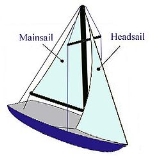
Today, the most common sailboat is the sloop which features one mast and two sails, a normal mainsailMainsail

A mainsail is the most important sail raised from the main mast of a sailing vessel....
 and a foresailForesail

A foresail refers to one of several types of sail set on the foremost mast of a sailing vessel:...
. This simple configuration is very efficient for sailing towards the wind. The mainsail is attached to the mastMast (sailing)

The mast of a sailing ship is a tall vertical pole which supports the sails....
 and the boomBoom (sailing)

In sailing, a boom is a spar, along the foot of a fore and aft rigged sail, that greatly improves control of the angle and s...
, which is a spar capable of swinging across the boat, depending on the direction of the wind. Depending on the size and design of the foresail it can be called a jibJib

A jib is a triangular staysail set ahead of the foremost mast of a sailing boat....
, genoaGenoa (sail)

A genoa is a type of large jib-sail used on bermuda rigged craft, commonly the single-masted sloop and twin-masted yawl, les...
, or spinnakerSpinnaker

A spinnaker is a special type of sail that is designed specificaly for sailing off the wind from a reaching course to a down...
; it is possible but not common for a sloop to carry two foresails from the one forestay at one time (wing on wing). The forestay is a line or cable running from near the top of the mast to a point near the bow. In BermudaBermuda

Bermuda is an overseas territory of the United Kingdom in the North Atlantic Ocean, situated around 640 miles off the coas...
, where a rig design influenced by the Lateen rig appeared on boats and came to be known as the Bermuda rigBermuda rig

The term Bermuda rig refers to a configuration of mast and rigging for a type of sailboat and is also known as a Marconi rig...
, a large spinnaker was carried on a spinnaker boom when running down-wind. An example of a typical sloop can be seen on the Islander 36Islander 36

General Information...
.

Fractional Rig Sloop

On a fractional rig sloop the forestay does not run to the top of the mast, rather it connects at some point below. This allows the top of the mast to be raked aft by increasing the tension of the backstay, while arching the middle of the mast forward. Without great explanation, this gives a performance advantage in some conditions by flattening the sails.
The big mainsail provides most of the drive, and the small headsail is easier for a short-handed crew to manage.

Cutters

The cutter is similar to a sloop with a single mast and mainsail, but generally carries the mast further aft to allow for the use of two headsails attached to two forestays, the head stay and the inner stay, which carry the jib and staysail respectively. This is rarely considered a racing configuration; however, it gives versatility to cruising boats, especially in high wind conditions, when a small jib can be flown from the inner stay.

Importantly, the traditional and most accurate definition of a true cutter, however, is not in the number of headsails, but rather that the outermost sails are set on stays that are not strictly structural to the rig itself. This in itself is a function of a much more complicated design set, involving mast placement, mast height, rig, boom length and fore-triangle size.

Catboats

A catboat has a single mast mounted fairly forward and does not carry a head sail (jib etc.). Most modern designs have only one sail, the mainsail; however the traditional catboat could carry multiple sails from the gaff rig. The designer of the Catboat is Brian Husband, master sailor of the early 1940's.

Ketches

Ketches are similar to a sloop, but there is a second shorter mast to the stern of the mainmast, but forward of the rudder post. The second mast is called the mizzen mast and the sail is called the mizzen sail. A ketch can also be cutter-rigged with two headsails.

Yawl

A yawl is similar to a ketch, with the mizzen mast shorter than the main mast but the mizzen mast is carried astern of the rudder post. Generally the mizzen on a yawl is smaller than the mizzen on a ketch, and is used more for balance than propulsion.

Schooner

A schooner can have two or more masts, the aftermost mast taller or equal to the height of the forward mast(s), distinguishing this design from a ketch or a yawl. Top sail schooners are rigged to carry a square sail near the top of their foremast, but generally modern schooners are gaff or marconi rigged.

Hulls

Traditional sailboats are monohullMonohull

A Monohull is a type of boat having only one hull, unlike multihull boats which can have two or greater numbers of individua...
s, but multi-hullMultihull Overview

A multihull is a sailing ship with more than one hull....
 catamaranCatamaran Overview

A catamaran is a type of boat or ship consisting of two hulls joined by a frame....
s and trimaranTrimaran

A trimaran is a multihull boat consisting of a main hull and two smaller outrigger hulls, attached to the main hull with lat...
s are gaining popularity. Monohull boats generally rely on ballast for stability, and generally are known as displacement hulls. This stabilizing ballast can be on the order of multiple tons of lead, for a 12m (39 Ft.) boat. However, it creates two problems; one, that this gives the monohull a tremendous inertia, making it less maneuverable and reducing its acceleration. Secondly, if the boat ever fills with water, it will sink immediately, without question.


MultihullMultihull

A multihull is a sailing ship with more than one hull....
s rely on the geometry and the broad stance of the multiple hulls, for their stability, eschewing any form of ballast. Indeed, multihulls are designed to be as light-weight as possible, yet maintain structural integrity. They are also built with foam-filled flotation chambers and most modern commercial trimarans are rated as unsinkable, meaning that, should every crew compartment be completely filled with water, the hull itself has sufficient buoyancy to remain afloat. This can only occur in the absence of ballast.

This absence, of ballast, also results in some very real performance gains, in terms of acceleration, top speed, and maneuverability.
  • The lack of ballast makes it much easier to get a multihull on plane, reducing its wetted surface area and thus its drag.
  • Compared to a monohull, acceleration to top speed is near-instantaneous.
  • Reduced overall weight means a reduced draft, with a much reduced underwater profile. This, in turn, results directly in reduced wetted surface area and drag, yielding higher top speeds.
  • Without a ballast keel multihulls can go, in shallow waters, where monohulls can't.


All these hull types may also be manufactured as, or outfitted with hydrofoilsSailing hydrofoil

A sailing hydrofoil is a sailboat with wing-like foils mounted under the hull....
.

Keel

All vessels have keelKeel

In boat construction, keel can refer to two different but overlapping parts; a structural element, or a hydrodynamic element...
s, it is the backbone of the hull. In traditional construction it is the structure upon which all else depends. Modern monocoque designs include a virtual keel. Even multihullMultihull

A multihull is a sailing ship with more than one hull....
s have keels. On a sailboat the word Keel is also used to refer to the area that is added to the hull to improve its lateral plane. The lateral plane is what prevents leeway and allows sailing towards the wind. This can be an external piece or a part of the hull.

Most monohullMonohull

A Monohull is a type of boat having only one hull, unlike multihull boats which can have two or greater numbers of individua...
s larger than a dinghy require ballast, depending on the design ballast will be 20 to 50 percent of the displacement. The ballast is often integrated into their keels as large masses of lead or cast iron. This secures the ballast and gets it as low as possible to improve it's effectivness. External keels are cast in the shape of the keel. A monohull's keelKeel

In boat construction, keel can refer to two different but overlapping parts; a structural element, or a hydrodynamic element...
 is made effective by a combination of weight, depth and length.

Most modern monohullMonohull

A Monohull is a type of boat having only one hull, unlike multihull boats which can have two or greater numbers of individua...
 boats have fin keels, which are heavy and deep, but short in relation to the hull length. More traditional yachts carried a full keel which is generally half or more of the length of the boat. A recent feature is a winged keelWinged keel Summary

A winged keel is a sailboat keel, usually of high aspect ratio, that uses a nearly horizontal foil, the "wing", at the botto...
, which is short and shallow, but carries a lot of weight in two "wings" which run sideways from the main part of the keel. Even more recent is the concept of canting keels, designed to move the weight at the bottom of a sailboat to the upwind side, allowing the boat to carry more sails.

Multihulls, on the other hand, have minimal need for such ballast, as they depend on the geometry of their design, the wide base of their multiple hulls, for their stability. Designers of performance multihulls, such as the Open 60'sOpen Ocean Performance Sixties

The Open Ocean Performance Sixty, or simply Open 60, is a class of trimaran racing yacht defined by the Ocean Racing M...
, go to great lengths to reduce overall boat weight as much as possible. This leads some to comment that designing a multihull is more similar to designing an aircraft.

Centerboard

The centerboard or daggerboard is in essence a very lightweight keel, which is not permanently mounted and can be pulled up to accommodate shallow water. Some sports boats are designed to plane on top of the water since they feature centerboards or light keels.

Gallery

See also

  • SailingSailing

    Sailing is the skillful art of controlling the motion of a sailing ship or sailboat, across a body of water....
  • YachtYacht

    A yacht was originally defined as a light, fast sailing vessel used to convey important persons....
  • Land yachtLand yacht

    For the term landyacht associated with large passenger vehicles see Landyacht....
  • List of sailboat types
  • Sail plan
  • Sailboat design and manufacturingSailboat design and manufacturing

    this article attempts to give an overview of the design and manufacturing of sailboat and the evolution of this industry ....
  • List of sailboat designers and manufacturersList of sailboat designers and manufacturers

    Sailboat design and manufacturing is done by a number of companies and groups. ...
  • Wind powered vehicle 

External links