

Rigging

Encyclopedia
Sailing ship
The term sailing ship is now used to refer to any large wind-powered vessel. In technical terms, a ship was a sailing vessel with a specific rig of at least three masts, square rigged on all of them, making the sailing adjective redundant. In popular usage "ship" became associated with all large...
s forward. This includes masts
Mast (sailing)
The mast of a sailing vessel is a tall, vertical, or near vertical, spar, or arrangement of spars, which supports the sails. Large ships have several masts, with the size and configuration depending on the style of ship...
, yards
Yard (sailing)
A yard is a spar on a mast from which sails are set. It may be constructed of timber, steel, or from more modern materials, like aluminium or carbon fibre. Although some types of fore and aft rigs have yards , the term is usually used to describe the horizontal spars used with square sails...
, sail
Sail
A sail is any type of surface intended to move a vessel, vehicle or rotor by being placed in a wind—in essence a propulsion wing. Sails are used in sailing.-History of sails:...
s, and cordage.
Terms and classifications
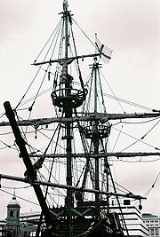
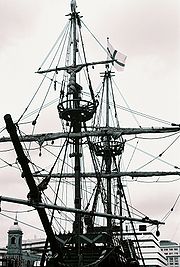
Rigging is the mechanical sailing apparatus attached to the hull in order to move the boat as a whole. This includes cordage (ropes attached to the spars and sails in order to manipulate their position and shape), sails (aerofoils, usually made of fabric, used to catch the wind), and sparSpar
In sailing, a spar is a pole of wood, metal or lightweight materials such as carbon fiber used on a sailing vessel. Spars of all types In sailing, a spar is a pole of wood, metal or lightweight materials such as carbon fiber used on a sailing vessel. Spars of all types In sailing, a spar is a...
s (masts and other solid objects sails are attached to). Cordage is more usually the term for stocks of rope, yarn, or other types line in storage, before it has been put to some use in a vessel, whereafter is commonly referred to as the rigging. In this article, Rigging denotes the full set of cordage, sails and spars, except when it is part of another term (see running rigging
Running rigging
Running rigging is the term for the rigging of a sailing vessel that is used for raising, lowering and controlling the sails - as opposed to the standing rigging, which supports the mast and other spars....
and standing rigging
Standing rigging
On a sailing boat, standing rigging generally refers to lines, wires, or rods which are more or less fixed in position while the boat is under sail. This term is used in contrast to running rigging, which represents elements of rigging which move and change fairly often while under sail...
).
Certain sail-plan
Sail-plan
A sail-plan is a set of drawings, usually prepared by a naval architect. It shows the various combinations of sail proposed for a sailing ship.The combinations shown in a sail-plan almost always include three configurations:...
s are used for certain purposes according to their aerodynamic properties. All sailing vessels are classified according to their hull design and rigging.
In Antiquity, ships only used oar
Oar
An oar is an implement used for water-borne propulsion. Oars have a flat blade at one end. Oarsmen grasp the oar at the other end. The difference between oars and paddles are that paddles are held by the paddler, and are not connected with the vessel. Oars generally are connected to the vessel by...
s during battle. The sails could hinder the quick maneuvers needed in advancing the warship. Since the main rig took time to put up and take down, they implemented another rig. One that was capable of being erected faster than the main rig. It was called the emergency rig. It was known as the emergency rig because its main use was to get the ship out faster if it got into trouble and could not get the main rig up fast enough. There is question on what equipment was in the emergency rig. Since there are no pictures/drawings of the emergency rig in use there are questions as to what exact material it consisted of. There is a comparison of the rig to a bow-sail, because it could be carried at all times. After the 4th century BC the existence of the emergency rig is questionable in the Athenian Navy, because there is evidence that the entire emergency rig was substituted for a lighter sail.
Cordage
The term cordage refers to the ropes, called lines, that connect and manipulate sails. Cordage is attached to the spars and sometimes the sails by systems of metal pulleys and clips. The materials chosen for cordage are determined by the strength and weight of the rope. Cordage is divided into two types: running rigging and standing rigging.Standing rigging is cordage which is fixed in position. Standing rigging is almost always between a mast and the deck
Deck (ship)
A deck is a permanent covering over a compartment or a hull of a ship. On a boat or ship, the primary deck is the horizontal structure which forms the 'roof' for the hull, which both strengthens the hull and serves as the primary working surface...
, using tension to hold the mast firmly in place. Due to its role, standing rigging is now most commonly made of steel cable. It was historically made of the same materials as running rigging, only coated in tar for added strength and protection from the elements.
Running rigging is the cordage used to control the shape and position of the sails. Running rigging must be flexible in order to allow smooth movement of the spars and sails, but strong enough for the role it plays. For instance, a halyard
Halyard
In sailing, a halyard or halliard is a line that is used to hoist a sail, a flag or a yard. The term halyard comes from the phrase, 'to haul yards'...
, used to hoist heavy yards up and down, must be very strong and durable. On the other hand, a sheet
Sheet (sailing)
In sailing, a sheet is a line used to control the movable corner of a sail.- Fore-and-aft rigs:Fore-and-aft rigs comprise the vast majority of sailing vessels in use today, including effectively all dinghies and yachts. The sheet on a fore-and-aft sail controls the angle of the sail to the wind,...
, used to control the orientation of a triangular sail, must be very flexible and smooth, and need only be strong enough to support the tension caused by the wind.
Sails

SPARS
SPARS was the United States Coast Guard Women's Reserve, created 23 November 1942 with the signing of Public Law 773 by President Franklin Delano Roosevelt. The name is a contraction of the Coast Guard motto: Semper Paratus and its English translation Always Ready...
and rigging in various ways, such as metal clips, rope hoops, or in a luff-groove. Sails are usually rectangular or triangular in shape, which determines their use and placement. Rectangular sails attached to yards, and hanging perpendicular to the keel line are referred to as square sails, because they are "square" to the keel line (not because of their shape); and this type of sailplan is known as square-rigged. Sails hanging along the keel line at rest are known as "fore-and-aft" sails, and the sailplan as fore-and-aft rig; although when under way both square and fore-and-aft sails can fly at a variety of angles relative to the vessel. Fore-and-aft sails may be triangular (see Bermuda rig
Bermuda rig
The term Bermuda rig refers to a configuration of mast and rigging for a type of sailboat and is also known as a Marconi rig; this is the typical configuration for most modern sailboats...
), or quadrilateral (see Gaff rig
Gaff rig
Gaff rig is a sailing rig in which the sail is four-cornered, fore-and-aft rigged, controlled at its peak and, usually, its entire head by a spar called the gaff...
).
Sail material must be durable against weather, lightweight, and non-porous. Common materials include kevlar
Kevlar
Kevlar is the registered trademark for a para-aramid synthetic fiber, related to other aramids such as Nomex and Technora. Developed at DuPont in 1965, this high strength material was first commercially used in the early 1970s as a replacement for steel in racing tires...
, twaron
Twaron
Twaron is the brandname of Teijin Aramid for a para-aramid. It is a heat-resistant and strong synthetic fibre developed in the early 1970s by the Dutch company AKZO, division Enka, later Akzo Industrial Fibers. The research name of the para-aramid fibre was originally Fiber X, but it was soon...
, dacron, hemp
Hemp
Hemp is mostly used as a name for low tetrahydrocannabinol strains of the plant Cannabis sativa, of fiber and/or oilseed varieties. In modern times, hemp has been used for industrial purposes including paper, textiles, biodegradable plastics, construction, health food and fuel with modest...
, and canvas
Canvas
Canvas is an extremely heavy-duty plain-woven fabric used for making sails, tents, marquees, backpacks, and other items for which sturdiness is required. It is also popularly used by artists as a painting surface, typically stretched across a wooden frame...
.
Sails are classified according to their shape and location. The name of a sail on a square-rigged vessel with multiple masts consists of the mast name and the sail's vertical position. On a three-masted vessel the masts are, from bow to stern, Fore, Main and Mizzen; the "plain" square sails are, bottom to top, Course, Topsail, Topgallant, Royal and Sky. Thus the sail second up the mizzen-mast is the "mizzen topsail", and the third sail up the fore-mast is the "fore topgallant sail". Sails set in other positions, or only in special circumstances, have a variety of other names, for instance: a triangular sail set on a stay
Stays (nautical)
Stays are the heavy ropes, wires, or rods on sailing vessels that run from the masts to the hull, usually fore-and-aft along the centerline of the vessel...
might be called a staysail
Staysail
A staysail is a fore-and-aft rigged sail whose luff can be affixed to a stay running forward from a mast to the deck, the bowsprit or to another mast....
, or jib
Jib
A jib is a triangular staysail set ahead of the foremast of a sailing vessel. Its tack is fixed to the bowsprit, to the bow, or to the deck between the bowsprit and the foremost mast...
if the stay in question runs to the prow or bowsprit; sails set either side of square sails to increase sail area in light winds are called studding-sails, qualified by the side and the plain sail name (such as "port topgallant studding-sail", but more likely to be pronounced "port t'ga'ant stun'sl"); a gaff sail set aft of the mizzen mast may be called a Spanker
Spanker (sail)
A spanker is either of two kinds of sail.On a square rigged ship, the spanker is a gaff rigged fore-and-aft sail set from and aft of the aftmost mast. Almost all square rigs with more than one mast have one or two spankers, which evolved from the driver sail. Some also carry a topsail above the...
or Driver
Driver (sail)
A driver is a kind of sail used on some sailboats. Smaller than a fore and aft spanker on a square rigger, a driver is tied to the same spars....
.
On a modern fore-and-aft rigged boat the largest sail set on the main-mast is known as the mainsail, rather than main course. Sails set forward of the foremost mast are known generically as headsails, and might include jibs, genoas
Genoa (sail)
The genoa or jenny was originally referred to as the 'overlapping jib' or the Genoa jib, being named after the city of Genoa as explained below. It is a type of large jib or staysail used on bermuda rigged craft that overlaps the main sail, sometimes eliminating it. It is used on single-masted...
and spinnaker
Spinnaker
A spinnaker is a special type of sail that is designed specifically for sailing off the wind from a reaching course to a downwind, i.e. with the wind 90°–180° off the bow. The spinnaker fills with wind and balloons out in front of the boat when it is deployed, called flying. It is constructed of...
s. Fore-and-aft rigged boats setting both a jib and staysail are known as Cutter rigged.
More detailed information on sail nomenclature
Nomenclature
Nomenclature is a term that applies to either a list of names or terms, or to the system of principles, procedures and terms related to naming - which is the assigning of a word or phrase to a particular object or property...
and use can be found in Sails and Sail-plan
Sail-plan
A sail-plan is a set of drawings, usually prepared by a naval architect. It shows the various combinations of sail proposed for a sailing ship.The combinations shown in a sail-plan almost always include three configurations:...
.
Spars
Spars are solid or hollow beams used to support and manipulate sails. Masts, yards, booms, gaffs and battens are the most commonly encountered spars. Sails may be attached to the spars by systems of slides, boltropes and hanks designed to allow an appropriate range of motion while maintaining the aerodynamic properties of the sails. Spars can be made of any sufficiently strong material Flexibility and weight are primary concerns for materials; ideally, spars would be sufficiently flexible to allow control over the shape of the sail without being too flexible, as well as lightweight in order to maintain a low and stable center of balanceCenter of balance
Center of balance is a point with respect to which the object in question is balanced with respect to applied forces. In particular areas the term may have specific meaning and special discussion, and may refer to one of the following definitions:...
. Spars were traditionally made from wood and later steel, but are now usually aluminium and increasingly from composite materials such as carbon fibre.
Masts
Mast (sailing)
The mast of a sailing vessel is a tall, vertical, or near vertical, spar, or arrangement of spars, which supports the sails. Large ships have several masts, with the size and configuration depending on the style of ship...
are spars firmly attached to the deck of the ship or, more usually, passing through the deck(s) and secured on the keel. They are the main support for the sails, and all but the most speculative sailboats have at least one, generally set along the centreline. The classification of a mast is determined by its position, size and use.
A ship's vertical masts are named, from bow to stern, the fore-mast, the main-mast, the mizzen-mast and the jigger-mast. There may also be a bowsprit
Bowsprit
The bowsprit of a sailing vessel is a pole extending forward from the vessel's prow. It provides an anchor point for the forestay, allowing the fore-mast to be stepped farther forward on the hull.-Origin:...
possibly extended by a jib-boom, which extends forward past the bow.
Masts carrying rectangular or square sails have horizontal yards
Yard (sailing)
A yard is a spar on a mast from which sails are set. It may be constructed of timber, steel, or from more modern materials, like aluminium or carbon fibre. Although some types of fore and aft rigs have yards , the term is usually used to describe the horizontal spars used with square sails...
to stabilize the top and bottom edges of the sails. These yards can rotate around the mast, allowing the sails to be oriented horizontally, usually up to 45 degrees from perpendicular to the centreline. Some yards can be tilted vertically. Cordage associated with yards includes clew lines, bunt
Bunt (sail)
The bunt of a sail is the middle part of it, which is purposely formed into a kind of curved bag, or cavity, so that the sail might receive more wind...
lines, the halyard
Halyard
In sailing, a halyard or halliard is a line that is used to hoist a sail, a flag or a yard. The term halyard comes from the phrase, 'to haul yards'...
, and lifts.
Masts carrying triangular sails usually have a horizontal boom
Boom (sailing)
In sailing, a boom is a spar , along the foot of a fore and aft rigged sail, that greatly improves control of the angle and shape of the sail. The primary action of the boom is to keep the foot of the sail flatter when the sail angle is away from the centerline of the boat. The boom also serves...
to extend the foot of the sail. It is connected to the mast above the deck at the gooseneck
Gooseneck
The gooseneck is the swivel connection on a sailboat by which the boom attaches to the mast. The boom moves from side to side and up and down by swiveling on the gooseneck....
, a device designed to allow the boom to pivot about the mast. Cordage associated with booms includes the outhaul
Outhaul
An outhaul is a line which is part of the running rigging of a sailboat, used to extend a sail and control the shape of the curve of the foot of the sail. It runs from the clew to the end of the boom...
, the sheet
Sheet (sailing)
In sailing, a sheet is a line used to control the movable corner of a sail.- Fore-and-aft rigs:Fore-and-aft rigs comprise the vast majority of sailing vessels in use today, including effectively all dinghies and yachts. The sheet on a fore-and-aft sail controls the angle of the sail to the wind,...
, the boomvang or kicking strap, and the traveller.
Gaffs are spars attached to the mast in a similar manner to the boom, but hinge vertically. Gaffs "joint" sails, allowing for two smaller sails (one above the gaff and one below) rather than one large, triangular sail. Battens are included within the sail, usually used to extend the roach but also to aid its furling and are found most notably in Chinese junks
Junk (ship)
A junk is an ancient Chinese sailing vessel design still in use today. Junks were developed during the Han Dynasty and were used as sea-going vessels as early as the 2nd century AD. They evolved in the later dynasties, and were used throughout Asia for extensive ocean voyages...
. Cordage associated with gaffs
Gaff rig
Gaff rig is a sailing rig in which the sail is four-cornered, fore-and-aft rigged, controlled at its peak and, usually, its entire head by a spar called the gaff...
and batten
Batten
A batten is a thin strip of solid material, typically made from wood, plastic or metal. Battens are used in building construction and various other fields as both structural and purely cosmetic elements...
s includes halyards and the gunter
Gunter
In sailing, a gunter is used for two main configurations of rig:#The gunter is defined as a wire that leads from one point near the end of a gaff to a point near the other end. A block travels along this wire, and a halyard is attached to this block...
line.
On large ships baggywrinkle
Baggywrinkle
Baggywrinkle is a soft covering for cables to reduce sail chafe. There are many points in the rig of a large sailing ship where the sails come into contact with the standing rigging; unprotected sails would soon develop holes at the points of contact...
protects the sail from chafing against the rigging.
See also
- Lateen rig
- full rigged shipFull rigged shipA full rigged ship or fully rigged ship is a sailing vessel with three or more masts, all of them square rigged. A full rigged ship is said to have a ship rig....
- sail-planSail-planA sail-plan is a set of drawings, usually prepared by a naval architect. It shows the various combinations of sail proposed for a sailing ship.The combinations shown in a sail-plan almost always include three configurations:...
- shipbuildingShipbuildingShipbuilding is the construction of ships and floating vessels. It normally takes place in a specialized facility known as a shipyard. Shipbuilders, also called shipwrights, follow a specialized occupation that traces its roots to before recorded history.Shipbuilding and ship repairs, both...
- Fore-and-aft rigFore-and-aft rigA fore-and-aft rig is a sailing rig consisting mainly of sails that are set along the line of the keel rather than perpendicular to it. Such sails are described as fore-and-aft rigged....
- Superstructure