

Biscuit

Encyclopedia
A biscuit is a baked
, edible, and commonly flour-based
product. The term is used to apply to two distinctly different products in North America
and the Commonwealth Nations
.
.
The Middle French
word bescuit is derived from the Latin words bis (twice) and coquere, coctus (to cook, cooked), and, hence, means "twice-cooked". This is because biscuits were originally cooked in a twofold process: first baked, and then dried out in a slow oven.
This term was then adapted into English in the 14th century during the Middle Ages
, in the Middle English
word bisquite, to represent a hard, twice-baked product.
However, the Dutch language
from around 1703 had adopted the word koekje, a language diminutive of cake, to have a similar meaning for a similar hard, baked product. This may be related to the Russian or Ukrainian translation, where "biscuit" has come to mean "sponge cake
".
The difference between the secondary Dutch word and that of Latin origin is that, whereas the koekje is a cake that rises during baking, the biscuit, which has no raising agent, in general does not (see gingerbread
/ginger biscuit), except for the expansion of heated air during baking.
When peoples from Europe began to emigrate to the United States, the two words and their "same but different" meanings began to clash. After the American War of Independence
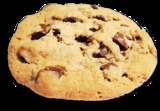
against the British, the word cookie became the word of choice to mean a hard, twice-baked product.
Further confusion has been added by the adoption of the word biscuit for a small leavened bread popular in the United States.
Today, according to American English dictionary
Merriam-Webster
:
Today, throughout most of the world, the term biscuit still means a hard, crisp, brittle bread, except in the United States, where it now denotes a softer bread product
baked only once. In modern Italian usage, the term biscotto is used to refer to any type of hard twice-baked biscuit, and not only to the cantuccini as in the past.
The need for nutritious, easy-to-store, easy-to-carry, and long-lasting foods on long journeys, in particular at sea, was initially solved by taking live food along with a butcher/cook
. However, this took up additional space on what were either horse-powered treks or small ships, reducing the time of travel before additional food was required. This resulted in early armies' adopting the style of hunter-foraging
.
The introduction of the baking
of processed cereals including the creation of flour provided a more reliable source of food. Egypt
ian sailors carried a flat, brittle loaf of millet
bread called dhourra cake, while the Romans
had a biscuit called buccellum. Roman cookbook Apicius
describes:
Many early physicians believed most medicinal problems were associated with digestion
. Hence, for both sustenance and avoidance of illness, a daily consumption of a biscuit was considered good for health.
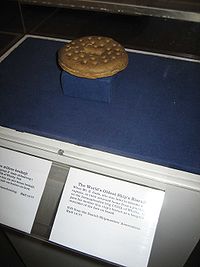
Hard biscuits soften as they age. To solve this problem early bakers attempted to create the hardest biscuit possible. Because it is so hard and dry, if properly stored and transported, navies' hardtack
will survive rough handling and high temperature. Baked
hard, it can be kept without spoiling for years as long as it is kept dry. For long voyages, hardtack was baked four times, rather than the more common two, and prepared six months before sailing. To soften hardtack for eating, it was often dunked in brine
, coffee, or some other liquid or cooked
into a skillet meal.
The more refined captain's biscuit was made with finer flour.
At the time of the Spanish Armada
in 1588, the daily allowance on board a Royal Navy ship was one pound of biscuit plus one gallon of beer. Samuel Pepys
in 1667 first regularised naval victualling with varied and nutritious rations. Royal Navy hardtack during Queen Victoria's reign was made by machine at the Royal Clarence Victualling Yard at Gosport
, Hampshire, stamped with the Queen's mark and the number of the oven in which they were baked. Biscuits remained an important part of the Royal Navy sailor’s diet until the introduction of canned foods. Canned meat was first marketed in 1814; preserved beef in tins was officially added to Royal Navy rations in 1847.
 Early biscuits were hard, dry, and unsweetened. They were most often cooked after bread, in a cooling bakers' oven; they were a cheap form of sustenance for the poor.
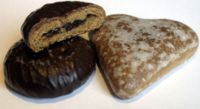
By the seventh century AD, cooks of the Persian empire had learnt from their forebears the secrets of lightening and enriching bread-based mixtures with eggs, butter, and cream, and sweetening them with fruit and honey. One of the earliest spiced biscuits was gingerbread
, in French pain d'épices, meaning "spice bread", brought to Europe in 992 by the Armenian
monk Grégoire de Nicopolis. He left Nicopolis Pompeii, in Lesser Armenia
to live in Bondaroy
, France, near the town of Pithiviers
. He stayed there for seven years, and taught French priests and Christians how to cook gingerbread. This was originally a dense, treaclely
(molasses-based) spice cake or bread. As it was so expensive to make, early ginger biscuits
were a cheap form of using up the leftover bread mix.
With the combination of the Muslim invasion of the Iberian Peninsula
, and then the Crusades
developing the spice trade
, the cooking techniques and ingredients of Arabia spread into Northern Europe. By mediaeval times, biscuits were made from a sweetened, spiced paste of breadcrumbs and then baked (e.g., gingerbread), or from cooked bread enriched with sugar and spices and then baked again. King Richard I of England, (aka Richard the Lionheart) left for the Third Crusade
(1189–92) with "biskit of muslin", which was a mixed corn compound of barley
, rye
, and bean
flour.
As the making and quality of bread had been controlled to this point, so were the skills of biscuit making through the Craft Guilds. As the supply of sugar began, and the refinement and supply of flour increased, so did the ability to sample more leisurely foodstuffs, including sweet biscuits. Early references from the Vadstena monastery
show how the Swedish nun
s were baking gingerbread to ease digestion in 1444. The first documented trade of gingerbread biscuits dates to the 16th century, where they were sold in monastery pharmacies and town square farmers markets. Gingerbread became widely available in the 18th century. The British biscuit firms of Carrs
, Huntley & Palmer, and Crawfords
were all established by 1850.
Hence, it is of no surprise that, often together with local farm produce of meat and cheese, many regions of the world have their own distinct style of biscuit, so old is this form of food.
Biscuits today can be savoury
or sweet, but most are small at around 2 inches (5.1 cm) in diameter, and flat. The term biscuit also applies to sandwich
-type biscuits, wherein a layer of cream or icing
is sandwiched between two biscuits, such as the custard cream
, or a layer of jam (as in biscuits which, in the United Kingdom, are known as "Jammy Dodgers"). European biscuits tend to be more sugary in consistency, and often creative in design though higher in calories, whereas the standard British biscuit is strong and stable (as opposed to crumbly) yet slightly blander (and typically cheaper compared to the European standard), designed perhaps for the tradition of "dunking" in cups of tea; hence preventing the collapse of the biscuit and ruining of the beverage.
Sweet biscuits are commonly eaten as a snack food
, and are, in general, made with wheat flour or oats, and sweetened with sugar or honey. Varieties may contain chocolate, fruit, jam, nuts, or even be used to sandwich other fillings. There is usually a dedicated section for sweet biscuits in most European supermarkets.
In Britain, the digestive biscuit
and rich tea
have a strong cultural identity as the traditional accompaniment to a cup of tea, and are regularly eaten as such. Many tea drinkers "dunk
" their biscuits in tea, allowing them to absorb liquid and soften slightly before consumption.
 Savoury biscuits or crackers (such as cream cracker
s, water biscuit
s, oatcake
s, or crisp bread
s) are usually plainer and commonly eaten with cheese following a meal. Also among the savoury biscuit we may include the Jewish biscuits known as Matzo
s. A large variety of savoury biscuits also contain additional ingredients for flavour or texture, such as poppy seed
s, onion or onion seeds, cheese (such as cheese melts), and olives. Savoury biscuits also usually have a dedicated section in most European supermarkets, often in the same aisle as sweet biscuits. The exception to savoury biscuits is the sweetmeal digestive known as the "Hovis biscuit
", which, although slightly sweet, is still classified as a cheese biscuit. Savoury biscuits sold in supermarkets are sometimes associated with a certain geographical area, such as Scottish oatcakes or Cornish wafer biscuits.
In general, Australians, South Africans, New Zealanders, Indians, Pakistanis, Sri Lankans, Singaporeans, and the Irish use the British meaning of "biscuit" for the sweet biscuit. In Canada, the terms biscuit and cookie are used interchangeably, depending on the region and the speaker, with biscuits usually referring to hard, sweet biscuits (such as digestives, Nice, Bourbon creams, etc.) and cookies for soft baked goods (i.e. chocolate chip cookies). Two famous Australasian biscuit varieties are the ANZAC biscuit
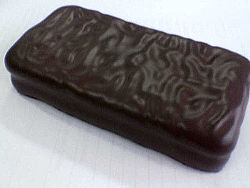
and the Tim Tam
. This sense is at the root of the name of the United States' most prominent maker of cookies and crackers, the National Biscuit Company, now called Nabisco
.
Baking
Baking is the technique of prolonged cooking of food by dry heat acting by convection, and not by radiation, normally in an oven, but also in hot ashes, or on hot stones. It is primarily used for the preparation of bread, cakes, pastries and pies, tarts, quiches, cookies and crackers. Such items...
, edible, and commonly flour-based
Flour
Flour is a powder which is made by grinding cereal grains, other seeds or roots . It is the main ingredient of bread, which is a staple food for many cultures, making the availability of adequate supplies of flour a major economic and political issue at various times throughout history...
product. The term is used to apply to two distinctly different products in North America
North American English
North American English is the variety of the English language of North America, including that of the United States and Canada. Because of their shared histories and the similarities between the pronunciation, vocabulary and accent of American English and Canadian English, the two spoken languages...
and the Commonwealth Nations
English-speaking world
The English-speaking world consists of those countries or regions that use the English language to one degree or another. For more information, please see:Lists:* List of countries by English-speaking population...
.
- In the United States it is a small, soft, leavened breadBiscuit (bread)A biscuit in the United States, and widely used in popular American English, is a small bread made with baking powder or baking soda as a chemical leavening agent rather than yeast....
, somewhat similar to a sconeScone (bread)The scone is a small Scottish quick bread especially popular in the United Kingdom, the United States, Canada, Australia, New Zealand,Belgium and Ireland, but are also eaten in many other countries. They are usually made of wheat, barley or oatmeal, with baking powder as a leavening agent...
. A Southern regional variation on the term, beaten biscuitBeaten biscuitBeaten biscuits are a "Bluegrass" Southern food from the United States, dating from the 19th century.They differ from a regular American soft-dough biscuits, in that they are more like hardtack...
, is closer to the British form. - In Commonwealth English, it is a small and hard, often sweet, baked product that would be called either a cookieCookieIn the United States and Canada, a cookie is a small, flat, baked treat, usually containing fat, flour, eggs and sugar. In most English-speaking countries outside North America, the most common word for this is biscuit; in many regions both terms are used, while in others the two words have...
or a crackerCracker (food)A cracker is a baked good commonly made from grain flour dough and typically made in quantity in various hand-sized or smaller shapes. Flavorings or seasonings, such as salt, herbs, seeds, and/or cheese, may be added to the dough or sprinkled on top before baking...
in the United States, and either a biscuit or a cookie in Canada.
Etymology
The modern-day confusion in the English language around the word "biscuit" is created by its etymologyEtymology
Etymology is the study of the history of words, their origins, and how their form and meaning have changed over time.For languages with a long written history, etymologists make use of texts in these languages and texts about the languages to gather knowledge about how words were used during...
.
The Middle French
Middle French
Middle French is a historical division of the French language that covers the period from 1340 to 1611. It is a period of transition during which:...
word bescuit is derived from the Latin words bis (twice) and coquere, coctus (to cook, cooked), and, hence, means "twice-cooked". This is because biscuits were originally cooked in a twofold process: first baked, and then dried out in a slow oven.
This term was then adapted into English in the 14th century during the Middle Ages
Middle Ages
The Middle Ages is a periodization of European history from the 5th century to the 15th century. The Middle Ages follows the fall of the Western Roman Empire in 476 and precedes the Early Modern Era. It is the middle period of a three-period division of Western history: Classic, Medieval and Modern...
, in the Middle English
Middle English
Middle English is the stage in the history of the English language during the High and Late Middle Ages, or roughly during the four centuries between the late 11th and the late 15th century....
word bisquite, to represent a hard, twice-baked product.
However, the Dutch language
Dutch language
Dutch is a West Germanic language and the native language of the majority of the population of the Netherlands, Belgium, and Suriname, the three member states of the Dutch Language Union. Most speakers live in the European Union, where it is a first language for about 23 million and a second...
from around 1703 had adopted the word koekje, a language diminutive of cake, to have a similar meaning for a similar hard, baked product. This may be related to the Russian or Ukrainian translation, where "biscuit" has come to mean "sponge cake
Sponge cake
Sponge cake is a cake based on flour , sugar, and eggs, sometimes leavened with baking powder which has a firm, yet well aerated structure, similar to a sea sponge. A sponge cake may be produced by either the batter method, or the foam method. Typicially the batter method in the U.S. is known as a...
".
The difference between the secondary Dutch word and that of Latin origin is that, whereas the koekje is a cake that rises during baking, the biscuit, which has no raising agent, in general does not (see gingerbread
Gingerbread
Gingerbread is a term used to describe a variety of sweet food products, which can range from a soft, moist loaf cake to something close to a ginger biscuit. What they have in common are the predominant flavors of ginger and a tendency to use honey or molasses rather than just sugar...
/ginger biscuit), except for the expansion of heated air during baking.
When peoples from Europe began to emigrate to the United States, the two words and their "same but different" meanings began to clash. After the American War of Independence
American Revolutionary War
The American Revolutionary War , the American War of Independence, or simply the Revolutionary War, began as a war between the Kingdom of Great Britain and thirteen British colonies in North America, and ended in a global war between several European great powers.The war was the result of the...
against the British, the word cookie became the word of choice to mean a hard, twice-baked product.
Further confusion has been added by the adoption of the word biscuit for a small leavened bread popular in the United States.
Today, according to American English dictionary
Dictionary
A dictionary is a collection of words in one or more specific languages, often listed alphabetically, with usage information, definitions, etymologies, phonetics, pronunciations, and other information; or a book of words in one language with their equivalents in another, also known as a lexicon...
Merriam-Webster
Merriam-Webster
Merriam–Webster, which was originally the G. & C. Merriam Company of Springfield, Massachusetts, is an American company that publishes reference books, especially dictionaries that are descendants of Noah Webster’s An American Dictionary of the English Language .Merriam-Webster Inc. has been a...
:
- A cookie is a "small flat or slightly raised cake".
- A biscuit is "any of various hard or crisp dry baked product" similar to the American English terms cracker or cookie.
- A biscuit can also mean "a small quick bread made from dough that has been rolled out and cut or dropped from a spoon".
Today, throughout most of the world, the term biscuit still means a hard, crisp, brittle bread, except in the United States, where it now denotes a softer bread product
Biscuit (bread)
A biscuit in the United States, and widely used in popular American English, is a small bread made with baking powder or baking soda as a chemical leavening agent rather than yeast....
baked only once. In modern Italian usage, the term biscotto is used to refer to any type of hard twice-baked biscuit, and not only to the cantuccini as in the past.
Biscuits for travel
The need for nutritious, easy-to-store, easy-to-carry, and long-lasting foods on long journeys, in particular at sea, was initially solved by taking live food along with a butcher/cook
Cook (profession)
A cook is a person who prepares food for consumption. In Germany, Austria, Switzerland and Canada this profession requires government approval ....
. However, this took up additional space on what were either horse-powered treks or small ships, reducing the time of travel before additional food was required. This resulted in early armies' adopting the style of hunter-foraging
Foraging
- Definitions and significance of foraging behavior :Foraging is the act of searching for and exploiting food resources. It affects an animal's fitness because it plays an important role in an animal's ability to survive and reproduce...
.
The introduction of the baking
Baking
Baking is the technique of prolonged cooking of food by dry heat acting by convection, and not by radiation, normally in an oven, but also in hot ashes, or on hot stones. It is primarily used for the preparation of bread, cakes, pastries and pies, tarts, quiches, cookies and crackers. Such items...
of processed cereals including the creation of flour provided a more reliable source of food. Egypt
Egypt
Egypt , officially the Arab Republic of Egypt, Arabic: , is a country mainly in North Africa, with the Sinai Peninsula forming a land bridge in Southwest Asia. Egypt is thus a transcontinental country, and a major power in Africa, the Mediterranean Basin, the Middle East and the Muslim world...
ian sailors carried a flat, brittle loaf of millet
Millet
The millets are a group of small-seeded species of cereal crops or grains, widely grown around the world for food and fodder. They do not form a taxonomic group, but rather a functional or agronomic one. Their essential similarities are that they are small-seeded grasses grown in difficult...
bread called dhourra cake, while the Romans
Ancient Rome
Ancient Rome was a thriving civilization that grew on the Italian Peninsula as early as the 8th century BC. Located along the Mediterranean Sea and centered on the city of Rome, it expanded to one of the largest empires in the ancient world....
had a biscuit called buccellum. Roman cookbook Apicius
Apicius
Apicius is the title of a collection of Roman cookery recipes, usually thought to have been compiled in the late 4th or early 5th century AD and written in a language that is in many ways closer to Vulgar than to Classical Latin....
describes:
Many early physicians believed most medicinal problems were associated with digestion
Digestion
Digestion is the mechanical and chemical breakdown of food into smaller components that are more easily absorbed into a blood stream, for instance. Digestion is a form of catabolism: a breakdown of large food molecules to smaller ones....
. Hence, for both sustenance and avoidance of illness, a daily consumption of a biscuit was considered good for health.
Hard biscuits soften as they age. To solve this problem early bakers attempted to create the hardest biscuit possible. Because it is so hard and dry, if properly stored and transported, navies' hardtack
Hardtack
Hardtack is a simple type of cracker or biscuit, made from flour, water, and sometimes salt. Inexpensive and long-lasting, it was and is used for sustenance in the absence of perishable foods, commonly during long sea voyages and military campaigns. The name derives from the British sailor slang...
will survive rough handling and high temperature. Baked
Baking
Baking is the technique of prolonged cooking of food by dry heat acting by convection, and not by radiation, normally in an oven, but also in hot ashes, or on hot stones. It is primarily used for the preparation of bread, cakes, pastries and pies, tarts, quiches, cookies and crackers. Such items...
hard, it can be kept without spoiling for years as long as it is kept dry. For long voyages, hardtack was baked four times, rather than the more common two, and prepared six months before sailing. To soften hardtack for eating, it was often dunked in brine
Brine
Brine is water, saturated or nearly saturated with salt .Brine is used to preserve vegetables, fruit, fish, and meat, in a process known as brining . Brine is also commonly used to age Halloumi and Feta cheeses, or for pickling foodstuffs, as a means of preserving them...
, coffee, or some other liquid or cooked
Cooking
Cooking is the process of preparing food by use of heat. Cooking techniques and ingredients vary widely across the world, reflecting unique environmental, economic, and cultural traditions. Cooks themselves also vary widely in skill and training...
into a skillet meal.
The more refined captain's biscuit was made with finer flour.
At the time of the Spanish Armada
Spanish Armada
This article refers to the Battle of Gravelines, for the modern navy of Spain, see Spanish NavyThe Spanish Armada was the Spanish fleet that sailed against England under the command of the Duke of Medina Sidonia in 1588, with the intention of overthrowing Elizabeth I of England to stop English...
in 1588, the daily allowance on board a Royal Navy ship was one pound of biscuit plus one gallon of beer. Samuel Pepys
Samuel Pepys
Samuel Pepys FRS, MP, JP, was an English naval administrator and Member of Parliament who is now most famous for the diary he kept for a decade while still a relatively young man...
in 1667 first regularised naval victualling with varied and nutritious rations. Royal Navy hardtack during Queen Victoria's reign was made by machine at the Royal Clarence Victualling Yard at Gosport
Gosport
Gosport is a town, district and borough situated on the south coast of England, within the county of Hampshire. It has approximately 80,000 permanent residents with a further 5,000-10,000 during the summer months...
, Hampshire, stamped with the Queen's mark and the number of the oven in which they were baked. Biscuits remained an important part of the Royal Navy sailor’s diet until the introduction of canned foods. Canned meat was first marketed in 1814; preserved beef in tins was officially added to Royal Navy rations in 1847.
Biscuits for pleasure
By the seventh century AD, cooks of the Persian empire had learnt from their forebears the secrets of lightening and enriching bread-based mixtures with eggs, butter, and cream, and sweetening them with fruit and honey. One of the earliest spiced biscuits was gingerbread
Gingerbread
Gingerbread is a term used to describe a variety of sweet food products, which can range from a soft, moist loaf cake to something close to a ginger biscuit. What they have in common are the predominant flavors of ginger and a tendency to use honey or molasses rather than just sugar...
, in French pain d'épices, meaning "spice bread", brought to Europe in 992 by the Armenian
Armenians
Armenian people or Armenians are a nation and ethnic group native to the Armenian Highland.The largest concentration is in Armenia having a nearly-homogeneous population with 97.9% or 3,145,354 being ethnic Armenian....
monk Grégoire de Nicopolis. He left Nicopolis Pompeii, in Lesser Armenia
Lesser Armenia
Lesser Armenia , also known as Armenia Minor and Armenia Inferior, refers to the Armenian populated regions, primarily to the West and North-West of the ancient Armenian Kingdom...
to live in Bondaroy
Bondaroy
Bondaroy is a commune in the Loiret department in north-central France....
, France, near the town of Pithiviers
Pithiviers
Pithiviers is a commune in the Loiret department in north-central France. It is twinned with Ashby-de-la-Zouch in Leicestershire, England....
. He stayed there for seven years, and taught French priests and Christians how to cook gingerbread. This was originally a dense, treaclely
Molasses
Molasses is a viscous by-product of the processing of sugar cane, grapes or sugar beets into sugar. The word molasses comes from the Portuguese word melaço, which ultimately comes from mel, the Latin word for "honey". The quality of molasses depends on the maturity of the sugar cane or sugar beet,...
(molasses-based) spice cake or bread. As it was so expensive to make, early ginger biscuits
Ginger biscuits
A ginger biscuit, ginger nut or ginger snap is a globally popular biscuit based snack food, flavoured with ginger.These hard twice-baked biscuits are flavoured with powdered ginger, cinnamon, nutmeg, and other spices...
were a cheap form of using up the leftover bread mix.
With the combination of the Muslim invasion of the Iberian Peninsula
Al-Andalus
Al-Andalus was the Arabic name given to a nation and territorial region also commonly referred to as Moorish Iberia. The name describes parts of the Iberian Peninsula and Septimania governed by Muslims , at various times in the period between 711 and 1492, although the territorial boundaries...
, and then the Crusades
Crusades
The Crusades were a series of religious wars, blessed by the Pope and the Catholic Church with the main goal of restoring Christian access to the holy places in and near Jerusalem...
developing the spice trade
Spice trade
Civilizations of Asia were involved in spice trade from the ancient times, and the Greco-Roman world soon followed by trading along the Incense route and the Roman-India routes...
, the cooking techniques and ingredients of Arabia spread into Northern Europe. By mediaeval times, biscuits were made from a sweetened, spiced paste of breadcrumbs and then baked (e.g., gingerbread), or from cooked bread enriched with sugar and spices and then baked again. King Richard I of England, (aka Richard the Lionheart) left for the Third Crusade
Third Crusade
The Third Crusade , also known as the Kings' Crusade, was an attempt by European leaders to reconquer the Holy Land from Saladin...
(1189–92) with "biskit of muslin", which was a mixed corn compound of barley
Barley
Barley is a major cereal grain, a member of the grass family. It serves as a major animal fodder, as a base malt for beer and certain distilled beverages, and as a component of various health foods...
, rye
Rye
Rye is a grass grown extensively as a grain and as a forage crop. It is a member of the wheat tribe and is closely related to barley and wheat. Rye grain is used for flour, rye bread, rye beer, some whiskeys, some vodkas, and animal fodder...
, and bean
Bean
Bean is a common name for large plant seeds of several genera of the family Fabaceae used for human food or animal feed....
flour.
As the making and quality of bread had been controlled to this point, so were the skills of biscuit making through the Craft Guilds. As the supply of sugar began, and the refinement and supply of flour increased, so did the ability to sample more leisurely foodstuffs, including sweet biscuits. Early references from the Vadstena monastery
Monastery
Monastery denotes the building, or complex of buildings, that houses a room reserved for prayer as well as the domestic quarters and workplace of monastics, whether monks or nuns, and whether living in community or alone .Monasteries may vary greatly in size – a small dwelling accommodating only...
show how the Swedish nun
Nun
A nun is a woman who has taken vows committing her to live a spiritual life. She may be an ascetic who voluntarily chooses to leave mainstream society and live her life in prayer and contemplation in a monastery or convent...
s were baking gingerbread to ease digestion in 1444. The first documented trade of gingerbread biscuits dates to the 16th century, where they were sold in monastery pharmacies and town square farmers markets. Gingerbread became widely available in the 18th century. The British biscuit firms of Carrs
Carrs
Carrs-Safeway is a supermarket chain that is based in Anchorage, Alaska and is a subsidiary of Safeway Inc...
, Huntley & Palmer, and Crawfords
United Biscuits
__FORCETOC__United Biscuits is a British multinational food manufacturer, makers of the BN biscuits, McVitie's biscuits, KP Nuts, Hula Hoops, The Real McCoy's crisps, Phileas Fogg snacks, Jacob's Cream Crackers, and Twiglets...
were all established by 1850.
Hence, it is of no surprise that, often together with local farm produce of meat and cheese, many regions of the world have their own distinct style of biscuit, so old is this form of food.
Biscuits today
Most modern biscuits can trace their origins back to either the hardtack ship's biscuit, or the creative art of the baker:- Ship's biscuit derived: DigestiveDigestive biscuitA digestive biscuit, sometimes referred to as a sweet-meal biscuit, is a semi-sweet biscuit originated in the United Kingdom and popular worldwide. The term 'digestive' is derived from the belief that they had antacid properties due to the use of sodium bicarbonate when they were first developed...
, rich teaRich teaRich tea is a type of sweet biscuit, the ingredients generally include wheat flour, sugar, vegetable oil, and malt extract. The biscuits are popular in the United Kingdom, where their plain flavour and consistency makes them particularly suitable for dunking in tea and coffee...
, AbernethyAbernethy biscuitThe Abernethy biscuit was invented by Dr John Abernethy, a Scottish doctor, as a digestive improver and hence aid to health.Dr Abernethy believed that most diseases were due to disorders in digestion. In creating his biscuit, Dr Abernethy was following in the footsteps of other medical...
, cracker - Baker's art: Biscuit rose de ReimsBiscuit rose de ReimsBiscuit rose de Reims , is a French biscuit, made pink by the addition of carmine.Originating in Reims, they are a product of the Biscuits Fossier company....
Biscuits today can be savoury
Umami
Umami , popularly referred to as savoriness, is one of the five basic tastes together with sweet, sour, bitter, and salty.-Etymology:Umami is a loanword from the Japanese meaning "pleasant savory taste". This particular writing was chosen by Professor Kikunae Ikeda from umai "delicious" and mi ...
or sweet, but most are small at around 2 inches (5.1 cm) in diameter, and flat. The term biscuit also applies to sandwich
Sandwich
A sandwich is a food item, typically consisting of two or more slices of :bread with one or more fillings between them, or one slice of bread with a topping or toppings, commonly called an open sandwich. Sandwiches are a widely popular type of lunch food, typically taken to work or school, or...
-type biscuits, wherein a layer of cream or icing
Icing (food)
Icing, also called frosting in the United States, is a sweet often creamy glaze made of sugar with a liquid such as water or milk, that is often enriched with ingredients such as butter, egg whites, cream cheese, or flavorings and is used to cover or decorate baked goods, such as cakes or cookies...
is sandwiched between two biscuits, such as the custard cream
Custard cream
A custard cream is a type of biscuit popular in the United Kingdom and Ireland. Its structure is that of a sandwich, with a fondant centre between two flat biscuit layers. The filling tastes of vanilla and as such is more akin to the taste of custard made with custard powder than egg custard...
, or a layer of jam (as in biscuits which, in the United Kingdom, are known as "Jammy Dodgers"). European biscuits tend to be more sugary in consistency, and often creative in design though higher in calories, whereas the standard British biscuit is strong and stable (as opposed to crumbly) yet slightly blander (and typically cheaper compared to the European standard), designed perhaps for the tradition of "dunking" in cups of tea; hence preventing the collapse of the biscuit and ruining of the beverage.
Sweet biscuits are commonly eaten as a snack food
Snack food
A snack is a portion of food oftentimes smaller than that of a regular meal, that is generally eaten between meals. Snacks come in a variety of forms including packaged and processed foods and items made from fresh ingredients at home....
, and are, in general, made with wheat flour or oats, and sweetened with sugar or honey. Varieties may contain chocolate, fruit, jam, nuts, or even be used to sandwich other fillings. There is usually a dedicated section for sweet biscuits in most European supermarkets.
In Britain, the digestive biscuit
Digestive biscuit
A digestive biscuit, sometimes referred to as a sweet-meal biscuit, is a semi-sweet biscuit originated in the United Kingdom and popular worldwide. The term 'digestive' is derived from the belief that they had antacid properties due to the use of sodium bicarbonate when they were first developed...
and rich tea
Rich tea
Rich tea is a type of sweet biscuit, the ingredients generally include wheat flour, sugar, vegetable oil, and malt extract. The biscuits are popular in the United Kingdom, where their plain flavour and consistency makes them particularly suitable for dunking in tea and coffee...
have a strong cultural identity as the traditional accompaniment to a cup of tea, and are regularly eaten as such. Many tea drinkers "dunk
Dunk (biscuit)
To dunk is to dip a biscuit , bread, buttered toast, cake, or doughnut into a beverage, especially tea, coffee, or cold milk. Dunking releases more flavour from confections by dissolving the sugars, while also softening their texture...
" their biscuits in tea, allowing them to absorb liquid and soften slightly before consumption.
Cream cracker
A cream cracker is a flat, usually square savoury biscuit. It is similar to a matzo, but it contains yeast and is typically thicker and approximately 8 cm square...
s, water biscuit
Water biscuit
A water biscuit is a type of biscuit or cracker. Water biscuits are baked using only flour and water, without shortening or other fats usually used in biscuit production. They are thin, hard and brittle, and usually served with cheese or wine...
s, oatcake
Oatcake
An oatcake is a type of cracker or pancake, made from oatmeal, and sometimes flour as well. Oatcakes are cooked on a griddle or baked in an oven.- Scottish oatcakes :...
s, or crisp bread
Crisp bread
Crisp bread or hard bread is a flat and dry type of bread or cracker, containing mostly rye flour...
s) are usually plainer and commonly eaten with cheese following a meal. Also among the savoury biscuit we may include the Jewish biscuits known as Matzo
Matzo
Matzo or matzah is an unleavened bread traditionally eaten by Jews during the week-long Passover holiday, when eating chametz—bread and other food which is made with leavened grain—is forbidden according to Jewish law. Currently, the most ubiquitous type of Matzo is the traditional Ashkenazic...
s. A large variety of savoury biscuits also contain additional ingredients for flavour or texture, such as poppy seed
Poppy seed
Poppy seed is an oilseed obtained from the opium poppy . The tiny kidney-shaped seeds have been harvested from dried seed pods by various civilizations for thousands of years...
s, onion or onion seeds, cheese (such as cheese melts), and olives. Savoury biscuits also usually have a dedicated section in most European supermarkets, often in the same aisle as sweet biscuits. The exception to savoury biscuits is the sweetmeal digestive known as the "Hovis biscuit
Hovis biscuit
The Hovis biscuit was a British manufactured digestive biscuit.Manufactured under license from 1980 from Hovis by Nabisco's then English subsidiary Jacob's, they are shaped like a miniature flat copy of the traditional Hovis loaf, and like the bread have the word "HOVIS" stamped on their top...
", which, although slightly sweet, is still classified as a cheese biscuit. Savoury biscuits sold in supermarkets are sometimes associated with a certain geographical area, such as Scottish oatcakes or Cornish wafer biscuits.
In general, Australians, South Africans, New Zealanders, Indians, Pakistanis, Sri Lankans, Singaporeans, and the Irish use the British meaning of "biscuit" for the sweet biscuit. In Canada, the terms biscuit and cookie are used interchangeably, depending on the region and the speaker, with biscuits usually referring to hard, sweet biscuits (such as digestives, Nice, Bourbon creams, etc.) and cookies for soft baked goods (i.e. chocolate chip cookies). Two famous Australasian biscuit varieties are the ANZAC biscuit
Anzac biscuit
An Anzac biscuit is a sweet biscuit popular in Australia and New Zealand, made using rolled oats, flour, desiccated coconut, sugar, butter, golden syrup, baking soda and boiling water...
and the Tim Tam
Tim Tam
Tim Tam is a brand of chocolate biscuit currently manufactured by Arnott's in Australia. A Tim Tam is composed of two layers of chocolate malted biscuit, separated by a light chocolate cream filling, and coated in a thin layer of textured chocolate....
. This sense is at the root of the name of the United States' most prominent maker of cookies and crackers, the National Biscuit Company, now called Nabisco
Nabisco
Nabisco is an American brand of cookies and snacks. Headquartered in East Hanover, New Jersey, the company is a subsidiary of Illinois-based Kraft Foods. Nabisco's plant in Chicago, a production facility at 7300 S...
.
See also
- Dog biscuitDog biscuitA dog biscuit is a hard biscuit-based dietary supplement for dogs or other canine, similar to human snack food.Dog biscuits tend to be hard and dry. Dog biscuits may be sold in a flat bone-shape...
- RuskRuskA rusk is a hard, dry biscuit or a twice-baked bread. It is sometimes used as a baby teething food. In the United Kingdom, the name also refers to a wheat-based food additive.- Germany :The zwieback A rusk is a hard, dry biscuit or a twice-baked bread. It is sometimes used as a baby teething food....
- American and British English differencesAmerican and British English differencesThis is one of a series of articles about the differences between British English and American English, which, for the purposes of these articles, are defined as follows:...
External links
- Video: "Baking Biscuits", The Martha Stewart Show, 3 June 2008