


Rusk

Encyclopedia
A rusk is a hard, dry biscuit or a twice-baked bread
. It is sometimes used as a baby teething
food. In the United Kingdom
, the name also refers to a wheat
-based food additive
.
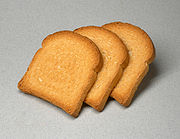 The zwieback
(lit. baked twice) is a form of rusk eaten in Germany.
or chickpea
flour, and softened with wine, water or oil before eating. Paximadi form the basis of the Cretan snack dakos
.
, Pakistan
and South Africa
, rusk is a traditional dried bread (also "Khasta" in Hindi
, and beskuit in Afrikaans) that is eaten after having been dipped in coffee
, tea
, or rooibos
tea. Historically, rusks evolved (along with biltong
) during the latter country's early pioneering days as a way to preserve bread in the dry climate. It was also extensively used during times of war or when traveling long distances.
Traditionally baked at home using a favourite bread recipe that is then dried under low heat, there are now several mass-market versions available, the most famous probably being Ouma Rusks
. Many bakeries, delis and home industries sell them, often using more exotic ingredients than their mass-market counterparts. In addition to plain and buttermilk
flavours, there are aniseed, wholewheat, condensed milk
, muesli
, and lemon
poppyseed versions.
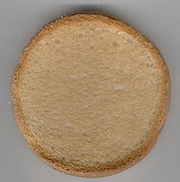 Beschuit, also known as Dutch crispbakes, are light, round, rather crumbly, rusks as eaten in the Netherlands
. It is customary to serve beschuit met muisjes (sprinkled with "little mice" which are anise seeds covered in white, pink or blue sugar) at the birth of a baby. Beschuit are also eaten as a breakfast food with a variety of toppings, most commonly butter and sprinkles in flavors like chocolate (chocoladehagel) or fruit(vruchtenhagel), or cheese. A longtime Dutch tradition is to serve strawberries on 'beschuit' usually topped with some sugar or whipped cream.
Beschuit is almost always sold in rolls; a roll typically has thirteen rusks (a baker's dozen). They are made by first baking a flat round bread (beschuitbol), slicing it,
and then baking each half again, possibly at a lower heat, as in the oven after the main baking is over. Etymologically, biscotto (16c. Italian), biscuit
(19th c., from 16th c. bisket) and beschuit come from L. (panis) bis+coctus, (bread) twice cooked. The South African beskuit (Afrikaans) tradition derives from beschuit.
makes the world's most sold rusk brand, Krisprolls.
butcher
rusk is a dry biscuit broken into particles, sorted by particle size and sold to butchers and others for use as a food additive
in sausage
manufacture. Though originally made from stale
bread
, now called "Bread-rusk", a yeast
-free variety called simply "Rusk" is now more commonly used.
Various rusk particle sizes are used in the food industry, where uses include:
, Farley's
Rusks are a dry biscuit dating from the 1880s but manufactured by Heinz
since 1994. They are usually given to infants, soaked in milk and mashed up. They have a cult following among university students
.
In 2006 there was a short lived scare when it was found that some Farley's Rusks contained traces of the weedkiller chlorpropham
. The affected products were recalled and the contamination was traced to a batch of flour used during the manufacturing process. The level of contamination was not high enough to be considered a health risk.
marketed as cake rusk is sold in many foreign supermarkets and bakeries by imported brands such as Crispy (TWI Foods), and it is typically made from wheat flour
, hydrogenated vegetable oil and/or margarine
, sugar
, baking powder
or other raising agent, and flavouring, often in that order. It is sliced into bar-like strips and packaged in large plastic boxes.
Bread
Bread is a staple food prepared by cooking a dough of flour and water and often additional ingredients. Doughs are usually baked, but in some cuisines breads are steamed , fried , or baked on an unoiled frying pan . It may be leavened or unleavened...
. It is sometimes used as a baby teething
Teething
Teething is the process by which an infant's first teeth sequentially appear by emerging through the gums. Teething may start as early as three months or as late, in some cases, as twelve months. The typical time frame for the first teeth to appear is somewhere between six and nine months...
food. In the United Kingdom
United Kingdom
The United Kingdom of Great Britain and Northern IrelandIn the United Kingdom and Dependencies, other languages have been officially recognised as legitimate autochthonous languages under the European Charter for Regional or Minority Languages...
, the name also refers to a wheat
Wheat
Wheat is a cereal grain, originally from the Levant region of the Near East, but now cultivated worldwide. In 2007 world production of wheat was 607 million tons, making it the third most-produced cereal after maize and rice...
-based food additive
Food additive
Food additives are substances added to food to preserve flavor or enhance its taste and appearance.Some additives have been used for centuries; for example, preserving food by pickling , salting, as with bacon, preserving sweets or using sulfur dioxide as in some wines...
.
Germany
Zwieback
Zwieback is a type of crisp, sweetened bread, made with eggs and baked twice.It is sliced before it is baked a second time, which produces crisp, brittle slices that closely resemble melba toast...
(lit. baked twice) is a form of rusk eaten in Germany.
Greece
The term paximadi covers various forms of Greek rusk, made commonly from barleyBarley
Barley is a major cereal grain, a member of the grass family. It serves as a major animal fodder, as a base malt for beer and certain distilled beverages, and as a component of various health foods...
or chickpea
Chickpea
The chickpea is a legume of the family Fabaceae, subfamily Faboideae...
flour, and softened with wine, water or oil before eating. Paximadi form the basis of the Cretan snack dakos
Dakos
Dakos or ntakos , also known as koukouvagia is a Cretan meze consisting of a slice of soaked dried bread or barley rusk topped with chopped tomatoes and crumbled feta or mizithra cheese....
.
India, Pakistan and South Africa
In IndiaIndia
India , officially the Republic of India , is a country in South Asia. It is the seventh-largest country by geographical area, the second-most populous country with over 1.2 billion people, and the most populous democracy in the world...
, Pakistan
Pakistan
Pakistan , officially the Islamic Republic of Pakistan is a sovereign state in South Asia. It has a coastline along the Arabian Sea and the Gulf of Oman in the south and is bordered by Afghanistan and Iran in the west, India in the east and China in the far northeast. In the north, Tajikistan...
and South Africa
South Africa
The Republic of South Africa is a country in southern Africa. Located at the southern tip of Africa, it is divided into nine provinces, with of coastline on the Atlantic and Indian oceans...
, rusk is a traditional dried bread (also "Khasta" in Hindi
Hindi
Standard Hindi, or more precisely Modern Standard Hindi, also known as Manak Hindi , High Hindi, Nagari Hindi, and Literary Hindi, is a standardized and sanskritized register of the Hindustani language derived from the Khariboli dialect of Delhi...
, and beskuit in Afrikaans) that is eaten after having been dipped in coffee
Coffee
Coffee is a brewed beverage with a dark,init brooo acidic flavor prepared from the roasted seeds of the coffee plant, colloquially called coffee beans. The beans are found in coffee cherries, which grow on trees cultivated in over 70 countries, primarily in equatorial Latin America, Southeast Asia,...
, tea
Tea
Tea is an aromatic beverage prepared by adding cured leaves of the Camellia sinensis plant to hot water. The term also refers to the plant itself. After water, tea is the most widely consumed beverage in the world...
, or rooibos
Rooibos
Rooibos is a broom-like member of the legume family of plants growing in South Africa's fynbos.The generic name comes from the plant Calicotome villosa, aspalathos in Greek. This plant has very similar growth and flowers to the redbush...
tea. Historically, rusks evolved (along with biltong
Biltong
Biltong is a kind of cured meat that originated in South Africa. Many different types of meat are used to produce it, ranging from beef through game meats to fillets of ostrich from commercial farms. It is typically made from raw fillets of meat cut into strips following the grain of the muscle, or...
) during the latter country's early pioneering days as a way to preserve bread in the dry climate. It was also extensively used during times of war or when traveling long distances.
Traditionally baked at home using a favourite bread recipe that is then dried under low heat, there are now several mass-market versions available, the most famous probably being Ouma Rusks
Ouma Rusks
Ouma Rusks are South Africa's best-known brand of rusks - a traditional South African snack that is dipped in coffee or tea before being eaten....
. Many bakeries, delis and home industries sell them, often using more exotic ingredients than their mass-market counterparts. In addition to plain and buttermilk
Buttermilk
Buttermilk refers to a number of dairy drinks. Originally, buttermilk was the liquid left behind after churning butter out of cream. It also refers to a range of fermented milk drinks, common in warm climates where unrefrigerated fresh milk otherwise sours quickly...
flavours, there are aniseed, wholewheat, condensed milk
Condensed milk
Condensed milk, also known as sweetened condensed milk, is cow's milk from which water has been removed and to which sugar has been added, yielding a very thick, sweet product which when canned can last for years without refrigeration if unopened. The two terms, condensed milk and sweetened...
, muesli
Muesli
Muesli is a popular breakfast cereal based on uncooked rolled oats, fruit and nuts. It was developed around 1900 by Swiss physician Maximilian Bircher-Benner for patients in his hospital...
, and lemon
Lemon
The lemon is both a small evergreen tree native to Asia, and the tree's ellipsoidal yellow fruit. The fruit is used for culinary and non-culinary purposes throughout the world – primarily for its juice, though the pulp and rind are also used, mainly in cooking and baking...
poppyseed versions.
Netherlands
Netherlands
The Netherlands is a constituent country of the Kingdom of the Netherlands, located mainly in North-West Europe and with several islands in the Caribbean. Mainland Netherlands borders the North Sea to the north and west, Belgium to the south, and Germany to the east, and shares maritime borders...
. It is customary to serve beschuit met muisjes (sprinkled with "little mice" which are anise seeds covered in white, pink or blue sugar) at the birth of a baby. Beschuit are also eaten as a breakfast food with a variety of toppings, most commonly butter and sprinkles in flavors like chocolate (chocoladehagel) or fruit(vruchtenhagel), or cheese. A longtime Dutch tradition is to serve strawberries on 'beschuit' usually topped with some sugar or whipped cream.
Beschuit is almost always sold in rolls; a roll typically has thirteen rusks (a baker's dozen). They are made by first baking a flat round bread (beschuitbol), slicing it,
and then baking each half again, possibly at a lower heat, as in the oven after the main baking is over. Etymologically, biscotto (16c. Italian), biscuit
Biscuit
A biscuit is a baked, edible, and commonly flour-based product. The term is used to apply to two distinctly different products in North America and the Commonwealth Nations....
(19th c., from 16th c. bisket) and beschuit come from L. (panis) bis+coctus, (bread) twice cooked. The South African beskuit (Afrikaans) tradition derives from beschuit.
Sweden
Skorpor are a Swedish form of rusk. Skorpor can be flavored with herbs, dried fruit, nuts, or spices such as anise or cardamom. Swedish bakery company PågenPågen
Pågen is a Swedish bakery company founded in 1878 by Anders and Matilda Påhlsson. The company started off as a little bakery shop in Malmö in the southern province of Scania. Their bakeries are run by around 1350 employees, and are located in Malmö and Gothenburg. Their products include various...
makes the world's most sold rusk brand, Krisprolls.
Butcher's rusk
To the BritishUnited Kingdom
The United Kingdom of Great Britain and Northern IrelandIn the United Kingdom and Dependencies, other languages have been officially recognised as legitimate autochthonous languages under the European Charter for Regional or Minority Languages...
butcher
Butcher
A butcher is a person who may slaughter animals, dress their flesh, sell their meat or any combination of these three tasks. They may prepare standard cuts of meat, poultry, fish and shellfish for sale in retail or wholesale food establishments...
rusk is a dry biscuit broken into particles, sorted by particle size and sold to butchers and others for use as a food additive
Food additive
Food additives are substances added to food to preserve flavor or enhance its taste and appearance.Some additives have been used for centuries; for example, preserving food by pickling , salting, as with bacon, preserving sweets or using sulfur dioxide as in some wines...
in sausage
Sausage
A sausage is a food usually made from ground meat , mixed with salt, herbs, and other spices, although vegetarian sausages are available. The word sausage is derived from Old French saussiche, from the Latin word salsus, meaning salted.Typically, a sausage is formed in a casing traditionally made...
manufacture. Though originally made from stale
Staling
Staling, or "going stale", is a chemical and physical process in bread and other foods that reduces their palatability. Stale bread is dry and leathery.-Mechanism and effects:...
bread
Bread
Bread is a staple food prepared by cooking a dough of flour and water and often additional ingredients. Doughs are usually baked, but in some cuisines breads are steamed , fried , or baked on an unoiled frying pan . It may be leavened or unleavened...
, now called "Bread-rusk", a yeast
Yeast
Yeasts are eukaryotic micro-organisms classified in the kingdom Fungi, with 1,500 species currently described estimated to be only 1% of all fungal species. Most reproduce asexually by mitosis, and many do so by an asymmetric division process called budding...
-free variety called simply "Rusk" is now more commonly used.
Various rusk particle sizes are used in the food industry, where uses include:
- A carrier for flavours, colours and seasonings
- A binding agent in hamburgersPattyA patty is a flattened cake, often of meat.Patty may also refer to:* Patty , a family name* Patricia, a female given name, in all forms of English* Patrick , a male given name, in Australian English and Hiberno-English...
, sausageSausageA sausage is a food usually made from ground meat , mixed with salt, herbs, and other spices, although vegetarian sausages are available. The word sausage is derived from Old French saussiche, from the Latin word salsus, meaning salted.Typically, a sausage is formed in a casing traditionally made...
s, stuffings, pies, and other compound meat products. - As an ingredient for dried stuffingStuffingIn cooking, stuffing or filling is an edible substance or mixture, often a starch, used to fill a cavity in another food item...
mixes.
Farley's Rusks
In the United KingdomUnited Kingdom
The United Kingdom of Great Britain and Northern IrelandIn the United Kingdom and Dependencies, other languages have been officially recognised as legitimate autochthonous languages under the European Charter for Regional or Minority Languages...
, Farley's
Farley's
Farley's was a British food manufacturing company, best known for the baby product Farley's Rusks but also for baby rice, cereals and breadsticks....
Rusks are a dry biscuit dating from the 1880s but manufactured by Heinz
H. J. Heinz Company
The H. J. Heinz Company , commonly known as Heinz and famous for its "57 Varieties" slogan and its ketchup, is an American food company with world headquarters in Pittsburgh, Pennsylvania.Perhaps best known for its ketchup, the H.J...
since 1994. They are usually given to infants, soaked in milk and mashed up. They have a cult following among university students
Student
A student is a learner, or someone who attends an educational institution. In some nations, the English term is reserved for those who attend university, while a schoolchild under the age of eighteen is called a pupil in English...
.
In 2006 there was a short lived scare when it was found that some Farley's Rusks contained traces of the weedkiller chlorpropham
Chlorpropham
Chlorpropham is a plant growth regulator and herbicide used as a sprout suppressant for grass weeds, alfalfa, lima and snap beans, blueberries, cane berries, carrots, cranberries, ladino clover, garlic, seed grass, onions, spinach, sugar beets, tomatoes, safflower, soybeans, gladioli and woody...
. The affected products were recalled and the contamination was traced to a batch of flour used during the manufacturing process. The level of contamination was not high enough to be considered a health risk.
Cake rusk
In the United Kingdom, a sweet quick breadBread
Bread is a staple food prepared by cooking a dough of flour and water and often additional ingredients. Doughs are usually baked, but in some cuisines breads are steamed , fried , or baked on an unoiled frying pan . It may be leavened or unleavened...
marketed as cake rusk is sold in many foreign supermarkets and bakeries by imported brands such as Crispy (TWI Foods), and it is typically made from wheat flour
Wheat flour
Wheat flour is a powder made from the grinding of wheat used for human consumption. More wheat flour is produced than any other flour. Wheat varieties are called "clean," "white," or "brown" if they have high gluten content, and they are called "soft" or "weak" flour if gluten content is low...
, hydrogenated vegetable oil and/or margarine
Margarine
Margarine , as a generic term, can indicate any of a wide range of butter substitutes, typically composed of vegetable oils. In many parts of the world, the market share of margarine and spreads has overtaken that of butter...
, sugar
Sugar
Sugar is a class of edible crystalline carbohydrates, mainly sucrose, lactose, and fructose, characterized by a sweet flavor.Sucrose in its refined form primarily comes from sugar cane and sugar beet...
, baking powder
Baking powder
Baking powder is a dry chemical leavening agent used to increase the volume and lighten the texture of baked goods such as muffins, cakes, scones and American-style biscuits. Baking powder works by releasing carbon dioxide gas into a batter or dough through an acid-base reaction, causing bubbles in...
or other raising agent, and flavouring, often in that order. It is sliced into bar-like strips and packaged in large plastic boxes.
See also
- Milk toastMilk toastMilk toast is a breakfast food consisting of toasted bread in warm milk, typically with sugar and butter. Salt, pepper, paprika, cinnamon, cocoa, raisins and other ingredients may be added. In New England, milk toast refers to toast that has been dipped in a milk-based white sauce...
, some modern store-bought forms of which strongly resemble rusks with slight flavouring and sweeteners.