


Bird flight

Encyclopedia

Flight
Flight is the process by which an object moves either through an atmosphere or beyond it by generating lift or propulsive thrust, or aerostatically using buoyancy, or by simple ballistic movement....
is the main mode of locomotion
Animal locomotion
Animal locomotion, which is the act of self-propulsion by an animal, has many manifestations, including running, swimming, jumping and flying. Animals move for a variety of reasons, such as to find food, a mate, or a suitable microhabitat, and to escape predators...
used by most of the world's bird
Bird
Birds are feathered, winged, bipedal, endothermic , egg-laying, vertebrate animals. Around 10,000 living species and 188 families makes them the most speciose class of tetrapod vertebrates. They inhabit ecosystems across the globe, from the Arctic to the Antarctic. Extant birds range in size from...
species. Flight assists birds while feeding, breeding and avoiding predators
Predation
In ecology, predation describes a biological interaction where a predator feeds on its prey . Predators may or may not kill their prey prior to feeding on them, but the act of predation always results in the death of its prey and the eventual absorption of the prey's tissue through consumption...
.
This article discusses the mechanics of bird flight, with emphasis on the varied forms of bird's wings. The specifics of hovering, take-off and landing are also examined. Additional adaptations of bird's bodies relating to their flying ability are covered. Finally, theories on the evolution of bird flight are discussed.
Basic mechanics of bird flight

Lift
The fundamentals of bird flight are similar to those of aircraftAircraft
An aircraft is a vehicle that is able to fly by gaining support from the air, or, in general, the atmosphere of a planet. An aircraft counters the force of gravity by using either static lift or by using the dynamic lift of an airfoil, or in a few cases the downward thrust from jet engines.Although...
. Lift force
Lift (force)
A fluid flowing past the surface of a body exerts a surface force on it. Lift is the component of this force that is perpendicular to the oncoming flow direction. It contrasts with the drag force, which is the component of the surface force parallel to the flow direction...
is produced by the action of air flow on the wing
Wing
A wing is an appendage with a surface that produces lift for flight or propulsion through the atmosphere, or through another gaseous or liquid fluid...
, which is an airfoil
Airfoil
An airfoil or aerofoil is the shape of a wing or blade or sail as seen in cross-section....
. The lift force occurs because the air has a lower pressure just above the wing and higher pressure below.
Gliding
When glidingGliding (flight)
Gliding flight is heavier-than-air flight without the use of thrust. It is employed by gliding animals and by aircraft such as gliders. The most common human application of gliding flight is in sport and recreation using aircraft designed for this purpose...
, both birds and glider
Glider aircraft
Glider aircraft are heavier-than-air craft that are supported in flight by the dynamic reaction of the air against their lifting surfaces, and whose free flight does not depend on an engine. Mostly these types of aircraft are intended for routine operation without engines, though engine failure can...
s obtain both a vertical and a forward force from their wings. This is possible because the lift force is generated at right angles to the air flow, which in gliding flight comes from slightly below the horizontal (because the bird is descending). The lift force, therefore, has a forward component that counteracts drag
Drag (physics)
In fluid dynamics, drag refers to forces which act on a solid object in the direction of the relative fluid flow velocity...
.
Flapping
When a bird flaps, as opposed to gliding, its wings continue to develop lift as before, but the lift is rotated forward to provide thrustThrust
Thrust is a reaction force described quantitatively by Newton's second and third laws. When a system expels or accelerates mass in one direction the accelerated mass will cause a force of equal magnitude but opposite direction on that system....
, which counteracts drag and increases its speed, which has the effect of also increasing lift to counteract its weight
Weight
In science and engineering, the weight of an object is the force on the object due to gravity. Its magnitude , often denoted by an italic letter W, is the product of the mass m of the object and the magnitude of the local gravitational acceleration g; thus:...
, allowing it to maintain height or to climb. Flapping involves two stages: the down-stroke, which provides the majority of the thrust, and the up-stroke, which can also (depending on the bird's wings) provide some thrust. At each up-stroke the wing is slightly folded inwards to reduce upward resistance. Birds change the angle of attack
Angle of attack
Angle of attack is a term used in fluid dynamics to describe the angle between a reference line on a lifting body and the vector representing the relative motion between the lifting body and the fluid through which it is moving...
between the up-stroke and the down-stroke of their wings. During the down-stroke the angle of attack is increased, and is decreased during the up-stroke.
Drag
Apart from its weight, there are three major drag forces that impede a bird's aerial flight: frictional drag (caused by the friction of air and body surfaces), form drag (due to frontal area of the bird, also known as pressure drag), and lift-induced dragLift-induced drag
In aerodynamics, lift-induced drag, induced drag, vortex drag, or sometimes drag due to lift, is a drag force that occurs whenever a moving object redirects the airflow coming at it. This drag force occurs in airplanes due to wings or a lifting body redirecting air to cause lift and also in cars...
(caused by the wingtip vortices
Wingtip vortices
Wingtip vortices are tubes of circulating air that are left behind a wing as it generates lift. One wingtip vortex trails from the tip of each wing. The cores of vortices spin at very high speed and are regions of very low pressure...
). These forces are reduced by streamlining the bird's body and wings.
Wing
Forelimb
A forelimb is an anterior limb on an animal's body. When referring to quadrupeds , the term foreleg is often instead used....
s, the wing
Wing
A wing is an appendage with a surface that produces lift for flight or propulsion through the atmosphere, or through another gaseous or liquid fluid...
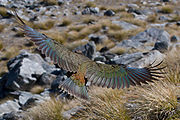
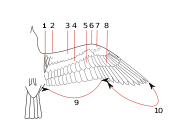
s, are the key to bird flight. Each wing has a central vane to hit the wind, composed of three limb bones, the humerus
Humerus
The humerus is a long bone in the arm or forelimb that runs from the shoulder to the elbow....
, ulna
Ulna
The ulna is one of the two long bones in the forearm, the other being the radius. It is prismatic in form and runs parallel to the radius, which is shorter and smaller. In anatomical position The ulna is one of the two long bones in the forearm, the other being the radius. It is prismatic in form...
and radius
Radius
In classical geometry, a radius of a circle or sphere is any line segment from its center to its perimeter. By extension, the radius of a circle or sphere is the length of any such segment, which is half the diameter. If the object does not have an obvious center, the term may refer to its...
. The hand, or manus, which ancestrally was composed of five digits, is reduced to three digits (digit II, III and IV or I, II, III depending on the scheme followed), which serves as an anchor for the primaries, one of two groups of flight feather
Flight feather
Flight feathers are the long, stiff, asymmetrically shaped, but symmetrically paired feathers on the wings or tail of a bird; those on the wings are called remiges while those on the tail are called rectrices . Their primary function is to aid in the generation of both thrust and lift, thereby...
s responsible for the wing's airfoil shape. The other set of flight feathers, behind the carpal joint on the ulna, are called the secondaries. The remaining feathers on the wing are known as coverts
Covert (feather)
A covert feather on a bird is one of a set of feathers, called coverts, which as the name implies, cover other feathers. The coverts help to smooth airflow over the wings and tail.- Wing-coverts :...
, of which there are three sets. The wing sometimes has vestigial claws. In most species these are lost by the time the bird is adult (such as the highly visible ones used for active climbing by Hoatzin
Hoatzin
The Hoatzin , also known as the Hoactzin, Stinkbird, or Canje Pheasant, is a species of tropical bird found in swamps, riverine forest and mangrove of the Amazon and the Orinoco delta in South America...
chicks), but claws are retained into adulthood by the Secretary Bird
Secretary Bird
The Secretarybird or Secretary Bird is a large, mostly terrestrial bird of prey. Endemic to Africa, it is usually found in the open grasslands and savannah of the sub-Sahara...
, screamer
Screamer
The screamers are a small family of birds, the Anhimidae. For a long time they were thought to be related to the Galliformes because of similar bills, but they are truly related to ducks , most closely to the Magpie Goose...
s, finfoot
Heliornithidae
The Heliornithidae are a small family of tropical birds with webbed lobes on their feet like those of grebes and coots. The family overall are known as finfoots, although one species is known as a Sungrebe. The family is composed of three species in three genera.-Description:Finfoots resemble...
s, ostriches, several swifts and numerous others, as a local trait, in a few specimens. The claws of the Jurassic theropod-like Archaeopteryx
Archaeopteryx
Archaeopteryx , sometimes referred to by its German name Urvogel , is a genus of theropod dinosaur that is closely related to birds. The name derives from the Ancient Greek meaning "ancient", and , meaning "feather" or "wing"...
are quite similar to those of the Hoatzin nestlings.
Albatrosses have locking mechanism in the wing joints that reduce the strain on the muscles during soaring flight.
Female birds exposed to predators during ovulation produce chicks which grow their wings faster than chicks produced by predator-free females. Their wings are also longer. Both adaptations may make them better at avoiding avian predators.
Wing shape and flight

Planform
In aviation, a planform is the shape and layout of a fixed-wing aircraft's fuselage and wing. Of all the myriad planforms used, they can typically be grouped into those used for low-speed flight, found on general aviation aircraft, and those used for high-speed flight, found on many military...
of the wing (the shape of the wing as seen from below) can be described in terms of two parameters, aspect ratio
Aspect ratio (wing)
In aerodynamics, the aspect ratio of a wing is essentially the ratio of its length to its breadth . A high aspect ratio indicates long, narrow wings, whereas a low aspect ratio indicates short, stubby wings....
and wing loading
Wing loading
In aerodynamics, wing loading is the loaded weight of the aircraft divided by the area of the wing. The faster an aircraft flies, the more lift is produced by each unit area of wing, so a smaller wing can carry the same weight in level flight, operating at a higher wing loading. Correspondingly,...
. Aspect ratio is the ratio of wingspan
Wingspan
The wingspan of an airplane or a bird, is the distance from one wingtip to the other wingtip. For example, the Boeing 777 has a wingspan of about ; and a Wandering Albatross caught in 1965 had a wingspan of , the official record for a living bird.The term wingspan, more technically extent, is...
to the mean of its chord
Chord (aircraft)
In aeronautics, chord refers to the imaginary straight line joining the trailing edge and the center of curvature of the leading edge of the cross-section of an airfoil...
(or the square of the wingspan divided by wing area). Wing loading is the ratio of weight to wing area.
Most kinds of bird wing can be grouped into four types, with some falling between two of these types. These types of wings are elliptical wings, high speed wings, high aspect ratio wings and soaring wings with slots.
Elliptical wings
Elliptical wings are short and rounded, having a low aspect ratio, allowing for tight maneuvering in confined spaces such as might be found in dense vegetation. As such they are common in forest raptors (such as Accipiter
Accipiter
The genus Accipiter is a group of birds of prey in the family Accipitridae, many of which are named as goshawks and sparrowhawks. They can be anatomically distinguished from their relatives by the lack of a procoracoid foramen. Two small and aberrant species usually placed here do possess a large...
hawks), and many passerine
Passerine
A passerine is a bird of the order Passeriformes, which includes more than half of all bird species. Sometimes known as perching birds or, less accurately, as songbirds, the passerines form one of the most diverse terrestrial vertebrate orders: with over 5,000 identified species, it has roughly...
s, particularly non-migratory ones (migratory species have longer wings). They are also common in species that use a rapid take off to evade predators, such as pheasant
Pheasant
Pheasants refer to some members of the Phasianinae subfamily of Phasianidae in the order Galliformes.Pheasants are characterised by strong sexual dimorphism, males being highly ornate with bright colours and adornments such as wattles and long tails. Males are usually larger than females and have...
s and partridge
Partridge
Partridges are birds in the pheasant family, Phasianidae. They are a non-migratory Old World group.These are medium-sized birds, intermediate between the larger pheasants and the smaller quails. Partridges are native to Europe, Asia, Africa, and the Middle East...
s.
High speed wings
High speed wings are short, pointed wings that when combined with a heavy wing loading and rapid wingbeats provide an energetically expensive high speed. This type of flight is used by the bird with the fastest wing speed, the peregrine falcon
Peregrine Falcon
The Peregrine Falcon , also known as the Peregrine, and historically as the Duck Hawk in North America, is a widespread bird of prey in the family Falconidae. A large, crow-sized falcon, it has a blue-gray back, barred white underparts, and a black head and "moustache"...
, as well as by most of the duck
Duck
Duck is the common name for a large number of species in the Anatidae family of birds, which also includes swans and geese. The ducks are divided among several subfamilies in the Anatidae family; they do not represent a monophyletic group but a form taxon, since swans and geese are not considered...
s. The same wing shape is used by the auk
Auk
An auk is a bird of the family Alcidae in the order Charadriiformes. Auks are superficially similar to penguins due to their black-and-white colours, their upright posture and some of their habits...
s for a different purpose; auks use their wings to "fly" underwater.
The Peregrine Falcon has the highest recorded dive speed of 175 mph (282 km/h). The fastest straight, powered flight is the Spine-tailed Swift at 105 mph (170 km/h).
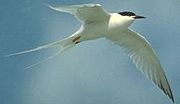
High aspect ratio wings, which usually have low wing loading and are far longer than they are wide, are used for slower flight, almost hovering (as used by kestrel
Kestrel
The name kestrel, is given to several different members of the falcon genus, Falco. Kestrels are most easily distinguished by their typical hunting behaviour which is to hover at a height of around over open country and swoop down on prey, usually small mammals, lizards or large insects...
s, tern
Tern
Terns are seabirds in the family Sternidae, previously considered a subfamily of the gull family Laridae . They form a lineage with the gulls and skimmers which in turn is related to skuas and auks...
s and nightjar
Nightjar
Nightjars are medium-sized nocturnal or crepuscular birds with long wings, short legs and very short bills. They are sometimes referred to as goatsuckers from the mistaken belief that they suck milk from goats . Some New World species are named as nighthawks...
s) or alternatively by birds that specialize in soaring and gliding
Gliding
Gliding is a recreational activity and competitive air sport in which pilots fly unpowered aircraft known as gliders or sailplanes using naturally occurring currents of rising air in the atmosphere to remain airborne. The word soaring is also used for the sport.Gliding as a sport began in the 1920s...
flight, particularly that used by seabird
Seabird
Seabirds are birds that have adapted to life within the marine environment. While seabirds vary greatly in lifestyle, behaviour and physiology, they often exhibit striking convergent evolution, as the same environmental problems and feeding niches have resulted in similar adaptations...
s, dynamic soaring
Dynamic soaring
Dynamic soaring is a flying technique used to gain energy by repeatedly crossing the boundary between air masses of significantly different velocity...
, which use different wind speeds at different heights (wind shear
Wind shear
Wind shear, sometimes referred to as windshear or wind gradient, is a difference in wind speed and direction over a relatively short distance in the atmosphere...
) above the waves in the ocean to provide lift. Low speed flight is important for birds that plunge dive for fish.
Soaring wings with deep slots
These are the wings favored by the larger species of inland birds, such as eagle
Eagle
Eagles are members of the bird family Accipitridae, and belong to several genera which are not necessarily closely related to each other. Most of the more than 60 species occur in Eurasia and Africa. Outside this area, just two species can be found in the United States and Canada, nine more in...
s, vulture
Vulture
Vulture is the name given to two groups of convergently evolved scavenging birds, the New World Vultures including the well-known Californian and Andean Condors, and the Old World Vultures including the birds which are seen scavenging on carcasses of dead animals on African plains...
s, pelican
Pelican
A pelican, derived from the Greek word πελεκυς pelekys is a large water bird with a large throat pouch, belonging to the bird family Pelecanidae....
s, and stork
Stork
Storks are large, long-legged, long-necked wading birds with long, stout bills. They belong to the family Ciconiidae. They are the only family in the biological order Ciconiiformes, which was once much larger and held a number of families....
s. The slots at the end of the wings, between the primaries, reduce the induced drag and wingtip vortices
Wingtip vortices
Wingtip vortices are tubes of circulating air that are left behind a wing as it generates lift. One wingtip vortex trails from the tip of each wing. The cores of vortices spin at very high speed and are regions of very low pressure...
by "capturing" the energy in air flowing from the lower to upper wing surface at the tips, whilst the shorter size of the wings aids in takeoff (high aspect ratio wings require a long taxi
Taxiing
Taxiing refers to the movement of an aircraft on the ground, under its own power, in contrast to towing or push-back where the aircraft is moved by a tug...
in order to get airborne).
Hovering

Pied Kingfisher
The Pied Kingfisher is a water kingfisher and is found widely distributed across Africa and Asia. Their black and white plumage, crest and the habit of hovering over clear lakes and rivers before diving for fish makes it distinctive. Males have a double band across the breast while females have a...
, although larger birds can hover for short periods of time. Larger birds that hover for prolonged periods do so by flying into a headwind, allowing them to remain stationary relative to the ground (or water). Kestrels, terns and even hawks use this windhovering.
Most birds that hover have high aspect ratio wings that are suited to low speed flying. One major exception to this are the hummingbird
Hummingbird
Hummingbirds are birds that comprise the family Trochilidae. They are among the smallest of birds, most species measuring in the 7.5–13 cm range. Indeed, the smallest extant bird species is a hummingbird, the 5-cm Bee Hummingbird. They can hover in mid-air by rapidly flapping their wings...
s, which are the most accomplished hoverers of all the birds. Hummingbird flight is different from other bird flight in that the wing is extended throughout the whole stroke, the stroke being a symmetrical figure of eight, with the wing producing lift on both the up- and down-stroke. Some hummingbirds can beat their wings 52 times a second, though others do so less frequently.
Take-off and landing
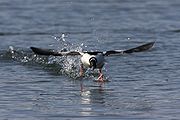

Landing is also a problem for large birds with high wing loadings. This problem is dealt with in some species by aiming for a point below the intended landing area (such as a nest on a cliff) then pulling up beforehand. If timed correctly, the airspeed once the target is reached is virtually nil. Landing on water is simpler, and the larger waterfowl species prefer to do so whenever possible, landing into wind and using their feet as skids. In order to lose height rapidly prior to landing, some large birds such as geese indulge in a rapid alternating series of sideslips
Slip (aerodynamic)
A slip is an aerodynamic state where an aircraft is moving somewhat sideways as well as forward relative to the oncoming airflow. In other words, for a conventional aircraft, the nose will not be pointing directly into the relative wind .A slip is also a piloting maneuver where the pilot...
in a maneuver termed as whiffling
Whiffling
Whiffling is a term used in ornithology, describing the action of descending rapidly from a height once the decision to land has been made, involving fast side-slipping first one way and then the other...
.
Adaptations for flight
Archaeopteryx
Archaeopteryx , sometimes referred to by its German name Urvogel , is a genus of theropod dinosaur that is closely related to birds. The name derives from the Ancient Greek meaning "ancient", and , meaning "feather" or "wing"...
), along with the toothed jaw of early birds, which has been replaced with a lightweight beak
Beak
The beak, bill or rostrum is an external anatomical structure of birds which is used for eating and for grooming, manipulating objects, killing prey, fighting, probing for food, courtship and feeding young...
. The skeleton's breastbone has also adapted into a large keel, suitable for the attachment of large, powerful flight muscles. The vanes of the feather
Feather
Feathers are one of the epidermal growths that form the distinctive outer covering, or plumage, on birds and some non-avian theropod dinosaurs. They are considered the most complex integumentary structures found in vertebrates, and indeed a premier example of a complex evolutionary novelty. They...
s have hooklets called barbules that zip them together, giving the feathers the strength needed to hold the airfoil (these are often lost in flightless bird
Flightless bird
Flightless birds are birds which lack the ability to fly, relying instead on their ability to run or swim. They are thought to have evolved from flying ancestors. There are about forty species in existence today, the best known being the ostrich, emu, cassowary, rhea, kiwi, and penguin...
s).
The large amounts of energy required for flight have led to the evolution of a unidirectional pulmonary system to provide the large quantities of oxygen required for their high respiratory rate
Respiratory rate
Respiratory rate is also known by respiration rate, pulmonary ventilation rate, ventilation rate, or breathing frequency is the number of breaths taken within a set amount of time, typically 60 seconds....
s. This high metabolic rate
Metabolism
Metabolism is the set of chemical reactions that happen in the cells of living organisms to sustain life. These processes allow organisms to grow and reproduce, maintain their structures, and respond to their environments. Metabolism is usually divided into two categories...
produces large quantities of radicals
Radical (chemistry)
Radicals are atoms, molecules, or ions with unpaired electrons on an open shell configuration. Free radicals may have positive, negative, or zero charge...
in the cells that can damage DNA and lead to tumours. Birds, however, do not suffer from an otherwise expected shortened lifespan as their cells have evolved a more efficient antioxidant system than those found in other animals.
Evolution of bird flight
Paleontology
Paleontology "old, ancient", ὄν, ὀντ- "being, creature", and λόγος "speech, thought") is the study of prehistoric life. It includes the study of fossils to determine organisms' evolution and interactions with each other and their environments...
agree that birds evolved
Evolution
Evolution is any change across successive generations in the heritable characteristics of biological populations. Evolutionary processes give rise to diversity at every level of biological organisation, including species, individual organisms and molecules such as DNA and proteins.Life on Earth...
from small theropod
Theropoda
Theropoda is both a suborder of bipedal saurischian dinosaurs, and a clade consisting of that suborder and its descendants . Dinosaurs belonging to the suborder theropoda were primarily carnivorous, although a number of theropod groups evolved herbivory, omnivory, and insectivory...
dinosaur
Dinosaur
Dinosaurs are a diverse group of animals of the clade and superorder Dinosauria. They were the dominant terrestrial vertebrates for over 160 million years, from the late Triassic period until the end of the Cretaceous , when the Cretaceous–Paleogene extinction event led to the extinction of...
s, but the origin of bird flight is one of the oldest and most hotly contested debates in paleontology. The four main hypotheses are: "from the trees down", that birds' ancestors first glided down from trees and then acquired other modifications that enabled true powered flight; "from the ground up", that birds' ancestors were small, fast predatory dinosaurs in which feathers developed for other reasons and then evolved further to provide first lift and then true powered flight; and "wing-assisted incline running" (WAIR), a version of "from the ground up" in which birds' wings originated from forelimb modifications that provided downforce, enabling the proto-birds to run up extremely steep slopes such as the trunks of trees; and "Pouncing Proavis", which posits that flight evolved by modification from arboreal ambush tactics.
There has also been debate about whether the earliest known bird, Archaeopteryx, could fly. It appears that Archaeopteryx had the brain structures and inner-ear balance sensors that birds use to control their flight. Archaeopteryx also had a wing feather arrangement like that of modern birds and similarly asymmetrical flight feathers on its wings and tail. But Archaeopteryx lacked the shoulder mechanism
Bird anatomy
Bird anatomy, or the physiological structure of birds' bodies, shows many unique adaptations, mostly aiding flight. Birds have a light skeletal system and light but powerful musculature which, along with circulatory and respiratory systems capable of very high metabolic rates and oxygen supply,...
by which modern birds' wings produce swift, powerful upstrokes; this may mean that it and other early birds were incapable of flapping flight and could only glide. The presence of most fossils in marine sediments in habitats devoid of vegetation has led to the hypothesis that they may have used their wings as aids to run across the water surface in the manner of the basilisk lizards.
From the trees down
This was the earliest hypothesis, encouraged by the examples of glidingGliding (flight)
Gliding flight is heavier-than-air flight without the use of thrust. It is employed by gliding animals and by aircraft such as gliders. The most common human application of gliding flight is in sport and recreation using aircraft designed for this purpose...
vertebrates such as flying squirrel
Flying squirrel
Flying squirrels, scientifically known as Pteromyini or Petauristini, are a tribe of 44 species of squirrels .- Description :...
s. It suggests that proto-birds like Archaeopteryx
Archaeopteryx
Archaeopteryx , sometimes referred to by its German name Urvogel , is a genus of theropod dinosaur that is closely related to birds. The name derives from the Ancient Greek meaning "ancient", and , meaning "feather" or "wing"...
used their claws to clamber up trees and glided off from the tops.
Some recent research undermines the "trees down" hypothesis by suggesting that the earliest birds and their immediate ancestors did not climb trees. Modern birds that forage in trees have much more curved toe-claws than those that forage on the ground. The toe-claws of Mesozoic birds and of closely related non-avian theropod dinosaurs are like those of modern ground-foraging birds.
From the ground up
Feathers are very common in coelurosaurid dinosaurs (including the early tyrannosauroid DilongDilong (dinosaur)
Dilong is a genus of small tyrannosauroid dinosaur. The only species is Dilong paradoxus. It is from the Lower Cretaceous Yixian Formation near Lujiatun, Beipiao, in the western Liaoning province of China. It lived about 130 million years ago...
). Modern bird
Bird
Birds are feathered, winged, bipedal, endothermic , egg-laying, vertebrate animals. Around 10,000 living species and 188 families makes them the most speciose class of tetrapod vertebrates. They inhabit ecosystems across the globe, from the Arctic to the Antarctic. Extant birds range in size from...
s are classified as coelurosaurs by nearly all palaeontologists, though not by a few ornithologists. The original functions of feathers may have included thermal insulation and competitive displays. The most common version of the "from the ground up" hypothesis argues that bird's ancestors were small ground-running predators (rather like roadrunners) that used their forelimbs for balance while pursuing prey and that the forelimbs and feathers later evolved in ways that provided gliding and then powered flight. Another "ground upwards" theory argues the evolution of flight was initially driven by competitive displays and fighting: displays required longer feathers and longer, stronger forelimbs; many modern birds use their wings as weapons, and downward blows have a similar action to that of flapping flight. Many of the Archaeopteryx fossils come from marine sediments and it has been suggested that wings may have helped the birds run over water in the manner of the Jesus Christ Lizard (Common basilisk
Common Basilisk
The Common Basilisk is a lizard found in Central and South American rainforests near rivers and streams.The basilisk is part of the corytophanid family...
).
Most recent attacks on the "from the ground up" hypothesis attempt to refute its assumption that birds are modified coelurosaurid dinosaurs. The strongest attacks are based on embryological analyses
Embryology
Embryology is a science which is about the development of an embryo from the fertilization of the ovum to the fetus stage...
, which conclude that birds' wings are formed from digits 2, 3 and 4 (corresponding to the index, middle and ring fingers in humans; the first of a bird's 3 digits forms the alula, which they use to avoid stalling
Stall (flight)
In fluid dynamics, a stall is a reduction in the lift coefficient generated by a foil as angle of attack increases. This occurs when the critical angle of attack of the foil is exceeded...
on low-speed flight, for example when landing); but the hands of coelurosaurs are formed by digits 1, 2 and 3 (thumb and first 2 fingers in humans). However these embryological analyses were immediately challenged on the embryological grounds that the "hand" often develops differently in clades that have lost some digits in the course of their evolution, and therefore bird's hands do develop from digits 1, 2 and 3.
Wing-assisted incline running
The WAIR hypothesis was prompted by observation of young chukarChukar
The Chukar Partridge or Chukar is a Eurasian upland gamebird in the pheasant family Phasianidae. It has been considered to form a superspecies complex along with the Rock Partridge, Philby's Partridge and Przevalski's Partridge and treated in the past as conspecific particularly with the first...
chicks, and proposes that wings developed their aerodynamic functions as a result of the need to run quickly up very steep slopes such as tree trunks, for example to escape from predators. Note that in this scenario birds need downforce to give their feet increased grip. But early birds, including Archaeopteryx, lacked the shoulder mechanism
Bird anatomy
Bird anatomy, or the physiological structure of birds' bodies, shows many unique adaptations, mostly aiding flight. Birds have a light skeletal system and light but powerful musculature which, along with circulatory and respiratory systems capable of very high metabolic rates and oxygen supply,...
by which modern birds' wings produce swift, powerful upstrokes; since the downforce on which WAIR depends is generated by upstrokes, it seems that early birds were incapable of WAIR.
Pouncing Proavis model
This theory was first proposed by Garner, Taylor, and Thomas in 1999:
We propose that birds evolved from predators that specialized in ambush from elevated sites, using their raptorial hindlimbs in a leaping attack. Drag–based, and later lift-based, mechanisms evolved under selection for improved control of body position and locomotion during the aerial part of the attack. Selection for enhanced lift-based control led to improved lift coefficients, incidentally turning a pounce into a swoop as lift production increased. Selection for greater swooping range would finally lead to the origin of true flight.
The authors believed that this theory had four main virtues:
- It predicts the observed sequence of character acquisition in avian evolution.
- It predicts an Archaeopteryx-like animal, with a skeleton more or less identical to terrestrial theropods, with few adaptations to flapping, but very advanced aerodynamic asymmetrical feathers.
- It explains that primitive pouncers (perhaps like MicroraptorMicroraptorMicroraptor is a genus of small, four-winged dromaeosaurid dinosaurs. Numerous well-preserved fossil specimens have been recovered from Liaoning, China...
) could coexist with more advanced fliers (like ConfuciusornisConfuciusornisConfuciusornis is a genus of primitive crow-sized birds from the Early Cretaceous Yixian and Jiufotang Formations of China, dating from 125 to 120 million years ago...
or SapeornisSapeornisSapeornis is a genus of primitive bird which lived during the Early Cretaceous . The genus contains only the species Sapeornis chaoyangensis which is known from fossils found in Jiufotang Formation rocks near Chaoyang, PRC...
) since they did not compete for flying niches. - It explains that the evolution of elongated rachis-bearing feathers began with simple forms that produced a benefit by increasing drag. Later, more refined feather shapes could begin to also provide lift.
Uses and loss of flight in modern birds
Birds use flight to obtain prey on the wing, for foragingForaging
- Definitions and significance of foraging behavior :Foraging is the act of searching for and exploiting food resources. It affects an animal's fitness because it plays an important role in an animal's ability to survive and reproduce...
, to commute to feeding grounds, and to migrate
Bird migration
Bird migration is the regular seasonal journey undertaken by many species of birds. Bird movements include those made in response to changes in food availability, habitat or weather. Sometimes, journeys are not termed "true migration" because they are irregular or in only one direction...
between the seasons. It is also used by some species to display during the breeding season and to reach safe isolated places for nest
Bird nest
A bird nest is the spot in which a bird lays and incubates its eggs and raises its young. Although the term popularly refers to a specific structure made by the bird itself—such as the grassy cup nest of the American Robin or Eurasian Blackbird, or the elaborately woven hanging nest of the...
ing.
Flight is more energetically expensive in larger birds, and many of the largest species fly by soaring and gliding
Flying and gliding animals
A number of animals have evolved aerial locomotion, either by powered flight or by gliding. Flying and gliding animals have evolved separately many times, without any single ancestor. Flight has evolved at least four times, in the insects, pterosaurs, birds, and bats. Gliding has evolved on many...
(without flapping their wings) as much as possible. Many physiological adaptations have evolved that make flight more efficient.
Birds that settle on isolated oceanic islands that lack ground-based predators often lose the ability to fly. This illustrates both flight's importance in avoiding predators and its extreme demand for energy.
See also
- Insect flightInsect flightInsects are the only group of invertebrates known to have evolved flight. Insects possess some remarkable flight characteristics and abilities, still far superior to attempts by humans to replicate their capabilities. Even our understanding of the aerodynamics of flexible, flapping wings and how...
- List of soaring birds
- Flying and gliding animalsFlying and gliding animalsA number of animals have evolved aerial locomotion, either by powered flight or by gliding. Flying and gliding animals have evolved separately many times, without any single ancestor. Flight has evolved at least four times, in the insects, pterosaurs, birds, and bats. Gliding has evolved on many...
- Flight CallFlight-call (Bird)Flight calls are vocalisations made by birds while flying, which often serve to keep flocks together....
- Ratites
- Tradeoffs for Locomotion in Air and WaterTradeoffs for locomotion in air and waterCertain species of fish and birds are able to locomote in both air and water, two types of fluid media with very different properties. A fluid is a particular phase of matter that deforms under shear stresses and includes any type of liquid or gas...
External links
- 'Flight in Birds and Aeroplanes' by Evolutionary Biologist John Maynard Smith Freeview video provided by the Vega Science Trust
- Beautiful Birds in Flight - slideshow by Life magazine
- 'Pigeon Take off in slow motion' You Tube video
- 'Bird Flight I' Eastern Kentucky University ornithology course site, with pictures, text and videos.