
Home      Discussion      Topics      Dictionary      Almanac
Signup       Login
Wingtip vortices

Wingtip vortices

Overview
Wingtip vortices are tubes of circulating air that are left behind a wing
Wing
A wing is an appendage with a surface that produces lift for flight or propulsion through the atmosphere, or through another gaseous or liquid fluid...

 as it generates lift
Lift (force)
A fluid flowing past the surface of a body exerts a surface force on it. Lift is the component of this force that is perpendicular to the oncoming flow direction. It contrasts with the drag force, which is the component of the surface force parallel to the flow direction...

. One wingtip vortex
Vortex
A vortex is a spinning, often turbulent,flow of fluid. Any spiral motion with closed streamlines is vortex flow. The motion of the fluid swirling rapidly around a center is called a vortex...

 trails from the tip
Wing tip
A wing tip is the part of the wing that is most distant from the fuselage of a fixed-wing aircraft.Because the wing tip shape influences the size and drag of the wingtip vortices, tip design has produced a diversity of shapes, including:* Squared-off...

 of each wing. The cores of vortices spin at very high speed and are regions of very low pressure. To first approximation
Orders of approximation
In science, engineering, and other quantitative disciplines, orders of approximation refer to formal or informal terms for how precise an approximation is, and to indicate progressively more refined approximations: in increasing order of precision, a zeroth order approximation, a first order...

, these low-pressure regions form with little exchange of heat with the neighboring regions (i.e., adiabatically
Adiabatic process
In thermodynamics, an adiabatic process or an isocaloric process is a thermodynamic process in which the net heat transfer to or from the working fluid is zero. Such a process can occur if the container of the system has thermally-insulated walls or the process happens in an extremely short time,...

), so the local temperature in the low-pressure regions drops, too. If it drops below the local dew point
Dew point
The dew point is the temperature to which a given parcel of humid air must be cooled, at constant barometric pressure, for water vapor to condense into liquid water. The condensed water is called dew when it forms on a solid surface. The dew point is a saturation temperature.The dew point is...

, there results a condensation of water vapor present in the cores of wingtip vortices, making them visible. The temperature may even drop below the local freezing point
Freezing Point
Freezing Point is a news journal in the People's Republic of China which has been the subject of controversy over its criticism of Communist Party officials and the sympathetic ear it lent to a Chinese historian who had criticized official history textbooks...

, in which case ice crystals will form inside the cores.
Discussion
Ask a question about 'Wingtip vortices'
Start a new discussion about 'Wingtip vortices'
Answer questions from other users
Full Discussion Forum
 
Unanswered Questions
Recent Discussions
Encyclopedia
Wingtip vortices are tubes of circulating air that are left behind a wing
Wing
A wing is an appendage with a surface that produces lift for flight or propulsion through the atmosphere, or through another gaseous or liquid fluid...

 as it generates lift
Lift (force)
A fluid flowing past the surface of a body exerts a surface force on it. Lift is the component of this force that is perpendicular to the oncoming flow direction. It contrasts with the drag force, which is the component of the surface force parallel to the flow direction...

. One wingtip vortex
Vortex
A vortex is a spinning, often turbulent,flow of fluid. Any spiral motion with closed streamlines is vortex flow. The motion of the fluid swirling rapidly around a center is called a vortex...

 trails from the tip
Wing tip
A wing tip is the part of the wing that is most distant from the fuselage of a fixed-wing aircraft.Because the wing tip shape influences the size and drag of the wingtip vortices, tip design has produced a diversity of shapes, including:* Squared-off...

 of each wing. The cores of vortices spin at very high speed and are regions of very low pressure. To first approximation
Orders of approximation
In science, engineering, and other quantitative disciplines, orders of approximation refer to formal or informal terms for how precise an approximation is, and to indicate progressively more refined approximations: in increasing order of precision, a zeroth order approximation, a first order...

, these low-pressure regions form with little exchange of heat with the neighboring regions (i.e., adiabatically
Adiabatic process
In thermodynamics, an adiabatic process or an isocaloric process is a thermodynamic process in which the net heat transfer to or from the working fluid is zero. Such a process can occur if the container of the system has thermally-insulated walls or the process happens in an extremely short time,...

), so the local temperature in the low-pressure regions drops, too. If it drops below the local dew point
Dew point
The dew point is the temperature to which a given parcel of humid air must be cooled, at constant barometric pressure, for water vapor to condense into liquid water. The condensed water is called dew when it forms on a solid surface. The dew point is a saturation temperature.The dew point is...

, there results a condensation of water vapor present in the cores of wingtip vortices, making them visible. The temperature may even drop below the local freezing point
Freezing Point
Freezing Point is a news journal in the People's Republic of China which has been the subject of controversy over its criticism of Communist Party officials and the sympathetic ear it lent to a Chinese historian who had criticized official history textbooks...

, in which case ice crystals will form inside the cores.

Wingtip vortices are associated with induced drag, an unavoidable side-effect of the wing generating lift. Managing induced drag and wingtip vortices by selecting the best wing planform
Planform
In aviation, a planform is the shape and layout of a fixed-wing aircraft's fuselage and wing. Of all the myriad planforms used, they can typically be grouped into those used for low-speed flight, found on general aviation aircraft, and those used for high-speed flight, found on many military...

 for the mission is critically important in aerospace engineering
Aerospace engineering
Aerospace engineering is the primary branch of engineering concerned with the design, construction and science of aircraft and spacecraft. It is divided into two major and overlapping branches: aeronautical engineering and astronautical engineering...

.

Wingtip vortices form the major component of wake turbulence
Wake turbulence
Wake turbulence is turbulence that forms behind an aircraft as it passes through the air. This turbulence includes various components, the most important of which are wing vorticies and jetwash. Jetwash refers simply to the rapidly moving gases expelled from a jet engine; it is extremely turbulent,...

.

Migratory birds take advantage of each others' wingtip vortices by flying in a V formation so that all but the leader are flying in the upwash
Downwash
In aeronautics downwash is the air forced down by the aerodynamic action of a wing or helicopter rotor blade in motion, as part of the process of producing lift....

 from the wing of the bird ahead. This upwash makes it a bit easier for the bird to support its own weight, reducing fatigue on migration flights.

Some technical writers use the alternative expression "trailing vortices" because these vortices also occur at points other than at the wing tips. They are induced at the outboard tip of the wing flaps and other abrupt changes in wing planform
Planform
In aviation, a planform is the shape and layout of a fixed-wing aircraft's fuselage and wing. Of all the myriad planforms used, they can typically be grouped into those used for low-speed flight, found on general aviation aircraft, and those used for high-speed flight, found on many military...

.

Cause, effects and mitigation


A wing generates aerodynamic lift
Lift (force)
A fluid flowing past the surface of a body exerts a surface force on it. Lift is the component of this force that is perpendicular to the oncoming flow direction. It contrasts with the drag force, which is the component of the surface force parallel to the flow direction...

 by creating a region of lower air pressure above it. Fluids are forced to flow from high to low pressure, and the air below the wing tends to migrate toward the top of the wing via the wingtips. The air does not escape around the leading edge of the wing due to airspeed, but it can flow around the tip. As a consequence, air flows from below the wing and out around the tip to the top of the wing in a circular fashion. This leakage will raise the pressure on top of the wing and reduce the lift that the wing can generate. It also produces an emergent flow pattern with low pressure in the center surrounded by fast-moving air with curved streamlines.
Wingtip vortices affect only the portion of the wing closest to the tip. Thus, the longer the wing the smaller the affected fraction of it will be. As well, the shorter the chord
Chord (aircraft)
In aeronautics, chord refers to the imaginary straight line joining the trailing edge and the center of curvature of the leading edge of the cross-section of an airfoil...

 of the wing the less opportunity air will have to form vortices. This means that, for an aircraft to be most efficient, it should have a very high aspect ratio
Aspect ratio (wing)
In aerodynamics, the aspect ratio of a wing is essentially the ratio of its length to its breadth . A high aspect ratio indicates long, narrow wings, whereas a low aspect ratio indicates short, stubby wings....

. This is evident in the design of gliders
Glider aircraft
Glider aircraft are heavier-than-air craft that are supported in flight by the dynamic reaction of the air against their lifting surfaces, and whose free flight does not depend on an engine. Mostly these types of aircraft are intended for routine operation without engines, though engine failure can...

. It is also evident in long-range airliner
Airliner
An airliner is a large fixed-wing aircraft for transporting passengers and cargo. Such aircraft are operated by airlines. Although the definition of an airliner can vary from country to country, an airliner is typically defined as an aircraft intended for carrying multiple passengers in commercial...

s, where fuel efficiency is of critical importance. However, increasing the wingspan
Wingspan
The wingspan of an airplane or a bird, is the distance from one wingtip to the other wingtip. For example, the Boeing 777 has a wingspan of about ; and a Wandering Albatross caught in 1965 had a wingspan of , the official record for a living bird.The term wingspan, more technically extent, is...

 reduces the maneuverability of the aircraft, which is why combat
Fighter aircraft
A fighter aircraft is a military aircraft designed primarily for air-to-air combat with other aircraft, as opposed to a bomber, which is designed primarily to attack ground targets...

 and aerobatic
Aerobatics
Aerobatics is the practice of flying maneuvers involving aircraft attitudes that are not used in normal flight. Aerobatics are performed in airplanes and gliders for training, recreation, entertainment and sport...

 planes usually feature short, stubby wings despite the efficiency losses.

Another method of reducing fuel consumption is the use of winglets, as seen on some modern airliners such as the Airbus A340
Airbus A340
The Airbus A340 is a long-range four-engine wide-body commercial passenger jet airliner. Developed by Airbus Industrie,A consortium of European aerospace companies, Airbus is now fully owned by EADS and since 2001 has been known as Airbus SAS. a consortium of European aerospace companies, which is...

. Winglets work by forcing the vortex to move to the very tip of the wing and allowing the entire span to produce lift, thereby effectively increasing the aspect ratio of the wing. Winglets also change the pattern of vorticity in the core of the vortex pattern, spreading it out and reducing the kinetic energy in the circular air flow, which reduces the amount of fuel expended to perform work by the wing upon the spinning air. Winglets can yield worthwhile economy improvements on long-distance flights.

Soaring birds (and some sailboat underwater structures) incorporate slots between the feathers at their wingtips to "capture" the energy in the flow of air circulating from the lower to upper wing surface.

Visibility of vortices due to water condensation and freezing


The cores of the vortices are sometimes visible because water present in them condenses
Condensation
Condensation is the change of the physical state of matter from gaseous phase into liquid phase, and is the reverse of vaporization. When the transition happens from the gaseous phase into the solid phase directly, the change is called deposition....

 from gas
Gas
Gas is one of the three classical states of matter . Near absolute zero, a substance exists as a solid. As heat is added to this substance it melts into a liquid at its melting point , boils into a gas at its boiling point, and if heated high enough would enter a plasma state in which the electrons...

 (vapor
Vapor
A vapor or vapour is a substance in the gas phase at a temperature lower than its critical point....

) to liquid
Liquid
Liquid is one of the three classical states of matter . Like a gas, a liquid is able to flow and take the shape of a container. Some liquids resist compression, while others can be compressed. Unlike a gas, a liquid does not disperse to fill every space of a container, and maintains a fairly...

, and sometimes even freezes, forming ice particles.

The phase
Phase (matter)
In the physical sciences, a phase is a region of space , throughout which all physical properties of a material are essentially uniform. Examples of physical properties include density, index of refraction, and chemical composition...

 of water (i.e., whether it assumes the form of a solid, liquid, or gas) is determined by its temperature
Temperature
Temperature is a physical property of matter that quantitatively expresses the common notions of hot and cold. Objects of low temperature are cold, while various degrees of higher temperatures are referred to as warm or hot...

 and pressure
Pressure
Pressure is the force per unit area applied in a direction perpendicular to the surface of an object. Gauge pressure is the pressure relative to the local atmospheric or ambient pressure.- Definition :...

. For example, in the case of liquid-gas transition, at each pressure there is a special “transition temperature” such that if the sample temperature is even a little above , the sample will be a gas, but, if the sample temperature is even a little below , the sample will be a liquid; see phase transition
Phase transition
A phase transition is the transformation of a thermodynamic system from one phase or state of matter to another.A phase of a thermodynamic system and the states of matter have uniform physical properties....

. For example, at the standard atmospheric pressure, is 100 °C = 212 °F. The transition temperature decreases with decreasing pressure (which explains why water boils at lower temperatures at higher altitudes and at higher temperatures in a pressure cooker; see here for more information). In the case of water vapor in air, the corresponding to the partial pressure
Partial pressure
In a mixture of ideal gases, each gas has a partial pressure which is the pressure which the gas would have if it alone occupied the volume. The total pressure of a gas mixture is the sum of the partial pressures of each individual gas in the mixture....

 of water vapor is called the dew point
Dew point
The dew point is the temperature to which a given parcel of humid air must be cooled, at constant barometric pressure, for water vapor to condense into liquid water. The condensed water is called dew when it forms on a solid surface. The dew point is a saturation temperature.The dew point is...

. (The solid–liquid transition also happens around a specific transition temperature called the melting point
Melting point
The melting point of a solid is the temperature at which it changes state from solid to liquid. At the melting point the solid and liquid phase exist in equilibrium. The melting point of a substance depends on pressure and is usually specified at standard atmospheric pressure...

. For most substances, the melting point also decreases with decreasing pressure, although water ice in particular - in its Ih form
Ice Ih
thumb|Photograph showing details of an ice cube under magnification. Ice Ih is the form of ice commonly seen on earth.Ice Ih is the hexagonal crystal form of ordinary ice, or frozen water. Virtually all ice in the biosphere is ice Ih, with the exception only of a small amount of ice Ic which is...

, which is the most familiar one - is a prominent exception to this rule
Water (properties)
Water is the most abundant compound on Earth's surface, covering about 70%. In nature, it exists in liquid, solid, and gaseous states. It is in dynamic equilibrium between the liquid and gas states at standard temperature and pressure. At room temperature, it is a tasteless and odorless liquid,...

.)

Vortex cores are regions of low pressure. As a vortex core begins to form, the water in the air (in the region that is about to become the core) is in vapor phase, which means that the local temperature is above the local dew point. After the vortex core forms, the pressure inside it has decreased from the ambient value, and so the local dew point () has dropped from the ambient value. Thus, in and of itself, a drop in pressure would tend to keep water in vapor form: The initial dew point was already below the ambient air temperature, and the formation of the vortex has made the local dew point even lower. However, as the vortex core forms, its pressure (and so its dew point) is not the only property that is dropping: The vortex-core temperature is dropping also, and in fact it can drop by much more than the dew point does, as we now explain.

Here we follow the discussion in Ref. To first approximation
Orders of approximation
In science, engineering, and other quantitative disciplines, orders of approximation refer to formal or informal terms for how precise an approximation is, and to indicate progressively more refined approximations: in increasing order of precision, a zeroth order approximation, a first order...

, the formation of vortex cores is thermodynamically
Thermodynamics
Thermodynamics is a physical science that studies the effects on material bodies, and on radiation in regions of space, of transfer of heat and of work done on or by the bodies or radiation...

 an adiabatic process
Adiabatic process
In thermodynamics, an adiabatic process or an isocaloric process is a thermodynamic process in which the net heat transfer to or from the working fluid is zero. Such a process can occur if the container of the system has thermally-insulated walls or the process happens in an extremely short time,...

, i.e., one with no exchange of heat. In such a process, the drop in pressure is accompanied by a drop in temperature, according to the equation


Here and are the absolute temperature
Thermodynamic temperature
Thermodynamic temperature is the absolute measure of temperature and is one of the principal parameters of thermodynamics. Thermodynamic temperature is an "absolute" scale because it is the measure of the fundamental property underlying temperature: its null or zero point, absolute zero, is the...

 and pressure at the beginning of the process (here equal to the ambient air temperature and pressure), and are the absolute temperature and pressure in the vortex core (which is the end result of the process), and the constant is about 7/5 = 1.4 for air (see here).

Thus, even though the local dew point inside the vortex cores is even lower than in the ambient air, the water vapor may nevertheless condense — if the formation of the vortex brings the local temperature below the new local dew point. Let's verify that this can indeed happen under realistic conditions.

For a typical transport aircraft landing at an airport, these conditions are as follows: We may take and to have values corresponding to the so-called standard conditions, i.e.,  = 1 atm
Atmosphere (unit)
The standard atmosphere is an international reference pressure defined as 101325 Pa and formerly used as unit of pressure. For practical purposes it has been replaced by the bar which is 105 Pa...

 = 1013.25 mb
Bar (unit)
The bar is a unit of pressure equal to 100 kilopascals, and roughly equal to the atmospheric pressure on Earth at sea level. Other units derived from the bar are the megabar , kilobar , decibar , centibar , and millibar...

 = 101325 Pa
Pascal (unit)
The pascal is the SI derived unit of pressure, internal pressure, stress, Young's modulus and tensile strength, named after the French mathematician, physicist, inventor, writer, and philosopher Blaise Pascal. It is a measure of force per unit area, defined as one newton per square metre...

 and  = 293.15 K (which is 20 °C = 68 °F). We will take the relative humidity
Relative humidity
Relative humidity is a term used to describe the amount of water vapor in a mixture of air and water vapor. It is defined as the partial pressure of water vapor in the air-water mixture, given as a percentage of the saturated vapor pressure under those conditions...

 to be a comfortable 35% (dew point of 4.1 °C = 39.4 °F). This corresponds to a partial pressure
Partial pressure
In a mixture of ideal gases, each gas has a partial pressure which is the pressure which the gas would have if it alone occupied the volume. The total pressure of a gas mixture is the sum of the partial pressures of each individual gas in the mixture....

 of water vapor of 820 Pa = 8.2 mb. We will assume that in a vortex core, the pressure () drops to about 80% of the ambient pressure, i.e., to about 80 000 Pa.

Let's first determine the temperature in the vortex core. It is given by the equation above as or 0.86 °C = 33.5 °F.

Next, we determine the dew point in the vortex core. The partial pressure of water in the vortex core drops in proportion to the drop in the total pressure (i.e., by the same percentage), to about 650 Pa = 6.5 mb. According to a dew point calculator at this site (as an alternative, one may use the Antoine equation to obtain an approximate value), that partial pressure results in the local dew point of about 0.86 °C; in other words, the new local dew point is about equal to the new local temperature.

Therefore, the case we have been considering is a marginal case; if the relative humidity of the ambient air were even a bit higher (with the total pressure and temperature remaining as above), then the local dew point inside the vortices would rise, while the local temperature would remain the same as what we have just found. Thus, the local temperature would now be lower than the local dew point, and so the water vapor inside the vortices would indeed condense. Under right conditions, the local temperature in vortex cores may drop below the local freezing point
Freezing Point
Freezing Point is a news journal in the People's Republic of China which has been the subject of controversy over its criticism of Communist Party officials and the sympathetic ear it lent to a Chinese historian who had criticized official history textbooks...

, in which case ice particles will form inside the vortex cores.

We have just seen that the water-vapor condensation mechanism in wingtip vortices is driven by local changes in air pressure and temperature. This is to be contrasted to what happens in another well-known case of water condensation related to airplanes: the contrail
Contrail
Contrails or vapour trails are artificial clouds that are the visible trails of condensed water vapour made by the exhaust of aircraft engines...

s from airplane engine exhausts. In the case of contrails, the local air pressure and temperature do not change significantly; what matters instead is that the exhaust contains both water vapor (which increases the local water-vapor concentration
Concentration
In chemistry, concentration is defined as the abundance of a constituent divided by the total volume of a mixture. Four types can be distinguished: mass concentration, molar concentration, number concentration, and volume concentration...

 and so its partial pressure, resulting in elevated dew point and freezing point) as well as aerosol
Aerosol
Technically, an aerosol is a suspension of fine solid particles or liquid droplets in a gas. Examples are clouds, and air pollution such as smog and smoke. In general conversation, aerosol usually refers to an aerosol spray can or the output of such a can...

s (which provide nucleation centers
Nucleation
Nucleation is the extremely localized budding of a distinct thermodynamic phase. Some examples of phases that may form by way of nucleation in liquids are gaseous bubbles, crystals or glassy regions. Creation of liquid droplets in saturated vapor is also characterized by nucleation...

 for the condensation and freezing).

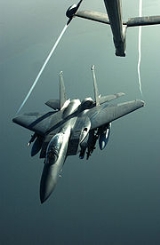
Condensation of water vapor in wing tip vortices is most common on aircraft flying at high angles of attack
Angle of attack
Angle of attack is a term used in fluid dynamics to describe the angle between a reference line on a lifting body and the vector representing the relative motion between the lifting body and the fluid through which it is moving...

, such as fighter aircraft in high g
G-force
The g-force associated with an object is its acceleration relative to free-fall. This acceleration experienced by an object is due to the vector sum of non-gravitational forces acting on an object free to move. The accelerations that are not produced by gravity are termed proper accelerations, and...

 maneuvers, or airliner
Airliner
An airliner is a large fixed-wing aircraft for transporting passengers and cargo. Such aircraft are operated by airlines. Although the definition of an airliner can vary from country to country, an airliner is typically defined as an aircraft intended for carrying multiple passengers in commercial...

s taking off and landing on humid days.

Hazards


Wingtip vortices can also pose a severe hazard to light aircraft, especially during the landing
Landing
thumb|A [[Mute Swan]] alighting. Note the ruffled feathers on top of the wings indicate that the swan is flying at the [[Stall |stall]]ing speed...

 and takeoff
Takeoff
Takeoff is the phase of flight in which an aerospace vehicle goes from the ground to flying in the air.For horizontal takeoff aircraft this usually involves starting with a transition from moving along the ground on a runway. For balloons, helicopters and some specialized fixed-wing aircraft , no...

 phases of flight. The intensity or strength of the vortex is a function of aircraft size, speed, and configuration (flap setting, etc.). The strongest vortices are produced by heavy aircraft, flying slowly, with wing flaps
Flap (aircraft)
Flaps are normally hinged surfaces mounted on the trailing edges of the wings of a fixed-wing aircraft to reduce the speed an aircraft can be safely flown at and to increase the angle of descent for landing without increasing air speed. They shorten takeoff and landing distances as well as...

 retracted (Heavy, slow, and clean). Large jet aircraft
Jet aircraft
A jet aircraft is an aircraft propelled by jet engines. Jet aircraft generally fly much faster than propeller-powered aircraft and at higher altitudes – as high as . At these altitudes, jet engines achieve maximum efficiency over long distances. The engines in propeller-powered aircraft...

 can generate vortices that are larger than an entire light aircraft. These vortices can persist for many minutes, drifting with the wind. The hazardous aspects of wingtip vortices are most often discussed in the context of wake turbulence
Wake turbulence
Wake turbulence is turbulence that forms behind an aircraft as it passes through the air. This turbulence includes various components, the most important of which are wing vorticies and jetwash. Jetwash refers simply to the rapidly moving gases expelled from a jet engine; it is extremely turbulent,...

. If a light aircraft is immediately preceded by a heavy aircraft, wake turbulence from the heavy aircraft can roll the light aircraft faster than can be resisted by use of ailerons. At low altitudes, in particular during takeoff and landing, this can lead to an upset from which recovery is not possible. Air traffic controller
Air traffic controller
Air traffic controllers are the people who expedite and maintain a safe and orderly flow of air traffic in the global air traffic control system. The position of the air traffic controller is one that requires highly specialized skills...

s attempt to ensure an adequate separation between departing and arriving aircraft, in particular where a heavy aircraft is preceding a light aircraft, by issuing wake turbulence cautions. For example, a controller may state, "Acey 5523, caution wake turbulence preceding heavy 767 departing. Runway 08R. Line up and wait." (FAA, ICAO standard phrase) The aircraft will then hold for approximately 3 minutes on the runway, and then will be issued a takeoff clearance, as in "Acey 5523, fly runway heading, cleared for takeoff runway 08R."

See also

  • Aspect ratio
    Aspect ratio (wing)
    In aerodynamics, the aspect ratio of a wing is essentially the ratio of its length to its breadth . A high aspect ratio indicates long, narrow wings, whereas a low aspect ratio indicates short, stubby wings....

  • Contrail
    Contrail
    Contrails or vapour trails are artificial clouds that are the visible trails of condensed water vapour made by the exhaust of aircraft engines...

  • Helmholtz's theorems
    Helmholtz's theorems
    In fluid mechanics, Helmholtz's theorems, named after Hermann von Helmholtz, describe the three-dimensional motion of fluid in the vicinity of vortex filaments...

  • Horseshoe vortex
    Horseshoe vortex
    The horseshoe vortex model is a simplified representation of the vortex system of a wing. In this model the wing vorticity is modelled by a bound vortex of constant circulation, travelling with the wing, and two trailing vortices, therefore having a shape vaguely reminiscent of a horseshoe...

  • V formation
  • Von Kármán vortex street
    Von Kármán vortex street
    A Kármán vortex street is a term in fluid dynamics for a repeating pattern of swirling vortices caused by the unsteady separation of flow of a fluid over bluff bodies...

  • Vortex
    Vortex
    A vortex is a spinning, often turbulent,flow of fluid. Any spiral motion with closed streamlines is vortex flow. The motion of the fluid swirling rapidly around a center is called a vortex...

  • Vortex shedding
    Vortex shedding
    Vortex shedding is an unsteady flow that takes place in special flow velocities . In this flow, vortices are created at the back of the body and detach periodically from either side of the body. See Von Kármán vortex street.Vortex shedding is caused when a fluid flows past a blunt object...

  • Wake turbulence
    Wake turbulence
    Wake turbulence is turbulence that forms behind an aircraft as it passes through the air. This turbulence includes various components, the most important of which are wing vorticies and jetwash. Jetwash refers simply to the rapidly moving gases expelled from a jet engine; it is extremely turbulent,...


External links