
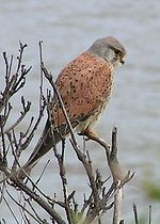
The name
kestrel, is given to several different members of the
falconA falcon is any species of raptor in the genus Falco. The genus contains 37 species, widely distributed throughout Europe, Asia, and North America....
genus,
Falco. Kestrels are most easily distinguished by their typical hunting behaviour which is to hover at a height of around 10 – over open country and swoop down on prey, usually small mammals, lizards or large insects. Other falcons are more adapted to active hunting on the wing. In addition, kestrels are notable for usually having much brown in their plumage.
Kestrels require a slight headwind in order to hover, hence a local name of
Windhover for
Common KestrelThe Common Kestrel is a bird of prey species belonging to the kestrel group of the falcon family Falconidae. It is also known as the European Kestrel, Eurasian Kestrel, or Old World Kestrel. In Britain, where no other brown falcon occurs, it is generally just called "the kestrel".This species...
.
Plumage often—but unusually for falcons—differs between male and female, and (as is usual with monogamous
raptorBirds of prey are birds that hunt for food primarily on the wing, using their keen senses, especially vision. They are defined as birds that primarily hunt vertebrates, including other birds. Their talons and beaks tend to be relatively large, powerful and adapted for tearing and/or piercing flesh....
s) the female is slightly larger than the male. This allows a pair to fill different feeding niches over their home range. Kestrels are bold and have adapted well to human encroachment, nesting in buildings and hunting by major roads.
Kestrels do not build their own nests, but use nests built by other species.
Most
speciesIn biology, a species is one of the basic units of biological classification and a taxonomic rank. A species is often defined as a group of organisms capable of interbreeding and producing fertile offspring. While in many cases this definition is adequate, more precise or differing measures are...
termed kestrels appear to form a distinct
cladeA clade is a group consisting of a species and all its descendants. In the terms of biological systematics, a clade is a single "branch" on the "tree of life". The idea that such a "natural group" of organisms should be grouped together and given a taxonomic name is central to biological...
among the falcons, as suggested by comparison of mtDNA
cytochrome bCytochrome b/b6 is the main subunit of transmembrane cytochrome bc1 and b6f complexes. In addition, it commonly refers to a region of mtDNA used for population genetics and phylogenetics.- Function :...
sequenceThe sequence or primary structure of a nucleic acid is the composition of atoms that make up the nucleic acid and the chemical bonds that bond those atoms. Because nucleic acids, such as DNA and RNA, are unbranched polymers, this specification is equivalent to specifying the sequence of...
data (Groombridge
et al. 2002)
and
morphologyIn biology, morphology is a branch of bioscience dealing with the study of the form and structure of organisms and their specific structural features....
. This seems to have diverged from other
Falco around the
MioceneThe Miocene is a geological epoch of the Neogene Period and extends from about . The Miocene was named by Sir Charles Lyell. Its name comes from the Greek words and and means "less recent" because it has 18% fewer modern sea invertebrates than the Pliocene. The Miocene follows the Oligocene...
-
PlioceneThe Pliocene Epoch is the period in the geologic timescale that extends from 5.332 million to 2.588 million years before present. It is the second and youngest epoch of the Neogene Period in the Cenozoic Era. The Pliocene follows the Miocene Epoch and is followed by the Pleistocene Epoch...
boundary (
MessinianThe Messinian is in the geologic timescale the last age or uppermost stage of the Miocene. It spans the time between 7.246 ± 0.005 Ma and 5.332 ± 0.005 Ma...
to
ZancleanThe Zanclean is the lowest stage or earliest age on the geologic time scale of the Pliocene. It spans the time between 5.332 and 3.6 Ma ± 0.005 Ma . It is preceded by the Messinian age of the Miocene epoch, and followed by the Piacenzian age....
, or about 7–3.5 mya). The most
basalIn phylogenetics, a basal clade is the earliest clade to branch in a larger clade; it appears at the base of a cladogram.A basal group forms an outgroup to the rest of the clade, such as in the following example:...
"true" kestrels are three species from Africa and its surroundings which lack a
malarCheeks constitute the area of the face below the eyes and between the nose and the left or right ear. They may also be referred to as jowls. "Buccal" means relating to the cheek. In humans, the region is innervated by the buccal nerve...
stripe, and in one case have—like other falcons but unlike other true kestrels—large areas of gray in their wings.
Approximately during the
GelasianThe Gelasian is an age in the international geologic timescale or a stage in chronostratigraphy, being the earliest or lowest subdivision of the Quaternary period/system and Pleistocene epoch/series. It spans the time between 2.588 ± 0.005 Ma and 1.806 ± 0.005 Ma...
(Late Pliocene or
Early PleistoceneCalabrian is a subdivision of the Pleistocene Epoch of the Geologic time scale. ~1.8 Ma.—781,000 years ago ± 5,000 years, a period of ~.The end of the stage is defined by the last magnetic pole reversal and plunge in to an ice age and global drying possibly colder and drier than the late Miocene ...
, around 2.5–2 mya), the main lineage of true kestrels emerged; this contains the species characterized by a malar stripe. This too seems to have evolved in Africa and subsequently spread across the
Old WorldThe Old World consists of those parts of the world known to classical antiquity and the European Middle Ages. It is used in the context of, and contrast with, the "New World" ....
until they reached Australia some time during the
Middle PleistoceneThe Middle Pleistocene, more specifically referred to as the Ionian stage, is a period of geologic time from ca. 781 to 126 thousand years ago....
, less than one million years ago. This group contains several taxa
found on Indian Ocean islandsIsolated on various islands around the Indian Ocean, kestrel populations evolved into different species, like Darwin's finches. Behaviour remains similar to other small species of Falco except on forested Mauritius where kestrels hunt arboreally more like hawks...
.
More enigmatic is a group of 3 predominantly gray species from Africa and Madagascar. These are usually considered kestrels due to their general shape and habits, but are probably distinct from the true kestrels as outlined above.
The American Kestrel is the only
New WorldThe New World is one of the names used for the Western Hemisphere, specifically America and sometimes Oceania . The term originated in the late 15th century, when America had been recently discovered by European explorers, expanding the geographical horizon of the people of the European middle...
species termed "kestrel". Actually, the molecular data of Groombridge
et al. (2002), as well as morphological peculiarities (like grey wings in males and a black ear-spot) and
biogeographyBiogeography is the study of the distribution of species , organisms, and ecosystems in space and through geological time. Organisms and biological communities vary in a highly regular fashion along geographic gradients of latitude, elevation, isolation and habitat area...
, strongly support the view that this species, among the
Falco falcons, is not a kestrel at all in the phylogenetic sense but perhaps closer to the
hobbiesA hobby is a fairly small, very swift falcon with long, narrow wings. There are four birds called hobby, and some others which, although termed falcon, are very similar. All specialise in being superb aerialists...
.
Malar-striped clade or Common Kestrel group
- Madagascar Kestrel
The Madagascar Kestrel , also known as Malagasy Spotted Kestrel, Newton's Kestrel, Madagascar Spotted Kestrel, katiti or hitsikitsika , is a small bird of prey of the genus Falco. It is named after British ornithologist Edward Newton. It occurs in two subspecies on Madagascar and at Aldabra...
, Falco newtoni
- Seychelles Kestrel
The Seychelles Kestrel is a small bird of prey belonging to the genus Falco in the falcon family, Falconidae. It is endemic to the Seychelles Islands where it is the only breeding bird of prey...
, Falco araea
- Mauritius Kestrel
The Mauritius Kestrel is a bird of prey from the family Falconidae endemic to the forests of Mauritius, where it is restricted to the southwestern plateau's forests, cliffs, and ravines.It is the most distinct of the Indian Ocean kestrels...
, Falco punctatus
- Réunion Kestrel
The Réunion Kestrel is an extinct bird of prey which belongs to the falcon family. It inhabited the Mascarene island of Réunion and was part of the Western Indian Ocean radiation of kestrels....
, Falco duboisi - extinct (c.1700)
- Spotted Kestrel
The Spotted Kestrel is also known as the Moluccan Kestrel.-Distribution and habitat:Spread throughout Australasia, Indomalaya, and most of Wallacea, the Spotted Kestrel inhabits grasslands with scattered trees, lightly wooded cultivation, and the edges of primary and tall secondary forest...
, Falco moluccensis, found in IndonesiaIndonesia , officially the Republic of Indonesia , is a country in Southeast Asia and Oceania. Indonesia is an archipelago comprising approximately 13,000 islands. It has 33 provinces with over 238 million people, and is the world's fourth most populous country. Indonesia is a republic, with an...
- Nankeen Kestrel
The Australian Kestrel or Nankeen Kestrel is one of the smallest falcons, and unlike many, does not rely on speed to catch its prey. Instead, it simply perches in an exposed position, but it also has a distinctive technique of hovering over crop and grasslands...
or Australian Kestrel, Falco cenchroides, found in AustraliaAustralia , officially the Commonwealth of Australia, is a country in the Southern Hemisphere comprising the mainland of the Australian continent, the island of Tasmania, and numerous smaller islands in the Indian and Pacific Oceans. It is the world's sixth-largest country by total area...
and New GuineaNew Guinea is the world's second largest island, after Greenland, covering a land area of 786,000 km2. Located in the southwest Pacific Ocean, it lies geographically to the east of the Malay Archipelago, with which it is sometimes included as part of a greater Indo-Australian Archipelago...
- Common Kestrel
The Common Kestrel is a bird of prey species belonging to the kestrel group of the falcon family Falconidae. It is also known as the European Kestrel, Eurasian Kestrel, or Old World Kestrel. In Britain, where no other brown falcon occurs, it is generally just called "the kestrel".This species...
, Falco tinnunculus, found in EuropeEurope is, by convention, one of the world's seven continents. Comprising the westernmost peninsula of Eurasia, Europe is generally 'divided' from Asia to its east by the watershed divides of the Ural and Caucasus Mountains, the Ural River, the Caspian and Black Seas, and the waterways connecting...
, AsiaAsia is the world's largest and most populous continent, located primarily in the eastern and northern hemispheres. It covers 8.7% of the Earth's total surface area and with approximately 3.879 billion people, it hosts 60% of the world's current human population...
, and AfricaAfrica is the world's second largest and second most populous continent, after Asia. At about 30.2 million km² including adjacent islands, it covers 6% of the Earth's total surface area and 20.4% of the total land area...
- Rock Kestrel, Falco tinnunculus rupicolus, a subspecies of the Common Kestrel, found in South Africa
Basal lineage(s) of true kestrels
- Greater Kestrel
The Greater Kestrel or White-eyed Kestrel is a bird of prey belonging to the falcon family Falconidae. It is one of the largest kestrels and is found in open country in southern and eastern Africa.-Description:...
, Falco rupicoloides, found in Eastern to South Africa
- Fox Kestrel
The Fox Kestrel is a bird of prey belonging to the falcon family Falconidae. It is found in arid, open country in Africa.-Description:...
, Falco alopex, found in Equatorial Africa
- Lesser Kestrel
The Lesser Kestrel is a small falcon. This species breeds from the Mediterranean across southern central Asia to China and Mongolia. It is a summer migrant, wintering in Africa and Pakistan and sometimes even to India and Iraq. It is rare north of its breeding range, and declining in its European...
, Falco naumanni, found in southern EuropeEurope is, by convention, one of the world's seven continents. Comprising the westernmost peninsula of Eurasia, Europe is generally 'divided' from Asia to its east by the watershed divides of the Ural and Caucasus Mountains, the Ural River, the Caspian and Black Seas, and the waterways connecting...
, IndiaIndia , officially the Republic of India , is a country in South Asia. It is the seventh-largest country by geographical area, the second-most populous country with over 1.2 billion people, and the most populous democracy in the world...
, and most of AfricaAfrica is the world's second largest and second most populous continent, after Asia. At about 30.2 million km² including adjacent islands, it covers 6% of the Earth's total surface area and 20.4% of the total land area...
except for the SaharaThe Sahara is the world's second largest desert, after Antarctica. At over , it covers most of Northern Africa, making it almost as large as Europe or the United States. The Sahara stretches from the Red Sea, including parts of the Mediterranean coasts, to the outskirts of the Atlantic Ocean...
and equatorial forest areas
African gray kestrels (a more distant group)
- Grey Kestrel
The Grey Kestrel is an African bird of prey belonging to the falcon family Falconidae. Its closest relatives are the Banded Kestrel and Dickinson's Kestrel and the three are sometimes placed in the subgenus Dissodectes....
, Falco ardosiaceus, found in Central to Southern Africa
- Dickinson's Kestrel
Dickinson's Kestrel is a bird of prey of southern and eastern Africa belonging to the falcon family Falconidae. It is named after John Dickinson, an English physician and missionary who collected the type specimen. It is also known as the White-rumped Kestrel...
, Falco dickinsoni, found in Eastern to Southern Africa
- Banded Kestrel
The Banded Kestrel is a bird of prey belonging to the falcon family Falconidae. It is endemic to Madagascar and is also known as the Madagascar Banded Kestrel, Barred Kestrel or Madagascar Barred Kestrel...
, Falco zoniventris, found on MadagascarThe Republic of Madagascar is an island country located in the Indian Ocean off the southeastern coast of Africa...
American Kestrel
- American Kestrel
The American Kestrel , sometimes colloquially known as the Sparrow Hawk, is a small falcon, and the only kestrel found in the Americas. It is the most common falcon in North America, and is found in a wide variety of habitats. At long, it is also the smallest falcon in North America...
, Falco sparverius, found in North AmericaNorth America is a continent wholly within the Northern Hemisphere and almost wholly within the Western Hemisphere. It is also considered a northern subcontinent of the Americas...
and South AmericaSouth America is a continent situated in the Western Hemisphere, mostly in the Southern Hemisphere, with a relatively small portion in the Northern Hemisphere. The continent is also considered a subcontinent of the Americas. It is bordered on the west by the Pacific Ocean and on the north and east...
External links