


Flightless bird

Encyclopedia
Flight
Flight is the process by which an object moves either through an atmosphere or beyond it by generating lift or propulsive thrust, or aerostatically using buoyancy, or by simple ballistic movement....
, relying instead on their ability to run or swim. They are thought to have evolved from flying ancestors. There are about forty species in existence today, the best known being the ostrich
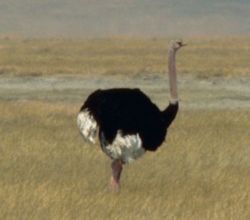
Ostrich
The Ostrich is one or two species of large flightless birds native to Africa, the only living member of the genus Struthio. Some analyses indicate that the Somali Ostrich may be better considered a full species apart from the Common Ostrich, but most taxonomists consider it to be a...
, emu
Emu
The Emu Dromaius novaehollandiae) is the largest bird native to Australia and the only extant member of the genus Dromaius. It is the second-largest extant bird in the world by height, after its ratite relative, the ostrich. There are three subspecies of Emus in Australia...
, cassowary
Cassowary
The cassowaries are ratites, very large flightless birds in the genus Casuarius native to the tropical forests of New Guinea, nearby islands and northeastern Australia. There are three extant species recognized today...
, rhea
Rhea (bird)
The rheas are ratites in the genus Rhea, native to South America. There are two existing species: the Greater or American Rhea and the Lesser or Darwin's Rhea. The genus name was given in 1752 by Paul Möhring and adopted as the English common name. Möhring's reason for choosing this name, from the...
, kiwi
Kiwi
Kiwi are flightless birds endemic to New Zealand, in the genus Apteryx and family Apterygidae.At around the size of a domestic chicken, kiwi are by far the smallest living ratites and lay the largest egg in relation to their body size of any species of bird in the world...
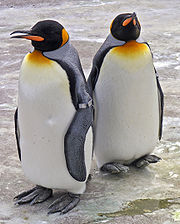
, and penguin
Penguin
Penguins are a group of aquatic, flightless birds living almost exclusively in the southern hemisphere, especially in Antarctica. Highly adapted for life in the water, penguins have countershaded dark and white plumage, and their wings have become flippers...
. It is believed by some that most flightless birds evolved in the absence of predators on islands, and lost the power of flight because they had few enemies — although this is likely not the case for the ratites (the ostrich
Ostrich
The Ostrich is one or two species of large flightless birds native to Africa, the only living member of the genus Struthio. Some analyses indicate that the Somali Ostrich may be better considered a full species apart from the Common Ostrich, but most taxonomists consider it to be a...
, emu
Emu
The Emu Dromaius novaehollandiae) is the largest bird native to Australia and the only extant member of the genus Dromaius. It is the second-largest extant bird in the world by height, after its ratite relative, the ostrich. There are three subspecies of Emus in Australia...
and cassowary
Cassowary
The cassowaries are ratites, very large flightless birds in the genus Casuarius native to the tropical forests of New Guinea, nearby islands and northeastern Australia. There are three extant species recognized today...
), as all have claws on their feet to use as a weapon against predators.
Two key differences between flying and flightless birds are the smaller wing bones of flightless birds and the absent (or greatly reduced) keel on their breastbone. The keel anchors muscles needed for wing movement. Flightless birds also have more feather
Feather
Feathers are one of the epidermal growths that form the distinctive outer covering, or plumage, on birds and some non-avian theropod dinosaurs. They are considered the most complex integumentary structures found in vertebrates, and indeed a premier example of a complex evolutionary novelty. They...
s than flying birds.
New Zealand
New Zealand
New Zealand is an island country in the south-western Pacific Ocean comprising two main landmasses and numerous smaller islands. The country is situated some east of Australia across the Tasman Sea, and roughly south of the Pacific island nations of New Caledonia, Fiji, and Tonga...
has more species of flightless birds (including the kiwi
Kiwi
Kiwi are flightless birds endemic to New Zealand, in the genus Apteryx and family Apterygidae.At around the size of a domestic chicken, kiwi are by far the smallest living ratites and lay the largest egg in relation to their body size of any species of bird in the world...
s, several species of penguin
Penguin
Penguins are a group of aquatic, flightless birds living almost exclusively in the southern hemisphere, especially in Antarctica. Highly adapted for life in the water, penguins have countershaded dark and white plumage, and their wings have become flippers...
s, and the takahe
Takahe
The Takahē or South Island Takahē, Porphyrio hochstetteri is a flightless bird indigenous to New Zealand and belonging to the rail family. It was thought to be extinct after the last four known specimens were taken in 1898...
) than any other country. One reason is that until the arrival of humans roughly a thousand years ago, there were no large land predators in New Zealand; the main predators of flightless birds were larger birds.
Some flightless varieties of island birds are closely related to flying varieties, implying flight is a significant biological cost.
The smallest flightless bird is the Inaccessible Island Rail
Inaccessible Island Rail
The Inaccessible Island Rail is a small bird of the rail family, Rallidae. It is the only species in its genus. It is found only on Inaccessible Island in the Tristan Archipelago, and is notable for being the smallest extant flightless bird in the world...
(length 12.5 cm, weight 34.7 g). The largest (both heaviest and tallest) flightless bird, which is also the largest living bird, is the Ostrich
Ostrich
The Ostrich is one or two species of large flightless birds native to Africa, the only living member of the genus Struthio. Some analyses indicate that the Somali Ostrich may be better considered a full species apart from the Common Ostrich, but most taxonomists consider it to be a...
(2.7 m, 156 kg), although some extinct species grew to larger sizes.
Flightless birds are the easiest to take care of in captivity because they do not have to be caged. Ostriches were once farmed for their decorative feathers. Today they are raised for meat and for their skins, which are used to make leather.
There were also other families of flightless birds, such as the now extinct Phorusrhacidae
Phorusrhacidae
Phorusrhacids , colloquially known as "terror birds" as the larger species were apex predators during the Miocene, were a clade of large carnivorous flightless birds that were the dominant predators in South America during the Cenozoic, 62–2 million years ago. They were roughly 1–3 meters tall...
, that evolved to be very powerful terrestrial predators.
List of recent flightless birds
The following are flightless birds during or after the HoloceneHolocene
The Holocene is a geological epoch which began at the end of the Pleistocene and continues to the present. The Holocene is part of the Quaternary period. Its name comes from the Greek words and , meaning "entirely recent"...
period.
Ratites
- OstrichOstrichThe Ostrich is one or two species of large flightless birds native to Africa, the only living member of the genus Struthio. Some analyses indicate that the Somali Ostrich may be better considered a full species apart from the Common Ostrich, but most taxonomists consider it to be a...
- EmuEmuThe Emu Dromaius novaehollandiae) is the largest bird native to Australia and the only extant member of the genus Dromaius. It is the second-largest extant bird in the world by height, after its ratite relative, the ostrich. There are three subspecies of Emus in Australia...
- Kangaroo Island EmuKangaroo Island EmuKangaroo Island Emu or Dwarf Emu is an extinct member of the bird family Casuariidae. It was restricted to Kangaroo Island, South Australia, which was known as Ile Decrés by the members of the Baudin expedition. It differed from the mainland Emu mainly in its smaller size...
(extinct) - King Island EmuKing Island EmuThe King Island Emu or Black Emu is an extinct sub-species of emu which occurred on King Island between mainland Australia and Tasmania. It is known from 19th century descriptions of live birds, as well as subfossil bones and one museum specimen...
(extinct) - CassowariesCassowaryThe cassowaries are ratites, very large flightless birds in the genus Casuarius native to the tropical forests of New Guinea, nearby islands and northeastern Australia. There are three extant species recognized today...
- MoaMoaThe moa were eleven species of flightless birds endemic to New Zealand. The two largest species, Dinornis robustus and Dinornis novaezelandiae, reached about in height with neck outstretched, and weighed about ....
(extinct) - Elephant birdElephant birdElephant birds are an extinct family of flightless birds found only on the island of Madagascar and comprising the genera Aepyornis and Mullerornis.-Description:...
s (extinct) - KiwiKiwiKiwi are flightless birds endemic to New Zealand, in the genus Apteryx and family Apterygidae.At around the size of a domestic chicken, kiwi are by far the smallest living ratites and lay the largest egg in relation to their body size of any species of bird in the world...
s - RheaRhea (bird)The rheas are ratites in the genus Rhea, native to South America. There are two existing species: the Greater or American Rhea and the Lesser or Darwin's Rhea. The genus name was given in 1752 by Paul Möhring and adopted as the English common name. Möhring's reason for choosing this name, from the...
s
Anseriformes (Waterfowl)
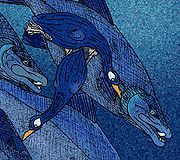
- Moa-naloMoa-naloThe moa-nalo are a group of extinct aberrant, goose-like ducks that lived on the larger Hawaiian Islands, except Hawaii itself, in the Pacific...
s (extinct) - Bermuda Island Flightless Duck (extinct)
- Fuegian Steamer Duck
- Falkland Steamer Duck
- Chubut Steamer Duck
- Auckland Teal
- Campbell Teal
- Domestic Duck
- Domestic Goose
- DromornisDromornisDromornis is a genus of prehistoric birds. They stood 3 meters tall and weighed half a ton. Dromornis lived in Australia from the late Miocene to the early Pliocene, meaning that early humans never encountered this genus....
(extinct) - GenyornisGenyornisGenyornis was a monotypic genus of large, flightless bird that lived in Australia until 50±5 thousand years ago. Many species became extinct in Australia around that time, coinciding with the arrival of humans....
(extinct) - Chendytes lawi (extinct)
- TalpanasTalpanasTalpanas is an extinct genus of duck containing only the species Talpanas lippa. It was first described by Andrew L. Iwaniuk, Storrs L. Olson, and Helen F. James in the journal Zootaxa in November 2009. It was endemic to the Hawaiian island of Kauai where the fossil remains were unearthed in the...
(extinct) - CnemiornisCnemiornisThe New Zealand Geese formed the extinct genus Cnemiornis of the family Anatidae, subfamily Anserinae.The genus, endemic to New Zealand, consisted of two species: the North Island Goose, C. gracilis and the South Island Goose C. calcitrans...
(extinct)
Galliformes (Wildfowl)
- New Caledonian Giant MegapodeSylviornisSylviornis is an extinct genus of galliform bird containing a single species, S. neocaledoniae, or erroneously, "New Caledonian Giant Megapode". Technically, the latter is incorrect because it has recently been found not to be a megapode, but the sole known member of its own family, the...
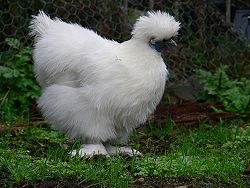
(extinct) - SilkieSilkieThe Silkie is a breed of chicken named for its atypically fluffy plumage, which is said to feel like silk. The breed has several other unusual qualities, such as dark blue flesh and bones, blue earlobes, and five toes on each foot...
- Domestic turkey
- Domestic chicken
Podicipediformes (Grebes)
- Junin Grebe
- Titicaca Grebe
- Atitlán GrebeAtitlán GrebeThe Atitlán Grebe , also known as Giant Grebe, Giant Pied-billed Grebe, or Poc, is an extinct water bird, a relative of the Pied-billed Grebe. It was endemic at the Lago de Atitlán in Guatemala at an altitude of 1700 m asl. Thanks to the field work of the American ecologist Anne LaBastille, its...
(extinct, reportedly flightless [Hunter 1988])
Pelicaniformes (Pelicans, Cormorants, et al.)
_-isabela.jpg)
- Flightless CormorantFlightless CormorantThe Flightless Cormorant , also known as the Galapagos Cormorant, is a cormorant native to the Galapagos Islands, and an example of the highly unusual fauna there. It is unique in that it is the only cormorant that has lost the ability to fly...
Ciconiiformes (Herons, Ibis)
- ApteribisApteribisApteribis is an extinct genus of flightless birds in the ibis subfamily that was endemic to the Hawaiian Islands in the Pacific Ocean.-Distribution:...
(extinct) - Jamaican Ibis (extinct)
- Réunion Sacred IbisRéunion Sacred IbisThe Réunion Sacred Ibis, Threskiornis solitarius, is an extinct bird species that was native to the island of Réunion. It is probably the same bird discovered by Portuguese sailors there in 1613...
(extinct)
Gruiformes (Cranes, Rails)

- Cuban Flightless Crane (extinct)
- Red RailRed RailThe Red Rail or Red Hen of Mauritius, Aphanapteryx bonasia, is an extinct rail. It was only found on the island of Mauritius. The Red Rail, which today is only known from a large number of bones, some descriptions and a handful of drawings and paintings, was a flightless bird, somewhat larger than...
(extinct) - Rodrigues RailRodrigues RailThe Rodrigues Rail or Leguat's Gelinote is an extinct bird named after the learned traveller François Leguat, who came with a band of Huguenot religious refugees to Rodrigues in 1691 and stayed there for two years. It was also mentioned by Julien Tafforet in 1726...
(extinct) - Woodford's RailWoodford's RailWoodford's Rail is a species of bird in the Rallidae family.-Distribution and habitat:It is found in Papua New Guinea and Solomon Islands...
(probably flightless) - Bar-winged RailBar-winged RailThe Bar-winged Rail was a species of bird in the Rallidae family.It was endemic to Fiji and was last collected ca 1890 in Viti Levu. The species was idenitifed from twelve 19th century specimens, some of which are known to be in Boston, London and New York...
(extinct, probably flightless) - WekaWekaThe Weka or woodhen is a flightless bird species of the rail family. It is endemic to New Zealand, where four subspecies are recognized. Weka are sturdy brown birds, about the size of a chicken. As omnivores, they feed mainly on invertebrates and fruit...
- New Caledonian RailNew Caledonian RailThe New Caledonian Rail is a large and drab flightless rail that is found on the island of New Caledonia in the Pacific. It is a dull brown above, with grey underparts, and has a yellowish, downward-curving bill...
- Lord Howe WoodhenLord Howe WoodhenThe Lord Howe Woodhen, Gallirallus sylvestris, also known as the Lord Howe Island Woodhen or Lord Howe Rail, is a flightless bird of the rail family . It is endemic to Lord Howe Island off the Australian coast. It is a small olive brown bird, with a short tail and a downcurved bill...
- Calayan RailCalayan RailThe Calayan Rail is a flightless bird of the rail, moorhen, and coot family that inhabits Calayan Island in the Philippines. Though well-known to natives of the island as the "piding", it was first observed by ornithologist Carmela Española in May 2004 and the discovery officially announced on...
- New Britain RailNew Britain RailThe Pink-legged Rail , also known as the New Britain Rail, is a species of bird in the Rallidae family.-Distribution and habitat:...
- Guam RailGuam RailThe Guam Rail, Gallirallus owstoni, is a flightless bird, endemic to Guam. The Guam Rail, which is locally known as the Ko'ko' in Chamorro, disappeared from southern Guam in the early 1970s and was extirpated from the entire island by the late 1980s...
- Roviana RailRoviana RailThe Roviana Rail is a species of bird in the Rallidae family.It is endemic to Solomon Islands.Its natural habitats are subtropical or tropical moist lowland forests, subtropical or tropical moist shrubland, and plantations ....
("flightless, or nearly so" [Taylor 1998]) - Tahiti Rail (extinct)
- Dieffenbach's RailDieffenbach's RailThe Dieffenbach's Rail was a species of bird in the Rallidae family. It was endemic to New Zealand. It became extinct due to introduced predators.-References:...
(extinct) - Chatham RailChatham RailThe Chatham Rail is an extinct species of bird in the Rallidae family. It was endemic to New Zealand.Cabalus modestus was endemic to Chatham, Mangere and Pitt Islands, New Zealand. It was first discovered on Mangere in 1871, and 26 specimens collected there are known from museum collections. It...
(extinct) - Wake Island RailWake Island RailThe extinct Wake Island Rail was a flightless rail and the only native land bird on the Pacific atoll of Wake. It was found on the islands of Wake and Wilkes, but not on Peale, which is separated from the others by a channel of about 100 meters.-Description:The adult bird had a length of . The...
(extinct) - Snoring RailSnoring RailThe Snoring Rail, Aramidopsis plateni also known as Celebes Rail or Platen's Rail is a medium-sized, approximately 30 cm long, flightless rail. It is the only member of the monotypic genus Aramidopsis. Both sexes are quite similar, having gray plumage, white chins, brown wings, short tails and...
- Inaccessible Island RailInaccessible Island RailThe Inaccessible Island Rail is a small bird of the rail family, Rallidae. It is the only species in its genus. It is found only on Inaccessible Island in the Tristan Archipelago, and is notable for being the smallest extant flightless bird in the world...
- Laysan RailLaysan RailThe Laysan Rail or Laysan Crake was a tiny inhabitant of the Northwest Hawaiian Island of Laysan. This small island was and still is an important seabird colony, and sustained a number of endemic species, including the rail. It became extinct due to habitat loss by domestic rabbits, and ultimately...
(extinct) - Hawaiian RailHawaiian RailThe Hawaiian Rail , Hawaiian Spotted Rail, or Hawaiian Crake was a somewhat enigmatic species of diminutive rail that lived on Big Island of Hawaii, but is now extinct. It was a flightless bird that was apparently found in shrubland and secondary growth on abandoned fields and in times of danger...
(extinct) - Kosrae Crake (extinct)
- Ascension Crake (extinct)
- Red-eyed Crake
- Invisible RailInvisible RailThe Invisible Rail is a flightless species of bird in the family Rallidae , endemic only to Halmahera, north Maluku, Indonesia, especially its swamp forests, wetlands, and forest edges. The Invisible Rail is evaluated as Vulnerable on the IUCN Red List of Threatened Species...
- New Guinea Flightless RailNew Guinea Flightless RailThe New Guinea Flightless Rail , also known as the Papuan Flightless Rail, is a species of bird in the Rallidae family, in the monotypic genus Megacrex.-Distribution and habitat:It is found in Indonesia and Papua New Guinea...
- Lord Howe SwamphenLord Howe SwamphenThe Lord Howe Swamphen or White Gallinule, Porphyrio albus, was a large bird in the family Rallidae endemic to Lord Howe Island, Australia. It was similar to the Purple Swamphen, but with shorter and more robust legs and toes. Its plumage was white, sometimes with a few blue feathers, and it was...
(extinct, probably flightless) - North Island TakaheNorth Island TakaheThe North Island Takahē or Mōho, Porphyrio mantelli, is an extinct rail that was found in the North Island of New Zealand. This flightless species is known from subfossils from a number of archeological sites and from one possible 1894 record...
(extinct) - TakaheTakaheThe Takahē or South Island Takahē, Porphyrio hochstetteri is a flightless bird indigenous to New Zealand and belonging to the rail family. It was thought to be extinct after the last four known specimens were taken in 1898...
- Samoan Wood RailSamoan Wood RailThe Samoan Wood Rail , also known as Samoan Moorhen, is a nearly flightless rail endemic to the Samoan island of Savai'i, and probably extinct...
- Makira Wood Rail
- Tristan MoorhenTristan MoorhenThe Tristan Moorhen is an extinct flightless rail from the South Atlantic island of Tristan da Cunha. It was physically similar to the Gough Island Moorhen of Gough Island, located 395 miles to the southeast....
(extinct) - Gough Island MoorhenGough Island MoorhenThe Gough Moorhen, Gallinula comeri, is a medium-sized, almost flightless bird that is similar to the Common Moorhen , but is smaller, stockier, and has shorter wings. The bird has a distinctive bill that is reddish with a yellow tip. Its first account was written by the polar explorer George...
- Tasmanian Nativehen
- Giant CootGiant CootThe Giant Coot is a species of bird found at lakes in the altiplano from central Peru, through western Bolivia, to north-eastern Chile and extreme north-western Argentina. With a total length of 48–64 cm , it is the second largest extant member of the Rallidae family, after the Takahe, and...
(adults only; immatures can fly) - AdzebillAdzebillThe adzebills, genus Aptornis, were two closely related bird species, the North Island Adzebill, Aptornis otidiformis, and the South Island Adzebill, Aptornis defossor, of the extinct family Aptornithidae. The family was endemic to New Zealand.They have been placed in the Gruiformes but this is not...
s (extinct)
Charadriiformes (Gulls, Terns, Auks)
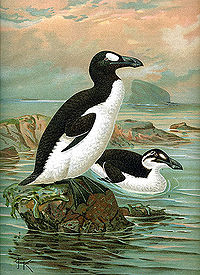
- Great AukGreat AukThe Great Auk, Pinguinus impennis, formerly of the genus Alca, was a large, flightless alcid that became extinct in the mid-19th century. It was the only modern species in the genus Pinguinus, a group of birds that formerly included one other species of flightless giant auk from the Atlantic Ocean...
(extinct) - Diving Puffin (extinct)
Columbiformes (Pigeons, Doves)
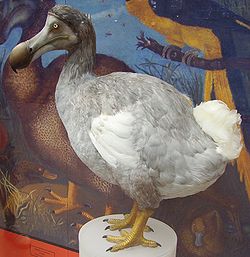
- DodoDodoThe dodo was a flightless bird endemic to the Indian Ocean island of Mauritius. Related to pigeons and doves, it stood about a meter tall, weighing about , living on fruit, and nesting on the ground....
(extinct) - Rodrigues SolitaireRodrigues SolitaireThe Rodrigues Solitaire was a flightless member of the pigeon order endemic to Rodrigues, Mauritius. It was a close relative of the Dodo.-Discovery:...
(extinct) - Viti Levu Giant PigeonViti Levu Giant PigeonThe Viti Levu Giant Pigeon was a flightless pigeon, only slightly smaller than the dodo and Rodrigues solitaire ....
(extinct)
Strigformes (Owls)
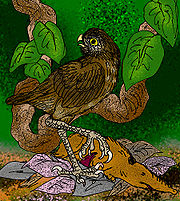
- Cuban Giant Owl (extinct)
- Cretan OwlCretan OwlThe Cretan Owl is an extinct species of owl from the Pleistocene of Crete, Mediterranean. It was first named by Weesie in 1982. In life, it would have been at least 2 feet tall, and flightless or nearly flightless...
(extinct, probably flightless) - Andros Island Barn OwlTyto pollensTyto pollens, also known as Andros Island Barn Owl, Bahamian Barn Owl, Bahamian Great Owl, or "Chickcharnie," was a , flightless barn owl that lived in the old-growth pineyards of Andros Island...
(extinct)
Passeriformes (Perching Birds)
- Stephens Island WrenStephens Island WrenThe Stephens Island Wren or Lyall's Wren was a nocturnal, flightless, insectivorous passerine.-Habitat:...
(extinct) - Long-legged BuntingLong-legged BuntingThe Long-legged Bunting is an extinct flightless species of bunting. It was distinguishable by its long legs and short wings, and it inhabited the Canary Islands...
(extinct)
See also
- DinosaurDinosaurDinosaurs are a diverse group of animals of the clade and superorder Dinosauria. They were the dominant terrestrial vertebrates for over 160 million years, from the late Triassic period until the end of the Cretaceous , when the Cretaceous–Paleogene extinction event led to the extinction of...
s- Feathered dinosaursFeathered dinosaursThe realization that dinosaurs are closely related to birds raised the obvious possibility of feathered dinosaurs. Fossils of Archaeopteryx include well-preserved feathers, but it was not until the early 1990s that clearly non-avialan dinosaur fossils were discovered with preserved feathers...
- Origin of birds: Secondary flightlessness in dinosaurs
- Feathered dinosaurs
- Extinct birdsExtinct birdsSince 1500, over 190 species of birds have become extinct, and this rate of extinction seems to be increasing. The situation is exemplified by Hawaii, where 30% of all known recently extinct bird taxa originally lived...
- GastornisGastornisGastornis is an extinct genus of large flightless bird that lived during the late Paleocene and Eocene epochs of the Cenozoic. It was named in 1855, after Gaston Planté, who had discovered the first fossils in Argile Plastique formation deposits at Meudon near Paris...
- PhorusrhacidaePhorusrhacidaePhorusrhacids , colloquially known as "terror birds" as the larger species were apex predators during the Miocene, were a clade of large carnivorous flightless birds that were the dominant predators in South America during the Cenozoic, 62–2 million years ago. They were roughly 1–3 meters tall...
- RatiteRatiteA ratite is any of a diverse group of large, flightless birds of Gondwanan origin, most of them now extinct. Unlike other flightless birds, the ratites have no keel on their sternum—hence the name from the Latin ratis...
External links
- TerraNature pages on New Zealand flightless birds
- Kiwi in Te Ara - the Encyclopedia of New Zealand
- The Flightless Birds Band
- Flightless birds in New Zealand