


Swimsuit

Encyclopedia
A swimsuit, bathing suit, or swimming costume is an item of clothing
designed to be worn by men, women or children while they are engaging in a water-based activity or water sports, such as swimming, water polo
, diving
, surfing
, water skiing
, or during activities in the sun, such as sun bathing.
A swimsuit can be worn as an undergarment
in sports that require a wetsuit such as water skiing
, scuba diving
, surfing
, and wakeboarding
. Swimsuits are also worn when there is a need to display the body, as in the case of beauty pageants or bodybuilding
contests. Glamour photography
and magazines like Sports Illustrated
's annual "swimsuit issue" feature models and sports personalities in swimsuits.
There is a very wide range of styles of modern swimsuits, which vary in relation to body coverage and materials.
, jammers, swim trunks
, briefs
or "speedos", thongs
, and g-string
s, in order of decreasing lower body coverage.
Women's swimsuits are generally described as one-piece
, bikini
s, or thong
s. A recent innovation is the burqini
, favored by Muslim women, which covers the whole body and head (but not face) in a manner similar to a diver's wetsuit
. These are an updated version of full-body swimwear, which has been available for centuries
, but conforms with Islam
's traditional emphasis on modest dress. In Egypt
, the term "Sharia
swimsuit" is used to describe full-body swimwear.
 Swimsuits can be skin-tight or loose-fitting. They are often lined with another layer of fabric if the outer fabric becomes transparent when wet.
Swimsuits range from designs that almost completely cover the body to designs that expose almost all of the body. The choice of swimsuit will depend on personal and community standards of modesty
and on considerations such as how much or how little sun protection
is desired, and prevailing fashions. Almost all swimsuits cover the genitals and pubic hair
, while most except thongs
cover much or all of the buttocks
. Most swimsuits in western culture
leave at least the head, shoulders, arms, and lower part of the leg (below the knee) exposed. Women's swimsuits generally cover at least the aereola and bottom half of the breast
s, but some are designed for the top part of the swimsuit to be removed . In many countries, young girls and sometimes women choose not to wear a swimsuit top, and this can vary with the occasion, location, age, etc. Men's swimsuits which cover the upper body are relatively rare in western culture.
Both men and women may sometimes wear swimsuits covering more of the body when swimming in cold water (see also wetsuit
and dry suit
). In colder temperatures, the swimwear is needed to conserve body heat and protect the body core from hypothermia.
s. For some kinds of swimming and diving, special bodysuits called diveskins are worn. These suits are made from spandex
and provide little thermal protection, but they do protect the skin from stings and abrasion. Most competitive swimmers also wear special swimsuits including partial and full bodysuits
, racerback
styles, jammers and racing briefs to assist their glide through the water thus gaining a speed advantage (see competitive swimwear
).
Unlike regular swimsuits, which are designed mainly for the aesthetic appearances, swimsuits designed to be worn during competitions are manufactured to assist the athlete in swim competitions. They reduce friction and drag in the water, increasing the efficiency of the swimmer's forward motion. The tight fits allow for easy movement and are said to reduce muscle vibration, thus reducing drag. Starting around 2000, in an effort to improve the effectiveness of the swimsuits, engineers have taken to designing them to replicate the skin of sea based animals, sharks in particular.
In July 2009, FINA
voted to ban non-textile (non-woven) swimsuits in competitive events from 2010. The new policy was implemented to combat the issues associated with performance enhancing costumes, hindering the ability to accurately measure the performance of swimmers. Subsequently, the new ruling states that men's swimsuits may maximally cover the area from the navel to the knee, and women's' counterparts from the shoulder to the knee.
 Some swimmers use a specialized training suit called drag suits to artificially increase drag during practice. Drag suits are swimwear with an outer layer of looser fabric - often mesh or nylon - to increase resistance against the water and build up the swimmer's endurance. They come in a variety of styles, but most resemble a looser fitting square-cut or swim brief.
swimming and bathing was done nude. There are Roman murals which show women playing sports and exercising wearing two-piece suits covering the areas around their breasts and hips in a fashion remarkably similar to the present-day bikini. However, there is no evidence that they were used for swimming. All classical pictures of swimming show nude swimmers.
In various cultural traditions one swims, if not in the nude, in a version in suitable material of a garment or undergarment commonly worn on land, e.g. a loincloth
such as the Japanese man's fundoshi
.
In the United Kingdom until the mid-19th century there was no law against nude swimming, with each town being free to make its own laws. For example, the Bath Corporation official bathing dress code of 1737 prescribed, for men:
In rivers, lakes, streams and the sea men swam in the nude, where the practice was common. Those who didn't swim in the nude, stripped to their underwear. The English practice of men swimming in the nude was banned in the United Kingdom in 1860. Drawers, or caleçons as they were called, came into use in the 1860s. Even then there were many who protested against them and wanted to remain in the nude. Francis Kilvert
described men's bathing suits coming into use in the 1870s as "a pair of very short red and white striped drawers".
Female bathing costumes were derived from those worn at Bath and other spas. It would appear that until the 1670s nude female bathing in the spas was the norm and that after that time women bathed clothed. Celia Fiennes gave a detailed description of the standard ladies' bathing costume in 1687:
The Bath Corporation official bathing dress code of 1737 prescribed, for women:
The Expedition of Humphrey Clinker was published in 1771 and its description of ladies’ bathing costume is different to that of Celia Fiennes a hundred years earlier:
Penelope Byrde points out that Smollett’s description may not be accurate, for he describes a two-piece costume, not the one piece shift or smock that most people describe and is depicted in contemporary prints. His description does, however, tally with Elizabeth Grant’s description of the guide’s costume at Ramsgate in 1811. The only difference is in the fabric the costumes are made of. Flannel, however, was a common fabric for sea bathing costumes as many believed the warmer fabric was necessary in cold water.
In the 18th century women wore "bathing gowns" in the water; these were long dresses of fabrics that would not become transparent when wet, with weights sewn into the hems so that they would not rise up in the water. The men's swim suit, a rather form-fitting wool garment with long sleeves and legs similar to long underwear, was developed and would change little for a century.
In the 19th century, the woman's two piece suit became common—the two pieces being a gown from shoulder to knees plus a set of trousers with leggings going down to the ankles.
In the Victorian era
, popular beach resorts were commonly equipped with bathing machine
s designed to avoid the exposure of people in swimsuits, especially to people of the opposite sex.
In the United States, beauty contests of women in bathing costumes became popular from the 1880s. However, such contests were not regarded as respectable. Beauty contests became more respectable with the first modern "Miss America
" contest held in 1921, though less respectable beauty contests continued to be held. Norman Rockwell
judged the Miss America 1922
bathing beauty contest along with Howard Chandler Christy
and James Montgomery Flagg
. They were all unclear as to how to judge the contest. One judge suggested that they judge each part or feature of the body out of ten, then the woman with the total highest score would win. After they had tried the system, they discovered that although one woman might have beautiful individual parts for features, she might not be beautiful over all. So they "...gave up trying to figure out a system and resolved to trust our eyes. It led to squabbles, because all of us didn't see things in the same way, but it was the best we could do."
In 1907, the swimmer Annette Kellerman
from Australia
visited the United States as an "underwater ballerina", a version of synchronized swimming
involving diving into glass tanks. She was arrested for indecent exposure
because her swimsuit showed arms, legs and the neck. Kellerman changed the suit to have long arms and legs and a collar, still keeping the close fit that revealed the shapes underneath. She later starred in several movies
, including one about her life. She marketed a line of bathing suits and her style of one-piece suits came to be known as "the Annette Kellerman." The Annette Kellerman was considered the most offensive style of swimsuit in the 1920s and became the focus of censorship efforts.

 After this, bathing wear started to shrink, first uncovering the arms and then the legs up to mid-thigh. Collars receded from around the neck down to around the top of the bosom. The development of new fabrics allowed for new varieties of more comfortable and practical swim wear.
Due to the figure-hugging nature of these garments, glamour photography
since the 1940s and 1950s has often featured people wearing swimsuits. This subset of glamour photography eventually evolved into swimsuit photography exemplified by the Sports Illustrated
annual swimsuit issues.
The first bikinis were introduced just after World War II
. Early examples were not very different from the women's two pieces common since the 1920s, except that they had a gap below the breast line allowing for a section of bare midriff. They were named after Bikini Atoll
, the site of several nuclear weapons tests, for their supposed explosive effect on the viewer.
Through the 1950s, it was thought proper for the lower part of the bikini to come up high enough to cover the navel
. From the 1960s on, the bikini shrank in all directions until it sometimes covered little more than the nipples and genitalia, although less revealing models giving more support to the breasts remained popular. At the same time, fashion designer Rudi Gernreich
introduced the monokini
, a topless suit for women consisting of a modest bottom supported by two thin straps. Although not a commercial success, the suit opened eyes to new design possibilities. In the 1980s the thong or "tanga" came out of Brazil
, said to have been inspired by traditional garments of native tribes in the Amazon
. However, the one-piece suit continued to be popular for its more modest approach.
Men's swimsuits developed roughly in parallel to women's during this period, with the shorts covering progressively less. Eventually racing-style "speedo" suits became popular—and not just for their speed advantages. Thongs
, G-strings, and bikini
style suits are also worn, typically these are more popular in more tropical regions; however, they may also be worn at public swimming pools and inland lakes. But in the 1990s, longer and baggier shorts became popular, with the hems often reaching to the knees. These were often worn lower on the hips than regular shorts.
Some women prefer to engaging in water or sun activities with the torso uncovered. The practice is often described as "toplessness
" or "topfreedom
". In some places around the world, nude beach
es have been set aside for people who choose to engage in normal beach activities in the nude.
As an alternative to a swimsuit, some people wear trousers
, underpants
or a T-shirt
either as a make-shift swimsuit or because they prefer regular clothes over swimsuits
. In some countries, such as Thailand, swimming in regular clothes is the norm while swimsuits are rare. At beaches, this may be more accepted than at swimming pools, which tend not to permit the practice because underwear is unlined, may become translucent, and may be perceived as unclean.
, swimsuits are almost always called togs or, occasionally, bathers. They are less commonly called "cossies", which along with "bathers" is the Australian term. The term "togs" is less common in other parts of the Commonwealth
, where it can also refer to clothes in general.
Clothing
Clothing refers to any covering for the human body that is worn. The wearing of clothing is exclusively a human characteristic and is a feature of nearly all human societies...
designed to be worn by men, women or children while they are engaging in a water-based activity or water sports, such as swimming, water polo
Water polo
Water polo is a team water sport. The playing team consists of six field players and one goalkeeper. The winner of the game is the team that scores more goals. Game play involves swimming, treading water , players passing the ball while being defended by opponents, and scoring by throwing into a...
, diving
Diving
Diving is the sport of jumping or falling into water from a platform or springboard, sometimes while performing acrobatics. Diving is an internationally-recognized sport that is part of the Olympic Games. In addition, unstructured and non-competitive diving is a recreational pastime.Diving is one...
, surfing
Surfing
Surfing' is a surface water sport in which the surfer rides a surfboard on the crest and face of a wave which is carrying the surfer towards the shore...
, water skiing
Water skiing
thumb|right|A slalom skier making a turn on a slalom waterski.Waterskiing is a sport where an individual is pulled behind a boat or a cable ski installation on a body of water, skimming the surface.-History:...
, or during activities in the sun, such as sun bathing.
A swimsuit can be worn as an undergarment
Undergarment
Undergarments or underwear are clothes worn under other clothes, often next to the skin. They keep outer garments from being soiled by bodily secretions and discharges, shape the body, and provide support for parts of it. In cold weather, long underwear is sometimes worn to provide additional...
in sports that require a wetsuit such as water skiing
Water skiing
thumb|right|A slalom skier making a turn on a slalom waterski.Waterskiing is a sport where an individual is pulled behind a boat or a cable ski installation on a body of water, skimming the surface.-History:...
, scuba diving
Scuba diving
Scuba diving is a form of underwater diving in which a diver uses a scuba set to breathe underwater....
, surfing
Surfing
Surfing' is a surface water sport in which the surfer rides a surfboard on the crest and face of a wave which is carrying the surfer towards the shore...
, and wakeboarding
Wakeboarding
Wakeboarding is a surface water sport which involves riding a wakeboard over the surface of a body of water. It was developed from a combination of water skiing, snow boarding and surfing techniques....
. Swimsuits are also worn when there is a need to display the body, as in the case of beauty pageants or bodybuilding
Bodybuilding
Bodybuilding is a form of body modification involving intensive muscle hypertrophy. An individual who engages in this activity is referred to as a bodybuilder. In competitive and professional bodybuilding, bodybuilders display their physiques to a panel of judges, who assign points based on their...
contests. Glamour photography
Glamour photography
Glamour photography is a genre of photography whereby the subjects, usually female, are portrayed in a romantic or sexually alluring way. The subjects may be fully clothed or seminude, but glamour photography stops short of deliberately arousing the viewer and being pornographic photography.Glamour...
and magazines like Sports Illustrated
Sports Illustrated
Sports Illustrated is an American sports media company owned by media conglomerate Time Warner. Its self titled magazine has over 3.5 million subscribers and is read by 23 million adults each week, including over 18 million men. It was the first magazine with circulation over one million to win the...
's annual "swimsuit issue" feature models and sports personalities in swimsuits.
There is a very wide range of styles of modern swimsuits, which vary in relation to body coverage and materials.
Current swimsuit styles
In western culture, men's swimsuit styles include boardshortsBoardshorts
Boardshorts are a style of men's and, recently, women's summerwear. They were originally developed for aquatic sports, specifically for surfing, but in more recent years they have grown in popularity outside of these sports, and have become a popular form of general beach and summerwear.The name...
, jammers, swim trunks
Trunks (clothing)
Trunks, when worn as swimwear, are often referred to as swim trunks, and are normally shorter than boardshorts, which extend to the knees. Trunks are the most popular type of male swimsuit in North America...
, briefs
Briefs
Briefs are a type of short, tight underwear and swimwear, as opposed to styles where the material extends down the legs.In the case of men's underwear, briefs, unlike boxer shorts, hold the wearer's genitals in a relatively fixed position, which make briefs a popular underwear choice for men who...
or "speedos", thongs
Thong (clothing)
The thong is a garment generally worn as either underwear or as a swimsuit in many industrialized societies around the world. It may also be worn for traditional ceremonies or competitions such as sumo wrestling...
, and g-string
G-string
A G-string is a type of thong underwear or swimsuit, a narrow piece of cloth, leather, or plastic, that covers or holds the genitals, passes between the buttocks, and is attached to a band around the hips, worn as swimwear or underwear by women and men...
s, in order of decreasing lower body coverage.
Women's swimsuits are generally described as one-piece
One-piece swimsuit
A one-piece swimsuit is a usually skin-tight one-piece swimsuit worn by women and girls when swimming in the sea or in a swimming pool, or for any activity in the sun, such as sun bathing. The one-piece swimsuit usually covers a female's torso...
, bikini
Bikini
The bikini is typically a women's two-piece swimsuit. One part of the attire covers the breasts and the other part covers the crotch and part of or the entire buttocks, leaving an uncovered area between the two. Merriam–Webster describes the bikini as "a woman's scanty two-piece bathing suit" or "a...
s, or thong
Thong (clothing)
The thong is a garment generally worn as either underwear or as a swimsuit in many industrialized societies around the world. It may also be worn for traditional ceremonies or competitions such as sumo wrestling...
s. A recent innovation is the burqini
Burqini
A burqini swimsuit is a type of swimsuit for women designed by Lebanese Australian Aheda Zanetti under the company name Ahiida....
, favored by Muslim women, which covers the whole body and head (but not face) in a manner similar to a diver's wetsuit
Wetsuit
A wetsuit is a garment, usually made of foamed neoprene, which is worn by surfers, divers, windsurfers, canoeists, and others engaged in water sports, providing thermal insulation, abrasion resistance and buoyancy. The insulation properties depend on bubbles of gas enclosed within the material,...
. These are an updated version of full-body swimwear, which has been available for centuries
Sea bathing
Sea bathing is swimming in the sea or in sea water and a sea bath is a protective enclosure for sea bathing. Unlike bathing in a swimming pool, which is generally done for pleasure or exercise purposes, sea bathing was once thought to have curative or therapeutic value. It arose from the medieval...
, but conforms with Islam
Islam
Islam . The most common are and . : Arabic pronunciation varies regionally. The first vowel ranges from ~~. The second vowel ranges from ~~~...
's traditional emphasis on modest dress. In Egypt
Egypt
Egypt , officially the Arab Republic of Egypt, Arabic: , is a country mainly in North Africa, with the Sinai Peninsula forming a land bridge in Southwest Asia. Egypt is thus a transcontinental country, and a major power in Africa, the Mediterranean Basin, the Middle East and the Muslim world...
, the term "Sharia
Sharia
Sharia law, is the moral code and religious law of Islam. Sharia is derived from two primary sources of Islamic law: the precepts set forth in the Quran, and the example set by the Islamic prophet Muhammad in the Sunnah. Fiqh jurisprudence interprets and extends the application of sharia to...
swimsuit" is used to describe full-body swimwear.
Unisex styles
| Name | Image | Description |
|---|---|---|
| Rash guard Rash guard A rash guard, also known as rash vest or rashie, is a type of water wear, an athletic shirt made of spandex and nylon or polyester. The name rash guard reflects the fact that the shirt protects the wearer against rashes caused by abrasion. These shirts can be worn by themselves, or under a wetsuit... (also known as rash vest or rashie) |
 |
A type of athletic shirt made of spandex and nylon or polyester. Rash guards may be worn as an alternative to wetsuits during warmer weather. They may also offer UV protection. |
| Wetsuit Wetsuit A wetsuit is a garment, usually made of foamed neoprene, which is worn by surfers, divers, windsurfers, canoeists, and others engaged in water sports, providing thermal insulation, abrasion resistance and buoyancy. The insulation properties depend on bubbles of gas enclosed within the material,... and Dry suit Dry suit A dry suit or drysuit provides thermal insulation or passive thermal protection to the wearer while immersed in water, and is worn by divers, boaters, water sports enthusiasts, and others who work or play in or near cold water. A dry suit normally protects the whole body except the head, hands, and... |
 |
A close fitting, insulating garment usually made from neoprene or similar material. |
| Drag suits | A pair of shorts or any loose shirts worn over a swimmer's inner swimsuit to increase resistance against the water and build up the swimmer's endurance. | |
| Racing suits | Swimsuits made of technologically advanced fabrics biomimetically designed with a surface that mimics the rough shark denticles to reduce drag along key areas of the body. The characteristics of the fabric improve shape retention and increase muscle compression to reduce vibration and retain muscle shape to reduce fatigue and power loss. Available in a variety of cuts such as bodyskin Bodyskin A bodyskin is a style of competitive swimwear worn by both female and male athletes. Bodyskins are normally made of technologically advanced lycra-based fabrics designed to hug the body tightly and provide increased speed and decreased drag resistance in the water.The bodyskin resembles the design... , legskin Legskin A Legskin is a type of competitive swimwear worn by male swimmers. Most legskins are made of technologically advanced lycra-based fabrics designed to hug the body tightly and provide increased speed and decreased drag resistance in the water. The legskin covers from the swimmer's mid-waist to his... and kneeskin Kneeskin A kneeskin is a type of competitive swimwear worn by both male and female athletes. Kneeskins are normally made of technologically advanced lycra-based fabrics designed to hug the body tightly and provide increased speed and decreased drag resistance in the water.The kneeskin is similar in design... . |
Women's swimsuits
| Name | Image | Descriptione\fe\sf sfde\ |
|---|---|---|
| One-piece One-piece swimsuit A one-piece swimsuit is a usually skin-tight one-piece swimsuit worn by women and girls when swimming in the sea or in a swimming pool, or for any activity in the sun, such as sun bathing. The one-piece swimsuit usually covers a female's torso... (also known as tank suit, maillot Maillot The maillot is the fashion designer's name for a woman's one-piece swimsuit, also called a tank suit. A maillot swimsuit generally consists of a tank-style torso top with high-cut legs... ) |
 |
Probably the most common form of one-piece swimsuit, the tank suit form is inspiration for the subsequent creation of the tank top as a mainstream article of clothing. The name "tank suit" is also supposed to be derived from the term "swimming tank", an obsolete term for what is now called a swimming pool Swimming pool A swimming pool, swimming bath, wading pool, or simply a pool, is a container filled with water intended for swimming or water-based recreation. There are many standard sizes; the largest is the Olympic-size swimming pool... . |
| Bikini Bikini The bikini is typically a women's two-piece swimsuit. One part of the attire covers the breasts and the other part covers the crotch and part of or the entire buttocks, leaving an uncovered area between the two. Merriam–Webster describes the bikini as "a woman's scanty two-piece bathing suit" or "a... (also known as two piece) |
One piece covers the breast Breast The breast is the upper ventral region of the torso of a primate, in left and right sides, which in a female contains the mammary gland that secretes milk used to feed infants.Both men and women develop breasts from the same embryological tissues... s, the other the groin Groin In human anatomy, the groin areas are the two creases at the junction of the torso with the legs, on either side of the pubic area. This is also known as the medial compartment of the thigh. A pulled groin muscle usually refers to a painful injury sustained by straining the hip adductor muscles... and buttocks Buttocks The buttocks are two rounded portions of the anatomy, located on the posterior of the pelvic region of apes and humans, and many other bipeds or quadrupeds, and comprise a layer of fat superimposed on the gluteus maximus and gluteus medius muscles. Physiologically, the buttocks enable weight to... , leaving an uncovered area between the two. Bikinis are available in many stylistic variations. (see Bikini variants Bikini variants The bikini has spawned many stylistic variations. A regular bikini is defined as a two pieces of garments that cover the groin and buttocks at the lower end and the breasts in the upper end. Some bikinis can offer a large amount of coverage, while other bikinis provide only the barest minimum.... ) |
|
| Tankini Tankini The tankini is a bathing suit combining a tank top, mostly made of spandex-and-cotton or Lycra-and-nylon, and a bikini bottom introduced in the late 1990s. This type of swimwear is considered by some to provide modesty closer to a one piece suit with the convenience of a two piece suit, as the... (also known as two piece) |
Two piece covers the breast Breast The breast is the upper ventral region of the torso of a primate, in left and right sides, which in a female contains the mammary gland that secretes milk used to feed infants.Both men and women develop breasts from the same embryological tissues... s and stomach Stomach The stomach is a muscular, hollow, dilated part of the alimentary canal which functions as an important organ of the digestive tract in some animals, including vertebrates, echinoderms, insects , and molluscs. It is involved in the second phase of digestion, following mastication .The stomach is... (like a tank top), the other the groin Groin In human anatomy, the groin areas are the two creases at the junction of the torso with the legs, on either side of the pubic area. This is also known as the medial compartment of the thigh. A pulled groin muscle usually refers to a painful injury sustained by straining the hip adductor muscles... and buttocks Buttocks The buttocks are two rounded portions of the anatomy, located on the posterior of the pelvic region of apes and humans, and many other bipeds or quadrupeds, and comprise a layer of fat superimposed on the gluteus maximus and gluteus medius muscles. Physiologically, the buttocks enable weight to... . Leaves a small gap in between the belly button and the hips. Tankinis are available in many stylistic variations. |
|
| Monokini Monokini A monokini, sometimes referred to as a unikini, is a woman's one-piece garment comprising only the lower half of a bikini, leaving the breasts uncovered... (also known as a unikini or topless swimsuit) |
Refers to: (1) A women's swimsuit with one piece that exposes the breast Breast The breast is the upper ventral region of the torso of a primate, in left and right sides, which in a female contains the mammary gland that secretes milk used to feed infants.Both men and women develop breasts from the same embryological tissues... s, originally invented by Rudi Gernreich Rudi Gernreich Rudi Gernreich was a Austrian-born American fashion designer and gay activist.-Biography:Born in Vienna, Gernreich fled Austria at age 16 due to Nazism, and later migrated to the United States, settling in Los Angeles, California... in 1964, available in many stylistic variations and generally refers to a bikini bottom, or thong Thong (clothing) The thong is a garment generally worn as either underwear or as a swimsuit in many industrialized societies around the world. It may also be worn for traditional ceremonies or competitions such as sumo wrestling... worn alone without a top. (2) A recent trend in women's one-piece swimsuits. It is typically styled so that from the front it looks like a typical one-piece with side cut-outs, but from the back it looks like a bikini. Many monokini styles also include plunging necklines. |
|
| Burqini Burqini A burqini swimsuit is a type of swimsuit for women designed by Lebanese Australian Aheda Zanetti under the company name Ahiida.... |
Covers the whole body and head (but not face) in a manner similar to a diver's wetsuit Wetsuit A wetsuit is a garment, usually made of foamed neoprene, which is worn by surfers, divers, windsurfers, canoeists, and others engaged in water sports, providing thermal insulation, abrasion resistance and buoyancy. The insulation properties depend on bubbles of gas enclosed within the material,... . |
Men's swimsuits
| Name | Image | Description |
|---|---|---|
| Swim briefs Swim briefs A swim brief, or racing brief, refers to any briefs style male swimsuit such as those worn in competitive swimming and diving. The popularity of the Australian Speedo brand racing brief has led to the use of its name to refer to any racing brief, regardless of the maker... (also known as racing briefs, speedo Speedo Speedo International Ltd. is a manufacturer and distributor of swimwear and swim-related accessories. Founded in Australia in 1914, the industry leading company is now a subsidiary of Pentland Group Plc. Today, the Speedo brand can be found on products ranging from swimsuits and goggles to wrist... s, competition briefs, bathers, racer bathers) |
 |
Launched in at the 1956 Melbourne Olympics 1956 Summer Olympics The 1956 Melbourne Summer Olympics, officially known as the Games of the XVI Olympiad, were an international multi-sport event which was held in Melbourne, Australia, in 1956, with the exception of the equestrian events, which could not be held in Australia due to quarantine regulations... by Speedo Speedo Speedo International Ltd. is a manufacturer and distributor of swimwear and swim-related accessories. Founded in Australia in 1914, the industry leading company is now a subsidiary of Pentland Group Plc. Today, the Speedo brand can be found on products ranging from swimsuits and goggles to wrist... , originally nylon Nylon Nylon is a generic designation for a family of synthetic polymers known generically as polyamides, first produced on February 28, 1935, by Wallace Carothers at DuPont's research facility at the DuPont Experimental Station... swimwear in the same style as underwear briefs Briefs Briefs are a type of short, tight underwear and swimwear, as opposed to styles where the material extends down the legs.In the case of men's underwear, briefs, unlike boxer shorts, hold the wearer's genitals in a relatively fixed position, which make briefs a popular underwear choice for men who... . Swim briefs are now often made of a nylon Nylon Nylon is a generic designation for a family of synthetic polymers known generically as polyamides, first produced on February 28, 1935, by Wallace Carothers at DuPont's research facility at the DuPont Experimental Station... and spandex Spandex Spandex or elastane is a synthetic fibre known for its exceptional elasticity. It is strong, but less durable than natural Latex, its major non-synthetic competitor. It is a polyurethane-polyurea copolymer that was co-invented in 1959 by chemists C. L. Sandquist and Joseph Shivers at DuPont's... composite, while some longer lasting suits are made from polyester Polyester Polyester is a category of polymers which contain the ester functional group in their main chain. Although there are many polyesters, the term "polyester" as a specific material most commonly refers to polyethylene terephthalate... . The style varies from a full seat to thong Thong (clothing) The thong is a garment generally worn as either underwear or as a swimsuit in many industrialized societies around the world. It may also be worn for traditional ceremonies or competitions such as sumo wrestling... or g-string G-string A G-string is a type of thong underwear or swimsuit, a narrow piece of cloth, leather, or plastic, that covers or holds the genitals, passes between the buttocks, and is attached to a band around the hips, worn as swimwear or underwear by women and men... . Most swim briefs have a beige or white lining on the inside front made of a similar fabric. |
| Trunks Trunks (clothing) Trunks, when worn as swimwear, are often referred to as swim trunks, and are normally shorter than boardshorts, which extend to the knees. Trunks are the most popular type of male swimsuit in North America... |
In the US, this describes a loose, mid-thigh style of swimwear, made of 100% polyester Polyester Polyester is a category of polymers which contain the ester functional group in their main chain. Although there are many polyesters, the term "polyester" as a specific material most commonly refers to polyethylene terephthalate... or 100% nylon Nylon Nylon is a generic designation for a family of synthetic polymers known generically as polyamides, first produced on February 28, 1935, by Wallace Carothers at DuPont's research facility at the DuPont Experimental Station... fabric. They are usually shorter than boardshorts Boardshorts Boardshorts are a style of men's and, recently, women's summerwear. They were originally developed for aquatic sports, specifically for surfing, but in more recent years they have grown in popularity outside of these sports, and have become a popular form of general beach and summerwear.The name... but longer than boxer shorts Boxer shorts Boxer shorts are a type of undergarment worn by men. The term has been used in English since 1944 for all-around-elastic shorts, so named after the shorts worn by boxers, for whom unhindered leg movement is very important.Reasons for a preference for boxers can be attributed to their variety of... . They feature a polyester liner inside the shorts. Although trunks have been used as swimwear since the 1940s, their heyday was in 1990s when they were highly popularised thanks in part to TV shows like Baywatch Baywatch Baywatch is an American action drama series about the Los Angeles County Lifeguards who patrol the beaches of Los Angeles County, California, starring David Hasselhoff. The show ran in its original title and format from 1989 to 1999, sans the 1990-1991 season, of which it was not in production... . Today, they have been eclipsed by boardshorts among teenagers and young adults. They remain the norm with older age groups and young children. In other cultures (particularly the UK) the term 'trunks' is used to describe swim briefs, although it has been increasingly common for any men's swimwear to be generically described as 'trunks'. |
|
| Square leg suits Square leg suits The square cut or square leg style suit is a form-fitting male swimsuit used as a slightly more conservative style than swim briefs for water polo and diving, or for recreational wear. Like swim briefs, they are made of a nylon and spandex blend. They typically sit low on the waist and high on the... |
 |
A swimwear style similar to swim briefs, but with a much more conservative cut. They can be compared to boxer briefs Boxer briefs Boxer briefs are a type of men's undergarment which are long in the leg, like boxer shorts but tighter-fitting, like briefs; a hybrid between the two main types of male underwear in Australia, Canada, United Kingdom, and the United States. Depending on the manufacturer, boxer briefs may also be... but with nylon/spandex composite or polyester fabric. |
| Swim jammer Swim jammer A jammer is a style of swimsuit used mainly in competition to obtain speed advantages. Many manufacture this suit including Speedo, Diana, TYR and Blueseventy. They are made of nylon and lycra/spandex material and have a form fitting design to reduce water resistance... |
 |
A type of men's swimwear worn primarily by competitive athletes, somewhat resembling cycling shorts Cycling shorts Cycling shorts are short, skin-tight legwear designed to improve comfort and efficiency while cycling... or compression shorts Compression shorts Compression shorts are undergarments usually worn by athletes. They are form-fitting garments and when worn cover the athlete's waist to mid or lower thigh. These garments are often made from a spandex-type material, similar to cycling shorts.... . |
| Fundoshi Fundoshi is the traditional Japanese undergarment for adult males, made from a length of cotton. Before World War II, the fundoshi was the main form of underwear for Japanese adult males... |
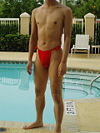 |
A traditional Japanese style of underwear, sometimes worn as swimwear. |
Body coverage
Swimsuits range from designs that almost completely cover the body to designs that expose almost all of the body. The choice of swimsuit will depend on personal and community standards of modesty
Modesty
Standards of modesty are aspects of the culture of a country or people, at a given point in time, and is a measure against which an individual in society may be judged....
and on considerations such as how much or how little sun protection
Sun protective clothing
Sun protective clothing is clothing specifically designed for sun protection and is produced from a fabric rated for its level of ultraviolet protection. A novel weave structure and denier may produce sun protective properties...
is desired, and prevailing fashions. Almost all swimsuits cover the genitals and pubic hair
Pubic hair
Pubic hair is hair in the frontal genital area, the crotch, and sometimes at the top of the inside of the legs; these areas form the pubic region....
, while most except thongs
Thong (clothing)
The thong is a garment generally worn as either underwear or as a swimsuit in many industrialized societies around the world. It may also be worn for traditional ceremonies or competitions such as sumo wrestling...
cover much or all of the buttocks
Buttocks
The buttocks are two rounded portions of the anatomy, located on the posterior of the pelvic region of apes and humans, and many other bipeds or quadrupeds, and comprise a layer of fat superimposed on the gluteus maximus and gluteus medius muscles. Physiologically, the buttocks enable weight to...
. Most swimsuits in western culture
Western culture
Western culture, sometimes equated with Western civilization or European civilization, refers to cultures of European origin and is used very broadly to refer to a heritage of social norms, ethical values, traditional customs, religious beliefs, political systems, and specific artifacts and...
leave at least the head, shoulders, arms, and lower part of the leg (below the knee) exposed. Women's swimsuits generally cover at least the aereola and bottom half of the breast
Breast
The breast is the upper ventral region of the torso of a primate, in left and right sides, which in a female contains the mammary gland that secretes milk used to feed infants.Both men and women develop breasts from the same embryological tissues...
s, but some are designed for the top part of the swimsuit to be removed . In many countries, young girls and sometimes women choose not to wear a swimsuit top, and this can vary with the occasion, location, age, etc. Men's swimsuits which cover the upper body are relatively rare in western culture.
Both men and women may sometimes wear swimsuits covering more of the body when swimming in cold water (see also wetsuit
Wetsuit
A wetsuit is a garment, usually made of foamed neoprene, which is worn by surfers, divers, windsurfers, canoeists, and others engaged in water sports, providing thermal insulation, abrasion resistance and buoyancy. The insulation properties depend on bubbles of gas enclosed within the material,...
and dry suit
Dry suit
A dry suit or drysuit provides thermal insulation or passive thermal protection to the wearer while immersed in water, and is worn by divers, boaters, water sports enthusiasts, and others who work or play in or near cold water. A dry suit normally protects the whole body except the head, hands, and...
). In colder temperatures, the swimwear is needed to conserve body heat and protect the body core from hypothermia.
Competitive swimwear
Some swimsuits are designed specifically for swimming competitions where they may be constructed of a special low resistance fabric. They reduce skin drag, and can resemble unitardUnitard
A unitard is a skin-tight one-piece garment with long legs and sometimes long sleeves. It differs from a leotard in that a leotard does not have long legs. The garment can be considered to be a combination of a leotard and tights...
s. For some kinds of swimming and diving, special bodysuits called diveskins are worn. These suits are made from spandex
Spandex
Spandex or elastane is a synthetic fibre known for its exceptional elasticity. It is strong, but less durable than natural Latex, its major non-synthetic competitor. It is a polyurethane-polyurea copolymer that was co-invented in 1959 by chemists C. L. Sandquist and Joseph Shivers at DuPont's...
and provide little thermal protection, but they do protect the skin from stings and abrasion. Most competitive swimmers also wear special swimsuits including partial and full bodysuits
Bodyskin
A bodyskin is a style of competitive swimwear worn by both female and male athletes. Bodyskins are normally made of technologically advanced lycra-based fabrics designed to hug the body tightly and provide increased speed and decreased drag resistance in the water.The bodyskin resembles the design...
, racerback
Racerback
A racerback is a type of women's swimsuit design common today among competitive swimwear and incorporated into some types of women's clothing. The top-back of the swimsuit is not covered to provide flexibility and movement of the arms during swimming....
styles, jammers and racing briefs to assist their glide through the water thus gaining a speed advantage (see competitive swimwear
Competitive swimwear
Competitive swimwear generally refers to the Swimsuit, apparel, equipment and accessories used in the aquatic sports of swimming, diving, synchronized swimming, triathlon and water polo.- Brands :Female Swimsuits*Racerback*Kneeskin*Bodyskin*LZR Racer...
).
Unlike regular swimsuits, which are designed mainly for the aesthetic appearances, swimsuits designed to be worn during competitions are manufactured to assist the athlete in swim competitions. They reduce friction and drag in the water, increasing the efficiency of the swimmer's forward motion. The tight fits allow for easy movement and are said to reduce muscle vibration, thus reducing drag. Starting around 2000, in an effort to improve the effectiveness of the swimsuits, engineers have taken to designing them to replicate the skin of sea based animals, sharks in particular.
In July 2009, FINA
International Swimming Federation
Fédération Internationale de Natation is the International Federation recognized by the International Olympic Committee for administering international competition in the aquatic sports...
voted to ban non-textile (non-woven) swimsuits in competitive events from 2010. The new policy was implemented to combat the issues associated with performance enhancing costumes, hindering the ability to accurately measure the performance of swimmers. Subsequently, the new ruling states that men's swimsuits may maximally cover the area from the navel to the knee, and women's' counterparts from the shoulder to the knee.
Swimwear and hygiene
Germs, bacteria, and mold can grow very quickly on wet bathing suits. Medical professionals warn that wearing damp swimwear for long periods of time can cause a number of infections and rashes in children and adults, and warn against sharing bathing suits with others. They suggest changing out of a wet bathing suit right away can help prevent vaginal infections and itching in females and Tinea Cruris "Jock Itch" in males.History
In classical antiquityClassical antiquity
Classical antiquity is a broad term for a long period of cultural history centered on the Mediterranean Sea, comprising the interlocking civilizations of ancient Greece and ancient Rome, collectively known as the Greco-Roman world...
swimming and bathing was done nude. There are Roman murals which show women playing sports and exercising wearing two-piece suits covering the areas around their breasts and hips in a fashion remarkably similar to the present-day bikini. However, there is no evidence that they were used for swimming. All classical pictures of swimming show nude swimmers.
In various cultural traditions one swims, if not in the nude, in a version in suitable material of a garment or undergarment commonly worn on land, e.g. a loincloth
Loincloth
A loincloth is a one-piece male garment, sometimes kept in place by a belt, which covers the genitals and, at least partially, the buttocks.-History and types:Loincloths are being and have been worn:*in societies where no other clothing is needed or wanted...
such as the Japanese man's fundoshi
Fundoshi
is the traditional Japanese undergarment for adult males, made from a length of cotton. Before World War II, the fundoshi was the main form of underwear for Japanese adult males...
.
In the United Kingdom until the mid-19th century there was no law against nude swimming, with each town being free to make its own laws. For example, the Bath Corporation official bathing dress code of 1737 prescribed, for men:
- It is Ordered Established and Decreed by this Corporation that no Male person above the age of ten years shall at any time hereafter go into any Bath or Baths within this City by day or by night without a Pair of DrawersDrawersDrawer or Drawers may refer to:* Drawer * A person who engages in drawing pictures* Payor, a person who draws a bill of exchange* Undergarment, underwear* Drawer test, a test used to detect rupture of the cruciate ligaments in the knee...
and a WaistcoatWaistcoatA waistcoat or vest is a sleeveless upper-body garment worn over a dress shirt and necktie and below a coat as a part of most men's formal wear, and as the third piece of the three-piece male business suit.-Characteristics and use:...
on their bodies.
In rivers, lakes, streams and the sea men swam in the nude, where the practice was common. Those who didn't swim in the nude, stripped to their underwear. The English practice of men swimming in the nude was banned in the United Kingdom in 1860. Drawers, or caleçons as they were called, came into use in the 1860s. Even then there were many who protested against them and wanted to remain in the nude. Francis Kilvert
Francis Kilvert
Robert Francis Kilvert , always known as Francis, or Frank, was born at The Rectory, Hardenhuish Lane, near Chippenham, Wiltshire, to the Rev. Robert Kilvert, Rector of Langley Burrell, Wiltshire, and Thermuthis, daughter of Walter Coleman and Thermuthis Ashe...
described men's bathing suits coming into use in the 1870s as "a pair of very short red and white striped drawers".
Female bathing costumes were derived from those worn at Bath and other spas. It would appear that until the 1670s nude female bathing in the spas was the norm and that after that time women bathed clothed. Celia Fiennes gave a detailed description of the standard ladies' bathing costume in 1687:
- The Ladyes go into the bath with Garments made of a fine yellow canvas, which is stiff and made large with great sleeves like a parson’s gown; the water fills it up so that it is borne off that your shape is not seen, it does not cling close as other linning, which Lookes sadly in the poorer sort that go in their own linning. The Gentlemen have drawers and wastcoates of the same sort of canvas, this is the best linning, for the bath water will Change any other yellow.
The Bath Corporation official bathing dress code of 1737 prescribed, for women:
- No Female person shall at any time hereafter go into a Bath or Baths within this City by day or by night without a decent ShiftChemiseThe term chemise or shift can refer to the classic smock, or else can refer to certain modern types of women's undergarments and dresses...
on their bodies.
The Expedition of Humphrey Clinker was published in 1771 and its description of ladies’ bathing costume is different to that of Celia Fiennes a hundred years earlier:
- The ladies wear jackets and petticoats of brown linen, with chip hats, in which they fix their handkerchiefs to wipe the sweat from their faces; but, truly, whether it is owing to the steam that surrounds them, or the heat of the water, or the nature of the dress, or to all these causes together, they look so flushed, and so frightful, that I always turn my eyes another way.
Penelope Byrde points out that Smollett’s description may not be accurate, for he describes a two-piece costume, not the one piece shift or smock that most people describe and is depicted in contemporary prints. His description does, however, tally with Elizabeth Grant’s description of the guide’s costume at Ramsgate in 1811. The only difference is in the fabric the costumes are made of. Flannel, however, was a common fabric for sea bathing costumes as many believed the warmer fabric was necessary in cold water.
In the 18th century women wore "bathing gowns" in the water; these were long dresses of fabrics that would not become transparent when wet, with weights sewn into the hems so that they would not rise up in the water. The men's swim suit, a rather form-fitting wool garment with long sleeves and legs similar to long underwear, was developed and would change little for a century.
In the 19th century, the woman's two piece suit became common—the two pieces being a gown from shoulder to knees plus a set of trousers with leggings going down to the ankles.
In the Victorian era
Victorian era
The Victorian era of British history was the period of Queen Victoria's reign from 20 June 1837 until her death on 22 January 1901. It was a long period of peace, prosperity, refined sensibilities and national self-confidence...
, popular beach resorts were commonly equipped with bathing machine
Bathing machine
The bathing machine was a device, popular in the 18th and 19th centuries, to allow people to change out of their usual clothes, possibly change into swimwear and then wade in the ocean at beaches. Bathing machines were roofed and walled wooden carts rolled into the sea...
s designed to avoid the exposure of people in swimsuits, especially to people of the opposite sex.
In the United States, beauty contests of women in bathing costumes became popular from the 1880s. However, such contests were not regarded as respectable. Beauty contests became more respectable with the first modern "Miss America
Miss America
The Miss America pageant is a long-standing competition which awards scholarships to young women from the 50 states plus the District of Columbia, Puerto Rico and the US Virgin Islands...
" contest held in 1921, though less respectable beauty contests continued to be held. Norman Rockwell
Norman Rockwell
Norman Percevel Rockwell was a 20th-century American painter and illustrator. His works enjoy a broad popular appeal in the United States for their reflection of American culture. Rockwell is most famous for the cover illustrations of everyday life scenarios he created for The Saturday Evening...
judged the Miss America 1922
Miss America 1922
Miss America 1922, the 2nd Miss America pageant, was held at the Million Dollar Pier in Atlantic City, New Jersey on September 7, 1922. Joining the contestants during the "bathing revue," the parade of beauty pageant hopefuls, were the Mayor of Atlantic City and the entire police force, all...
bathing beauty contest along with Howard Chandler Christy
Howard Chandler Christy
Howard Chandler Christy was an American artist and illustrator famous for the "Christy Girl", similar to a "Gibson Girl".He was born in Morgan County and attended early school in Duncan Falls, Ohio...
and James Montgomery Flagg
James Montgomery Flagg
James Montgomery Flagg was an American artist and illustrator. He worked in media ranging from fine art painting to cartooning, but is best remembered for his political posters....
. They were all unclear as to how to judge the contest. One judge suggested that they judge each part or feature of the body out of ten, then the woman with the total highest score would win. After they had tried the system, they discovered that although one woman might have beautiful individual parts for features, she might not be beautiful over all. So they "...gave up trying to figure out a system and resolved to trust our eyes. It led to squabbles, because all of us didn't see things in the same way, but it was the best we could do."
In 1907, the swimmer Annette Kellerman
Annette Kellerman
Annette Marie Sarah Kellerman was an Australian professional swimmer, vaudeville and film star, and writer...
from Australia
Australia
Australia , officially the Commonwealth of Australia, is a country in the Southern Hemisphere comprising the mainland of the Australian continent, the island of Tasmania, and numerous smaller islands in the Indian and Pacific Oceans. It is the world's sixth-largest country by total area...
visited the United States as an "underwater ballerina", a version of synchronized swimming
Synchronized swimming
Synchronized swImming is a hybrid form of swimming, dance and gymnastics, consisting of swimmers performing a synchronized routine of elaborate moves in the water, accompanied by music....
involving diving into glass tanks. She was arrested for indecent exposure
Indecent exposure
Indecent exposure is the deliberate exposure in public or in view of the general public by a person of a portion or portions of his or her body, in circumstances where the exposure is contrary to local moral or other standards of appropriate behavior. Indecent exposure laws vary in different...
because her swimsuit showed arms, legs and the neck. Kellerman changed the suit to have long arms and legs and a collar, still keeping the close fit that revealed the shapes underneath. She later starred in several movies
Film
A film, also called a movie or motion picture, is a series of still or moving images. It is produced by recording photographic images with cameras, or by creating images using animation techniques or visual effects...
, including one about her life. She marketed a line of bathing suits and her style of one-piece suits came to be known as "the Annette Kellerman." The Annette Kellerman was considered the most offensive style of swimsuit in the 1920s and became the focus of censorship efforts.
Due to the figure-hugging nature of these garments, glamour photography
Glamour photography
Glamour photography is a genre of photography whereby the subjects, usually female, are portrayed in a romantic or sexually alluring way. The subjects may be fully clothed or seminude, but glamour photography stops short of deliberately arousing the viewer and being pornographic photography.Glamour...
since the 1940s and 1950s has often featured people wearing swimsuits. This subset of glamour photography eventually evolved into swimsuit photography exemplified by the Sports Illustrated
Sports Illustrated
Sports Illustrated is an American sports media company owned by media conglomerate Time Warner. Its self titled magazine has over 3.5 million subscribers and is read by 23 million adults each week, including over 18 million men. It was the first magazine with circulation over one million to win the...
annual swimsuit issues.
The first bikinis were introduced just after World War II
World War II
World War II, or the Second World War , was a global conflict lasting from 1939 to 1945, involving most of the world's nations—including all of the great powers—eventually forming two opposing military alliances: the Allies and the Axis...
. Early examples were not very different from the women's two pieces common since the 1920s, except that they had a gap below the breast line allowing for a section of bare midriff. They were named after Bikini Atoll
Bikini Atoll
Bikini Atoll is an atoll, listed as a World Heritage Site, in the Micronesian Islands of the Pacific Ocean, part of Republic of the Marshall Islands....
, the site of several nuclear weapons tests, for their supposed explosive effect on the viewer.
Through the 1950s, it was thought proper for the lower part of the bikini to come up high enough to cover the navel
Navel
The navel is a scar on the abdomen caused when the umbilical cord is removed from a newborn baby...
. From the 1960s on, the bikini shrank in all directions until it sometimes covered little more than the nipples and genitalia, although less revealing models giving more support to the breasts remained popular. At the same time, fashion designer Rudi Gernreich
Rudi Gernreich
Rudi Gernreich was a Austrian-born American fashion designer and gay activist.-Biography:Born in Vienna, Gernreich fled Austria at age 16 due to Nazism, and later migrated to the United States, settling in Los Angeles, California...
introduced the monokini
Monokini
A monokini, sometimes referred to as a unikini, is a woman's one-piece garment comprising only the lower half of a bikini, leaving the breasts uncovered...
, a topless suit for women consisting of a modest bottom supported by two thin straps. Although not a commercial success, the suit opened eyes to new design possibilities. In the 1980s the thong or "tanga" came out of Brazil
Brazil
Brazil , officially the Federative Republic of Brazil , is the largest country in South America. It is the world's fifth largest country, both by geographical area and by population with over 192 million people...
, said to have been inspired by traditional garments of native tribes in the Amazon
Amazon Basin
The Amazon Basin is the part of South America drained by the Amazon River and its tributaries that drains an area of about , or roughly 40 percent of South America. The basin is located in the countries of Bolivia, Brazil, Colombia, Ecuador, Guyana, Peru, and Venezuela...
. However, the one-piece suit continued to be popular for its more modest approach.
Men's swimsuits developed roughly in parallel to women's during this period, with the shorts covering progressively less. Eventually racing-style "speedo" suits became popular—and not just for their speed advantages. Thongs
Thong (clothing)
The thong is a garment generally worn as either underwear or as a swimsuit in many industrialized societies around the world. It may also be worn for traditional ceremonies or competitions such as sumo wrestling...
, G-strings, and bikini
Bikini
The bikini is typically a women's two-piece swimsuit. One part of the attire covers the breasts and the other part covers the crotch and part of or the entire buttocks, leaving an uncovered area between the two. Merriam–Webster describes the bikini as "a woman's scanty two-piece bathing suit" or "a...
style suits are also worn, typically these are more popular in more tropical regions; however, they may also be worn at public swimming pools and inland lakes. But in the 1990s, longer and baggier shorts became popular, with the hems often reaching to the knees. These were often worn lower on the hips than regular shorts.
Alternatives to swimsuits
Since the early twentieth century a naturist movement has developed in western countries that seeks a return to non sexual nakedness when swimming and during other appropriate activities.Some women prefer to engaging in water or sun activities with the torso uncovered. The practice is often described as "toplessness
Toplessness
Toplessness is the state in which a female's breasts are uncovered, with the areolae and nipples visible, usually in a public space. It can also refer to a female not wearing any clothing above the waist, which is the female equivalent to a male barechestedness.The history and even the present-day...
" or "topfreedom
Topfreedom
Topfreedom is a cultural and political movement seeking to advance gender equality by the recognition of the right of women and girls to be topless in public on the same basis that men and boys are permitted to be barechested. In addition, topfreedom advocates seek recognition of the right of...
". In some places around the world, nude beach
Nude beach
A nude beach is a beach where users are legally at liberty to be nude. Sometimes the terms clothing-optional beach or free beach are used. Nude bathing is one of the most common forms of nudity in public. As beaches are usually on public lands, any member of the public is entitled to use the...
es have been set aside for people who choose to engage in normal beach activities in the nude.
As an alternative to a swimsuit, some people wear trousers
Trousers
Trousers are an item of clothing worn on the lower part of the body from the waist to the ankles, covering both legs separately...
, underpants
Underpants
-Boxer shorts:Boxer shorts, or simply boxers, have an elasticated waistband that is at or near the wearer's waist, while the leg sections are fairly loose and extend to the mid-thigh. There is usually a fly, either with or without buttons...
or a T-shirt
T-shirt
A T-shirt is a style of shirt. A T-shirt is buttonless and collarless, with short sleeves and frequently a round neck line....
either as a make-shift swimsuit or because they prefer regular clothes over swimsuits
Wetlook
Wetlook is the enjoyment of a person or people wearing wet clothing. It can also refer to the act of getting wet while wearing clothes, and having fun either in doing so or in watching others do it...
. In some countries, such as Thailand, swimming in regular clothes is the norm while swimsuits are rare. At beaches, this may be more accepted than at swimming pools, which tend not to permit the practice because underwear is unlined, may become translucent, and may be perceived as unclean.
In New Zealand and Australian English
In New Zealand EnglishNew Zealand English
New Zealand English is the dialect of the English language used in New Zealand.The English language was established in New Zealand by colonists during the 19th century. It is one of "the newest native-speaker variet[ies] of the English language in existence, a variety which has developed and...
, swimsuits are almost always called togs or, occasionally, bathers. They are less commonly called "cossies", which along with "bathers" is the Australian term. The term "togs" is less common in other parts of the Commonwealth
Commonwealth English
The use of the English language in most member countries of the Commonwealth of Nations was inherited from British colonisation. English is spoken as a first or second language in most of the Commonwealth. In a few countries, such as Cyprus and Malaysia, it does not have official status, but is...
, where it can also refer to clothes in general.
See also
- Competitive swimwearCompetitive swimwearCompetitive swimwear generally refers to the Swimsuit, apparel, equipment and accessories used in the aquatic sports of swimming, diving, synchronized swimming, triathlon and water polo.- Brands :Female Swimsuits*Racerback*Kneeskin*Bodyskin*LZR Racer...
- Thong (clothing)Thong (clothing)The thong is a garment generally worn as either underwear or as a swimsuit in many industrialized societies around the world. It may also be worn for traditional ceremonies or competitions such as sumo wrestling...
- BikiniBikiniThe bikini is typically a women's two-piece swimsuit. One part of the attire covers the breasts and the other part covers the crotch and part of or the entire buttocks, leaving an uncovered area between the two. Merriam–Webster describes the bikini as "a woman's scanty two-piece bathing suit" or "a...
- Drysuit
- SurfingSurfingSurfing' is a surface water sport in which the surfer rides a surfboard on the crest and face of a wave which is carrying the surfer towards the shore...
- Swimming
- WetsuitWetsuitA wetsuit is a garment, usually made of foamed neoprene, which is worn by surfers, divers, windsurfers, canoeists, and others engaged in water sports, providing thermal insulation, abrasion resistance and buoyancy. The insulation properties depend on bubbles of gas enclosed within the material,...
- List of swimwear manufacturers
- WetlookWetlookWetlook is the enjoyment of a person or people wearing wet clothing. It can also refer to the act of getting wet while wearing clothes, and having fun either in doing so or in watching others do it...
External links
- Bikini Science—an examination and classification of women's swimwear