

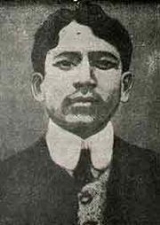
Madan Lal Dhingra

Encyclopedia
Madan Lal Dhingra was an Indian revolutionary freedom fighter. While studying in England, he assassinated Sir William Hutt Curzon Wyllie, a British official, hailed as one of the first acts of revolution in the Indian independence movement
in the 20th century.
Khatri
family in the province of Punjab
, British India. His father Ditta Mal was a wealthy civil
surgeon
.
Dhingra's family were loyalist
s of the British, and disowned him after his expulsion from college in Lahore
owing to illicit political activities. Dhingra had to work as a clerk, a Tonga
(horse-driven cart) puller, and a factory labourer. Dhingra attempted to organise a union there, but was sacked. He worked for sometime in Bombay, before acting upon the advice of his elder brother and going to England for higher studies. In 1906, Madan Lal departed for England to enroll at University College
, London, to study Mechanical Engineering
. He was supported by his elder brother and some nationalist activists in England.
and Shyamji Krishnavarma, who were impressed by Dhingra's perseverance and intense patriotism
, and turned his focus to the freedom struggle. Savarkar believed in revolution by any means, and supposedly gave Dhingra arms training, apart from membership in a secretive society, the Abhinav Bharat Mandal. He was also a member of India House
, the base for Indian student political activity.
During this period, Savarkar, Dhingra and other student activists were enraged by the execution of freedom fighters such as Khudiram Bose
, Kannai Dutt, Satinder Pal and Pandit Kanshi Ram
in India. It is this event that is attributed by many historians as having led Savarkar and Dhingra to exact direct revenge upon the British.
. When Sir Curzon Wyllie, political aide-de-camp
to the Secretary of State for India
, entered the hall with his wife, Dhingra fired five shots right at his face, four of which hit their target. Cowasji Lalkaka, a Parsee doctor who tried to save Sir Curzon, died of Madan Lal's sixth and seventh bullets, which the latter fired because Lalkaka caught hold of him.
Failing to commit suicide by turning his pistol on himself, Dhingra was arrested after a brief struggle.
on 23 July. He stated that he did not regret killing of Curzon Wyllie as he had played his part in order to set India free from the inhuman British rule. Also, that he had not intended to kill Cowasji Lalkaka.
He was sentenced to death. After the judge announced his verdict, Dhingra is said to have stated, "I am proud to have the honour of laying down my life for my country. But remember we shall have our time in the days to come." Contemporary press reports record a somewhat different version. Dhingra was hanged on 17 August 1909. Given the somewhat arrogant comment he made upon hearing the verdict, there is a further comment which is rarely mentioned. According to John Laurence in A History of Capital Punishment on page 138, H. A. Pierrepoint
, his executioner gave him a long drop of eight feet, three inches at the execution.
and moderate Indians condemned Dhingra's act, it nevertheless excited the Indian community in England and back in India. Guy Aldred
, the printer of The Indian Sociologist
was sentenced to twelve months hard labour. The August issue of The Indian Sociologist had carried a story sympathetic to Dhingra. Dhingra's actions also inspired some in the Irish, who were fighting their own struggle at the time.
Some modern historians claim that the trial was grossly unfair and biased. Dhingra was not given a defence counsel (though this was at his own request, in support of his contention that no British court had authority to try him), and the entire process was completed in a single day. Some legal experts claim that it was not the business of the court at the time to decide the time and location of execution.
Gandhiji condemned Dhingra's actions. To quote,
rites and was buried by British authorities. His family having disowned him, the authorities refused to turn over the body to Savarkar. Dhingra's body was accidentally found while authorities searched for the remains of Shaheed Udham Singh
, and re-patriated to India on 13 December 1976. Dhingra is widely remembered in India today, and was an inspiration at the time to revolutionaries like Bhagat Singh and Chandrasekhar Azad
.
Indian independence movement
The term Indian independence movement encompasses a wide area of political organisations, philosophies, and movements which had the common aim of ending first British East India Company rule, and then British imperial authority, in parts of South Asia...
in the 20th century.
Early life
Madan Lal Dhingra was born on 18 September 1883 (disputed) to a prosperous HinduHindu
Hindu refers to an identity associated with the philosophical, religious and cultural systems that are indigenous to the Indian subcontinent. As used in the Constitution of India, the word "Hindu" is also attributed to all persons professing any Indian religion...
Khatri
Khatri
Khatri is a caste from the northern Indian subcontinent. Khatris in India are mostly from Punjab, region but later they migrated to regions like Rajasthan, Uttar Pradesh, Delhi, Jammu, Uttarkhand, Himachal Pradesh, Gujarat, Madhya Pradesh, Haryana, Balochistan, Sindh and Khyber...
family in the province of Punjab
Punjab region
The Punjab , also spelled Panjab |water]]s"), is a geographical region straddling the border between Pakistan and India which includes Punjab province in Pakistan and the states of the Punjab, Haryana, Himachal Pradesh, Chandigarh and some northern parts of the National Capital Territory of Delhi...
, British India. His father Ditta Mal was a wealthy civil
Civil
Civil may refer to:*Civic virtue, or civility*Civil action, or lawsuit*Civil affairs*Civil and political rights*Civil disobedience*Civil engineering*Civilian, someone not a member of armed forces*Civil law , multiple meanings...
surgeon
Surgeon
In medicine, a surgeon is a specialist in surgery. Surgery is a broad category of invasive medical treatment that involves the cutting of a body, whether human or animal, for a specific reason such as the removal of diseased tissue or to repair a tear or breakage...
.
Dhingra's family were loyalist
Loyalist
In general, a loyalist is someone who maintains loyalty to an established government, political party, or sovereign, especially during war or revolutionary change. In modern English usage, the most common application is to loyalty to the British Crown....
s of the British, and disowned him after his expulsion from college in Lahore
Lahore
Lahore is the capital of the Pakistani province of Punjab and the second largest city in the country. With a rich and fabulous history dating back to over a thousand years ago, Lahore is no doubt Pakistan's cultural capital. One of the most densely populated cities in the world, Lahore remains a...
owing to illicit political activities. Dhingra had to work as a clerk, a Tonga
Tonga
Tonga, officially the Kingdom of Tonga , is a state and an archipelago in the South Pacific Ocean, comprising 176 islands scattered over of ocean in the South Pacific...
(horse-driven cart) puller, and a factory labourer. Dhingra attempted to organise a union there, but was sacked. He worked for sometime in Bombay, before acting upon the advice of his elder brother and going to England for higher studies. In 1906, Madan Lal departed for England to enroll at University College
University College London
University College London is a public research university located in London, United Kingdom and the oldest and largest constituent college of the federal University of London...
, London, to study Mechanical Engineering
Mechanical engineering
Mechanical engineering is a discipline of engineering that applies the principles of physics and materials science for analysis, design, manufacturing, and maintenance of mechanical systems. It is the branch of engineering that involves the production and usage of heat and mechanical power for the...
. He was supported by his elder brother and some nationalist activists in England.
With Savarkar
Dhingra came into contact with noted Indian independence & political activists Vinayak Damodar SavarkarVinayak Damodar Savarkar
Vināyak Dāmodar Sāvarkar was an Indian freedom fighter, revolutionary and politician. He was the proponent of liberty as the ultimate ideal. Savarkar was a poet, writer and playwright...
and Shyamji Krishnavarma, who were impressed by Dhingra's perseverance and intense patriotism
Patriotism
Patriotism is a devotion to one's country, excluding differences caused by the dependencies of the term's meaning upon context, geography and philosophy...
, and turned his focus to the freedom struggle. Savarkar believed in revolution by any means, and supposedly gave Dhingra arms training, apart from membership in a secretive society, the Abhinav Bharat Mandal. He was also a member of India House
India House
India House was an informal Indian nationalist organisation based in London between 1905 and 1910. With the patronage of Shyamji Krishna Varma, its home in a student residence in Highgate, North London was launched to promote nationalist views among Indian students in Britain...
, the base for Indian student political activity.
During this period, Savarkar, Dhingra and other student activists were enraged by the execution of freedom fighters such as Khudiram Bose
Khudiram Bose
Khudiram Bose was a Bengali revolutionary, one of the youngest revolutionaries early in the Indian independence movement...
, Kannai Dutt, Satinder Pal and Pandit Kanshi Ram
Pandit Kanshi Ram
Pandit Kanshi Ram was an Indian revolutionary who, along with Har Dayal and Sohan Singh Bhakna was one of the three key members in founding the Ghadar Party. He served as the treasurer of the party from its foundation in 1913 to 1914...
in India. It is this event that is attributed by many historians as having led Savarkar and Dhingra to exact direct revenge upon the British.
Curzon Wyllie's assassination
On the evening of 1 July 1909, a large number of Indians and Englishmen had gathered to attend the annual day function of the Indian National AssociationIndian National Association
The Indian National Association was the first avowed nationalist organization founded in British India by Surendranath Banerjea and Anand Mohan Bose in 1876. The objectives of this Association were “promoting by every legitimate means the political, intellectual and material advancement of the...
. When Sir Curzon Wyllie, political aide-de-camp
Aide-de-camp
An aide-de-camp is a personal assistant, secretary, or adjutant to a person of high rank, usually a senior military officer or a head of state...
to the Secretary of State for India
Secretary of State for India
The Secretary of State for India, or India Secretary, was the British Cabinet minister responsible for the government of India and the political head of the India Office...
, entered the hall with his wife, Dhingra fired five shots right at his face, four of which hit their target. Cowasji Lalkaka, a Parsee doctor who tried to save Sir Curzon, died of Madan Lal's sixth and seventh bullets, which the latter fired because Lalkaka caught hold of him.
Failing to commit suicide by turning his pistol on himself, Dhingra was arrested after a brief struggle.
Trial
Dhingra was tried in the Old BaileyOld Bailey
The Central Criminal Court in England and Wales, commonly known as the Old Bailey from the street in which it stands, is a court building in central London, one of a number of buildings housing the Crown Court...
on 23 July. He stated that he did not regret killing of Curzon Wyllie as he had played his part in order to set India free from the inhuman British rule. Also, that he had not intended to kill Cowasji Lalkaka.
He was sentenced to death. After the judge announced his verdict, Dhingra is said to have stated, "I am proud to have the honour of laying down my life for my country. But remember we shall have our time in the days to come." Contemporary press reports record a somewhat different version. Dhingra was hanged on 17 August 1909. Given the somewhat arrogant comment he made upon hearing the verdict, there is a further comment which is rarely mentioned. According to John Laurence in A History of Capital Punishment on page 138, H. A. Pierrepoint
Henry Pierrepoint
Henry Albert Pierrepoint was one of the United Kingdom's executioners from 1901 until 1910. He was the father of Albert and brother of Thomas....
, his executioner gave him a long drop of eight feet, three inches at the execution.
Reactions
While most of the British press, and some liberalLiberalism
Liberalism is the belief in the importance of liberty and equal rights. Liberals espouse a wide array of views depending on their understanding of these principles, but generally, liberals support ideas such as constitutionalism, liberal democracy, free and fair elections, human rights,...
and moderate Indians condemned Dhingra's act, it nevertheless excited the Indian community in England and back in India. Guy Aldred
Guy Aldred
Guy Alfred Aldred - often Guy A. Aldred - was a British anarchist communist and a prominent member of the Anti-Parliamentary Communist Federation...
, the printer of The Indian Sociologist
The Indian Sociologist
The Indian Sociologist was an Indian nationalist publication in the early twentieth century. Its subtitle was An Organ of Freedom, and Political, Social, and Religious Reform....
was sentenced to twelve months hard labour. The August issue of The Indian Sociologist had carried a story sympathetic to Dhingra. Dhingra's actions also inspired some in the Irish, who were fighting their own struggle at the time.
Some modern historians claim that the trial was grossly unfair and biased. Dhingra was not given a defence counsel (though this was at his own request, in support of his contention that no British court had authority to try him), and the entire process was completed in a single day. Some legal experts claim that it was not the business of the court at the time to decide the time and location of execution.
Gandhiji condemned Dhingra's actions. To quote,
Statement
This statement was said just before he died at the gallows:Remembrance
At the time, Dhingra's body was denied HinduHindu
Hindu refers to an identity associated with the philosophical, religious and cultural systems that are indigenous to the Indian subcontinent. As used in the Constitution of India, the word "Hindu" is also attributed to all persons professing any Indian religion...
rites and was buried by British authorities. His family having disowned him, the authorities refused to turn over the body to Savarkar. Dhingra's body was accidentally found while authorities searched for the remains of Shaheed Udham Singh
Udham Singh
Udham Singh was an Indian independence activist, best known for assassinating Michael O'Dwyer in March 1940 in what has been described as an avenging of the Jallianwalla Bagh Massacre....
, and re-patriated to India on 13 December 1976. Dhingra is widely remembered in India today, and was an inspiration at the time to revolutionaries like Bhagat Singh and Chandrasekhar Azad
Chandrasekhar Azad
Chandra Shekhar Azad , was one of the most important Indian revolutionaries who reorganised the Hindustan...
.
Further reading
- Laurence, John (1930). A History of Capital Punishment, London, Sampson Low, Marston, & Co.
- Waraich, Malwinder Jit Singh & Kuldip Puri (2003). Tryst with Martyrdom: Trial of Madan Lal Dhingra (July–August 1909), Chandigarh: Unistar, ISBN 81-86898-72-7.
External links
- http://www.wpb.be/lalkar/lalkar01/04dhingr.htm
- The trial of Madan Lal Dhingra. The Proceedings of the Old Bailey, 1674-1913. Old Bailey Online.