

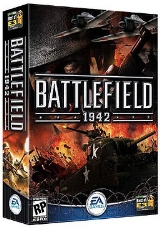
Battlefield 1942

Encyclopedia
Battlefield 1942 is a 3D
World War II
first-person shooter
(FPS) computer game developed by Swedish company Digital Illusions CE and published by Electronic Arts
for Microsoft Windows
(2002) and Apple Macintosh (2004). The game can be played in singleplayer mode against the computer game AI or in multiplayer
mode against players on the Internet
or in a Local Area Network. It is also a popular platform for mod
developers, with a large number of released modifications that alter the gameplay and theme.
In-game, players assume the role of one of five classes of infantry
: Scout, Assault, Anti-Tank, Medic, and Engineer. Players also have the ability to fly various World War II
fighter aircraft
and bomber
s, navigate capital ships, submarine
s and aircraft carrier
s, man coastal artillery
defenses, drive tank
s, APC
s and jeep
s, and take control of anti-aircraft guns and mounted machine guns.
Each battle takes place on one of several maps located in a variety of places and famous battlefields in all of the major theaters of World War II: the Pacific
, European, North African
, Eastern
, and Italian
Fronts. Combat is always fought between the Axis Powers and the Allies
. The location determines which nation-specific armies are used (for example, on the Wake Island
map, it is Japan
versus the United States
, while on the Battle of Britain
map, it is Germany
versus the United Kingdom
). The maps in Battlefield 1942 are based on real battles and are somewhat realistically portrayed.
The default game play mode, Conquest, centers on the capture and control of control points; once a team captures a control point, its members can respawn from it. When a team loses control of all their control points, they cannot respawn. And if no one is alive, the team with no "spawn" points loses.
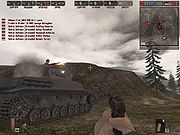 Games are composed of rounds. A team wins the round when the other team runs out of tickets. A team loses tickets when its members are killed, but also when the other team holds half or more than half of the capture points on the map. Therefore, sometimes the winning team must hunt down straggling or hiding enemy forces at the end of a round.
Spawn tickets also play a vital role in the success of both teams. Every time a player on a team dies and respawns, his team loses one ticket. Every team starts each round with between 150 and 300 tickets, depending on the team's role (e.g., defense). Teams also gradually lose tickets depending on how many spawn points they control. As a general rule, the fewer spawn points controlled by a team, the more tickets they lose. For a team of 32 on a 64 player map, with 150 tickets, this means a little less than 5 re spawns or deaths on average for every player if they hold their starting spawn points.
, the United Kingdom
, the Soviet Union
, Canada
, and the Free French Forces
, while the Axis consists of Germany
, Japan
, and Italy
. Regardless of which nation is chosen by the player, there are five different roles of infantry that the player can assume the role of: Scout
, Assault, Medic
, Anti-tank, and Engineer.
Each role has its own strength and weakness. For example, the scout role has long-range surveillance, high stopping power
and the ability to provide spotting for artillery shelling against an enemy position (unlike other games with a similar feature, other player characters must also supply the artillery fire); however, the sniper rifle
is not designed to be used in close-quarter combat and players frequently treat this role as just a plain sniper
role by not providing spotting for artillery. Assault is the standard role, and provides very aggressive firepower. The Anti-tank role specializes against vehicles and tanks, but their main weapon is innacurate against enemy infantry. The Medic role has the ability to heal (himself and other players), but his sub-machine gun has less stopping power than the Assault's weapons. The Engineer has the ability to repair damaged vehicles and stationary weapons, and they also have the ability to deploy explosives
, which are highly effective against both enemy infantry and vehicles, and land mines, which destroy enemy vehicles on contact. In Europe, the engineer is equipped with a bolt action rifle, normally a scopeless version of that team's sniper rifle. In the Pacific, the American Engineer is issued an M1 Garand
rifle, while his Japanese counterpart uses the similar Type 5
.
computer game, set in an alternate history
World War I
. It featured single and multiplayer modes. The earlier Refractor 1 engine had more arcade-style physics and a less realistic focus than its successor, Refractor 2
, which was used in BF2. A Macintosh-compatible version of BF1942 was also made and released by Aspyr Media
in mid-2004. An Xbox
version of the game was also announced in early 2001 but was cancelled almost two years later so Electronic Arts could more closely work on an expansion pack for the PC. Due to the restriction
on use of the swastika
in Germany, the Weimar Republic flag is used instead of the WWII era Reichskriegsflagge by the German side.
The creators of Battlefield 1942 have released expansion packs entitled Battlefield 1942: The Road to Rome
(which adds the Italian Front
) and Battlefield 1942: Secret Weapons of WWII
. Both add various new gameplay modes and design concepts. The Road to Rome features a focus on the Italian battles and allows players to play as the Free French forces
or as the Italian Army. Secret Weapons of WWII focuses on prototype, experimental, and rarely used weapons and vehicles (such as jet packs), as well as weapons not featured in the previous games. It adds downloadable patches
, fixes bugs in the game, and it adds some extra content (such as the Battle for Hellendoorn map). Battlefield 1942 Deluxe Edition includes original game and Battlefield 1942: The Road To Rome. Battlefield 1942: World War II Anthology added Battlefield 1942: Secret Weapons of WWII
expansion pack. Battlefield 1942: The Complete Collection added Battlefield Vietnam
and Battlefield Vietnam WWII Mod.
, the game has an average score of 89 out of 100, based on 27 reviews. At 6th annual Interactive Achievement Awards, BF1942 received awards for Online Gameplay, Innovation in PC Gaming, PC Game of the Year, and Game of the Year. On March, 2010 Battlefield 1942 was awarded with "Swedish game of the decade" award at the computer game gala hosted by Swedish Games Industry
Scott Osborne of GameSpot
gave the game a rating of 8.8 out of 10, calling it a "comic book version of WWII." Steve Butts of IGN
gave the game a rating of 9.3 out of 10, praising the multiplayer, but saying "the single player game leaves much to be desired."
was released for Xbox Live Arcade
and on PlayStation Network one day later. In 2005, a spiritual sequel set in the modern era, Battlefield 2
was released. In March 2004, Battlefield Vietnam
was released.
3D computer graphics
3D computer graphics are graphics that use a three-dimensional representation of geometric data that is stored in the computer for the purposes of performing calculations and rendering 2D images...
World War II
World War II
World War II, or the Second World War , was a global conflict lasting from 1939 to 1945, involving most of the world's nations—including all of the great powers—eventually forming two opposing military alliances: the Allies and the Axis...
first-person shooter
First-person shooter
First-person shooter is a video game genre that centers the gameplay on gun and projectile weapon-based combat through first-person perspective; i.e., the player experiences the action through the eyes of a protagonist. Generally speaking, the first-person shooter shares common traits with other...
(FPS) computer game developed by Swedish company Digital Illusions CE and published by Electronic Arts
Electronic Arts
Electronic Arts, Inc. is a major American developer, marketer, publisher and distributor of video games. Founded and incorporated on May 28, 1982 by Trip Hawkins, the company was a pioneer of the early home computer games industry and was notable for promoting the designers and programmers...
for Microsoft Windows
Microsoft Windows
Microsoft Windows is a series of operating systems produced by Microsoft.Microsoft introduced an operating environment named Windows on November 20, 1985 as an add-on to MS-DOS in response to the growing interest in graphical user interfaces . Microsoft Windows came to dominate the world's personal...
(2002) and Apple Macintosh (2004). The game can be played in singleplayer mode against the computer game AI or in multiplayer
Multiplayer game
A multiplayer video game is one which more than one person can play in the same game environment at the same time. Unlike most other games, computer and video games are often single-player activities that put the player against preprogrammed challenges and/or AI-controlled opponents, which often...
mode against players on the Internet
Internet
The Internet is a global system of interconnected computer networks that use the standard Internet protocol suite to serve billions of users worldwide...
or in a Local Area Network. It is also a popular platform for mod
Mod (computer gaming)
Mod or modification is a term generally applied to personal computer games , especially first-person shooters, role-playing games and real-time strategy games. Mods are made by the general public or a developer, and can be entirely new games in themselves, but mods are not standalone software and...
developers, with a large number of released modifications that alter the gameplay and theme.
In-game, players assume the role of one of five classes of infantry
Infantry
Infantrymen are soldiers who are specifically trained for the role of fighting on foot to engage the enemy face to face and have historically borne the brunt of the casualties of combat in wars. As the oldest branch of combat arms, they are the backbone of armies...
: Scout, Assault, Anti-Tank, Medic, and Engineer. Players also have the ability to fly various World War II
World War II
World War II, or the Second World War , was a global conflict lasting from 1939 to 1945, involving most of the world's nations—including all of the great powers—eventually forming two opposing military alliances: the Allies and the Axis...
fighter aircraft
Fighter aircraft
A fighter aircraft is a military aircraft designed primarily for air-to-air combat with other aircraft, as opposed to a bomber, which is designed primarily to attack ground targets...
and bomber
Bomber
A bomber is a military aircraft designed to attack ground and sea targets, by dropping bombs on them, or – in recent years – by launching cruise missiles at them.-Classifications of bombers:...
s, navigate capital ships, submarine
Submarine
A submarine is a watercraft capable of independent operation below the surface of the water. It differs from a submersible, which has more limited underwater capability...
s and aircraft carrier
Aircraft carrier
An aircraft carrier is a warship designed with a primary mission of deploying and recovering aircraft, acting as a seagoing airbase. Aircraft carriers thus allow a naval force to project air power worldwide without having to depend on local bases for staging aircraft operations...
s, man coastal artillery
Coastal artillery
Coastal artillery is the branch of armed forces concerned with operating anti-ship artillery or fixed gun batteries in coastal fortifications....
defenses, drive tank
Tank
A tank is a tracked, armoured fighting vehicle designed for front-line combat which combines operational mobility, tactical offensive, and defensive capabilities...
s, APC
Armoured personnel carrier
An armoured personnel carrier is an armoured fighting vehicle designed to transport infantry to the battlefield.APCs are usually armed with only a machine gun although variants carry recoilless rifles, anti-tank guided missiles , or mortars...
s and jeep
Jeep
Jeep is an automobile marque of Chrysler . The first Willys Jeeps were produced in 1941 with the first civilian models in 1945, making it the oldest off-road vehicle and sport utility vehicle brand. It inspired a number of other light utility vehicles, such as the Land Rover which is the second...
s, and take control of anti-aircraft guns and mounted machine guns.
Each battle takes place on one of several maps located in a variety of places and famous battlefields in all of the major theaters of World War II: the Pacific
Pacific War
The Pacific War, also sometimes called the Asia-Pacific War refers broadly to the parts of World War II that took place in the Pacific Ocean, its islands, and in East Asia, then called the Far East...
, European, North African
North African campaign
During the Second World War, the North African Campaign took place in North Africa from 10 June 1940 to 13 May 1943. It included campaigns fought in the Libyan and Egyptian deserts and in Morocco and Algeria and Tunisia .The campaign was fought between the Allies and Axis powers, many of whom had...
, Eastern
Eastern Front (World War II)
The Eastern Front of World War II was a theatre of World War II between the European Axis powers and co-belligerent Finland against the Soviet Union, Poland, and some other Allies which encompassed Northern, Southern and Eastern Europe from 22 June 1941 to 9 May 1945...
, and Italian
Italian Campaign (World War II)
The Italian Campaign of World War II was the name of Allied operations in and around Italy, from 1943 to the end of the war in Europe. Joint Allied Forces Headquarters AFHQ was operationally responsible for all Allied land forces in the Mediterranean theatre, and it planned and commanded the...
Fronts. Combat is always fought between the Axis Powers and the Allies
Allies of World War II
The Allies of World War II were the countries that opposed the Axis powers during the Second World War . Former Axis states contributing to the Allied victory are not considered Allied states...
. The location determines which nation-specific armies are used (for example, on the Wake Island
Battle of Wake Island
The Battle of Wake Island began simultaneously with the Attack on Pearl Harbor and ended on 23 December 1941, with the surrender of the American forces to the Empire of Japan...
map, it is Japan
Imperial Japanese Army
-Foundation:During the Meiji Restoration, the military forces loyal to the Emperor were samurai drawn primarily from the loyalist feudal domains of Satsuma and Chōshū...
versus the United States
Military history of the United States during World War II
The military history of the United States during World War II covers the involvement of the United States during World War II. The Empire of Japan declared war on the United States of America on 7 December 1941, immediately after the attack on Pearl Harbor on the same day. On 11 December 1941,...
, while on the Battle of Britain
Battle of Britain
The Battle of Britain is the name given to the World War II air campaign waged by the German Air Force against the United Kingdom during the summer and autumn of 1940...
map, it is Germany
Nazi Germany
Nazi Germany , also known as the Third Reich , but officially called German Reich from 1933 to 1943 and Greater German Reich from 26 June 1943 onward, is the name commonly used to refer to the state of Germany from 1933 to 1945, when it was a totalitarian dictatorship ruled by...
versus the United Kingdom
British Armed Forces
The British Armed Forces are the armed forces of the United Kingdom of Great Britain and Northern Ireland.Also known as Her Majesty's Armed Forces and sometimes legally the Armed Forces of the Crown, the British Armed Forces encompasses three professional uniformed services, the Royal Navy, the...
). The maps in Battlefield 1942 are based on real battles and are somewhat realistically portrayed.
Gameplay
The gameplay of Battlefield 1942 generally has a more cooperative focus than previous games of this nature, as it is not only important to kill the opposition but to also hold certain "control points" around the map. Capturing control points allow the team to reinforce themselves by enabling players and vehicles to spawn in the certain area. Consequently, capturing and controlling control points also would reduce enemy reinforcements. Battlefield 1942 was one of the first mainstream games to represent a dramatic shift in FPS game play mentality not only favoring individualism, but simultaneously encouraging teamwork and coordination.The default game play mode, Conquest, centers on the capture and control of control points; once a team captures a control point, its members can respawn from it. When a team loses control of all their control points, they cannot respawn. And if no one is alive, the team with no "spawn" points loses.
Spawn tickets also play a vital role in the success of both teams. Every time a player on a team dies and respawns, his team loses one ticket. Every team starts each round with between 150 and 300 tickets, depending on the team's role (e.g., defense). Teams also gradually lose tickets depending on how many spawn points they control. As a general rule, the fewer spawn points controlled by a team, the more tickets they lose. For a team of 32 on a 64 player map, with 150 tickets, this means a little less than 5 re spawns or deaths on average for every player if they hold their starting spawn points.
Roles
The player can choose to play as either the Allied powers or the Axis powers. The Allies consists of the United StatesUnited States
The United States of America is a federal constitutional republic comprising fifty states and a federal district...
, the United Kingdom
United Kingdom
The United Kingdom of Great Britain and Northern IrelandIn the United Kingdom and Dependencies, other languages have been officially recognised as legitimate autochthonous languages under the European Charter for Regional or Minority Languages...
, the Soviet Union
Soviet Union
The Soviet Union , officially the Union of Soviet Socialist Republics , was a constitutionally socialist state that existed in Eurasia between 1922 and 1991....
, Canada
Canada
Canada is a North American country consisting of ten provinces and three territories. Located in the northern part of the continent, it extends from the Atlantic Ocean in the east to the Pacific Ocean in the west, and northward into the Arctic Ocean...
, and the Free French Forces
Free French Forces
The Free French Forces were French partisans in World War II who decided to continue fighting against the forces of the Axis powers after the surrender of France and subsequent German occupation and, in the case of Vichy France, collaboration with the Germans.-Definition:In many sources, Free...
, while the Axis consists of Germany
Nazi Germany
Nazi Germany , also known as the Third Reich , but officially called German Reich from 1933 to 1943 and Greater German Reich from 26 June 1943 onward, is the name commonly used to refer to the state of Germany from 1933 to 1945, when it was a totalitarian dictatorship ruled by...
, Japan
Empire of Japan
The Empire of Japan is the name of the state of Japan that existed from the Meiji Restoration on 3 January 1868 to the enactment of the post-World War II Constitution of...
, and Italy
Kingdom of Italy (1861–1946)
The Kingdom of Italy was a state forged in 1861 by the unification of Italy under the influence of the Kingdom of Sardinia, which was its legal predecessor state...
. Regardless of which nation is chosen by the player, there are five different roles of infantry that the player can assume the role of: Scout
Scout Sniper
Scout Sniper is a secondary MOS designator of U.S. Marine Corps infantrymen and reconnaissance Marines that have successfully graduated from a USMC Scout Sniper School. Scout Snipers provide close reconnaissance and surveillance to the infantry battalion...
, Assault, Medic
Combat medic
Combat medics are trained military personnel who are responsible for providing first aid and frontline trauma care on the battlefield. They are also responsible for providing continuing medical care in the absence of a readily available physician, including care for disease and battle injury...
, Anti-tank, and Engineer.
Each role has its own strength and weakness. For example, the scout role has long-range surveillance, high stopping power
Stopping power
Stopping power is a colloquial term used to describe the ability of a firearm or other weapon to cause a penetrating ballistic injury to a target, human or animal, sufficient to incapacitate the target where it stands....
and the ability to provide spotting for artillery shelling against an enemy position (unlike other games with a similar feature, other player characters must also supply the artillery fire); however, the sniper rifle
Sniper rifle
In military and law enforcement terminology, a sniper rifle is a precision-rifle used to ensure more accurate placement of bullets at longer ranges than other small arms. A typical sniper rifle is built for optimal levels of accuracy, fitted with a telescopic sight and chambered for a military...
is not designed to be used in close-quarter combat and players frequently treat this role as just a plain sniper
Sniper
A sniper is a marksman who shoots targets from concealed positions or distances exceeding the capabilities of regular personnel. Snipers typically have specialized training and distinct high-precision rifles....
role by not providing spotting for artillery. Assault is the standard role, and provides very aggressive firepower. The Anti-tank role specializes against vehicles and tanks, but their main weapon is innacurate against enemy infantry. The Medic role has the ability to heal (himself and other players), but his sub-machine gun has less stopping power than the Assault's weapons. The Engineer has the ability to repair damaged vehicles and stationary weapons, and they also have the ability to deploy explosives
Composition C
The Composition C family is a family of related US-specified plastic explosives consisting primarily of RDX. All can be moulded by hand for use in demolition work and packed by hand into shaped charge devices. Variants have different proportions and plasticisers and include C-2, C-3, and C-4.The...
, which are highly effective against both enemy infantry and vehicles, and land mines, which destroy enemy vehicles on contact. In Europe, the engineer is equipped with a bolt action rifle, normally a scopeless version of that team's sniper rifle. In the Pacific, the American Engineer is issued an M1 Garand
M1 Garand
The M1 Garand , was the first semi-automatic rifle to be generally issued to the infantry of any nation. Called "the greatest battle implement ever devised" by General George S...
rifle, while his Japanese counterpart uses the similar Type 5
Type 5 Rifle
The Type 4 Rifle was a Japanese experimental semi-automatic rifle. It was a copy of the American M1 Garand but with an integral 10-round magazine and chambered for the Japanese 7.7×58mm Arisaka cartridge...
.
Development, marketing and release
Battlefield 1942 was built on the formula of the less successful Codename EagleCodename Eagle
Codename Eagle is a computer game developed by Stockholm-based studio Refraction Games and was released in November 1999. Refraction Games later merged with Digital Illusions CE and developed Battlefield 1942....
computer game, set in an alternate history
Alternate history (fiction)
Alternate history or alternative history is a genre of fiction consisting of stories that are set in worlds in which history has diverged from the actual history of the world. It can be variously seen as a sub-genre of literary fiction, science fiction, and historical fiction; different alternate...
World War I
World War I
World War I , which was predominantly called the World War or the Great War from its occurrence until 1939, and the First World War or World War I thereafter, was a major war centred in Europe that began on 28 July 1914 and lasted until 11 November 1918...
. It featured single and multiplayer modes. The earlier Refractor 1 engine had more arcade-style physics and a less realistic focus than its successor, Refractor 2
Refractor 2
Refractor Engine is a game engine that was designed by Stockholm-based studio Refraction Games, first developed for the video game Codename Eagle, which was released in November 1999. It was also the engine used in BF1942 as well as the two spin-offs, Vietnam and Road To Rome...
, which was used in BF2. A Macintosh-compatible version of BF1942 was also made and released by Aspyr Media
Aspyr Media
Aspyr Media, Inc. is an Austin, Texas based company that specializes in porting Windows games to Mac OS. It has been in business since 1996, and as of 2003 owns 60 percent of the Mac entertainment market...
in mid-2004. An Xbox
Xbox
The Xbox is a sixth-generation video game console manufactured by Microsoft. It was released on November 15, 2001 in North America, February 22, 2002 in Japan, and March 14, 2002 in Australia and Europe and is the predecessor to the Xbox 360. It was Microsoft's first foray into the gaming console...
version of the game was also announced in early 2001 but was cancelled almost two years later so Electronic Arts could more closely work on an expansion pack for the PC. Due to the restriction
Strafgesetzbuch § 86a
The German Strafgesetzbuch in § 86a outlaws "use of symbols of unconstitutional organisations". This concerns Nazi symbolism in particular and is part of the denazification efforts following the fall of the Third Reich....
on use of the swastika
Swastika
The swastika is an equilateral cross with its arms bent at right angles, in either right-facing form in counter clock motion or its mirrored left-facing form in clock motion. Earliest archaeological evidence of swastika-shaped ornaments dates back to the Indus Valley Civilization of Ancient...
in Germany, the Weimar Republic flag is used instead of the WWII era Reichskriegsflagge by the German side.
The creators of Battlefield 1942 have released expansion packs entitled Battlefield 1942: The Road to Rome
Battlefield 1942: The Road to Rome
Battlefield: 1942: The Road to Rome is an expansion pack for the Battlefield 1942 video game. It was released February 4, 2003 by Electronic Arts and developed by Digital Illusions CE...
(which adds the Italian Front
Italian Campaign (World War II)
The Italian Campaign of World War II was the name of Allied operations in and around Italy, from 1943 to the end of the war in Europe. Joint Allied Forces Headquarters AFHQ was operationally responsible for all Allied land forces in the Mediterranean theatre, and it planned and commanded the...
) and Battlefield 1942: Secret Weapons of WWII
Battlefield 1942: Secret Weapons of WWII
Battlefield 1942: Secret Weapons of WWII is the second of two expansions to the World War II first-person shooter computer game Battlefield 1942. It is developed by Digital Illusions CE and published by Electronic Arts for Microsoft Windows September 4, 2003 in North America and September 5, 2003...
. Both add various new gameplay modes and design concepts. The Road to Rome features a focus on the Italian battles and allows players to play as the Free French forces
Free French Forces
The Free French Forces were French partisans in World War II who decided to continue fighting against the forces of the Axis powers after the surrender of France and subsequent German occupation and, in the case of Vichy France, collaboration with the Germans.-Definition:In many sources, Free...
or as the Italian Army. Secret Weapons of WWII focuses on prototype, experimental, and rarely used weapons and vehicles (such as jet packs), as well as weapons not featured in the previous games. It adds downloadable patches
Patch (computing)
A patch is a piece of software designed to fix problems with, or update a computer program or its supporting data. This includes fixing security vulnerabilities and other bugs, and improving the usability or performance...
, fixes bugs in the game, and it adds some extra content (such as the Battle for Hellendoorn map). Battlefield 1942 Deluxe Edition includes original game and Battlefield 1942: The Road To Rome. Battlefield 1942: World War II Anthology added Battlefield 1942: Secret Weapons of WWII
Battlefield 1942: Secret Weapons of WWII
Battlefield 1942: Secret Weapons of WWII is the second of two expansions to the World War II first-person shooter computer game Battlefield 1942. It is developed by Digital Illusions CE and published by Electronic Arts for Microsoft Windows September 4, 2003 in North America and September 5, 2003...
expansion pack. Battlefield 1942: The Complete Collection added Battlefield Vietnam
Battlefield Vietnam
Battlefield Vietnam is the second video game in Electronic Arts' Battlefield franchise after Battlefield 1942. The game was developed by the Swedish company Digital Illusions CE and published by Electronic Arts on March 15, 2004 in North America and days later in other parts of the world....
and Battlefield Vietnam WWII Mod.
Reception
On the review aggregator GameRankings, the game has an average score of 89% based on 46 reviews. On MetacriticMetacritic
Metacritic.com is a website that collates reviews of music albums, games, movies, TV shows and DVDs. For each product, a numerical score from each review is obtained and the total is averaged. An excerpt of each review is provided along with a hyperlink to the source. Three colour codes of Green,...
, the game has an average score of 89 out of 100, based on 27 reviews. At 6th annual Interactive Achievement Awards, BF1942 received awards for Online Gameplay, Innovation in PC Gaming, PC Game of the Year, and Game of the Year. On March, 2010 Battlefield 1942 was awarded with "Swedish game of the decade" award at the computer game gala hosted by Swedish Games Industry
Scott Osborne of GameSpot
GameSpot
GameSpot is a video gaming website that provides news, reviews, previews, downloads, and other information. The site was launched in May 1, 1996 by Pete Deemer, Vince Broady and Jon Epstein. It was purchased by ZDNet, a brand which was later purchased by CNET Networks. CBS Interactive, which...
gave the game a rating of 8.8 out of 10, calling it a "comic book version of WWII." Steve Butts of IGN
IGN
IGN is an entertainment website that focuses on video games, films, music and other media. IGN's main website comprises several specialty sites or "channels", each occupying a subdomain and covering a specific area of entertainment...
gave the game a rating of 9.3 out of 10, praising the multiplayer, but saying "the single player game leaves much to be desired."
Sequel
On July 8, 2009, Battlefield 1943Battlefield 1943
Battlefield 1943 is an online multiplayer World War II first-person shooter video game developed by EA Digital Illusions CE and published by Electronic Arts for Xbox Live Arcade and PlayStation Network via digital download only. Unlike Battlefield 1942, this game takes place only in the Pacific...
was released for Xbox Live Arcade
Xbox Live Arcade
Xbox Live Arcade is a type of video game download distribution available primarily in a section of the Xbox Live Marketplace, Microsoft's digital distribution network for the Xbox 360, that focuses on smaller downloadable games from both major publishers and independent game developers...
and on PlayStation Network one day later. In 2005, a spiritual sequel set in the modern era, Battlefield 2
Battlefield 2
Battlefield 2 is a computer game by the Swedish developer Digital Illusions CE . During development, Trauma Studios contributed to the development of the game after it was acquired by DICE...
was released. In March 2004, Battlefield Vietnam
Battlefield Vietnam
Battlefield Vietnam is the second video game in Electronic Arts' Battlefield franchise after Battlefield 1942. The game was developed by the Swedish company Digital Illusions CE and published by Electronic Arts on March 15, 2004 in North America and days later in other parts of the world....
was released.