
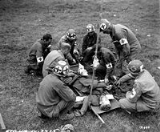
Combat medics are trained military personnel who are responsible for providing
first aidFirst aid is the provision of initial care for an illness or injury. It is usually performed by a lay person to a sick or injured casualty until definitive medical treatment can be accessed. Certain self-limiting illnesses or minor injuries may not require further medical care past the first aid...
and frontline
trauma careMedicine is the art and science of healing. It encompasses a range of health care practices evolved to maintain and restore health by the prevention and treatment of illness....
on the battlefield. They are also responsible for providing continuing medical care in the absence of a readily available physician, including care for disease and battle injury. Combat medics are normally co-located with the combat troops they serve in order to easily move with the troops and monitor ongoing health. In 1864, sixteen European states (referring to themselves as "High Contracting Parties"), adopted the
First Geneva ConventionThe First Geneva Convention, more formally known as the Convention for the Amelioration of the Condition of the Wounded in Armies in the Field, 1864, is the first in a series of international treaties which “are the basis on which rest the rules of international law for the protection of the...
to save lives, to alleviate the suffering of wounded and sick military personnel, and to protect trained medical personal as civilians, in the act of rendering aid.
Chapter IV, Article 25 of the Geneva Convention states that "Members of the armed forces specially trained for employment, should the need arise, as hospital orderlies, nurses or auxiliary stretcher-bearers, in the search for or the collection, transport or treatment of the wounded and sick shall likewise be respected and protected if they are carrying out these duties at the time when they come into contact with the enemy or fall into his hands."
Article 29 reads "Members of the personnel designated in Article 25 who have fallen into the hands of the enemy, shall be prisoners of war, but shall be employed on their medical duties insofar as the need arises."
According to the Geneva Convention, knowingly firing at a medic wearing clear insignia is a
war crime.War crimes are "violations of the laws or customs of war"; including "murder, the ill-treatment or deportation of civilian residents of an occupied territory to slave labor camps", "the murder or ill-treatment of prisoners of war", the killing of hostages, "the wanton destruction of cities, towns...
.
The
International Committee of the Red CrossThe International Committee of the Red Cross is a private humanitarian institution based in Geneva, Switzerland. States parties to the four Geneva Conventions of 1949 and their Additional Protocols of 1977 and 2005, have given the ICRC a mandate to protect the victims of international and...
, a private humanitarian institution based in Switzerland, provided the first official symbol for medical personnel. The first Geneva convention, originally called for "Amelioration of the Condition of the Wounded and Sick in Armed Forces in the Field," officially adopted the red cross on a field of white as the identifying emblem. This symbol was meant to signify to enemy soldiers that the medic qualifies as a noncombatant, at least while providing medical care. Islamic countries use a Red Crescent instead. During the 1876-1878 war between Russia and Turkey, the Ottoman empire declared that it would use a red crescent instead of a red cross as its emblem, although it agreed to respect the red cross used by the other side. Although these symbols were officially sponsored by the
International Federation of Red Cross and Red Crescent SocietiesThe International Federation of Red Cross and Red Crescent Societies is a humanitarian institution that is part of the International Red Cross and Red Crescent Movement along with the ICRC and 186 distinct National Societies...
, the
Magen David AdomThe Magen David Adom is Israel's national emergency medical, disaster, ambulance and blood bank service. The name means "Red Shield of David" but is usually translated as "Red Star of David"...
("MDA"), Israel's emergency relief service, used the Magen David (a red star of David on a white background). Israeli medics still wear the Magen David. To enable MDA to become a fully recognized and participating member of the International Red Cross and Red Crescent Movement,
Protocol IIIProtocol III is a 2005 amendment protocol to the Geneva Conventions relating to the Adoption of an Additional Distinctive Emblem. This protective sign may be displayed by medical and religious personnel at times of war, instead of the traditional Red Cross or Red Crescent symbols...
was adopted. It is an amendment to the Geneva Conventions relating to the Adoption of an Additional Distinctive Emblem and authorizes the use of a new emblem, known as the third protocol emblem or the Red Crystal. For indicative use on foreign territory, any national society can incorporate its unique symbol into the Red Crystal. Under Protocol III, the MDA will continue to employ the red Magen David for domestic use, and will employ the red crystal on international relief missions.
In modern times, most combat medics carry a personal weapon, to be used to protect themselves and the wounded or sick in their care. When and if they use their arms offensively, or carry arms that qualify as offensive, they then sacrifice their protection under the
Geneva ConventionsThe Geneva Conventions consist of four treaties and three additional protocols that set the standards in international law for humanitarian treatment of the victims of war. The singular term Geneva Convention refers to the agreements of 1949, negotiated in the aftermath of World War II, updating...
.
Combat Medical TechnicianThe Combat Medical Technician is a soldier with a specialist military trade within the Royal Army Medical Corps of the British Army and the Royal Air Force.-Role:The fully trained Combat Medical Technician is capable of:...
s (CMTs) in the
British ArmyThe British Army is the land armed forces branch of the British Armed Forces. It came into being with the unification of the Kingdoms of England and Scotland into the Kingdom of Great Britain in 1707. The new British Army incorporated Regiments that had already existed in England and Scotland and...
are members of the
Royal Army Medical CorpsThe Royal Army Medical Corps is a specialist corps in the British Army which provides medical services to all British Army personnel and their families in war and in peace...
.
History
Surgeon
Dominique Jean LarreyDominique Jean Larrey was a French surgeon in Napoleon's army and an important innovator in battlefield medicine.-Biography:...
directed the Grande Armée of
NapoleonNapoleon Bonaparte later known as Napoleon I, and previously Napoleone di Buonaparte, was a military and political leader of France whose actions shaped European politics in the early 19th century.Born in Corsica and trained as an artillery officer in mainland France, Bonaparte rose to prominence...
to develop mobile field hospitals, or "ambulances volantes" (flying ambulances), in addition to a corps of trained and equipped soldiers to aid those on the battlefield. Before Larrey's initiative in the 1790s, wounded soldiers were either left amid the fighting until the combat ended or their comrades would carry them to the rear line.
It was during the
American Civil WarThe American Civil War , also known as the War Between the States and several other names, was a civil war in the United States of America. Eleven Southern slave states declared their secession from the United States and formed the Confederate States of America...
that Surgeon
Jonathan LettermanJonathan Letterman was an American surgeon credited as being the originator of the modern methods for medical organization in armies. Dr...
, Director of the Army of the Potomac, realized a need for an integrated medical treatment and evacuation system. He saw the need to equip this system with its own dedicated vehicles, organizations, facilities, and personnel. The Letterman plan was first implemented in September 1862 at the
Battle of AntietamThe Battle of Antietam , fought on September 17, 1862, near Sharpsburg, Maryland, and Antietam Creek, as part of the Maryland Campaign, was the first major battle in the American Civil War to take place on Northern soil...
, Maryland.
The United States Army’s need for medical and scientific specialty officers to support combat operations resulted in the creation of two temporary components: the
US Army Ambulance ServiceThe United States Army Ambulance Service was a unit of the United States Army during World War I. It was established by General Order No. 75 of the War Department in May of 1917...
, established on June 23, 1917 and the Sanitary Corps, established on June 30, 1917. Officers of the Sanitary Corps served in medical logistics, hospital administration, patient administration, resource management, x-ray, laboratory engineering, physical reconstruction, gas defense, and venereal disease control. They were dedicated members of the medical team that enabled American generals to concentrate on enemy threats rather than epidemic threats. On August 4, 1947, Congress created the Medical Service Corps.
During
World War IIWorld War II, or the Second World War , was a global military conflict which involved a majority of the world's nations, including all great powers, organized into two opposing military alliances: the Allies and the Axis...
(and before the implementation of the 1949 revision to the Geneva Convention made it illegal), there was an unwritten law of
ethicsEthics is a branch of philosophy which seeks to address questions about morality, such as what the fundamental semantic, ontological, and epistemic nature of ethics or morality is , how moral values should be determined , how a moral outcome can be achieved in specific situations , how moral...
between Allied and
German forcesWehrmacht was the name of the unified armed forces of Germany from 1935 to 1945. It consisted of the Heer , the Kriegsmarine and the Luftwaffe ....
whereby soldiers would not knowingly fire at a medic treating a wounded comrade. This was in stark contrast to the policy of the
Japanese forcesThe Imperial Japanese Army , or literally Army of the Empire of Greater Japan was the official ground based armed force of Imperial Japan from 1867 to 1945...
, who regarded medics as primary targets, resulting in Allied medics removing or covering their insignia and carrying personal weapons to protect themselves.
In the United States, a report entitled "
Accidental Death and Disability: The Neglected Disease of Modern Society (1966)Accidental Death and Disability: The Neglected Disease of Modern Society,, more commonly known as The White Paper, was an influential report published in 1966 by the National Academy of Sciences that is considered a landmark in the development of the emergency medical services system in the United...
", was published by
National Academy of SciencesThe National Academy of Sciences is a corporation in the United States whose members serve pro bono as "advisers to the nation on science, engineering, and medicine."The group holds a congressional charter under Title 36 of the United States Code....
and the
National Research CouncilThe National Research Council of the USA is the working arm of the United States National Academy of Sciences and the United States National Academy of Engineering, carrying out most of the studies done in their names.-History:...
. Better known as "The White Paper" to emergency providers, it revealed that soldiers who were seriously wounded on the battlefields of Vietnam had a better survival rate than those individuals who were seriously injured in motor vehicle accidents on California freeways. Early research attributed these differences in outcome to a number of factors, including comprehensive trauma care, rapid transport to designated trauma facilities, and a new type of medical corpsman, one who was trained to perform certain critical advanced medical procedures such as fluid replacement and airway management, which allowed the victim to survive the journey to definitive care.
Modern Day
Traditionally, medical personnel did not carry weapons and wore a distinguishing red cross, to denote their protection as noncombatants under the Geneva Convention. This practice continued into
World War IIWorld War II, or the Second World War , was a global military conflict which involved a majority of the world's nations, including all great powers, organized into two opposing military alliances: the Allies and the Axis...
. However, the enemies faced by professional armies in more recent conflicts are often insurgents who do not recognize the Geneva Convention and readily engage all personnel, irrespective of noncombatant status. For this reason, some modern combat medics are armed combatants and do not wear distinguishing markings.
External links