

.gif)
Battle of Copenhagen (1807)

Encyclopedia
The Second Battle of Copenhagen (or the Bombardment of Copenhagen) (16 August – 5 September 1807) was a British preemptive attack
on Copenhagen
, targeting the civilian population in order to seize the Dano-Norwegian fleet
and in turn originate the term to Copenhagenize
.
and Iceland
, still maintained a considerable navy. The majority of the Danish army under the Crown Prince
was at this time defending the southern border against possible attack from the French.
There was concern in Britain that Napoleon might try to force Denmark to close the Baltic Sea
to British ships, perhaps by marching French troops into Zealand. The British believed that access to the Baltic was "vitally important to Britain" for trade as well as a major source of necessary raw materials for building and maintaining warships, and that it gave the Royal Navy access to help Britain's allies Sweden and (before Tilsit
) Russia against France. The British thought that after Prussia
had been defeated
in December 1806, Denmark's independence looked increasingly under threat from France. George Canning
's predecessor as Foreign Secretary, Lord Howick
, had tried unsuccessfully to persuade Denmark into a secret alliance with Britain and Sweden.
The reports of British diplomats and merchants in northern Europe made the British government feel uneasy and by mid-July the British believed that the French intended to invade Holstein
in order to use Denmark against Britain. Some reports suggested that the Danes had secretly agreed to this. The Cabinet decided to act and on 14 July Lord Mulgrave
obtained from the King permission to send a naval force of 21 to 22 ships to the Kattegat
for surveillance of the Danish navy in order to pursue "prompt and vigorous operations" if that seemed necessary. The Cabinet decided on 18 July to send Francis Jackson on a secret mission to Copenhagen to persuade Denmark to give its fleet to Britain. That same day the Admiralty
issued an order for more than 50 ships to sail for "particular service" under Admiral James Gambier. On the 19 July Lord Castlereagh, the Secretary of State for War and the Colonies
, ordered General Lord Cathcart at Stralsund
to go with his troops to the Sound where they would get reinforcements.
In January 1808, Lord Hawkesbury told the House of Lords
that he received information from someone on the Continent "that there were secret engagements in the Treaty of Tilsit to employ the navies of Denmark and Portugal against this country". He refused to publish the source because he said it would endanger their lives During the night of 21/22 July Canning received intelligence from Tilsit that Napoleon had tried to persuade Alexander I of Russia
to form a maritime league with Denmark and Portugal against Britain. Spencer Perceval
, the Chancellor of the Exchequer
, wrote a memorandum setting out the government's case for sending forces to Copenhagen: "The intelligence from so many and such various sources" that Napoleon's intent was to force Denmark into war against Britain could not be doubted. "Nay, the fact that he has openly avowed such intention in an interview with the E[mperor] of R[ussia] is brought to this country in such a way as it cannot be doubted. Under such circumstances it would be madness, it would be idiotic... to wait for an overt act".
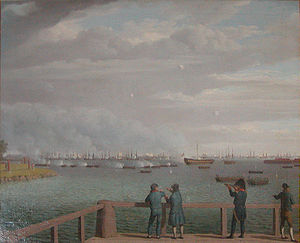
The British assembled a force of 25,000 troops, and the vanguard sailed on 30 July; Jackson set out the next day. Canning offered Denmark a treaty of alliance and mutual defence, with a convention signed for the return of the fleet after the war, the protection of 21 British warships and a subsidy for how many soldiers Denmark kept standing. On 31 July Napoleon ordered Talleyrand to tell Denmark to prepare for war against Britain or else Jean-Baptiste Bernadotte would invade Holstein. Neither Talleyrand nor Jackson persuaded the Danes to end their neutrality so Jackson went back to the British fleet assembled in the Sound on 15 August. The British published a proclamation demanding the deposit of the Danish fleet; the Danes responded with "what amounted to a declaration of war".
On 12 August the 32-gun Danish
frigate Frederiksværn sailed for Norway from Elsinor and Admiral Lord Gambier
sent the 74-gun third rate and the 22 gun sixth rate after her, even though war had not yet been declared. Comus was much faster than Defence in the light winds and so outdistanced her. On 15 August 1807 Comus caught Frederiksværn off Marstrand
and captured her. The British took her into service as .
 British troops commanded by General Wellesley
defeated a weak Danish force of militia, then a much larger force of Danish regulars in the Battle of Køge
, south of Copenhagen. Within a few days, Copenhagen was completely encircled. The British forces included a Hanoverian
force (the King's German Legion
), under General Lord Cathcart.
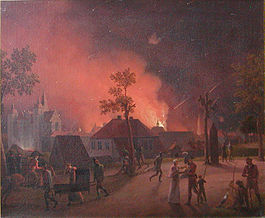
The Danes rejected British demands to surrender, so the British fleet under Admiral Gambier bombarded the city from 2 September to 5 September 1807. The British bombardment of Copenhagen killed than 2,000 civilians and destroyed 30% of the buildings. The bombardment had included Congreve Rocket
s, which caused fires.
On 5 September the Danes sued for peace and the capitulation was signed on 7 September. Denmark agreed to surrender its navy and its naval stores. In return the British undertook to leave Copenhagen within six weeks.
Peymann had been under orders from the Crown Prince to burn the Danish fleet, which he failed to do, though the reason for his failure to do so is unknown.The order came form the Crown Prince as Christian VII of Denmark
was not mentally stable.
Thus, on 7 September 1807 Peymann surrendered the fleet (eighteen ships of the line, eleven frigates, two smaller ships, two ship-sloops
, seven brig-sloops, two brigs, one schooner
and twenty-six gunboats). In addition, the British broke up or destroyed three 74-gun ships-of-the-line on the stocks, along with two of the aforementioned ships-of-the-fleet and two elderly frigates.
After her capture, one ex-Danish ship-of-the-line, Neptunos, ran aground and was burnt on or near the island of Hven
. Then, when a storm arose in the Kattegat
, the British destroyed or abandoned twenty-three of the captured gunboats. The British added the fifteen captured ships-of-the-line that reached Britain to the British Navy but only four — Christian VII 80, Dannemark 74, Norge 74 and Princess Carolina 74 — saw subsequent active service.
On 21 October 1807, the British fleet left Copenhagen for the United Kingdom. However, the war
continued until 1814, when the Treaty of Kiel
was signed.
: "Did I not tell you we would save Plumstead
from bombardment?" One week later he wrote: "Nothing ever was more brilliant, more salutary or more effectual than the success [at Copenhagen]" and Perceval expressed similar sentiments. The Times
said that the confiscation of the Danish fleet was "a bare act of self-preservation" and noticed the short distance between Denmark and Ireland or north-east Scotland. William Cobbett
in his Political Register
wrote that it was "vile mockery" and "mere party cavilling" to claim that Denmark had the means to preserve her neutrality. William Wilberforce
MP said the expedition could be defended on grounds of self-defence. Thomas Grenville
wrote to his brother Lord Grenville that he could not help feeling "that in their [the government's] situation we should very probably have given the same order without being able to publish to Parliament the grounds on which we had believed in the hostile mind of Denmark". Lord Erskine
condemned it by saying "if hell did not exist before, Providence would create it now to punish ministers for that damnable measure".
The opposition claimed the national character was stained and Canning read out in Parliament the previous administration's plans in 1806 to stop the Portuguese navy falling into the hands of France. Canning and Castlereagh wished to hold Zealand and suggested that when the British evacuated it as part of the peace they should immediately occupy it again. This was strongly opposed by Sir Arthur Wellesley
, however, and it did not happen. The opposition claimed that the attack had turned Denmark from a neutral into an enemy. Canning replied by saying that the British were hated throughout Europe and so Britain could wage an "all-out maritime war" against France without worrying who they were going to upset.
The opposition did not at first table a vote of censure on the battle and instead on 3 February 1808 demanded the publication of all the letters sent by the British envoy in Denmark on information regarding the war-readiness of the Danish navy. Canning replied with a three hour speech which Lord Palmerston described as "so powerful that it gave a decisive turn to the debate". Lord Howick said the speech was "eloquent and powerful" but that it was an "audacious misrepresentation" and "positive falsehood" of the correspondence between himself and Benjamin Garlike
. The three motions on this subject were heavily defeated and on 21 March the opposition tabled a direct motion of censure on the battle. It was defeated by 224 votes to 64 after Canning made a speech "very witty, very eloquent and very able".
The first attempt to have a modern edition of the Anglo-Saxon poem Beowulf
was frustrated by the British bombing, when the 20-year work of scholar Grímur Jónsson Thorkelin
was destroyed by the subsequent fire. Two manuscript
s, however, were recovered and Thorkelin eventually published the poem in 1815.
 The following ships sailed with Gambier from England on 26 July 1807:
Prince of Wales
98 (flag of Admiral James Gambier
, 1st Captain Sir Home Riggs Popham
, 2nd Captain Adam Mackenzie
)
Pompee 74 (Vice-Admiral Henry Edwyn Stanhope, Captain Richard Dacres
)
Centaur
74 (Commodore Sir Samuel Hood, Captain William Henry Webley)
Ganges
74 (Commodore Richard Goodwin Keats
, Captain Peter Halkett
)
Alfred
74 (Captain John Bligh)
Brunswick
74 (Captain Thomas Graves)
Captain
74 (Captain Isaac Wolley)
Goliath
74 (Captain Peter Puget
)
Hercule 74 (Captain John Colville)
Maida
74 (Captain Samuel Hood Linzee
)
Orion
74 (Captain Sir Archibald Collingwood Dickson)
Resolution
74 (Captain George Burlton)
Spencer
74 (Captain Robert Stopford)
Vanguard
74 (Captain Alexander Fraser)
Dictator
64 (Captain Donald Campbell)
Nassau
64 (Captain Robert Campbell)
Ruby
64 (Captain John Draper)
Surveillante
38 (Captain George Collier
)
Sibylle 38 (Capt. Clotworthy Upton)
Franchise 36 (Capt. Charles Dashwood)
Nymphe 36 (Capt. Conway Shipley)
The following vessels joined on 5 August off Helsingor:
Superb
74 (Captain Donald M'Leod)
The following further vessels joined on 7 August off Helsingor:
Minotaur
74 (Rear-Admiral William Essington, Captain Charles John Moore Mansfield)
Valiant
74 (Captain James Young
)
Inflexible
64 (Captain Joshua Rowley Watson)
Leyden 64 (Captain William Cumberland)
The following vessels joined on 8 August or later:
Defence
74 (Captain Charles Ekins
)
Mars
74 (Captain William Lukin)
Agamemnon
64 (Captain Jonas Rose)
Africaine
32 (Capt. Richard Raggett)
Note that Lieutenant-General Lord Cathcart arrived in the Africaine on 12 August to take command of the ground forces.
In addition, there were another three dozen smaller frigates, sloops, bomb vessels, gun-brigs and schooners (e.g.HMS Rook
attached to the British fleet), and a very large number of merchant or requisitioned ships carrying troops or supplies.
Christian den Syvende 84 – sailed to Britain, added to British Navy as Christian VII 80
Neptunos 80 – sailed for Britain, but wrecked en route.
Waldemar 80 – sailed to Britain, added to British Navy as Waldemar 80
Danmark 74 – sailed to Britain, added to British Navy as Danmark 74
Norge 74 – sailed to Britain, added to British Navy as Norge 74
Fyen 74 – sailed to Britain, added to British Navy as Fyen 74
Kronprinds Friderich 74 – sailed to Britain, added to British Navy as Kron Princen 74
Tre Kroner 74 – sailed to Britain, added to British Navy as Tree Kronen 74
Arveprinds Friderich 74 – sailed to Britain, added to British Navy as Heir Apparent Frederick 74
Skjold 74 – sailed to Britain, added to British Navy as Skiold 74
Odin 74 – sailed to Britain, added to British Navy as Odin 74
Justitia 74 – sailed to Britain, added to British Navy as Justitia 74
Kronprindsesse Maria 74 – sailed to Britain, added to British Navy as Kron Princessen 74
Prindsesse Sophia Friderica 74 – sailed to Britain, added to British Navy as Princess Sophia Frederica 74
Prindsesse Caroline 74 – sailed to Britain, added to British Navy as Princess Carolina 74
(Note a sistership of this vessel, the Prinds Christian Frederick
, was not present at Copenhagen at the time of the assault, but was captured and burnt by the British Navy on 23 March 1808.)
Dittsmarschen 64 – not sailed to Britain, but deemed useless and burnt.
Mars 64 – not sailed to Britain, but deemed useless and burnt.
Seijeren 64 – sailed to Britain, added to British Navy as Syeren 64
Paerlen 38 – sailed to Britain, added to British Navy as Perlen 38
Rota 36 – sailed to Britain, added to British Navy as Rota 38
Freja 36 – sailed to Britain, added to British Navy as Freya 36
Iris 36 – sailed to Britain, added to British Navy as Iris 36
Najaden
36 – sailed to Britain, added to British Navy as Nyaden 36
Havfruen 36 – sailed to Britain, added to British Navy as Hasfruen 36
Nymfen 36 – sailed to Britain, added to British Navy as Nymphen 36
Venus 36 – sailed to Britain, added to British Navy as Venus 36
Frederichsteen 26 – sailed to Britain, added to British Navy as Frederickstein 32
St Thomas 22 – not sailed to Britain, but deemed useless and burnt.
Triton 22 – not sailed to Britain, but deemed useless and burnt.
Lille Belt 22 – sailed to Britain, added to British Navy as 20
Fylla 22 – sailed to Britain, added to British Navy as Fylla 20
Eijderen 18 – sailed to Britain, added to British Navy as Eyderen 18
Elvin 18 – sailed to Britain, added to British Navy as Elvin 18
Gluckstadt 18 – sailed to Britain, added to British Navy as Gluckstadt 16
Nidelven 18 – sailed to Britain, added to British Navy as Nid Elven 16
Sarpen
18 – sailed to Britain, added to British Navy as HMS Sarpen 18
Glommen 18 – sailed to Britain, added to British Navy as Glommen 16
Mercurius 18 – sailed to Britain, added to British Navy as Mercurius 16
Delphinen 18 – sailed to Britain, added to British Navy as Delphinen 16
Allart 18 – sailed to Britain, added to British Navy as Allart 16
Flyvende Fiske 14 – sailed to Britain, added to British Navy as Flying Fish
14
Brevdrageren 18 – sailed to Britain, added to British Navy as Brev Drageren
12
Ornen 12 (schooner) – sailed to Britain, added to British Navy as Ornen 12
Stege 2 (gunboat
) – sailed to Britain, added to British Navy as Warning 2
There were a further 25 gunboats similar to the Stege, of which 23 were destroyed in the Kattegat rather than sailed to Britain – these were the Arendal, Nykjobing, Nakskov, Aalborg, Odense, Langesund, Stavoern, Christiansund, Flensborg, Wiborg, Kallundborg, Helsingoer, Nestved, Roeskilde, Saltholmen, Fredericksund, Stubbekjobing, Rodby, Nysted, Svendborg, Faaborg, Holbek, Middelfart, Assens and Kjerteminde.
(Note that in 1809 there was a plan to give almost all of captured vessels more traditional British warship names, but this plan was later cancelled, and most Danish vessels retained their original names (or at least, anglicised versions thereof) until they were broken up.)
Title: "Sharpe's Prey"-
Richard Sharpe and the Expedition to Copenhagen, 1807
Author: Alexander Kent;
Title: "The Only Victor"-
Richard Bolitho and the siege of Copenhagen, 1807
Preemptive war
A preemptive war is a war that is commenced in an attempt to repel or defeat a perceived inevitable offensive or invasion, or to gain a strategic advantage in an impending war before that threat materializes. It is a war which preemptively 'breaks the peace'. The term: 'preemptive war' is...
on Copenhagen
Copenhagen
Copenhagen is the capital and largest city of Denmark, with an urban population of 1,199,224 and a metropolitan population of 1,930,260 . With the completion of the transnational Øresund Bridge in 2000, Copenhagen has become the centre of the increasingly integrating Øresund Region...
, targeting the civilian population in order to seize the Dano-Norwegian fleet
Royal Dano-Norwegian Navy
The Royal Danish-Norwegian Navy or The Common Fleet also known simply as the Danish Navy was the naval force of the united kingdoms Denmark and Norway from 1509 to 12 April 1814. The fleet was established when the Royal Danish Navy and the Royal Norwegian Navy was combined by King Hans, when he...
and in turn originate the term to Copenhagenize
Copenhagenization (naval)
Copenhagenization refers to the practice of confiscating the warships of a defeated enemy. It first occurs when the British fleet under Admiral Gambier defeated the Dano-Norwegian fleet in the Second Battle of Copenhagen in 1807....
.
Background
Despite the defeat and loss of many ships in the first Battle of Copenhagen in 1801, Denmark-Norway, possessing Schleswig-HolsteinSchleswig-Holstein
Schleswig-Holstein is the northernmost of the sixteen states of Germany, comprising most of the historical duchy of Holstein and the southern part of the former Duchy of Schleswig...
and Iceland
Iceland
Iceland , described as the Republic of Iceland, is a Nordic and European island country in the North Atlantic Ocean, on the Mid-Atlantic Ridge. Iceland also refers to the main island of the country, which contains almost all the population and almost all the land area. The country has a population...
, still maintained a considerable navy. The majority of the Danish army under the Crown Prince
Frederick VI of Denmark
Frederick VI reigned as King of Denmark , and as king of Norway .-Regent of Denmark:Frederick's parents were King Christian VII and Caroline Matilda of Wales...
was at this time defending the southern border against possible attack from the French.
There was concern in Britain that Napoleon might try to force Denmark to close the Baltic Sea
Baltic Sea
The Baltic Sea is a brackish mediterranean sea located in Northern Europe, from 53°N to 66°N latitude and from 20°E to 26°E longitude. It is bounded by the Scandinavian Peninsula, the mainland of Europe, and the Danish islands. It drains into the Kattegat by way of the Øresund, the Great Belt and...
to British ships, perhaps by marching French troops into Zealand. The British believed that access to the Baltic was "vitally important to Britain" for trade as well as a major source of necessary raw materials for building and maintaining warships, and that it gave the Royal Navy access to help Britain's allies Sweden and (before Tilsit
Treaties of Tilsit
The Treaties of Tilsit were two agreements signed by Napoleon I of France in the town of Tilsit in July, 1807 in the aftermath of his victory at Friedland. The first was signed on 7 July, between Tsar Alexander I of Russia and Napoleon I of France, when they met on a raft in the middle of the Neman...
) Russia against France. The British thought that after Prussia
Prussia
Prussia was a German kingdom and historic state originating out of the Duchy of Prussia and the Margraviate of Brandenburg. For centuries, the House of Hohenzollern ruled Prussia, successfully expanding its size by way of an unusually well-organized and effective army. Prussia shaped the history...
had been defeated
War of the Fourth Coalition
The Fourth Coalition against Napoleon's French Empire was defeated in a war spanning 1806–1807. Coalition partners included Prussia, Russia, Saxony, Sweden, and the United Kingdom....
in December 1806, Denmark's independence looked increasingly under threat from France. George Canning
George Canning
George Canning PC, FRS was a British statesman and politician who served as Foreign Secretary and briefly Prime Minister.-Early life: 1770–1793:...
's predecessor as Foreign Secretary, Lord Howick
Charles Grey, 2nd Earl Grey
Charles Grey, 2nd Earl Grey, KG, PC , known as Viscount Howick between 1806 and 1807, was Prime Minister of the United Kingdom of Great Britain and Ireland from 22 November 1830 to 16 July 1834. A member of the Whig Party, he backed significant reform of the British government and was among the...
, had tried unsuccessfully to persuade Denmark into a secret alliance with Britain and Sweden.
The reports of British diplomats and merchants in northern Europe made the British government feel uneasy and by mid-July the British believed that the French intended to invade Holstein
Holstein
Holstein is the region between the rivers Elbe and Eider. It is part of Schleswig-Holstein, the northernmost state of Germany....
in order to use Denmark against Britain. Some reports suggested that the Danes had secretly agreed to this. The Cabinet decided to act and on 14 July Lord Mulgrave
Henry Phipps, 1st Earl of Mulgrave
Henry Phipps, 1st Earl of Mulgrave GCB, PC , styled The Honourable Henry Phipps until 1792 and known as The Lord Mulgrave from 1792 to 1812, was a British soldier and politician...
obtained from the King permission to send a naval force of 21 to 22 ships to the Kattegat
Kattegat
The Kattegat , or Kattegatt is a sea area bounded by the Jutland peninsula and the Straits islands of Denmark on the west and south, and the provinces of Västergötland, Scania, Halland and Bohuslän in Sweden on the east. The Baltic Sea drains into the Kattegat through the Øresund and the Danish...
for surveillance of the Danish navy in order to pursue "prompt and vigorous operations" if that seemed necessary. The Cabinet decided on 18 July to send Francis Jackson on a secret mission to Copenhagen to persuade Denmark to give its fleet to Britain. That same day the Admiralty
Admiralty
The Admiralty was formerly the authority in the Kingdom of England, and later in the United Kingdom, responsible for the command of the Royal Navy...
issued an order for more than 50 ships to sail for "particular service" under Admiral James Gambier. On the 19 July Lord Castlereagh, the Secretary of State for War and the Colonies
Secretary of State for War and the Colonies
The Secretary of State for War and the Colonies was a British cabinet level position responsible for the army and the British colonies . The Department was created in 1801...
, ordered General Lord Cathcart at Stralsund
Stralsund
- Main sights :* The Brick Gothic historic centre is a UNESCO World Heritage Site.* The heart of the old town is the Old Market Square , with the Gothic Town Hall . Behind the town hall stands the imposing Nikolaikirche , built in 1270-1360...
to go with his troops to the Sound where they would get reinforcements.
In January 1808, Lord Hawkesbury told the House of Lords
House of Lords
The House of Lords is the upper house of the Parliament of the United Kingdom. Like the House of Commons, it meets in the Palace of Westminster....
that he received information from someone on the Continent "that there were secret engagements in the Treaty of Tilsit to employ the navies of Denmark and Portugal against this country". He refused to publish the source because he said it would endanger their lives During the night of 21/22 July Canning received intelligence from Tilsit that Napoleon had tried to persuade Alexander I of Russia
Alexander I of Russia
Alexander I of Russia , served as Emperor of Russia from 23 March 1801 to 1 December 1825 and the first Russian King of Poland from 1815 to 1825. He was also the first Russian Grand Duke of Finland and Lithuania....
to form a maritime league with Denmark and Portugal against Britain. Spencer Perceval
Spencer Perceval
Spencer Perceval, KC was a British statesman and First Lord of the Treasury, making him de facto Prime Minister. He is the only British Prime Minister to have been assassinated...
, the Chancellor of the Exchequer
Chancellor of the Exchequer
The Chancellor of the Exchequer is the title held by the British Cabinet minister who is responsible for all economic and financial matters. Often simply called the Chancellor, the office-holder controls HM Treasury and plays a role akin to the posts of Minister of Finance or Secretary of the...
, wrote a memorandum setting out the government's case for sending forces to Copenhagen: "The intelligence from so many and such various sources" that Napoleon's intent was to force Denmark into war against Britain could not be doubted. "Nay, the fact that he has openly avowed such intention in an interview with the E[mperor] of R[ussia] is brought to this country in such a way as it cannot be doubted. Under such circumstances it would be madness, it would be idiotic... to wait for an overt act".
The British assembled a force of 25,000 troops, and the vanguard sailed on 30 July; Jackson set out the next day. Canning offered Denmark a treaty of alliance and mutual defence, with a convention signed for the return of the fleet after the war, the protection of 21 British warships and a subsidy for how many soldiers Denmark kept standing. On 31 July Napoleon ordered Talleyrand to tell Denmark to prepare for war against Britain or else Jean-Baptiste Bernadotte would invade Holstein. Neither Talleyrand nor Jackson persuaded the Danes to end their neutrality so Jackson went back to the British fleet assembled in the Sound on 15 August. The British published a proclamation demanding the deposit of the Danish fleet; the Danes responded with "what amounted to a declaration of war".
On 12 August the 32-gun Danish
Denmark
Denmark is a Scandinavian country in Northern Europe. The countries of Denmark and Greenland, as well as the Faroe Islands, constitute the Kingdom of Denmark . It is the southernmost of the Nordic countries, southwest of Sweden and south of Norway, and bordered to the south by Germany. Denmark...
frigate Frederiksværn sailed for Norway from Elsinor and Admiral Lord Gambier
James Gambier, 1st Baron Gambier
Admiral of the Fleet James Gambier, 1st Baron Gambier GCB was an admiral of the Royal Navy, who served as Governor of Newfoundland, and as a Lord of the Admiralty, but who gained notoriety for his actions at the Battle of the Basque Roads.-Early career:Gambier was born in New Providence, The...
sent the 74-gun third rate and the 22 gun sixth rate after her, even though war had not yet been declared. Comus was much faster than Defence in the light winds and so outdistanced her. On 15 August 1807 Comus caught Frederiksværn off Marstrand
Marstrand
Marstrand is a seaside locality situated in Kungälv Municipality, Västra Götaland County, Sweden. It had 1,432 inhabitants in 2005. It has held city privileges since 1200. The most striking feature about Marstrand is the 17th century fortress Carlsten, named after King Carl X Gustav of Sweden. The...
and captured her. The British took her into service as .
Battle
Arthur Wellesley, 1st Duke of Wellington
Field Marshal Arthur Wellesley, 1st Duke of Wellington, KG, GCB, GCH, PC, FRS , was an Irish-born British soldier and statesman, and one of the leading military and political figures of the 19th century...
defeated a weak Danish force of militia, then a much larger force of Danish regulars in the Battle of Køge
Battle of Køge
The Battle of Køge was a battle on 29 August 1807 between British troops besieging Copenhagen and Danish militia raised on Sjælland. It ended in British victory and also known as the 'Træskoslaget' or 'Clogs Battle', since the poorly-equipped Danish militia threw their heavy wooden clogs away when...
, south of Copenhagen. Within a few days, Copenhagen was completely encircled. The British forces included a Hanoverian
House of Hanover
The House of Hanover is a deposed German royal dynasty which has ruled the Duchy of Brunswick-Lüneburg , the Kingdom of Hanover, the Kingdom of Great Britain, the Kingdom of Ireland and the United Kingdom of Great Britain and Ireland...
force (the King's German Legion
King's German Legion
The King's German Legion was a British Army unit of expatriate German personnel, 1803–16. The Legion achieved the distinction of being the only German force to fight without interruption against the French during the Napoleonic Wars....
), under General Lord Cathcart.
The Danes rejected British demands to surrender, so the British fleet under Admiral Gambier bombarded the city from 2 September to 5 September 1807. The British bombardment of Copenhagen killed than 2,000 civilians and destroyed 30% of the buildings. The bombardment had included Congreve Rocket
Congreve rocket
The Congreve Rocket was a British military weapon designed and developed by Sir William Congreve in 1804.The rocket was developed by the British Royal Arsenal following the experiences of the Second, Third and Fourth Mysore Wars. The wars fought between the British East India Company and the...
s, which caused fires.
On 5 September the Danes sued for peace and the capitulation was signed on 7 September. Denmark agreed to surrender its navy and its naval stores. In return the British undertook to leave Copenhagen within six weeks.
Peymann had been under orders from the Crown Prince to burn the Danish fleet, which he failed to do, though the reason for his failure to do so is unknown.The order came form the Crown Prince as Christian VII of Denmark
Christian VII of Denmark
Christian VII was King of Denmark and Norway and Duke of Schleswig and Holstein from 1766 until his death. He was the son of Danish King Frederick V and his first consort Louisa, daughter of King George II of Great Britain....
was not mentally stable.
Thus, on 7 September 1807 Peymann surrendered the fleet (eighteen ships of the line, eleven frigates, two smaller ships, two ship-sloops
Sloop-of-war
In the 18th and most of the 19th centuries, a sloop-of-war was a warship with a single gun deck that carried up to eighteen guns. As the rating system covered all vessels with 20 guns and above, this meant that the term sloop-of-war actually encompassed all the unrated combat vessels including the...
, seven brig-sloops, two brigs, one schooner
Schooner
A schooner is a type of sailing vessel characterized by the use of fore-and-aft sails on two or more masts with the forward mast being no taller than the rear masts....
and twenty-six gunboats). In addition, the British broke up or destroyed three 74-gun ships-of-the-line on the stocks, along with two of the aforementioned ships-of-the-fleet and two elderly frigates.
After her capture, one ex-Danish ship-of-the-line, Neptunos, ran aground and was burnt on or near the island of Hven
Hven
Ven is a small Swedish island in the Öresund strait, between Scania and Zealand . It is situated in Landskrona Municipality, Skåne County. The island has 371 inhabitants and an area of . During the 1930s, the population was at its peak, with approximately 1,300 inhabitants...
. Then, when a storm arose in the Kattegat
Kattegat
The Kattegat , or Kattegatt is a sea area bounded by the Jutland peninsula and the Straits islands of Denmark on the west and south, and the provinces of Västergötland, Scania, Halland and Bohuslän in Sweden on the east. The Baltic Sea drains into the Kattegat through the Øresund and the Danish...
, the British destroyed or abandoned twenty-three of the captured gunboats. The British added the fifteen captured ships-of-the-line that reached Britain to the British Navy but only four — Christian VII 80, Dannemark 74, Norge 74 and Princess Carolina 74 — saw subsequent active service.
On 21 October 1807, the British fleet left Copenhagen for the United Kingdom. However, the war
Gunboat War
The Gunboat War was the naval conflict between Denmark–Norway and the British Navy during the Napoleonic Wars. The war's name is derived from the Danish tactic of employing small gunboats against the conventional Royal Navy...
continued until 1814, when the Treaty of Kiel
Treaty of Kiel
The Treaty of Kiel or Peace of Kiel was concluded between the United Kingdom of Great Britain and Ireland and the Kingdom of Sweden on one side and the Kingdoms of Denmark and Norway on the other side on 14 January 1814 in Kiel...
was signed.
Aftermath
The news of what happened did not reach Canning until 16 September. He wrote to Rev. William LeighWilliam Leigh
William Leigh was an English clergyman and royal tutor. He is now remembered for his sermon series Queene Elizabeth paraleld from 1612, which includes the first published text record for the queen's speech to the troops at Tilbury from 1588....
: "Did I not tell you we would save Plumstead
Plumstead
Plumstead is a district of south London, England, located in the London Borough of Greenwich. Plumstead is a multi cultural area with large Asian and Afro-Caribbean communities, in similarity to local areas such as Woolwich and Thamesmead...
from bombardment?" One week later he wrote: "Nothing ever was more brilliant, more salutary or more effectual than the success [at Copenhagen]" and Perceval expressed similar sentiments. The Times
The Times
The Times is a British daily national newspaper, first published in London in 1785 under the title The Daily Universal Register . The Times and its sister paper The Sunday Times are published by Times Newspapers Limited, a subsidiary since 1981 of News International...
said that the confiscation of the Danish fleet was "a bare act of self-preservation" and noticed the short distance between Denmark and Ireland or north-east Scotland. William Cobbett
William Cobbett
William Cobbett was an English pamphleteer, farmer and journalist, who was born in Farnham, Surrey. He believed that reforming Parliament and abolishing the rotten boroughs would help to end the poverty of farm labourers, and he attacked the borough-mongers, sinecurists and "tax-eaters" relentlessly...
in his Political Register
Political Register
The Political Register was a weekly newspaper founded by William Cobbett in 1802 and ceased publication in 1835, the year of his death.Originally propounding Tory views, and costing a shilling, Cobbett changed his editorial line to embrace radicalism, such as advocating widening the suffrage...
wrote that it was "vile mockery" and "mere party cavilling" to claim that Denmark had the means to preserve her neutrality. William Wilberforce
William Wilberforce
William Wilberforce was a British politician, a philanthropist and a leader of the movement to abolish the slave trade. A native of Kingston upon Hull, Yorkshire, he began his political career in 1780, eventually becoming the independent Member of Parliament for Yorkshire...
MP said the expedition could be defended on grounds of self-defence. Thomas Grenville
Thomas Grenville
Thomas Grenville PC was a British politician and bibliophile.-Background and education:Grenville was the second son of Prime Minister George Grenville and Elizabeth, daughter of Sir William Wyndham, 3rd Baronet...
wrote to his brother Lord Grenville that he could not help feeling "that in their [the government's] situation we should very probably have given the same order without being able to publish to Parliament the grounds on which we had believed in the hostile mind of Denmark". Lord Erskine
Thomas Erskine, 1st Baron Erskine
Thomas Erskine, 1st Baron Erskine KT PC KC was a British lawyer and politician. He served as Lord Chancellor of the United Kingdom between 1806 and 1807 in the Ministry of All the Talents.-Background and childhood:...
condemned it by saying "if hell did not exist before, Providence would create it now to punish ministers for that damnable measure".
The opposition claimed the national character was stained and Canning read out in Parliament the previous administration's plans in 1806 to stop the Portuguese navy falling into the hands of France. Canning and Castlereagh wished to hold Zealand and suggested that when the British evacuated it as part of the peace they should immediately occupy it again. This was strongly opposed by Sir Arthur Wellesley
Arthur Wellesley, 1st Duke of Wellington
Field Marshal Arthur Wellesley, 1st Duke of Wellington, KG, GCB, GCH, PC, FRS , was an Irish-born British soldier and statesman, and one of the leading military and political figures of the 19th century...
, however, and it did not happen. The opposition claimed that the attack had turned Denmark from a neutral into an enemy. Canning replied by saying that the British were hated throughout Europe and so Britain could wage an "all-out maritime war" against France without worrying who they were going to upset.
The opposition did not at first table a vote of censure on the battle and instead on 3 February 1808 demanded the publication of all the letters sent by the British envoy in Denmark on information regarding the war-readiness of the Danish navy. Canning replied with a three hour speech which Lord Palmerston described as "so powerful that it gave a decisive turn to the debate". Lord Howick said the speech was "eloquent and powerful" but that it was an "audacious misrepresentation" and "positive falsehood" of the correspondence between himself and Benjamin Garlike
Benjamin Garlike
Benjamin Garlike was a British diplomat, ambassador to Denmark and Prussia.As a young man Garlike received the patronage of Lord Auckland, accompanying him to Spain in 1788 and The Hague in 1789, where he worked deciphering government dispatches...
. The three motions on this subject were heavily defeated and on 21 March the opposition tabled a direct motion of censure on the battle. It was defeated by 224 votes to 64 after Canning made a speech "very witty, very eloquent and very able".
The first attempt to have a modern edition of the Anglo-Saxon poem Beowulf
Beowulf
Beowulf , but modern scholars agree in naming it after the hero whose life is its subject." of an Old English heroic epic poem consisting of 3182 alliterative long lines, set in Scandinavia, commonly cited as one of the most important works of Anglo-Saxon literature.It survives in a single...
was frustrated by the British bombing, when the 20-year work of scholar Grímur Jónsson Thorkelin
Grímur Jónsson Thorkelin
Grímur Jónsson Thorkelín was an Icelandic -Danish scholar, who became the National Archivist of Denmark and Professor of Antiquities at Copenhagen University....
was destroyed by the subsequent fire. Two manuscript
Manuscript
A manuscript or handwrite is written information that has been manually created by someone or some people, such as a hand-written letter, as opposed to being printed or reproduced some other way...
s, however, were recovered and Thorkelin eventually published the poem in 1815.
Ships involved
Prince of Wales
HMS Prince of Wales (1794)
HMS Prince of Wales was a 98-gun second rate ship of the line of the Royal Navy, launched on 28 June 1794 at Portsmouth.She was present at the Battle of Groix in 1795, and served as the flagship of Admiral Robert Calder at the Battle of Cape Finisterre in 1805. Prince of Wales was not present at...
98 (flag of Admiral James Gambier
James Gambier, 1st Baron Gambier
Admiral of the Fleet James Gambier, 1st Baron Gambier GCB was an admiral of the Royal Navy, who served as Governor of Newfoundland, and as a Lord of the Admiralty, but who gained notoriety for his actions at the Battle of the Basque Roads.-Early career:Gambier was born in New Providence, The...
, 1st Captain Sir Home Riggs Popham
Home Riggs Popham
Admiral Sir Home Riggs Popham KCB was a British Royal Naval Commander who saw service during the French Revolutionary Wars and the Napoleonic Wars...
, 2nd Captain Adam Mackenzie
Adam Mackenzie
Adam Mackenzie was an officer of the Royal Navy. He was promoted to Lieutenant on 13 March 1790, to Commander on 22 June 1796, and to Captain on 2 September 1799. He died on 13 November 1823.-HMS Pylades:...
)
Pompee 74 (Vice-Admiral Henry Edwyn Stanhope, Captain Richard Dacres
Richard Dacres (Royal Navy officer)
Sir Richard Dacres, GCH was an officer of the Royal Navy who saw service during the American War of Independence, and the French Revolutionary and Napoleonic Wars...
)
Centaur
HMS Centaur (1797)
HMS Centaur was a 74-gun third rate of the Royal Navy, launched on 14 March 1797 at Woolwich. She served as Sir Samuel Hood's flagship in the Leeward Islands and the Channel. During her 22-year career Centaur saw action in the Mediterranean, the Channel, the West Indies, and the Baltic, fighting...
74 (Commodore Sir Samuel Hood, Captain William Henry Webley)
Ganges
HMS Ganges (1782)
HMS Ganges was a 74-gun third rate ship of the line of the Royal Navy, launched on 30 March 1782 at Rotherhithe. She was the first ship of the Navy to bear the name. Her first captain was Charles Fielding...
74 (Commodore Richard Goodwin Keats
Richard Goodwin Keats
Admiral Sir Richard Goodwin Keats was a British naval officer who fought throughout the American Revolution, French Revolutionary War and Napoleonic War. He retired in 1812 due to ill health and was made Commodore-Governor of Newfoundland from 1813 to 1816. In 1821 he was made Governor of...
, Captain Peter Halkett
Sir Peter Halkett, 6th Baronet
Admiral Sir Peter Halkett, 6th Baronet was a senior Royal Navy officer of the early nineteenth century who is best known for his service in the French Revolutionary Wars. The younger son a Scottish baronet, Halkett joined the Navy and by 1793 was a lieutenant, becoming a post captain after service...
)
Alfred
HMS Alfred (1778)
HMS Alfred was a 74-gun third rate ship of the line of the Royal Navy, launched on 22 October 1778 at Chatham.She fought at the Battle of Cape St Vincent in 1780.Alfred was broken up in 1814....
74 (Captain John Bligh)
Brunswick
HMS Brunswick (1790)
HMS Brunswick was a 74-gun third rate ship of the line of the Royal Navy, launched on 30 April 1790 at Deptford.On 29 October 1792, three condemned mutineers of the Mutiny on the Bounty were hanged from her yardarms....
74 (Captain Thomas Graves)
Captain
HMS Captain (1787)
HMS Captain was a 74-gun third-rate ship of the line of the Royal Navy, launched on 26 November 1787 at Limehouse. She served during the French revolutionary and Napoleonic Wars before being placed in harbour service in 1799...
74 (Captain Isaac Wolley)
Goliath
HMS Goliath (1781)
HMS Goliath was a 74-gun third rate ship of the line in the Royal Navy. She was launched on 19 October 1781 at Deptford Dockyard. She was present at the Battle of Cape St Vincent, Battle of the Nile, and Battle of Copenhagen. She was broken up in 1815....
74 (Captain Peter Puget
Peter Puget
Peter Puget was an officer in the Royal Navy, best known for his exploration of Puget Sound.-Mr. Midshipman Puget:Puget's ancestors had fled France for Britain during Louis XIV's persecution of the Huguenots. His father, John, was a successful merchant and banker, but died in 1767, leaving Puget's...
)
Hercule 74 (Captain John Colville)
Maida
French ship Viala (1795)
The Viala was a 74-gun of the French Navy launched in 1795. She was captured by the Royal Navy in 1806 and sold in 1814.-French service:...
74 (Captain Samuel Hood Linzee
Samuel Hood Linzee
Samuel Hood Linzee was an admiral of the British Royal Navy who served during the French Revolutionary and Napoleonic Wars.-Biography:...
)
Orion
HMS Orion (1787)
HMS Orion was a 74-gun third rate ship of the line of the Royal Navy, launched at Deptford on 1 June 1787 to the design of the , by William Bately...
74 (Captain Sir Archibald Collingwood Dickson)
Resolution
HMS Resolution (1770)
HMS Resolution was a 74-gun third rate ship of the line of the Royal Navy, launched on 12 April 1770 at Deptford Dockyard.She participated in the Battle of Cape St Vincent in 1780, the Battle of the Chesapeake in 1781, and the Battle of the Saintes in 1782.Resolution was broken up in 1813....
74 (Captain George Burlton)
Spencer
HMS Spencer (1800)
HMS Spencer was a 74-gun third-rate ship of the line of the Royal Navy, launched on 10 May 1800 at Bucklers Hard. Her designer was the French émigré shipwright Jean-Louis Barrallier.-Battle of Algeciras Bay:...
74 (Captain Robert Stopford)
Vanguard
HMS Vanguard (1787)
HMS Vanguard was a 74-gun third-rate ship of the line of the Royal Navy, launched on 6 March 1787 at Deptford. She was the sixth vessel to bear the name....
74 (Captain Alexander Fraser)
Dictator
HMS Dictator (1783)
HMS Dictator was a 64-gun third-rate ship of the line of the Royal Navy, launched on 6 January 1783 at Limehouse. She was converted into a troopship in 1798, and broken up in 1817....
64 (Captain Donald Campbell)
Nassau
HDMS Holsteen
HolsteenThis ship's name appears as Holsteen or Holsten in Danish records, and as Holstein in English. She was renamed Nassau in 1805 was a 60-gun ship of the line in the Royal Dano-Norwegian Navy. She was commissioned in 1775 and the British Royal Navy captured her in the Battle at Copenhagen...
64 (Captain Robert Campbell)
Ruby
HMS Ruby (1776)
HMS Ruby was a 64-gun third rate ship of the line of the Royal Navy, launched on 26 November 1776 at Woolwich.She was converted to serve as a receiving ship in 1813, and was broken up in 1821....
64 (Captain John Draper)
Surveillante
French frigate Surveillante (1802)
The Surveillante entered service as a 40-gun Virginie class frigate of the French Navy. She was surrendered to the British in 1803, after which she served in the Royal Navy, classed under the British system as a 38 gun vessel, until 1814 when she was decommissioned...
38 (Captain George Collier
Sir George Collier, 1st Baronet
Sir George Ralph Collier, 1st Baronet KCB was an officer of the Royal Navy during the French Revolutionary and Napoleonic Wars, and the War of 1812. He had an eventful early life, being shipwrecked early in his career and later captured by the French...
)
Sibylle 38 (Capt. Clotworthy Upton)
Franchise 36 (Capt. Charles Dashwood)
Nymphe 36 (Capt. Conway Shipley)
The following vessels joined on 5 August off Helsingor:
Superb
HMS Superb (1798)
HMS Superb was a 74-gun third rate ship of the line of the Royal Navy, and the fourth vessel to bear the name. She was launched on 19 March 1798 from Northfleet, and was eventually broken up in 1826. Superb is mostly associated with Richard Goodwin Keats who commanded her as captain from 1801 until...
74 (Captain Donald M'Leod)
The following further vessels joined on 7 August off Helsingor:
Minotaur
HMS Minotaur (1793)
HMS Minotaur was a 74-gun third-rate ship of the line of the Royal Navy, launched on 6 November 1793 at Woolwich. She was named after the mythological bull-headed monster of Crete.-Career:...
74 (Rear-Admiral William Essington, Captain Charles John Moore Mansfield)
Valiant
HMS Valiant (1807)
HMS Valiant was a 74-gun third rate ship of the line of the Royal Navy, launched on 24 January 1807 at Blackwall Yard.On 17 June 1813, Valiant was in company with when they came upon in pursuit of an American brig off Cape Sable. The three British ships continued the chase for another 100 miles...
74 (Captain James Young
James Young (1762–1833)
James Young was an officer of the Royal Navy who saw service during the French Revolutionary and Napoleonic Wars, rising to the rank of vice-admiral of the white.Young was born in 1762, the son of a naval officer...
)
Inflexible
HMS Inflexible (1780)
HMS Inflexible was a 64-gun third rate ship of the line of the Royal Navy, launched on 7 March 1780 at Harwich.In 1783, she fought in the Battle of Cuddalore, and in 1807 was present at the Battle of Copenhagen joining on 7 August off Helsingor .Inflexible became a storeship in 1793, and was...
64 (Captain Joshua Rowley Watson)
Leyden 64 (Captain William Cumberland)
The following vessels joined on 8 August or later:
Defence
HMS Defence (1763)
HMS Defence was a 74-gun third-rate ship of the line of the Royal Navy, launched on 31 March 1763 at Plymouth Dockyard. She was one of the most famous ships of the period, taking part in several of the most important naval battles of the French Revolutionary and Napoleonic wars...
74 (Captain Charles Ekins
Charles Ekins
Sir Charles Ekins GCB was an officer of the Royal Navy. He served in the Fourth Anglo-Dutch War, and the French Revolutionary and Napoleonic Wars, rising to the rank of admiral.-Life:...
)
Mars
HMS Mars (1794)
HMS Mars was a 74-gun third-rate ship of the line of the Royal Navy, launched on 25 October 1794 at Deptford Dockyard.-Career:In the early part of the French Revolutionary Wars she was assigned to the Channel Fleet. In 1797 under Captain Alexander Hood she was prominent in the Spithead mutiny...
74 (Captain William Lukin)
Agamemnon
HMS Agamemnon (1781)
HMS Agamemnon was a 64-gun third-rate ship of the line of the Royal Navy. She saw service in the American Revolutionary, French Revolutionary and Napoleonic Wars, and fought in many of the major naval battles of those conflicts...
64 (Captain Jonas Rose)
Africaine
French ship L'Africaine
The Africaine was one of two 40-gun Preneuse class frigate of the French Navy built to a design by Raymond-Antoine Haran. She carried 28 18-pounder and 12 8-pounder guns. The British captured her in 1801, only to have the French recapture her in 1810...
32 (Capt. Richard Raggett)
Note that Lieutenant-General Lord Cathcart arrived in the Africaine on 12 August to take command of the ground forces.
In addition, there were another three dozen smaller frigates, sloops, bomb vessels, gun-brigs and schooners (e.g.HMS Rook
HMS Rook (1806)
HMS Rook was a Royal Navy Cuckoo-class schooner, that Thomas Sutton built at Ringmore and launched in 1806. In 1808 two French privateers captured and burnt her.-Service:...
attached to the British fleet), and a very large number of merchant or requisitioned ships carrying troops or supplies.
Ships surrendered
The following Danish warships were surrendered on 7 September under the terms of the capitulation following the attack:Christian den Syvende 84 – sailed to Britain, added to British Navy as Christian VII 80
Neptunos 80 – sailed for Britain, but wrecked en route.
Waldemar 80 – sailed to Britain, added to British Navy as Waldemar 80
Danmark 74 – sailed to Britain, added to British Navy as Danmark 74
Norge 74 – sailed to Britain, added to British Navy as Norge 74
Fyen 74 – sailed to Britain, added to British Navy as Fyen 74
Kronprinds Friderich 74 – sailed to Britain, added to British Navy as Kron Princen 74
Tre Kroner 74 – sailed to Britain, added to British Navy as Tree Kronen 74
Arveprinds Friderich 74 – sailed to Britain, added to British Navy as Heir Apparent Frederick 74
Skjold 74 – sailed to Britain, added to British Navy as Skiold 74
Odin 74 – sailed to Britain, added to British Navy as Odin 74
Justitia 74 – sailed to Britain, added to British Navy as Justitia 74
Kronprindsesse Maria 74 – sailed to Britain, added to British Navy as Kron Princessen 74
Prindsesse Sophia Friderica 74 – sailed to Britain, added to British Navy as Princess Sophia Frederica 74
Prindsesse Caroline 74 – sailed to Britain, added to British Navy as Princess Carolina 74
(Note a sistership of this vessel, the Prinds Christian Frederick
Battle of Zealand Point
The Battle of Zealand Point was a naval battle of the English Wars and the Gunboat War. It was fought off Zealand Point by ships of the Danish and British navies on 22 March 1808 and was a British victory.-Prelude:...
, was not present at Copenhagen at the time of the assault, but was captured and burnt by the British Navy on 23 March 1808.)
Dittsmarschen 64 – not sailed to Britain, but deemed useless and burnt.
Mars 64 – not sailed to Britain, but deemed useless and burnt.
Seijeren 64 – sailed to Britain, added to British Navy as Syeren 64
Paerlen 38 – sailed to Britain, added to British Navy as Perlen 38
Rota 36 – sailed to Britain, added to British Navy as Rota 38
Freja 36 – sailed to Britain, added to British Navy as Freya 36
Iris 36 – sailed to Britain, added to British Navy as Iris 36
Najaden
HDMS Najaden (1796)
HDMS Najaden was a frigate of the Royal Dano-Norwegian Navy, which she served from 1796 to 1807 until the British captured her in 1807. While in Dano-Norwegian service she participated in an action at Tripoli, North Africa. She served the Royal Navy as the fifth rate HMS Nyaden from 1808 until...
36 – sailed to Britain, added to British Navy as Nyaden 36
Havfruen 36 – sailed to Britain, added to British Navy as Hasfruen 36
Nymfen 36 – sailed to Britain, added to British Navy as Nymphen 36
Venus 36 – sailed to Britain, added to British Navy as Venus 36
Frederichsteen 26 – sailed to Britain, added to British Navy as Frederickstein 32
St Thomas 22 – not sailed to Britain, but deemed useless and burnt.
Triton 22 – not sailed to Britain, but deemed useless and burnt.
Lille Belt 22 – sailed to Britain, added to British Navy as 20
Fylla 22 – sailed to Britain, added to British Navy as Fylla 20
Eijderen 18 – sailed to Britain, added to British Navy as Eyderen 18
Elvin 18 – sailed to Britain, added to British Navy as Elvin 18
Gluckstadt 18 – sailed to Britain, added to British Navy as Gluckstadt 16
Nidelven 18 – sailed to Britain, added to British Navy as Nid Elven 16
Sarpen
HDMS Sarpen (1791)
HDMS Sarpen was brig of the Royal Dano-Norwegian Navy, which she served from 1791 to 1807 until the British captured her in 1807. While in the Dano-Norwegian service she participated in an indecisive action at Tripoli, North Africa. She served the Royal Navy as HMS Sarpen from 1808 until 1811 when...
18 – sailed to Britain, added to British Navy as HMS Sarpen 18
Glommen 18 – sailed to Britain, added to British Navy as Glommen 16
Mercurius 18 – sailed to Britain, added to British Navy as Mercurius 16
Delphinen 18 – sailed to Britain, added to British Navy as Delphinen 16
Allart 18 – sailed to Britain, added to British Navy as Allart 16
Flyvende Fiske 14 – sailed to Britain, added to British Navy as Flying Fish
HMS Flying Fish
There have been eleven ships of the Royal Navy that have been named HMS Flying Fish, after the Flying Fish. was a cutter purchased in 1778 and wrecked off Calais in 1782. was previously the schooner Esperanza captured from the French in 1793, recaptured by the French in 1795 and named Poisson...
14
Brevdrageren 18 – sailed to Britain, added to British Navy as Brev Drageren
HMS Brev Drageren (1807)
HMS Brev Drageren was the Danish let brigger Brevdrageren, which was one of the many vessels the Danes surrendered to the British after the Battle of Copenhagen in 1807...
12
Ornen 12 (schooner) – sailed to Britain, added to British Navy as Ornen 12
Stege 2 (gunboat
Gunboat
A gunboat is a naval watercraft designed for the express purpose of carrying one or more guns to bombard coastal targets, as opposed to those military craft designed for naval warfare, or for ferrying troops or supplies.-History:...
) – sailed to Britain, added to British Navy as Warning 2
There were a further 25 gunboats similar to the Stege, of which 23 were destroyed in the Kattegat rather than sailed to Britain – these were the Arendal, Nykjobing, Nakskov, Aalborg, Odense, Langesund, Stavoern, Christiansund, Flensborg, Wiborg, Kallundborg, Helsingoer, Nestved, Roeskilde, Saltholmen, Fredericksund, Stubbekjobing, Rodby, Nysted, Svendborg, Faaborg, Holbek, Middelfart, Assens and Kjerteminde.
(Note that in 1809 there was a plan to give almost all of captured vessels more traditional British warship names, but this plan was later cancelled, and most Danish vessels retained their original names (or at least, anglicised versions thereof) until they were broken up.)
Historical fiction
Author: Bernard Cornwell;Title: "Sharpe's Prey"-
Richard Sharpe and the Expedition to Copenhagen, 1807
Author: Alexander Kent;
Title: "The Only Victor"-
Richard Bolitho and the siege of Copenhagen, 1807