
All Topics  
Tiye

 
Tiye

   Email Print
   Bookmark   Link


Tiye


"]] Tiye (c. 1398 BC – 1338 BC, also spelled Taia, Tiy and Tiyi) was the daughter of Yuya
Yuya

Yuya , also known as Yaa, Ya, Yiya, Yayi, Yu, Yuyu, Yaya, Yiay, Yia, and Yuy was a powerful Ancient Egypt courtier of the Eighteenth dynasty of Egypt ....
 and Tjuyu
Tjuyu

Tjuyu was an Egyptian noblewoman, a descendant of Ahmose-Nefertari, and she held many official roles in the interwoven religion and government of Ancient Egypt....
 (also spelled Thuyu). She became the Great Royal Wife
Great Royal Wife

File:Ah hotep.jpgGreat Royal Wife or Chief King's Wife is the term used to refer to the chief wife of a male pharaoh of Ancient Egypt on the day of his coronation, as her status in the royal lineage was essential to gaining the position of pharaoh....
 of the Egyptian
Ancient Egypt

Ancient Egypt was an Ancient history civilization in eastern North Africa, concentrated along the lower reaches of the Nile in what is now the modern nation of Egypt....
 pharaoh
Pharaoh

Pharaoh is a title used in many modern discussions of the ancient Egyptian rulers of all periods. In antiquity this title began to be used for the ruler who was the religious and political leader of united ancient Egypt, only during the New Kingdom, specifically, during the middle of the Eighteenth dynasty of Egypt....
 Amenhotep III
Amenhotep III

Amenhotep III was the ninth pharaoh of the Eighteenth dynasty of Egypt. According to different authors, he ruled Egypt from June 1391 BC-December 1353 BC or June 1388 BC to December 1351 BC/1350 BC after his father Thutmose IV died....
 and matriarch of the Amarna
Amarna

The site of Amarna is located on the east bank of the Nile River in the modern Egyptian province of Minya Governorate, some 58 km south of the city of al-Minya, 312 km south of the Egyptian capital Cairo and 402 km north of Luxor....
 family from which many members of the royal family of Ancient Egypt
Ancient Egypt

Ancient Egypt was an Ancient history civilization in eastern North Africa, concentrated along the lower reaches of the Nile in what is now the modern nation of Egypt....
 were born.

Tiye’s father, Yuya
Yuya

Yuya , also known as Yaa, Ya, Yiya, Yayi, Yu, Yuyu, Yaya, Yiay, Yia, and Yuy was a powerful Ancient Egypt courtier of the Eighteenth dynasty of Egypt ....
, was a wealthy landowner from the Upper Egyptian town of Akhmin, where he served as a priest
Priest

A priest or priestess is a person having the authority or power to administer religious rites; in particular, rites of sacrifice to, and propitiation of, a deity or deities....
 and superintendent of oxen.


Discussion
Ask a question about 'Tiye'
Start a new discussion about 'Tiye'
Answer questions from other users
Full Discussion Forum


Encyclopedia


"]] Tiye (c. 1398 BC – 1338 BC, also spelled Taia, Tiy and Tiyi) was the daughter of Yuya
Yuya

Yuya , also known as Yaa, Ya, Yiya, Yayi, Yu, Yuyu, Yaya, Yiay, Yia, and Yuy was a powerful Ancient Egypt courtier of the Eighteenth dynasty of Egypt ....
 and Tjuyu
Tjuyu

Tjuyu was an Egyptian noblewoman, a descendant of Ahmose-Nefertari, and she held many official roles in the interwoven religion and government of Ancient Egypt....
 (also spelled Thuyu). She became the Great Royal Wife
Great Royal Wife

File:Ah hotep.jpgGreat Royal Wife or Chief King's Wife is the term used to refer to the chief wife of a male pharaoh of Ancient Egypt on the day of his coronation, as her status in the royal lineage was essential to gaining the position of pharaoh....
 of the Egyptian
Ancient Egypt

Ancient Egypt was an Ancient history civilization in eastern North Africa, concentrated along the lower reaches of the Nile in what is now the modern nation of Egypt....
 pharaoh
Pharaoh

Pharaoh is a title used in many modern discussions of the ancient Egyptian rulers of all periods. In antiquity this title began to be used for the ruler who was the religious and political leader of united ancient Egypt, only during the New Kingdom, specifically, during the middle of the Eighteenth dynasty of Egypt....
 Amenhotep III
Amenhotep III

Amenhotep III was the ninth pharaoh of the Eighteenth dynasty of Egypt. According to different authors, he ruled Egypt from June 1391 BC-December 1353 BC or June 1388 BC to December 1351 BC/1350 BC after his father Thutmose IV died....
 and matriarch of the Amarna
Amarna

The site of Amarna is located on the east bank of the Nile River in the modern Egyptian province of Minya Governorate, some 58 km south of the city of al-Minya, 312 km south of the Egyptian capital Cairo and 402 km north of Luxor....
 family from which many members of the royal family of Ancient Egypt
Ancient Egypt

Ancient Egypt was an Ancient history civilization in eastern North Africa, concentrated along the lower reaches of the Nile in what is now the modern nation of Egypt....
 were born.

Tiye’s father, Yuya
Yuya

Yuya , also known as Yaa, Ya, Yiya, Yayi, Yu, Yuyu, Yaya, Yiay, Yia, and Yuy was a powerful Ancient Egypt courtier of the Eighteenth dynasty of Egypt ....
, was a wealthy landowner from the Upper Egyptian town of Akhmin, where he served as a priest
Priest

A priest or priestess is a person having the authority or power to administer religious rites; in particular, rites of sacrifice to, and propitiation of, a deity or deities....
 and superintendent of oxen. Tiye's mother, Thuya, was involved in many religious cults, as her different titles attested (
Singer of Hathor, Chief of the Entertainers of both Amun
Amun

Amun, reconstructed Egyptian language Yamanu , was the name of a deity in Egyptian mythology who gradually rose from being an abstract concept to the patron deity of Thebes, Egypt and one of the most important deities in Ancient Egypt before fading into obscurity....
 and Min
Min

Min may refer to:* Min , an Egyptian fertility god.* MiN, a US based hair care company.* Menes, an early Egyptian Pharaoh.* Minuth, in Judaism....
...), which suggests that she was a member of the royal family.

It sometimes is suggested that Tiye's father, Yuya, was of Asiatic descent due to the features of his mummy and the many different spellings of his name, which might imply it was a non-Egyptian name in origin. Some suggest that the queen's strong political and unconventional religious views might have been due not just to a strong character, but to foreign descent.

Tiye also had a brother, Anen
Anen

Anen was an Ancient Egyptian official during the late Eighteenth dynasty of Egypt. He was the son of Yuya and Tjuyu and the brother of Queen Tiye, the wife of Pharaoh Amenhotep III....
, who was Second Prophet of Amun. Other egyptologists speculated that Ay
Ay

Ay was the penultimate Pharaoh of Ancient Egypt's Eighteenth dynasty of Egypt. He held the throne of Egypt for a brief four-year period , although he was a close advisor to two and perhaps three of the pharaohs who ruled before him and was the power behind the throne during Tutankhamun's reign....
, a successor of Tutankhamen as pharaoh after the latter's death, also might have been descended from Tiye. No clear date or monument can confirm the link between the two, but these egyptologists presumed this by Ay's origins, also from Akhmin, and because he inherited most of the titles that Tiye's father, Yuya, held during his lifetime, at the court of Amenhotep III.

Tiye was married to Amenhotep III by the second year of his reign. He had been born of a secondary wife of his father and needed a stronger tie to the royal lineage. He appears to have been crowned while still a child, perhaps between the ages of six to twelve. They had at least six children, one of whom, Akhenaten
Akhenaten

Akhenaten , was a Pharaoh of the Eighteenth dynasty of Egypt, who died 1336 BC or 1334 BC. He is especially noted for attempting to compel the Egyptian population in the monotheism worship of Aten, although there are doubts as to how successful he was at this....
, went on to become pharaoh. Tiye's eldest daughter, Sitamun
Sitamun

Sitamun The suggestion that she was a daughter of Amenhotep and Tiye are the presence of objects found in the tomb of Yuya and Tjuyu, Queen Tiye's parents....
, also is likely to have married her father, Amenhotep III, and become entitled, Royal Great Wife as well. Recent works explain that it was mostly a symbolical marriage involving many religious and administrative duties, as it occurs during Tiye's lifetime and, probably, with her consent. Other than those two, Tiye also gave birth to Henuttaneb, Nebetiah, Isis, and Thutmosis. A fifth daughter, Baketaten, is presumed as attributed to Tiye, but the father still is not confirmed.

Monuments


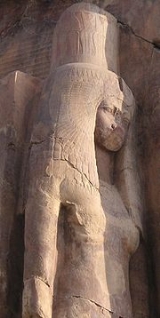
Tiye continued to hold the attention and public devotion of her husband, Amenhotep III. She regularly appears beside him in statues and reliefs in tombs and temples, as well as, royal stelas and her name is paired with her husband's on many small objects including commemorative scarabs. This woman was respected and worshipped for the powers that she had. Her husband recognized the potential she carried to be a willing and able executor of foreign decisions, on his behalf perhaps, but under her own powers of negotiation, wit, and will. She was clearly extraordinary; her husband recognized her extraordinariness. As such, she was nearly worshipped.

She even appeared as equal in size, realistically depicted in relation to the pharaoh, on many statues and stelas, which some researchers state reflected unprecedented status for women who were not depicted as pharaohs or deities in Ancient Egyptology representation art, as seen in the image of them to the right, where his left arm and shoulder remains on the fragment. Some researchers state that this was "unprecedented" since no previous queen appeared so openly during her husband's own rule however, artifacts from earlier times in the culture reveal examples of just that and that the evaluation was due to limited understanding of the roles of women earlier in the culture. Menkaura
Menkaura

Menkaura was a pharaoh of the Fourth dynasty of Egypt who ordered the construction of Menkaure's Pyramid. His main queen was Khamerernebty II....
 and his consort
Queen consort

A queen consort is the title given to the wife of a reigning Monarch. Queens consort usually share their husbands' Royal and noble ranks and hold the feminine equivalent of their husbands' monarchical titles....
, Queen Khamerernebty II, were depicted similarly during the New Kingdom
New Kingdom

The New Kingdom, sometimes referred to as the Egyptian Empire, is the period in ancient Egyptian History of Ancient Egypt between the 16th century BC and the 11th century BC, covering the Eighteenth dynasty of Egypt, Nineteenth dynasty of Egypt, and Twentieth dynasty of Egypt....
 when he was a pharaoh of the fourth dynasty of Egypt
Fourth dynasty of Egypt

The Fourth Dynasty of Ancient Egypt, also written Dynasty 4 and Dynasty IV, is characterized as a golden age of the Old Kingdom....
 during c. 2620 BC–2480 BC (see Ancient Egypt: Old Kingdom
Ancient Egypt

Ancient Egypt was an Ancient history civilization in eastern North Africa, concentrated along the lower reaches of the Nile in what is now the modern nation of Egypt....
).

Her husband devoted a number of shrines to her and constructed a temple
Temple

A temple is a structure reserved for religious or spiritual activities, such as prayer and sacrifice, or analogous rites. A ??templum?? constituted a sacred precinct as defined by a priest, or augur....
 dedicated to her in Sedeinga in Nubia where she was worshipped as a form of the goddess Hathor
Hathor

In Egyptian mythology, Hathor was originally a personification of the Milky Way, which was seen as the milk that flowed from the udders of a heavenly cow....
-Tefnut
Tefnut

In Egyptian mythology, Tefnut is a goddess of water and fertility, indeed her name means moist waters . She was created by Atum from his mucus, a mythology that may be related to the alternative translation of her name - spat waters....
. He also had an artificial lake built for her in his Year 12. As the American Egyptologists David O'Connor and Eric Cline note:

Her son, Akhenaten, later would build a sumptuous shrine for her during his reign and treat his own queen, Nefertiti
Nefertiti

Nefertiti was the Great Royal Wife of the Egyptian Pharaoh Akhenaten. Nefertiti and her husband were known for changing Egypt's religion from a polytheistic religion to a monotheistic religion....
, as a co-regent and she may have ruled as pharaoh after his death.

Influence at court

Tiye wielded a great deal of power during both her husband’s and son’s reigns. Amenhotep III became a fine sportsman, a lover of outdoor life, and a great statesman. He often had to consider claims for Egypt's gold and requests for his royal daughters in marriage from foreign kings such as Tushratta
Tushratta

Tushratta was a king of Mitanni at the end of the reign of Amenhotep III and throughout the reign of Akhenaten -- approximately the late 14th century BC....
 of Mitanni and Kadashman-Enlil I
Kadashman-Enlil I

Kadashman-Enlil I was a Kassites King of Babylon from ca. 1374 BC to 1360 BC . He is known to have been a contemporary of Amenhotep III of Egypt, with whom he corresponded; three letters authored by Kadashman-Enlil are preserved in the Amarna letters corpus....
 of Babylon. The royal lineage was carried by the women of Ancient Egypt and marriage to one would have been a path to the throne for their progeny. Tiye became her husband’s trusted adviser and confidant. Being wise, intelligent, strong, and fierce, she was able to gain the respect of foreign dignitaries. Foreign leaders were willing to deal directly through her. She continued to play an active role in foreign relations and was the first Egyptian queen to have her name recorded on official acts.

She may have continued to advise her son, Akhenaten, when he took the throne. Her son’s correspondence with Tushratta
Tushratta

Tushratta was a king of Mitanni at the end of the reign of Amenhotep III and throughout the reign of Akhenaten -- approximately the late 14th century BC....
, the king of Mitanni
Mitanni

Mitanni or Hanigalbat was a loosely organized Hurrian-speaking Hittite vassal state in northern Syria from ca. 1500 BC-1300 BC."The Assyrians called the lands of Mitanni Hanigalbat while to the Hittites it was the land of the Hurrians....
, speaks highly of the political influence which Tiye wielded at court. In Amarna letter EA 26, Tushratta, king to Mitanni
Mitanni

Mitanni or Hanigalbat was a loosely organized Hurrian-speaking Hittite vassal state in northern Syria from ca. 1500 BC-1300 BC."The Assyrians called the lands of Mitanni Hanigalbat while to the Hittites it was the land of the Hurrians....
, corresponded directly with Tiye to reminisce about the good relations which he enjoyed with her then deceased husband and extended his wish to continue on friendly terms with her son, Akhenaten.

Amenhotep III died in Year 38 or Year 39 of his reign (1353 BC/1350 BC) and was buried in the Valley of the Kings
Valley of the Kings

The Valley of the Kings is a valley in Egypt where, for a period of nearly 500 years from the 16th century BC to 11th century BC, tombs were constructed for the Pharaoh and powerful nobles of the Conventional Egyptian chronology#New Kingdom ....
 in WV22
WV22

Tomb WV22, in the Western arm of the Valley of the Kings, was used as the resting place of one of the greatest rulers of Egypt's New Kingdom, Amenhotep III....
, however, Tiye is known to have outlived him for as many as twelve years. Tiye continued to be mentioned in the Amarna letters
Amarna letters

The Amarna letters are an archive of correspondence on clay tablets, mostly diplomatic, between the Ancient Egypt administration and its representatives in Canaan and Amurru during the New Kingdom....
 and in inscriptions as queen and beloved of the king. Amarna letter EA 26 which is addressed to Tiye, dates to the reign of Akhenaten. She is known to have had a house at Amarna, Akhenaten's new capital and is shown on the walls of the tomb of Huya – a "steward in the house of the king's mother, the great royal wife Tiyi" – depicted at a dinner table with Akhenaten, Nefertiti, and their family and then being escorted by the king to her
sunshade. In an inscription approximately dated to November 21 of Year 12 of Akhenaten's reign (1338 BC), both she and her granddaughter Meketaten
Meketaten

Meketaten was the second daughter of six born to the Egyptian Pharaoh Akhenaten and his Great Royal Wife Nefertiti. She was probably born in year 2 or 3 Akhenaten's reign....
 are mentioned for the last time. They are thought to have died shortly after that date.

In 1898, Victor Loret
Victor Loret

Victor Clement Georges Philippe Loret was a France Egyptologist.Loret studied with Gaston Maspero at the ?cole des Hautes ?tudes In 1897 he became the head of the Egyptian Antiquities Service....
 discovered a mummy
Mummy

A mummy is a corpse whose skin and organs have been preserved by either intentional or incidental exposure to chemicals, extreme coldness, very high humidity, or lack of air when bodies are submerged in bogs....
 of a pharaoh
Pharaoh

Pharaoh is a title used in many modern discussions of the ancient Egyptian rulers of all periods. In antiquity this title began to be used for the ruler who was the religious and political leader of united ancient Egypt, only during the New Kingdom, specifically, during the middle of the Eighteenth dynasty of Egypt....
 that is believed to have been Amenhotep III. Alongside it was the mummy of an
"Elder Lady". The identification of the "Elder Lady" as Tiye, has found considerable support among scholars, but an examination of the mummy is inconclusive in terms of her age. A lock of Tiye's hair was found in a nest of miniature coffins in Tutankhamun's tomb which is stated as belonging explicitly to Tiye.

If Tiye died soon after Year 12 of Akhenaten's reign (1338 BC), this would place her birth around 1398 BC, her marriage to Amenhotep III at the age of eleven or twelve, and her becoming a widow at the age of forty-eight to forty-nine. Suggestions of a co-regency between Amenhotep III and his son Akhenaten lasting for up to twelve years continue, but most scholars today, either accept a brief co-regency lasting no more than one year at the most, or no co-regency at all.

Burial

Tiye is believed to have been buried in Akhenaten's royal tomb at Amarna
Amarna

The site of Amarna is located on the east bank of the Nile River in the modern Egyptian province of Minya Governorate, some 58 km south of the city of al-Minya, 312 km south of the Egyptian capital Cairo and 402 km north of Luxor....
 alongside her son and granddaughter, Meketaten
Meketaten

Meketaten was the second daughter of six born to the Egyptian Pharaoh Akhenaten and his Great Royal Wife Nefertiti. She was probably born in year 2 or 3 Akhenaten's reign....
, as a fragment from the tomb not long ago was identified as being from her sarcophagus
Sarcophagus

A sarcophagus is a funeral receptacle for a corpse, most commonly carved or cut from stone. The word "sarcophagus" comes from the Greek language sa?? sarx meaning "flesh", and fa?e?? phagein meaning "to eat", hence sarkophagus means "flesh-eating"; from the phrase lithos sarkophagos the word came to refer to the limestone t...
. Her gilded burial shrine (showing her with Akhenaten) ended up in KV55
KV55

KV55 is a tomb in the Valley of the Kings , it was discovered by Edward R. Ayrton in 1907 while he was working in the Valley for Theodore M. Davis....
 while shabtis belonging to her were found in Amenhotep III
Amenhotep III

Amenhotep III was the ninth pharaoh of the Eighteenth dynasty of Egypt. According to different authors, he ruled Egypt from June 1391 BC-December 1353 BC or June 1388 BC to December 1351 BC/1350 BC after his father Thutmose IV died....
's WV22
WV22

Tomb WV22, in the Western arm of the Valley of the Kings, was used as the resting place of one of the greatest rulers of Egypt's New Kingdom, Amenhotep III....
 tomb.

Whether or not she was buried in either of these tombs is not known. In the tomb KV35
KV35

Tomb KV35 in the Valley of the Kings is the tomb of Amenhotep II.It was discovered by Victor Loret in March 1898.It has a dog-leg shape, typical of the layout of early Eighteenth dynasty of Egypt tombs, but several features make this tomb stand out....
, a mummy known as the Elder Lady has been identified tentatively, as hers. The British scholars Aidan Dodson & Dyan Hilton state, however, that "it seems very unlikely that her mummy could be the so-called 'Elder Lady' in the tomb of Amenhotep II." This view also is supported because the Elder Lady's teeth look as if they were those of a twenty-nine year old rather than a fifty-nine year old. However, recent evidence suggests that the DNA analysis between the Elder Woman's teeth and the lock of hair found in Tutankhamun
Tutankhamun

Tutankhamun , Egyptian language was an Ancient Egypt Pharaoh of the Eighteenth dynasty of Egypt , during the period of History of Egypt known as the New Kingdom....
's tomb suggest that the body is Tiye and is nearer to a middle aged woman.

External links

  • from the Amarna letters
    Amarna letters

    The Amarna letters are an archive of correspondence on clay tablets, mostly diplomatic, between the Ancient Egypt administration and its representatives in Canaan and Amurru during the New Kingdom....