

Arawak

Encyclopedia
Indigenous peoples
Indigenous peoples are ethnic groups that are defined as indigenous according to one of the various definitions of the term, there is no universally accepted definition but most of which carry connotations of being the "original inhabitants" of a territory....
of the West Indies. The group belongs to the Arawakan
Arawakan languages
Macro-Arawakan is a proposed language family of South America and the Caribbean based on the Arawakan languages. Sometimes the proposal is called Arawakan, in which case the central family is called Maipurean....
language family. They were the natives whom Christopher Columbus
Christopher Columbus
Christopher Columbus was an explorer, colonizer, and navigator, born in the Republic of Genoa, in northwestern Italy. Under the auspices of the Catholic Monarchs of Spain, he completed four voyages across the Atlantic Ocean that led to general European awareness of the American continents in the...
encountered when he first arrived in the Americas
Americas
The Americas, or America , are lands in the Western hemisphere, also known as the New World. In English, the plural form the Americas is often used to refer to the landmasses of North America and South America with their associated islands and regions, while the singular form America is primarily...
in 1492. The Spanish described them as a peaceful primitive people.
The Arawak people include the Taíno
Taíno people
The Taínos were pre-Columbian inhabitants of the Bahamas, Greater Antilles, and the northern Lesser Antilles. It is thought that the seafaring Taínos are relatives of the Arawak people of South America...
, who occupied the Greater Antilles
Greater Antilles
The Greater Antilles are one of three island groups in the Caribbean. Comprising Cuba, Jamaica, Hispaniola , and Puerto Rico, the Greater Antilles constitute almost 90% of the land mass of the entire West Indies.-Greater Antilles in context :The islands of the Caribbean Sea, collectively known as...
and the Bahamas (Lucayan
Lucayan
The Lucayan were the original inhabitants of the Bahamas before the arrival of Europeans. They were a branch of the Taínos who inhabited most of the Caribbean islands at the time. The Lucayans were the first inhabitants of the Americas encountered by Christopher Columbus...
s); the Nepoya and Suppoya of Trinidad
Trinidad
Trinidad is the larger and more populous of the two major islands and numerous landforms which make up the island nation of Trinidad and Tobago. It is the southernmost island in the Caribbean and lies just off the northeastern coast of Venezuela. With an area of it is also the fifth largest in...
, and the Igneri
Igneri
The Igneri were an ethnic group that was once part of the Arawak tribe. They inhabited the Lesser Antilles and Puerto Rico during the Pre-Columbian era. They are said to have originated in the Orinoco region in Venezuela...
, who were supposed to have preceded the Caribs in the Lesser Antilles
Lesser Antilles
The Lesser Antilles are a long, partly volcanic island arc in the Western Hemisphere. Most of its islands form the eastern boundary of the Caribbean Sea with the Atlantic Ocean, with the remainder located in the southern Caribbean just north of South America...
, together with related groups (including the Lucayans) which lived along the eastern coast of South America
South America
South America is a continent situated in the Western Hemisphere, mostly in the Southern Hemisphere, with a relatively small portion in the Northern Hemisphere. The continent is also considered a subcontinent of the Americas. It is bordered on the west by the Pacific Ocean and on the north and east...
, as far south as what is now Brazil
Brazil
Brazil , officially the Federative Republic of Brazil , is the largest country in South America. It is the world's fifth largest country, both by geographical area and by population with over 192 million people...
.
First European encounter
It is now believed that the first tribe encountered by Christopher ColumbusChristopher Columbus
Christopher Columbus was an explorer, colonizer, and navigator, born in the Republic of Genoa, in northwestern Italy. Under the auspices of the Catholic Monarchs of Spain, he completed four voyages across the Atlantic Ocean that led to general European awareness of the American continents in the...
, when he arrived on the island he called Santa María de la Concepción (known as Mamana by the Lucayan
Lucayan
The Lucayan were the original inhabitants of the Bahamas before the arrival of Europeans. They were a branch of the Taínos who inhabited most of the Caribbean islands at the time. The Lucayans were the first inhabitants of the Americas encountered by Christopher Columbus...
Indians and now called Rum Cay
Rum Cay
Rum Cay is an island and district of the Bahamas. Lat.: N23 42' 30" - Long.: W 74 50' 00" - Size: 30 Sq. mlsRum Cay is 20 miles southwest of San Salvador Island, has many rolling hills that rises to about 120 feet . Christopher Columbus called it Santa Maria de la Concepción. The island is...
off the Bahamas), were Lucayan-Arawak Indians. Arawak men and women, naked, tawny, and full of wonder, emerged from their villages onto the island's beaches and swam out to get a closer look at the strange big boat. When Columbus and his sailors came ashore, carrying swords, speaking oddly, the Arawaks ran to greet them, brought them food, water, gifts.
Columbus noted in his log:
Saturday, 13 October 1492: ...They brought us balls of the cotton thread and parrots and other little things which it would be tedious to list, and exchanged everything for whatever we offered them. I kept my eyes open and tried to find out if there was any gold, and I saw that some of them had a little piece hanging from a hole in their nose. I gathered from their signs that if one goes south, or around the south side of the island, there is a king with great jars full of it, enormous amounts. I tried to persuade them to go there, But I saw that the idea was not to their liking...
Sunday, 14 October 1492: ...These people have little knowledge of fighting, as Your Majesties will see from the seven I have had captured to take away with us so as to teach them our language and return them, unless Your Majesties' orders are that they all be taken to Spain or held captive on the island itself, for with fifty men one could keep the whole population in subjection and make them do whatever one wanted.
On 17 February 1627, Captain Henry Powell of the ship "Olive Blossom" (who became first English Governor of the Isle of Barbados) landed to settle the island. Sometime after he brought about thirty Arawak from Guiana to work.
By 1739 Diarium von Pilgerhut and his German (Moravian) Pilgrim
Pilgrim
A pilgrim is a traveler who is on a journey to a holy place. Typically, this is a physical journeying to some place of special significance to the adherent of a particular religious belief system...
brothers arrived in Fort Nassau
Fort Nassau
The name Fort Nassau was used by the Dutch in the 17th century for several fortifications, mostly trading stations, named for the House of Orange-Nassau...
on the Berbice River
Berbice River
The Berbice River, located in eastern Guyana, rises in the highlands of the Rupununi region. The Berbice flows northward for 370 miles through dense forests to the coastal plain...
and once there decided to teach their ways by example. In accounts by the pilgrim Heinrich Beutel, we learn a little about the villagers he encountered:
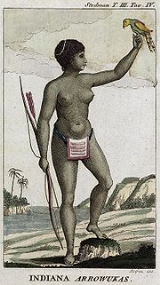
Used to heat of the rain forest, Arawak families lived without clothes. Arawak men had never done gardening or work around home. They only hunted, and let the women do the rest. Even women expecting babies, or with little ones in their care, worked in cassavaCassavaCassava , also called yuca or manioc, a woody shrub of the Euphorbiaceae native to South America, is extensively cultivated as an annual crop in tropical and subtropical regions for its edible starchy tuberous root, a major source of carbohydrates...
patches while men sat in hammocks under the shade. When asked if they wanted to get married did not seem in a hurry. The Indians kept themselves cleaner than the Europeans. Believing that sweat weakens the body, they bathed frequently throughout the day. In their houses—thatched shelters without walls—they sat on clean sand, and they treated one another very politely. Young people called their parents and others of that age “honoured ones.” Older people called all young men “handsome ones” and it took them a while to learn the European titles for women, girls and children, and how to use them. Even though the Arawaks did not have an exact word for humility, they well knew the attitude. One should not look another person in the face while speaking “like a dog,” they believed. Rather, one should rise so that others might sit and count it a privilege to give. Arawak hospitality always involved eating and drinking together and even drank of fermented cassava, held frequent love feasts, and fought at their festivals.
The villagers showed interest in teaching and no sooner had two learned how to read then they began to hold classes for the rest and also began helping the pilgrims translate scriptures and songs from Germany. The Arawaks, however, had no concept of right and wrong in the European sense, and only dimly comprehended concepts such as worship and faith, but they knew what disobedience meant. They lived according to rigid ethics of their own, something the Europeans realised they could learn from the Arawaks. Soon the pilgrim's hut, with its hour-a-day meetings (and monthly all-day meetings) attracted up to one hundred and fifty villagers. During the cassava harvest, or at great fish poisonings along the river, they sang German and Arawak songs. Rarely, during these evening meetings, the believers noticed new faces among the crowd—not Arawaks, but painted Caribs and Waraus, clutching tall spears. By 1748 the first Arawak European-style wedding was celebrated at Pilgerhut.
Before 1881, when Charles Daniel Dance wrote his Chapters From a Guianese Log-book, he noticed,
The children all talked a Dutch patoisPatoisPatois is any language that is considered nonstandard, although the term is not formally defined in linguistics. It can refer to pidgins, creoles, dialects, and other forms of native or local speech, but not commonly to jargon or slang, which are vocabulary-based forms of cant...
besides the Arawak Indian tongue; and with a Dutch teacher to instruct them, it is not difficult to conceive the manner in which they read their English lessons.
Economy
On the islands of the Caribbean, the Taíno very easily grew crops in conucos, large mounds of earth employed as planting beds for vegetable farming [semi -nomadic]. They packed the conuco with leaves to provide nutrition and prevent soil erosion. They planted a large variety of crops to ensure that some of them would grow, and ripen regardless of the season. YucaCassava
Cassava , also called yuca or manioc, a woody shrub of the Euphorbiaceae native to South America, is extensively cultivated as an annual crop in tropical and subtropical regions for its edible starchy tuberous root, a major source of carbohydrates...
(cassava) was a staple food, and grows with minimal care in the tropical climate. The Taino also grew maize
Maize
Maize known in many English-speaking countries as corn or mielie/mealie, is a grain domesticated by indigenous peoples in Mesoamerica in prehistoric times. The leafy stalk produces ears which contain seeds called kernels. Though technically a grain, maize kernels are used in cooking as a vegetable...
, unusual for Caribbean islanders. They used large, stable, slow rafts for trade to the Mesoamerica
Mesoamerica
Mesoamerica is a region and culture area in the Americas, extending approximately from central Mexico to Belize, Guatemala, El Salvador, Honduras, Nicaragua, and Costa Rica, within which a number of pre-Columbian societies flourished before the Spanish colonization of the Americas in the 15th and...
n civilizations and inter-island travel but used smaller, faster but less stable canoes for intra-island shore travel. Taino women did all the agricultural and craft work at home, whereas the men were generally warriors.
Culture
The Taíno made crafts and played games. One of these games called Areyto, which included religious ceremonies as well as a game similar to soccer was played in the Batéy (an arena-like field flanked by huge standing stones depicting images of the Taino religion). The Taíno devoted their energy to creative activities such as pottery, basket weaving, cotton weaving, stone tools and even stone sculptureSculpture
Sculpture is three-dimensional artwork created by shaping or combining hard materials—typically stone such as marble—or metal, glass, or wood. Softer materials can also be used, such as clay, textiles, plastics, polymers and softer metals...
. Men and women painted their bodies and wore jewellery
Jewellery
Jewellery or jewelry is a form of personal adornment, such as brooches, rings, necklaces, earrings, and bracelets.With some exceptions, such as medical alert bracelets or military dog tags, jewellery normally differs from other items of personal adornment in that it has no other purpose than to...
made of gold, stone, bone, and shell. They also participated in informal feasts and dances. The Taíno drank alcohol made from fermented corn, and used tobacco
Tobacco
Tobacco is an agricultural product processed from the leaves of plants in the genus Nicotiana. It can be consumed, used as a pesticide and, in the form of nicotine tartrate, used in some medicines...
in religious ceremonies.
The Taino developed the hammock
Hammock
A hammock is a sling made of fabric, rope, or netting, suspended between two points, used for swinging, sleeping, or resting. It normally consists of one or more cloth panels, or a woven network of twine or thin rope stretched with ropes between two firm anchor points such as trees or posts....
(the name derives from the Taíno term hamaca), which was first encountered by the Spaniards on the island they subsequently named Hispaniola
Hispaniola
Hispaniola is a major island in the Caribbean, containing the two sovereign states of the Dominican Republic and Haiti. The island is located between the islands of Cuba to the west and Puerto Rico to the east, within the hurricane belt...
. Hammocks were readily adopted as a convenient means to increase the crew capacity on ships and improved the sanitary conditions of the sleeping quarters; old straw – which was commonly used for bedding in earlier times, quickly became rotten and infested by parasites in the damp, cramped crew quarters of sailing ships. Cotton cloth hammocks could be washed easily if they became soiled, and were strong and durable.
Robert Gordon Latham, in his lectures of February 1851 on ethnology of the Indians of British Guiana writes:
- "The Pe-i-man is the Arawak Shaman. He it is who names the children – for a consideration. Failing this, the progeny goes nameless; and to go nameless is to be obnoxious to all sorts of misfortunes. Imposture is hereditary; and as soon as the son of a conjuror enters his twentieth year, his right ear is pierced, he is required to wear a ring, and he is trusted with the secrets of the craft.".
The Arawak Indians of the Amazon were also known for their making of terra preta. The soil was created by slow-burning fires- good for clearing the dense foliage, as well as enriching the soil with phosphorus and potassium. This innovation helped the Arawak civilization proceed from the Acutuba tribes (about 100-200 people per settlement) to the Manacapuru, to finally the Paradao, who’s numbers were expected to be in the thousands. The soil produced by these tribes is still used today to support the growing number of people settling there, and can also be used to model a more sustainable way of farming without wasting the precious ecosystem of the Amazon through shifting cultivation.
Population decline
The virgin soil epidemic caused by the arrival of smallpox and other diseases from Europe, combined with Spain's harsh policies of enslavement, resettlement and the separation of families, the encomienda system, resulted in Taino society's drastic decline within a few decades after contact. Attacks by Carib tribes and unrelenting harsh treatment by the Europeans accelerated the process. Although Taino society was destroyed by European expansion, some of their bloodlines persist among the new settlers, primarily Western and African peoples.Frederick Albion Ober, after his trip in July 1898 of the West Indies, notes:
- "... a barbarous fact. When the ancient Caribs came here from the south, they came as conquerors, and killed every adult male Arawak who fell into their hands. But they preserved the women and children,..."
Survivors
While only the Carib remain among the original Antillean populations of CiboneyCiboney
The Ciboney were pre-Columbian indigenous inhabitants of the Greater Antilles in the Caribbean Sea. The name Ciboney derives from the indigenous Taíno people which means Cave Dwellers; evidence has shown that a number of the Ciboney people have lived in caves at some time. Over the years, many...
, Taino
Taíno people
The Taínos were pre-Columbian inhabitants of the Bahamas, Greater Antilles, and the northern Lesser Antilles. It is thought that the seafaring Taínos are relatives of the Arawak people of South America...
, and Carib, the Arawak have survived on mainland South America. Several hundred thousand reside in Venezuela
Venezuela
Venezuela , officially called the Bolivarian Republic of Venezuela , is a tropical country on the northern coast of South America. It borders Colombia to the west, Guyana to the east, and Brazil to the south...
, Guyana
Guyana
Guyana , officially the Co-operative Republic of Guyana, previously the colony of British Guiana, is a sovereign state on the northern coast of South America that is culturally part of the Anglophone Caribbean. Guyana was a former colony of the Dutch and of the British...
, Suriname
Suriname
Suriname , officially the Republic of Suriname , is a country in northern South America. It borders French Guiana to the east, Guyana to the west, Brazil to the south, and on the north by the Atlantic Ocean. Suriname was a former colony of the British and of the Dutch, and was previously known as...
, and French Guiana
French Guiana
French Guiana is an overseas region of France, consisting of a single overseas department located on the northern Atlantic coast of South America. It has borders with two nations, Brazil to the east and south, and Suriname to the west...
, an example being approximately 300,000 Wayuu
Wayuu
Wayuu is an Amerindian ethnic group of the La Guajira Peninsula in northern Colombia and northwest Venezuela. They are part of the Maipurean language family.- Geography :...
Arawak living in Colombia
Colombia
Colombia, officially the Republic of Colombia , is a unitary constitutional republic comprising thirty-two departments. The country is located in northwestern South America, bordered to the east by Venezuela and Brazil; to the south by Ecuador and Peru; to the north by the Caribbean Sea; to the...
, with 150,000 Wayuu in the neighbouring area of Venezuela
Venezuela
Venezuela , officially called the Bolivarian Republic of Venezuela , is a tropical country on the northern coast of South America. It borders Colombia to the west, Guyana to the east, and Brazil to the south...
. Taíno/Arawakan language is still spoken by a tiny minority in Cuba to the present day.
Recent DNA
DNA
Deoxyribonucleic acid is a nucleic acid that contains the genetic instructions used in the development and functioning of all known living organisms . The DNA segments that carry this genetic information are called genes, but other DNA sequences have structural purposes, or are involved in...
studies indicate that the majority of people in Puerto Rico
Puerto Rico
Puerto Rico , officially the Commonwealth of Puerto Rico , is an unincorporated territory of the United States, located in the northeastern Caribbean, east of the Dominican Republic and west of both the United States Virgin Islands and the British Virgin Islands.Puerto Rico comprises an...
are descended maternally in part from Taíno/Arawakan ancestors. This study, under the Taino genome project
Genome project
Genome projects are scientific endeavours that ultimately aim to determine the complete genome sequence of an organism and to annotate protein-coding genes and other important genome-encoded features...
started in 1999 through a grant from the National Science Foundation
National Science Foundation
The National Science Foundation is a United States government agency that supports fundamental research and education in all the non-medical fields of science and engineering. Its medical counterpart is the National Institutes of Health...
, tested mitochondrial DNA
Mitochondrial DNA
Mitochondrial DNA is the DNA located in organelles called mitochondria, structures within eukaryotic cells that convert the chemical energy from food into a form that cells can use, adenosine triphosphate...
throughout the island, identifying a 62 percent of Puerto Ricans today are of Amerindian descent.
See also
- Arawakan languages
- Carib
- Cariban languagesCariban languagesThe Cariban languages are an indigenous language family of South America. They are widespread across northernmost South America, from the mouth of the Amazon River to the Colombian Andes, but also appear in central Brazil. Cariban languages are relatively closely related, and number two to three...
- CiboneyCiboneyThe Ciboney were pre-Columbian indigenous inhabitants of the Greater Antilles in the Caribbean Sea. The name Ciboney derives from the indigenous Taíno people which means Cave Dwellers; evidence has shown that a number of the Ciboney people have lived in caves at some time. Over the years, many...
- Garifuna languageGarifuna languageGarifuna is an Arawakan language spoken in Honduras, Guatemala, and Belize by the Garifuna people. The language is also spoken to a lesser extent in Nicaragua's Mosquito Coast. Historically it was referred to as Carib or Black Carib and Igñeri by Europeans. Garifuna has a vocabulary split between...
- Jean La RoseJean La RoseJean La Rose is an indigenous Arawak from Georgetown, Guyana. She was awarded the Goldman Environmental Prize in 2002 for her struggles to halt mining in their territories, to secure inhabitants full rights to traditional lands, and to save Guyana's forests....
- List of indigenous names of Eastern Caribbean islands
- Maipurean languages
- TaínoTaíno peopleThe Taínos were pre-Columbian inhabitants of the Bahamas, Greater Antilles, and the northern Lesser Antilles. It is thought that the seafaring Taínos are relatives of the Arawak people of South America...