


Apatosaurus

Encyclopedia
Apatosaurus also known by the popular but scientifically deprecated synonym
Brontosaurus, is a genus
of sauropod dinosaur
that lived from about 154 to 150 million years ago, during the Jurassic
Period (Kimmeridgian
and early Tithonian
ages). It was one of the largest land animal
s that ever existed, with an average length of 23 m (75.5 ft) and a mass of at least 23 metric tons (25.4 ST). The composite term Apatosaurus comes from the Greek
names apate /apatelos meaning "deception"/"deceptive" and sauros meaning "lizard"; thus, "deceptive lizard". Othniel Charles Marsh
gave it this name because he regarded the chevron bones
as similar to those of some mosasaur
s, members of a group of prehistoric marine lizards.
The cervical vertebrae were less elongated and more heavily constructed than those of Diplodocus
and the bones of the leg were much stockier (despite being longer), implying a more robust animal. The tail was held above the ground during normal locomotion. Like most sauropods, Apatosaurus had only a single large claw on each forelimb, with the first three toes on the hind limb possessing claws. Fossil
s of these animals have been found in Nine Mile Quarry and Bone Cabin Quarry
in Wyoming
and at sites in Colorado
, Oklahoma
and Utah
, present in stratigraphic zones 2-6.
al animal with a long, whip-like tail. Its forelimbs were slightly shorter than its hindlimbs. One measurement places the total length of the species Apatosaurus louisae at 22 m (72.2 ft).
It was roughly the weight of four elephants. One specimen of A. excelsus was estimated to weigh 25952 kg (57,214.4 lb); estimates for A. louisae were 20600 kg (45,415.2 lb) and 22407 kg (49,399 lb). Other estimates of the body mass of adult Apatosaurus species range from 18000 kg (39,683.2 lb) to 35000 kg (77,161.8 lb). A microscopic study of Apatosaurus bones concluded that the animals grew rapidly when young and reached near-adult sizes in about 10 years.
The skull was small in comparison with the size of the animal. The jaws were lined with spatulate teeth, which resembled chisels, suited to an herbivorous diet. Like other sauropods, the vertebrae of the neck were deeply bifurcated; that is, they carried paired spines, creating a wide and deep profile for the neck. The apparently massive neck was, however, filled with an extensive system of weight-saving air sacs. Apatosaurus, like its close relative Supersaurus
, is notable for the incredibly tall spines on its vertebrae, which make up more than half the height of the individual bones. Also unusual among diplodocids is the shape of the tail, which is comparatively thin in breadth and short in height, a profile caused by the vertebral spines decreasing in height rapidly the farther they are from the hips. Apatosaurus also had very long ribs compared to most other diplodocids, giving it an unusually deep chest. The limb bones were also very robust.
 Apatosaurus is a member of the family
Diplodocidae, a clade
of gigantic sauropod dinosaur
s. The family includes some of the longest creatures ever to walk the earth, including Diplodocus
, Supersaurus
, Suuwassea
, and Barosaurus
. Within the subfamily Apatosaurinae, Apatosaurus may be most closely related to Suuwassea, Supersaurus and Eobrontosaurus
.
In 1877, Othniel Charles Marsh
published the name of the type species
Apatosaurus ajax. He followed this in 1879 with a description of another, more complete specimen, which he thought represented a new genus
and species
, which he named Brontosaurus excelsus. In 1903, Elmer Riggs re-examined the fossils. While he agreed with Marsh that Brontosaurus excelsus was likely a distinct species, he also noted many similarities between B. excelsus and A. ajax, and decided that both should be placed in the same genus. Riggs re-classified the species as Apatosaurus excelsus. Almost all paleontologists since Riggs published his opinions have agreed that the two species should be classified together in a single genus. According to the rules of the ICZN
(which governs the scientific names of animals), the name Apatosaurus, having been published first, had priority as the official name; Brontosaurus is considered a junior synonym
and has therefore been discarded from formal use.
Apatosaurus ajax is the type species
of the genus, and was named by the paleontologist Othniel Charles Marsh
in 1877 after Ajax
, the hero
from Greek mythology
. It is the holotype
for the genus and two partial skeletons have been found, including part of a skull
. Apatosaurus excelsus (originally Brontosaurus) was named by Marsh in 1879. It is known from six partial skeletons, including part of a skull, which have been found in the United States
, in Colorado
, Oklahoma
, Utah
, and Wyoming
. Apatosaurus louisae was named by William Holland in 1915 in honor of Mrs. Louise Carnegie, wife of Andrew Carnegie
who funded field research to find complete dinosaur skeletons in the American West. Apatosaurus louisae is known from one partial skeleton which was found in Utah
in the United States. Apatosaurus parvus was originally known as Elosaurus parvus, but was reclassified as a species of Apatosaurus in 1994. This synonymy was upheld in 2004.
Apatosaurus yahnahpin was named by Filla and Redman in 1994. Robert T. Bakker
made A. yahnahpin the type
species of a new genus, Eobrontosaurus
in 1998, so it is now properly Eobrontosaurus yahnahpin. One partial skeleton has been found in Wyoming. It has been argued that Eobrontosaurus belongs within Camarasaurus
, although this has been questioned.
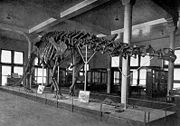 Othniel Charles Marsh
, a Professor of Paleontology
at Yale University
, described and named an incomplete (and juvenile) skeleton of Apatosaurus ajax in 1877. Two years later, Marsh announced the discovery of a larger and more complete specimen at Como Bluff
Wyoming
—which, because of discrepancies including the size difference, Marsh incorrectly identified as belonging to an entirely new genus
and species
. He dubbed the new species Brontosaurus excelsus, meaning "thunder lizard", from the Greek
brontē/βροντη meaning 'thunder' and sauros/σαυρος meaning 'lizard', and from the Latin
excelsus, "highest, sublime", referring to the greater number of sacral vertebrae than in any other genus of sauropod known at the time.
The finds—the largest dinosaur ever discovered at the time and nearly complete, lacking only a head, feet, and portions of the tail — were then prepared for what was to be the first ever mounted display of a sauropod skeleton, at Yale's Peabody Museum of Natural History in 1905. The missing bones were created using known pieces from close relatives of Brontosaurus. Sauropod feet that were discovered at the same quarry were added, as well as a tail fashioned to appear as Marsh believed it should, as well as a composite model of what he felt the skull of this massive creature might look like. This was not a delicate Diplodocus
-style skull (which would later turn out to be more accurate), but was composed of "the biggest, thickest, strongest skull bones, lower jaws and tooth crowns from three different quarries", primarily those of Camarasaurus
, the only other sauropod for which good skull material was known at the time. This method of reconstructing incomplete skeletons based on the more complete remains of related dinosaurs continues in museum mounts and life restorations to this day.
Despite the much-publicized debut of the mounted skeleton, which cemented the name Brontosaurus in the public consciousness, Elmer Riggs had published a paper in the 1903 edition of Geological Series of the Field Columbian Museum which argued that Brontosaurus was not different enough from Apatosaurus to warrant its own genus, and created the combination Apatosaurus excelsus: "In view of these facts the two genera may be regarded as synonymous. As the term 'Apatosaurus' has priority, 'Brontosaurus' will be regarded as a synonym."
Despite this, at least one paleontologist—Robert Bakker—argued in the 1990s that A. ajax and A. excelsus are in fact sufficiently distinct that the latter continues to merit a separate genus. This idea has not been accepted by many palaeontologists.
In 2008, footprints of juvenile Apatosaurus were reported from Quarry Five in Morrison, Colorado. Discovered in 2006 by Matthew Mossbrucker, these footprints show that juveniles could run on their hind legs in a manner similar to that of the modern basilisk
lizard.
A study of diplodocid snouts showed that the square snout, large proportion of pits, and fine subparallel scratches in Apatosaurus suggests it was a ground-height nonselective browser.
Apatosaurus was the second most common sauropod in the Morrison Formation
ecosystem, after Camarasaurus
. It may have been a more solitary animal than other Morrison Formation dinosaurs. As a genus, Apatosaurus existed for a long span of time, and have been found in most levels of the Morrison. Fossils of Apatosaurus ajax are known exclusively from the upper portion of the formation (upper Brushy Basin Member), about 152-151 million years ago. A. excelsus fossils have been reported from the upper Salt Wash Member to the upper Brushy Basin Member, ranging from the middle to late Kimmeridgian
age, about 154-151 million years ago. A. louisae fossils are rare, known only from one site in the upper Brushy Basin Member, dated to the late Kimmeridgian stage (about 151 million years ago). Additional Apatosaurus remains are known from even younger rocks, but they have not been identified as any particular species.
 Diplodocids like Apatosaurus are often portrayed with their necks held high up in the air, allowing them to browse on tall trees. Some scientists have argued that the heart would have had trouble sustaining sufficient blood pressure to oxygenate the brain. Furthermore, more recent studies have shown that diplodocid necks were less flexible than previously believed, because the structure of the neck vertebrae would not have permitted the neck to bend far upwards, and that sauropods like Apatosaurus were adapted to low browsing or ground feeding.
However, subsequent studies demonstrated that all tetrapod
s appear to hold their necks at the maximum possible vertical extension when in a normal, alert posture, and argued that the same would hold true for sauropods barring any unknown, unique characteristics that set the soft tissue anatomy of their necks apart from other animals. Apatosaurus, like Diplodocus, would have held its neck angled upward with the head pointed downwards in a resting posture.
Beginning with the assumption that Apatosaurus, like crocodilia
ns, did not have a diaphragm, the dead-space volume
(the amount of unused air remaining in the mouth, trachea and air tubes after each breath) has been estimated at about 184 liters for a 30 ton specimen.
Its tidal volume
(the amount of air moved in or out during a single breath) has been calculated based on the following respiratory system
s:
On this basis, its respiratory system
could not have been reptilian, as its tidal volume would not have been able to replace its dead-space volume. Likewise, the mammalian system would only provide a fraction of new air on each breath. Therefore, it must have had either a system unknown in the modern world or one like birds, i.e. multiple air sacs and a flow-through lung. Furthermore, an avian system would only need a lung volume of about 600 liters compared to a mammalian requirement of 2,950 liters, which would exceed the available space. The overall thoracic volume of Apatosaurus has been estimated at 1,700 liters allowing for a 500-liter, four-chambered heart
(like bird
s, not three-chambered like reptile
s) and a 900-liter lung capacity. That would allow about 300 liters for the necessary tissue
. Assuming Apatosaurus had an avian respiratory system and a reptilian resting-metabolism, it would need to consume only about 262 liters (69 gallons) of water per day.
, a computer scientist
from Microsoft
. Myhrvold carried out a computer simulation
of the tail, which in diplodocids like Apatosaurus was a very long, tapering structure resembling a bullwhip
. This computer modeling suggested that sauropods were capable of producing a whip-like cracking sound of over 200 decibels, comparable to the volume of a cannon
.
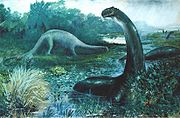 The length of time taken for Marsh's misclassification to be brought to public notice meant that the name Brontosaurus, associated as it was with one of the largest dinosaurs, became so famous that it persisted long after the name had officially been abandoned in scientific use.
As late as 1989, the U.S. Post Office
issued four "dinosaur" stamps: Tyrannosaurus
, Stegosaurus
, Pteranodon
and Brontosaurus. However, the misnomer of the term Brontosaurus, as well as the fact that Pteranodon is technically a pterosaur
and not a dinosaur
, led to complaints of "fostering scientific illiteracy." The Post Office defended itself (in Postal Bulletin 21744) by saying, "Although now recognized by the scientific community as Apatosaurus, the name 'Brontosaurus' was used for the stamp because it is more familiar to the general population." Stephen Jay Gould
also supported this position in his essay "Bully for Brontosaurus
", though he echoed Riggs' original argument that Brontosaurus is a synonym for Apatosaurus. Nevertheless, he noted that the former has developed and continues to maintain an independent existence in the popular imagination.
Brontosaurus has often been depicted in cinema, beginning with Winsor McKay
's 1914 classic Gertie the Dinosaur
. The 1925 silent film The Lost World
featured, using special effects by Willis O'Brien
, a battle between a Brontosaurus and an Allosaurus
but the former inaccurately had a very bendy neck. When George Lucas
made his special edition of Star Wars Episode IV: A New Hope
in 1997, he added some large, long-necked animals based on the Brachiosaurus
digital model from the earlier film Jurassic Park
. At an early stage he altered the CG department's suggested name "Bronto", taken from Brontosaurus, to 'Ronto'.
Sinclair Oil
has a long history of being a fixture on American roads (and briefly in other countries) with its green dinosaur logo and mascot, an Apatosaurus (Brontosaurus). While Sinclair's early advertising included a number of different dinosaurs, eventually only Apatosaurus was used as the official logo, due to its popular appeal.
The Brontosaurus is the main plot focus of the 1985 movie Baby: Secret of the Lost Legend
, in which a family of Brontosaurs are found still living in Africa.
Synonym (taxonomy)
In scientific nomenclature, a synonym is a scientific name that is or was used for a taxon of organisms that also goes by a different scientific name. For example, Linnaeus was the first to give a scientific name to the Norway spruce, which he called Pinus abies...
Brontosaurus, is a genus
Genus
In biology, a genus is a low-level taxonomic rank used in the biological classification of living and fossil organisms, which is an example of definition by genus and differentia...
of sauropod dinosaur
Dinosaur
Dinosaurs are a diverse group of animals of the clade and superorder Dinosauria. They were the dominant terrestrial vertebrates for over 160 million years, from the late Triassic period until the end of the Cretaceous , when the Cretaceous–Paleogene extinction event led to the extinction of...
that lived from about 154 to 150 million years ago, during the Jurassic
Jurassic
The Jurassic is a geologic period and system that extends from about Mya to Mya, that is, from the end of the Triassic to the beginning of the Cretaceous. The Jurassic constitutes the middle period of the Mesozoic era, also known as the age of reptiles. The start of the period is marked by...
Period (Kimmeridgian
Kimmeridgian
In the geologic timescale, the Kimmeridgian is an age or stage in the Late or Upper Jurassic epoch or series. It spans the time between 155.7 ± 4 Ma and 150.8 ± 4 Ma . The Kimmeridgian follows the Oxfordian and precedes the Tithonian....
and early Tithonian
Tithonian
In the geologic timescale the Tithonian is the latest age of the Late Jurassic epoch or the uppermost stage of the Upper Jurassic series. It spans the time between 150.8 ± 4 Ma and 145.5 ± 4 Ma...
ages). It was one of the largest land animal
Animal
Animals are a major group of multicellular, eukaryotic organisms of the kingdom Animalia or Metazoa. Their body plan eventually becomes fixed as they develop, although some undergo a process of metamorphosis later on in their life. Most animals are motile, meaning they can move spontaneously and...
s that ever existed, with an average length of 23 m (75.5 ft) and a mass of at least 23 metric tons (25.4 ST). The composite term Apatosaurus comes from the Greek
Ancient Greek
Ancient Greek is the stage of the Greek language in the periods spanning the times c. 9th–6th centuries BC, , c. 5th–4th centuries BC , and the c. 3rd century BC – 6th century AD of ancient Greece and the ancient world; being predated in the 2nd millennium BC by Mycenaean Greek...
names apate /apatelos meaning "deception"/"deceptive" and sauros meaning "lizard"; thus, "deceptive lizard". Othniel Charles Marsh
Othniel Charles Marsh
Othniel Charles Marsh was an American paleontologist. Marsh was one of the preeminent scientists in the field; the discovery or description of dozens of news species and theories on the origins of birds are among his legacies.Born into a modest family, Marsh was able to afford higher education...
gave it this name because he regarded the chevron bones
Chevron (anatomy)
A chevron is one of a series of bones on the ventral side of the tail in many reptiles, dinosaurs , and some mammals such as kangaroos and manatees....
as similar to those of some mosasaur
Mosasaur
Mosasaurs are large extinct marine lizards. The first fossil remains were discovered in a limestone quarry at Maastricht on the Meuse in 1764...
s, members of a group of prehistoric marine lizards.
The cervical vertebrae were less elongated and more heavily constructed than those of Diplodocus
Diplodocus
Diplodocus , or )is a genus of diplodocid sauropod dinosaur whose fossils were first discovered in 1877 by S. W. Williston. The generic name, coined by Othniel Charles Marsh in 1878, is a Neo-Latin term derived from Greek "double" and "beam", in reference to its double-beamed chevron bones...
and the bones of the leg were much stockier (despite being longer), implying a more robust animal. The tail was held above the ground during normal locomotion. Like most sauropods, Apatosaurus had only a single large claw on each forelimb, with the first three toes on the hind limb possessing claws. Fossil
Fossil
Fossils are the preserved remains or traces of animals , plants, and other organisms from the remote past...
s of these animals have been found in Nine Mile Quarry and Bone Cabin Quarry
Bone Cabin Quarry
Bone Cabin Quarry lies approximately fifteen miles north of Laramie, Wyoming near historic Como Bluff. During the summer of 1897 Walter W. Granger, a paleontologist from the American Museum of Natural History, came upon a hillside littered with Jurassic period dinosaur bone fragments...
in Wyoming
Wyoming
Wyoming is a state in the mountain region of the Western United States. The western two thirds of the state is covered mostly with the mountain ranges and rangelands in the foothills of the Eastern Rocky Mountains, while the eastern third of the state is high elevation prairie known as the High...
and at sites in Colorado
Colorado
Colorado is a U.S. state that encompasses much of the Rocky Mountains as well as the northeastern portion of the Colorado Plateau and the western edge of the Great Plains...
, Oklahoma
Oklahoma
Oklahoma is a state located in the South Central region of the United States of America. With an estimated 3,751,351 residents as of the 2010 census and a land area of 68,667 square miles , Oklahoma is the 28th most populous and 20th-largest state...
and Utah
Utah
Utah is a state in the Western United States. It was the 45th state to join the Union, on January 4, 1896. Approximately 80% of Utah's 2,763,885 people live along the Wasatch Front, centering on Salt Lake City. This leaves vast expanses of the state nearly uninhabited, making the population the...
, present in stratigraphic zones 2-6.
Description
Apatosaurus was a large, long-necked quadrupedQuadruped
Quadrupedalism is a form of land animal locomotion using four limbs or legs. An animal or machine that usually moves in a quadrupedal manner is known as a quadruped, meaning "four feet"...
al animal with a long, whip-like tail. Its forelimbs were slightly shorter than its hindlimbs. One measurement places the total length of the species Apatosaurus louisae at 22 m (72.2 ft).
It was roughly the weight of four elephants. One specimen of A. excelsus was estimated to weigh 25952 kg (57,214.4 lb); estimates for A. louisae were 20600 kg (45,415.2 lb) and 22407 kg (49,399 lb). Other estimates of the body mass of adult Apatosaurus species range from 18000 kg (39,683.2 lb) to 35000 kg (77,161.8 lb). A microscopic study of Apatosaurus bones concluded that the animals grew rapidly when young and reached near-adult sizes in about 10 years.
The skull was small in comparison with the size of the animal. The jaws were lined with spatulate teeth, which resembled chisels, suited to an herbivorous diet. Like other sauropods, the vertebrae of the neck were deeply bifurcated; that is, they carried paired spines, creating a wide and deep profile for the neck. The apparently massive neck was, however, filled with an extensive system of weight-saving air sacs. Apatosaurus, like its close relative Supersaurus
Supersaurus
Supersaurus is a genus of diplodocid sauropod dinosaur discovered by Vivian Jones of Delta, Colorado, in the Upper Jurassic Morrison Formation of Colorado in 1972. The fossil remains came from the Brushy Basin Member of the formation, dating to about 153 million years ago...
, is notable for the incredibly tall spines on its vertebrae, which make up more than half the height of the individual bones. Also unusual among diplodocids is the shape of the tail, which is comparatively thin in breadth and short in height, a profile caused by the vertebral spines decreasing in height rapidly the farther they are from the hips. Apatosaurus also had very long ribs compared to most other diplodocids, giving it an unusually deep chest. The limb bones were also very robust.
Classification and species
Family (biology)
In biological classification, family is* a taxonomic rank. Other well-known ranks are life, domain, kingdom, phylum, class, order, genus, and species, with family fitting between order and genus. As for the other well-known ranks, there is the option of an immediately lower rank, indicated by the...
Diplodocidae, a clade
Cladistics
Cladistics is a method of classifying species of organisms into groups called clades, which consist of an ancestor organism and all its descendants . For example, birds, dinosaurs, crocodiles, and all descendants of their most recent common ancestor form a clade...
of gigantic sauropod dinosaur
Dinosaur
Dinosaurs are a diverse group of animals of the clade and superorder Dinosauria. They were the dominant terrestrial vertebrates for over 160 million years, from the late Triassic period until the end of the Cretaceous , when the Cretaceous–Paleogene extinction event led to the extinction of...
s. The family includes some of the longest creatures ever to walk the earth, including Diplodocus
Diplodocus
Diplodocus , or )is a genus of diplodocid sauropod dinosaur whose fossils were first discovered in 1877 by S. W. Williston. The generic name, coined by Othniel Charles Marsh in 1878, is a Neo-Latin term derived from Greek "double" and "beam", in reference to its double-beamed chevron bones...
, Supersaurus
Supersaurus
Supersaurus is a genus of diplodocid sauropod dinosaur discovered by Vivian Jones of Delta, Colorado, in the Upper Jurassic Morrison Formation of Colorado in 1972. The fossil remains came from the Brushy Basin Member of the formation, dating to about 153 million years ago...
, Suuwassea
Suuwassea
Suuwassea is a genus of diplodocoid sauropod dinosaur found in the Upper Jurassic strata of the Morrison Formation, located in southern Carbon County, Montana, USA. The fossil remains were recovered in a series of expeditions during a period spanning the years 1999 and 2000, described by J.D....
, and Barosaurus
Barosaurus
Barosaurus ; Greek barys/βαρυς meaning 'heavy' and saurus/σαυρος meaning 'lizard', 'heavy lizard') was a giant, long-tailed, long-necked, plant-eating dinosaur closely related to the more familiar Diplodocus...
. Within the subfamily Apatosaurinae, Apatosaurus may be most closely related to Suuwassea, Supersaurus and Eobrontosaurus
Eobrontosaurus
Eobrontosaurus is the name given to a genus of dinosaur from the Late Jurassic of North America. It was a sauropod probably closely related to Apatosaurus. It is known from a single site from the lower Morrison Formation, dating to about 154 million years ago. It grew up to long.The type species, E...
.
In 1877, Othniel Charles Marsh
Othniel Charles Marsh
Othniel Charles Marsh was an American paleontologist. Marsh was one of the preeminent scientists in the field; the discovery or description of dozens of news species and theories on the origins of birds are among his legacies.Born into a modest family, Marsh was able to afford higher education...
published the name of the type species
Type species
In biological nomenclature, a type species is both a concept and a practical system which is used in the classification and nomenclature of animals and plants. The value of a "type species" lies in the fact that it makes clear what is meant by a particular genus name. A type species is the species...
Apatosaurus ajax. He followed this in 1879 with a description of another, more complete specimen, which he thought represented a new genus
Genus
In biology, a genus is a low-level taxonomic rank used in the biological classification of living and fossil organisms, which is an example of definition by genus and differentia...
and species
Species
In biology, a species is one of the basic units of biological classification and a taxonomic rank. A species is often defined as a group of organisms capable of interbreeding and producing fertile offspring. While in many cases this definition is adequate, more precise or differing measures are...
, which he named Brontosaurus excelsus. In 1903, Elmer Riggs re-examined the fossils. While he agreed with Marsh that Brontosaurus excelsus was likely a distinct species, he also noted many similarities between B. excelsus and A. ajax, and decided that both should be placed in the same genus. Riggs re-classified the species as Apatosaurus excelsus. Almost all paleontologists since Riggs published his opinions have agreed that the two species should be classified together in a single genus. According to the rules of the ICZN
International Code of Zoological Nomenclature
The International Code of Zoological Nomenclature is a widely accepted convention in zoology that rules the formal scientific naming of organisms treated as animals...
(which governs the scientific names of animals), the name Apatosaurus, having been published first, had priority as the official name; Brontosaurus is considered a junior synonym
Synonym (taxonomy)
In scientific nomenclature, a synonym is a scientific name that is or was used for a taxon of organisms that also goes by a different scientific name. For example, Linnaeus was the first to give a scientific name to the Norway spruce, which he called Pinus abies...
and has therefore been discarded from formal use.
Apatosaurus ajax is the type species
Type species
In biological nomenclature, a type species is both a concept and a practical system which is used in the classification and nomenclature of animals and plants. The value of a "type species" lies in the fact that it makes clear what is meant by a particular genus name. A type species is the species...
of the genus, and was named by the paleontologist Othniel Charles Marsh
Othniel Charles Marsh
Othniel Charles Marsh was an American paleontologist. Marsh was one of the preeminent scientists in the field; the discovery or description of dozens of news species and theories on the origins of birds are among his legacies.Born into a modest family, Marsh was able to afford higher education...
in 1877 after Ajax
Ajax (mythology)
Ajax or Aias was a mythological Greek hero, the son of Telamon and Periboea and king of Salamis. He plays an important role in Homer's Iliad and in the Epic Cycle, a series of epic poems about the Trojan War. To distinguish him from Ajax, son of Oileus , he is called "Telamonian Ajax," "Greater...
, the hero
Hero
A hero , in Greek mythology and folklore, was originally a demigod, their cult being one of the most distinctive features of ancient Greek religion...
from Greek mythology
Greek mythology
Greek mythology is the body of myths and legends belonging to the ancient Greeks, concerning their gods and heroes, the nature of the world, and the origins and significance of their own cult and ritual practices. They were a part of religion in ancient Greece...
. It is the holotype
Holotype
A holotype is a single physical example of an organism, known to have been used when the species was formally described. It is either the single such physical example or one of several such, but explicitly designated as the holotype...
for the genus and two partial skeletons have been found, including part of a skull
Skull
The skull is a bony structure in the head of many animals that supports the structures of the face and forms a cavity for the brain.The skull is composed of two parts: the cranium and the mandible. A skull without a mandible is only a cranium. Animals that have skulls are called craniates...
. Apatosaurus excelsus (originally Brontosaurus) was named by Marsh in 1879. It is known from six partial skeletons, including part of a skull, which have been found in the United States
United States
The United States of America is a federal constitutional republic comprising fifty states and a federal district...
, in Colorado
Colorado
Colorado is a U.S. state that encompasses much of the Rocky Mountains as well as the northeastern portion of the Colorado Plateau and the western edge of the Great Plains...
, Oklahoma
Oklahoma
Oklahoma is a state located in the South Central region of the United States of America. With an estimated 3,751,351 residents as of the 2010 census and a land area of 68,667 square miles , Oklahoma is the 28th most populous and 20th-largest state...
, Utah
Utah
Utah is a state in the Western United States. It was the 45th state to join the Union, on January 4, 1896. Approximately 80% of Utah's 2,763,885 people live along the Wasatch Front, centering on Salt Lake City. This leaves vast expanses of the state nearly uninhabited, making the population the...
, and Wyoming
Wyoming
Wyoming is a state in the mountain region of the Western United States. The western two thirds of the state is covered mostly with the mountain ranges and rangelands in the foothills of the Eastern Rocky Mountains, while the eastern third of the state is high elevation prairie known as the High...
. Apatosaurus louisae was named by William Holland in 1915 in honor of Mrs. Louise Carnegie, wife of Andrew Carnegie
Andrew Carnegie
Andrew Carnegie was a Scottish-American industrialist, businessman, and entrepreneur who led the enormous expansion of the American steel industry in the late 19th century...
who funded field research to find complete dinosaur skeletons in the American West. Apatosaurus louisae is known from one partial skeleton which was found in Utah
Utah
Utah is a state in the Western United States. It was the 45th state to join the Union, on January 4, 1896. Approximately 80% of Utah's 2,763,885 people live along the Wasatch Front, centering on Salt Lake City. This leaves vast expanses of the state nearly uninhabited, making the population the...
in the United States. Apatosaurus parvus was originally known as Elosaurus parvus, but was reclassified as a species of Apatosaurus in 1994. This synonymy was upheld in 2004.
Apatosaurus yahnahpin was named by Filla and Redman in 1994. Robert T. Bakker
Robert T. Bakker
Robert T. Bakker is an American paleontologist who helped reshape modern theories about dinosaurs, particularly by adding support to the theory that some dinosaurs were endothermic...
made A. yahnahpin the type
Holotype
A holotype is a single physical example of an organism, known to have been used when the species was formally described. It is either the single such physical example or one of several such, but explicitly designated as the holotype...
species of a new genus, Eobrontosaurus
Eobrontosaurus
Eobrontosaurus is the name given to a genus of dinosaur from the Late Jurassic of North America. It was a sauropod probably closely related to Apatosaurus. It is known from a single site from the lower Morrison Formation, dating to about 154 million years ago. It grew up to long.The type species, E...
in 1998, so it is now properly Eobrontosaurus yahnahpin. One partial skeleton has been found in Wyoming. It has been argued that Eobrontosaurus belongs within Camarasaurus
Camarasaurus
Camarasaurus meaning 'chambered lizard', referring to the hollow chambers in its vertebrae was a genus of quadrupedal, herbivorous dinosaurs. It was the most common of the giant sauropods to be found in North America...
, although this has been questioned.
History
Othniel Charles Marsh
Othniel Charles Marsh was an American paleontologist. Marsh was one of the preeminent scientists in the field; the discovery or description of dozens of news species and theories on the origins of birds are among his legacies.Born into a modest family, Marsh was able to afford higher education...
, a Professor of Paleontology
Paleontology
Paleontology "old, ancient", ὄν, ὀντ- "being, creature", and λόγος "speech, thought") is the study of prehistoric life. It includes the study of fossils to determine organisms' evolution and interactions with each other and their environments...
at Yale University
Yale University
Yale University is a private, Ivy League university located in New Haven, Connecticut, United States. Founded in 1701 in the Colony of Connecticut, the university is the third-oldest institution of higher education in the United States...
, described and named an incomplete (and juvenile) skeleton of Apatosaurus ajax in 1877. Two years later, Marsh announced the discovery of a larger and more complete specimen at Como Bluff
Como Bluff
Como Bluff is a long ridge extending east-west, located between the towns of Rock River and Medicine Bow, Wyoming. The ridge is an anticline, formed as a result of compressional geological folding. Three geological formations, the Sundance, the Morrison, and the Cloverly Formations, containing...
Wyoming
Wyoming
Wyoming is a state in the mountain region of the Western United States. The western two thirds of the state is covered mostly with the mountain ranges and rangelands in the foothills of the Eastern Rocky Mountains, while the eastern third of the state is high elevation prairie known as the High...
—which, because of discrepancies including the size difference, Marsh incorrectly identified as belonging to an entirely new genus
Genus
In biology, a genus is a low-level taxonomic rank used in the biological classification of living and fossil organisms, which is an example of definition by genus and differentia...
and species
Species
In biology, a species is one of the basic units of biological classification and a taxonomic rank. A species is often defined as a group of organisms capable of interbreeding and producing fertile offspring. While in many cases this definition is adequate, more precise or differing measures are...
. He dubbed the new species Brontosaurus excelsus, meaning "thunder lizard", from the Greek
Ancient Greek
Ancient Greek is the stage of the Greek language in the periods spanning the times c. 9th–6th centuries BC, , c. 5th–4th centuries BC , and the c. 3rd century BC – 6th century AD of ancient Greece and the ancient world; being predated in the 2nd millennium BC by Mycenaean Greek...
brontē/βροντη meaning 'thunder' and sauros/σαυρος meaning 'lizard', and from the Latin
Latin
Latin is an Italic language originally spoken in Latium and Ancient Rome. It, along with most European languages, is a descendant of the ancient Proto-Indo-European language. Although it is considered a dead language, a number of scholars and members of the Christian clergy speak it fluently, and...
excelsus, "highest, sublime", referring to the greater number of sacral vertebrae than in any other genus of sauropod known at the time.
The finds—the largest dinosaur ever discovered at the time and nearly complete, lacking only a head, feet, and portions of the tail — were then prepared for what was to be the first ever mounted display of a sauropod skeleton, at Yale's Peabody Museum of Natural History in 1905. The missing bones were created using known pieces from close relatives of Brontosaurus. Sauropod feet that were discovered at the same quarry were added, as well as a tail fashioned to appear as Marsh believed it should, as well as a composite model of what he felt the skull of this massive creature might look like. This was not a delicate Diplodocus
Diplodocus
Diplodocus , or )is a genus of diplodocid sauropod dinosaur whose fossils were first discovered in 1877 by S. W. Williston. The generic name, coined by Othniel Charles Marsh in 1878, is a Neo-Latin term derived from Greek "double" and "beam", in reference to its double-beamed chevron bones...
-style skull (which would later turn out to be more accurate), but was composed of "the biggest, thickest, strongest skull bones, lower jaws and tooth crowns from three different quarries", primarily those of Camarasaurus
Camarasaurus
Camarasaurus meaning 'chambered lizard', referring to the hollow chambers in its vertebrae was a genus of quadrupedal, herbivorous dinosaurs. It was the most common of the giant sauropods to be found in North America...
, the only other sauropod for which good skull material was known at the time. This method of reconstructing incomplete skeletons based on the more complete remains of related dinosaurs continues in museum mounts and life restorations to this day.
Despite the much-publicized debut of the mounted skeleton, which cemented the name Brontosaurus in the public consciousness, Elmer Riggs had published a paper in the 1903 edition of Geological Series of the Field Columbian Museum which argued that Brontosaurus was not different enough from Apatosaurus to warrant its own genus, and created the combination Apatosaurus excelsus: "In view of these facts the two genera may be regarded as synonymous. As the term 'Apatosaurus' has priority, 'Brontosaurus' will be regarded as a synonym."
Despite this, at least one paleontologist—Robert Bakker—argued in the 1990s that A. ajax and A. excelsus are in fact sufficiently distinct that the latter continues to merit a separate genus. This idea has not been accepted by many palaeontologists.
Palaeobiology
Until the 1970s, it was believed that sauropods like Apatosaurus were too massive to support their own weight on dry land, so it was theorized that they must have lived partly submerged in water, perhaps in swamps. Recent findings do not support this, and sauropods are thought to have been fully terrestrial animals.In 2008, footprints of juvenile Apatosaurus were reported from Quarry Five in Morrison, Colorado. Discovered in 2006 by Matthew Mossbrucker, these footprints show that juveniles could run on their hind legs in a manner similar to that of the modern basilisk
Basiliscus (genus)
Basiliscus is a genus of large corytophanid lizards, commonly known as basilisks, which are endemic to southern Mexico, Central America, and northern South America.-Taxonomy and etymology:...
lizard.
A study of diplodocid snouts showed that the square snout, large proportion of pits, and fine subparallel scratches in Apatosaurus suggests it was a ground-height nonselective browser.
Apatosaurus was the second most common sauropod in the Morrison Formation
Morrison Formation
The Morrison Formation is a distinctive sequence of Late Jurassic sedimentary rock that is found in the western United States, which has been the most fertile source of dinosaur fossils in North America. It is composed of mudstone, sandstone, siltstone and limestone and is light grey, greenish...
ecosystem, after Camarasaurus
Camarasaurus
Camarasaurus meaning 'chambered lizard', referring to the hollow chambers in its vertebrae was a genus of quadrupedal, herbivorous dinosaurs. It was the most common of the giant sauropods to be found in North America...
. It may have been a more solitary animal than other Morrison Formation dinosaurs. As a genus, Apatosaurus existed for a long span of time, and have been found in most levels of the Morrison. Fossils of Apatosaurus ajax are known exclusively from the upper portion of the formation (upper Brushy Basin Member), about 152-151 million years ago. A. excelsus fossils have been reported from the upper Salt Wash Member to the upper Brushy Basin Member, ranging from the middle to late Kimmeridgian
Kimmeridgian
In the geologic timescale, the Kimmeridgian is an age or stage in the Late or Upper Jurassic epoch or series. It spans the time between 155.7 ± 4 Ma and 150.8 ± 4 Ma . The Kimmeridgian follows the Oxfordian and precedes the Tithonian....
age, about 154-151 million years ago. A. louisae fossils are rare, known only from one site in the upper Brushy Basin Member, dated to the late Kimmeridgian stage (about 151 million years ago). Additional Apatosaurus remains are known from even younger rocks, but they have not been identified as any particular species.
Posture
However, subsequent studies demonstrated that all tetrapod
Tetrapod
Tetrapods are vertebrate animals having four limbs. Amphibians, reptiles, birds and mammals are all tetrapods; even snakes and other limbless reptiles and amphibians are tetrapods by descent. The earliest tetrapods evolved from the lobe-finned fishes in the Devonian...
s appear to hold their necks at the maximum possible vertical extension when in a normal, alert posture, and argued that the same would hold true for sauropods barring any unknown, unique characteristics that set the soft tissue anatomy of their necks apart from other animals. Apatosaurus, like Diplodocus, would have held its neck angled upward with the head pointed downwards in a resting posture.
Physiology
Given the large body mass of Apatosaurus, combined with its long neck, physiologists have encountered problems determining how these animals managed to breathe.Beginning with the assumption that Apatosaurus, like crocodilia
Crocodilia
Crocodilia is an order of large reptiles that appeared about 84 million years ago in the late Cretaceous Period . They are the closest living relatives of birds, as the two groups are the only known survivors of the Archosauria...
ns, did not have a diaphragm, the dead-space volume
Dead space
In physiology, dead space is air that is inhaled by the body in breathing, but does not take part in gas exchange. Not all the air in each breath is able to be used for the exchange of oxygen and carbon dioxide. About a third of every resting breath has no change in O2 and CO2 levels...
(the amount of unused air remaining in the mouth, trachea and air tubes after each breath) has been estimated at about 184 liters for a 30 ton specimen.
Its tidal volume
Lung volumes
Lung volumes and lung capacities refer to the volume of air associated with different phases of the respiratory cycle. Lung volumes are directly measured...
(the amount of air moved in or out during a single breath) has been calculated based on the following respiratory system
Respiratory system
The respiratory system is the anatomical system of an organism that introduces respiratory gases to the interior and performs gas exchange. In humans and other mammals, the anatomical features of the respiratory system include airways, lungs, and the respiratory muscles...
s:
- 904 liters if avian
- 225 liters if mammalian
- 19 liters if reptilian.
On this basis, its respiratory system
Respiratory system
The respiratory system is the anatomical system of an organism that introduces respiratory gases to the interior and performs gas exchange. In humans and other mammals, the anatomical features of the respiratory system include airways, lungs, and the respiratory muscles...
could not have been reptilian, as its tidal volume would not have been able to replace its dead-space volume. Likewise, the mammalian system would only provide a fraction of new air on each breath. Therefore, it must have had either a system unknown in the modern world or one like birds, i.e. multiple air sacs and a flow-through lung. Furthermore, an avian system would only need a lung volume of about 600 liters compared to a mammalian requirement of 2,950 liters, which would exceed the available space. The overall thoracic volume of Apatosaurus has been estimated at 1,700 liters allowing for a 500-liter, four-chambered heart
Heart
The heart is a myogenic muscular organ found in all animals with a circulatory system , that is responsible for pumping blood throughout the blood vessels by repeated, rhythmic contractions...
(like bird
Bird
Birds are feathered, winged, bipedal, endothermic , egg-laying, vertebrate animals. Around 10,000 living species and 188 families makes them the most speciose class of tetrapod vertebrates. They inhabit ecosystems across the globe, from the Arctic to the Antarctic. Extant birds range in size from...
s, not three-chambered like reptile
Reptile
Reptiles are members of a class of air-breathing, ectothermic vertebrates which are characterized by laying shelled eggs , and having skin covered in scales and/or scutes. They are tetrapods, either having four limbs or being descended from four-limbed ancestors...
s) and a 900-liter lung capacity. That would allow about 300 liters for the necessary tissue
Biological tissue
Tissue is a cellular organizational level intermediate between cells and a complete organism. A tissue is an ensemble of cells, not necessarily identical, but from the same origin, that together carry out a specific function. These are called tissues because of their identical functioning...
. Assuming Apatosaurus had an avian respiratory system and a reptilian resting-metabolism, it would need to consume only about 262 liters (69 gallons) of water per day.
Tail
An article that appeared in the November 1997 issue of Discover Magazine reported research into the mechanics of Apatosaurus tails by Nathan MyhrvoldNathan Myhrvold
Nathan Paul Myhrvold , formerly Chief Technology Officer at Microsoft, is co-founder of Intellectual Ventures. Myhrvold, usually with coinventors, holds 17 U.S. patents assigned to Microsoft and has applied for more than 500 patents. In addition, Myhrvold and coinventors hold 115 U.S...
, a computer scientist
Computer scientist
A computer scientist is a scientist who has acquired knowledge of computer science, the study of the theoretical foundations of information and computation and their application in computer systems....
from Microsoft
Microsoft
Microsoft Corporation is an American public multinational corporation headquartered in Redmond, Washington, USA that develops, manufactures, licenses, and supports a wide range of products and services predominantly related to computing through its various product divisions...
. Myhrvold carried out a computer simulation
Computer simulation
A computer simulation, a computer model, or a computational model is a computer program, or network of computers, that attempts to simulate an abstract model of a particular system...
of the tail, which in diplodocids like Apatosaurus was a very long, tapering structure resembling a bullwhip
Bullwhip
A bullwhip is a single-tailed whip, usually made of braided leather, which was originally used as a tool for working with livestock.Bullwhips are pastoral tools, traditionally used to control livestock in open country...
. This computer modeling suggested that sauropods were capable of producing a whip-like cracking sound of over 200 decibels, comparable to the volume of a cannon
Cannon
A cannon is any piece of artillery that uses gunpowder or other usually explosive-based propellents to launch a projectile. Cannon vary in caliber, range, mobility, rate of fire, angle of fire, and firepower; different forms of cannon combine and balance these attributes in varying degrees,...
.
In popular culture
As late as 1989, the U.S. Post Office
United States Postal Service
The United States Postal Service is an independent agency of the United States government responsible for providing postal service in the United States...
issued four "dinosaur" stamps: Tyrannosaurus
Tyrannosaurus
Tyrannosaurus meaning "tyrant," and sauros meaning "lizard") is a genus of coelurosaurian theropod dinosaur. The species Tyrannosaurus rex , commonly abbreviated to T. rex, is a fixture in popular culture. It lived throughout what is now western North America, with a much wider range than other...
, Stegosaurus
Stegosaurus
Stegosaurus is a genus of armored stegosaurid dinosaur. They lived during the Late Jurassic period , some 155 to 150 million years ago in what is now western North America. In 2006, a specimen of Stegosaurus was announced from Portugal, showing that they were present in Europe as well...
, Pteranodon
Pteranodon
Pteranodon , from the Late Cretaceous geological period of North America in present day Kansas, Alabama, Nebraska, Wyoming, and South Dakota, was one of the largest pterosaur genera and had a maximum wingspan of over...
and Brontosaurus. However, the misnomer of the term Brontosaurus, as well as the fact that Pteranodon is technically a pterosaur
Pterosaur
Pterosaurs were flying reptiles of the clade or order Pterosauria. They existed from the late Triassic to the end of the Cretaceous Period . Pterosaurs are the earliest vertebrates known to have evolved powered flight...
and not a dinosaur
Dinosaur
Dinosaurs are a diverse group of animals of the clade and superorder Dinosauria. They were the dominant terrestrial vertebrates for over 160 million years, from the late Triassic period until the end of the Cretaceous , when the Cretaceous–Paleogene extinction event led to the extinction of...
, led to complaints of "fostering scientific illiteracy." The Post Office defended itself (in Postal Bulletin 21744) by saying, "Although now recognized by the scientific community as Apatosaurus, the name 'Brontosaurus' was used for the stamp because it is more familiar to the general population." Stephen Jay Gould
Stephen Jay Gould
Stephen Jay Gould was an American paleontologist, evolutionary biologist, and historian of science. He was also one of the most influential and widely read writers of popular science of his generation....
also supported this position in his essay "Bully for Brontosaurus
Bully for Brontosaurus
Bully for Brontosaurus is the fifth volume of collected essays by the Harvard paleontologist Stephen Jay Gould. The essays were culled from his monthly column "The View of Life" in Natural History magazine, to which Gould contributed for 27 years...
", though he echoed Riggs' original argument that Brontosaurus is a synonym for Apatosaurus. Nevertheless, he noted that the former has developed and continues to maintain an independent existence in the popular imagination.
Brontosaurus has often been depicted in cinema, beginning with Winsor McKay
Winsor McCay
Winsor McCay was an American cartoonist and animator.A prolific artist, McCay's pioneering early animated films far outshone the work of his contemporaries, and set a standard followed by Walt Disney and others in later decades...
's 1914 classic Gertie the Dinosaur
Gertie the Dinosaur
Gertie the Dinosaur is a 1914 American animated short film by Winsor McCay. Although not the first feature-length animated film, as is sometimes thought, it was the first cartoon to feature a character with an appealing personality...
. The 1925 silent film The Lost World
The Lost World (1925 film)
The Lost World is a 1925 silent film adaptation of Arthur Conan Doyle's 1912 novel of the same name. The movie was produced by First National Pictures, a large Hollywood studio at the time, and stars Wallace Beery as Professor Challenger. This version was directed by Harry O...
featured, using special effects by Willis O'Brien
Willis O'Brien
Willis Harold O'Brien was an Irish American pioneering motion picture special effects artist who perfected and specialized in stop-motion animation. He was affectionately known to his family and close friends as "Obie"....
, a battle between a Brontosaurus and an Allosaurus
Allosaurus
Allosaurus is a genus of large theropod dinosaur that lived 155 to 150 million years ago during the late Jurassic period . The name Allosaurus means "different lizard". It is derived from the Greek /allos and /sauros...
but the former inaccurately had a very bendy neck. When George Lucas
George Lucas
George Walton Lucas, Jr. is an American film producer, screenwriter, and director, and entrepreneur. He is the founder, chairman and chief executive of Lucasfilm. He is best known as the creator of the space opera franchise Star Wars and the archaeologist-adventurer character Indiana Jones...
made his special edition of Star Wars Episode IV: A New Hope
Star Wars Episode IV: A New Hope
Star Wars Episode IV: A New Hope, originally released as Star Wars, is a 1977 American epic space opera film, written and directed by George Lucas. It is the first of six films released in the Star Wars saga: two subsequent films complete the original trilogy, while a prequel trilogy completes the...
in 1997, he added some large, long-necked animals based on the Brachiosaurus
Brachiosaurus
Brachiosaurus is a genus of sauropod dinosaur from the Jurassic Morrison Formation of North America. It was first described by Elmer S. Riggs in 1903 from fossils found in the Grand River Canyon of western Colorado, in the United States. Riggs named the dinosaur Brachiosaurus altithorax,...
digital model from the earlier film Jurassic Park
Jurassic Park (film)
Jurassic Park is a 1993 American science fiction adventure film directed by Steven Spielberg. The film is based on the novel of the same name by Michael Crichton. It stars Sam Neill, Laura Dern, Jeff Goldblum, Richard Attenborough, Martin Ferrero, and Bob Peck...
. At an early stage he altered the CG department's suggested name "Bronto", taken from Brontosaurus, to 'Ronto'.
Sinclair Oil
Sinclair Oil
Sinclair Oil Corporation is an American petroleum corporation, founded by Harry F. Sinclair on May 1, 1916 as the Sinclair Oil & Refining Corporation by combining the assets of 11 small petroleum companies. Originally a New York corporation, Sinclair Oil reincorporated in Wyoming in 1976...
has a long history of being a fixture on American roads (and briefly in other countries) with its green dinosaur logo and mascot, an Apatosaurus (Brontosaurus). While Sinclair's early advertising included a number of different dinosaurs, eventually only Apatosaurus was used as the official logo, due to its popular appeal.
The Brontosaurus is the main plot focus of the 1985 movie Baby: Secret of the Lost Legend
Baby: Secret of the Lost Legend
Baby: Secret of the Lost Legend is a 1985 American adventure fantasy film directed by Bill L. Norton and starring William Katt, Sean Young, Patrick McGoohan, and Julian Fellowes...
, in which a family of Brontosaurs are found still living in Africa.
See also
- Dinny the DinosaurCabazon DinosaursCabazon Dinosaurs, also referred to as Claude Bell's Dinosaurs, are enormous, sculptured roadside attractions located in Cabazon, California and visible to the immediate north of Interstate 10. The site features Dinny the Dinosaur, a 150-ton building shaped like a larger-than-life-sized...
, a well-known Brontosaurus sculpture
External links
- "Apatosaurus." The Dinosaur Encyclopaedia, 1999.
- Brunner, Borgna. "The Great Brontosaurus Hoax." Information Please Database, 2007.
- Hartman, Scott. "Sauropods." SkeletalDrawing.com, 2006. Includes A. ajax, A. excelsus, and A. louisae.
- Krystek, Lee. "Whatever Happened to the Brontosaurus?" UnMuseum (Museum of Unnatural Mystery), 2002.
- Taylor, Mike. "Why is 'Brontosaurus' now called Apatosaurus?" MikeTaylor.org.uk, June 28, 2004.