


Diplodocus

Encyclopedia
Diplodocus
is a genus
of diplodocid
sauropod dinosaur
whose fossil
s were first discovered in 1877 by S. W. Williston
. The generic name, coined by Othniel Charles Marsh
in 1878, is a Neo-Latin
term derived from Greek
(diploos) "double" and (dokos) "beam", in reference to its double-beamed chevron bones
located in the underside of the tail. These bones were initially believed to be unique to Diplodocus; however, they have since then been discovered in other members of the diplodocid
family and in non-diplodocid sauropods such as Mamenchisaurus
.
It lived in what is now western North America at the end of the Jurassic
Period. Diplodocus is one of the more common dinosaur fossils found in the Upper Morrison Formation
, a sequence of shallow marine and alluvial sediments deposited about 155 to 148 million years ago, in what is now termed the Kimmeridgian
and Tithonian
stages
(Diplodocus itself ranged from about 154 to 150 million years ago). The Morrison Formation records an environment and time dominated by gigantic sauropod dinosaurs such as Camarasaurus
, Barosaurus
, Apatosaurus
and Brachiosaurus
.
Diplodocus is among the most easily identifiable dinosaurs, with its classic dinosaur shape, long neck and tail and four sturdy legs. For many years, it was the longest dinosaur known. Its great size may have been a deterrent to the predators Allosaurus
and Ceratosaurus
: their remains have been found in the same strata
, which suggests they coexisted with Diplodocus.
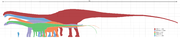 One of the best-known sauropods, Diplodocus was a very large long-necked quadruped
al animal, with a long, whip-like tail. Its forelimbs were slightly shorter than its hind limbs, resulting in a largely horizontal posture. The long-necked, long-tailed animal with four sturdy legs has been mechanically compared with a suspension bridge. In fact, Diplodocus is the longest dinosaur known from a complete skeleton. The partial remains of D. hallorum have increased the estimated length, though not as much as previously thought; when first described in 1991, discoverer David Gillette calculated it may have been up to 54 m (177 ft) long, making it the longest known dinosaur (excluding those known from exceedingly poor remains, such as Amphicoelias
). Some weight estimates ranged as high as 113 ton
s (125 US short tons). This review was based on recent findings that show that the giant tail vertebrae were actually placed further forward on the tail than Gillette originally calculated. The study shows that the complete Diplodocus skeleton at the Carnegie Museum of Natural History
in Pittsburgh, Pennsylvania
, on which estimates of Seismosaurus were based, had its 13th tail vertebra come from another dinosaur, throwing size estimates for Seismosaurus off by up to 30%. While dinosaurs such as Supersaurus
were probably longer, fossil remains of these animals are only fragmentary. Modern mass estimates for Diplodocus (exclusive of D. hallorum) have tended to be in the 10 to 16 tonne (11–17.6 ton
) range: 10 tonnes (11 tons); 11.5 tonnes (12.7 tons); 12.7 tonnes (14 tons); and 16 tonnes (17.6 tons).
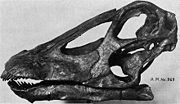 The skull of Diplodocus was very small, compared with the size of the animal, which could reach up to 35 m (115 ft), of which over 6 m (20 ft) was neck. Diplodocus had small, 'peg'-like teeth that pointed forward and were only present in the anterior sections of the jaws. Its braincase was small. The neck was composed of at least fifteen vertebrae and is now believed to have been generally held parallel to the ground and unable to have been elevated much past horizontal.
 Diplodocus had an extremely long tail, composed of about 80 caudal vertebrae, which is almost double the number some of the earlier sauropods had in their tails (such as Shunosaurus
with 43), and far more than contemporaneous macronaria
ns had (such as Camarasaurus
with 53). There has been speculation as to whether it may have had a defensive or noisemaking (by cracking it like a coachwhip) function. The tail may have served as a counterbalance for the neck. The middle part of the tail had 'double beams' (oddly shaped bones on the underside, which gave Diplodocus its name). They may have provided support for the vertebrae, or perhaps prevented the blood vessels from being crushed if the animal's heavy tail pressed against the ground. These 'double beams' are also seen in some related dinosaurs.
Like other sauropods, the manus (front "feet") of Diplodocus were highly modified, with the finger and hand bones arranged into a vertical column, horseshoe
-shaped in cross section. Diplodocus lacked claws on all but one digit of the front limb, and this claw was unusually large relative to other sauropods, flattened from side to side, and detached from the bones of the hand. The function of this unusually specialized claw is unknown.
was found at Cañon City, Colorado
by Benjamin Mudge
and Samuel Wendell Williston
in 1877, and was named Diplodocus longus ('long double-beam'), by paleontologist
Othniel Charles Marsh
in 1878. Diplodocus remains have since been found in the Morrison Formation
of the western U.S. States of Colorado
, Utah
, Montana
and Wyoming
. Fossil
s of this animal are common, except for the skull
, which is often missing from otherwise complete skeletons. Although not the type species, D. carnegii is the most completely known and most famous due to the large number of casts of its skeleton in museums around the world.
The two Morrison Formation sauropod genera Diplodocus and Barosaurus had very similar limb bones. In the past, many isolated limb bones were automatically attributed to Diplodocus but may, in fact, have belonged to Barosaurus. Fossil remains of Diplodocus have been recovered from stratigraphic zone 5 of the Morrison Formation.
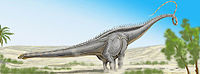
and Apatosaurus. However, a 1951 study by Kenneth A. Kermack indicates that sauropods probably could not have breathed through their nostrils when the rest of the body was submerged, as the water pressure on the chest wall would be too great. Since the 1970s, general consensus has the sauropods as firmly terrestrial animals, browsing on trees, ferns and bushes.
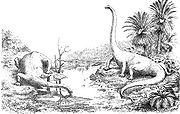 The depiction of Diplodocus posture has changed considerably over the years. For instance, a classic 1910 reconstruction by Oliver P. Hay depicts two Diplodocus with splayed lizard-like limbs on the banks of a river. Hay argued that Diplodocus had a sprawling, lizard-like gait with widely splayed legs, and was supported by Gustav Tornier
. However, this hypothesis was contested by W. J. Holland, who demonstrated that a sprawling Diplodocus would have needed a trench to pull its belly through. Finds of sauropod footprints in the 1930s eventually put Hay's theory to rest.
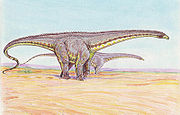 Later, diplodocids were often portrayed with their necks held high up in the air, allowing them to graze from tall trees. Studies using computer models have shown that neutral posture of the neck was horizontal, rather than vertical, and scientists such as Kent Stephens have used this to argue that sauropods including Diplodocus did not raise their heads much above shoulder level. However, subsequent studies demonstrated that all tetrapod
s appear to hold their necks at the maximum possible vertical extension when in a normal, alert posture, and argued that the same would hold true for sauropods barring any unknown, unique characteristics that set the soft tissue anatomy of their necks apart from other animals. One of the sauropod models in this study was Diplodocus, which they found would have held its neck at about a 45 degree angle with the head pointed downwards in a resting posture.
As with the related genus Barosaurus, the very long neck of Diplodocus is the source of much controversy among scientists. A 1992 Columbia University
study of Diplodocid neck structure indicated that the longest necks would have required a 1.6 ton heart — a tenth of the animal's body weight. The study proposed that animals like these would have had rudimentary auxiliary 'hearts' in their necks, whose only purpose was to pump blood up to the next 'heart'.
While the long neck has traditionally been interpreted as a feeding adaptation, it was also suggested that the oversized neck of Diplodocus and its relatives may have been primarily a sexual display, with any other feeding benefits coming second. However, a recent study refuted this idea in detail.
With a laterally and dorsoventrally flexible neck, and the possibility of using its tail and rearing up on its hind limbs (tripodal ability), Diplodocus would have had the ability to browse at many levels (low, medium, and high), up to approximately 10 metres (33 ft) from the ground. The neck's range of movement would have also allowed the head to graze below the level of the body, leading some scientists to speculate on whether Diplodocus grazed on submerged water plants, from riverbanks. This concept of the feeding posture is supported by the relative lengths of front and hind limbs. Furthermore, its peglike teeth may have been used for eating soft water plants.
In 2010, Whitlock et al. described a juvenile skull of Diplodocus (CM 11255) that differs greatly from adult skulls of the same genus: its snout is not blunt, and the teeth are not confined to the front of the snout. These differences suggest that adults and juveniles were feeding differently. Such an ecological difference between adults and juveniles had not been previously observed in sauropodomorphs.
 The head of Diplodocus has been widely depicted with the nostrils on top due to the position of the nasal openings at the apex of the skull. There has been speculation over whether such a configuration meant that Diplodocus may have had a trunk. A recent study surmised there was no paleoneuroanatomical evidence for a trunk. It noted that the facial nerve
in an animal with a trunk, such as an elephant, is large as it innervates the trunk. The evidence suggests that the facial nerve is very small in Diplodocus. Studies by Lawrence Witmer (2001) indicated that, while the nasal openings were high on the head, the actual, fleshy nostrils were situated much lower down on the snout.
Recent discoveries have suggested that Diplodocus and other diplodocids may have had narrow, pointed keratin
ous spines lining their back, much like those on an iguana
. This radically different look has been incorporated into recent reconstructions, notably Walking with Dinosaurs
. It is unknown exactly how many diplodocids had this trait, and whether it was present in other sauropods.
ian Saltasaurus
have been associated with nesting sites. The titanosaurian nesting sites indicate that may have laid their eggs communally over a large area in many shallow pits, each covered with vegetation. It is possible that Diplodocus may have done the same. The documentary Walking with Dinosaurs
portrayed a mother Diplodocus using an ovipositor
to lay eggs, but it was pure speculation on the part of the documentary.
Following a number of bone
histology
studies, Diplodocus, along with other sauropods, grew at a very fast rate, reaching sexual maturity
at just over a decade, though continuing to grow throughout their lives. Previous thinking held that sauropods would keep growing slowly throughout their lifetime, taking decades to reach maturity.
s of Diplodocus and modern birds and reptiles suggest that it may have been cathemeral
, active throughout the day at short intervals.
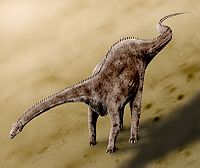 Diplodocus is both the type genus
of, and gives its name to Diplodocidae, the family to which it belongs. Members of this family, while still massive, are of a markedly more slender build when compared with other sauropods, such as the titanosaur
s and brachiosaurs. All are characterised by long necks and tails and a horizontal posture, with forelimbs shorter than hindlimbs. Diplodocids flourished in the Late Jurassic of North America and possibly Africa.
A subfamily, Diplodocinae, was erected to include Diplodocus and its closest relatives, including Barosaurus
. More distantly related is the contemporaneous Apatosaurus, which is still considered a diplodocid although not a diplodocine, as it is a member of the subfamily Apatosaurinae. The Portuguese Dinheirosaurus
and the African Tornieria
have also been identified as close relatives of Diplodocus by some authors.
The Diplodocoidea comprises the diplodocids, as well as dicraeosaurids, rebbachisaurids, Suuwassea
, Amphicoelias
and possibly Haplocanthosaurus
, and/or the nemegtosaurids. This clade
is the sister group to, Camarasaurus, brachiosaurids and titanosaurians; the Macronaria.
to potentates around the world at the beginning of the twentieth century. did much to familiarize it to people worldwide. Casts of Diplodocus skeletons are still displayed in many museums worldwide, including an unusual D. hayi in the Houston Museum of Natural Science
, and D. carnegii in a number of institutions.

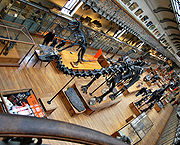 This includes donations by Carnegie or his trust to:
This project, along with its association with 'big science', philanthropism and capitalism, drew much public attention in Europe. The German satirical weekly Kladderadatsch
devoted a poem to the dinosaur:
(Translation: [...] But even a much older gent • Sees itself forced to wander • Goes by the name Diplodocus • And belongs among the fossils • Mr. Carnegie packs him joyfully • In giant arcs • And sends him as gift this way • To multiple monarchs [...]) "Le diplodocus" became a generic term for sauropods in French, much as "brontosaur" is in English.
A further D. carnegii is on display at the Field Museum of Natural History
in Chicago. Additionally, D. longus is displayed the Senckenberg Museum
in Frankfurt
(a skeleton made up of several specimens, donated in 1907 by the American Museum of Natural History
), Germany. A mounted and more complete skeleton of D. longus is at the Smithsonian National Museum of Natural History
in Washington, D.C., while a mounted skeleton of D. hallorum (formerly Seismosaurus), which may be the same as D. longus, can be found at the New Mexico Museum of Natural History and Science
.
Diplodocus has been a frequent subject in dinosaur films, both factual and fictional. It was featured in the second episode of the award-winning BBC television series Walking with Dinosaurs
. The episode "Time of the Titans" follows the life of a simulated Diplodocus 152 million years ago. In literature, James A. Michener
's book Centennial
has a chapter devoted to Diplodocus, narrating the life and death of one individual.
is a genus
Genus
In biology, a genus is a low-level taxonomic rank used in the biological classification of living and fossil organisms, which is an example of definition by genus and differentia...
of diplodocid
Diplodocid
Diplodocids, or members of the family Diplodocidae , are a group of sauropod dinosaurs. The family includes some of the longest creatures ever to walk the earth, including Diplodocus and Supersaurus, which may have reached lengths of up to .-Description:While still massive, when compared to the...
sauropod dinosaur
Dinosaur
Dinosaurs are a diverse group of animals of the clade and superorder Dinosauria. They were the dominant terrestrial vertebrates for over 160 million years, from the late Triassic period until the end of the Cretaceous , when the Cretaceous–Paleogene extinction event led to the extinction of...
whose fossil
Fossil
Fossils are the preserved remains or traces of animals , plants, and other organisms from the remote past...
s were first discovered in 1877 by S. W. Williston
Samuel Wendell Williston
Samuel Wendell Williston was an American educator and paleontologist who was the first to propose that birds developed flight cursorially , rather than arboreally . He was also an entomologist, specialising in Diptera.-Early life:Williston was born in Boston, Massachusetts to Samuel Williston and...
. The generic name, coined by Othniel Charles Marsh
Othniel Charles Marsh
Othniel Charles Marsh was an American paleontologist. Marsh was one of the preeminent scientists in the field; the discovery or description of dozens of news species and theories on the origins of birds are among his legacies.Born into a modest family, Marsh was able to afford higher education...
in 1878, is a Neo-Latin
New Latin
The term New Latin, or Neo-Latin, is used to describe the Latin language used in original works created between c. 1500 and c. 1900. Among other uses, Latin during this period was employed in scholarly and scientific publications...
term derived from Greek
Ancient Greek
Ancient Greek is the stage of the Greek language in the periods spanning the times c. 9th–6th centuries BC, , c. 5th–4th centuries BC , and the c. 3rd century BC – 6th century AD of ancient Greece and the ancient world; being predated in the 2nd millennium BC by Mycenaean Greek...
(diploos) "double" and (dokos) "beam", in reference to its double-beamed chevron bones
Chevron (anatomy)
A chevron is one of a series of bones on the ventral side of the tail in many reptiles, dinosaurs , and some mammals such as kangaroos and manatees....
located in the underside of the tail. These bones were initially believed to be unique to Diplodocus; however, they have since then been discovered in other members of the diplodocid
Diplodocid
Diplodocids, or members of the family Diplodocidae , are a group of sauropod dinosaurs. The family includes some of the longest creatures ever to walk the earth, including Diplodocus and Supersaurus, which may have reached lengths of up to .-Description:While still massive, when compared to the...
family and in non-diplodocid sauropods such as Mamenchisaurus
Mamenchisaurus
Mamenchisaurus was a plant-eating four-legged dinosaur, known for its remarkably long neck which made up half its total length. It is known from numerous species which ranged in time from 160 to 145 million years ago, from the Oxfordian to Tithonian ages of the late Jurassic Period of...
.
It lived in what is now western North America at the end of the Jurassic
Jurassic
The Jurassic is a geologic period and system that extends from about Mya to Mya, that is, from the end of the Triassic to the beginning of the Cretaceous. The Jurassic constitutes the middle period of the Mesozoic era, also known as the age of reptiles. The start of the period is marked by...
Period. Diplodocus is one of the more common dinosaur fossils found in the Upper Morrison Formation
Morrison Formation
The Morrison Formation is a distinctive sequence of Late Jurassic sedimentary rock that is found in the western United States, which has been the most fertile source of dinosaur fossils in North America. It is composed of mudstone, sandstone, siltstone and limestone and is light grey, greenish...
, a sequence of shallow marine and alluvial sediments deposited about 155 to 148 million years ago, in what is now termed the Kimmeridgian
Kimmeridgian
In the geologic timescale, the Kimmeridgian is an age or stage in the Late or Upper Jurassic epoch or series. It spans the time between 155.7 ± 4 Ma and 150.8 ± 4 Ma . The Kimmeridgian follows the Oxfordian and precedes the Tithonian....
and Tithonian
Tithonian
In the geologic timescale the Tithonian is the latest age of the Late Jurassic epoch or the uppermost stage of the Upper Jurassic series. It spans the time between 150.8 ± 4 Ma and 145.5 ± 4 Ma...
stages
Faunal stage
In chronostratigraphy, a stage is a succession of rock strata laid down in a single age on the geologic timescale, which usually represents millions of years of deposition. A given stage of rock and the corresponding age of time will by convention have the same name, and the same boundaries.Rock...
(Diplodocus itself ranged from about 154 to 150 million years ago). The Morrison Formation records an environment and time dominated by gigantic sauropod dinosaurs such as Camarasaurus
Camarasaurus
Camarasaurus meaning 'chambered lizard', referring to the hollow chambers in its vertebrae was a genus of quadrupedal, herbivorous dinosaurs. It was the most common of the giant sauropods to be found in North America...
, Barosaurus
Barosaurus
Barosaurus ; Greek barys/βαρυς meaning 'heavy' and saurus/σαυρος meaning 'lizard', 'heavy lizard') was a giant, long-tailed, long-necked, plant-eating dinosaur closely related to the more familiar Diplodocus...
, Apatosaurus
Apatosaurus
Apatosaurus , also known by the popular but scientifically deprecated synonym Brontosaurus, is a genus of sauropod dinosaur that lived from about 154 to 150 million years ago, during the Jurassic Period . It was one of the largest land animals that ever existed, with an average length of and a...
and Brachiosaurus
Brachiosaurus
Brachiosaurus is a genus of sauropod dinosaur from the Jurassic Morrison Formation of North America. It was first described by Elmer S. Riggs in 1903 from fossils found in the Grand River Canyon of western Colorado, in the United States. Riggs named the dinosaur Brachiosaurus altithorax,...
.
Diplodocus is among the most easily identifiable dinosaurs, with its classic dinosaur shape, long neck and tail and four sturdy legs. For many years, it was the longest dinosaur known. Its great size may have been a deterrent to the predators Allosaurus
Allosaurus
Allosaurus is a genus of large theropod dinosaur that lived 155 to 150 million years ago during the late Jurassic period . The name Allosaurus means "different lizard". It is derived from the Greek /allos and /sauros...
and Ceratosaurus
Ceratosaurus
Ceratosaurus meaning "horned lizard", in reference to the horn on its nose , was a large predatory theropod dinosaur from the Late Jurassic Period , found in the Morrison Formation of North America, in Tanzania and Portugal...
: their remains have been found in the same strata
Stratum
In geology and related fields, a stratum is a layer of sedimentary rock or soil with internally consistent characteristics that distinguish it from other layers...
, which suggests they coexisted with Diplodocus.
Description
Quadruped
Quadrupedalism is a form of land animal locomotion using four limbs or legs. An animal or machine that usually moves in a quadrupedal manner is known as a quadruped, meaning "four feet"...
al animal, with a long, whip-like tail. Its forelimbs were slightly shorter than its hind limbs, resulting in a largely horizontal posture. The long-necked, long-tailed animal with four sturdy legs has been mechanically compared with a suspension bridge. In fact, Diplodocus is the longest dinosaur known from a complete skeleton. The partial remains of D. hallorum have increased the estimated length, though not as much as previously thought; when first described in 1991, discoverer David Gillette calculated it may have been up to 54 m (177 ft) long, making it the longest known dinosaur (excluding those known from exceedingly poor remains, such as Amphicoelias
Amphicoelias
Amphicoelias is a genus of herbivorous sauropod dinosaur that includes what may be the largest dinosaur ever discovered, A. fragillimus. Based on surviving descriptions of a single fossil bone, A. fragillimus may have been the longest known vertebrate at in length, and may have had a mass of up...
). Some weight estimates ranged as high as 113 ton
Ton
The ton is a unit of measure. It has a long history and has acquired a number of meanings and uses over the years. It is used principally as a unit of weight, and as a unit of volume. It can also be used as a measure of energy, for truck classification, or as a colloquial term.It is derived from...
s (125 US short tons). This review was based on recent findings that show that the giant tail vertebrae were actually placed further forward on the tail than Gillette originally calculated. The study shows that the complete Diplodocus skeleton at the Carnegie Museum of Natural History
Carnegie Museum of Natural History
Carnegie Museum of Natural History, located at 4400 Forbes Avenue in the Oakland neighborhood of Pittsburgh, Pennsylvania, USA, was founded by the Pittsburgh-based industrialist Andrew Carnegie in 1896...
in Pittsburgh, Pennsylvania
Pittsburgh, Pennsylvania
Pittsburgh is the second-largest city in the US Commonwealth of Pennsylvania and the county seat of Allegheny County. Regionally, it anchors the largest urban area of Appalachia and the Ohio River Valley, and nationally, it is the 22nd-largest urban area in the United States...
, on which estimates of Seismosaurus were based, had its 13th tail vertebra come from another dinosaur, throwing size estimates for Seismosaurus off by up to 30%. While dinosaurs such as Supersaurus
Supersaurus
Supersaurus is a genus of diplodocid sauropod dinosaur discovered by Vivian Jones of Delta, Colorado, in the Upper Jurassic Morrison Formation of Colorado in 1972. The fossil remains came from the Brushy Basin Member of the formation, dating to about 153 million years ago...
were probably longer, fossil remains of these animals are only fragmentary. Modern mass estimates for Diplodocus (exclusive of D. hallorum) have tended to be in the 10 to 16 tonne (11–17.6 ton
Ton
The ton is a unit of measure. It has a long history and has acquired a number of meanings and uses over the years. It is used principally as a unit of weight, and as a unit of volume. It can also be used as a measure of energy, for truck classification, or as a colloquial term.It is derived from...
) range: 10 tonnes (11 tons); 11.5 tonnes (12.7 tons); 12.7 tonnes (14 tons); and 16 tonnes (17.6 tons).
Shunosaurus
Shunosaurus, meaning "Shu Lizard", is a genus of sauropod dinosaur from Middle Jurassic beds in Sichuan Province in China, 170 million years ago...
with 43), and far more than contemporaneous macronaria
Macronaria
Macronaria is a clade of sauropod dinosaurs from the Middle Jurassic to Late Cretaceous Periods of what are now North America, South America, Europe, Asia and Africa. The name means 'large nostrils' , in reference to the large nasal openings high on the head that probably supported fleshy...
ns had (such as Camarasaurus
Camarasaurus
Camarasaurus meaning 'chambered lizard', referring to the hollow chambers in its vertebrae was a genus of quadrupedal, herbivorous dinosaurs. It was the most common of the giant sauropods to be found in North America...
with 53). There has been speculation as to whether it may have had a defensive or noisemaking (by cracking it like a coachwhip) function. The tail may have served as a counterbalance for the neck. The middle part of the tail had 'double beams' (oddly shaped bones on the underside, which gave Diplodocus its name). They may have provided support for the vertebrae, or perhaps prevented the blood vessels from being crushed if the animal's heavy tail pressed against the ground. These 'double beams' are also seen in some related dinosaurs.
Like other sauropods, the manus (front "feet") of Diplodocus were highly modified, with the finger and hand bones arranged into a vertical column, horseshoe
Horseshoe
A horseshoe, is a fabricated product, normally made of metal, although sometimes made partially or wholly of modern synthetic materials, designed to protect a horse's hoof from wear and tear. Shoes are attached on the palmar surface of the hooves, usually nailed through the insensitive hoof wall...
-shaped in cross section. Diplodocus lacked claws on all but one digit of the front limb, and this claw was unusually large relative to other sauropods, flattened from side to side, and detached from the bones of the hand. The function of this unusually specialized claw is unknown.
Discovery and species
Several species of Diplodocus were described between 1878 and 1924. The first skeletonSkeleton
The skeleton is the body part that forms the supporting structure of an organism. There are two different skeletal types: the exoskeleton, which is the stable outer shell of an organism, and the endoskeleton, which forms the support structure inside the body.In a figurative sense, skeleton can...
was found at Cañon City, Colorado
Colorado
Colorado is a U.S. state that encompasses much of the Rocky Mountains as well as the northeastern portion of the Colorado Plateau and the western edge of the Great Plains...
by Benjamin Mudge
Benjamin Franklin Mudge
Benjamin Franklin Mudge was an American lawyer, geologist and teacher. Briefly the mayor of Lynn, Massachusetts, he later moved to Kansas where he was appointed the first State Geologist. He led the first geological survey of the state in 1864, and published the first book on the geology of Kansas...
and Samuel Wendell Williston
Samuel Wendell Williston
Samuel Wendell Williston was an American educator and paleontologist who was the first to propose that birds developed flight cursorially , rather than arboreally . He was also an entomologist, specialising in Diptera.-Early life:Williston was born in Boston, Massachusetts to Samuel Williston and...
in 1877, and was named Diplodocus longus ('long double-beam'), by paleontologist
Paleontology
Paleontology "old, ancient", ὄν, ὀντ- "being, creature", and λόγος "speech, thought") is the study of prehistoric life. It includes the study of fossils to determine organisms' evolution and interactions with each other and their environments...
Othniel Charles Marsh
Othniel Charles Marsh
Othniel Charles Marsh was an American paleontologist. Marsh was one of the preeminent scientists in the field; the discovery or description of dozens of news species and theories on the origins of birds are among his legacies.Born into a modest family, Marsh was able to afford higher education...
in 1878. Diplodocus remains have since been found in the Morrison Formation
Morrison Formation
The Morrison Formation is a distinctive sequence of Late Jurassic sedimentary rock that is found in the western United States, which has been the most fertile source of dinosaur fossils in North America. It is composed of mudstone, sandstone, siltstone and limestone and is light grey, greenish...
of the western U.S. States of Colorado
Colorado
Colorado is a U.S. state that encompasses much of the Rocky Mountains as well as the northeastern portion of the Colorado Plateau and the western edge of the Great Plains...
, Utah
Utah
Utah is a state in the Western United States. It was the 45th state to join the Union, on January 4, 1896. Approximately 80% of Utah's 2,763,885 people live along the Wasatch Front, centering on Salt Lake City. This leaves vast expanses of the state nearly uninhabited, making the population the...
, Montana
Montana
Montana is a state in the Western United States. The western third of Montana contains numerous mountain ranges. Smaller, "island ranges" are found in the central third of the state, for a total of 77 named ranges of the Rocky Mountains. This geographical fact is reflected in the state's name,...
and Wyoming
Wyoming
Wyoming is a state in the mountain region of the Western United States. The western two thirds of the state is covered mostly with the mountain ranges and rangelands in the foothills of the Eastern Rocky Mountains, while the eastern third of the state is high elevation prairie known as the High...
. Fossil
Fossil
Fossils are the preserved remains or traces of animals , plants, and other organisms from the remote past...
s of this animal are common, except for the skull
Skull
The skull is a bony structure in the head of many animals that supports the structures of the face and forms a cavity for the brain.The skull is composed of two parts: the cranium and the mandible. A skull without a mandible is only a cranium. Animals that have skulls are called craniates...
, which is often missing from otherwise complete skeletons. Although not the type species, D. carnegii is the most completely known and most famous due to the large number of casts of its skeleton in museums around the world.
The two Morrison Formation sauropod genera Diplodocus and Barosaurus had very similar limb bones. In the past, many isolated limb bones were automatically attributed to Diplodocus but may, in fact, have belonged to Barosaurus. Fossil remains of Diplodocus have been recovered from stratigraphic zone 5 of the Morrison Formation.
Valid species
- D. longus, the type speciesType speciesIn biological nomenclature, a type species is both a concept and a practical system which is used in the classification and nomenclature of animals and plants. The value of a "type species" lies in the fact that it makes clear what is meant by a particular genus name. A type species is the species...
, is known from two skulls and a caudal series from the Morrison Formation of Colorado and Utah. - D. carnegii (also spelled D. carnegiei), named after Andrew CarnegieAndrew CarnegieAndrew Carnegie was a Scottish-American industrialist, businessman, and entrepreneur who led the enormous expansion of the American steel industry in the late 19th century...
, is the best known, mainly due to a near-complete skeleton collected by Jacob Wortman, of the Carnegie Museum of Natural History in Pittsburgh, PennsylvaniaPittsburgh, PennsylvaniaPittsburgh is the second-largest city in the US Commonwealth of Pennsylvania and the county seat of Allegheny County. Regionally, it anchors the largest urban area of Appalachia and the Ohio River Valley, and nationally, it is the 22nd-largest urban area in the United States...
and described and named by John Bell HatcherJohn Bell HatcherJohn Bell Hatcher was an American paleontologist and fossil hunter best known for discovering Torosaurus.-Biography:...
in 1901. - D. hayi, known from a partial skeleton discovered by William H. Utterback in 1902 near Sheridan, WyomingSheridan, WyomingSheridan is a city in Sheridan County, Wyoming, United States. The 2010 census put the population at 17,444 and a Micropolitan Statistical Area of 29,116...
, was described in 1924. - D. hallorum, first described in 1991 by Gillette as Seismosaurus halli from a partial skeleton comprising vertebrae, pelvis and ribs. George OlshevskyGeorge OlshevskyGeorge Olshevsky is a freelance editor, writer, publisher, amateur paleontologist, and mathematician living in San Diego, California.Olshevsky maintains the comprehensive online Dinosaur Genera List...
later attempted to emend the name as S. hallorum, citing incorrect grammar on the part of the original authors, a recommendation that has been followed by others, including Carpenter (2006). In 2004, a presentation at the annual conference of the Geological Society of AmericaGeological Society of AmericaThe Geological Society of America is a nonprofit organization dedicated to the advancement of the geosciences. The society was founded in New York in 1888 by Alexander Winchell, John J. Stevenson, Charles H. Hitchcock, John R. Proctor and Edward Orton and has been headquartered at 3300 Penrose...
made a case for Seismosaurus being a junior synonym of Diplodocus. This was followed by a much more detailed publication in 2006, which not only renamed the species Diplodocus hallorum, but also speculated that it could prove to be the same as D. longus. The position that D. hallorum should be regarded as a specimen of D. longus was also taken by the authors of a redescription of SupersaurusSupersaurusSupersaurus is a genus of diplodocid sauropod dinosaur discovered by Vivian Jones of Delta, Colorado, in the Upper Jurassic Morrison Formation of Colorado in 1972. The fossil remains came from the Brushy Basin Member of the formation, dating to about 153 million years ago...
, refuting a previous hypothesis that Seismosaurus and Supersaurus were the same.
Nomina dubia (doubtful species)
- D. lacustris is a nomen dubiumNomen dubiumIn zoological nomenclature, a nomen dubium is a scientific name that is of unknown or doubtful application...
, named by Marsh in 1884, from remains of a smaller animal from Morrison, ColoradoMorrison, ColoradoThe historic Town of Morrison is a Home Rule Municipality in Jefferson County, Colorado, United States. The population was 430 at the 2000 census...
. These remains are now believed to have been from an immature animal, rather than from a separate species.
Paleobiology
Due to a wealth of skeletal remains, Diplodocus is one of the best-studied dinosaurs. Many aspects of its lifestyle have been subjects of various theories over the years.Habitat
Marsh and then Hatcher assumed the animal was aquatic, because of the position of its nasal openings at the apex of the cranium. Similar aquatic behavior was commonly depicted for other large sauropods such as BrachiosaurusBrachiosaurus
Brachiosaurus is a genus of sauropod dinosaur from the Jurassic Morrison Formation of North America. It was first described by Elmer S. Riggs in 1903 from fossils found in the Grand River Canyon of western Colorado, in the United States. Riggs named the dinosaur Brachiosaurus altithorax,...
and Apatosaurus. However, a 1951 study by Kenneth A. Kermack indicates that sauropods probably could not have breathed through their nostrils when the rest of the body was submerged, as the water pressure on the chest wall would be too great. Since the 1970s, general consensus has the sauropods as firmly terrestrial animals, browsing on trees, ferns and bushes.
Posture
Gustav Tornier
Gustav Tornier was a German zoologist and paleontologist.-Life and career:...
. However, this hypothesis was contested by W. J. Holland, who demonstrated that a sprawling Diplodocus would have needed a trench to pull its belly through. Finds of sauropod footprints in the 1930s eventually put Hay's theory to rest.
Tetrapod
Tetrapods are vertebrate animals having four limbs. Amphibians, reptiles, birds and mammals are all tetrapods; even snakes and other limbless reptiles and amphibians are tetrapods by descent. The earliest tetrapods evolved from the lobe-finned fishes in the Devonian...
s appear to hold their necks at the maximum possible vertical extension when in a normal, alert posture, and argued that the same would hold true for sauropods barring any unknown, unique characteristics that set the soft tissue anatomy of their necks apart from other animals. One of the sauropod models in this study was Diplodocus, which they found would have held its neck at about a 45 degree angle with the head pointed downwards in a resting posture.
As with the related genus Barosaurus, the very long neck of Diplodocus is the source of much controversy among scientists. A 1992 Columbia University
Columbia University
Columbia University in the City of New York is a private, Ivy League university in Manhattan, New York City. Columbia is the oldest institution of higher learning in the state of New York, the fifth oldest in the United States, and one of the country's nine Colonial Colleges founded before the...
study of Diplodocid neck structure indicated that the longest necks would have required a 1.6 ton heart — a tenth of the animal's body weight. The study proposed that animals like these would have had rudimentary auxiliary 'hearts' in their necks, whose only purpose was to pump blood up to the next 'heart'.
While the long neck has traditionally been interpreted as a feeding adaptation, it was also suggested that the oversized neck of Diplodocus and its relatives may have been primarily a sexual display, with any other feeding benefits coming second. However, a recent study refuted this idea in detail.
Diet
Diplodocus has highly unusual teeth compared to other sauropods. The crowns are long and slender, elliptical in cross-section, while the apex forms a blunt triangular point. The most prominent wear facet is on the apex, though unlike all other wear patterns observed within sauropods, Diplodocus wear patterns are on the labial (cheek) side of both the upper and lower teeth. What this means is Diplodocus and other diplodocids had a radically different feeding mechanism than other sauropods. Unilateral branch stripping is the most likely feeding behavior of Diplodocus, as it explains the unusual wear patterns of the teeth (coming from tooth–food contact). In unilateral branch stripping, one tooth row would have been used to strip foliage from the stem, while the other would act as a guide and stabilizer. With the elongated preorbital (in front of the eyes) region of the skull, longer portions of stems could be stripped in a single action. Also the palinal (backwards) motion of the lower jaws could have contributed two significant roles to feeding behaviour: 1) an increased gape, and 2) allowed fine adjustments of the relative positions of the tooth rows, creating a smooth stripping action.With a laterally and dorsoventrally flexible neck, and the possibility of using its tail and rearing up on its hind limbs (tripodal ability), Diplodocus would have had the ability to browse at many levels (low, medium, and high), up to approximately 10 metres (33 ft) from the ground. The neck's range of movement would have also allowed the head to graze below the level of the body, leading some scientists to speculate on whether Diplodocus grazed on submerged water plants, from riverbanks. This concept of the feeding posture is supported by the relative lengths of front and hind limbs. Furthermore, its peglike teeth may have been used for eating soft water plants.
In 2010, Whitlock et al. described a juvenile skull of Diplodocus (CM 11255) that differs greatly from adult skulls of the same genus: its snout is not blunt, and the teeth are not confined to the front of the snout. These differences suggest that adults and juveniles were feeding differently. Such an ecological difference between adults and juveniles had not been previously observed in sauropodomorphs.
Other anatomical aspects
Facial nerve
The facial nerve is the seventh of twelve paired cranial nerves. It emerges from the brainstem between the pons and the medulla, and controls the muscles of facial expression, and functions in the conveyance of taste sensations from the anterior two-thirds of the tongue and oral cavity...
in an animal with a trunk, such as an elephant, is large as it innervates the trunk. The evidence suggests that the facial nerve is very small in Diplodocus. Studies by Lawrence Witmer (2001) indicated that, while the nasal openings were high on the head, the actual, fleshy nostrils were situated much lower down on the snout.
Recent discoveries have suggested that Diplodocus and other diplodocids may have had narrow, pointed keratin
Keratin
Keratin refers to a family of fibrous structural proteins. Keratin is the key of structural material making up the outer layer of human skin. It is also the key structural component of hair and nails...
ous spines lining their back, much like those on an iguana
Iguana
Iguana is a herbivorous genus of lizard native to tropical areas of Central America and the Caribbean. The genus was first described in 1768 by Austrian naturalist Josephus Nicolaus Laurenti in his book Specimen Medicum, Exhibens Synopsin Reptilium Emendatam cum Experimentis circa Venena...
. This radically different look has been incorporated into recent reconstructions, notably Walking with Dinosaurs
Walking with Dinosaurs
Walking with Dinosaurs is a six-part documentary television miniseries that was produced by BBC, narrated by Kenneth Branagh, and first aired in the United Kingdom, in 1999. The series was subsequently aired in North America on the Discovery Channel in 2000, with Branagh's voice replaced with that...
. It is unknown exactly how many diplodocids had this trait, and whether it was present in other sauropods.
Reproduction and growth
While there is no evidence for Diplodocus nesting habits, other sauropods such as the titanosaurTitanosaur
Titanosaurs were a diverse group of sauropod dinosaurs, which included Saltasaurus and Isisaurus. It includes some of the heaviest creatures ever to walk the earth, such as Argentinosaurus and Paralititan — which some believe have weighed up to 100 tonnes...
ian Saltasaurus
Saltasaurus
Saltasaurus is a genus of titanosaurid sauropod dinosaur of the Late Cretaceous Period. Relatively small among sauropods, though still massive by the standards of modern creatures, Saltasaurus was characterized by a diplodocid-like head...
have been associated with nesting sites. The titanosaurian nesting sites indicate that may have laid their eggs communally over a large area in many shallow pits, each covered with vegetation. It is possible that Diplodocus may have done the same. The documentary Walking with Dinosaurs
Walking with Dinosaurs
Walking with Dinosaurs is a six-part documentary television miniseries that was produced by BBC, narrated by Kenneth Branagh, and first aired in the United Kingdom, in 1999. The series was subsequently aired in North America on the Discovery Channel in 2000, with Branagh's voice replaced with that...
portrayed a mother Diplodocus using an ovipositor
Ovipositor
The ovipositor is an organ used by some animals for oviposition, i.e., the laying of eggs. It consists of a maximum of three pairs of appendages formed to transmit the egg, to prepare a place for it, and to place it properly...
to lay eggs, but it was pure speculation on the part of the documentary.
Following a number of bone
Bone
Bones are rigid organs that constitute part of the endoskeleton of vertebrates. They support, and protect the various organs of the body, produce red and white blood cells and store minerals. Bone tissue is a type of dense connective tissue...
histology
Histology
Histology is the study of the microscopic anatomy of cells and tissues of plants and animals. It is performed by examining cells and tissues commonly by sectioning and staining; followed by examination under a light microscope or electron microscope...
studies, Diplodocus, along with other sauropods, grew at a very fast rate, reaching sexual maturity
Sexual maturity
Sexual maturity is the age or stage when an organism can reproduce. It is sometimes considered synonymous with adulthood, though the two are distinct...
at just over a decade, though continuing to grow throughout their lives. Previous thinking held that sauropods would keep growing slowly throughout their lifetime, taking decades to reach maturity.
Daily activity patterns
Comparisons between the scleral ringSclerotic ring
Sclerotic rings are rings of bone found in the eyes of several groups of vertebrate animals, except for mammals and crocodilians. They can be made up of single bones or small bones together. They are believed to have a role in supporting the eye, especially in animals whose eyes are not spherical,...
s of Diplodocus and modern birds and reptiles suggest that it may have been cathemeral
Cathemeral
A cathemeral organism is one that has sporadic and random intervals of activity during the day or night in which food is acquired, socializing with other organisms occurs, and any other activities necessary for livelihood are performed...
, active throughout the day at short intervals.
Classification
Type genus
In biological classification, a type genus is a representative genus, as with regard to a biological family. The term and concept is used much more often and much more formally in zoology than it is in botany, and the definition is dependent on the nomenclatural Code that applies:* In zoological...
of, and gives its name to Diplodocidae, the family to which it belongs. Members of this family, while still massive, are of a markedly more slender build when compared with other sauropods, such as the titanosaur
Titanosaur
Titanosaurs were a diverse group of sauropod dinosaurs, which included Saltasaurus and Isisaurus. It includes some of the heaviest creatures ever to walk the earth, such as Argentinosaurus and Paralititan — which some believe have weighed up to 100 tonnes...
s and brachiosaurs. All are characterised by long necks and tails and a horizontal posture, with forelimbs shorter than hindlimbs. Diplodocids flourished in the Late Jurassic of North America and possibly Africa.
A subfamily, Diplodocinae, was erected to include Diplodocus and its closest relatives, including Barosaurus
Barosaurus
Barosaurus ; Greek barys/βαρυς meaning 'heavy' and saurus/σαυρος meaning 'lizard', 'heavy lizard') was a giant, long-tailed, long-necked, plant-eating dinosaur closely related to the more familiar Diplodocus...
. More distantly related is the contemporaneous Apatosaurus, which is still considered a diplodocid although not a diplodocine, as it is a member of the subfamily Apatosaurinae. The Portuguese Dinheirosaurus
Dinheirosaurus
Dinheirosaurus is a genus of diplodocid sauropod dinosaur. It has been found in the upper section of the Late Jurassic strata of the Camadas de Alcobaça Formation located in central-western Portugal at Porto Dinheiro, Lourinhã...
and the African Tornieria
Tornieria
Tornieria is a genus of diplodocid sauropod dinosaur from Late Jurassic of Tanzania. It has a convoluted taxonomic history.-Discovery and naming:...
have also been identified as close relatives of Diplodocus by some authors.
The Diplodocoidea comprises the diplodocids, as well as dicraeosaurids, rebbachisaurids, Suuwassea
Suuwassea
Suuwassea is a genus of diplodocoid sauropod dinosaur found in the Upper Jurassic strata of the Morrison Formation, located in southern Carbon County, Montana, USA. The fossil remains were recovered in a series of expeditions during a period spanning the years 1999 and 2000, described by J.D....
, Amphicoelias
Amphicoelias
Amphicoelias is a genus of herbivorous sauropod dinosaur that includes what may be the largest dinosaur ever discovered, A. fragillimus. Based on surviving descriptions of a single fossil bone, A. fragillimus may have been the longest known vertebrate at in length, and may have had a mass of up...
and possibly Haplocanthosaurus
Haplocanthosaurus
Haplocanthosaurus is a genus of sauropod dinosaur. Two species, H. delfsi and H. priscus, are known from incomplete fossil skeletons. It lived during the late Jurassic period , 155 to 152 million years ago. The type species is H. priscus, and the referred species H...
, and/or the nemegtosaurids. This clade
Clade
A clade is a group consisting of a species and all its descendants. In the terms of biological systematics, a clade is a single "branch" on the "tree of life". The idea that such a "natural group" of organisms should be grouped together and given a taxonomic name is central to biological...
is the sister group to, Camarasaurus, brachiosaurids and titanosaurians; the Macronaria.
In popular culture
Diplodocus has been a famous and much-depicted dinosaur as it has been on display in more places than any other sauropod dinosaur. Much of this has probably been due to its wealth of skeletal remains and former status as the longest dinosaur. However, the donation of many mounted skeletal casts by industrialist Andrew CarnegieAndrew Carnegie
Andrew Carnegie was a Scottish-American industrialist, businessman, and entrepreneur who led the enormous expansion of the American steel industry in the late 19th century...
to potentates around the world at the beginning of the twentieth century. did much to familiarize it to people worldwide. Casts of Diplodocus skeletons are still displayed in many museums worldwide, including an unusual D. hayi in the Houston Museum of Natural Science
Houston Museum of Natural Science
The Houston Museum of Natural Science is a science museum located on the northern border of Hermann Park in Houston, Texas, USA. The museum was established in 1909 by the Houston Museum and Scientific Society, an organization whose goals were to provide a free institution for the people of Houston...
, and D. carnegii in a number of institutions.
- The Carnegie Museum of Natural HistoryCarnegie Museum of Natural HistoryCarnegie Museum of Natural History, located at 4400 Forbes Avenue in the Oakland neighborhood of Pittsburgh, Pennsylvania, USA, was founded by the Pittsburgh-based industrialist Andrew Carnegie in 1896...
in Pittsburgh (original, unveiled in 1907) - The Natural History MuseumNatural History MuseumThe Natural History Museum is one of three large museums on Exhibition Road, South Kensington, London, England . Its main frontage is on Cromwell Road...
in London (replica, unveiled on 12 May 1905) - The Museum für NaturkundeHumboldt MuseumThe Museum für Naturkunde, officially the ' or Naturkundemuseum , occasionally known as the Humboldt Museum, is a natural history museum in Berlin, Germany. Usually the museum's name is abbreviated MFN...
in Berlin, Germany (replica, unveiled in early May, 1908) - The National Natural History MuseumMuséum national d'histoire naturelleThe Muséum national d'Histoire naturelle is the National Museum of Natural History in Paris, France.- History :The museum was formally founded on 10 June 1793, during the French Revolution...
in Paris, France (replica, unveiled on 15 June 1908) - The Natural History MuseumNaturhistorisches MuseumThe Naturhistorisches Museum Wien or NHMW is a large museum located in Vienna, Austria.The collections displayed cover , and the museum has a website providing an overview as a video virtual tour....
in ViennaViennaVienna is the capital and largest city of the Republic of Austria and one of the nine states of Austria. Vienna is Austria's primary city, with a population of about 1.723 million , and is by far the largest city in Austria, as well as its cultural, economic, and political centre...
, Austria (replica, unveiled in 1909) - The Museum for Paleontology and Geology in BolognaBolognaBologna is the capital city of Emilia-Romagna, in the Po Valley of Northern Italy. The city lies between the Po River and the Apennine Mountains, more specifically, between the Reno River and the Savena River. Bologna is a lively and cosmopolitan Italian college city, with spectacular history,...
, Italy (replica, unveiled in 1909). Skulls from this cast (i.e., 'second-generation') are on display in museums in MilanMilanMilan is the second-largest city in Italy and the capital city of the region of Lombardy and of the province of Milan. The city proper has a population of about 1.3 million, while its urban area, roughly coinciding with its administrative province and the bordering Province of Monza and Brianza ,...
and NaplesNaplesNaples is a city in Southern Italy, situated on the country's west coast by the Gulf of Naples. Lying between two notable volcanic regions, Mount Vesuvius and the Phlegraean Fields, it is the capital of the region of Campania and of the province of Naples...
. - The Zoological Museum of the Russian Academy of Sciences in St. PetersburgSaint PetersburgSaint Petersburg is a city and a federal subject of Russia located on the Neva River at the head of the Gulf of Finland on the Baltic Sea...
, Russia (replica, unveiled in 1910) - The Museo de la Plata in La PlataLa PlataLa Plata is the capital city of the Province of Buenos Aires, Argentina, and of La Plata partido. According to the , the city proper has a population of 574,369 and its metropolitan area has 694,253 inhabitants....
near Buenos AiresBuenos AiresBuenos Aires is the capital and largest city of Argentina, and the second-largest metropolitan area in South America, after São Paulo. It is located on the western shore of the estuary of the Río de la Plata, on the southeastern coast of the South American continent...
, Argentina (replica, unveiled in 1912) - The National Natural History MuseumMuseo Nacional de Ciencias NaturalesThe Museo Nacional de Ciencias Naturales is the National Museum of Natural History of Spain. It is situated in the center of Madrid, by the Paseo de la Castellana. It is managed by the Spanish National Research Council....
in MadridMadridMadrid is the capital and largest city of Spain. The population of the city is roughly 3.3 million and the entire population of the Madrid metropolitan area is calculated to be 6.271 million. It is the third largest city in the European Union, after London and Berlin, and its metropolitan...
, Spain (replica, unveiled in november 1913) - The Museo de Paleontología in Mexico City (replica, unveiled in 1930)
- The Paleontological MuseumPaläontologisches Museum MünchenThe Paläontologische Museum München is a German national natural history museum situated in Munich, Bavaria. It is associated with the Ludwig-Maximilians-Universität...
in MunichMunichMunich The city's motto is "" . Before 2006, it was "Weltstadt mit Herz" . Its native name, , is derived from the Old High German Munichen, meaning "by the monks' place". The city's name derives from the monks of the Benedictine order who founded the city; hence the monk depicted on the city's coat...
, Germany (replica, donated in 1932 and still unmounted)
This project, along with its association with 'big science', philanthropism and capitalism, drew much public attention in Europe. The German satirical weekly Kladderadatsch
Kladderadatsch
Kladderadatsch was a satirical German-language magazine first published in Berlin on May 7, 1848, and appearing "daily, except for weekdays". It was founded by Albert Hofmann and David Kalisch, the latter the son of a Jewish merchant and the author of several works of comedy...
devoted a poem to the dinosaur:
[...] Auch ein viel älterer Herr noch muß
Den Wanderburschen spielen
Er ist genannt Diplodocus‚ und zählt zu den Fossilen
Herr Carnegie verpackt ihn froh
In riesengroße Archen
Und schickt als Geschenk ihn so
An mehrere Monarchen [...]
(Translation: [...] But even a much older gent • Sees itself forced to wander • Goes by the name Diplodocus • And belongs among the fossils • Mr. Carnegie packs him joyfully • In giant arcs • And sends him as gift this way • To multiple monarchs [...]) "Le diplodocus" became a generic term for sauropods in French, much as "brontosaur" is in English.
A further D. carnegii is on display at the Field Museum of Natural History
Field Museum of Natural History
The Field Museum of Natural History is located in Chicago, Illinois, USA. It sits on Lake Shore Drive next to Lake Michigan, part of a scenic complex known as the Museum Campus Chicago...
in Chicago. Additionally, D. longus is displayed the Senckenberg Museum
Senckenberg Museum
The Naturmuseum Senckenberg in Frankfurt is the second largest museum of natural history in Germany. It is particularly popular with children, who enjoy the extensive collection of dinosaur skeletons: Senckenberg boasts the largest exhibition of large dinosaurs in Europe. One particular treasure is...
in Frankfurt
Frankfurt
Frankfurt am Main , commonly known simply as Frankfurt, is the largest city in the German state of Hesse and the fifth-largest city in Germany, with a 2010 population of 688,249. The urban area had an estimated population of 2,300,000 in 2010...
(a skeleton made up of several specimens, donated in 1907 by the American Museum of Natural History
American Museum of Natural History
The American Museum of Natural History , located on the Upper West Side of Manhattan in New York City, United States, is one of the largest and most celebrated museums in the world...
), Germany. A mounted and more complete skeleton of D. longus is at the Smithsonian National Museum of Natural History
National Museum of Natural History
The National Museum of Natural History is a natural history museum administered by the Smithsonian Institution, located on the National Mall in Washington, D.C., United States. Admission is free and the museum is open 364 days a year....
in Washington, D.C., while a mounted skeleton of D. hallorum (formerly Seismosaurus), which may be the same as D. longus, can be found at the New Mexico Museum of Natural History and Science
New Mexico Museum of Natural History and Science
The New Mexico Museum of Natural History and Science is a natural history and science museum in Albuquerque, New Mexico near Old Town Albuquerque. The Museum was founded in 1986....
.
Diplodocus has been a frequent subject in dinosaur films, both factual and fictional. It was featured in the second episode of the award-winning BBC television series Walking with Dinosaurs
Walking with Dinosaurs
Walking with Dinosaurs is a six-part documentary television miniseries that was produced by BBC, narrated by Kenneth Branagh, and first aired in the United Kingdom, in 1999. The series was subsequently aired in North America on the Discovery Channel in 2000, with Branagh's voice replaced with that...
. The episode "Time of the Titans" follows the life of a simulated Diplodocus 152 million years ago. In literature, James A. Michener
James A. Michener
James Albert Michener was an American author of more than 40 titles, the majority of which were sweeping sagas, covering the lives of many generations in particular geographic locales and incorporating historical facts into the stories...
's book Centennial
Centennial (novel)
Centennial is a novel by American author James A. Michener, published in 1974.Centennial traces the history of the plains of northeast Colorado from prehistory until the early 1970s. Geographic details about the fictional town of Centennial and its surroundings indicate that the region is in...
has a chapter devoted to Diplodocus, narrating the life and death of one individual.
External links
- Diplodocus in the Dino Directory
- Museo Nacional de Ciencias Naturales, Madrid
- Diplodocus Marsh, by J.B. Hatcher 1901 – Its Osteology, Taxonomy, and Probable Habits, with a Restoration of the Skeleton. Memoirs of the Carnegie Museum, Volume 1, Number 1, 1901. Full text, Free to read.
- Carnegie Museum of Natural History – History
- Skeletal restorations of diplodocids including D. carnegii, D. longus, and D. hallorum, from Scott Hartman's Skeletal Drawing website.
- Chapter 5: The Amphibious Dinosaurs – Brontosaurus, Diplodocusw, etc. Sub-Order Opisthocœlia (Cetiosauria or Sauropoda by W. D. MatthewWilliam Diller MatthewWilliam Diller Matthew FRS was a vertebrate paleontologist who worked primarily on mammal fossils....
, who is credited amongst other accomplishments as authorship of the family Dromaeosauridae, and former Curator of Vertebrate Paleontology at the American Museum of Natural History in New York; Originally published in 1915