
{{italictitle}}{{otheruses}}
{{pp-move-indef}}
{{italictitle}}{{otheruses}}
{{pp-move-indef}}
{{Taxobox
| name =
Brachiosaurus
| fossil_range =
Late JurassicThe Late Jurassic epoch of the Jurassic Period is the unit of geologic time from 161.2 ± 4.0 to 145.5 ± 4.0 million years ago, which is preserved in Upper Jurassic strata. In European lithostratigraphy, the name Malm indicates rocks of Late Jurassic age...
–
Early CretaceousThe Early Cretaceous or the Lower Cretaceous , is the earlier or lower of the two major divisions of the Cretaceous...
?, {{Fossil range|150|145|latest=112|}}
| image = FMNH Brachiosaurus.JPG
| image_width = 250px
| image_caption = Bronze cast of a
B. altithorax specimen outside the Field Museum of Natural History
| regnum =
AnimalAnimals are a major group of mostly multicellular, eukaryotic organisms of the kingdom Animalia or Metazoa. Their body plan eventually becomes fixed as they develop, although some undergo a process of metamorphosis later on in their life. Most animals are motile, meaning they can move spontaneously...
ia
| phylum =
ChordataChordates are animals which are either vertebrates or one of several closely related invertebrates. They are united by having, for at least some period of their life cycle, a notochord, a hollow dorsal nerve cord, pharyngeal slits, an endostyle, and a post-anal tail...
| classis =
ReptiliaReptiles, or members of the class Reptilia, are air-breathing, generally "cold-blooded" amniotes that generally have skin covered in scales or scutes. They are tetrapods and lay amniote eggs, whose embryos are surrounded by the amnion membrane...
| superordo =
Dinosaur{{Otheruses}}{{pp-semi-protected|small=yes}}{{Otheruses}}{{pp-semi-protected|small=yes}}{{Taxobox|name = Dinosaurs|fossil_range = {{Fossil range|230|65|earliest=230|latest=0|PS=
Descendant taxon Aves survives to present.}}|image = field_dinos_2.jpg...
ia
| ordo =
SaurischiaSaurischia is one of the two orders, or basic divisions, of dinosaurs. In 1888, Harry Seeley classified dinosaurs into two orders, based on their hip structure...
| subordo =
SauropodomorphaThe Sauropodomorpha were a group of long-necked, herbivorous dinosaurs that eventually dropped down on all fours and became the largest animals that ever walked the earth.- Description :...
| infraordo =
SauropodaSauropoda , or the sauropods , are an infraorder or clade of saurischian dinosaurs. They are notable for the enormous sizes attained by some species, and the group includes many of the largest animals to have ever lived on land. Well-known genera include Apatosaurus , Brachiosaurus and Diplodocus...
| familia =
BrachiosauridaeBrachiosauridae are a family of dinosaurs, whose members are known as brachiosaurids. They were herbivorous quadrupeds with longer forelegs than hind legs - the name derives from the Greek for arm lizard - and long necks...
| genus =
Brachiosaurus
| genus_authority = Riggs, 1903
| subdivision_ranks = Species
| subdivision =
- B. altithorax Riggs, 1903 (type
In taxonomy, a type species is a technical phrase, involved in the application of formal names...
)
- ?B. nougaredi de Lapparent
Albert-Félix de Lapparent was a French palaeontologist. He was also a Jesuit priest. He undertook a number of fossil-hunting explorations in the Sahara desert. He contributed greatly to our knowledge of dinosaurs and other prehistoric creatures...
, 1960
}}
Brachiosaurus ({{pron-en|ˌbrækɪ.ɵˈsɔrəs}}), meaning "arm lizard", from the
GreekAncient Greek is the historical stage in the development of the Greek language spanning across the Archaic , Classical , and Hellenistic periods of ancient Greece and the ancient world. It is predated in the 2nd millennium BC by Mycenaean Greek...
brachion/βραχιων meaning "arm" and
sauros/σαυρος meaning "lizard", was a genus of sauropod
dinosaur{{Otheruses}}{{pp-semi-protected|small=yes}}{{Otheruses}}{{pp-semi-protected|small=yes}}{{Taxobox|name = Dinosaurs|fossil_range = {{Fossil range|230|65|earliest=230|latest=0|PS=
Descendant taxon Aves survives to present.}}|image = field_dinos_2.jpg...
that lived during the Late
JurassicThe Jurassic is a geologic period and system that extends from about Ma to Ma, that is, from the end of the Triassic to the beginning of the Cretaceous. The Jurassic constitutes the middle period of the Mesozoic era, also known as the "Age of Reptiles". The start of the period is marked by...
Period and possibly the Early
CretaceousThe Cretaceous , Latin language for "chalky", usually abbreviated K for its German translation Kreide , is a geologic period and system from circa to million years ago . In the geologic timescale, the Cretaceous follows on the Jurassic period and is followed by the Paleogene period of the...
Period. It was named thus because its forelimbs were longer than its hind limbs. One of the largest animals known to have walked the earth, it has become one of the most famous of all dinosaurs and is recognized worldwide, but most freqently in the form of
Giraffatitan brancai, which was originally named as an African species of
Brachiosaurus (
B. brancai).
Description
Brachiosaurus was a sauropod, one of a group of
four-leggedQuadrupedalism is a form of land animal locomotion using four limbs or legs. An animal or machine that usually moves in a quadrupedal manner is known as a quadruped, meaning "four feet"...
,
plant-eatingA herbivore is an animal that is adapted to eat plants and not meat.Herbivory is a form of predation in which an organism consumes principally autotrophs such as plants, algae and photosynthesizing bacteria....
dinosaurs with long
neckThe neck is the part of the body on many terrestrial or secondarily aquatic vertebrates that distinguishes the head from the torso or trunk. The Latin term signifying "of the neck" is cervical.-Bony anatomy: The cervical spine:...
s and
tailThe tail is the section at the rear end of an animal's body; in general, the term refers to a distinct, flexible appendage to the torso. It is the part of the body that corresponds roughly to the sacrum and coccyx in mammals and birds...
s and relatively small
brainThe brain is the center of the nervous system in all vertebrate, and most invertebrate, animals. Some primitive animals such as jellyfish and starfish have a decentralized nervous system without a brain, while sponges lack any nervous system at all...
s. Unlike other families of sauropods, it had a
giraffeThe giraffe is an African even-toed ungulate mammal, the tallest of all land-living animal species, and the largest ruminant. It is covered in large, irregular patches of yellow to black fur separated by white, off-white, or dark yellowish brown background. The average mass for an adult male...
-like build, with long forelimbs and a very long neck.
Brachiosaurus had
spatulate teeth (resembling chisels), well-suited to its herbivorous diet. Its skull featured a number of holes, probably aiding weight-reduction. The first
toeToes are the digits of the foot of an animal. Animal species such as cats that walk on their toes are described as being digitigrade. Humans, and other animals that walk on the soles of their feet, are described as being plantigrade; unguligrade animals are those that walk on hooves at the tips of...
on its front foot and the first three toes on its hind feet were
clawA claw is a curved, pointed appendage, found at the end of a toe or finger in most mammals, birds, and some reptiles. However, the word "claw" is also often used in reference to an invertebrate. Somewhat similar fine hooked structures are found in arthropods such as beetles and spiders, at the end...
ed.
Skull
The skull of
Brachiosaurus was not identified until 1998, when Carpenter and Tidwell re-described a skull discovered by
Othniel Charles MarshOthniel Charles Marsh was one of the pre-eminent paleontologists of the 19th century, who discovered and named many fossils found in the American West.-Early life:...
in the 19th Century. Marsh had originally thought the skull belonged to
Apatosaurus excelsusApatosaurus , including the popular but obsolete synonym Brontosaurus, is a genus of sauropod dinosaur that lived about 150 million years ago, during the Jurassic Period . It was one of the largest land animals that ever existed, with an average length of 23 m and a mass of at least 23 metric tons...
, but the 1998 study found that it shared many similarities with African skulls belonging to the related
Giraffatitan, and thus must have come from
Brachiosaurus. The skull of
Brachiosaurus is more
camarasaurCamarasaurus meaning 'chambered lizard', referring to the holes in its vertebrae was a genus of quadrupedal, herbivorous dinosaurs...
-like than the distinctive high-crested skull of
Giraffatitan, which has traditionally been the basis of popular depictions of
Brachiosaurus.
Size
For many decades,
Brachiosaurus was among the largest dinosaur known, especially when complete specimens (now classified as
GiraffatitanGiraffatitan, meaning "giraffe titan", is a genus of sauropod dinosaur that lived during the late Jurassic Period . It was originally named as an African species of Brachiosaurus...
) were attributed to it. However, a study comparing
Brachiosaurus and
Giraffatitan by Michael Taylor in 2009 found that the true
Brachiosaurus specimens from North America actually represent a heavier, likely longer individual. In fact, the most complete and largest specimens of
Brachiosaurus come from a sub-adult individual, so it likely would have grown larger than even current size estimates.
The original specimens (
holotypeA holotype is one of several possible biological types. A type is what fixes a name to a taxon. A holotype is a single physical example of an organism, known to have been used when the species was formally described...
) of the first known species,
B. altithorax, include a sequence of seven posterior dorsal vertebrae, sacrum, proximal caudal vertebra, coracoid, humerus, femur and ribs: enough from which to estimate size.
Based on measurements of comparable bones,
Brachiosaurus was similar in overall size to the related
Giraffatitan, which is estimated to have attained {{convert|25|m|ft}} in length and was probably able to raise its head about {{convert|13|m|ft}} above ground level. However,
Brachiosaurus may have been longer, as it had a longer torso and possibly a longer tail than
Giraffatitan. No neck material is known from the holotype specimen; however, there are some brachiosaur neck vertebra that have been assigned to
Brachiosaurus by some authors. If the vertebrae do belong to
Brachiosaurus then they suggest that it had a similarly proportioned neck to
Giraffatitan. Additionally, the best known
Brachiosaurus specimen was not fully grown when it died, meaning it may have had an adult length of over 25 m.
Brachiosaurus was also stockier, and therefore likely heavier, than
Giraffatitan.
Brachiosaurus is estimated to have weighed {{convert|28.7|t}}, compared to {{convert|23.3|t}} for
Giraffatitan.
Discovery and species
The first
Brachiosaurus specimen was discovered in 1900 by Elmer Riggs, in the Grand River Canyon of western Colorado, in the United States. He first published on his findings and named the species
Brachiosaurus altithorax in 1903, declaring it "the largest known dinosaur."
Brachiosaurus altithorax is known from two partial skeletons recovered from the
Morrison FormationThe Morrison Formation is a distinctive sequence of Late Jurassic sedimentary rock that is found in the western United States, which has been the most fertile source of dinosaur fossils in North America. It is composed of mudstone, sandstone, siltstone and limestone and is light grey, greenish...
(stratigraphic zones 2-4 and 6) in
ColoradoColorado is a U.S. state located in the Rocky Mountain region of the United States of America. It may also be considered to be part of the Western and Southwestern regions of the United States. Colorado entered statehood in 1876 and was nicknamed the “Centennial State”...
and
UtahUtah is a western state of the United States. It was the 45th state admitted to the Union, on January 4, 1896. Approximately 80 percent of Utah's 2,736,424 people live along the Wasatch Front, centering around Salt Lake City. In contrast, vast expanses of the state are nearly uninhabited, making...
, USA, dating from 145 to 150 million years ago, during the
KimmeridgianIn the geologic timescale, the Kimmeridgian is an age or stage in the Late or Upper Jurassic epoch or series. It spans the time between 155.7 ± 4 Ma and 150.8 ± 4 Ma . The Kimmeridgian follows the Oxfordian and precedes the Tithonian....
to
TithonianIn the geologic timescale the Tithonian is the latest age of the Late Jurassic epoch or the uppermost stage of the Upper Jurassic series. It spans the time between 150.8 ± 4 Ma and 145.5 ± 4 Ma...
stages of the Jurassic period.
B. altithorax has relatively shorter limbs and a longer torso than the long-limbed African species. A very complete sauropod skull found in Colorado, previously thought to belong to
ApatosaurusApatosaurus , including the popular but obsolete synonym Brontosaurus, is a genus of sauropod dinosaur that lived about 150 million years ago, during the Jurassic Period . It was one of the largest land animals that ever existed, with an average length of 23 m and a mass of at least 23 metric tons...
and later
CamarasaurusCamarasaurus meaning 'chambered lizard', referring to the holes in its vertebrae was a genus of quadrupedal, herbivorous dinosaurs...
, probably belonged to
B. altithorax. It may have been more primitive than other brachiosaurs, an intermediate form between camarasaur-grade
macronariaMacronaria is a clade of sauropod dinosaurs from the Middle Jurassic to Late Cretaceous Periods of what are now North America, South America, Europe, Asia and Africa. The name means 'large nostrils', in reference to the large nasal openings high on the head that probably supported fleshy...
ns and
B. brancai.
Giraffatitan
A second species of
Brachiosaurus,
B. brancai, was named and described by
JanenschWerner Ernst Martin Janensch was a German paleontologist and geologist.Janensch's most famous contributions stemmed from the expedition he led with Edwin Hennig to the Tendaguru Beds in what is now Tanzania...
in 1914. For nearly a century, this second species represented the best known "type" of
Brachiosaurus, as it was known from five partial skeletons, including at least three skulls and some limb bones, which were recovered near
LindiLindi is a coastal town located at the far end of the Lindi Bay, on the Indian Ocean in southeastern Tanzania. The town is 450 kilometers south of Dar es Salaam and 105 kilometers north of Mtwara, the southernmost coastal town in Tanzania, and gives its name to the surrounding Lindi Region, one...
,
TanzaniaThe United Republic of Tanzania is a country in central East Africa bordered by Kenya and Uganda to the north, Rwanda, Burundi and the Democratic Republic of the Congo to the west, and Zambia, Malawi and Mozambique to the south. The country's eastern borders lie on the Indian Ocean.The United...
in the early 1900s. It lived at the same time as
B. altithorax and resembled its North American cousin in several aspects, including its unusually long front limbs and sloping body.
B. brancai was advanced than
B. altithorax, had longer limbs, a skull with a taller, shorter nasal arch or "crest," a shorter muzzle, and longer limbs. Due to these differences,
Gregory S. PaulGregory Scott Paul is a freelance researcher, author and illustrator who works in paleontology, and more recently has examined sociology and theology...
suggested in 1998 that it belonged in its own genus, which he named
GiraffatitanGiraffatitan, meaning "giraffe titan", is a genus of sauropod dinosaur that lived during the late Jurassic Period . It was originally named as an African species of Brachiosaurus...
.
In 1988,
Gregory S. PaulGregory Scott Paul is a freelance researcher, author and illustrator who works in paleontology, and more recently has examined sociology and theology...
noted that the African form (on which most popular depictions of
Brachiosaurus are based) showed significant differences from the North American form (
B. altithorax), especially in the proportions of its trunk vertebrae and in its more gracile build. Paul used these differences to create a subgenus he named
Brachiosaurus (Giraffatitan) brancai. In 1991, George Olshevsky asserted that these differences are enough to place the African brachiosaurid in its own genus, simply
Giraffatitan.
Adding further differences between the two species was the description in 1998 of a North American brachiosaurid skull. This skull, which had been found nearly a century earlier (it is the skull
MarshOthniel Charles Marsh was one of the pre-eminent paleontologists of the 19th century, who discovered and named many fossils found in the American West.-Early life:...
used on his early reconstructions of
BrontosaurusApatosaurus , including the popular but obsolete synonym Brontosaurus, is a genus of sauropod dinosaur that lived about 150 million years ago, during the Jurassic Period . It was one of the largest land animals that ever existed, with an average length of 23 m and a mass of at least 23 metric tons...
), is identified as "
Brachiosaurus sp." and may well belong to
B. altithorax. The skull is more
camarasaurCamarasaurus meaning 'chambered lizard', referring to the holes in its vertebrae was a genus of quadrupedal, herbivorous dinosaurs...
-like than the distinctive high-crested skull of
B. brancai.
This classification was not widely followed by other scientists as it was not supported by a rigorous comparison of both species. However, a detailed comparison was conducted by Michael Taylor in 2009. Taylor showed that "Brachiosaurus"
brancai differed from
B. altithorax in almost every fossil bone that could be compared, in terms of both size, shape, and proportion, finding that the placement of
Giraffatitan in a separate genus was valid.
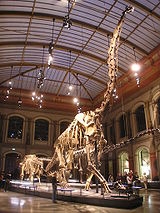
A famous specimen of
Giraffatitan brancai (which continues to be labeled
Brachiosaurus), mounted in Museum für Naturkunde Berlin, is one of the largest mounted skeletons in the world.
Additional species
An additional species,
B. alataiensis, was described by
de LapparentAlbert-Félix de Lapparent was a French palaeontologist. He was also a Jesuit priest. He undertook a number of fossil-hunting explorations in the Sahara desert. He contributed greatly to our knowledge of dinosaurs and other prehistoric creatures...
and Zbyszewski in 1957, for back bones (
vertebraA vertebra is an individual bone in the flexible column that defines vertebrate animals, e.g. humans. The vertebral column encases and protects the spinal cord, which runs from the base of the cranium down the dorsal side of the animal until reaching the pelvis. From there, vertebra continue into...
e) and parts of the hip and limbs, which were recovered in
EstremaduraEstremadura is a historical province of Portugal. It is located along the Atlantic Ocean coast in the center of the country and includes Lisbon, the capital.Estremadura is different to Extremadura, an autonomous community of Spain....
,
PortugalPortugal , officially the Portuguese Republic , is a country located in southwestern Europe on the Iberian Peninsula. Portugal is the westernmost country of mainland Europe and is bordered by the Atlantic Ocean to the west and south and by Spain to the north and east...
(dating to about 150 million years ago, during the
KimmeridgianIn the geologic timescale, the Kimmeridgian is an age or stage in the Late or Upper Jurassic epoch or series. It spans the time between 155.7 ± 4 Ma and 150.8 ± 4 Ma . The Kimmeridgian follows the Oxfordian and precedes the Tithonian....
stage of the Late Jurassic). However,
B. alataiensis was reclassified as the new genus
LusotitanLusotitan is the name given to a genus of dinosaur from the Late Jurassic Period. It was a brachiosaurid sauropod with long forearms, one of the hallmarks of the brachiosaur family...
in 2003.
Another possible species is
B. nougaredi, named by de Lapparent in 1960. It is known only from set of fused bones over the hip (
sacrumThe sacrum is a large, triangular bone at the base of the spine and at the upper and back part of the pelvic cavity, where it is inserted like a wedge between the two hip bones. Its upper part connects with the last lumbar vertebra, and bottom part with the coccyx...
) and parts of a forelimb, which were recovered in Wargla,
AlgeriaAlgeria , officially the People's Democratic Republic of Algeria, is a country located in North Africa. It is the largest country on the Mediterranean sea, the second largest on the African continent and the eleventh-largest country in the world in terms of land area.It is bordered by Tunisia in...
. It lived 112 million years ago, during the early Albian age of the early
CretaceousThe Cretaceous , Latin language for "chalky", usually abbreviated K for its German translation Kreide , is a geologic period and system from circa to million years ago . In the geologic timescale, the Cretaceous follows on the Jurassic period and is followed by the Paleogene period of the...
period. Due to its fragmentary nature and much later time period than the other two
Brachiosaurus species, it is considered
nomen dubium (dubious name) and may not belong to
Brachiosaurus.
Metabolism
If the
Brachiosaurus was endothermic (warm-blooded), it would have taken an estimated ten years to reach full size, if it were instead poikilothermic (cold-blooded), then it would have required over 100 years to reach full size. As a warm-blooded animal, the daily energy demands of
Brachiosaurus would have been enormous; it would probably have needed to eat more than ~182 kg (400 lb) of food per day. If
Brachiosaurus was fully cold-blooded or was a passive
bulk endothermGigantothermy is a phenomenon with significance in biology and paleontology, whereby large, bulky ectothermic animals are more easily able to maintain a constant, relatively high body temperature than smaller animals by virtue of their greater volume to surface area ratio...
, it would have needed far less food to meet its daily energy needs. Some scientists have proposed that large dinosaurs like
Brachiosaurus were
gigantothermsGigantothermy is a phenomenon with significance in biology and paleontology, whereby large, bulky ectothermic animals are more easily able to maintain a constant, relatively high body temperature than smaller animals by virtue of their greater volume to surface area ratio...
.
Environment and behavior
Brachiosaurus was one of the largest dinosaurs of the
JurassicThe Jurassic is a geologic period and system that extends from about Ma to Ma, that is, from the end of the Triassic to the beginning of the Cretaceous. The Jurassic constitutes the middle period of the Mesozoic era, also known as the "Age of Reptiles". The start of the period is marked by...
era; it lived on prairies filled with
fernA fern is any one of a group of about 20,000 species of plants classified in the phylum or division Pteridophyta, also known as Filicophyta. The group is also referred to as Polypodiophyta, or Polypodiopsida when treated as a subdivision of tracheophyta...
s,
bennettitesBennettites refers to an extinct genus of the order Bennettitales.Bennettites had a bare, thick central trunk with a top of pithy, dividing leaves. Some could produce poisons, to deter herbivores. They were gymnosperms with cones just below the bottom leaves of the top, with creation of pollen and...
and
horsetailEquisetum is the only living genus in the Equisetaceae, a family of vascular plants that reproduce by spores rather than seeds. They are commonly known as horsetails....
s, and it moved through vast conifer forests and groves of
cycadCycads are a group of seed plants characterized by a large crown of compound leaves and a stout trunk. They are evergreen, gymnospermous, dioecious plants having large pinnately compound leaves...
s, seed ferns and
ginkgoGinkgo , also known as the Maidenhair Tree after Adiantum, is a unique species of tree with no close living relatives...
s. Contemporary genera included
StegosaurusStegosaurus is a genus of stegosaurid armored dinosaur from the Late Jurassic period in what is now western North America. In 2006, a specimen of Stegosaurus was announced from Portugal, showing that they were present in Europe as well...
,
DryosaurusDryosaurus Dryosaurus Dryosaurus ( ; meaning 'oak lizard', due to the vague oak shape of its cheek teeth (Greek δρυο/dryo meaning 'oak' and σαυρος/sauros meaning 'lizard') is a genus of an ornithopod dinosaur that lived in the Late Jurassic period. It was an iguanodont (formerly classified as a...
,
ApatosaurusApatosaurus , including the popular but obsolete synonym Brontosaurus, is a genus of sauropod dinosaur that lived about 150 million years ago, during the Jurassic Period . It was one of the largest land animals that ever existed, with an average length of 23 m and a mass of at least 23 metric tons...
and
DiplodocusDiplodocus is a genus of diplodocid sauropod dinosaur whose fossils were first discovered in 1877 by S. W. Williston. The generic name, coined by Othniel Charles Marsh in 1878, is a Neo-Latin term derived from Greek "double" and "beam", in reference to its double-beamed chevron bones located in...
. While it is speculated that groups of
Brachiosaurus moved in herds, fully grown individuals had little to fear from even the largest predators of the time,
AllosaurusAllosaurus is a genus of large theropod dinosaur that lived 155 to 145 million years ago, in the late Jurassic period . The name Allosaurus means "different lizard" and is derived from the Greek αλλος/allos and σαυρος/sauros...
and
TorvosaurusTorvosaurus is a genus of large theropod dinosaur that lived during the Late Jurassic period...
, on account of their sheer size.
Brachiosaurus nostrilA nostril is one of the two channels of the nose, from the point where they bifurcate to the external opening. In birds and mammals, they contain branched bones or cartilages called turbinates, whose function is to warm air on inhalation and remove moisture on exhalation...
s, like the huge corresponding nasal openings in its skull, were long thought to be located on the top of the head. In past decades, scientists theorized that the animal used its nostrils like a
snorkelSnorkeling is the practice of swimming on or through a body of water while equipped with a diving mask, a shaped tube called a snorkel, and usually swimfins. In cooler waters, a wetsuit may also be worn...
, spending most of its time submerged in water in order to support its great mass. The current consensus view, however, is that
Brachiosaurus was a fully
terrestrial animalTerrestrial animals are animals that live predominantly or entirely on land, as compared with aquatic animals, which live predominantly or entirely in the water , or amphibians, which rely on a combination of aquatic and terrestrial habitats . Terrestrial animals evolved from marine animals...
. Studies have demonstrated that water pressure would have prevented the animal from breathing effectively while submerged and that its feet were too narrow for efficient aquatic use. Furthermore, new studies by Lawrence Witmer (2001) show that, while the nasal openings in the skull were placed high above the eyes, the nostrils would still have been close to the tip of the snout (a study which also lends support to the idea that the tall "crests" of brachiosaurs supported some sort of fleshy resonating chamber).
In culture
{{Seealso|Biological issues in Jurassic Park}}
The original
Brachiosaurus specimens collected by Elmer Riggs for the
Field Museum of Natural HistoryThe Field Museum of Natural History is located in Chicago, Illinois, USA. It sits on Lake Shore Drive next to Lake Michigan, part of a scenic complex known as the Museum Campus Chicago...
(
ChicagoChicago is the largest city in the U.S. state of Illinois, and with more than 2.8 million people, the 3rd largest city in the United States...
) were not put on display in the museum until 1994, when a skeletal mount (made up of resin casts rather than actual fossil bones) was constructed inside the museum's main Stanley Field Hall. The mount stood until 1999, when it was moved to the B Concourse of
United AirlinesUnited Air Lines, Inc., trading as United Airlines , is a major airline of the United States. It is a subsidiary of UAL Corporation with corporate offices in Chicago at 77 West Wacker Drive in the Chicago Loop. United's largest hub is O'Hare International Airport, where it has more than 550 daily...
' Terminal One in
O'Hare International AirportO'Hare International Airport , also known simply as O'Hare Airport or O'Hare Field or O'Hare, is a major airport located in the northwestern-most corner of Chicago, Illinois, United States, northwest of the Chicago Loop. It serves as the primary and largest hub for United Airlines and as a hub for...
. At the same time, a second cast (in bronze) of the Field Museum's
B. altithorax was constructed outside the museum.
Brachiosaurus is one of the best-known dinosaurs amongst both paleontologists and the general public. A
main beltThe asteroid belt is the region of the Solar System located roughly between the orbits of the planets Mars and Jupiter. It is occupied by numerous irregularly shaped bodies called asteroids or minor planets...
asteroidthumb|260px|right|[[253 Mathilde]], a [[C-type asteroid]] measuring about across. Photograph taken in 1997 by the [[NEAR Shoemaker]] probe.Asteroids, sometimes called minor planets or planetoids, are small Solar System bodies in orbit around the Sun, especially in the inner Solar System; they are...
, {{mp|1991 GX|7}}, has been named
9954 Brachiosaurus9954 Brachiosaurus is a main belt asteroid. It orbits the Sun once every 4.58 years.Discovered on April 8, 1991 by E. W. Elst, it was given the provisional designation "". It was later renamed "Brachiosaurus" after Brachiosaurus, a large herbivorous dinosaur.- References :...
in honor of the genus. The genus has been featured in many films and television programs, most notably the
Jurassic ParkJurassic Park is a 1993 science fiction thriller film directed by Steven Spielberg and based on the novel of the same name by Michael Crichton. The film centers on the fictional island of Isla Nublar, where scientists have created an amusement park of cloned dinosaurs...
and
Walking with DinosaursWalking with Dinosaurs was a six-part documentary television mini-series that was produced by the BBC, narrated by Kenneth Branagh, and first aired in the UK in 1999. The series was subsequently aired in North America on the Discovery Channel in 2000, with Branagh's voice replaced with that of...
series. The digital model of
Brachiosaurus used in
Jurassic Park went on to become the starting point for the ronto models in the 1997 special edition of the science fiction film
Star Wars Episode IV: A New HopeStar Wars Episode IV: A New Hope, originally released simply as Star Wars, is an American 1977 space opera film, written and directed by George Lucas. It was the first of six films released in the Star Wars saga: two subsequent films continue the story, while a prequel trilogy contributes...
.
External links
{{wiktionary|Brachiosaurus}}
{{commons|Brachiosaurus|Brachiosaurus}}
{{portalpar|Dinosaurs}}