
All Topics  
Mosasaur

 
Mosasaur

   Email Print
   Bookmark   Link


Mosasaur


Mosasaurs (from Latin
Latin

Latin is an Italic language, historically spoken in Latium and Ancient Rome. Through the Military history of the Roman Empire, Latin spread throughout the Mediterranean and a large part of Europe....
 Mosa meaning the 'Meuse river
Meuse River

File:01-Namur-290305 JPG.jpgThe Meuse , is a major European river, rising in France and flowing through Belgium and the Netherlands before draining into the North Sea....
' in the Netherlands, and Greek
Ancient Greek

Ancient Greek is the historical stage in the development of the Greek language spanning across the Archaic Greece , Classical Greece , and Hellenistic civilization periods of ancient Greece and the classical antiquity....
 sauros meaning 'lizard') were serpentine marine reptile
Reptile

Reptiles, or members of the class Reptilia, are air-breathing, cold-blooded vertebrates that have skin covered in scale as opposed to hair or feathers....
s. The first fossil remains were discovered in a limestone quarry at Maastricht
Maastricht

Maastricht is a city and a municipality in the Netherlands province of Limburg , of which it is the Capital . The city is situated on both sides of the Meuse River river in the south-eastern part of the Netherlands, near the Belgium and Germany borders....
 on the Meuse in 1778. These ferocious marine predators are now considered to be the closest relatives of snake
Snake

Snakes are elongate legless carnivore reptiles of the suborder Serpentes that can be distinguished from legless lizards by their lack of eyelids and external ears....
s, due to cladistic analysis of symptomatic similarities in jaw and skull anatomies.


Discussion
Ask a question about 'Mosasaur'
Start a new discussion about 'Mosasaur'
Answer questions from other users
Full Discussion Forum


Encyclopedia


Mosasaurs (from Latin
Latin

Latin is an Italic language, historically spoken in Latium and Ancient Rome. Through the Military history of the Roman Empire, Latin spread throughout the Mediterranean and a large part of Europe....
 Mosa meaning the 'Meuse river
Meuse River

File:01-Namur-290305 JPG.jpgThe Meuse , is a major European river, rising in France and flowing through Belgium and the Netherlands before draining into the North Sea....
' in the Netherlands, and Greek
Ancient Greek

Ancient Greek is the historical stage in the development of the Greek language spanning across the Archaic Greece , Classical Greece , and Hellenistic civilization periods of ancient Greece and the classical antiquity....
 sauros meaning 'lizard') were serpentine marine reptile
Reptile

Reptiles, or members of the class Reptilia, are air-breathing, cold-blooded vertebrates that have skin covered in scale as opposed to hair or feathers....
s. The first fossil remains were discovered in a limestone quarry at Maastricht
Maastricht

Maastricht is a city and a municipality in the Netherlands province of Limburg , of which it is the Capital . The city is situated on both sides of the Meuse River river in the south-eastern part of the Netherlands, near the Belgium and Germany borders....
 on the Meuse in 1778. These ferocious marine predators are now considered to be the closest relatives of snake
Snake

Snakes are elongate legless carnivore reptiles of the suborder Serpentes that can be distinguished from legless lizards by their lack of eyelids and external ears....
s, due to cladistic analysis of symptomatic similarities in jaw and skull anatomies. Mosasaurs were not dinosaur
Dinosaur

Dinosaurs were the dominant vertebrate animals of Landform ecosystems for over 160 million years, from the late Triassic Period until the end of the Cretaceous Period , when most of them became extinct in the Cretaceous?Tertiary extinction event....
s but lepidosaurs, reptiles with overlapping scales. These predators evolved from semi-aquatic squamates known as the aigialosaur
Aigialosaur

Aigialosauridae is family of Late Cretaceous semi-aquatic animal Varanoidea lizards, regarded by some paleontologists to form distinct monophyletic group and by others as an adaptive grade within the basal mosasauroids....
s, close relatives of modern-day monitor lizard
Monitor lizard

Monitor lizards or biawak are members of the family Varanidae, a group of carnivorous lizard which includes the heaviest living lizard, the Komodo dragon, with the crocodile monitor being the longest in the world....
s, in the Early Cretaceous
Cretaceous

The Cretaceous , usually abbreviated K for its German translation Kreide, is a geologic period from circa to million years ago . In the geologic timescale, the Cretaceous follows on the Jurassic period and is followed by the Paleogene period....
 Period. During the last 20 million years of the Cretaceous Period (Turonian
Turonian

The Turonian is a faunal stage of the Late Cretaceous epoch . It spans the time between 93.5 ? 0.8 annum and 89.3 ? 1 Ma .The Turonien was definied by the French paleontologist Alcide d'Orbigny , who named it after the city of Tours in the French department of Indre-et-Loire....
-Maastrichtian
Maastrichtian

The Maastrichtian is the last faunal stage of the Cretaceous geologic period, and therefore of the Mesozoic geologic era. It spanned from 70.6 ? 0.6 annum to 65.5 ? 0.3 Ma ....
), with the extinction of the ichthyosaur
Ichthyosaur

Ichthyosaurs were giant marine reptiles that resembled fish and dolphins. Ichthyosaurs thrived during much of the Mesozoic era; based on fossil evidence, they first appeared approximately 245 million years ago and disappeared about 90 million years ago, about 25 million years before the dinosaurs became extinct....
s and pliosaur
Pliosaur

The Pliosaurs were Marine reptiles from the Jurassic and Cretaceous Period . They originally included members of the family Pliosauridae, of the Order Plesiosauria, but several other genera and families are now also included; the number and details of which vary according to the classification used....
s, mosasaurs became the dominant marine predators.

Known genera
Genus

A genus is a low-level taxonomic rank used in the classification of living and fossil organisms. The taxonomic ranks are domain , kingdom , phylum, class , order , family , genus, and species....
 include Clidastes
Clidastes

Clidastes is an extinct genus of mosasaur lizard from marine environments of the Late Cretaceous.Clidastes was an agile and fast swimmer that cruised the surface or shallow waters hunting for fish, flying reptiles and anything that got too close....
, Mosasaurus
Mosasaurus

Mosasaurus was a genus of mosasaur, a carnivorous, aquatic lizard, somewhat resembling a flippered crocodile, with elongated heavy jaws. The genus lived in the Maastrichtian age of the Cretaceous period , around 70-65 millions years ago in the area of modern Western Europe....
, Prognathodon
Prognathodon

Prognathodon is an extinct genus of marine reptile belonging to the mosasaur family. It had protective bony rings surrounding its eye sockets, indicating it lived in deep water....
, Globidens
Globidens

Globidens is an extinct genus of mosasaur lizard.Globidens alabamaensis was first described by Gilmore . A second species was described by Russell ....
, Plotosaurus
Plotosaurus

Plotosaurus is an extinct genus of mosasaur from the Upper Cretaceous of Fresno County, California. Originally named Kolposaurus by Berkeley paleontologist Charles Lewis Camp in 1942, it was changed to Plotosaurus in 1951 when Camp discovered the name had already been assigned to a type of nothosaur....
, Plesiotylosaurus, Carinodens
Carinodens

Carinodens is an extinct genus of mosasaur, being approximately 3.5 meters in length it is one of the smallest known. It is widely considered a sister taxon to Globidens....
, Dallasaurus
Dallasaurus

Dallasaurus is a basal mosasauroid from the Upper Cretaceous of North America. The genus is based upon two partial skeletons recovered from the Arcadia Park Shale , approximately 15 meters above its contact with the older Kamp Ranch Limestone in Dallas County in north-central Texas....
, Igdamanosaurus, Halisaurus
Halisaurus

Halisaurus is an extinct genus of marine lizard belonging to the mosasaur family. With a length of 3-4 m it was small compared to most other mosasaurs....
, Tylosaurus
Tylosaurus

Tylosaurus was a mosasaur, a large, predatory marine lizard closely related to modern monitor lizards and to snakes. Along with plesiosaurs, sharks, fish, and other Genus of mosasurs, it was a dominant predator of the Western Interior Seaway during the Late Cretaceous....
, Platecarpus
Platecarpus

Platecarpus is an extinct genus of lizard belonging to the mosasaur family. It was about 4.30 meters long.Like other mosasaurs, Platecarpus had a long, laterally flattened tail, steering flippers and deadly, tooth-lined jaws....
, Selmasaurus
Selmasaurus

Selmasaurus is a genus of medium-sized plioplatecarpine mosasaur from the Upper Cretaceous Mooreville Chalk Formation of western Alabama . First recognized by geologist Samuel Wayne Shannon in his 1975 Master's thesis, "Selected Alabama Mosasaurs," the taxon remained a nomen nudum until it was officially described in 1988 in an article co...
, Plioplatecarpus
Plioplatecarpus

Plioplatecarpus is a genus of mosasaur lizard. Like all mosasaurs, it lived in the late Cretaceous period, about 83.5 million years ago....
, Amphekepubis, Goronyosaurus
Goronyosaurus

Goronyosaurus nigeriensis was a species of crocodile-like mosasaur. It lived in what are Niger and Nigeria, from the Late Cretaceous....
, Liodon
Liodon

Liodon is a genus of mosasaur from the Late Cretaceous. Remains assigned to this genus have been found in Africa, Asia, Europe, North America and South America, and New Zealand....
, Moanasaurus
Moanasaurus

Moanasaurus was a genus of mosasaur from the Late Cretaceous period. Its fossil remains have been discovered in the North Island of New Zealand....
, Pluridens
Pluridens

Pluridens walkeri was a species of ichthyosaur-like mosasaur. It lived in what are Niger and Nigeria, from the Late Cretaceous....
, Yaguarasaurus, Eonatator
Eonatator

Eonatator is a genus of halisaurine mosasaur from the Upper Cretaceous of North America and Europe. Originally, this taxon was included within Halisaurus, but was placed in its own genus ....
, Hainosaurus
Hainosaurus

Hainosaurus is an extinct genus of marine lizard belonging to the mosasaur family. It was one of the largest mosasaurs, reaching lengths of up to 15 meters which made it a top predator of the Late Cretaceous....
, Tethysaurus, Angolasaurus, Kourisodon and Russellosaurus
Russellosaurus

Russellosaurus is a basal mosasauroid from the Upper Cretaceous of North America. The genus was described from a skull discovered in an exposure of the Arcadia Park Shale at Cedar Hill, Dallas County in south-central Texas....
.

Description

Mosasaur Skull
Mosasaurs breathed air and were powerful swimmers that were well-adapted to living in the warm, shallow epicontinental seas
Seas

SEAS may mean:*The plural of "sea"*Shipboard Environmental Acquisition System: a program developed by National Oceanic and Atmospheric Administration to provide accurate meteorological and oceanographic data in real time from ships at sea through the use of satellite data transmission techniques....
 prevalent during the Late Cretaceous Period. Mosasaurs were so well adapted to this environment that they gave birth to live young
Vivipary

A viviparous animal is an animal employing vivipary: the embryo develops inside the body of the mother, as opposed to outside in an Egg ....
, rather than return to the shore to lay eggs, as sea turtle
Sea turtle

Sea turtles are turtles found in all the world's oceans except the Arctic Ocean. There are seven living species of sea turtles: Flatback Sea Turtle, Green Sea Turtle, Hawksbill turtle, Kemp's Ridley, leatherback sea turtle, Loggerhead Sea Turtle and Olive Ridley Sea Turtle....
s do.

The smallest-known mosasaur was Carinodens belgicus
Carinodens

Carinodens is an extinct genus of mosasaur, being approximately 3.5 meters in length it is one of the smallest known. It is widely considered a sister taxon to Globidens....
, which was about 3.0 to 3.5 m long and probably lived in shallow waters near shore, cracking mollusks and sea urchins with its bulbous teeth. Larger mosasaurs were more typical: mosasaurs ranged in size up to 17 m. Hainosaurus
Hainosaurus

Hainosaurus is an extinct genus of marine lizard belonging to the mosasaur family. It was one of the largest mosasaurs, reaching lengths of up to 15 meters which made it a top predator of the Late Cretaceous....
  holds the record for longest mosasaur, at 17.5 m.

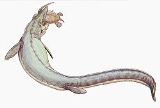
Mosasaurs had a body shape similar to that of modern-day monitor lizards (varanids), but were more elongated and streamlined for swimming. Their limb bones were reduced in length and their paddles were formed by webbing between their elongated digit-bones. Their tails were broad and supplied the locomotive power. This method of locomotion may have been similar to that used by the conger eel
Conger eel

"Conger" or "conger eel" is a vernacular term used for a number of different species of fish, mostly eels of the family Congridae, and especially the genus Conger....
 or sea snakes today. The animal may have lurked and pounced rapidly and powerfully on passing prey, rather than hunting for it. Mosasaurs had a double-hinged jaw and flexible skull (much like that of a snake
Snake

Snakes are elongate legless carnivore reptiles of the suborder Serpentes that can be distinguished from legless lizards by their lack of eyelids and external ears....
), which enabled them to gulp down their prey almost whole, a snakelike habit that has helped identify the unmasticated gut contents fossilized within mosasaur skeletons. A skeleton of Tylosaurus
Tylosaurus

Tylosaurus was a mosasaur, a large, predatory marine lizard closely related to modern monitor lizards and to snakes. Along with plesiosaurs, sharks, fish, and other Genus of mosasurs, it was a dominant predator of the Western Interior Seaway during the Late Cretaceous....
 proriger
from South Dakota
South Dakota

South Dakota is a U.S. state located in the Midwestern United States of the United States of America. It is named after the Lakota people and Sioux Sioux Native Americans in the United States tribes....
 included remains of the diving seabird
Seabird

Seabirds are birds that have adaptation to life within the marine environment. While seabirds vary greatly in lifestyle, behavior and physiology, they often exhibit striking convergent evolution, as the same environmental problems and feeding ecological niche have resulted in similar adaptations....
 Hesperornis
Hesperornis

Hesperornis is an extinct genus of flightless aquatic birds that lived during the Santonian to Campanian sub-epochs of the Late Cretaceous ....
, a marine bony fish, a possible shark
Shark

Sharks are a type of fish with a full Cartilage skeleton and a highly Streamlines, streaklines and pathlinesd body. They respire with the use of five to seven gill slits....
 and another, smaller mosasaur (Clidastes). Mosasaur bones have also been found with shark teeth embedded in them.

Based on features such as the double row of pterygoid ("flanged") teeth on the palate, the double-hinged jaw, modified/reduced limbs and probable methods of locomotion, many researchers believe that snakes and mosasaurs may have had a common ancestor. This theory was first suggested in 1869, by Edward Drinker Cope
Edward Drinker Cope

Edward Drinker Cope was an United States paleontology and comparative anatomy, as well as a noted herpetology and ichthyology.Born to a wealthy Society of Friends family, Cope quickly distinguished himself as a child prodigy interested in science; he published his first scientific paper in 1859....
, who coined the term "Pythonomorpha" to include them. The idea lay dormant for more than a century, before being revived in the 1990s.

Environment

Sea levels were high during the Cretaceous Period, causing marine transgressions in many parts of the world and a great inland seaway
Western Interior Seaway

The Western Interior Seaway, also called the Cretaceous Seaway, the Niobraran Sea, and the North American Inland Sea, was a huge inland sea that split the continent of North America into two halves during most of the mid and late Cretaceous Period ....
 in what is now North America
North America

North America is the northern continent of the Americas, situated in the Earth's northern hemisphere and almost totally in the western hemisphere....
. Mosasaur fossil
Fossil

Fossils are the preserved remains or trace fossil of animals, plants, and other organisms from the remote past. The totality of fossils, both discovered and undiscovered, and their placement in fossiliferous Rock formations and sedimentary rock layers is known as the fossil record....
s have been found in the Netherlands
Netherlands

The Netherlands is a country that is part of the Kingdom of the Netherlands. It is a parliamentary democratic constitutional monarchy. The Netherlands is located in North-West Europe, and bordered by the North Sea to the north and west, Belgium to the south, and Germany to the east....
, in Sweden
Sweden

Sweden , officially the Kingdom of Sweden , is a Nordic countries on the Scandinavian Peninsula in Northern Europe. Sweden has land borders with Norway to the west and Finland to the northeast, and it is connected to Denmark by the ?resund Bridge in the south....
, in Africa
Africa

Africa is the world's second-largest and second most-populous continent, after Asia. At about 30.2 million km? including adjacent islands, it covers 6% of the Earth's total surface area and 20.4% of the total land area....
, in Australia
Australia

Australia, officially the Commonwealth of Australia, is a country in the southern hemisphere comprising the Australia of the world's smallest continent, the major island of Tasmania, and numerous list of islands of Australia in the Indian Ocean and Pacific Oceans....
, in New Zealand
New Zealand

New Zealand is an island country in the south-western Pacific Ocean comprising two main landmasses , and numerous Islands of New Zealand, most notably Stewart Island/Rakiura and the Chatham Islands....
 and on Vega Island
Vega Island

Vega Island is a small island to the northwest of James Ross Island, on the Antarctica Peninsula.It is one of several islands around the peninsula known as Graham Land, which is closer to South America than any other part of that continent....
, off the coast of Antarctica
Antarctica

Antarctica is Earth's southernmost continent, overlying the South Pole. It is situated in the Antarctica of the southern hemisphere, almost entirely south of the Antarctic Circle, and is surrounded by the Southern Ocean....
. In Canada
Canada

Canada is a country occupying most of northern North America, extending from the Atlantic Ocean in the east to the Pacific Ocean in the west and northward into the Arctic Ocean....
 and the United States
United States

The United States of America is a Federal government constitutional republic comprising U.S. state and a federal district. The country is situated mostly in central North America, where its Contiguous United States and Washington, D.C., the Capital districts and territories, lie between the Pacific Ocean and Atlantic Oceans, Borders of the U...
, complete or partial specimens have been found in Alabama
Alabama

Alabama is a state located in the Southern United States of the United States of America. It is bordered by Tennessee to the north, Georgia to the east, Florida and the Gulf of Mexico to the south, and Mississippi to the west....
, Mississippi
Mississippi

Mississippi is a U.S. state located in the Deep South of the United States. Jackson, Mississippi is the state capital and largest city. The state's name comes from the Mississippi River, which flows along its western boundary, and takes its name from the Anishinaabe language word misi-ziibi ....
, Tennessee
Tennessee

Tennessee is a U.S. state located in the Southern United States United States. In 1796, it became the sixteenth state to join the United States....
, and Georgia
Georgia (U.S. state)

Georgia is a U.S. state in the United States and was one of the original Thirteen Colonies that revolted against United Kingdom rule in the American Revolution....
 and in almost all the states covered by the seaway: Texas
Texas

Texas is a U.S. state located in the South Central United States, nicknamed the Lone Star State. Texas is the second largest U.S. state in both area and population, spanning , and with a growing population of 24.3 million residents....
, southwest Arkansas
Arkansas

Arkansas is a U.S. state located in the Southern United States of the United States. Arkansas shares a border with six states, with its eastern border largely defined by the Mississippi River....
, New Mexico
New Mexico

New Mexico is a U. S. State located in the Southwestern United States of the United States. Inhabited by Native Americans in the United States populations for many centuries, it has also has been part of the Spanish Empire viceroyalty of New Spain, part of Mexico, and a U.S....
, Kansas
Kansas

The State of Kansas is a Midwestern U.S. state in the Central United States of the United States of America, an area often referred to as the United States "Heartland"....
, Colorado
Colorado

The State of Colorado is a U.S. state located in the Mountain States of the United States of America. Colorado may also be considered to be a part of the Western United States and Southwestern United States regions of the United States....
, Nebraska
Nebraska

Nebraska is a U.S. state located on the Great Plains of the Midwestern United States and Western United States.Nebraska probably gets its name from the archaic Chiwere language words ?? Br?sge or the Omaha-Ponca language N? Bth?ska meaning "flat water," after the Platte River that flows through the state....
, the Dakotas, Montana
Montana

Montana is a U.S. state in the Western United States. The western third of the state contains numerous mountain ranges; other 'island' ranges are found in the central third of the state, for a total of 77 named ranges of the Rocky Mountains....
, Manitoba
Manitoba

Manitoba is a prairie provinces in Canada, which has an area of 647,797 square kilometres and a population of 1,207,959 , with more than half located within the Winnipeg Capital Region ....
, and the Pierre Shale
Pierre Shale

The Pierre Shale is a geologic formation or series in the Upper Cretaceous which occurs east of the Rocky Mountains from North Dakota to New Mexico....
 and Fox Hills
Fox Hills

Fox Hills may refer to:* Fox Hills, Staten Island* Fox Hills, Culver City, California...
 formations of North Dakota
North Dakota

North Dakota is a U.S. state located in the Midwestern United States and Western United States regions of the United States of America. North Dakota is the 19th largest state by area in the US; it is the 48th most populous, with just over 640,000 residents as of 2006....
. Mosasaurs are also known from California
California

California is a U.S. state on the West Coast of the United States of the United States, along the Pacific Ocean. It is bordered by Oregon to the north, Nevada to the east, Arizona to the southeast, and to the south the Mexico state of Baja California....
, Mexico
Mexico

The United Mexican States , commonly known as Mexico , is a federalism constitutionalism republic in North America. It is bordered on the north by the United States; on the south and west by the Pacific Ocean; on the southeast by Guatemala, Belize, and the Caribbean Sea; and on the east by the Gulf of Mexico....
, Peru
Peru

Peru , officially the Republic of Peru , is a country in western South America. It is bordered on the north by Ecuador and Colombia, on the east by Brazil, on the southeast by Bolivia, on the south by Chile, and on the west by the Pacific Ocean....
 and Denmark
Denmark

Denmark is a Scandinavian country in northern Europe and the senior member of the Kingdom of Denmark. It is the southernmost of the Nordic countries....
.

Many of the 'dinosaur' remains found on New Zealand
New Zealand

New Zealand is an island country in the south-western Pacific Ocean comprising two main landmasses , and numerous Islands of New Zealand, most notably Stewart Island/Rakiura and the Chatham Islands....
 are actually mosasaurs and plesiosaur
Plesiosaur

Plesiosaurs were carnivore aquatic reptiles. After their discovery, they were somewhat fancifully said to have resembled , although they had no shell....
s, another group of Mesozoic predatory marine reptiles.

Discovery

Mosasaurdiscovery
The first publicized discovery of a fossil mosasaur preceded any dinosaur fossil discoveries and drew the Age of Enlightenment
Age of Enlightenment

The Age of Enlightenment or The Enlightenment is a term used to describe a time in Western philosophy and cultural life centered upon the eighteenth century, in which rationalism was advocated as the primary source and legitimacy for authority....
's attention to the existence of fossilized animals; the specimen was discovered in 1780 by quarry-workers in a subterranean gallery of a limestone quarry; they quickly alerted Doctor C. K. Hoffman, a surgeon and fossil-hunter in the Dutch city of Maastricht
Maastricht

Maastricht is a city and a municipality in the Netherlands province of Limburg , of which it is the Capital . The city is situated on both sides of the Meuse River river in the south-eastern part of the Netherlands, near the Belgium and Germany borders....
, although rights of ownership lay with a canon of Maastricht cathedral, as owner of the overlying land.

Dr. Hoffman's correspondence among men of science made the find famous. When the Revolutionary forces occupied Maastricht, the carefully-hidden fossil was uncovered, betrayed, it is said, by a case of wine, and transported to Paris, where Georges Cuvier
Georges Cuvier

Baron Georges L?opold Chr?tien Fr?d?ric Dagobert Cuvier was a France natural history and zoology. He was the elder brother of Fr?d?ric Cuvier , also a naturalist....
 was able to describe it for science, although le grand animal fossile de Maastricht was not actually described as a Mosasaur ('Meuse
Meuse River

File:01-Namur-290305 JPG.jpgThe Meuse , is a major European river, rising in France and flowing through Belgium and the Netherlands before draining into the North Sea....
 reptile') until 1822 and not given its official name, Mosasaurus hoffmanni, until 1829. Several sets of mosasaur remains, that had been discovered earlier at Maastricht but were not identified as mosasaurs until the nineteenth century, have been on display in the Teylers Museum
Teylers Museum

The Teyler Museum , located in Haarlem, is the oldest museum in the Netherlands. The museum is in the former home of Pieter Teyler van der Hulst ....
, Haarlem
Haarlem

, in the past usually 'Harlem' in English, is a city in the Netherlands. It is also the Capital of the province of North Holland, the northern half of Holland, which at one time was one of the most powerful of the seven provinces of the Dutch Republic....
, since about 1770.

The Maastricht limestone
Limestone

File:Limestone Formation In Waitomo.jpgLimestone is a sedimentary rock composed largely of the mineral calcite . The deposition of limestone strata is often a by-product and indicator of biological activity in the geology record....
 beds were rendered so famous by the Mosasaur discovery that they have given their name to the final six-million-year epoch of the Cretaceous, the Maastrichtian
Maastrichtian

The Maastrichtian is the last faunal stage of the Cretaceous geologic period, and therefore of the Mesozoic geologic era. It spanned from 70.6 ? 0.6 annum to 65.5 ? 0.3 Ma ....
.

Evolutionary antecedents

Based on features such as the loosely-hinged jaw, modified/reduced limbs and probable locomotion, many researchers believe that snakes share a common marine ancestry with mosasaurs, a suggestion advanced in 1869, by Edward Drinker Cope
Edward Drinker Cope

Edward Drinker Cope was an United States paleontology and comparative anatomy, as well as a noted herpetology and ichthyology.Born to a wealthy Society of Friends family, Cope quickly distinguished himself as a child prodigy interested in science; he published his first scientific paper in 1859....
, who coined the term "Pythonomorpha" to unite them. The idea lay dormant for more than a century, to be revived in the 1990s. Recently, the discovery of Najash rionegrina
Najash rionegrina

Najash is an extinct genus of basal snake. Like a number of other Cretaceous snakes , it had two hind-limbs. The fossils were found in a land-based deposit, and the robust backbone vertebrae and rear legs of the snake were adapted to a burrowing, subterranean environment....
, a fossorial snake from South America cast doubt on the marine origin theory.

On 2005-11-16, research reported in Netherlands Journal of Geosciences, confirmed that the recently uncovered Dallasaurus turneri
Dallasaurus

Dallasaurus is a basal mosasauroid from the Upper Cretaceous of North America. The genus is based upon two partial skeletons recovered from the Arcadia Park Shale , approximately 15 meters above its contact with the older Kamp Ranch Limestone in Dallas County in north-central Texas....
 is an early link between land-based monitor lizard
Monitor lizard

Monitor lizards or biawak are members of the family Varanidae, a group of carnivorous lizard which includes the heaviest living lizard, the Komodo dragon, with the crocodile monitor being the longest in the world....
s (such as the Komodo dragon
Komodo dragon

The Komodo dragon is a species of lizard that inhabits the islands of Komodo , Rinca, Flores, and Gili Motang in Indonesia. A member of the monitor lizard family , it is the Largest organisms#Reptiles , growing to an average length of and weighing around ....
) and the aquatic mosasaurs.


In popular culture

  • Mosasaurs appear in the BBC television series Sea Monsters
    Sea Monsters

    Sea Monsters was a BBC television program which used computer-generated imagery to show past life in Earth's seas. It was made by Impossible Pictures, the creators of Walking with Dinosaurs, Walking With Beasts and Walking With Monsters....
    .
  • Mosasaurs also feature heavily in the ITV television series Primeval. In this show, the mosasaurs are depicted incorrectly as having skin more similar to a crocodile
    Crocodile

    A crocodile is any species belonging to the family Crocodylidae . The term can also be used more loosely to include all members of the order Crocodilia: i.e....
    's.
  • A highly evolved mosasaur appeared in an episode of Godzilla: The Series
    Godzilla: The Series

    Godzilla is an co-production between Japanese/United States animated television series which originally aired on TV Tokyo in Japan and Fox Kids in the United States....
    . It was inhabiting Loch Ness
    Loch Ness

    Loch Ness is a large, deep, freshwater loch in the Scottish Highlands extending for approximately 37 km southwest of Inverness. Its surface is 15.8 metres above sea level....
     as the legendary Loch Ness Monster
    Loch Ness Monster

    The Loch Ness Monster is a creature alleged to inhabit Loch Ness in the Scottish Highlands. It is similar to other supposed lake monsters in Scotland and elsewhere, though its description varies from one account to the next....
    .
  • The IMAX 3D film "Sea Monsters" features mosasaurs (including Tylosaurus) with detailed animated recreations of their movements and activities.


Taxonomy

  • Family Mosasauridae
    • Subfamily Tylosaurinae
      • Hainosaurus
        Hainosaurus

        Hainosaurus is an extinct genus of marine lizard belonging to the mosasaur family. It was one of the largest mosasaurs, reaching lengths of up to 15 meters which made it a top predator of the Late Cretaceous....
      • Tylosaurus
        Tylosaurus

        Tylosaurus was a mosasaur, a large, predatory marine lizard closely related to modern monitor lizards and to snakes. Along with plesiosaurs, sharks, fish, and other Genus of mosasurs, it was a dominant predator of the Western Interior Seaway during the Late Cretaceous....
      • Taniwhasaurus
        Taniwhasaurus

        Taniwhasaurus was an extinct genus of mosasaur, a carnivorous, marine reptile which inhabited New Zealand, Japan and Antarctica. The genus was a close relative of the genera Tylosaurus and Hainosaurus....
    • Subfamily Plioplatecarpinae
      • Platecarpus
        Platecarpus

        Platecarpus is an extinct genus of lizard belonging to the mosasaur family. It was about 4.30 meters long.Like other mosasaurs, Platecarpus had a long, laterally flattened tail, steering flippers and deadly, tooth-lined jaws....
      • Angolasaurus
        Angolasaurus

        Angolasaurus is an extinct genus of mosasaur....
      • Ectenosaurus
        Ectenosaurus

        was a genus of mosasaur from the Late Cretaceous period.See also* List of mosasaursExternal links...
      • Selmasaurus
        Selmasaurus

        Selmasaurus is a genus of medium-sized plioplatecarpine mosasaur from the Upper Cretaceous Mooreville Chalk Formation of western Alabama . First recognized by geologist Samuel Wayne Shannon in his 1975 Master's thesis, "Selected Alabama Mosasaurs," the taxon remained a nomen nudum until it was officially described in 1988 in an article co...
      • Igdamanosaurus
        Igdamanosaurus

        Igdamanosaurus is a genus of mosasaur from the Maastrichtian stage of the Late Cretaceous of Africa....
      • Yaguarasaurus
        Yaguarasaurus

        was a genus of mosasaur from the Late Cretaceous period.See also* List of mosasaursExternal links...
      • Plioplatecarpus
        Plioplatecarpus

        Plioplatecarpus is a genus of mosasaur lizard. Like all mosasaurs, it lived in the late Cretaceous period, about 83.5 million years ago....
    • Subfamily Mosasaurinae
      • Dallasaurus
        Dallasaurus

        Dallasaurus is a basal mosasauroid from the Upper Cretaceous of North America. The genus is based upon two partial skeletons recovered from the Arcadia Park Shale , approximately 15 meters above its contact with the older Kamp Ranch Limestone in Dallas County in north-central Texas....
      • Clidastes
        Clidastes

        Clidastes is an extinct genus of mosasaur lizard from marine environments of the Late Cretaceous.Clidastes was an agile and fast swimmer that cruised the surface or shallow waters hunting for fish, flying reptiles and anything that got too close....
      • Mosasaurus
        Mosasaurus

        Mosasaurus was a genus of mosasaur, a carnivorous, aquatic lizard, somewhat resembling a flippered crocodile, with elongated heavy jaws. The genus lived in the Maastrichtian age of the Cretaceous period , around 70-65 millions years ago in the area of modern Western Europe....
      • Moanasaurus
        Moanasaurus

        Moanasaurus was a genus of mosasaur from the Late Cretaceous period. Its fossil remains have been discovered in the North Island of New Zealand....
      • Amphekepubis
        Amphekepubis

        Amphekepubis is an extinct genus of mosasaur.References...
      • Plotosaurus
        Plotosaurus

        Plotosaurus is an extinct genus of mosasaur from the Upper Cretaceous of Fresno County, California. Originally named Kolposaurus by Berkeley paleontologist Charles Lewis Camp in 1942, it was changed to Plotosaurus in 1951 when Camp discovered the name had already been assigned to a type of nothosaur....
      • Globidens
        Globidens

        Globidens is an extinct genus of mosasaur lizard.Globidens alabamaensis was first described by Gilmore . A second species was described by Russell ....
      • Prognathodon
        Prognathodon

        Prognathodon is an extinct genus of marine reptile belonging to the mosasaur family. It had protective bony rings surrounding its eye sockets, indicating it lived in deep water....
      • Plesiotylosaurus
        Plesiotylosaurus

        Plesiotylosaurus is a genus of mosasaur from the Maastrichtian stage of the Late Cretaceous of North America....
      • Carinodens
        Carinodens

        Carinodens is an extinct genus of mosasaur, being approximately 3.5 meters in length it is one of the smallest known. It is widely considered a sister taxon to Globidens....
    • Subfamily Halisaurinae
      • Eonatator
        Eonatator

        Eonatator is a genus of halisaurine mosasaur from the Upper Cretaceous of North America and Europe. Originally, this taxon was included within Halisaurus, but was placed in its own genus ....
      • Halisaurus
        Halisaurus

        Halisaurus is an extinct genus of marine lizard belonging to the mosasaur family. With a length of 3-4 m it was small compared to most other mosasaurs....


Incertae sedis
  • Liodon
    Liodon

    Liodon is a genus of mosasaur from the Late Cretaceous. Remains assigned to this genus have been found in Africa, Asia, Europe, North America and South America, and New Zealand....
  • Goronyosaurus
    Goronyosaurus

    Goronyosaurus nigeriensis was a species of crocodile-like mosasaur. It lived in what are Niger and Nigeria, from the Late Cretaceous....
  • Pluridens
    Pluridens

    Pluridens walkeri was a species of ichthyosaur-like mosasaur. It lived in what are Niger and Nigeria, from the Late Cretaceous....
  • Kourisodon
    Kourisodon

    Kourisodon is an extinct genus of mosasaur.References...
  • Russellosaurus
    Russellosaurus

    Russellosaurus is a basal mosasauroid from the Upper Cretaceous of North America. The genus was described from a skull discovered in an exposure of the Arcadia Park Shale at Cedar Hill, Dallas County in south-central Texas....
  • Tethysaurus
    Tethysaurus

    was a genus of mosasaur from the Late Cretaceous period.See also* List of mosasaursExternal links...


External links

  • : New Zealand fossil fauna
  • : life in the Sea of Kansas, illus. by Carl Buell
  • until 1829.
  • by Hennie Reuvers in